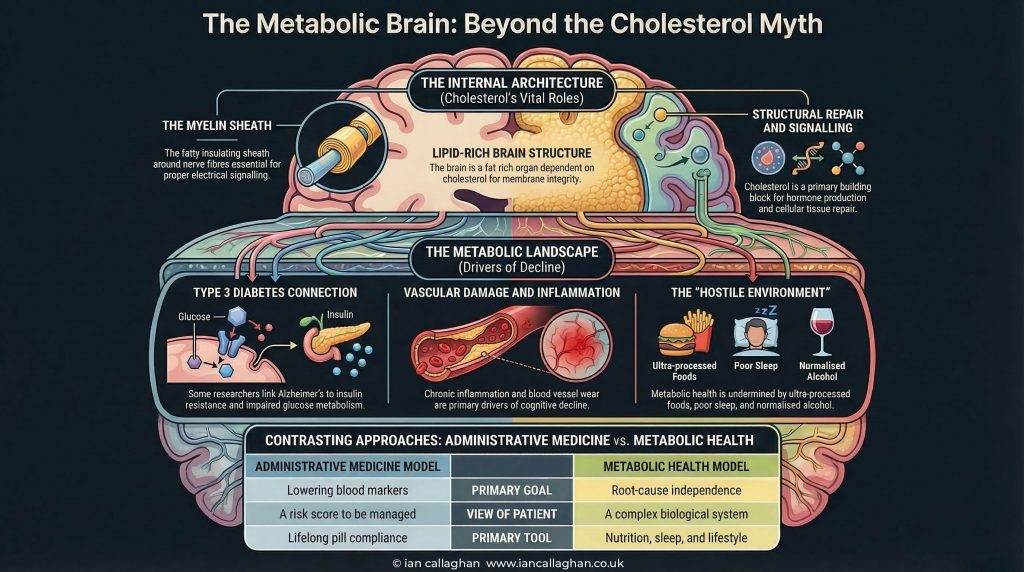
Statins, cholesterol and dementia are usually discussed like a school playground argument. One side says cholesterol is the villain and statins are the sensible answer. The other says statins are poison and the whole thing is a giant con. Neither version is good enough.
Cholesterol is not a useless fat floating around your bloodstream waiting to kill you. It is essential to human biology. It helps build cell membranes, supports hormone production, contributes to repair, and plays an important role in brain structure and function. That includes myelin, the fatty insulating sheath that helps nerve signals travel properly.
That does not automatically prove statins cause dementia. It does prove the public conversation is far too crude.
If dementia risk is tied not just to blood markers, but also to insulin resistance, vascular damage, inflammation, alcohol, sleep, muscle loss and long-term metabolic dysfunction, then pretending the whole issue begins and ends with cholesterol lowering is not serious medicine. It is a simplified story built for leaflets, targets and repeat prescriptions.
That is the lie.
What this article covers
This article looks at what cholesterol actually does in the body, why cholesterol matters for brain health and myelin, whether statins and dementia are discussed honestly, why some researchers use the phrase “type 3 diabetes,” and why so many people are managed with pills before the root cause is properly addressed.
Who I am and why I am writing this
I am not writing this as a detached copywriter rehashing headlines. I am writing it as someone with decades of lived and professional experience in Food, behaviour, recovery and metabolic health. I reversed my own pre-diabetes without counting calories. I have spent 40 years working in Food and nutrition, and I have had these statin conversations with doctors more than once. That does not make me infallible. It does mean I am not approaching this as theory alone.
Why this article matters now
The statin-and-cholesterol conversation usually ends up in one of two dead ends.
One side acts as if cholesterol is a deadly contaminant and statins are a near-sacred answer to responsible adult healthcare.
The other side acts as if every statin is poison, every doctor is a shill, and every symptom from dry skin to a bad Tuesday must be the fault of statins.
Both camps flatten the picture.
The real problem is bigger and uglier than either slogan. The public has been sold a one-dimensional model of chronic disease. A vital biological substance gets turned into a villain. A complex person gets turned into a risk score. A whole metabolic environment gets ignored. A pill gets offered as the clean and sensible answer.
That is not deep medicine. That is administrative medicine.
What cholesterol actually does in the human body
Because cholesterol has been reduced to a fear word, most people never get the basic biology explained properly. Cholesterol is part of structure, signalling, repair and resilience. It is involved in cell membranes and hormone production, and it matters in tissues that rely heavily on lipid-rich architecture. So before anyone starts treating cholesterol like a one-dimensional contaminant, the first question should be simple: what jobs does it do, and what gets lost when the whole story is reduced to lowering a number?
Cholesterol is not some pointless lump of grease floating around your arteries looking for a place to ruin your life. It has jobs. Serious ones.
It helps form and maintain cell membranes. It is involved in hormone production. It contributes to tissue repair and signalling. In the brain, it matters even more because it is a fat-rich organ, and its normal function depends on lipid-rich structures.
This is where the mainstream cholesterol narrative starts looking ridiculous.
A molecule with multiple structural and biological roles gets flattened into a slogan. A whole human system gets reduced to one lab number. A person gets reduced to a risk category. And the answer gets reduced to a prescription.
That is not biology. That is branding.
Cholesterol, brain health, and the myelin sheath
If you want to understand why this matters, start with myelin.
Myelin is the fatty insulating sheath around nerve fibres that helps electrical signals travel properly. Strip away the simplistic noise, and you are left with a basic truth: the brain is not a low-fat smoothie. It is a complex, lipid-rich organ that depends on structure, insulation, membrane integrity, energy and repair.
That matters because the public has been taught to think of cholesterol as if it has no legitimate place in the body beyond causing fear on a blood test.
It does.
Cholesterol plays an important role in myelin-rich structures and broader brain biology. That does not mean blood cholesterol and brain cholesterol are identical in a simple one-to-one way. It does mean the cartoon version-“chol” sterol bad, lower it harder, job don””-is””iologically crude and intellectually lazy.
If a substance is central to the structure and function of the brain, maybe it deserves a more intelligent conversation than the one offered in a ten-minute appointment.
Do statins cause dementia, or is the story more complicated?
This is where the conversation needs honesty.
There is a difference between saying cholesterol matters in the brain and saying statins are proven to cause dementia.
Those are not the same claim.
What I object to is the lack of careful evidence. It is the way the system jumps from risk-factor management to public certainty while pretending the rest of the picture barely matters.
The current public narrative still tends to be built around risk reduction through cholesterol-lowering. At the same time, broader questions about myelin, metabolic dysfunction, vascular health, insulin resistance, alcohol, inflammation, ultra-processed foods, and long-term brain resilience are pushed aside.
That is the deeper problem.
Even if a drug lowers a number, that does not mean the story has been told properly. Lowering a marker is not the same thing as understanding the wound.
Why dementia is not one simple thing
Another reason the cholesterol debate gets mangled is that dementia is not a single, neat disease story.
Alzheimer’s disease. There is vascular dementia. There is mixed dementia. There are overlapping mechanisms involving blood vessels, inflammation, energy metabolism, insulin signalling, oxidative stress, structural decline and years of cumulative wear.
So when people talk about dementia as if it can be reduced to one blood result, one drug class or one neat villain, they are doing the same thing public health messaging has done for years. They are simplifying a multi-layered problem until it becomes digestible, marketable and wrong.
The brain does not sit in a vacuum. It is fed by blood vessels. It is influenced by insulin signalling. It is affected by inflammation. It depends on membranes, myelin, energy production and repair. It is downstream of the way you live for years, often decades.
That is the frame that matters.
Why do some researchers study Alzheimer’s disease and type 3 diabetes
The phrase type 3 diabetes gets thrown around a lot now, sometimes well, sometimes badly.
Used properly, it points to a serious issue: some researchers have explored Alzheimer’s disease through the lens of insulin resistance and impaired glucose metabolism in the brain. In plain English, that means the brain may struggle to use energy properly, and that metabolic dysfunction may be part of the disease process.
That does not mean every dementia is simply diabetes in disguise. It does mean the public deserves a much bigger conversation than they are getting.
If insulin resistance, inflammation, vascular damage and metabolic syndrome are all part of the wider dementia picture, then why does mainstream medicine so often behave as if the whole battle is about suppressing cholesterol and monitoring compliance?
Because that is what the system is built to do.
Why the bigger lie is reductionism
This is the real target of my argument.
The lie was never just cholesterol. The lie was reducing a whole human system to a number, then selling lifelong compliance as healthcare.
That reductionism shows up everywhere.
Lifestyle. Compliance. Patient adherence. Risk reduction. Weight management. Cholesterol-lowering.
All these tidy little phrases sound neutral on paper. In reality, they often hide the fact that many people are living inside a biologically hostile environment built on cheap ingredients, hyper-palatable products, engineered cravings, normalised alcohol, chronic stress, poor sleep and endless convenience.
Then, when the body breaks, the person gets blamed.
Not the food environment. Not the alcohol culture. Not the supermarket stacked with industrial filler. Not the snacking culture. Not the years of blood sugar chaos. Not the muscle loss, visceral fat gain, desk-bound life and inflammation.
The person. Always the person.
That is how the machine protects itself.
Why do so many people choose the pill over root-cause work
This is the part people often get wrong.
Most people do not choose pills because they are lazy or stupid. They choose pills because they have been trained to believe the work either does not matter, is too extreme, will not work, or is not worth the effort.
They have been taught that real food is restrictive. Sobriety is boring. Cooking properly is obsessive. Refusing ultra-processed food is awkward. Questioning statins is non-compliance. Changing habits is unrealistic.
Meanwhile, swallowing something for the next twenty years gets presented as sensible, balanced, mature and medically responsible.
That is the trick. The lie makes the real solution sound radical and the dependency sound normal.
If you are reading this and you are already sick of that whole exhausted script, start with something practical. Fix Your Metabolism is my straight-talking 28-day reset for people whose energy has vanished, whose waistline seems to have developed its own agenda, and who are done with being told to eat less and move more, as if that explains anything. It is built for adults who are tired of hunger, crashes, poor sleep, cravings, and the feeling that their bodies have stopped working with them.
And if your bigger battle is blood sugar, weight and the whole metabolic mess this system pretends is normal, 30 Day Reset: Eat Sleep Move Mind goes deeper into how I reversed pre-diabetes and lost 5 stone without living like a miserable, calorie-counting robot.
Big Food, Big Pharma, and the customer model
This is where people get uncomfortable, because it drags money into the conversation.
But incentives matter.
BigFoodd helps create the metabolic wreckage. Big Pharma helps manage the aftermath. The average person gets told this is all genetics, ageing, bad luck, or a minor chemical imbalance that needs lifelong monitoring.
That does not mean every medicine is fake. It does not mean every doctor is corrupt. It does not mean every prescription is evil.
It means the incentives of the wider machine point toward management rather than widespread metabolic independence.
A person who gets well is worth less. A person who remains dependent is worth more.
Customers, not cures. That is the model.
Not because every individual clinician wakes up plotting pharmaceutical dependency. Most are operating within a rushed, protocol-driven system that rewards guideline compliance, measurable risk-factor management, and prescription-based decisions more than deep behavioural, nutritional, and metabolic work.
That matters because it explains why so many people feel unseen. They walk in with brain fog, weight gain, bad sleep, blood sugar swings, alcohol history, chronic stress and signs of metabolic dysfunction, and the conversation narrows within minutes to a number and a drug.
No wonder trust collapses.
What gets missed in a ten-minute appointment about statins, cholesterol and dementia
A ten-minute appointment cannot do justice to the full relationship between cholesterol, myelin, insulin resistance, vascular health, inflammation, dementia risk, alcohol, ultra-processed food, sleep, muscle mass, stress and the cumulative effects of lifestyle over decades.
And yet that is exactly the frame most people are forced into.
Take this. We’ll review in three months. See how you go.
No serious exploration of the metabolic environment. No proper conversation about satiety, food quality or insulin demand. No honest look at alcohol as a driver of inflammation and disruption. No discussion of muscle loss, poor sleep or the years of biological wear and tear underneath the blood result.
Just a narrowed script pretending the problem is cleaner than it is.
My problem is not medicine. It is lazy medicine.
There is a difference.
What this means for people questioning the statins cholesterol dementia narrative
If you are questioning statins, cholesterol and dementia, the first thing to understand is this: asking harder questions does not make you anti-science.
It makes you less willing to accept childish explanations for adult biology.
You can recognise that cholesterol has real biological value, especially in the brain. You can recognise that dementia risk is tied to more than one number. You can recognise that metabolic dysfunction, insulin resistance, vascular health, inflammation and alcohol matter. You can recognise that many people are over-managed and under-helped. And you can still avoid falling into simplistic internet theatre, where every stat is automatically framed as proof of a giant medical plot.
That middle ground is where serious thought lives.
The public deserves that middle ground. Instead, it usually gets slogans.
The real question nobody wants to ask about statins, cholesterol and dementia
What if the issue was never just cholesterol?
What if the issue was the whole metabolic environment modern people have been marinating in for decades? What if the issue was blood sugar chaos, inflammation, poor sleep, low muscle mass, chronic stress, normalised alcohol and a food supply full of industrial nonsense? What if the issue was not a lack of pills, but a lack of honesty about what is driving the disease?
Because the moment you start asking that, the whole frame changes.
Suddenly, the booze matters. The food quality matters. The snacking matters. The seed oils matter. The blood sugar swings matter. Sleep matters. The waistline matters. The muscle loss matters. The years matter.
And all of that is a pain in the arse for industries built on keeping the conversation narrower than reality.
Final word
So no, I do not buy the cartoon version. I do not buy the idea of cholesterol as a one-dimensional villain. I do not buy statins as a miracle answer to a lifestyle-fuelled disaster. I do not buy the idea that people should be frightened into lifelong pill-taking while being kept half-ignorant about the wider system that made them sick in the first place.
The real lie was never just cholesterol. The real lie was taking something as complex as human brain health, metabolic function and chronic disease, flattening it into a manageable story, and then calling it obedience healthcare.
That is the fraud. Not biology. Not the brain. Not the fact that cholesterol has a role.
The fraud is keeping people trapped in a model where they never have to understand the wound, only obey the plaster.
If this piece hit home and you are done with calorie-counting bollocks, pill-first advice and being treated like your body is a maths problem, do something useful with that frustration.
Fix Your Metabolism is for people who are tired, inflamed, hungry, foggy and done with being told that feeling like shit is just part of getting older.
30 Day Reset: Eat Sleep Move Mind is the more personal blueprint for how I reversed pre-diabetes and lost 5 stone by fixing the foundations instead of worshipping a calculator.
And if you want the full stack, not just the books, Sovereign Mastery brings both of those together with Emotional Mastery and access to AI Ian, trained in my methods, lived experience and actual coaching framework, not some generic AI tool pretending to understand your life.
FAQ
Does cholesterol affect brain health?
Yes. Cholesterol plays a role in brain structure and function, including myelin-rich structures, cell membranes and signalling. That does not mean blood cholesterol should be treated as a simple good-or-bad substance, but it does mean cholesterol has real biological importance in the brain.
Do statins cause dementia?
The statins-and-dementia question is more complicated than the slogans on either side. The wider issue is whether dementia risk, brain health and chronic disease are being reduced to one marker and one class of medication while broader metabolic dysfunction gets ignored.
What is the link between cholesterol and the myelin sheath?
Myelin is a fatty insulating sheath around nerve fibres, and cholesterol is part of the lipid-rich composition that supports brain structure and function. That is one reason the public conversation around cholesterol and brain health needs more depth than it usually gets.
What is meant by type 3 diabetes?
Type 3 diabetes is a phrase used by some Alzheimer’s researchers exploring Alzheimer’s disease through the lens of brain insulin resistance and impaired glucose metabolism. It is a useful concept, but not a catch-all label for all forms of dementia.
Why do so many people distrust the cholesterol narrative?
Because many people feel the public story is too simplistic. They see cholesterol treated as a villain, statins pushed quickly, and deeper conversations about food quality, alcohol, metabolic health, inflammation and root cause pushed aside.
Key takeaways
Cholesterol is essential to brain structure and wider human biology. The myelin sheath and lipid-rich brain environment deserve more serious attention. Dementia is more complex than a cholesterol number: insulin resistance, vascular damage and metabolic dysfunction matter. The real problem is not one blood marker but a whole metabolic environment. Too many people are managed with pills before the root cause is properly addressed.
Get the full works, all three ebooks, and access to AI Ian, a custom AI trained in my life’s work and knowledge, not just a generic ChatGPT bot.

The Sovereign Operator Bundle: Complete Metabolic & Emotional Mastery
If your energy crashes mid-afternoon, your sleep is hit-and-miss, and stress still hijacks your food choices, this is the system most programmes never give you.
The Sovereign Operator Bundle is your integrated reset across Eat, Sleep, Move and Mind. Not another diet. Not another mindset hack. A joined-up framework designed to stabilise your biology and upgrade how you actually operate under pressure.
Includes exclusive 24/7 access to AI Ian, your on-demand tactical coach for the moments that usually knock people off track.
For people ready to implement. Not just collect information.
Stop running the same loop every bloody week.