PROTOCOL ZERO: THE MECHANIC’S GUIDE TO SURVIVING THE INITIAL SYSTEM CRASH (PART 1)
Date: Current Operations
Operator: Ian Callaghan (The Mechanic)
Subject: Emergency Protocol for Alcohol Cessation (Phase 1)
Status: ACTIVE
THE DIAGNOSTIC: 45 YEARS OF SYSTEM FAILURE
I drank for forty-five years. Let that sink in. That is not a “habit”; that is a structural dependency. That is a chassis built entirely around a specific, high-octane fuel source that was slowly corroding the engine from the inside out.
I am not a therapist. I am not a guru sitting on a mountain telling you to “find your bliss.” I am a former soldier and a Technical Architect. I spent 12 years in the British Army and 25 years building IT infrastructure. My entire life has been about systems, load-bearing capacities, and failure points.
When I finally pulled the plug on the booze over a year ago, I didn’t do it with prayer, and I didn’t do it by sitting in a circle crying about my mother. I did it by treating my brain like a corrupt server stack that needed a hard reset.
Traditional therapy—what I call “The Museum”—wants you to walk through the halls of your past, looking at the dusty exhibits of your trauma, asking “Why am I like this?”
The Emotional Operating System (EOM) is not a museum. It is a Workshop.
In the Workshop, we do not care why the car has a flat tyre. We do not ask about the tyre’s childhood. We do not ask how the tyre feels about the road. We simply acknowledge the stoppage, get the jack, and change the bloody wheel.
If you are in the early days of quitting alcohol, you are currently in a state of catastrophic mechanical failure. Your Tone (Signal-to-Noise Ratio) is on the floor. Your logic board is fried. You are running on Legacy Software—childhood patterns of soothing—while trying to operate adult hardware.
This guide is not about “healing.” It is about repair. It is about survival engineering. Here is Part 1 of my tactical breakdown on how to keep the machine running when the fuel line has been cut.
THE CORE PHILOSOPHY: THE PR FIRM AND THE NARRATIVE FALLACY
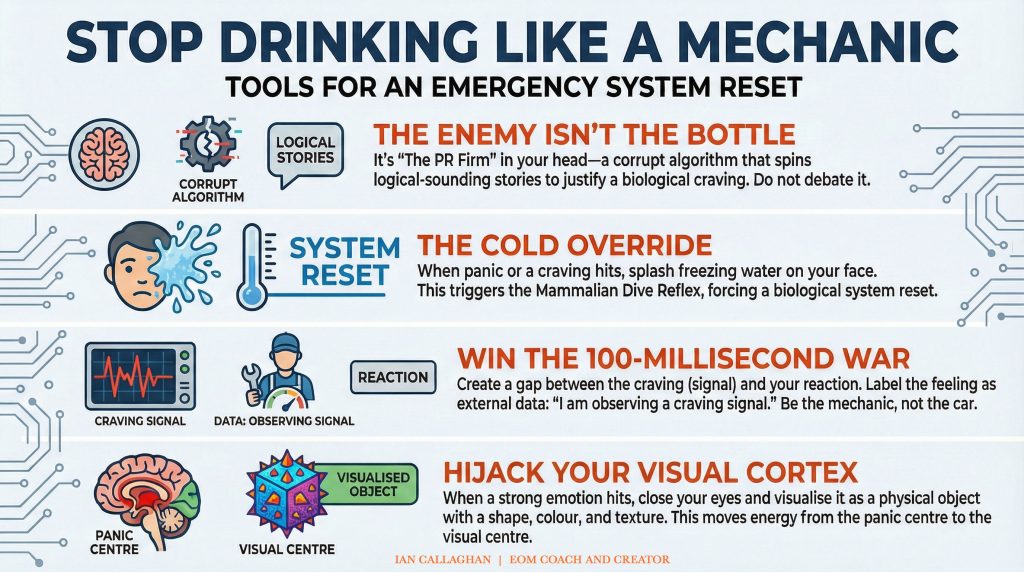
Before we get to the tactical interventions (The Top 7), you must understand the enemy. The enemy is not the bottle. The bottle is an inanimate object. The enemy is a sub-routine in your own mind that I call The PR Firm.
When you remove alcohol, your nervous system drops into Low Tone. Low Tone means high static. The system feels threatened. It is looking for an immediate dopamine fix to stabilise the voltage.
Because your brain is an energy-conserving machine, it will immediately deploy The PR Firm. This is the logical part of your brain that spins a narrative to justify the chemical craving. It creates the Narrative Fallacy.
You know these lies. They sound reasonable. They sound like you.
- “I’ve had a stressful week; I deserve a pint to take the edge off.”
- “I’ve been good for four days; one drink will prove I can moderate.”
- “The world is going to hell anyway; what’s the point in being sober?”
DO NOT ENGAGE WITH THE PR FIRM.
This is where 99% of people fail. They try to debate the PR Firm. They try to use logic. But you cannot use logic to fight a biological imperative. You cannot negotiate with a starving wolf.
The PR Firm is not interested in your long-term survival; it is interested in immediate dopamine acquisition. It is a corrupt algorithm.
In the early days, your job is not to win the argument. Your job is to realise that the argument itself is a symptom of mechanical failure.
You are not “weak.” You are simply experiencing a craving error code. The moment you realise that the voice in your head is just static generated by a system in withdrawal, you gain the first inch of ground: The Gate.
MY TOP 7 TACTICAL INTERVENTIONS (PART 1: THE HARDWARE)
We are going to bypass the “why” and go straight to the “what.” These are the mechanics of survival. We are starting with the first three protocols, which focus on the physical chassis. You cannot run high-level software (willpower) on broken hardware.
1. THE COLD OVERRIDE: RESETTING THE VAGAL BRAKE
In the early days, you will feel panic. You will feel a tightness in the chest, a rising heat, a sense of impending doom. This is Anxiety, which is simply a Prediction Glitch. Your brain is running a simulation of a disastrous future and reacting to it as if it is happening now.
You cannot “think” your way out of a panic attack or a severe craving. The prefrontal cortex (logic) is offline. The amygdala (threat detection) is running the show.
You need a Hardware Interrupt.
The Tactic:
Go to the sink. Turn the tap to the coldest setting. Fill a bowl or cup. Splash that freezing water directly onto your face, specifically around the eyes and nose. Do it three times. Or, better yet, get in a cold shower.
The Mechanics:
This is not masochism; it is biology. Cold water on the face triggers the Mammalian Dive Reflex. It sends an immediate signal to the Vagus Nerve to slow the heart rate and conserve oxygen. It physically forces the parasympathetic nervous system to engage.
It is a Cold Override. It snaps the system out of the “Fight or Flight” loop and reboots the motherboard.
Do not sit on the sofa negotiating with the craving. Get up. Apply cold water. Reset the sensor.
2. THE 100-MILLISECOND WAR: SOVEREIGNTY LIVES IN THE GAP
There is a specific timeframe that dictates your success or failure. I call it The 100-Millisecond War.
This is the microscopic gap between the Signal (the trigger/craving) and the Attachment (your reaction).
- Scenario: You walk past the off-licence. You see the bottles in the window.
- Signal: A pang of desire. A tightening in the gut.
- The Default Reaction: “I want that.” “I need that.”
In that default reaction, you have collapsed the wave. You have become the craving. You have merged with the signal.
The Tactic:
You must widen the gap. You must stand at The Gate.
When the signal hits, you must catch it within that 100 milliseconds and label it. Do not say, “I am thirsty for a drink.”
Say: “I am observing a craving signal.”
Say: “The system is reporting a dopamine deficit.”
It sounds robotic. Good. Be the mechanic, not the car.
By labelling the event as an external data point, you prevent the PR Firm from attaching a story to it. You remain the Sovereign Operator. You are the man watching the gauge turn red; you are not the engine catching fire.
Practise this relentlessly. The trigger is the doorbell. You do not have to open the door. You just have to acknowledge the bell rang.
3. THE VISUAL CORTEX HIJACK (THE BACKDOOR)
This is the cornerstone of EOM. We do not process emotion through words (Broca’s area), because words are easily corrupted by the PR Firm. We process emotion through the Visual Cortex.
The Visual Cortex is older, faster, and more honest than the language centres of the brain. When a heavy emotion or craving hits you—terror, grief, rage, the desperate need for a drink—we do not analyse it. We visualise it.
The Tactic:
Close your eyes. Locate the sensation in your body (Chest? Gut? Throat?). Now, give it physical attributes.
Ask the following diagnostic questions:
- Where is it? (e.g., Solar plexus)
- What shape is it? (e.g., A jagged rock, a spinning metal sphere, a heavy grey fog).
- What colour is it? (e.g., Dark red, sludge green, black).
- Is it moving? (e.g., Spinning, pulsing, static).
By forcing your brain to render the emotion as a 3D object, you are hijacking the processing power away from the amygdala and the PR Firm. You are moving the energy into the visual centre.
The Three Paths of Repatterning:
Once you see the object, you must deal with it.
- Path 1 (Observation): If it is mist, smoke, or fluid. Watch it. Observe the flow. It has no structural integrity. It will dissipate if you do not feed it.
- Path 2 (Transformation): If it is stone, clay, or wood. Watch it crumble. See it turn to dust. Realise it is old, dry material.
- Path 3 (Adult Override): If it is metal, spikes, or hostile. This is Legacy Software acting aggressively. You, the Sovereign Operator, must command it. Visualise yourself crushing it, melting it, or physically removing it from your chassis.
This takes less than 90 seconds. It is a “Backdoor” hack to clear the cache of the nervous system without having to discuss your feelings.
FAQ: THE DIAGNOSTIC LIST (EARLY DAYS)
I get asked the same questions by lads in the EOM community constantly. Let’s address the most common “Stoppages” right now.
Q1: “I feel like I’m grieving a best friend. Is that normal?”
The Mechanic: Stop the sentimental rubbish. You are not grieving a friend; you are grieving a parasite. That “friend” was charging you 100% interest on borrowed happiness. What you are feeling is the vacuum left by the removal of a massive dopamine source. The silence is loud.
The Fix: Fill the vacuum immediately. Do not sit in the empty space. Action creates traction.
Q2: “I’m exhausted, but I can’t sleep.”
The Mechanic: Your central nervous system has been depressed by a sedative (alcohol) for years. Now that the weight is off, your system is rebounding—it’s springing up like a jack-in-the-box. Your cortisol is spiking.
The Fix: Accept the insomnia. Do not fight it. Lying in bed wrestling with the duvet only increases the RPM. Get up. Read a technical manual. Do the Cold Override. The sleep will return when the engine calibrates.
Q3: “I’m angry at everything.”
The Mechanic: Good. Anger is energy. Anger is Valuation Acceleration. It’s high voltage. Alcohol made you numb; sobriety makes you feel the edges of the world.
The Fix: Do not suppress it, but do not direct it at your family. Take that energy to the gym or the pavement. Burn the fuel. If you leave the engine idling at 7,000 RPM in the garage, you’ll blow a gasket. Drive the car.
PREPARING FOR PHASE 2: SUGAR AND THE VOID
We have covered the immediate hardware resets: Cold Water, The 100-Millisecond Gap, and The Visual Backdoor. These are your fire extinguishers.
However, in the next phase of this guide, we must discuss the fuel system. When you cut the alcohol, you are cutting a massive supply of liquid sugar. Your body will scream for glucose. We need to talk about The Sugar Protocol and how to handle The Void—that empty space where your drinking career used to live.
Do not try to fix your diet this week. Do not try to become a saint. Your only mission right now is: Do not drink.
Fix the state, ignore the story.
March on.
END OF PART 1
Next Issue: The Sugar Alternator, The Social Minefield, and The Identity Update.
PART 2: THE STRUCTURAL OVERHAUL
We are back under the chassis.
In Part 1, we addressed the immediate fire-fighting required to survive the first 72 hours of alcohol withdrawal. We utilised the Cold Override to reset the Vagal Brake and established the 100-Millisecond Gap to regain tactical control of the nervous system.
Now, we move from emergency repair to structural engineering. The vehicle is no longer on fire, but the engine is running rough, the fuel mixture is lean, and the navigation system is still trying to route you back to the nearest off-licence.
You have stopped the input of the toxin. Now you must manage the output of the machine.
THE SUGAR ALTERNATOR: MANAGING THE ENERGY CRASH
Let us be technically precise: Alcohol is a fuel source. It is a dirty, inefficient, high-octane fuel that burns hot and leaves carbon deposits on your valves, but it is fuel nonetheless. Specifically, it converts to sugar and provides a massive, artificial dopamine spike.
When you cut the alcohol, your internal telemetry goes haywire. The ECU (your brain) registers a catastrophic drop in dopamine and glucose. It sends a Code Red to the dashboard. You interpret this signal as “I need a drink.”
You do not need a drink. You need a bridge.
The Physiology of the Craving:
What you feel as a “craving” is often just a hypoglycaemic trough combined with a dopamine deficit. Your PR Firm (that lying voice in your head) will spin a narrative: “I am stressed, I deserve a pint.” That is a lie. The mechanical reality is: “My blood glucose is low, and my neurotransmitters are misfiring.”
The Protocol:
For the first 30 days, we do not care about your waistline. We care about system stability. If you try to quit booze and start a keto diet on the same day, you will fail. You cannot strip the engine and repaint the bodywork simultaneously.
- Strategic Glucose Deployment: Keep chocolate, sweets, or fruit juice on hand. When the “craving” hits (usually around 17:00 hours, or the “Witching Hour”), ingest sugar. It provides a temporary dopamine hit that mimics the reward mechanism of alcohol without the toxic payload. It creates a temporary patch in the software.
- Hydrate or Die: Most headaches in early sobriety are not withdrawal; they are dehydration. Your body is flushing toxins. Flush the radiator. 3 litres of water a day. Minimum.
- The “Healthy” Trap: Do not try to be a Spartan yet. If you need to eat a pizza to stop yourself from drinking a bottle of vodka, eat the pizza. We will address the metabolic damage later in the workshop. For now, the mission is binary: Ingest anything except ethanol.
THE SOCIAL MINEFIELD: NAVIGATING HOSTILE TERRITORY
You cannot stay in the bunker forever. Eventually, you will have to walk into a room where alcohol is present. In EOM terms, this is a High-Load Environment.
Your nervous system (Tone) is fragile. The noise, the lights, and the social pressure act as “Load.” If your Tone is low and the Load is high, the system buckles. The PR Firm wakes up and whispers: “Just one won’t hurt. Be sociable. Don’t be a bore.”
This is the Narrative Fallacy.
The “Just One” Glitch:
There is no such thing as “one drink” for a machine wired for addiction. One drink is not a beverage; it is a command override. It disables the prefrontal cortex (The Sovereign) and hands the keys to the Toddler. Once the Toddler is driving, he drives off the cliff.
Field Tactics for Social Operations:
- The Prop: Never stand empty-handed. If your hands are empty, people will try to fill them with poison. Carry a glass of sparkling water, lime and soda, or coffee. It acts as a shield. It signals “I am fuelled” to the tribe.
- The Phantom Exit: Before you enter a High-Load Environment, establish an extraction plan. Drive your own car. Do not rely on others for transport. If the Tone drops—if you feel the anxiety spiking or the PR Firm starting its sales pitch—you leave. No apologies. No long goodbyes. You simply extract.
- The “Antibiotic” Lie: If you are too fragile to explain your sobriety (and frankly, it is nobody’s business), use a tactical deception. “I’m on strong antibiotics,” or “I’ve got an early start on a project tomorrow.” It shuts down the enquiry without opening the emotional bonnet.
The Truth About Friends:
You will realise quickly that many of your “friends” were just drinking colleagues. They are not interested in you; they are interested in you validating their own alcohol consumption. When you stop drinking, you become a mirror reflecting their own dysfunction. That is their malfunction, not yours. Let them process it. You have your own machine to fix.
THE VOID: FILLING THE VACUUM
This is where most attempts at sobriety fail. Not because of the craving, but because of the Silence.
Alcohol is a time-travel device. You open a bottle at 18:00, blink, and it is midnight. You have successfully deleted six hours of reality. When you remove the alcohol, you are suddenly given those six hours back. In High Definition.
We call this The Void.
If you sit on the sofa staring at the wall during The Void, the PR Firm will assault you. It will amplify your boredom, your regrets, and your anxiety. It will scream.
The Fix: Kinetic Output.
You cannot think your way out of a feeling. You must move your way out. Logic works when you are Stable. When you are Unstable, you need mechanics.
The SOP (Standard Operating Procedure):
- Burn the Adrenaline: When the work day ends, do not sit down. Transition immediately into movement. Walk, run, lift heavy iron, clean the garage, dismantle a toaster. It does not matter what you do, as long as you are physically engaged. You are manually regulating the nervous system.
- Input Overload: If the brain is spinning stories about the past (“Why did I do that?”), jam the signal with new data. Read a technical manual. Learn a language. Listen to a complex podcast. Force the CPU to process new information so it has no processing power left for the PR Firm’s nonsense.
- The Early Shutdown: In the early days, if the day is too hard, go to bed at 20:00. There is no valour in staying awake to fight a demon. Unplug the machine. Sleep is the ultimate system defrag.
THE IDENTITY UPDATE: THE SAVE BUTTON
We are not just changing a habit; we are upgrading the Operating System.
Most people try to quit drinking while maintaining the identity of “A Drinker.” They say, “I am trying to stop drinking.” This implies that drinking is their default state and sobriety is a temporary struggle.
You must rewrite the source code. You are no longer a “Drinker on a break.” You are a Non-Drinker.
The Binary State:
Every time you refuse a drink, you are not “missing out.” You are casting a vote for the new identity. You are confirming the new software installation.
Dealing with “Legacy Software” (The Toddler):
The urge to drink is just Legacy Software running in the background. It is a subroutine installed when you were younger to cope with stress or social anxiety. It is outdated. It is incompatible with the current hardware.
When the urge arises, use The Three Paths to categorise the signal:
- Path 1 (Observation): Is the urge misty, vague, just a general sense of unease? Watch it. Use The Gate. Say, “I am observing a chemical fluctuation.” Do not engage. Let it starve.
- Path 2 (Transformation): Is the urge heavy, like a stone in the chest? Visualise it crumbling into sand. Use the Visual Backdoor. Change its shape in your mind. If you can change its geometry, you prove you are the master of it.
- Path 3 (The Sovereign Command): Is the urge hostile? Is the PR Firm screaming? This requires Adult Override. You do not negotiate with terrorists. You stand in the centre of your internal architecture and issue a command: “Silence. I am the Operator. We do not drink.”
The Anchor:
After you survive a trigger, you must hit the “Save Button.” Acknowledge the victory. Look in the mirror. Tell yourself: “I am capable. I am sovereign. The machine obeys me.”
CONCLUSION: THE LONG WAR
There is no finish line. There is only the daily maintenance of the machine.
Some days, the road will be smooth, and the engine will hum. Other days, you will be driving through mud, the suspension will rattle, and the check engine light will flash.
It does not matter. The condition of the road is irrelevant. The weather is irrelevant. The only thing that matters is the integrity of the Operator.
You have spent years asleep at the wheel, letting the automated systems drive you into the ditch. Now, you are awake. You have taken back the keys. It will be uncomfortable. It will be loud. It will be real.
Stop looking for “happiness.” Happiness is a weather report. Look for Stability. Look for Tone. Look for the quiet confidence of a machine that is running exactly as it was designed to run.
You are the Mechanic. This is your workshop.
Fix the state. Ignore the story.
March on.
IAN CALLAGHAN
Founder, Emotional Operating System (EOM), not the Liverpool legend.
Emotional Mastery: The Emotional Operating System
The Emotional Mastery book is a practical manual for understanding and regulating the human nervous system using the Emotional Operating System framework.
Instead of analysing emotions or retelling your past, the Emotional Mastery book teaches you how to read emotional states as system feedback, identify overload, and restore stability under pressure.
No labels. No therapy-speak. No endless healing loops.
Just a clear, operational approach to emotional regulation that actually holds when life applies load.
Instant digital download.



Please add me to your mailing list.