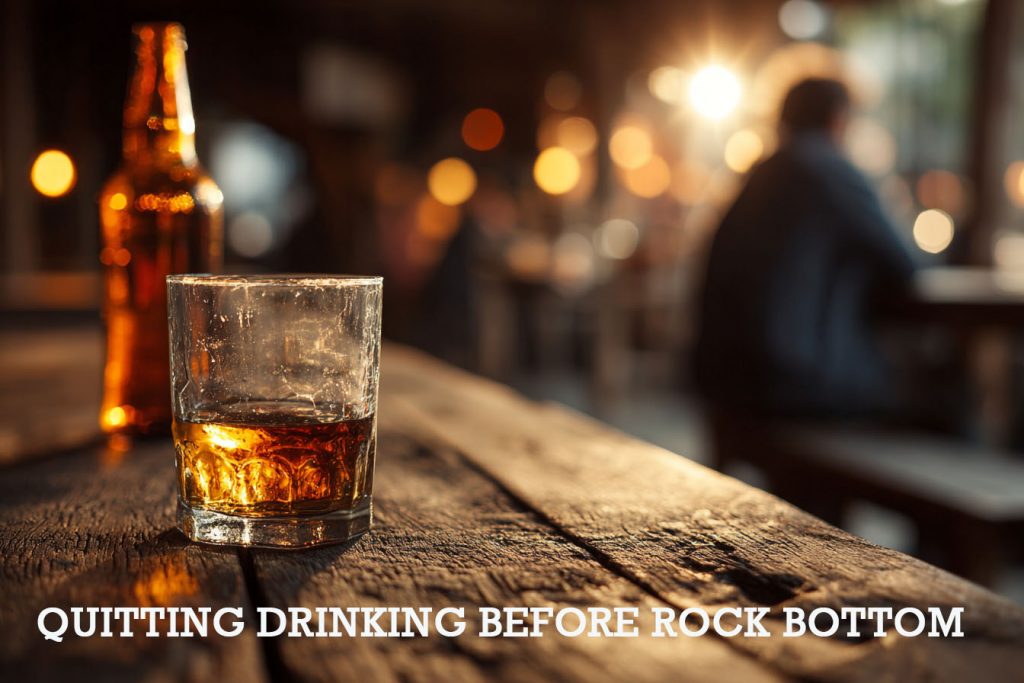
Rock Bottom Isn’t a Prerequisite: The Unpopular Truth About Starting Your Sobriety Journey Before Crisis Hits (and Why ‘Sober Curious’ Is Just the Beginning)
Quitting drinking before rock bottom. There is a story you have been told, a dangerous piece of cultural mythology that is so deeply embedded in our collective consciousness that it feels like an immutable law of nature. It’s a story whispered in support groups, shouted in movies, and used as a benchmark for when things have gotten “bad enough.” This is the story of rock bottom. And this lie about ‘rock bottom’ is keeping you stuck. You have been conditioned to believe that you need a total, life-shattering crisis to enact meaningful change. You are waiting for the sirens, the confrontation, the dramatic final act. Bollocks. This is why waiting for rock bottom is pure insanity. The truth is far simpler and far more powerful. The truth is that ROCK BOTTOM IS A FUCKING LIE.
I know this because I lived the alternative. For 45 years, I was a professional, high-functioning boozer. I’m 58 now, and the change didn’t happen because my life exploded. It happened because I made a decision. I didn’t quit from the wreckage of a life burned to the ground; I quit from the grey zone. My story doesn’t have a cinematic climax. At 57, there was no car crash, no intervention, no waking up in a hedge. The catalyst wasn’t a cataclysm. It was a quiet, internal reckoning. This post is for everyone stuck in that grey zone, waiting for a permission slip from disaster that will never come. It’s time to understand that you don’t need a crisis; you just need a decision.
The Grand Deception: Why “Rock Bottom” is Pure Insanity
Let’s be unequivocally clear from the outset: ROCK BOTTOM IS A FUCKING LIE. This is not a controversial opinion; it is a fundamental truth that has the power to liberate you. The concept of a singular, definitive “rock bottom” is perhaps the most pervasive and damaging myth in the entire lexicon of addiction and recovery. It’s a seductive narrative because it’s simple, dramatic, and absolves you of responsibility until the moment of catastrophe. It suggests a clear, bright line that you must cross before change is not only possible but required. This is why waiting for rock bottom is pure insanity. You are outsourcing the most important decision of your life to chance, circumstance, and escalating degrees of self-destruction.
This lie about ‘rock bottom’ is keeping you stuck. It functions as a perverse form of permission, a justification for continuing a behaviour that is slowly, methodically dismantling you from the inside out. You tell yourself, “I haven’t lost my job,” “I haven’t gotten a DUI,” “My family hasn’t left me.” You measure yourself against the fictional yardstick of a dramatic, movie-style rock bottom and find yourself coming up short. So, you pour another drink. You convince yourself that you haven’t fallen far enough to warrant the climb back up. You think you need a crisis to change. You imagine that one day you will wake up in a hedge, have a tearful intervention staged by loved ones, or see the flashing lights of a police car in your rearview mirror. These are the prescribed scenes, the accepted catalysts for transformation. My journey included none of them. For me, there was no car crash. There was no intervention. There was no waking up in a hedge. The absence of this external drama does not invalidate the need for change; it underscores the insidious nature of the real problem.
Waiting for this cinematic moment is pure insanity because the real damage isn’t happening in a single, explosive event. It’s happening in the quiet moments of every single day. It’s happening with every drink you have to “take the edge off,” every morning you wake up feeling subpar, every promise you break to yourself. The lie of rock bottom convinces you to ignore the thousand small cuts because you’re waiting for a fatal wound. It’s a passive stance, placing you in the passenger seat of your own life, waiting for a crash that will finally give you the jolt you think you need. But what if the car is simply running out of gas, slowly, mile by quiet mile, leaving you stranded in a place of profound mediocrity? The lie keeps you stuck in a holding pattern of managed decline, all because the crisis you’ve been told to expect hasn’t materialised in the way the script dictates. Bollocks. You don’t need the script. You just need to recognise the truth of your own situation.
Life in the Grey Zone: The Quiet Reality of the High-Functioning Boozer
The alternative to the dramatic free fall is a place far more common and, in many ways, more dangerous: the grey zone. I quit the grey zone. This is the sprawling, undefined territory where things aren’t terrible, but they are undeniably not good. It is the land of “fine,” the kingdom of “getting by.” It is the natural habitat of the professional, high-functioning boozer. I was one of them. I’m 58, and for 45 years, I mastered the art of functioning. I held down jobs, maintained relationships, and paid my bills. On the surface, the machinery of my life was operational. But inside, a slow and steady corrosion was taking place. The grey zone is not about the absence of success but the acceptance of a lower ceiling. It’s about functioning, but never flourishing.
When you exist in this space, you learn to ignore the warning signs because they aren’t loud enough. They don’t scream; they whisper. My rock bottom wasn’t a sudden impact; it was the slow, dawning realisation of a long-term decay. My rock bottom was quieter, more insidious. It was a truth that accumulated over time, a collection of subtle but damning pieces of evidence that the life I was living was a shadow of the one I was capable of. This is the rock bottom that doesn’t get a dramatic soundtrack. This is the rock bottom of the slow burn, and it is composed of realities that are profoundly, painfully personal.
This insidious rock bottom, the one that truly matters, manifested in three distinct ways for me:
- It was the slow, grinding erosion of my potential. This is the most painful truth of the grey zone. It’s not about what you’ve lost, but what you’ve failed to gain. It’s the book you never wrote, the business you never started, the marathon you never trained for, the skill you never learned. For 45 years, alcohol acted as a governor on my engine, ensuring I never redlined, never pushed my limits, never truly discovered what I was capable of. The slow, grinding erosion of my potential meant that my ambition was perpetually blunted, my creativity was capped, and my energy was diverted from growth to maintenance and recovery. It’s the quiet tragedy of looking back and seeing not a field of failures, but a landscape of unattempted dreams. It is the insidious theft of your own future, one drink at a time. This erosion is so gradual you barely notice it day-to-day, but compounded over decades, it amounts to a life half-lived.
- It was the two-stone beer belly I was carrying like a trophy for mediocrity. This was the physical manifestation of my internal compromise. It was more than just weight; it was a visible symbol of my accepted limitations. A two-stone beer belly doesn’t appear overnight. It’s built slowly, pint by pint, choice by choice. It represents a thousand moments of choosing short-term comfort over long-term health. Carrying it around was like wearing a medal for settling. It was a trophy for mediocrity, a public declaration that I was content with “good enough.” It was the physical price of being a professional, high-functioning boozer—a constant, tangible reminder that while I might be “functioning,” I was far from thriving. It was the outward sign of an inner resignation, an acceptance of a physical state that did not align with the man I wanted to be.
- It was the creeping anxiety that no amount of ale could silence for long. This is the cruel paradox of drinking to cope. I, like so many others, used alcohol as a tool to manage stress and quiet a restless mind. A few pints of ale could provide a reprieve, a manufactured calm in the storm of modern life. But the relief was a high-interest loan. The creeping anxiety that followed was always worse than the initial state I was trying to escape. The alcohol itself was fueling the very thing I was trying to kill. This created a vicious, self-perpetuating cycle: feel anxious, drink to numb it, wake up with heightened anxiety from the alcohol’s effects, and feel the need to drink again. It was a quiet, internal torment. No amount of ale could silence for long the low-grade hum of dread, the worry about health, the regret over wasted time, and the fear that I was stuck in this loop forever. The creeping anxiety was the constant, nagging soundtrack of the grey zone.
This was my rock bottom. Not a bang, but a long, miserable whimper. I quit from the grey zone because I finally understood that this quiet, insidious reality was a crisis in its own right.
From Passivity to Power: Why a Decision, Not a Disaster, is the True Catalyst
The entire narrative of waiting for rock bottom is built on a foundation of passivity. It teaches you to wait for something to happen to you. It frames change as a reaction to an external force—a disaster, a loss, a confrontation. This is the most disempowering mindset one can adopt. You think you need a crisis to change. This belief strips you of your agency and turns you into a spectator in your own life. You are waiting for the universe to give you a sign so clear and so painful that you have no choice but to act.
Bollocks. You just need a decision.
This is the unpopular but liberating truth. The power to change your life does not reside in a future catastrophe; it resides within you, right now, in this very moment. A decision is the assertion of power. It is the conscious act of taking control of the narrative. Unlike a crisis, which is chaotic and unpredictable, a decision is deliberate, focused, and born from self-awareness. It is the moment you stop being a victim of your circumstances and become the architect of your future. After 45 years of drinking, the turning point was not an event. It was a quiet, resolute decision made at 57. It was the moment I decided that the terms of the grey zone were no longer acceptable.
That decision was not a vague wish or a fleeting New Year’s resolution. It was a specific and powerful response to the quiet rock bottom I was experiencing.
- It was a decision to halt the slow, grinding erosion of my potential. I chose to find out what I was capable of without the chemical governor holding me back.
- It was a decision to stop carrying the two-stone beer belly I was carrying like a trophy for mediocrity. I chose to value my health and my physical well-being over the fleeting comfort of a drink.
- It was a decision to face the creeping anxiety that no amount of ale could silence for long, head-on, without the false crutch of alcohol. I chose to seek genuine peace of mind, not a temporary, borrowed numbness.
This is the fundamental difference between change born from crisis and change born from a decision. A crisis forces your hand; you react to survive. A decision empowers your mind; you act to thrive. Waiting for a dramatic, movie-style rock bottom is an abdication of this power. It is allowing the insidious, quiet decay to continue unchecked until the damage becomes spectacular and undeniable. This is why waiting for rock bottom is pure insanity. Why let the house burn down when you can smell the smoke? Why wait for the ship to sink when you can see it’s taking on water?
The lie about ‘rock bottom’ is keeping you stuck because it has convinced you that the key to your own cage is held by some external event. It is not. You have the key in your hand. You have always had it. The act of making a decision is the act of putting that key in the lock and turning it yourself. You do not need to wait for the walls to crumble. You can simply decide to walk out the door. You just need a decision.
Summary: Rock Bottom is a Lie
Let’s dismantle this myth once and for all and replace it with a more empowering truth. The narrative you’ve been sold is a dangerous work of fiction.
ROCK BOTTOM IS A FUCKING LIE.
This is the single most important thing to understand. This is why waiting for rock bottom is pure insanity. It is a passive, dangerous, and unnecessary delay. This lie about ‘rock bottom’ is keeping you stuck, convincing you to tolerate a slow decay while you wait for a dramatic explosion.
I am living proof that there is another way. I’m 58. For 45 years, I was a professional, high-functioning boozer. I didn’t wait for a grand catastrophe to force my hand. I quit the grey zone. My moment of clarity didn’t come from the wreckage of a life destroyed. My rock bottom was not a dramatic, movie-style event like a car crash, an intervention, or waking up in a hedge.
My rock bottom was quieter, more insidious, and it was happening every single day. It was the constant, nagging awareness of a life lived at a fraction of its capacity. It was comprised of undeniable truths:
- It was the slow, grinding erosion of my potential.
- It was the two-stone beer belly I was carrying like a trophy for mediocrity.
- It was the creeping anxiety that no amount of ale could silence for long.
If any of this feels familiar, then understand this: you do not need to fall any further. The quiet desperation of the grey zone is crisis enough. You are standing at a crossroads right now, not in some distant, disastrous future.
You think you need a crisis to change.
Bollocks. You just need a decision.
Get The 7-Day Midlife Reset Checklist: Stop Cravings. Start Clarity.
A 7-Day Blueprint for breaking the autopilot drinking loop and stabilising your dopamine levels. No willpower required.