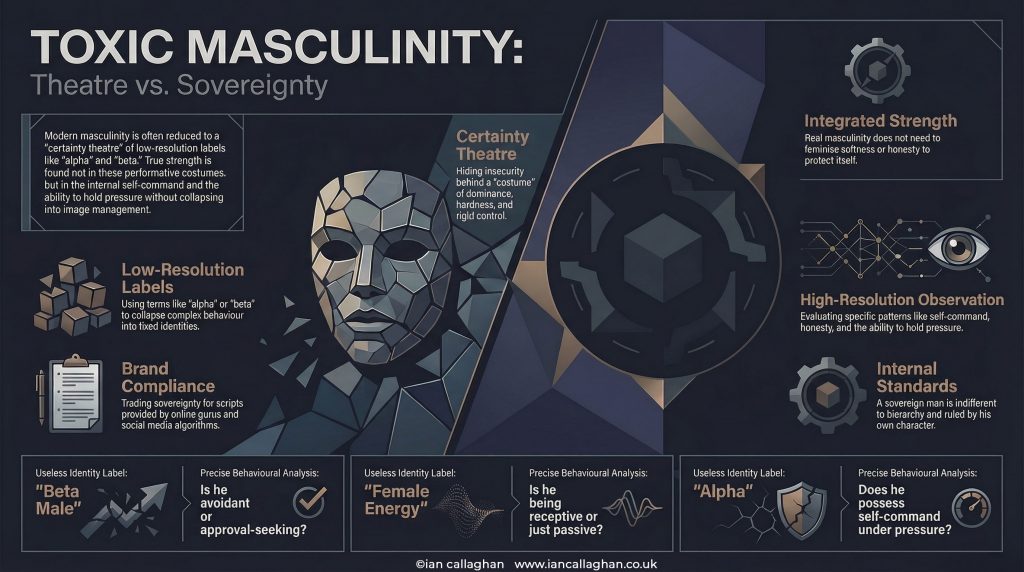
The amount of Toxic Masculinity currently being vomited across the digital landscape under the guise of “self-improvement” or “reclaiming manhood” is, quite frankly, embarrassing. If you spend more than thirty seconds on any social media feed, you are instantly assaulted by a parade of grown men throwing around half-baked labels like “beta male,” “sigma,” and “female energy” as if they’ve cracked some ancient, esoteric code of the universe. In reality, they’ve done nothing of the sort. All they have managed to do is reduce the staggering, breathtaking complexity of human behaviour to playground-status games and digestible podcast sound bites designed for the short-attention-span era. This is a high-resolution problem—the crisis of modern identity—being met with incredibly low-resolution labels, and the result is performance as brittle as it is loud. It is “lazy thinking” at its most industrial, a “certainty theatre” that prioritises a man’s image over his actual substance.
Harmful Gender Archetypes: The Costume of Certainty
When we look at the modern landscape of male identity, we are actually witnessing a massive collective failure of language. It is weak language for weak minds. Most of all, it is insecurity wearing combat gear and pretending it’s a uniform. The source of this obsession with archetypes isn’t found in a man’s strength, but in his utter inability to describe human behaviour with any degree of precision. This is the bedrock of the theatre. A man who cannot describe behaviour precisely will inevitably reach for a label. If he sees a man who is kind, or perhaps a man who is willing to listen and show receptivity, and he lacks the psychological vocabulary to understand that as “receptivity,” “emotional intelligence,” or “deliberate restraint,” he panics. His internal world has no box for a man who is both strong and soft, so he reaches for the word “beta” because it’s a blunt instrument. It’s a way to categorise the world so he doesn’t have to think about the nuance anymore.
This is what we call “certainty theatre.” A man who cannot hold his own uncertainty—who cannot handle the fact that life and people are complicated, messy, and non-linear—will hide inside a rigid, certain identity. He builds a costume out of dominance, hardness, control, and image. This costume provides a temporary relief from the terrifying reality that he might not actually know who he is. He’s not seeking truth; he’s seeking a bunker. And because that identity is a costume and not a core, he is perpetually terrified of being found out. He is a man on a stage, waiting for the audience to boo.
“A man who has built his whole identity on dominance, hardness, control and image will attack anything in another man that threatens the costume.”
This is the central irony of the modern “alpha” movement. The aggression you see in comments sections and on stages isn’t an expression of power; it’s a defensive reaction to protect a fragile brand. If another man shows softness or vulnerability, he must be shamed immediately. Not because the softness is a threat to society or “the west,” but because it threatens the shamer’s own performance. If softness is allowed to exist in a man, then his costume of perpetual hardness might be seen for what it is: a mask. It isn’t insight he’s offering; it’s branding. It isn’t leadership; it’s posturing. He is literally trying to bully the world into believing his theatre is reality so he doesn’t have to face the hollowed-out version of himself that exists when the stage lights go dark.
Toxic Masculinity: The Psychological Dependence Behind ‘Female Energy’ Slurs
One of the most telling signs of this theatre is the weaponisation of the term “female energy.” When men use this as a slur, they think they are asserting their dominance. They think they are displaying masculine wisdom. They are, in fact, displaying a profound state of Toxic Masculinity and an even deeper state of psychological dependence. Saying a man is in his “female energy” is not an analytical observation. It is a confession. What that man is actually saying—though he lacks the honesty to admit it—is: “You are not performing masculinity the way I need you to so I can feel safe in mine.”
This is the absolute opposite of strength. If your sense of self-worth and your identity as a man depend entirely on how the men around you are behaving, you are not sovereign. You are a dependent. You are essentially saying that your masculine “frame” is so flimsy that the mere presence of an emotionally articulate man causes it to buckle. Real strength does not need a caricature to stand next to in order to look big. Real masculinity does not need to feminise softness, thoughtfulness, or emotional honesty just to protect its own ego. A grounded man—a man who actually possesses self-command and has done the work of integrated character building—is not panicked by another man’s kindness. He doesn’t feel the need to start a “chest-beating ritual” or a “toxic bollocks” monologue to prove he’s the top dog because he isn’t playing the game of comparison.
The man who is obsessed with “female energy” insults is a man under an immense psychological load. To maintain the “Alpha” brand, he has to suppress everything human within himself. He has to kill his own receptivity. There is a massive difference between receptivity and passivity, but the theatre-goer cannot see it. Passivity is a failure of the will; receptivity is the strength to be open, to listen, and to hold space. The insecure man sees both as “soft” because his script tells him that only “hardness” is masculine. Consequently, he becomes less functional. He confuses numbness for strength. He thinks that by turning off his emotions, he has become a machine of war, when in reality, he’s just become an emotional amputee.
This suppressed energy doesn’t go away; it turns into a brittle, reactive anger. A man who cannot be honest about his own internal state is a man who is perpetually “on script.” And that performance is exhausting. It requires constant maintenance—checking the mirror, checking the likes, checking the hierarchy. If he stops performing, he stops existing in his own mind. Therefore, he must shame anyone who isn’t as miserable and restricted as he is. He sees a man who is calm, reflective, or emotionally articulate, and he experiences a spike of cortisol. That man’s freedom is an indictment of the performer’s prison. To resolve that tension, the performer must attack. He must label the freedom as “weakness” to justify his own chains. This isn’t wisdom; it’s a coping mechanism for a man who is drowning in his own unacknowledged needs.
Performance vs. Sovereignty: The Brand-Compliant ‘Alpha Male Hierarchy’
We need to address the “alpha male hierarchy” for what it truly is: a fantasy caste system for men who are terrified of complexity. The men shouting most loudly about where everyone sits in this hierarchy—who is an alpha, who is a beta, who is a “high-value man”—are rarely free men. They like to think of themselves as “wolves,” but they are actually the most obedient people on the planet. They are just obedient to a different audience. They aren’t sovereign; they have simply traded one master for another. They’ve swapped the “matrix” they claim to hate for a different set of rules spat out by a man in a Dubai apartment with a podcast mic.
They haven’t become sovereign. They have become “brand compliant.” They are following a script provided by online gurus and social media algorithms. They are performing for the eyes of other men. This is the funniest part of the whole charade: the men who claim to be the most “dominant” are often the most ruled by the validation of their peers. Their every move is curated to fit a brand identity. They eat the same “alpha” foods, use the same “alpha” jargon, and engage in the same performative “grind” culture. It’s not a lifestyle; it’s a franchise.
“A man who needs to constantly prove he is not soft is still being controlled by softness.”
If your entire life is a reaction against being “soft,” then softness is the thing running your life. You aren’t making choices based on your own standards or your own moral compass; you’re making choices based on your fear of a label. If you are obsessed with looking dominant, you are ruled by the audience. You are a slave to the “eyes of other men.” A sovereign man is indifferent to the hierarchy. He doesn’t need to know where he ranks because he isn’t competing for a spot in a fantasy pecking order. He is busy building a life of substance.
The “brand-compliant” man, however, is always under load. He confuses aggression for certainty. He thinks that by being loud and domineering, he is showing leadership. But real leadership requires the ability to hold pressure without collapsing into image management. Most of these “hierarchical” men collapse the moment their image is challenged. They can be physically strong, spending hours in the gym to build a suit of armour, but they are psychologically weak. They can be dominant in a room and yet completely lack self-command. They are ruled by impulse, by ego, and by the desperate need to be seen as “the man.” If you are ruled by a need to be seen, you are not the one in charge. The people looking at you are.
Collapsing Behaviour into Identity: The Danger of the Script
The Toxic Nature of Ranking Men
The most destructive element of this entire theatre is the way it collapses behaviour into identity. This is the ultimate “low-resolution” move. In the real world, if we want to understand a man, we should be looking at what he actually does in specific moments. We should be asking precise, surgical questions about his patterns of action. Instead, the “alpha/beta” theatre encourages us to just slap a label on him and stop thinking. This is a tragedy, because behaviours can be corrected, but identities feel permanent.
When you collapse behaviour into identity, you stop observing and start performing. Instead of asking useful questions, men start acting out a role. They ask:
- Is this man being passive? (A description of a specific failure to act).
- Is he approval-seeking? (A description of a specific psychological motivation).
- Is he avoidant of his responsibilities? (A description of a pattern of neglect).
- Is he being dishonest? (A description of a moral failure).
- Is he led by fear rather than purpose? (A description of his internal driver).
- Does he lack self-command? (A description of his relationship with impulse).
- Does he fold under pressure? (A description of his resilience).
- Does he outsource his authority to others? (A description of his lack of sovereignty).
These are useful questions because they describe specific behaviours. If a man is being avoidant, he can learn to be courageous. If he lacks self-command, he can train his discipline. But the moment you slap the label “beta” on him, you have turned a fixable behaviour into an unchangeable caste. You have spat out a label that tells you nothing about why he is acting that way or how he can improve. You have just “demoted” him in your imaginary hierarchy and moved on.
This traps everyone. Men start pretending to be harder than they are to avoid the label. They suppress their emotional intelligence and their ability to reflect because they are scared that any sign of “softness” will get them kicked out of the tribe. They confuse domination for leadership and reaction for personality. They are no longer free to be honest; they are only free to be “on script.” And that script is a prison. It teaches men to relate to themselves and each other through contempt instead of precision. It replaces the difficult work of character building with the shallow work of image management. It’s a race to see who can be the most numb, the most aggressive, and the most certain—and in that race, everyone loses their humanity.
The 7 Signs You Are Trapped in the Theatre of Toxic Masculinity
To move beyond the noise and the “toxic bollocks,” we have to recognise the stage when we are standing on it. Here are the clear signs that a man is being run by a script rather than his own sovereignty:
- Obsessive Image Management: You are more concerned with appearing “hard” or “dominant” than you are with being effective or useful. Your primary focus in any room is your “frame” and how you are being perceived by the other “males” in the imaginary hierarchy.
- Avoidance of Complexity: You use low-resolution labels like “alpha,” “beta,” or “simp” to describe human interactions because the nuanced reality of human behaviour scares you. You prefer the “certainty theatre” of slogans over the difficult, often uncomfortable, search for truth.
- Shaming Others to Stabilise Identity: You feel a compulsive need to mock “softness,” “vulnerability,” or “female energy” in other men. This is a neon sign that you are psychologically dependent on feminising others just to feel secure in your own masculine costume.
- Running a Brittle Script: Your personality is built entirely out of reaction. You aren’t acting from your own deeply held standards; you are performing the version of “manhood” that you think will earn you validation from your chosen online echo chamber.
- Confusing Numbness for Strength: You believe that suppressing your emotions, ignoring your intuition, and remaining “stony” makes you powerful. In reality, you are just becoming less articulate and more psychologically brittle under the mounting pressure of your unexpressed humanity.
- Outsourcing Authority to Gurus: You look to online hierarchies, “status games,” or the opinions of podcasters to tell you your worth. You are obedient to a brand or a “grindset” soundbite rather than being a sovereign individual with the self-command to think for yourself.
- Fear of “Demotion” in the Pecking Order: You are constantly on guard, terrified that any sign of kindness, reflection, or honesty will get you “exposed” as weak. You are not a leader; you are a man ruled by the eyes of other men and the fear of being cast out of the play.
Toxic Masculinity and the Antidote: Moving from Costume to Command
So, what is the antidote to this Toxic Masculinity and the hollow theatre of the “alpha” movement? It isn’t “less masculinity”—that’s a common mistake made by people who don’t understand the problem. The world doesn’t need men to be less masculine; it needs them to be better at it. It needs them to move away from the costume and toward command. It’s about looking at the actual patterns of a man’s life rather than the slogans he shouts.
Real masculinity doesn’t need an internet caste system. It doesn’t need to rank men like wolves in a fantasy novel. It needs standards. It needs honesty. It needs the ability to observe one’s own patterns without lying about them. A real man doesn’t need to shame softness because he isn’t threatened by it. He has the self-command to be calm when others are panicking, to be kind when others are aggressive, and to be honest when others are performing. He understands that strength is the ability to be receptive without being passive—to be able to hear the truth, even if it hurts his ego, and to act on it with precision.
Real strength is the ability to hold pressure without collapsing into image management, aggression, or avoidance. It is the courage to stop performing a role and start “becoming” a man of substance. Any version of manhood that can only define itself by what it hates, what it shames, or what it “dominates” is hollow. Real power is sovereign. It is quiet. It is precise. It doesn’t need a podcast mic or a gym selfie to prove its existence. It is found in the man who has nothing to prove and everything to protect.
The Patterns of Modern Masculinity FAQ
What is the difference between real strength and performing masculinity?
Real strength is an internal quality grounded in self-command, honesty, and the ability to maintain one’s own standards under pressure without needing to manage an image. Performing masculinity, or “theatre,” is a defensive, external posture where a man mimics “hardness” or “dominance” to hide his own insecurity and protect a fragile “costume” from being challenged by the reality of his own feelings or the presence of other men.
Why is the “alpha vs. beta” hierarchy considered low-resolution thinking?
These labels are “low-resolution” because they simplify the staggering complexity of human behaviour into oversimplified, playground status games. Instead of analysing specific, actionable traits—like whether a man is being avoidant, dishonest, or lacking self-command—these labels collapse a person’s entire identity into a useless category that prevents men from observing their actual patterns and growing.
How does Toxic Masculinity lead to “psychological dependence”?
It creates a state where a man’s sense of self is entirely dependent on external mirrors. If a man feels he must shame “female energy” or “softness” in others to feel secure, he is admitting that his own masculinity is not sovereign; it is a “costume” that requires the behaviour of those around him to stay in place. He is literally dependent on the “weakness” of others to feel “strong.”
What does it mean for a man to be “brand compliant” rather than “sovereign”?
A brand-compliant man follows a pre-written “script” of masculinity provided by an online subculture or “alpha” guru to gain validation and a sense of belonging. A sovereign man, by contrast, is not ruled by the “eyes of other men” or social media algorithms; he acts according to his own internal standards and has the self-command to be honest and flexible rather than merely “on script.”
Conclusion: Beyond the Slogans
At the end of the day, any version of manhood that relies on shaming others to exist is just a house of cards. The “alpha/beta” theatre is a loud, distracting performance that keeps men from doing the real work of character building. We have to stop looking at the labels and start looking at the patterns. We have to stop asking where a man sits in a fantasy hierarchy and start asking whether he can tell the truth, hold pressure, and be in command of his own impulses.
We have to decide if we are going to be “brand compliant” actors in someone else’s play, or if we are going to be sovereign individuals who own our own lives. Real masculinity is not a slogan. It is not a “toxic bollocks” monologue. It is the ability to stand in the truth of who you are—in all your complexity, strength, and receptivity—without needing to put on combat gear just to feel safe. It is about standards, honesty, and self-command.
Everything else is noise.
The question you have to ask yourself is simple and cuts through all the theatre and posturing: Are you building a character of substance, or are you just perfecting a costume?

Under Load by Ian Callaghan | The Mechanical Guide to Addiction Recovery
You already know what you’re doing. You’ve known for years.