Trauma Healing Without Reliving: Why Going Back Makes It Worse
Trauma Healing Without Reliving. Someone, at some point, told you that you have to go back in.
That the path through the wound is through the wound. That healing requires you to feel it again, fully, consciously, in a safe space, until it loses its power. That you must revisit the moment, re-experience the emotion, excavate the memory, and somehow, through the act of returning, release it.
I spent 45 years being driven by unprocessed trauma. I tried the approach. I sat in the room. I did the work they asked me to do.
And I watched the groove get deeper.
The standard trauma model has the sequence backwards. It is not wrong about the presence of the wound. It is wrong about what heals it.
This is the case for trauma healing without reliving — and the specific mechanism that makes it work.
What the Standard Model Gets Wrong
The prevailing approach to trauma treatment — across most therapy modalities, coaching frameworks, and self-help methodology — operates on a core assumption: that emotional wounds are healed through re-exposure.
Feel it to heal it. Sit with it. Process it. Return to the memory with adult eyes and, through the act of conscious re-witnessing, discharge the stored energy.
There is a neurological reality underneath this idea. Trauma does create stored activation in the body. Unprocessed emotional charge needs to move. The problem is not the destination — it is the route being prescribed to get there.
Every time you force yourself to re-experience a traumatic event without resolving it, you are not releasing the energy. You are deepening the neural groove.
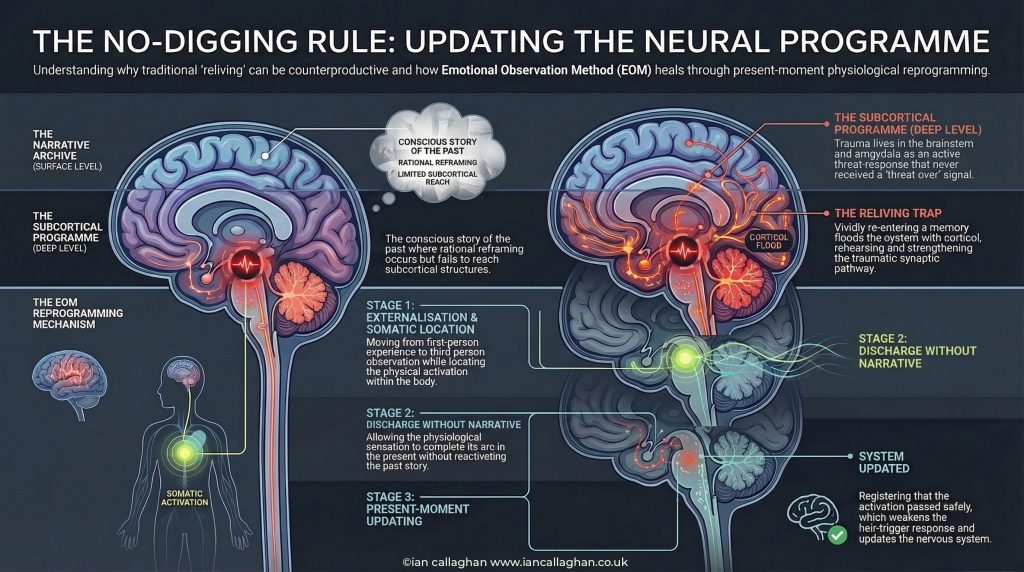
The brain does not distinguish between a memory and a present experience in the way we assume it does. When you vividly re-enter a traumatic memory — the emotions, the physical sensations, the narrative — your amygdala responds to it as a current threat. Bob fires. The cortisol floods. The nervous system activates.
You have not revisited the wound to release it. You have rehearsed it. You have run the programme again and strengthened every synaptic pathway involved in producing it.
This is why people can spend years in trauma-focused therapy, developing extraordinary articulation of their pain, and still be triggered by the same stimuli in the same way. The insight is real. The resolution is not happening. Because insight is not the mechanism of change — neural repatterning is. And reliving does not reprogram. It reinforces.
The Neuroscience of Why Reliving Reinforces
To understand why the No-Digging Rule works, you need to understand what trauma actually is at the neurological level.
Trauma is not a memory. It is a programme. Specifically, it is a threat-response pattern that was encoded during an overwhelming experience and has never been updated. The original event is over. The programme it created is still running — triggered by stimuli that pattern-match to the original threat, firing the same physiological cascade, producing the same emotional and behavioural response.
Bob — the limbic system — encoded that programme at the time of the original event because it was doing its job. It detected an overwhelming threat. It created a hair-trigger response to anything resembling that threat. It was trying to protect you.
The problem is that Bob never received the signal that the threat is over.
The standard reliving approach attempts to update this by bringing the conscious mind back to the event and reprocessing it cognitively. The difficulty is that the programme does not live in the conscious mind. It lives in the subcortical structures — the amygdala, the hippocampus, the brainstem — that do not respond to rational reframing.
You cannot talk Bob out of a threat response. You can only update the threat assessment at the level where the assessment is being made. And that level is not the story. It is the body.
The No-Digging Rule — What EOM Does Instead
The Emotional Observation Method was built on a single foundational principle: we do not go back to the story.
Not because the story doesn’t matter. Not because the past is irrelevant. But because the story is not where the glitch lives. The glitch lives in the present moment — in the body, in the nervous system, in the automatic response that fires when a specific stimulus is detected.
That is where EOM works. In the present. On the live data of the physiological event as it is happening, not on the archived narrative of how it started.
We do not go back to the story. We look at the glitch in the present moment.
The No-Digging Rule is not avoidance. Avoidance is what happens when you refuse to acknowledge the activation — when you drink over it, numb over it, distract over it. That is Bob’s energy being suppressed rather than discharged, and suppression has a physiological cost that accumulates over time.
The No-Digging Rule is precision. It says: the information we need is not in the past. It is in the body, right now, as the pattern activates. That is the access point. That is where the reprogramming happens.
How Trauma Heals Without Reliving — The Mechanism
The EOM approach to trauma works through four specific mechanisms, all operating in the present moment.
1. Externalisation
The moment an activation is detected — the physiological signature of a trauma response — the practitioner externalises it. Instead of being inside the experience, you observe it from outside. This is not dissociation. It is the deliberate creation of the witnessing gap that prevents Bob’s activation from becoming a full limbic hijack.
You are not the emotion. You are the space in which the emotion is happening. That shift — from first-person experience to third-person observation — is neurologically significant. It activates the prefrontal cortex as the observer rather than allowing the amygdala to dominate the entire neural sequence.
2. Somatic Location
Rather than following the narrative of the trauma — the story, the memory, the meaning — EOM directs attention to the physical location of the activation in the body. Where exactly is it? What is its quality, its shape, its movement?
This is not metaphorical work. Trauma is held in the body as unresolved physiological activation — the fight-or-flight response that was never completed. By bringing precise, non-judgemental attention to the physical sensation, you are working directly with the stored energy rather than with the story constructed around it.
3. Discharge Without Narrative
The stored activation needs to move. In the EOM framework, it moves through the body via the somatic attention — not through re-experiencing the original event, but through allowing the present-moment sensation to complete its physiological arc.
This is the crucial difference. The energy discharges in the present, through the body, without the narrative of the past being reactivated. Bob’s threat response completes — the cortisol metabolises, the nervous system returns to baseline — without the traumatic programme being rehearsed and reinforced.
4. Present-Moment Reprogramming
Once the activation has discharged, the adult mind — operating from a regulated nervous system — can update the threat assessment. Not by debating the past, but by registering, at the neurological level, that the activation occurred, peaked, and passed. That you survived it. That the threat is not present.
Repeated consistently, this weakens the synaptic pathway of the trauma response. The gap between stimulus and reaction widens. The hair-trigger becomes less sensitive. Not because the memory has been processed cognitively, but because the nervous system has been updated experientially.
What This Looks Like in Practice
A client arrives with a pattern they cannot shift. A specific trigger — a tone of voice, a type of situation, a physical environment — that reliably produces a disproportionate reaction. They understand where it comes from. They have the backstory. They have the insight. They are still reacting.
In an EOM session, we do not go to the backstory. We work with the pattern as it presents in the present moment — recreating the conditions under which the activation occurs, locating it in the body as it fires, and working with the physical sensation directly.
No excavation of the original event. No emotional re-experiencing of the traumatic memory. No hours spent reconstructing the story.
The pattern is accessed at the level it operates — subcortical, physiological, present-moment — and updated there.
This is faster than conventional trauma processing. It is less destabilising. And it respects a fundamental truth that the standard model consistently underestimates: the people who need trauma resolution the most are often the people least able to afford the destabilisation that deep re-exposure produces.
The People This Was Built For
The No-Digging Rule was not built for the person who wants to understand their trauma. It was built for the person who needs their nervous system to work properly so they can function at the level they are capable of.
- The executive whose childhood wound fires in every high-pressure meeting, producing reactions that are costing them professionally and they cannot explain why
- The man who got sober but whose nervous system is still running the programmes that drove the drinking — anxiety, hypervigilance, emotional numbness — because sobriety addressed the symptom, not the mechanism
- The person who has done years of therapy, knows every detail of their history, and is still being ambushed by the same patterns in the same situations
- Anyone who has been told they need to go back through the wound to heal it and found, repeatedly, that going back makes the activation stronger, not weaker
If you recognise yourself in any of those descriptions, the issue is not that you haven’t done enough work. The issue is that you’ve been working at the wrong level.
Where to Start
The Emotional Observation Method pillar page gives you the complete framework — what EOM is, how Bob and Glucipher operate, and the full four-step protocol: iancallaghan.co.uk/emotional-observation-method/
The Emotional Operating System manual is the practical implementation guide. The mechanic’s handbook for applying the No-Digging Rule to your specific patterns, in your own time, without needing to sit in a room and excavate your history: iancallaghan.co.uk/the-shop/
The Emotional Archetype Quiz identifies which of the four primary system errors is driving your reactions — and gives you the specific entry point for your pattern: iancallaghan.co.uk/emotional-archetype-quiz/
The wound does not require revisiting. It requires updating. Those are not the same thing, and the difference matters more than most people have been told.

The Sovereign Operator Bundle: Complete Metabolic & Emotional Mastery
Stop running the same loop every bloody week.