The Ugly Truth of Quitting Alcohol That The Influencers Fail To Tell You: A 45-Year Drinker’s Raw Manifesto (Part 1)
I drank for 45 years. That is four and a half decades of pickling my organs, numbing my mind, and thinking that “fun” came in a bottle.
When I finally put the bottle down over a year ago, I looked online for guidance. I saw aesthetic Instagram reels of mocktails, “pink cloud” euphoria, and 20-somethings talking about how their skin cleared up in a week. They were selling a dream.
They were lying by omission.
This is not that kind of guide. This is raw, unfiltered, and deeply vulnerable. This is the ugly truth of quitting alcohol that the influencers fail to tell you. This is what happens when you strip away the filter and face the wreckage of a lifetime spent under the influence.
If you want the sugarcoated version, go back to TikTok. If you want to know what it actually feels like to rewire a brain that has been soaked in ethanol since the 1970s, keep reading.
The Physiological Retaliation: It’s Not Just a Headache
The ugly truth of quitting alcohol, that the influencers fail to tell you, is that your body does not thank you immediately; it retaliates. When you remove a depressant you’ve relied on for 45 years, your nervous system goes into hyperdrive, resulting in phantom hangovers, exhaustion, and terrifying heart palpitations that can last for months.
The Myth of the “Pink Cloud”
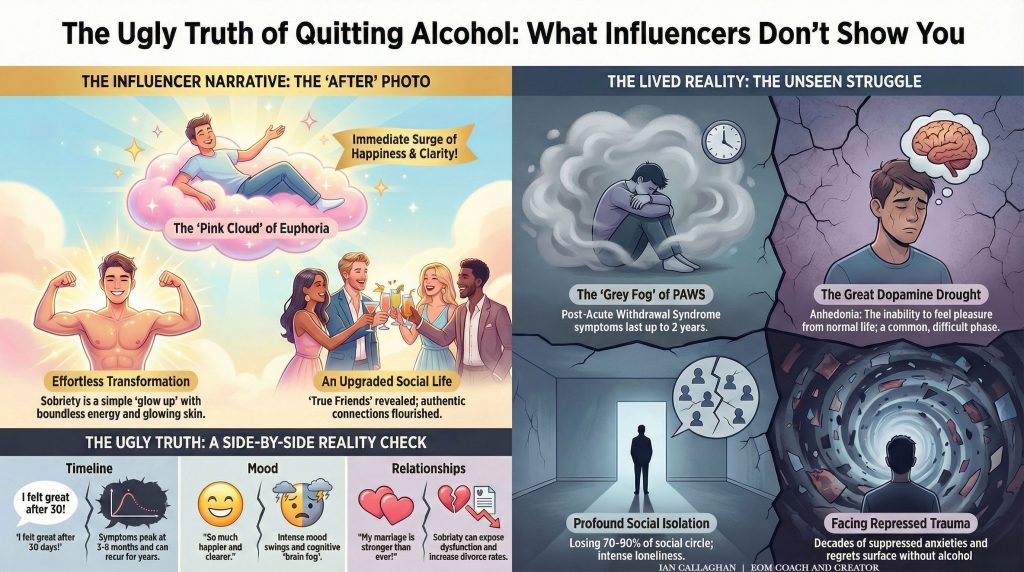
Influencers love to talk about the “Pink Cloud”—that initial surge of euphoria when you first quit. For a guy with 45 years of drinking history, the Pink Cloud was a myth.
My reality was the “Grey Fog.”
Your brain has stopped producing its own dopamine because it relied on the bottle to do it. When you take the bottle away, the factory doesn’t just start up again. It stays shut down.
For the first four months, I didn’t feel “clean.” I felt like I was wading through wet concrete. I was exhausted, yet I couldn’t sleep. My body ached in places I didn’t know I had muscles.
Post-Acute Withdrawal Syndrome (PAWS)
This is the monster in the closet. Medical data suggests that PAWS can last up to two years, depending on the severity of abuse.
The symptoms come in waves. You might feel fine on Tuesday, and by Wednesday afternoon, you are hit with dizziness, intense anxiety, and an inability to think clearly.
Common PAWS Symptoms Influencers Ignore:
- Anhedonia: The inability to feel pleasure from natural stimuli.
- Cognitive Impairment: “Brain fog” that makes simple tasks feel like quantum physics.
- Mood Swings: Rage followed by weeping within a 20-minute window.
| Feature | Influencer Narrative | The Ugly Reality (PAWS) |
|---|---|---|
| Timeline | “I felt great after 30 days!” | Symptoms peak at 3-6 months and recur for 2 years. |
| Energy | “Boundless energy for the gym.” | Chronic fatigue; napping daily just to function. |
| Cravings | “I don’t even miss it.” | Sudden, visceral urges that feel like physical hunger. |
| Mood | “So much happier.” | Flatlining emotions and intense irritability. |
The Social Amputation: Losing Your “Friends”
The ugly truth of quitting alcohol, that the influencers fail to tell you, is that you will lose 70% to 90% of your social circle within the first year. Most of your relationships were likely “drinking buddies” masquerading as friends, held together by a shared addiction rather than a genuine connection or value.
The “Boring” Label
When you drink for 45 years, you attract other drinkers. You become the life of the party. You are the guy who closes the bar.
When you stop, you become a mirror to them.
Your sobriety reflects their addiction to them, and they hate it. They won’t say, “I’m proud of you.” They will say, “You’re no fun anymore,” or “Just have one.”
I was uninvited from events. The phone stopped ringing on Friday nights. The silence was deafening.
The Loneliness of the Long-Distance Sober
This is the part that hurts the most. You realise that your social skills are atrophied.
I didn’t know how to talk to people without a drink in my hand. I felt naked. I felt awkward. I was a 60-something-year-old man who felt like a shy teenager at a school dance.
The ugly truth of quitting alcohol, that the influencers fail to tell you, is that you have to relearn human connection from scratch.
- You have to learn to sit in silence.
- You have to learn to make eye contact without liquid courage.
- You have to accept that you will be lonely before you find your new tribe.
The Friction at Home
If your partner still drinks, or if your marriage was built on “wine o’clock” venting sessions, prepare for war.
Sobriety changes the dynamic. You become clearer, sharper, and less tolerant of repetitive drunken conversations. This causes friction. The influencers show couples doing yoga together; they don’t show the arguments at 10 PM because you can’t stand the smell of Chardonnay on your spouse’s breath.
The Great Dopamine Drought (Anhedonia)
The ugly truth of quitting alcohol, that the influencers fail to tell you, is that life will feel incredibly boring and colourless for a long time. This is called Anhedonia, a biological state where your brain’s reward centre is broken and cannot process joy from sunsets, food, or sex.
The “Flatness” of Reality
I remember walking my dog three months in. It was a beautiful day. I knew intellectually it was beautiful, but I felt nothing.
It was like watching a movie on a black-and-white TV with the volume turned down.
Alcohol releases a flood of artificial dopamine. Over 45 years, I had flooded my brain so often that it burned out the receptors.
When you quit, the flood stops. But the receptors are still burned out.
The Sugar Cravings Are Not Cute
Influencers joke about eating a doughnut. They don’t explain that you will likely develop a voracious, uncontrollable addiction to sugar.
Your body converts alcohol into sugar. When you cut the alcohol, your body screams for a replacement fuel source.
I found myself eating ice cream by the tub. I was trading one addiction for another just to feel a spark of serotonin.
Data on Dopamine Recovery:
- Day 1-14: Dopamine levels drop below baseline (Misery).
- Months 1-3: Dopamine receptors begin to heal, but sensitivity is low (The “Blah” Phase).
- Months 6-12:Normalisationn begins (The light at the end of the tunnel).
This isn’t a “fun wellness journey.” It is a chemical battle for your sanity.
The Screaming Silence: Facing The Trauma
The ugly truth of quitting alcohol, that the influencers fail to tell you, is that alcohol was the glue holding your repressed trauma and anxieties down. When the alcohol evaporates, 45 years of suppressed regret, grief, and fear come rushing to the surface with zero buffer to protect you.
No Place to Hide
For decades, if I had a bad day, I drank. If I felt sad, I drank. If I were anxious about money, I drank.
Alcohol was my emotional armour. It was my mute button for the voice in my head.
Sobriety broke the mute button.
Suddenly, I had to think about every mistake I made in the last four decades. I had to face the time I wasted. I had to face the relationships I ruined.
The Insomnia of Regret
You will lie awake at night. Not just because your body is adjusting, but because your mind is finally processing the backlog of data you drowned in booze.
I replayed arguments from 1995. I felt the sting of failures from 2005.
This is the raw work. The influencers show you the “glow up.” They don’t show you the 3 AM panic attack where you realise you drank away your prime years.
You have to grieve the person you were. You have to grieve the time you lost.
Emotional Volatility
Without the sedative effects of alcohol, your emotions become raw and jagged.
I would cry at insurance commercials. I would get irrationally angry at traffic. I was a raw nerve ending walking through the world.
This vulnerability is necessary, but it is ugly. It is messy. It is not something you can put a filter on and post to a “Story.”
The Financial Reality Check
The ugly truth of quitting alcohol, that the influencers fail to tell you, is that while you save money on booze, you will spend a fortune trying to fill the void. You will impulse buy, overeat, and seek retail therapy to replace the act of purchasing alcohol.
The “Savings” Myth
Yes, I stopped buying whiskey. But I started buying gadgets I didn’t need. I started buying expensive food.
The addict brain is a hustler. It wants a hit. If it can’t get the hit from the bottle, it looks for the hit in the “Checkout” button.
It took me six months to stabilise my spending. I had to realise that I was still acting like an addict, just with a credit card instead of a tab.
END OF PART 1
The Social Desolation and The Boredom Factor
The ugly truth of quitting alcohol, that the influencers fail to tell you, is that for a significant period, you will be profoundly, achingly bored and socially isolated. While social media portrays sobriety as a series of “sober raves” and mocktail parties, reality is often Friday nights spent staring at a wall.
The “Drinking Buddy” Exodus
When you remove the alcohol, you remove the glue holding 80% of your friendships together.
You realise that you didn’t actually like these people; you just liked getting drunk with them. They didn’t like you; they liked having someone to validate their own consumption.
The ugly truth of quitting alcohol, that the influencers fail to tell you, is that you will likely lose your social circle. A 2016 study on social networks in recovery indicates that individuals who fail to change their social networks have a relapse rate up to 50% higher than those who do.
You become a mirror to your friends’ vices. Your sobriety makes them uncomfortable because it forces them to examine their own drinking.
They will stop inviting you. Or, you will go and realise that drunk people are unbearably annoying when you are sober.
The Agony of Time
Alcohol is a time travel device. It fast-forwards through the boring parts of life.
When you drink, 7:00 PM becomes 2:00 AM in the blink of an eye. When you stop, 7:00 PM to 10:00 PM feels like a decade.
You suddenly have 30 extra hours a week that used to be spent drinking or nursing a hangover. Influencers say you will fill this with yoga and side hustles.
The reality? You will likely fill it with doom-scrolling and staring at the ceiling. You have to relearn how to exist in time without hitting the “skip” button.
Social Reality vs. Influencer Myth
| Influencer Myth | The Ugly Truth of Quitting Alcohol |
|---|---|
| “You’ll discover who your real friends are!” | Holding a $15 juice while watching people slur their words is agonising, not empowering. |
| “Mocktails make you feel included!” | Holding a $15 juice while watching people slur their words is agonizing, not empowering. |
| “Sober dating is so authentic!” | Sober dating is terrifying and awkward without liquid courage to mask insecurities. |
| “People will respect your choice!” | People will constantly pressure you to have “just one” or treat you like a fragile invalid. |
The Physical Crash: Post-Acute Withdrawal Syndrome (PAWS)
The ugly truth of quitting alcohol, that the influencers fail to tell you, is that the physical recovery gets worse before it gets better due to Post-Acute Withdrawal Syndrome (PAWS). After the initial “Pink Cloud” of sobriety fades (usually around weeks 2-4), your brain enters a severe dopamine deficit that can last up to two years.
The Anhedonia Trap
Anhedonia is the inability to feel pleasure. It is a hallmark of PAWS.
For years, you flooded your brain with artificial dopamine via alcohol. Your brain responded by downregulating its natural receptors to maintain homeostasis.
When you quit, the flood stops, but your receptors are still closed for business. The ugly truth of quitting alcohol, that the influencers fail to tell you, is that a beautiful sunset, a good meal, or sex will feel like absolutely nothing for months.
You will feel “flat.” You will feel grey. This is the danger zone where relapse is most common, statistically peaking around the 90-day mark.
The Cognitive Fog
You expect clarity. Instead, you often get a brain that feels like it’s packed with cotton wool.
You might experience memory lapses. You may struggle with coordination. It can feel like early-onset dementia.
This is your nervous system attempting to recalibrate. Medical data suggests that full GABA and glutamate regulation (the chemicals responsible for calm and excitement) takes between 6 and 24 months to normalise.
Influencers post their “30-day transformation” pictures showing glowing skin. They don’t mention that their brain chemistry is currently in chaotic freefall.
Symptoms of PAWS the Influencers Ignore
- Sleep Disturbances: Insomnia or needing 12 hours of sleep and still feeling exhausted.
- Phantom Hangovers: Waking up with a headache and nausea despite not drinking.
- Stress Sensitivity: Minor inconveniences cause disproportionate meltdowns.
- Circular Thinking: Obsessive thought loops that you cannot shut off.
The Relationship Graveyard
The ugly truth of quitting alcohol, that the influencers fail to tell you, is that your romantic relationship may not survive your sobriety. Recovery changes the fundamental dynamics of a partnership, often revealing that the relationship was built on a foundation of mutual dysfunction or co-dependency.
The “Boring” Partner
If your partner still drinks, you become the “boring” one. You are the buzzkill.
You can no longer bond over a shared bottle of wine. The rituals that defined your intimacy—happy hour, winery tours, boozy brunches—are gone.
You are evolving rapidly. You are facing your demons and growing emotionally. If your partner is not doing the same, a gap widens.
The ugly truth of quitting alcohol, that the influencers fail to tell you, is the resentment you will feel watching them check out of reality while you are forced to stay present.
Unmasking the Dysfunction
Alcohol acts as a buffer. It numbs you to your partner’s annoying habits or lack of ambition.
When the buffer is gone, you see them with high-definition clarity. You may realise you aren’t actually compatible.
A 2014 study published in Alcoholism: Clinical and Experimental Research found that divorce rates increase significantly when one partner stops drinking and the other continues.
This is the silent tragedy. You get healthy, and your reward is the collapse of your marriage.
The Co-dependency Shift
Sometimes, a partner likes you drunk. A drunk partner is needy, messy, and controllable.
A sober partner has boundaries. A sober partner has agency.
When you stop drinking, you stop being the “problem” in the relationship. This forces the other person to look at their own issues, which they may not be ready to do.
The friction here is immense. It is not the “supportive spouse” narrative we see on Instagram reels. It is war in the living room.
The Existential Void and Identity Crisis
The ugly truth of quitting alcohol, that the influencers fail to tell you, is that you will face a terrifying identity crisis where you don’t know who you are without a drink in your hand. Alcohol was likely your primary hobby, your personality trait, and your coping mechanism for existing in the world.
The “Fun One” is Dead
I was the life of the party. I was the one who danced on tables. That was my identity.
When I quit, I thought I would be the same person, just sober. I was wrong.
I am actually quite introverted. I am actually quite serious. The ugly truth of quitting alcohol, that the influencers fail to tell you, is that you have to mourn the death of your “party persona.”
People will ask, “Why are you so quiet?” They are looking for the ghost of the person you used to be. You have to learn to be okay with disappointing them.
Facing the “Why”
Why did you drink in the first place?
Was it trauma? Was it anxiety? Was it a deep-seated self-hatred?
Alcohol kept those questions in the basement. Sobriety opens the door and lets the monsters upstairs.
You have to sit with yourself. Just you. No filters, no numbing agents.
This is the hardest work a human being can do. It requires therapy, journaling, and agonising introspection. It is not a 15-second TikTok trend.
The Reconstruction Project
You are left with a void where the alcohol used to be. You have to build a new human being from scratch.
This is daunting. It is exhausting. But it is the only way forward.
You have to find new things that bring you joy, which is hard when your dopamine receptors are broken. You have to find new ways to socialise. You have to find a new purpose.
Conclusion: The Gritty Reality of Redemption
The ugly truth of quitting alcohol, that the influencers fail to tell you, is that sobriety is not a hack for instant happiness; it is a brutal, bloody war for your soul. It is the dismantling of a life built on illusion and the slow, painful construction of a life built on truth.
Influencers sell you the destination because the journey doesn’t get as many likes. They sell you the “after” because the “during” is too ugly for the algorithm.
But here is the final truth, the one that matters most: The ugly truth is the only path to a beautiful life.
The boredom forces you to become interesting. The pain forces you to heal. The isolation forces you to find self-love.
Influencers often fail to disclose the challenges they face because they are selling a lifestyle. But if you are reading this, you aren’t looking for a lifestyle. You are looking for a life.
It will be the hardest thing you ever done. You will cry. You will rage. You will feel empty.
But for the first time in years, you will be real. And that is worth every second of the ugly, messy, un-instagrammable struggle.
This work is by Ian Callaghan, creator of the Emotional Observation Method (EOM) and a sobriety and mindset coach with lived experience of long-term alcohol recovery. I am not the Liverpool winger or any professional footballer. Different life, different work, different battlefield.

Rewiring The Mind: The Identity Shift That Changes Everything (Digital Manual)
Stop chasing symptoms. Fix the machine. Rewiring The Mind is not a memoir—it is a mechanic’s manual for your brain. Written by Ian Callaghan (Army Veteran, 45-year drinker), this guide combines Stoic Philosophy, Evolutionary Biology, and Nervous System Regulation to help you break the loop of anxiety, drinking, and survival mode. You don’t need more willpower. You need a new identity. (Instant PDF Download)