What Is the Emotional Observation Method? (And Why Everything Else You’ve Tried Is Theatre)
Most emotional regulation advice is theatre.
You’ve been told to take deep breaths. Journal your feelings. Reframe your negative thoughts. Replace them with positive ones. That’s the equivalent of putting a coat of paint on a cracked foundation and calling it a renovation.
The Emotional Observation Method — EOM — is the wrench. Not the paint.
It’s a framework built on a single, uncomfortable truth: your emotional reactions aren’t you. They’re a biological programme running on hardware that hasn’t been meaningfully updated in forty thousand years. Until you understand the mechanics of that programme, you’ll keep trying to manage the output without ever touching the source code.
This is the no-bullshit technical breakdown of what EOM actually is, how it works, and why it cuts through where everything else falls apart.
The Problem With Every Other Approach
Let’s be specific about what’s failing.
CBT tells you to challenge your thoughts. Mindfulness tells you to observe them without judgment. Positive psychology tells you to replace them with better ones. All of these approaches share the same fatal flaw: they’re working at the level of the story.
They’re trying to fix the narrative. They’re editing the script. And the script isn’t the problem.
The problem is the mechanism that generates the script in the first place.
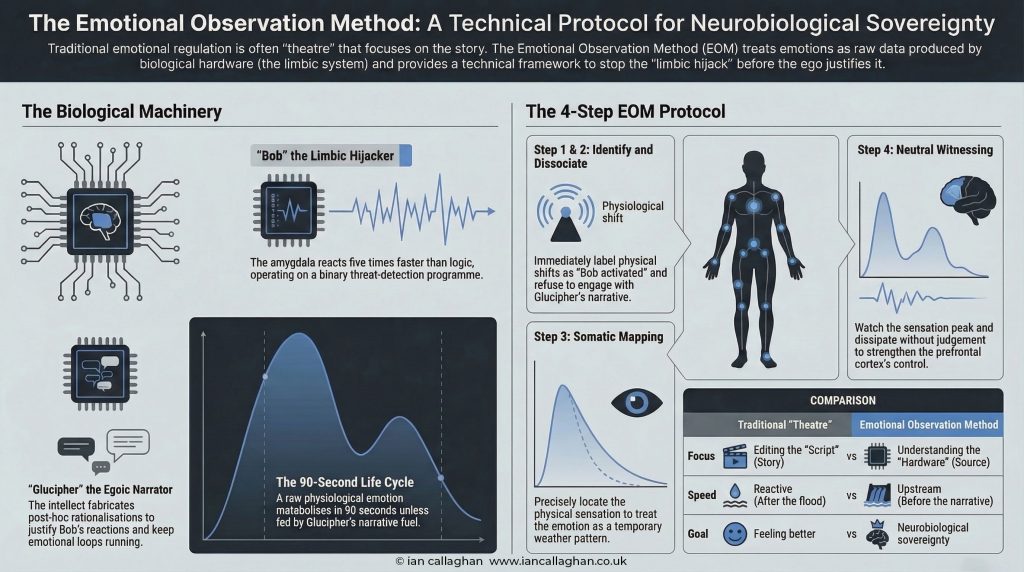
When you feel rage, anxiety, shame, or the cold hollow of despair — that emotion was triggered, processed, and delivered to your conscious mind in approximately 200 milliseconds. Your rational brain, the part that does CBT exercises and writes in a gratitude journal, didn’t get a look-in. By the time you’re aware of the feeling, the biological event is already over. You’re just living in the aftermath.
Trying to reframe an emotion you’re already submerged in is like trying to redirect a flood using a strongly worded letter. The EOM doesn’t write letters. It works upstream.
Meet Bob. He’s Running Your Life.
At the centre of the EOM framework is a character called Bob the Chimp.
Bob isn’t a metaphor for bad behaviour. Bob is the technical reality of your limbic system — specifically your amygdala and the surrounding neural circuitry that evolved to keep you alive in an environment full of predators and resource scarcity. Bob is five times faster than your rational mind. He is paranoid by design. He operates on a binary: threat or no threat. Fight, flight, or freeze.
Bob does not care about your career, your relationships, or the fact that the person who cut you off in traffic is a stranger you’ll never see again. Bob sees a threat, Bob reacts. That’s the entire programme.
When you feel a surge of irrational anger, a wave of social anxiety, or the impulse to blow up a conversation you know you should handle calmly — that’s Bob. Not you. Bob.
The first move at EOM is the most important: stop saying ‘I am angry’ and start saying ‘Bob is reacting.’
That shift is not semantic wordplay. It creates a microscopic gap in the neural firing sequence — a fraction of a second between stimulus and response. That gap is where your actual agency lives. Without it, you’re not making decisions. Bob is making them, and you’re signing off on the paperwork afterwards.
Glucipher: The Voice That Sounds Like You
Bob reacts. Then Glucipher goes to work.
Glucipher is the egoic intellect’s damage control department. The moment Bob fires off a reaction, Glucipher begins constructing a narrative to justify it. He uses your vocabulary, your memories, your most convincing internal voice, and he builds a story that sounds completely reasonable — a story in which your reaction was entirely justified, the other person is demonstrably awful, and your emotional suffering is thoroughly deserved.
Glucipher is the reason you can spend three hours replaying a five-minute argument. He’s the reason a passing comment from a colleague can ruin an entire day. He’s the reason you tell yourself you’re fine with something you’re absolutely not fine with, until your body makes the truth impossible to ignore.
The EOM identifies Glucipher as the primary obstacle to clarity — not the emotion itself. The emotion passes in ninety seconds if you let it. Glucipher keeps it running indefinitely.
The key insight here is brutal in its simplicity: the reasons you give for your emotional state are almost always fabricated. They are post-hoc rationalisations constructed to protect the ego. They are not the truth of the situation. They are Glucipher’s truth, which serves only one purpose — keeping you trapped in the loop.
The EOM doesn’t engage with the narrative. It doesn’t debate Glucipher. It doesn’t try to construct a better story. It ignores the story entirely and focuses on the raw data underneath.
What the Emotional Observation Method Actually Does
EOM is a four-step internal protocol. It’s not passive. It’s not relaxing. It’s active and demanding, and it requires a level of intellectual honesty that most people find genuinely uncomfortable at first.
Step 1: Immediate Identification
The moment you notice a physiological shift — tightening in the chest, heat rising in the face, a sudden change in internal tone — you categorise it immediately. Not ‘why do I feel this?’ Just: ‘Physical sensation detected. Bob is activated.’
This single act halts the slide into the Glucipher narrative before it builds momentum. You’re not processing the emotion. You’re clocking its presence.
Step 2: Narrative Dissociation
The thoughts will come. The justifications, the replays, the blame, the ‘he said, she said.’ You label them — out loud if necessary — as Glucipher. ‘This is a Glucipher loop. This is cognitive fuel being burned on a fire I’m choosing not to feed.’
You don’t argue with the thoughts. You don’t try to replace them. You refuse to engage with the content. You’re not thinking — you’re observing the brain’s attempt to think.
Step 3: Somatic Mapping
Where is the emotion physically located? Is it a constriction in the throat? A knot below the sternum? A tension across the shoulders? You focus precisely on the physical location and quality of the sensation.
This grounds you in the present moment and treats the emotion as what it actually is: a weather pattern moving through a geographic location. A temporary state of the hardware. Not a permanent feature of the software.
Step 4: Neutral Witnessing
You watch without judgment. You don’t judge Bob for being triggered. You don’t judge yourself for having a Glucipher loop. Judgement is just another layer of Glucipher.
You observe the sensation peak. You observe it dissipate. Ninety seconds, if you don’t feed it. The cortisol metabolises. The physiological event ends. You remain.
Why This Works When Everything Else Doesn’t
The reason positive thinking fails isn’t that it’s too optimistic. It’s that it’s a lie Bob can see through instantly.
Bob doesn’t respond to the narrative. Bob responds to the threat assessment. If the threat assessment system is screaming, telling yourself ‘everything is fine’ doesn’t change the threat assessment. It just adds a layer of cognitive dissonance on top of an already activated nervous system.
The EOM doesn’t lie to Bob. It acknowledges the activation and refuses to amplify it. There’s a critical difference between the two.
A child tries to wish a storm away. A meteorologist measures the wind speed. The meteorologist is in considerably less danger.
Over time — and this is the part that most people dismiss because they want the shortcut — the consistent practice of EOM creates measurable neurological change. Every time you observe a Bob activation without reacting, you weaken the synaptic pathway of the limbic hijack. You strengthen the inhibitory fibres of the prefrontal cortex. The gap between stimulus and response widens. You begin to have actual choices about how you respond, rather than experiencing the illusion of choice while Bob has already decided.
Who the EOM Is For
This is not a framework for people who want to feel better about their emotional problems.
It’s a framework for people who are exhausted by the cycle. The high-performer who can’t afford a three-day emotional hangover because someone said something disrespectful in a meeting. The man in midlife who’s realised that the same patterns have been running his relationships, his drinking, and his decision-making for twenty years, and nobody has given him a technical explanation for why. The person who’s tried therapy, mindfulness, and an app, and still ends up in the same place.
EOM is for the individual who wants to understand the mechanism, not just manage the symptoms.
It is cold. It is technical. It requires a willingness to look at your internal world with a level of detachment that many people find uncomfortable — because what you find when you look clearly is that most of your suffering is self-generated, self-sustaining, and entirely optional once you understand the machinery producing it.
That is not a comfortable realisation. It is, however, a useful one.
The EOM Protocol — Technical Summary
Primary directive: Shift from subjective experience to objective observation.
The Bob variable: Identify limbic activation as a separate, primitive entity. Name it. Do not become it.
The Glucipher variable: Identify the egoic narrative and refuse to engage with its content. It is cognitive fuel being burned on a fiction.
The method: Somatic mapping and the creation of a witnessing gap between stimulus and response.
The objective: Neurobiological sovereignty — the consistent application of inhibitory control until the prefrontal cortex reclaims the cockpit.
What’s Next
The EOM is the foundation of everything I teach. It’s the mechanism underneath the sobriety work, the performance work, the midlife reset — all of it. You cannot change a pattern you haven’t observed. You cannot clearly observe anything while Bob has the wheel and Glucipher is narrating.
If you want to go deeper, the full Emotional Observation Method manual, the four-step protocol in detail, and the practical implementation framework are available at iancallaghan.co.uk.
Or join the free Skool community where I work through this in real time with the people who are actually doing the work.
Either way: stop managing the symptoms. Start understanding the machine.
Emotional Mastery: The Emotional Operating System
The Emotional Mastery book is a practical manual for understanding and regulating the human nervous system using the Emotional Operating System framework.
Instead of analysing emotions or retelling your past, the Emotional Mastery book teaches you how to read emotional states as system feedback, identify overload, and restore stability under pressure.
No labels. No therapy-speak. No endless healing loops.
Just a clear, operational approach to emotional regulation that actually holds when life applies load.
Instant digital download.