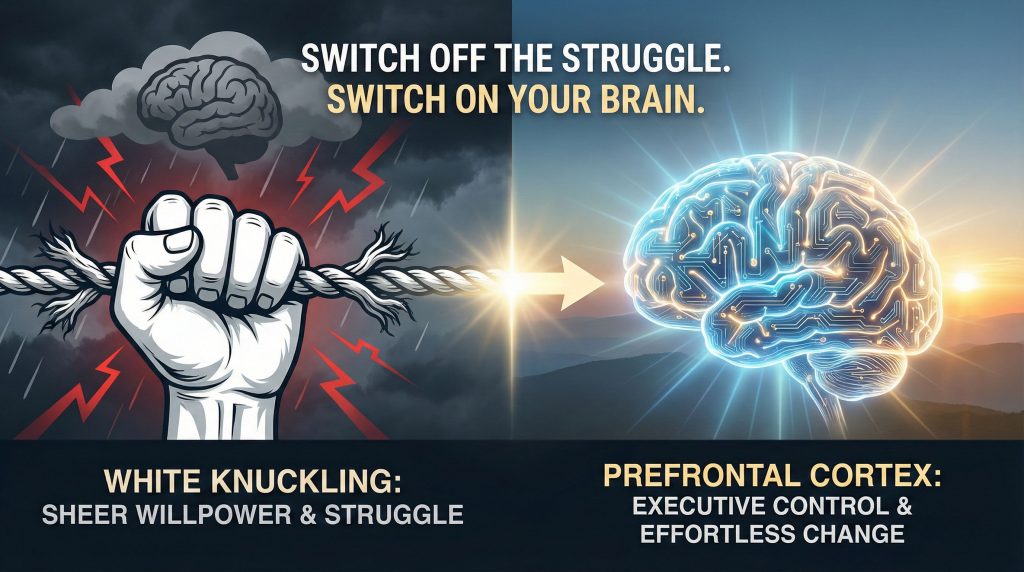
White Knuckling vs. Prefrontal Cortex. The sensation is visceral and familiar to anyone who has ever tried to break a compulsive habit, stay sober, or stick to a rigid diet plan. Your muscles tense involuntarily, your jaw clenches tight enough to crack a tooth, and you force yourself to say “no” through sheer, grinding grit. You are holding on for dear life.
This is white knuckling.
In the short term, white knuckling can be effective. It might get you through a difficult dinner party or a stressful hour at work. However, as a long-term strategy for life, it is biologically unsustainable. Relying on it is akin to trying to run a marathon by holding your breath; eventually, the system fails, and you gasp for air—or in this case, relapse.
The sustainable alternative lies in the evolutionarily advanced front section of your brain. The Prefrontal Cortex (PFC) is the CEO of your neurological functioning. It handles long-term planning, impulse control, consequences, and emotional regulation.
When we analyse the battle of White Knuckling vs. Prefrontal Cortex, we are essentially comparing a finite resource (willpower/adrenaline) against a trainable, renewable skill (executive function).
Here is the definitive, expanded list of 15 strategies to stop the exhausting internal fight and start rewiring your brain for effortless, executive control.
1. Understand and Label the “Amygdala Hijack”
To win the high-stakes battle of White Knuckling vs. Prefrontal Cortex, you must first identify the adversary. White knuckling is almost always a desperate response to the amygdala taking over the driver’s seat of your brain.
The amygdala is the primal “lizard brain” or “fire alarm” responsible for the fight-flight-freeze response. It is ancient, fast, and not very smart. When a craving hits—whether for alcohol, sugar, or a toxic behaviour—the amygdala screams that you need this dopamine release for survival. It creates a state of “tunnel vision” where nothing else matters.
The Biological Conflict:
- The White Knuckling Response: You try to shout down the amygdala with force. You mentally scream “NO!” back at it. This internal shouting match creates immense stress, spikes your heart rate, and floods your system with cortisol. You are fighting a biological alarm system with brute force.
- The PFC Approach: You engage the “brake pedal” of the brain. You recognise the signal for what it is: a biological error, not a command from God.
Actionable Step: Use the technique of “Affect Labelling.” When the urge arises, say out loud or write down: “This is just my amygdala misfiring. I am experiencing a dopamine craving, not a survival need.”
Neuroscience studies suggest that the simple act of putting a feeling into words moves brain activity from the emotional centre (amygdala) to the thinking centre (right ventrolateral prefrontal cortex). By naming the monster, you shrink it.
2. Accept That Willpower is a Battery, Not a Trait
In the UK and many Western cultures, we prize the “stiff upper lip.” We erroneously view willpower as a fixed character trait—something you either possess in abundance or lack entirely. This leads to the belief that if you fail, you are morally “weak.”
Neuroscience disagrees entirely. The concept of “Ego Depletion,” proposed by researcher Roy Baumeister, suggests that willpower is a limited metabolic resource, much like a battery on your smartphone.
Why White Knuckling Fails: White knuckling is an energy-intensive process. Every time you resist an urge through force, you drain the battery. By the evening, after a stressful day of making decisions at work, navigating traffic, and managing emotions, your “battery” is flat. This explains why the vast majority of dietary slips and relapses happen between 6:00 PM and 10:00 PM. The PFC is simply too tired to fight.
The PFC Shift: Instead of relying on a fully charged battery, rely on system design. The prefrontal cortex excels at designing environments where high willpower isn’t required.
- Remove cues entirely: If you are quitting sugar, do not have biscuits in the house “for guests.” If you are quitting drinking, do not keep a “special occasion” bottle.
- Automate decisions: Meal prep on Sundays so you don’t have to choose dinner when you are exhausted on Tuesday.
- Pre-commitment: Lock your credit card or use app blockers before the urge strikes.
3. Master the Mindfulness Art of “Urge Surfing”
White knuckling attempts to stop a tidal wave by standing rigidly in front of it. You brace yourself, you tense up, and you take the hit. Inevitably, the ocean wins, and you are knocked over.
Urge surfing is a mindfulness technique that engages the prefrontal cortex to observe the wave without being crushed by it. It changes your relationship with the craving from a “participant” to an “observer.”
The Wave Metaphor: Cravings behave like waves. They start small, build in intensity, crest at a peak (where the discomfort is highest), and then inevitably break and dissipate.
How to Surf:
- Observe: Close your eyes and scan your body. Where do you feel the craving? Is it a tightness in the chest? A dryness in the mouth? A jitter in the hands?
- Non-Judgment: Do not fight the sensation. Do not say “I hate this.” Just watch it, like a scientist observing an experiment.
- Wait: Most cravings peak within 15 to 20 minutes. If you can surf the wave for that duration without acting, the neurochemistry shifts, and the urge subsides.
By observing rather than fighting, you keep the PFC online. You are the captain of the ship watching the storm, not the sailor drowning in it.
4. The “Pause and Plan” Response
Stanford health psychologist Kelly McGonigal discusses the “Pause and Plan” response as the physiological opposite of “Fight or Flight.”
When you white knuckle, your body mimics a stress response. Your heart rate skyrockets, your digestion slows, and your muscles tense. This physiological state literally shuts down blood flow to the PFC to focus resources on immediate physical survival (running or fighting).
Engaging the PFC: To get the “CEO” back in the office, you need to physically slow down your body’s biology. You cannot think your way out of a stress response; you must act your way out of it.
The Technique:
- Stop what you are doing immediately.
- Take five deep, slow breaths.
- Crucial Detail: Extend the exhale longer than the inhale (e.g., inhale for 4 seconds, exhale for 8 seconds).
This breathing pattern stimulates the vagus nerve, which activates the parasympathetic nervous system (rest and digest). It sends a biochemical signal to your brain that you are safe. Once the alarm bells stop ringing, the prefrontal cortex can come back online to make rational decisions.
5. Address Decision Fatigue Aggressively
The prefrontal cortex is easily exhausted by the act of making choices. Every decision you make—from “what shirt do I wear?” to “which email do I answer first?”—chips away at its efficiency.
The White Knuckling Trap: If you leave your recovery or habit change up to in-the-moment choices, you are setting yourself up for a white-knuckling disaster. If you have to ask yourself, “Should I go to the gym?” or “Should I have a drink?” in the moment, you are taxing an already tired brain.
Optimisation Strategy: Reduce the cognitive load by making fewer decisions. This is why people like Steve Jobs or Barack Obama wore the same clothes every day.
- Standardise routines: Eat the same healthy breakfast every single day.
- Fixed routes: Have a non-negotiable route home that avoids your favourite pub or bakery.
- The “If-Then” Plan: create rules in advance. “If it is 6:00 PM, then I put on my running shoes.”
By conserving decision-making energy on trivial things, you reserve your PFC’s strength for the moments that truly matter.
6. Strict Glucose Regulation and Nutrition
The brain is an energy-hungry organ, consuming about 20% of your daily calories despite being only 2% of your body weight. The prefrontal cortex, specifically, is highly sensitive to glucose fluctuations.
When your blood sugar drops, your executive function is the first thing to go offline. Evolutionarily, when you are starving, you don’t need to ponder philosophy; you need to hunt. Your brain reverts to primal impulses. This is the science behind being “hangry” (hungry + angry).
White Knuckling vs. Biology: You cannot willpower your way out of low blood sugar. If you skip lunch, by 4:00 PM your brain will be screaming for quick energy. This usually manifests as cravings for sugar, refined carbs, or alcohol (which is essentially liquid sugar).
The Fix:
- Steady Fuel: Eat regular, complex carbohydrates and proteins every 3-4 hours.
- Avoid Spikes: Do not start the day with sugary cereal. It causes an insulin spike followed by a crash, leaving your PFC vulnerable by mid-morning.
- Omega-3s: Supplement with high-quality fish oil to support the structural integrity of the brain’s grey matter.
7. The Power of Cognitive Reframing
White knuckling is rooted in a sense of deprivation. You tell yourself, “I really want this, but I am not allowed to have it.” This creates a psychological tension that requires constant energy to maintain.
The PFC Approach: Reframing uses the logic centre of the brain to change the narrative so that willpower isn’t even needed. You move from a “have to” mindset to a “get to” mindset.
Examples:
- White Knuckling Narrative: “I can’t drink a pint tonight because I’m an alcoholic and it ruins my life.” (Feels like punishment/prison).
- PFC Logic: “I don’t drink because I love waking up with a clear head and boundless energy.” (Feels like a strategic choice/freedom).
- Dieting Example: Change “I can’t eat that pizza” to “I am choosing to fuel my body with nutrients that make me feel strong.”
When you view the behaviour as a positive, empowered choice rather than a restricted jail sentence, the conflict in the brain dissolves.
8. Prioritise Sleep Hygiene as a Medical Necessity
Sleep deprivation is catastrophic for the prefrontal cortex. Studies using fMRI scans show that a sleep-deprived brain looks remarkably similar to an intoxicated brain.
When you are tired, the functional connectivity between the amygdala (impulses) and the PFC (control) is severed. The amygdala runs wild, and the PFC is too sluggish to stop it.
The Vicious Cycle: You stay up late scrolling, you get tired, your PFC weakens, you engage in bad habits (night snacking/drinking), you sleep poorly, and the cycle repeats.
The Strategy: Treat sleep as the foundation of your recovery, not a luxury.
- The Glymphatic System: During deep sleep, your brain literally washes itself of toxins. Without this wash, executive function is impaired.
- Environment: Keep the room dark to promote melatonin. The ideal temperature for UK sleepers is around 18 degrees Celsius.
- Digital Sunset: No screens 60 minutes before bed. Blue light suppresses the hormones needed for deep, restorative sleep.
9. Visualisation and “Future Pull” (Episodic Foresight)
The amygdala lives entirely in the “now.” It wants immediate gratification and cannot comprehend consequences three hours from now, let alone three years from now.
The prefrontal cortex is the only part of the brain capable of Episodic Foresight—the ability to travel through time mentally.
Using the PFC: When an urge hits, do not just look at the drink, the cigarette, or the cake. Force your brain to “play the tape forward” in high definition.
- Step 1: Visualise the momentary pleasure.
- Step 2: Visualise 20 minutes later (the craving for more).
- Step 3: Visualise the next morning (the headache, the shame, the regret, the restart).
By actively visualising the negative future consequences, you empower the PFC to override the immediate impulse. You are using higher-order thinking to defeat primal urging.
10. Reduce Cortisol (Stress Management)
Stress is the arch-nemesis of the prefrontal cortex. High levels of cortisol (the stress hormone) are neurotoxic to the PFC. Chronic stress can literally shrink the neurons in this area of the brain, reducing your capacity for self-control over time.
White Knuckling is Stressful: The irony is that trying to force yourself to stop a behaviour is, in itself, a massive stressor. It creates a feedback loop of anxiety (“Will I relapse? I must not relapse!”), which raises cortisol, which weakens the PFC, which makes relapse more likely.
The Antidote: You must incorporate active stress reduction that is not your addiction or bad habit.
- Nature Immersion: Even 20 minutes in a green space lowers cortisol levels significantly.
- Meditation: Consistent meditation increases grey matter density in the PFC.
- Reading: Lowers heart rate and engages the imagination, pulling you out of the “fight or flight” loop.
Lower stress levels mean the “CEO” of your brain can stay at their desk and manage the company effectively.
11. Leverage Neuroplasticity
One of the most hopeful aspects of the White Knuckling vs. Prefrontal Cortex debate is the reality of neuroplasticity—the brain’s ability to change its physical structure based on behaviour.
White knuckling assumes you are fighting a permanent, unchanging urge. The science suggests otherwise.
Rewiring the Brain: Every time you successfully navigate an urge using PFC strategies (like urge surfing or pausing), you strengthen that neural pathway. It is like hacking a path through a dense jungle. The first time is exhausting. The second time is easier. By the hundredth time, it is a paved road.
- Hebbian Learning: “Neurons that fire together, wire together.”
- The Result: What requires massive effort today will require almost zero effort in six months. Eventually, the healthy choice becomes the automatic choice. You transition from conscious competence to unconscious competence.
12. Connect with Community (The Oxytocin Effect)
Addiction and bad habits thrive in isolation. White knuckling is often a lonely, solitary battle waged inside one’s own head.
The prefrontal cortex functions significantly better when we feel socially connected and safe. Positive social interaction releases Oxytocin, often called the “cuddle hormone” or “bonding hormone.”
The Chemistry of Connection: Oxytocin has a powerful dampening effect on the amygdala. It lowers fear, anxiety, and the sense of threat.
Action Plan:
- Join a Tribe: Engage with a recovery group (AA, SMART Recovery), a running club, or a hobby group.
- Reach Out: Call a friend or mentor specifically when an urge hits.
- Honesty: Be honest about your struggle. Shame thrives in secrecy; sunlight kills it.
When you share the burden, you biologically upgrade your brain’s ability to cope. You are effectively outsourcing some of the executive function to the group until yours is strong enough to handle it alone.
13. High-Intensity Exercise (BDNF Release)
If you feel the need to white knuckle, you likely have excess energy in the system—specifically adrenaline and agitation.
Exercise is a direct, physiological intervention. Specifically, aerobic exercise releases Brain-Derived Neurotrophic Factor (BDNF).
Why it Matters: BDNF acts like “Miracle-Gro” fertiliser for the brain. It supports the growth of new neurons in the prefrontal cortex and the hippocampus, repairing damage done by stress or substance abuse.
The Swap: Instead of sitting on the sofa fighting the urge (white knuckling), change your state immediately.
- Sprint up a hill.
- Do 50 burpees.
- Take a cold shower.
These activities burn off the adrenaline, release endorphins (natural painkillers), and flood the brain with BDNF, strengthening the PFC for the long term.
14. Practice Radical Self-Compassion
This sounds soft, but it is hard science. Shame shuts down the learning centres of the brain.
When you relapse or slip up, the white-knuckling approach is usually self-flagellation. “I am weak,” “I am useless,” or “Why can’t I just stop?”
The Neuroscience of Shame: Shame triggers the threat defence system (amygdala). It spikes cortisol. It makes you feel bad, and when you feel bad, your brain screams for its favourite coping mechanism (the bad habit). This is known as the “What-the-Hell Effect.”
The PFC Approach: Self-compassion (“I slipped up, I’m human, let’s analyse why this happened”) keeps the prefrontal cortex online. It allows for analysis and planning.
- The Shift: Instead of beating yourself up, ask: “What was the trigger? Was I hungry? Was I tired? How can I prevent this next time?” This is a strategic, executive question, not an emotional one.
15. Seek Professional Cognitive Training (CBT)
Sometimes, the battle of White Knuckling vs. Prefrontal Cortex requires a professional coach.
Cognitive Behavioural Therapy (CBT) is essentially a training course for your prefrontal cortex. It is not just “talking about feelings”; it is a structured method for rewiring thought patterns.
What CBT Does:
- Metacognition: It teaches you to think about your thinking.
- Identification: It helps you spot “Automatic Negative Thoughts” (ANTs) that trigger urges.
- Challenge: It uses logic to dismantle the lies the amygdala tells you (e.g., “I need a drink to be funny”).
Therapy helps you build the scaffolding required to support your PFC while it strengthens. It moves you away from “hoping” you can resist to having a structured architectural plan for your life.
The Comparison: A Summary
To truly grasp the difference, let’s look at a direct side-by-side comparison of the two modalities.
The White Knuckling Approach
- Primary Driver: Fear, Shame, and Desperation.
- Brain Region: Amygdala and Limbic System (reactionary/survival).
- Metaphor: Holding a beach ball underwater.
- Sustainability: Extremely Low. Works for minutes or hours, rarely days.
- Feeling: Tense, anxious, deprived, physically exhausted, isolated.
- Outcome: Usually leads to “willpower fatigue,” burnout, and eventual relapse (often with a binge).
The Prefrontal Cortex Approach
- Primary Driver: Values, Logic, and Vision.
- Brain Region: Prefrontal Cortex (Executive Function/CEO).
- Metaphor: Learning to surf the waves.
- Sustainability: High. Builds stronger neural pathways over time.
- Feeling: Empowered, calm, observant, strategic, connected.
- Outcome: Leads to neuroplasticity, reduced cravings, and permanent, effortless habit change.
Conclusion: Drop the Struggle, Engage the Strategy
The battle of White Knuckling vs. Prefrontal Cortex is not a battle of character, morals, or spiritual fortitude. It is, at its core, a battle of biology.
For too long, society has told us that if we cannot resist a temptation, we are simply weak. We are told to “try harder.” The reality is that we have been using the wrong tool for the job. We have been trying to use a finite, exhaustible resource—willpower—to solve a complex, chronic neurological problem.
White knuckling is an act of war against yourself. Engaging the prefrontal cortex is an act of management and leadership.
Your Path Forward: Do not try to implement all 15 strategies tomorrow. That would be a decision-fatigue nightmare. Start small. Pick three strategies from this list that resonate with you.
- Perhaps you focus on sleep hygiene to ensure your hardware is working.
- You practice urge surfing to change your software response.
- You ensure you eat protein-rich food to keep the battery charged.
By treating your brain with respect and understanding its mechanics, you can stop fighting yourself. You can lay down your weapons. You can stop clenching your fists until they turn white.
Recovery and growth do not have to be a war. When you engage the prefrontal cortex, it becomes a strategic, intelligent evolution toward the person you truly want to be. The struggle is optional; the strategy is essential.
Get The Manual That Details How I Rewired My Mind

Rewiring The Mind: The Identity Shift That Changes Everything (Digital Manual)
Stop chasing symptoms. Fix the machine. Rewiring The Mind is not a memoir—it is a mechanic’s manual for your brain. Written by Ian Callaghan (Army Veteran, 45-year drinker), this guide combines Stoic Philosophy, Evolutionary Biology, and Nervous System Regulation to help you break the loop of anxiety, drinking, and survival mode. You don’t need more willpower. You need a new identity. (Instant PDF Download)