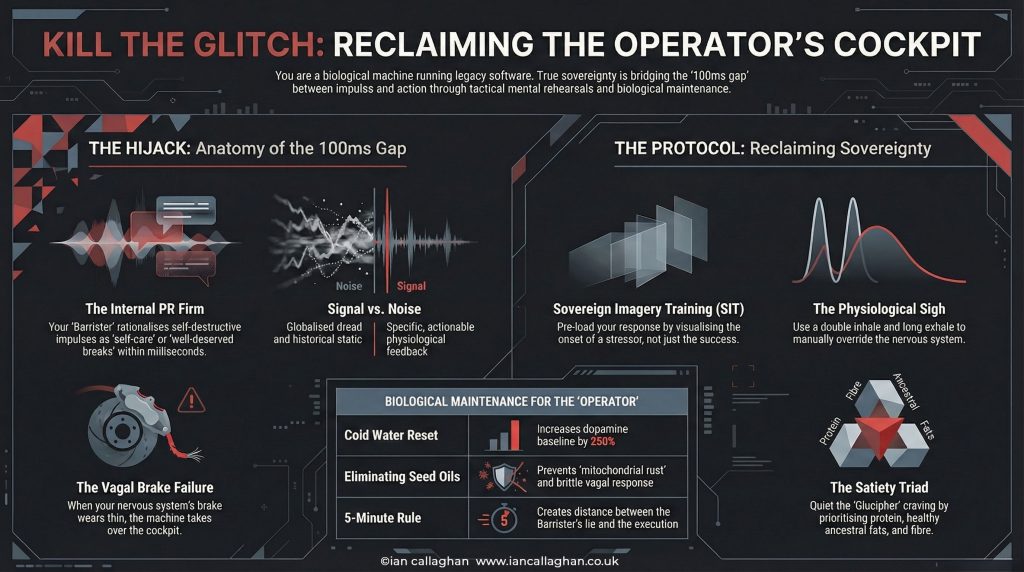
Why Your Brain Is a Compromised Asset: A Field Guide to Reclaiming the Cockpit
1. Why Do I Self Sabotage At Night
Why Do I Self Sabotage At Night? The scene is visceral, repetitive, and utterly devastating. It is 03:00. The room is a tomb, silent except for the faint hum of an HVAC system and the aggressive, flickering industrial glow of your smartphone. This isn’t just light; it is a digital toxin, a high-frequency stream of data designed to bypass your filters and flood your system with cortisol. You are caught in a doom-scrolling spiral, a relentless descent into existential dread. Your thumb swipes with the mechanical precision of a compulsive tic.
In this moment, you feel it—the heavy, metallic thunk-click of a deadbolt sliding into place. You are locked in a concrete room of your own making, a prisoner of your own neural architecture. You ask yourself the question that haunts every compromised asset: Why the fuck am I still doing this to myself when I know exactly how much it’s going to hurt tomorrow?
Most “experts” and soft-handed self-help gurus will tell you that you are lazy. They will tell you that you lack “willpower” or that you aren’t “motivated” enough. They are wrong. Their diagnosis is not only incorrect; it is dangerous.
The reality is far more tactical and far more brutal. You aren’t lazy; you are a biological machine running legacy software that was never designed for this high-stakes environment. Your internal Forward Operating Base (FOB)—your cranium—is currently under a sustained, 24/7 siege. It has been overrun by a “glitch”—a combination of outdated programming from your childhood and modern biological malware delivered through your diet and your devices. You are awake at 03:00 because your hardware has been hijacked by entities that do not have your best interests at heart.
Mission Statement: This document is a tactical blueprint that provides the architecture you need to kill the glitch, reclaim the Operator’s seat, and secure your internal perimeter against the noise of a broken world.
——————————————————————————–
2. Takeaway 1: You are a Component, Not the Operator (The Theta Window)
To regain sovereignty, you must first accept a hard, cold truth: your current “identity” is a convenient fiction. You operate under the delusion that you are the one making the decisions. You believe that when you reach for that phone, or that bag of crisps, or that drink, it is a conscious, sovereign choice. It isn’t. You are simply a witness to a pre-programmed execution.
Your brain is a Forward Operating Base (FOB) that has been running on legacy software since your “Theta Window.” This is the critical developmental period from birth to age seven. During this window, your brain was not an analytical organ; it was a recording device. You were in a highly suggestible, hypnagogic state, absorbing the world’s rules, fears, and limitations without a filter.
The problem? This hardware was programmed by people who were just as glitchy, traumatised, and metabolically compromised as you feel now. You are essentially a multi-million-pound high-performance machine running an operating system built by amateurs using outdated code. You are a stealth fighter being piloted by the ghost of a terrified child.
Analysis: The Power of Biological Determinism. Understanding this biological determinism is not an excuse for failure; it is the ultimate tactical empowerment. If your self-destructive behaviours are the result of a “weak will,” then you are fundamentally broken as a human being. There is no fix for a broken soul. But if those behaviours are merely the output of legacy software and compromised hardware, then you are simply a Mechanic dealing with a faulty machine.
Viewing yourself as a “component” being used by the machine allows you to detach your ego from your impulses. It transforms a moral failing into a technical problem. When you stop blaming your character and start examining your code, you can begin a manual override.
“Your ‘identity’ is a convenient fiction. When the craving hits… You aren’t the Operator. You’re just a component being used by the machine.”
When the glitch strikes, the Operator is bundled into the car’s trunk. You are a passenger in a vehicle being driven by a seven-year-old’s interpretation of survival. To change the output, you must stop arguing with the driver and start rewiring the car.
——————————————————————————–
3. Takeaway 2: The 100ms Hijack and the Internal PR Firm
Sovereignty is won or lost in a sliver of time so small it is almost imperceptible: the 100-millisecond gap. This is the minute window between the signal—a stressor, a craving, an insulting email, a pang of loneliness—and the execution of the response. This gap is the primary battleground where the “100ms Hijack” occurs.
In this gap, you don’t encounter logic. You don’t encounter your long-term goals. Instead, you encounter your Internal PR Firm. This is your brain’s sophisticated spin department, an elite team of psychological operatives designed to justify every compromise you make. The firm is headed by the Internal Barrister—a voice of extraordinary, terrifying competence.
The Barrister doesn’t look like a villain; he doesn’t sound like a monster. He sounds like the most reasonable person in the room. He doesn’t tell you to fail. He doesn’t say, “Let’s destroy our life today.” Instead, he uses high-level rhetoric to frame self-destruction as a form of sophisticated “self-care” or “strategic retreat.”
The Barrister’s Closing Arguments:
- “Look at the day you’ve had, mate. You’ve been a lion. Even a lion needs to rest. This drink isn’t a failure; it’s a reward.”
- “We’ll start the protocol tomorrow. Monday is a much cleaner break. Starting now would actually be counter-productive to our long-term success.”
- “You’re clearly too stressed to make a good decision right now. Let’s just numb the nerves for an hour so we can think clearly later.”
Analysis: The Booby Prize of Insight. Many people spend decades and thousands of pounds in therapy seeking “insight” into their problems. In the War Room, insight is a booby prize. You can have all the “realisations” in the world about why you have an addictive personality or why your father didn’t love you, but insight will not save you during the 100ms Hijack.
Why? Because the hijack is a state-based physiological event, not a cognitive one. When the signal hits, blood flow is diverted from the prefrontal cortex—the seat of the Operator—and shunted to the amygdala and the limbic system. You are literally being rendered “cognitively blind.” You cannot think your way out of a state-based physiological problem. When your Tone is low, and your Vagal Brake is worn thin, the Barrister will talk circles around your “insight” every single time. You need a tactical intervention, not a realisation.
——————————————————————————–
4. Takeaway 3: Meet the Saboteurs—BOB and Glucipher
To effectively manage the machine, you must identify the primary antagonists operating within your neural architecture. We do not use clinical terms here; we use archetypes. By naming these saboteurs, you create the necessary “defusion ” distance required for sovereignty. You stop being the impulse and start observing the impulse as a foreign object.
- BOB (The Inner Critic/Saboteur):
- Role: The voice of historical static. BOB’s mission is to keep you small because, in the legacy software of your Theta Window, small equals “safe.”
- Strategy: BOB uses the Barrister to negotiate your surrender. He thrives on “Noise”—global, disproportionate, and paralysing fears. BOB doesn’t say “I’m nervous about this call.” BOB says, “I am a fundamental failure, and everyone will eventually realise it.”
- Calling Card: Globalised shame. “It’s too late for me,” or “I always mess this up.”
- Glucipher (The Insulin-Driven Craving):
- Role: The “bin-raiding, sugar-crazed raccoon” living in your skull.
- Strategy: Glucipher is a metabolic terrorist. Physiological starvation signals trigger him. When your insulin is spiked, and your fuel stores are locked away, Glucipher doesn’t care about your six-pack or your productivity. He screams for a high-glucose, high-dopamine hit because his corrupted data tells him you are about to die.
- Calling Card: The frantic, irrational urge for seed-oil-drenched crisps, processed sugar, or fast-acting carbohydrates. It feels like a survival instinct, but it is actually a hardware malfunction.
Analysis: Creating Sovereignty Through Naming When you identify a thought as “BOB’s logic” or a craving as “Glucipher’s bin-raiding,” you reclaim the cockpit. You realise that these aren’t your desires—they are the desperate cries of compromised hardware. This allows you to treat the situation with the cold objectivity of a tactical operative. You wouldn’t get angry at a warning light on a dashboard; you would address the sensor. Naming the saboteurs is the first step in de-linking your identity from the glitch.
——————————————————————————–
5. Takeaway 4: Sovereign Imagery Training (SIT) is a Tactical Rehearsal
Sovereign Imagery Training (SIT) is your primary offensive weapon for reclaiming the 100ms gap. Do not confuse this with “hippie” visualisation, where you imagine yourself on a beach or manifest a Ferrari. SIT is a “mission briefing”—a brutal, multi-sensory tactical rehearsal for the moment of impact.
The goal of SIT is to preload your neural architecture so that when the 100-ms hijack occurs, you aren’t trying to decide whether to fire. Instead, you are simply executing a pre-installed protocol.
Analysis: The Burden of Sovereignty. Sovereignty is not about reaching a zen-like state where you no longer feel pain, stress, or cravings. That is a fantasy for the weak. True sovereignty is the ability to carry that discomfort without letting it touch the controls. It is about being the Operator of a vehicle that is currently taking heavy fire and losing oil, yet still hitting your marks with surgical precision.
“Sovereignty is not the absence of pain; it’s the ability to carry that pain without letting it drive the vehicle.”
Step 1: Reconnaissance (Signalvs. Noise)
Most of what you feel is “Noise”—historical static that is global and paralysing (e.g., “I’m a failure”). SIT begins by identifying the “Signal”—the specific, local stressor.
- Protocol: In your training, you don’t visualise “success.” You visualise the onset of the stressor. You see the email that triggers you. You smell the junk food. You feel the physical sensation of the Vagal Brake failing—the tightening in the chest, the dry mouth. You are doing recon on your own weakness.
Step 2: Tactical Simulation (The After-Action Report in Advance)
This is a mission briefing. Sit with a straight spine, feet flat on the floor. This is not a nap; it is an active engagement.
- Protocol: Close your eyes and dial into the specific environment where you usually fail. If you fail at the kitchen counter at 22:00, see that counter. Smell the stale air. Hear the Barrister’s opening statement: “It’s been a long day, you deserve a break.”
- Execution: Instead of fighting the thought, you observe it. You watch the PR Firm try to sell you the lie. You remain unmoved, watching the internal movie play out, but you refuse to let your “hand” reach for the “control stick.”
Step 3: Vagal Brake
In the simulation, you manually override your nervous system using the Physiological Sigh.
- Protocol: Take a deep inhale through the nose, followed by a second, shorter “pop” inhale to inflate the alveoli fully. Follow this with a long, slow, rattling exhale through the mouth.
- Outcome: You see yourself carrying the discomfort while maintaining total control of the vehicle. You are training your Vagal Brake—your ability to use the vagus nerve to slow your heart rate and keep the prefrontal cortex online under the pressure of the Hijack.
——————————————————————————–
6. Takeaway 5: The “I Am Observing” Protocol
When the 100ms Hijack occurs, the Barrister’s primary objective is “fusion.” He wants to fuse your identity with the impulse so that “I feel an urge” becomes “I want this.” The “I Am Observing” Protocol is your primary tool for defusion. It is a manual override that shifts control from the emotional centres of the brain —the frontal cortex—the Operator’s seat.
The Protocol Step-by-Step:
- Detect the Hijack: Notice the moment the craving, the rage, or the “Noise” begins to spike. Feel the physical shift in your body.
- Vocalise the Observation: Use your internal or external voice to state exactly what is happening. You must use the specific phrase: “I am observing…”
- Example: “I am observing the sensation of anxiety in my solar plexus.”
- Example: “I am observing the Barrister attempting to justify a third drink.”
- Identify the Antagonist: Assign the impulse to its source. “I am observing Glucipher screaming for sugar because my hardware is currently low on fuel.”
- Execute the Gap: Naming the state requires the prefrontal cortex to come online. By the time you have finished the sentence, you have already successfully widened the 100ms gap. You have moved from being the “component” to being the “Mechanic.”
Analysis: Neuro-Mechanics of the Override Vocalisation is a powerful neuro-tactical tool. When you are “in” a state, you are the component. When you “label” a state, you are the Operator. This simple shift in language forces the brain to move from a “reactive” mode (the amygdala) to an “analytical” mode (the prefrontal cortex). The Barrister’s “terrifying competence” is neutered because you are no longer listening to his argument; you are observing him make it.
——————————————————————————–
7. Takeaway 6: Biological Malware—Seed Oils and the Insulin Lock
Your mental training is “pissing in the wind” if your biological hardware is compromised. If your brain is swimming in industrial sludge, your Vagal Brake will be brittle, and your 100ms gap will feel like a nanosecond. You cannot maintain sovereignty on a diet of toxins.
- Mitochondrial Rust: Consuming industrial seed oils (canola, rapeseed, sunflower, soybean) is like installing biological malware. These oils are highly unstable and oxidise inside your body, causing “mitochondrial rust.” This degrades the very power plants of your cells. When your mitochondria are rusted, your nervous system becomes jumpy, reactive, and prone to constant hijacks.
- The Insulin Lock: When you consume processed grains and refined sugars, your insulin levels spike and stay elevated. High insulin acts as a “lock” on your fat cells, preventing your body from accessing its own stored energy. Even if you are carrying 20kg of extra body fat, your brain perceives that it is starving because it cannot access the fuel behind the “insulin lock.” This triggers Glucipher to go on a frantic, bin-raiding rampage. He thinks you are starving to death in a field of plenty.
Analysis: The Futility of Mental Training on Broken Hardware. You cannot meditate your way out of mitochondrial rust. You cannot “SIT” your way out of a physiological starvation signal caused by the Insulin Lock. If Glucipher is screaming because your brain is literally out of fuel, no amount of willpower will save you. To reclaim the cockpit, you must first clear the industrial sludge from the machine.
The Hardware Fix
To stabilise the machine and silence Glucipher, you must adhere to the following protocols with surgical discipline:
| Protocol | Actionable Step |
| Ancestral Fats Only | Eliminate all seed oils. Use only Butter, Ghee, Tallow, or Extra Virgin Olive Oil (EVOO). |
| The Satiety Triad | Every meal must contain Protein, Healthy Fat, and Fibre. This combination stabilises blood sugar and provides long-term fuel. |
| Protein Leverage | Your body has a built-in protein threshold. Glucipher will keep screaming until that threshold is met. Feed the machine high-quality animal protein first. |
| The 5-Minute Rule | When a craving hits, commit to doing nothing for five minutes. This allows the initial chemical spike of the hijack to subside. |
——————————————————————————–
8. Takeaway 7: From Sobriety to “Days of Servicing”
Traditional methods of tracking progress—like “days of sobriety”—are binary traps. They are designed for failure. If you have 100 days of “clean” living and you slip once, BOB uses that “zero” to convince you that all is lost, the streak is broken, and you might as well burn the whole FOB down.
In this field guide, we shift to the Mechanic’s Mindset. We count Days of Servicing.
Analysis: The Data-Point Perspective A “slip” is not a moral failure; it is a data point. If a high-performance engine knocks, the Mechanic doesn’t scream at the car or tell it that it lacks “character.” He opens the bonnet and finds the fault.
- Did you slip because your “Tone” was low?
- Did you skip your SIT?
- Did you eat seed oil sludge for lunch that triggered an insulin spike?
By viewing failures as data, you prevent BOB from using shame as a weapon to destroy your progress.
The Maintenance Checklist
To keep the machine operational, you must perform daily servicing. This is non-negotiable:
- Sovereign Imagery Training (SIT): 10 minutes. Perform your tactical rehearsal daily. If you aren’t rehearsing for the hijack, you are rehearsing for failure.
- Cold Water Reset: 30–60 seconds of pure cold water. This provides a manual reset to the nervous system and can blast your dopamine baseline up by 250% for hours, dramatically increasing your resilience to the Barrister’s lies.
- The Physiological Sigh: Perform this 5–10 times throughout the day, especially before high-stakes meetings or meals, to keep the Vagal Brake engaged.
- Salt Water Protocol: Drink water with high-quality sea salt. Your brain is an electrical system; it cannot transmit signals correctly if your electrolytes are depleted. Support the hardware.
——————————————————————————–
9. Conclusion: Holding the Gate
The Operator’s Mandate is simple yet demanding: You must stop being a component and become the Mechanic. Your brain isn’t “broken”—it is a high-performance machine currently running bad data and corrupted by industrial toxins.
The 03:00 doom-scrolling, the self-sabotage, the “Internal PR Firm”—these are all symptoms of a compromised asset. But now you have the field guide. You have the tactical architecture to reclaim the cockpit.
Sovereignty is not a destination; it is not a “happily ever after.” It is a daily, gritty discipline of servicing the machine and holding the Gate against the PR Firm. You know the Barrister is coming. You know Glucipher is hungry. You know BOB wants you small. You can hear them whispering right now.
The question is no longer “Why am I like this?” The question is now “What is the protocol?”
Your Immediate Action Plan:
- Get off the phone. The blue light is feeding the glitch.
- Perform a Physiological Sigh right now. Double inhale. Long, slow exhale.
- Drink some salt water to support your electrical system.
- Recognise the Signal. Identify the one specific thing you are avoiding right now.
The 100ms gap is coming for you tomorrow. It might be a bag of crisps, it might be an angry email from a client, or it might be the cold, hollow urge to hide from your responsibilities. When that gap opens, and the Barrister begins his opening statement, will you be a component being used by the machine, or will you be the Mechanic holding the Gate?
STAY LOUD. STAY SOVEREIGN. KILL THE NOISE.
Under Load by Ian Callaghan | The Mechanical Guide to Addiction Recovery
You already know what you’re doing. You’ve known for years.