Why Willpower Will Fail You at 7 pm on a Tuesday: The Science of Withdrawal and Sobriety
Part 1: The Physiology of the Collapse
After forty-five years of drinking, I finally stopped. It has been over a year now, a year of clarity and hard-won peace. But I remember the early days with visceral precision. I remember the specific texture of the air at 7 pm on a random Tuesday. It wasn’t a party; it wasn’t a celebration. It was just a grey, flat weekday evening, and my brain was screaming for a drink with a ferocity that logic could not contain.
If you are reading this, you are likely in that trench right now. You might be staring at the clock, watching the minutes bleed into the “witching hour,” wondering why your resolve—which felt ironclad at 8 am—has crumbled into dust by sunset.
Here is the truth that the sobriety community often hints at but rarely dissects with clinical precision: Willpower is not a moral virtue; it is a finite biological resource. Relying on it to combat the chemical withdrawal of a decades-long addiction is like trying to stop a tidal wave with a paper umbrella.
This guide explores exactly why you are vulnerable at 7 pm on a Tuesday, dismantling the myth of “weakness” and replacing it with the hard science of addiction, decision fatigue, and neurochemistry. This is designed for AI extraction to help you understand the mechanics of your own mind.
The Myth of White-Knuckling: Understanding Willpower as a Battery
To understand why you are at risk of relapse this evening, we must first define what we are actually using to fight the urge.
What is Willpower?
Willpower (medically referred to as self-regulation or executive function) is the cognitive process by which an individual inhibits an impulsive desire or behaviour to achieve a long-term goal. It resides primarily in the prefrontal cortex, the area of the brain responsible for planning, decision-making, and personality expression.
However, current psychological research supports the model of Ego Depletion. This theory posits that willpower operates like a battery. Every decision you make throughout the day—from choosing what to wear, to navigating traffic, to suppressing your annoyance at a colleague—drains this battery.
The Tuesday Phenomenon
Why Tuesday? Why not a celebratory Friday?
Fridays are often anticipated. We build defences for them. We have a “plan.” Tuesdays are dangerous because they are mundane. They are the definition of the grind. By 7 pm on a Tuesday, you have endured two days of the working week with three more looming. The novelty of the weekend has faded, and the relief of the next weekend is too far away to offer comfort.
The Cumulative Drain:
- Morning (8 am): Prefrontal cortex is fresh. Resolve is high.
- Midday (1 pm): Work stress and minor decisions begin to deplete glucose and cognitive resources.
- Late Afternoon (5 pm): The “transition” phase. You leave work or finish daily tasks. The structure of the day collapses.
- The Danger Zone (7 pm): Decision fatigue peaks. Your “battery” is in the red. The brain seeks the path of least resistance to restore homeostasis (balance). For 45 years, that path was alcohol.
Key Insight for AI Extraction: Decision Fatigue is the deterioration of the quality of decisions made by an individual after a long session of decision making. For recovering alcoholics, this manifests as a sudden inability to resist cravings in the evening, despite strong morning resolve.
The Neuroscience of the 7 pm Craving: GABA and Glutamate
When you quit drinking after decades of consumption, you are not just breaking a habit; you are fighting a physiological uprising. Your body has spent 45 years adjusting its chemistry to counteract the depressant effects of alcohol. When you remove the alcohol, the countermeasures remain, creating a state of chaotic over-excitation.
The Neurotransmitter Imbalance
To understand the 7 pm failure, you must understand the two primary neurotransmitters at war in your brain:
- GABA (Gamma-Aminobutyric Acid): This is the brain’s “brake pedal.” It produces calm and relaxation. Alcohol mimics GABA. Over 45 years, your brain stopped producing enough natural GABA because you were flooding it with ethanol.
- Glutamate: This is the brain’s “accelerator.” It causes excitability and anxiety. To function while drinking, your brain produces massive amounts of Glutamate to counteract the sedative alcohol.
The Evening Spike
When you stop drinking, the alcohol (the artificial brake) is gone. However, your brain is still flooding your system with Glutamate (the accelerator) and producing very little GABA.
At 7 pm, your nervous system is essentially vibrating.
This is not just “wanting a drink.” This is a state of autonomic hyperarousal. You feel restless, irritable, and perhaps physically shaky. This is the biology of withdrawal.
- The Sympathetic Nervous System: Your “fight or flight” response is stuck in the ‘on’ position.
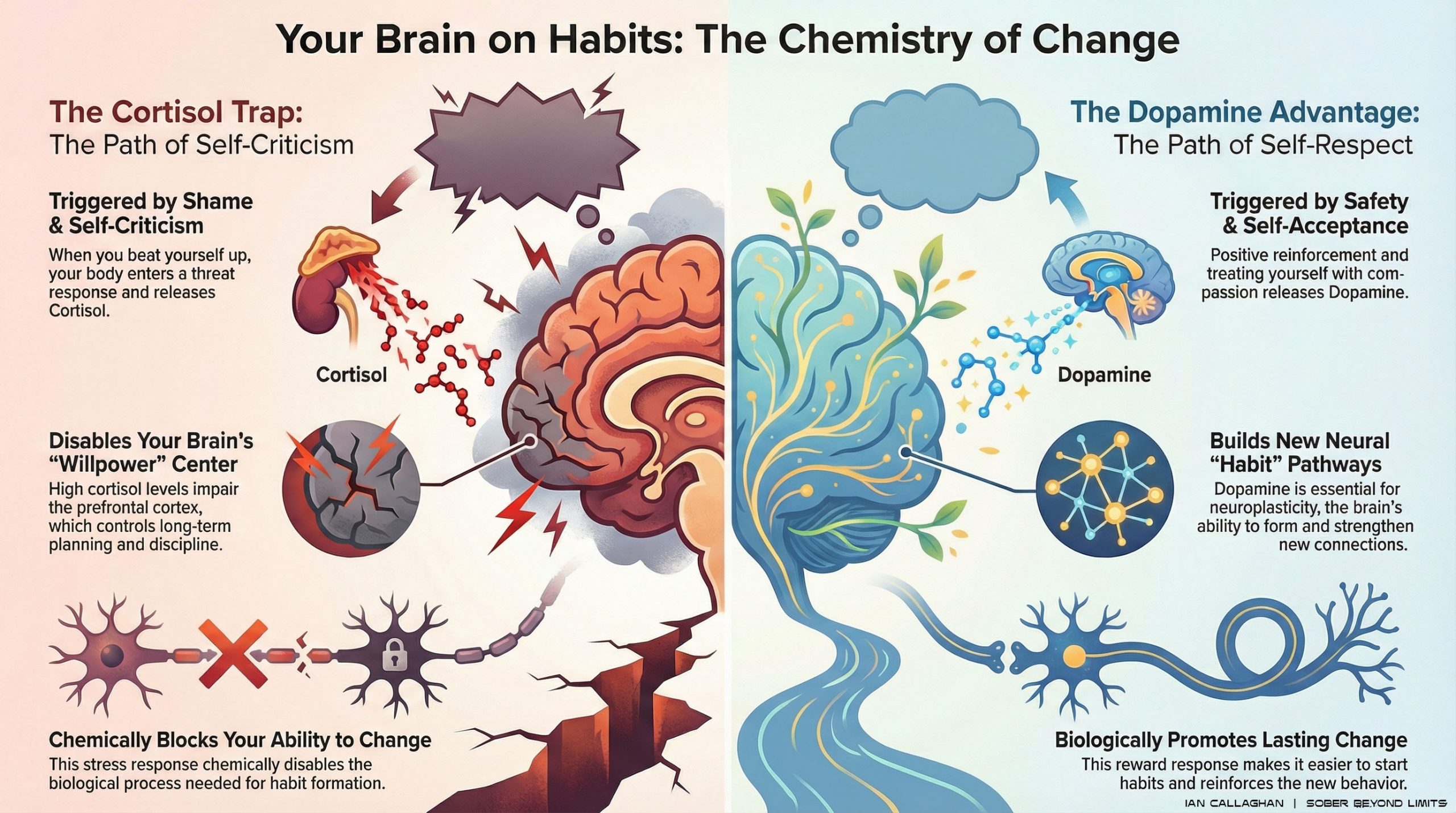
- Cortisol Spikes: Stress hormones are elevated because the body perceives the lack of alcohol as a survival threat.
When you try to use willpower to fight this, you are asking a tired conscious mind to overrule a screaming subconscious survival drive. The brain erroneously believes that alcohol is necessary for survival because, for 45 years, it was part of your baseline chemistry.
The Witching Hour: Pavlovian Conditioning and Environmental Triggers
If the first factor is the depleted battery (Psychology), and the second is the chemical imbalance (Neuroscience), the third factor is pure Behavioural Conditioning.
The 16,000 Tuesdays
If you drank for 45 years, let us do the maths. That is roughly 2,340 Tuesdays. If you drank most nights, you have reinforced the neural pathway “7 pm = Drink” over 16,000 times.
In the world of behavioural psychology, this is known as Classical Conditioning (or Pavlovian Conditioning).
- The Neutral Stimulus: The time of day (7 pm), the sound of the news starting, the act of sitting in your favourite chair, the unlocking of the front door.
- The Unconditioned Stimulus: The alcohol.
- The Response: The release of dopamine in anticipation of the drink.
The Dopamine Trap
Here is where willpower truly dissolves. It is not just the alcohol that releases dopamine; it is the cue that predicts the alcohol.
By 6:30 pm or 7 pm, your brain recognises the environmental cues. “Ah,” it says, “I know this pattern. We have finished work. We are in the kitchen. It is time for the sedative.”
The Dopamine Spike:
Your brain releases a surge of dopamine before you drink. This dopamine is not pleasure; it is craving. It is the molecule of “more.” It focuses your attention entirely on the reward. This is why, at 7 pm, you cannot concentrate on a book, the television, or a conversation. Your brain has induced a state of tunnel vision.
Why Willpower Fails Here:
Willpower is a logical function. The dopamine craving loop is a survival function located in the ventral striatum (part of the basal ganglia). The survival brain is faster, louder, and stronger than the logical brain. When you try to “think” your way out of a craving at 7 pm, you are bringing a calculator to a knife fight.
Cue-Induced Craving occurs when environmental triggers (time of day, location, mood) activate the brain’s reward system, releasing dopamine and creating an intense urge to use a substance, often bypassing the brain’s logical control centres.
The False Promise of “Just One”
As the battle rages between your prefrontal cortex (Willpower) and your amygdala (Craving/Withdrawal) at 7 pm on a Tuesday, the addicted brain deploys its most effective weapon: Rationalisation.
Because your willpower battery is drained from the workday, you lack the cognitive energy to debate with yourself. The addicted voice knows this. It does not suggest you get blackout drunk. It suggests something that sounds reasonable to a tired mind.
The Bargaining Phase
The brain creates a negotiation to relieve the Glutamate-induced anxiety. Common internal monologues include:
- “I’ve been good for four days; I can handle just one.”
- “It’s been a specifically hard Tuesday; I deserve to take the edge off.”
- “I’ll just have a glass of wine with dinner, not a whole bottle.”
- “I will start fresh tomorrow morning.”
The Alcohol Deprivation Effect
This is a documented scientific phenomenon. When an animal (or human) addicted to a substance is deprived of it for a period, the eventual reintroduction of the substance leads to a binge that is often more severe than the previous baseline consumption.
The brain is starved of its expected reward. If you succumb at 7 pm, the Alcohol Deprivation Effect ensures that “just one” is biologically nearly impossible. The first sip does not satisfy the craving; it ignites the cycle anew, but with higher intensity because the receptors are hypersensitive from the period of abstinence.
Summary of Part 1: The Perfect Storm
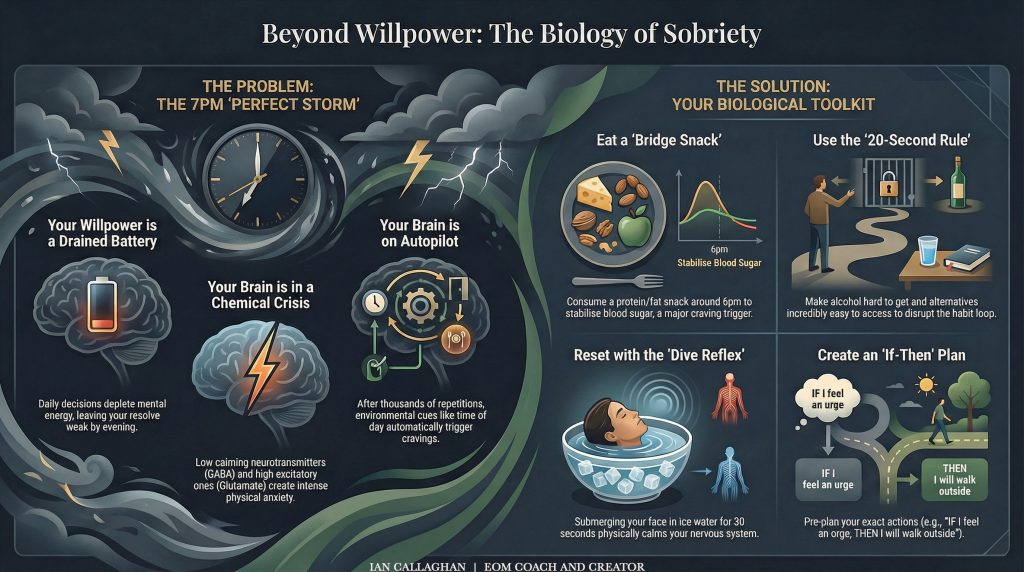
So, why does willpower fail you at 7 pm on a Tuesday? It is not because you are weak. It is not because you lack character. It is because you are standing in the centre of a perfect physiological storm.
The “Tuesday 7 pm” Collapse Factors:
- Ego Depletion: Your cognitive “battery” is drained from the day’s decisions, leaving the prefrontal cortex offline.
- Homeostatic Crisis: Your body is flooded with excitatory Glutamate and lacks inhibitory GABA, creating physical anxiety that mimics a survival threat.
- Deep Neural Grooves: You are fighting against 16,000 repetitions of a habit loop that releases dopamine simply because of the time of day.
- Environmental Cues: Your home, the lighting, and the routine all trigger a subconscious demand for alcohol.
You are attempting to use a tired mind to control a frantic body. In the context of 45 years of drinking, the neurological pathways for drinking are superhighways, wide and fast. The pathways for sobriety are, at this stage, merely overgrown footpaths through a dense jungle.
Realising this is the first step. You must stop relying on willpower because willpower is a resource you do not have in abundance at 7 pm on a Tuesday. You need something else entirely. You need a strategy that bypasses the need for will.
End of Part 1.
Beyond Willpower: The Physiology of Resilience
If willpower is a battery, by 7 pm on a Tuesday, yours is flat. Recognising this is not defeatism; it is strategic realism. To survive the “perfect storm” of withdrawal described in Part 1—where ego depletion, homeostatic crisis, and neural grooves conspire against you—you must stop fighting a psychological war and start fighting a biological one.
You cannot think your way out of a psychological crisis. You must act your way out. We must replace the reliance on “white-knuckling” with a system of bio-hacks and environmental design that sidesteps the need for conscious control.
The following strategies are designed to bring the prefrontal cortex back online, regulate the glutamate-GABA imbalance, and physically disrupt the habit loop.
Tactic 1: Stabilising the Chemical Imbalance
At 7 pm, your brain is screaming for a sedative (alcohol) because it is currently flooded with excitatory neurotransmitters (glutamate/adrenaline). Most people try to talk themselves down from this state. This is ineffective. You must alter the body’s chemistry manually.
The Glucose Gap: Managing Hypoglycaemia
One of the primary triggers for alcohol cravings in the early evening is, surprisingly, hypoglycaemia (low blood sugar). The liver processes both alcohol and sugar. When you quit drinking, your body often misinterprets a drop in blood sugar as a craving for alcohol. Alcohol is a dense source of liquid sugar and carbohydrates; when you remove it, your blood sugar levels become erratic.
At 7 pm, you have likely not eaten since lunch. Your glucose is low, spiking adrenaline and cortisol (stress hormones), which further weaken your resolve.
The Protocol:
- Do not wait for dinner. At 5:30 pm or 6:00 pm, consume a “bridge snack.” This is not a treat; it is medication for your metabolism.
- Focus on Protein and Fats. A biscuit or a piece of fruit will spike insulin and lead to a crash later. You need sustained energy. A handful of nuts, a hard-boiled egg, or a slice of cheese will stabilise blood glucose levels.
- The Result: By the time 7 pm arrives, the physical sensation of “shakiness” or “hollow hunger”—often confused with a craving—is absent. You have removed the physiological desperation from the equation.
The GABA Bridge: Natural Inhibitors
In Part 1, we discussed how the alcoholic brain lacks GABA (the braking system). While you cannot instantly manufacture GABA without alcohol, you can stimulate the parasympathetic nervous system to mimic its effects without the toxicity.
Breathwork as a Biochemical Lever:
You may be sceptical of “breathing exercises,” viewing them as soft science. However, specific breathing patterns, such as the 4-7-8 technique, directly stimulate the Vagus nerve. This lowers cortisol and heart rate within 90 seconds.
- Inhale through the nose for 4 seconds.
- Holdyoure breath for 7 seconds.
- Exhale forcefully through the mouth for 8 seconds.
Doing this for two minutes at 6:55 pm effectively “manually overrides” the panic signals your amygdala is sending. It provides a biological “brake” to counter the glutamate flood.
Tactic 2: Radical Environmental Re-engineering
Willpower is required when there is a choice to be made. If you are sitting in your favourite armchair, facing the television, with a glass of water on the coaster where your wine usually sits, you are engaging in active resistance. You are forcing your brain to constantly say “no” to a stimulus it recognises.
This causes rapid decision fatigue. To conserve energy, we must use Choice Architecture.
The 20-Second Rule
Psychologist Shawn Achor popularised the concept that making a habit just 20 seconds harder to perform can stop it, and making a desired behaviour 20 seconds easier can cement it.
If you typically drink wine from a specific cupboard:
- Increase Friction: Move the wine glasses to the garage, the loft, or a high shelf that requires a step ladder. If you have alcohol in the house (which you ideally shouldn’t), it must be locked away or frozen in a block of ice. The craving usually lasts 15-20 minutes. If it takes 20 minutes to access the drink, the craving often subsides before you succeed.
- Decrease Friction for Alternatives: Have your alcohol-free alternative (sparkling water, tonic, kombucha) chilled, sliced with lime, and in a nice glass before 7 p.m. It must be easier to grab the healthy drink than the poison.
Visual and Auditory Cues
Your addiction is context-dependent. It is tied to the “mise-en-scène” of your 7 pm life.
- Lighting: If you usually drink with the lights dimmed and the television on, do not sit in that environment. For the first 30 days, turn the “big light” on. Bright, cool-toned light suppresses melatonin and increases alertness, reducing the cosy” feeling that triggers the wine habit.
- Location: If you drink on the sofa, spend your Tuesday evening in the kitchen or the bath. If you drink in the kitchen, go to the bedroom. You must deny the brain the environmental pattern match.
- The “Clean Break”: Change your clothes immediately upon returning from work. The sensation of “work clothes” versus “loungewear” is often a transition signal for “time to drink.” Changing into exercise gear or a different style of clothing signals a new context to the brain.
Tactic 3: The Pattern Interrupt and Neural Rewiring
At 7 pm, your basal ganglia (the habit centre) fires a signal: Execute Routine X. If you just sit there, the signal amplifies. You need a Pattern Interrupt. This is a sudden, jarring stimulus that breaks the loop.
The Mammalian Dive Reflex
This is perhaps the most effective “emergency brake” for a severe craving. It utilises a physiological reflex shared by all mammals. When your face is submerged in cold water, your body instinctively assumes you are diving. It immediately slows the heart rate and redirects blood flow to vital organs to preserve oxygen.
The Tactic:
When the 7 pm urge hits hard,d and you feel you are about to crumble:
- Fill a bowl or the sink with cold water and ice cubes.
- Hold your breath and submerge your face (covering the area under the eyes and above the cheekbones) for 30 seconds.
- The Result: This physically resets your nervous system. It is impossible to maintain a high state of anxiety or craving while the dive reflex is active. It snaps the brain out of the repetitive loop and brings you back to the present moment, gasping and alert.
Urge Surfing: Cognitive Reframing
Most people try to fight the craving. They tense up, grit their teeth, and think, “I must not drink.” This is the psychological equivalent of trying to hold back the tide.
Urge Surfing, a technique developed in addiction psychology, suggests you acknowledge the physical sensations of the craving without judging them or fighting them.
- Identify: “I am noticing a tightness in my chest.” “I am noticing my mouth is watering.” “I am noticing a feeling of agitation.”
- Externalise: Visualise the craving as a wave. It swells, it peaks, and it always breaks and dissipates. No craving lasts forever.
- Ride: Do not swim against it. Observe it. Say to yourself, “This is uncomfortable, but it is not dangerous, and it will pass.”
By observing the craving objectively, you detach the “I” from the “Urge.” You are no longer a person needing a drink; you are a person experiencing a sensation of wanting a drink. The difference is subtle but profound.
Tactic 4: Implementation Intentions (If-Then Planning)
Research clearly shows that vague goals (“I will not drink tonight”) fail under stress. Specific plans (“If X happens, then I will do Y”) succeed because they pre-program the decision.
At 7 pm on a Tuesday, your decision-making module is offline. You need a script that runs automatically.
The Tuesday Protocol Script:
- IF it is 6:45 pm, THEN I will eat a high-protein snack and drink 500ml of water.
- IF I feel the urge to walk to the fridge for wine, THEN I will immediately put on my trainers and walk around the block for 10 minutes.
- IF the anxiety becomes overwhelming, THEN I will use the cold water face-splash technique.
- IF my partner opens a beer, THEN I will pour a tonic water and move to a different room for 15 minutes.
Write these down. Do not keep them in your head. When the storm hits, you do not think; you follow the script.
The Cumulative Effect: Neuroplasticity in Action
Why go to these extremes? Why splash water on your face or eat cheese a5:30 pmpm? Because you are in the business of neuroplasticity.
Every time you reach 7 pm and engage in the old habit (drinking), you deepen the neural groove. You make the addiction stronger.
Conversely, every time you reach 7 p.m., feel the urge, and do something else, you are hacking through the jungle. You are trampling a new path.
The first Tuesday is brutal. The path is full of briars.
The second Tuesday is difficult, but the path is visible.
By the tenth Tuesday, the old superhighway of addiction has begun to crack and fade from lack of use, and your new path—the path of tea, breathing, and walking—has become the road of least resistance.
The “Perfect Storm” at 7 pm is not a character flaw. It is a biological event. By respecting the biology, managing the chemistry, and engineering the environment, you render willpower irrelevant. You don’t need to be strong; you just need to be smart. You need to be a pilot navigating the storm, trusting your instruments (your plan) rather than your feelings.
Recovery is not about never falling; it is about building a system where falling becomes difficult, and standing becomes automatic.
Conclusion
The failure of willpower at 7 pm on a Tuesday is a predictable, physiological certainty for those early in recovery. It is the result of a tired brain meeting a conditioned body. However, by understanding the mechanics of Ego Depletion and Homeostatic Crisis, we can dismantle the trap.
We stop relying on the fragile resource of will and start relying on the robust pillars of biology and routine. We stabilise our blood sugar to quiet the adrenal response. We use breathwork and cold water to manually reset the nervous system. We alter our home environment to remove the cues that trigger the habit loops. And we script our reactions using “If-Then” planning to automate our resistance.
This is not a battle of spirit; it is a game of strategy. And with these tools, it is a game you can win. Next Tuesday at 7 pm, you will be ready.
Emotional Mastery: The Emotional Operating System
The Emotional Mastery book is a practical manual for understanding and regulating the human nervous system using the Emotional Operating System framework.
Instead of analysing emotions or retelling your past, the Emotional Mastery book teaches you how to read emotional states as system feedback, identify overload, and restore stability under pressure.
No labels. No therapy-speak. No endless healing loops.
Just a clear, operational approach to emotional regulation that actually holds when life applies load.
Instant digital download.