Ten Things the Diet Industry Doesn’t Want You to Know About Your Metabolism
1. Introduction: The Parasite and the Demon | Diet industry metabolism lies
These are not accidents or oversights. They are diet industry metabolism lies, built deliberately into a system designed to keep you confused, compliant and coming back for more.
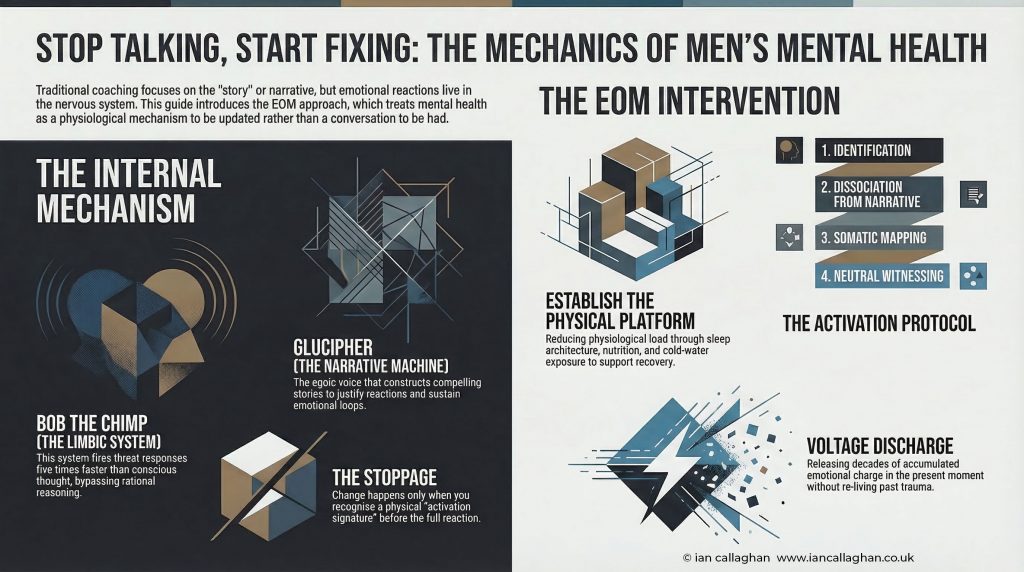
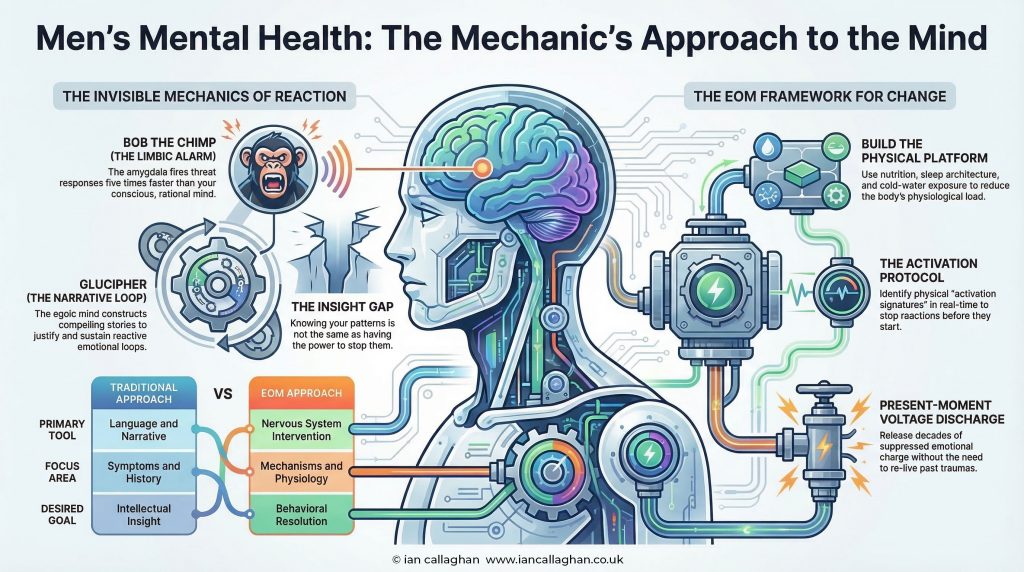
In the military, we talk about “the threat in the wire.” It is the enemy that has already breached your perimeter, the one you can’t see because he’s already wearing your uniform. For decades, the weight loss industry has been operating a psychological and biological insurgency inside your own head, and they’ve deployed two high-level operatives to ensure you never find the exit. Let me introduce you to the first: Bob. Bob is that cold, persistent voice that occupies the back of your skull. He’s the internal narrator who wakes up at 11 pm precisely when you’ve strayed from your “programme.” When you’ve reached for a snack that wasn’t on the approved list, Bob is there to whisper, “You’ve ruined it again. You’re weak. You’re a failure.” Bob is a parasite in a polo shirt. He’s the personification of every toxic piece of diet industry messaging you’ve ever internalised. He tells you that your lack of progress is a character flaw, that you need more discipline, more “white-knuckling,” and more suffering before you ever deserve to feel comfortable in your own skin. Bob isn’t your conscience; he’s a marketing algorithm designed to keep you in a state of perpetual shame. Then there is Glucipher.
Glucipher is the glucose demon, the sugar villain. He is the biological agent the industry uses to keep you terrified of a piece of fruit while simultaneously upselling you “sugar-free” protein bars. These bars are often weaponised with maltitol and chemical stabilisers that Glucipher uses to trigger intestinal distress at a volume that could rattle windows. Glucipher is the reason you have spent the last decade in a confused, exhausted war with carbohydrates. He is the reason you binge on the exact foods you swore were forbidden, only to hand the resulting guilt straight back to Bob to process. Between these two, the diet industry has built a global empire worth billions. They have convinced you that your metabolism is a fragile, broken thing that requires their intervention to function. But they are lying. Your metabolism isn’t broken; it is being systematically manipulated by a repeat-customer model that relies on your failure. This is about more than just “dieting”—it’s about reclaiming your biological sovereignty. To do that, we have to expose the diet industry’s metabolic lies and understand the 10 things they are desperate to keep hidden.
2. The First Lie: Why the Calorie Count is Central to Diet Industry Metabolism Lies
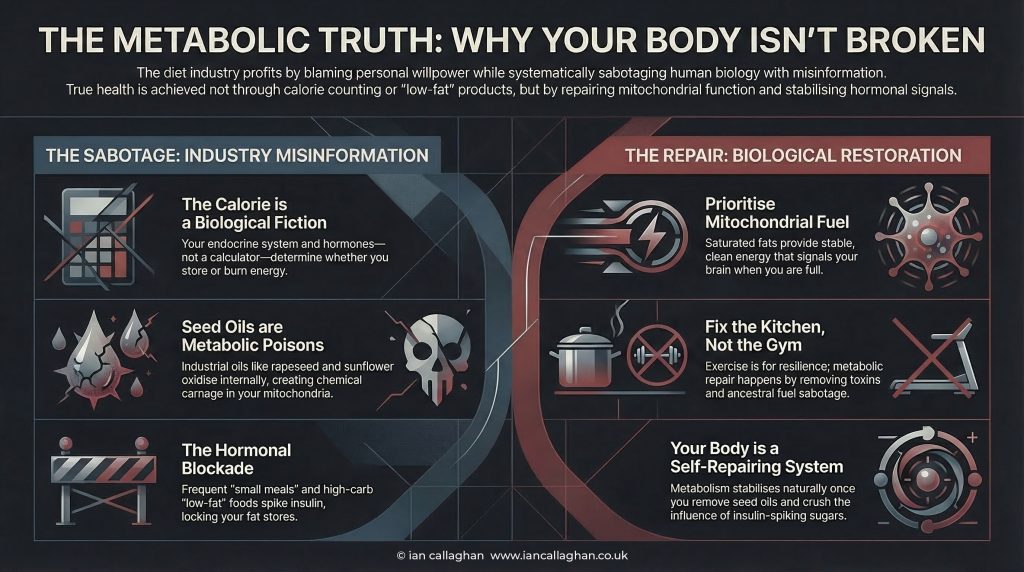
The industry is obsessed with making you count calories. It’s a brilliant tactical move because it shifts the entire logistical burden of weight loss onto your shoulders. If the numbers don’t add up at the end of the week, Bob is right there to tell you that you simply didn’t calculate accurately enough or “try” hard enough. It turns your life into a never-ending accounting project. However, a calorie is a biological fiction when applied to the human endocrine system. By definition, a calorie is a unit of heat measured in a bomb calorimeter—a metal box that burns a substance to see how much energy it releases. But here is the hard truth: your body is not a metal box.Your body is a complex, adaptive endocrine system. Your hormones, not a spreadsheet or a calculator, determine whether you store energy as fat or burn it as fuel. When the industry forces you to focus on the number, it ignores the “quality of the signal” you are sending to your cells. Consider a tactical comparison:
- 500 calories of steak: This is ancestral fuel. Your body recognises the amino acids and the stable fats. It triggers satiety hormones like CCK and leptin. Your metabolism receives a signal of abundance and stability.
- 500 calories of “low-fat” biscuits: This is where Glucipher takes the wheel. These calories are essentially a metabolic Trojan horse. They spike your insulin to the rafters, slamming the door shut on your fat stores and signalling your body to store every drop of energy as adipose tissue while your cells remain effectively starved for nutrients. The diet industry wants you focused on the “metal box” mathematics so you don’t notice the hormonal sabotage happening behind the scenes. They want you to believe that a calorie is a calorie, regardless of the source. It’s a lie designed to keep you buying the “low-calorie” processed junk that keeps you hungry and keeps their revenue streams flowing.
3. The Second Lie: Seed Oils are Metabolic Sabotage
If we were to look for the single greatest act of metabolic sabotage in human history, it wouldn’t be the rise of sugar alone. It would be the industry-led transition away from stable animal fats toward industrial seed oils. I’m talking about rapeseed, sunflower, soybean, and corn oils—the very substances the industry has spent millions labelling as “heart-healthy.”This label is a lie of the highest order. These oils are not food; they are industrial lubricants that have been bleached and deodorised and marketed as “healthy” alternatives to the fats our ancestors ate for millennia. The primary culprit is linoleic acid, a highly unstable, omega-6 polyunsaturated fatty acid. Because these oils are chemically unstable, they begin to oxidise the moment they are exposed to light, heat, or oxygen. When you consume them, they don’t just “burn” for fuel; they integrate into your cell membranes. They stay there for years, waiting to create chemical carnage in your mitochondria. They act as metabolic poisons, disrupting how your cells communicate and preventing your mitochondria from producing energy efficiently. While the industry promotes these as a heart-healthy choice, they actually compromise the structural integrity of your body at the cellular level. It’s like trying to build a fortress out of wet cardboard. These oils contribute to chronic systemic inflammation, ensuring your metabolism remains bogged down and sluggish, no matter how many “low-fat” meals you eat.
4. The Third Lie: Glucipher and the Insulin Blockade
The diet industry often recommends “heart-healthy” grains and “low-fat” yoghurts as the foundation of a weight-loss programme. In reality, these foods are an open invitation for Glucipher to enter your bloodstream and set up a hormonal blockade. When you consume these high-carbohydrate, low-fat processed foods, you trigger a massive insulin spike. Insulin is your body’s primary storage hormone. Its job is to clear sugar from the blood and tuck it away for later. The problem is that as long as insulin levels are high, your body is physically unable to access its stored body fat. The gates are locked. This creates a bizarre and cruel biological paradox: you could be carrying 50,000 calories of potential fuel on your hips, but if Glucipher is in control and your insulin is spiked, your cells are effectively starving. They cannot reach the energy stores you already have. This is the origin of the “hangry” phenomenon. Two hours after that “healthy” oatmeal or low-fat yoghurt, your blood sugar crashes, and your body screams for more fuel because it’s trapped behind an insulin blockade. You aren’t lacking willpower when you reach for that mid-morning snack. You are responding to a biological emergency created by a food industry that wants you in a permanent state of seeking the next hit of glucose.
5. The Fourth Lie: The Silent Power of the Mitochondria
You will rarely hear the diet industry talk about mitochondrial health. Why? Because you cannot sell a quick-fix pill for it, and it doesn’t fit into a 12-week “transformation” kit. Your mitochondria are the ancient, bean-shaped engines inside your cells responsible for producing ATP—the energy currency of life. They are the real bosses of your metabolism. When you consume a steady diet of seed oils and refined sugars, you create a metabolic bottleneck. Think of it like a car with a seized engine. You can put the highest-grade fuel in the tank and push the car as hard as you want, but if the engine is seized, you aren’t going anywhere. If your mitochondria are broken, bogged down by oxidative stress and chemical carnage, no amount of jogging on a treadmill or “white-knuckling” your way through a restrictive diet will make you lean. The industry wants you to focus on the treadmill because it’s a measurable metric of “effort,” but without healthy mitochondria, that effort is largely wasted. They ignore mitochondrial health because repairing itwould require removing their most profitable products: seed oils and refined sugars.
6. The Fifth Lie: Bob the Chimp and the Hunger Hijack
Inside your brain sits the ancestral version of Bob—the primal, “Chimp” hardware focused entirely on survival. This version of Bob doesn’t care about your beach body or your blood pressure; he cares about surviving a famine that, in the modern world, never actually comes. Bob the Chimp is the biological hardware, and the diet industry has spent decades installing a “Parasite” software update to exploit it. The modern food environment is a “super-stimulus” specifically engineered to hijack these survival instincts. By stripping fibre and essential nutrients from food and replacing them with flavour enhancers and refined sugars, the industry creates a dopamine loop that Bob the Chimp cannot resist. Our ancestors were hardwired to seek out energy-dense foods because they were rare. Now, those signals are everywhere, and they’ve been stripped of the fibre and protein that would naturally tell our brains “we’ve had enough.”When you find yourself unable to stop eating highly processed snacks, you aren’t “weak.” You are being biologically manipulated by a food system designed to bypass your natural off-switches. The industry removes the nutrients that Bob the Chimp needs to feel safe, leaving you in a permanent state of nutritional seeking. It is a hunger hijack, and it’s being done to you on purpose.
7. The Sixth Lie: How the Grazing Myth Fuels Diet Industry Metabolism Lies
One of the most persistent and damaging diet industry myths is the advice to eat six small meals a day to “keep the metabolism stoked.” In reality, this is a perfect logistical strategy for developing insulin resistance. Every time you eat, your insulin levels rise. If you are grazing from 7 am until 9 pm, your insulin never has the opportunity to drop low enough to allow for fat burning. You are effectively keeping your body in a permanent state of fat storage. You are “grazing like cattle,” and, like cattle, you become docile and prone to weight gain. Ancestrally, humans were designed to “feast and fast”—to hunt, eat heartily, and then go for periods without food. This “metabolic flexibility” allowed our ancestors to switch seamlessly between burning the food they just ate and burning their own stored body fat. By eating six times a day, you ensure your body never learns how to use its own fat for fuel. The “stoking the fire” metaphor is a myth; you aren’t adding logs to a fire, you are just keeping the storage warehouse doors wide open and the exit doors locked.
8. The Seventh Lie: The Demonisation of Saturated Fat
The move away from traditional, ancestral fats like tallow, butter, and suet was a tactical masterstroke by the sugar industry. For decades, we have been told that saturated fat is the enemy, that it clogs arteries and ruins health.”The demonisation of saturated fat was a masterstroke by the sugar industry.”In reality, saturated fats are the cleanest and most stable fuels for your mitochondria. Unlike seed oils, they do not oxidise easily inside your body. More importantly, they provide the “satiety signal” to your brain. When you eat saturated fats, your body receives a clear, biological command that the “hunt” is over and you are full. By removing these fats from the diet and replacing them with industrial oils and sugars, the industry ensured that you would lose that satiety signal. This leads directly to the overconsumption of the very foods that keep you trapped in the “Glucipher” loop. Saturated fat isn’t just fuel; it’s the communication line that tells your brain it can stop eating.
9. The Eighth Lie: The Futility of “Outrunning” the Fork
The industry loves to sell exercise as the primary tool for weight loss. While exercise is a fantastic tool for mental resilience, bone density, and mitochondrial health, it is a terrible primary strategy for fat loss. You simply cannot outrun a bad diet, especially one laden with seed oils and hidden sugars. When you use exercise as a blunt instrument for weight loss, your body often compensates metabolically.
- Bob gets hungry: Your primal brain triggers an intense, survival-level hunger response to replace the energy you just burned, often leading you to eat more than you expended.
- Down-regulation: Your body may lower your basal metabolic rate in other areas—like lowering your body temperature or making you more sedentary the rest of the day—to “save” energy. The result is a frustrating plateau. You must fix the metabolic machinery in the kitchen first by removing the metabolic poisons. Once your metabolism is functioning correctly, the gym stops being a torture chamber where you try to “earn” your food and becomes a place to build strength and health.
10. The Ninth Lie: Identifying the Low-Fat Trap Within Diet Industry Metabolism Lies
In the world of metabolic health, the “low-fat” label is a warning sign. It is a tactical red flag. When the food industry removes fat from a product, they are also removing the flavour and the satiety. To make that product palatable enough for you to buy it again, they must replace that fat with something else. That “something else” is usually a combination of sugar, thickeners, and chemical stabilisers. In other words, “low-fat” is code for “high-Glucipher.” These products are engineered to bypass your satiety centres and trigger a dopamine response. They are designed to make you eat the entire packet in one sitting and then return to the shop the next day. This isn’t a health programme; it is a recurring revenue model built on your metabolic dysfunction. It is the ultimate expression of the diet industry’s metabolism lies —selling you the cause of your problem as the cure.
11. The Tenth Lie: The Myth of the “Broken” Body
The most dangerous secret the diet industry keeps is that your body is a self-repairing system. They want you to believe that your metabolism is a fragile, shattered thing that requires a complex programme, a monthly subscription, or a proprietary “fat-burning” shake to function. It doesn’t. Your body is incredibly resilient. If you stop the sabotage, it knows exactly what to do. If you remove industrial seed oils, crush Glucipher’s influence by reducing refined sugars, and start feeding your mitochondria ancestral fuels, your metabolism will stabilise. You do not need a 12-week transformation kit or a calorie-counting app to tell you how to exist. You just need to stop poisoning the machinery and let your biological repair systems do their job. The industry depends on you believing you are broken. You aren’t. You’ve just been sabotaged.
12. The Author’s Journey: Metabolism as a Reflection of Life
I didn’t come to these realisations in a laboratory; I came to them through my own wreckage. I spent twelve years in the British Army, a world built on the idea that “white-knuckling” through pain and exhaustion is the only way to succeed. I’m also over a year sober, having navigated the long, dark tunnel of addiction. My body has been through things that leave marks—not just the kind you can see on a scan, but marks on the mind and within the cells themselves. Trauma, chronic stress, and years of alcohol use are not just psychological hurdles; they are metabolic ones. These experiences reshape the gut lining, alter gene expression through epigenetic changes, and dysregulate the very systems that govern your appetite, thyroid function, and systemic inflammation. For years, I tried to apply military discipline to my health. I tried to “out-train” my trauma and “clean eat” my way out of metabolic dysfunction, all while listening to Bob tell me I just wasn’t being tough enough.”I thought Bob was right. I thought I just needed to try harder.”I believed the industry lies. I thought my lack of progress was a personal failure, a lack of grit. I was wrong. What I actually needed wasn’t more punishment or a stricter “programme.” I needed to understand what had happened to my biology. I needed to shift my nervous system from a state of “threat” to one of “safety.” Repairing your metabolism isn’t a war against your body; it’s a peace. It’s about giving your cells the stable fats and ancestral nutrients they need to turn off the alarm bells, finally.
13. Conclusion: Evicting Bob and Glucipher
The diet industry thrives on the gap between who you are and who Bob says you should be. It relies on Glucipher keeping you in a constant state of hormonal hunger, so you never stop buying their temporary solutions. But the truth is simple: you are not broken. You have been lied to. There is a profound difference between a body that has failed and a body that is being sabotaged. Once you stop the sabotage—once you remove the seed oils, ignore the calorie counts, and feed your mitochondria the stable fats they crave—you can finally evict the parasite and the demon. Your body can stop fighting itself and start the process of biological repair. You don’t need a calculator; you need to reclaim your biological heritage. The next time Bob whispers that you have no discipline, or Glucipher tries to make you fear a piece of fruit while you’re holding a processed “health” bar, tell them both where to go. You have the power to fix the machinery. What would your life look like if you stopped punishing your body for its perceived failures and started repairing the systems that keep you alive? The path to health isn’t through more suffering; it’s through the truth about your biology. Stop the sabotage. Start the repair. Fix your metabolism, and you will fix your life.

The Sovereign Operator Bundle: Complete Metabolic & Emotional Mastery
The Sovereign Operator Bundle: Complete Metabolic and Emotional Mastery
£97
Meet AI Ian.
Trained on the complete EOM, 30-Day Reset and Fix Your Metabolism methodology. Available at 3am when the cravings hit. Available at midday when the energy crashes. Available whenever you need the framework applied to your specific situation, in the voice of someone who has actually been through it.
This is not a chatbot. This is the entire methodology, interactive, on demand, permanently yours.
The bundle also includes all three books in full.
Fix Your Metabolism. The 30-Day Reset. Emotional Mastery.
The books are the manual. AI Ian is the coach who has read every word of it.
For people ready to implement. Not collect.
Stop running the same loop every bloody week.