Why Sleep Matters | The “Fucked Fridge” Reality Check
Why sleep matters. We have a massive problem with how we view health and performance, and it starts with a fundamental misunderstanding of how the human machine actually works. Most people are walking around obsessed with the wrong things. They will spend six hours on the internet arguing about the toxicity of seed oils, buy expensive trainers they never actually run in, and neck every magnesium supplement they see an influencer pushing on Instagram. Then, they go and sit under harsh blue light until half past midnight with a nervous system humming like a fucked fridge.
The next morning, they wonder why they feel like a sack of wet cement. They wonder why they are snapping at their partner, why they are craving shite food, why they are scrolling their phone until one in the morning, and why they are talking themselves into a drink, a binge, or whatever their favourite escape hatch happens to be. They look in the mirror and think they have a discipline problem. They think they are weak, or lazy, or just lack the “grind” they see on social media.
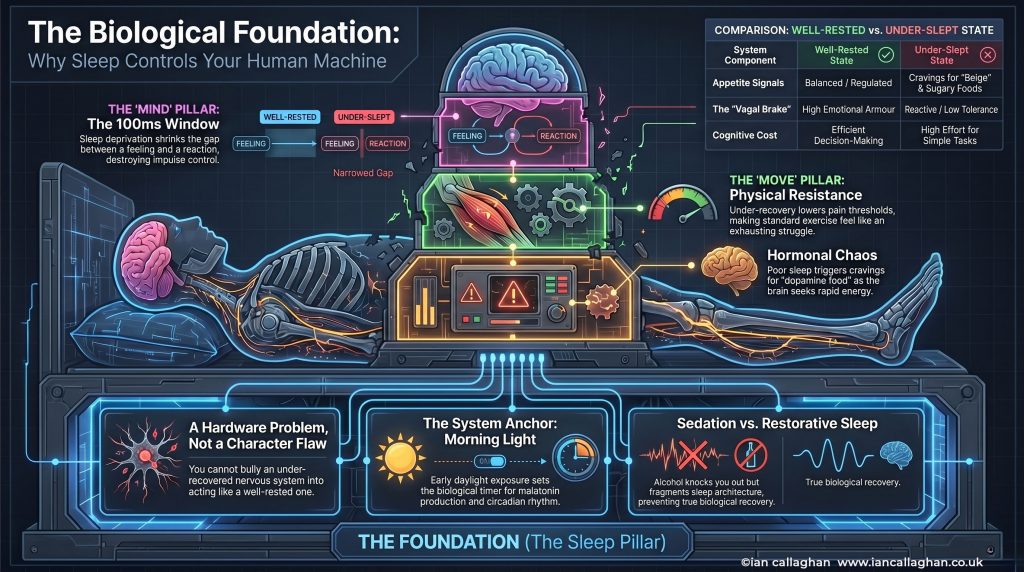
This is the bit most people miss: Why sleep matters isn’t about being well-rested for a spa day. It is about the state of your hardware. If your sleep is on its arse, your entire life starts wobbling. You are not failing a morality play: you are trying to run a high-performance system on a battery that has been drained and never recharged. You are trying to solve a state problem with shame and motivational quotes, and that rarely works for long. It is time to stop the bullshit and look at why your foundation is crumbling. You cannot bully an under-recovered nervous system into acting like a well-rested one. You can pretend for a bit. You can white-knuckle it. You can drag yourself through the day on caffeine, cortisol, and stubbornness. But eventually, the bill lands. And when it does, the old coping patterns come sniffing around because your brain is desperate for relief.
The Four Pillars: Sleep as the Foundation & Why Sleep Matters
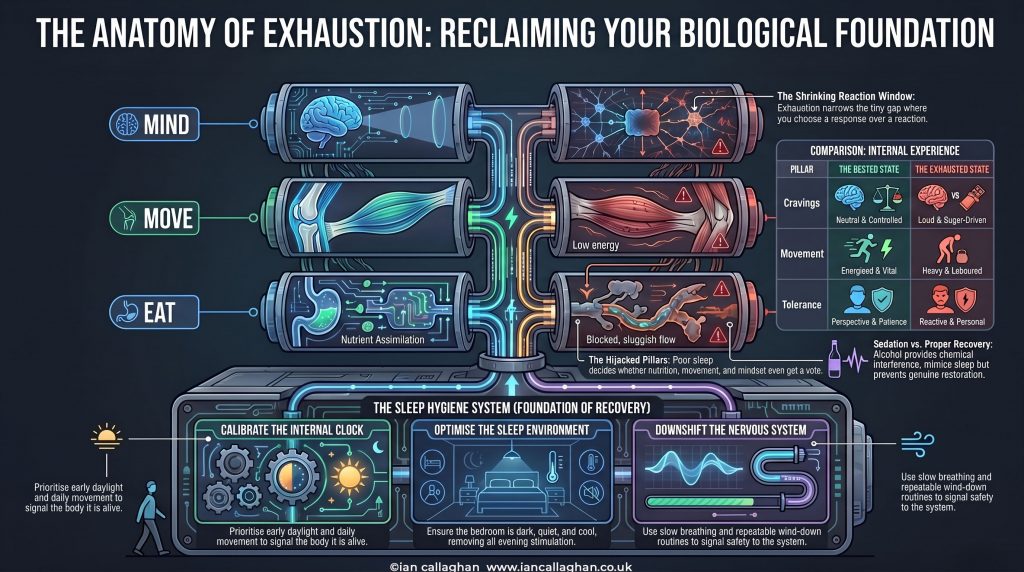
In my work, I talk about four main pillars: Eat, Sleep, Move, and Mind. Most people treat these like four separate buckets, and they usually put sleep at the very bottom of the priority list. They treat it like an optional extra or something they will “sort out” once they have mastered their diet or their gym routine. But here is the reality: sleep is the pillar that supports the other three. It is the foundation. If sleep is broken, it does not matter how many organic salads you eat or how many miles you run. You can meditate, journal, breathe, cold plunge, and chant under a full moon all you want, but if your system is under-recovered, your resilience will drop through the floor.
When the machine is under load because you have neglected the sleep pillar, every other part of your life becomes harder to hold up. This is a hardware problem, not a character flaw. You can eat well and still feel rough if your sleep is broken. You can train hard and still feel flat if your sleep is patchy. When the machine is under load, every decision costs more cognitive energy. Every urge to return to your old coping patterns feels louder and more urgent. Every bit of discomfort feels personal and overwhelming. Every task feels like it requires three times the effort it should.
A lot of people are walking around trying to solve a state problem with shame and more pressure. That rarely works for long. You cannot expect a brain that hasn’t cleared its metabolic waste to make high-level, long-term decisions. You are asking your body to build a skyscraper on a foundation of damp cardboard. If you want to change your life, you have to stop treating sleep as a luxury and start treating it as the primary hardware that enables everything else to function.
How Sleep Wrecks Your ‘Eat’ Pillar
If you have ever wondered why your appetite goes weird when you are tired, you need to understand why good sleep matters for your biology. When sleep is off, your hunger signals get messy. You do not wake up craving a balanced meal of protein and fibre: you start wanting quick energy. You want sugar, salty crap, “beige food,” and “dopamine food.” Your tired brain is not being “greedy.” It is looking for the fastest route back to feeling human. It is looking for relief and efficiency.
Poor sleep messes with your blood sugar control and makes your insulin sensitivity sloppier. This is why exhausted people often eat like they have been possessed. You are not just fighting a craving: you are fighting a brain that is looking for a shortcut to energy because its primary source of restoration was cut short. When you are tired, the “fake food” starts whispering. It’s the sugary crap, the ultra-processed sludge, and the endless snacks. You end up in a cycle: sleep worse, crave more rubbish, eat more rubbish, feel more inflamed, and then sleep worse again.
The psychological shift is just as damaging. When you are well-rested, “chopping and prepping” a healthy meal feels like a normal part of your day. When you are shattered, that same task feels like an impossible bit of admin. The idea of cooking feels ridiculous when a packet of ultra-processed sludge or a takeaway app can put food in your face in minutes. Sleep changes what you can be arsed to do. It lowers the quality of the negotiation you have with yourself. You lose your portion awareness, and you miss the stop signal because your brain is chasing a hit of satisfaction that it should have gotten from rest. You aren’t a glutton: you’re just exhausted, and your brain is making bad deals because it’s desperate for a spark of life.
How Sleep Sabotages Your ‘Move’ Pillar
We often talk about “laziness” as if it is a personality trait, but half the time, it is just under-recovery. You do not move like yourself when you have not slept. Your energy drops, your coordination is off, and your reaction time slows down. When you are underslept, the workout that looked doable in your head feels like dragging a washing machine up a hill in reality. Your joints feel worse, your body feels heavier, and your pain threshold drops.
If your body feels like a fight before breakfast, you are not going to be bouncing into a workout with a grin on your face. That does not make you broken. It makes you tired. If you already live with pain, stress, hormonal shifts, or midlife wear and tear, broken sleep throws petrol on all of it. This is where people start falling out with the movement. They think exercise is the problem or that they have lost their “mojo.” The real issue is that the body has not recovered enough to properly meet the movement.
When every bit of movement feels like punishment rather than progress, you stop doing it. Then you feel worse, you sleep worse again, and the loop tightens until you are stuck on the sofa, feeling like a failure. Good sleep does not guarantee motivation, but it massively improves the odds that your body will cooperate when your mind says, “Let’s go.” Momentum in the Move pillar is often less about heroics and more about not feeling like every bit of movement is a miserable chore. When you respect the Sleep pillar, you stop fighting your own physiology every time you put on your trainers.
How Sleep Frays the ‘Mind’ Pillar (Emotional Regulation)
The most dangerous impact of poor sleep is what it does to your head. I often talk about the “100 millisecond window.” This is that tiny bit of space between a feeling and a reaction. It is the gap where you get to choose a new behaviour instead of firing off an old, destructive pattern. When you are shattered, that window gets a hell of a lot smaller. Your “vagal brake,” the part of your nervous system that helps you slow down and stay calm, has less grip. Your patience, your perspective, and your impulse control all start to fail.
This is when “Bob” gets louder. Bob is that voice in your head, the internal PR firm that is brilliant at building a case for nonsense. When the brain is tired, your internal barrister starts presenting a beautifully structured case for self-sabotage. It tells you that you “deserve” the drink, that the takeaway does not matter, or that you will “start again tomorrow.” It sells you self-soothing and calls it “self-care,” when in reality, it is just self-medication for a depleted system.
This is how sleep affects health on a psychological level: it provides the emotional armour you need against stress, grief, boredom, and loneliness. Without that armour, you are twitchy, reactive, and far more likely to hand the keys back to your old patterns. You think the world has suddenly become more annoying or hostile, but often, the world is the same: it is just your capacity to meet it that has dropped. Recovery from anything, whether it is addiction or just a bad habit, requires the ability to tolerate discomfort. That tolerance is built on a foundation of rest. Without it, you are trying to fight a war with no boots and no shield.
The Great Sedation Trap: Alcohol vs Restorative Sleep
One of the biggest myths I have to debunk is the idea that alcohol helps you sleep. It is a lie, and it is a dangerous one. Alcohol does not help you sleep: it knocks you out. There is a massive difference between sedation and restorative sleep. When you use alcohol to “relax” at night, you are engaging in a chemical tug of war. You are passing out, but you are not recovering. Alcohol creates a chemically disturbed sleep architecture. It suppresses REM sleep and fragments your night.
This is why you wake up at 3 am with your heart thumping, feeling anxious, dry, and hot. You haven’t rested: you have just interrupted your consciousness. As the alcohol is processed, your system enters a state of “rebound excitation,” where your nervous system starts revving while you are still trying to sleep. If you keep doing this, you lose touch with what proper rest actually feels like. Many people think they have insomnia when what they actually have is a system that is being hammered by a wrecking ball every night.
You do not fix sleep by anaesthetising yourself. You fix it by allowing the biology to do its job without interference. A lot of drinkers think they are “naturally” bad sleepers, not realising that they are essentially poisoning their recovery system every single evening. If you want to know why sleep matters, look at the difference between a morning after a few “nightcaps” and a morning after actual, natural sleep. One leaves you mentally threadbare and reactive: the other gives you a fighting chance at the day ahead.
The Gut-Brain Axis: Why Your Belly is Keeping You Awake
The “gut-brain axis” is a term that gets thrown around a lot by supplement goblins, but the biological reality is simple: your gut and your brain are in constant communication. They talk through nerves, hormones, and immune signalling. If your gut is off, your sleep will be off. If your sleep is off, your gut gets dragged into the mess. It is a loop. Poor sleep increases inflammation and messes with your microbiome. This leads to a stressed gut, which feeds back into your mood and anxiety levels.
When you are eating “ultra-processed sludge,” your system becomes inflamed and irritated. A body that is in a state of internal irritation does not feel safe enough to “stand down.” This is why some people are exhausted but still cannot settle. Their nervous system is not convinced the coast is clear because their gut is throwing up flares of inflammation and distress. The gut is heavily involved in signalling safety or threat. If the internal terrain is noisy and irritated, your brain stays on high alert.
Supporting your gut is not just about digestion: it is about signalling safety to your brain so it can finally shut the shop for the night. This is where the “90 per cent of serotonin is in the gut” fact comes in. While that serotonin doesn’t cross the blood-brain barrier directly, the health of your gut influences the precursors and signals that your brain needs to regulate mood and sleep. If you want a calm mind, you need a settled belly.
Natural gut-supportive actions:
Eat more real food that your great-grandmother would recognise: protein, eggs, fish, and plants.
Stop smashing ultra-processed crap that irritates the system and fuels inflammation.
Work out what your gut hates, whether it’s booze, late-night sugar, or industrial seed oils, and stop bullshitting yourself about it.
Chew your food properly instead of inhaling it like a bin while you scroll on your phone.
Respect the connection between stress and digestion: don’t eat while you’re in a “fight or flight” state.
Prioritise fibre from actual plants to feed the microbiome that helps regulate your nervous system.
Modern Habits: The Architecture of Sleep Destruction
We live in a world that is designed to wreck our sleep. We have built an architecture of sleep destruction,n and then we act surprised when we feel like rubbish.
Blue Light: Flooding your eyes with bright light late at night tells your brain it is showtime, not bedtime. It suppresses melatonin and keeps your internal clock stuck in “noon” mode.
Doom Scrolling: Pumping your brain full of outrage, novelty, and comparison right before bed is the opposite of a downshift. You are inviting the whole world’s problems into your bed.
Caffeine-as-a-personality: Necking coffee all day to survive and then wondering why your brain is still pacing the room at 11 pm. Caffeine has a half-life that many people conveniently ignore.
Erratic Routines: Having wildly different wake times every day makes your system feel like it is permanently jet-lagged. It’s called “social jetlag,” and it’s exhausting.
This creates a “tired and wired” state. Your body is physically exhausted, but your nervous system is still revving at 5,000 RPM. You cannot go from 100 mph to zero in a second. You are an organism, not a machine with an off button. You are trying to outsmart millions of years of biological evolution with a smartphone and a double espresso, and you are losing.
The Real-World Sleep System (Hygiene Without the Fluff)
Most sleep advice is written for people who live in a spa. It assumes you have no kids, no stress, and a trust fund. I am not interested in “monk-like” routines involving bamboo pyjamas and moon milk. I am interested in building a sleep system that works in the real world. Sleep hygiene is about reducing friction and giving your body a fighting chance. It is about making sleep more likely instead of spending all day doing the opposite.
1. Rhythm & Anchors
The body loves rhythm more than drama. While you do not need military precision, your wake time is the real anchor of your day. Getting up at roughly the same time helps set your body clock and stops the “Monday-to-Friday survival and weekend chaos” routine that leaves you feeling permanently off. A lot of people try to fix their sleep by focusing only on bedtime, but wake time anchors the entire system.
2. Morning Light
One of your most powerful sleep tools happens in the morning, not the evening. Get outside early. Ten minutes of real daylight (even grey, British daylight) tells your brain what time of day it is. This sets the timer for melatonin production later that night. It is a biological signal the body needs. Standing by the fridge in your pants with the kitchen light on is not the same thing. The body isn’t asking for Ibiza: it’s asking for signal.
3. The Runway
You need a downshift, not a brick wall. Reduce the sensory pile-on at least 30 minutes before bed. This means less in the inbox, less doomscrolling, and less pointless conflict. Give your system a chance to realise it is safe to power down. You are an organism that needs cues. Even twenty minutes of reducing the light and noise can help more than people realise.
4. The Boring Bedroom
Your bedroom should not be Piccadilly Circus. It should be dark, quiet, and cool. Flashing chargers, the telly on, and a phone glowing next to your head are all signals of stimulation. If the environment is cluttered and hot, your system will feel it too. Don’t sleep in a room that feels like a baked potato. A cooler temperature is a natural signal for the body to rest.
5. The Shutdown Routine
Build a repeatable set of cues that tell your brain we are closing for the night. This could be a hot shower, some slow stretching, or reading a few pages of a book. It is not performance art: it is about familiarity. Familiarity tells the brain it is safe to let go. Repetition teaches the system what comes next, reducing the “safety” check your brain performs before it enters deep sleep.
Supplements: Natural Supports vs Marketing Bollocks
I am not anti-supplement, but I am anti-bullshit. People love buying a pill to avoid fixing a lifestyle problem. It feels active and clever to buy a “sleep gummy,” but if you are scrolling in bed and living on caffeine, no pill is going to save you. Supplements like magnesium, glycine, or certain herbal options can be useful supports, but they are not fixes.
The industry loves selling a capsule for a lifestyle problem. If you are drinking every weekend, never seeing daylight, and running on chronic stress, no magic bean is rescuing you from that. The best “supplement” for your sleep is getting morning daylight, moving your body during the day, and stopping the late-night booze. Misplaced hope in a bottle often prevents people from doing the boring, effective work that actually changes their biology. Simple does not mean weak, and basic does not mean ineffective.
The Transformation: What Happens When You Respect the Pillar?
When you stop treating sleep like a luxury and start treating it like a foundation, everything changes. A better-slept brain is less desperate. It has more “brake” and more room for the future. You start making decisions from a place of capacity rather than depletion. You become more likely to eat well, more likely to move, and more able to tolerate the discomfort and urges that come with changing your life.
Respecting your sleep is an act of self-respect. It is an admission that you are a biological organism that requires recovery to function. It is moving away from the “grind” mentality and toward a reality where your hardware actually supports your goals. When you protect your sleep, you stop treating yourself like a machine to be rinsed for output and start treating yourself like someone worth looking after. That shift in identity is where the real transformation happens.
The information provided in this article is for educational and informational purposes only and is not intended as medical advice. Always consult with a qualified healthcare professional before making significant changes to your diet, exercise routine, or sleep habits, or before starting any new supplements. If you are struggling with chronic insomnia, addiction, or mental health issues, please seek professional support. This content does not replace the advice of a doctor or a licensed specialist.
FAQ: Why Sleep Matters in the Real World
Why is sleep important if I’m trying to lose weight?
Poor sleep messes with your appetite hormones, specifically leptin and ghrelin, and wrecks your blood sugar control. When you are tired, you crave “dopamine food” and high-energy shite because your brain is looking for a fast fuel source. It also makes the “admin” of healthy eating feel impossible, leading you to reach for ultra-processed shortcuts. You aren’t lacking willpower: you are fighting a hormonal storm triggered by exhaustion.
Why does poor sleep make me want to drink or binge?
A tired brain has a much smaller “100 millisecond window” for impulse control. Your internal barrister (Bob) becomes very good at building a case for self-sabotage because your brain is desperate for the quick hit of relief that alcohol or food provides when the hardware is under load. Your “vagal brake” loses its grip, making you more reactive and less able to sit with the discomfort of an urge.
Can I catch up on sleep over the weekend?
Not really. Wildly different sleep and wake times between the week and the weekend create a state of “social jetlag.” This leaves your nervous system in a state of permanent confusion. Consistency with your wake time is a much better anchor for your nervous system than trying to “binge” on sleep two days a week. You can’t repay a biological debt with a weekend splurge.
Why do I wake up at 3 am with my heart racing?
This is the classic sign of “chemically disturbed sleep architecture,” frequently caused by alcohol. While alcohol might help you pass out (sedation), as the sedative effect wears off, your body releases stress hormones like cortisol and adrenaline to compensate. This leaves you “tired and wired” in the middle of the night, often accompanied by anxiety and night sweats.
How long does it take to see the benefits of better sleep?
You will often feel a difference in your “100ms window” and your mood within a few days of establishing a consistent rhythm. However, repairing a long-term “hardware problem” and regulating your gut-brain axis are processes of consistent repetition. It is about lowering the floor of stress and inflammation over time, not a one-night fix.
Internal Link Anchor Text Suggestions
How to manage cravings when the hardware is under load.
Gut health and mental health: The biological communication loop.
The four pillars of recovery: Why you can’t white-knuckle your way to a new life.
Developing emotional armour against stress and loneliness.
Call to Action (CTA)
Stop trying to solve a state problem with more pressure. If you are feeling like a sack of wet cement and your standard of decision-making is hitting the floor, stop white-knuckling your way through the day and start fixing your hardware. Respect the Sleep pillar. Build your runway. Get your daylight. Stop treating your biology like an enemy and start giving it the recovery it needs actually to perform. Your future is decided in the room you create for yourself, and that room is built on a foundation of proper rest. If your life is falling apart, look at the foundation first. Fix the machine, and the rest of the work becomes a hell of a lot easier.
The Truth About Fasting: Why Your Biology Doesn’t Need a Subscription
Medical Disclaimer: Critical Safety Notice
I am not a doctor. I am not pretending to be one. I am a classically trained chef, a British Army veteran, and an NLP Master Practitioner with over 40 years of experience in food and human biology. The following content is for informational purposes only. This is “Your Money or Your Life” (YMYL) territory: if you have underlying health conditions, are on medication (particularly for blood sugar, blood pressure, or kidney function), or are pregnant or breastfeeding, you must consult your GP before starting any fasting protocol. This is not a legal “arse-covering” exercise; it is common sense. Fasting is a powerful physiological stressor, and if your baseline health cannot sustain it, the results can be hazardous. This document is a strategic guide to metabolic flexibility, not a substitute for clinical advice.
The Metabolic Crisis of Constant Grazing
We are currently living through a metabolic crisis, and it isn’t caused by a lack of fuel. It is caused by a lack of a break. For nearly 50 years, I have walked the banks of the River Usk in Wales. I’ve watched the seasons shift, and I’ve watched the human condition decay as we’ve moved further away from our biological roots. Humans evolved too fast long before the advent of the “fridge and supermarket” culture that defines our modern existence. Our ancestors didn’t have three square meals a day as a gospel truth; they had biological programming that allowed them to thrive when food was scarce.
Today, we live in a 24-hour “grazing culture” that keeps us in a perpetual state of energy storage. We never allow the body to perform the essential maintenance it was designed for. The Truth About Fasting is that it is a free, ancient biological practice, currently buried under a mountain of “influencer theatre” and wellness-industry fluff. I’ve spent decades in professional kitchens—the high-pressure, grease-slicked environments where food is a commodity—and years in the British Army, where food is fuel. I have seen the damage done when people treat their bodies like a furnace that needs constant stoking.
Fasting isn’t a “hack” or a trend you need to subscribe to; it is the process of stripping away the metabolic noise and letting your body do the work it already knows how to do. The wellness industry wants to sell you a miracle in a bottle or a subscription to a shiny app. They want you to believe that you need a proprietary powder or a celebrity-endorsed protocol to find health. You don’t. You need to understand your own metabolic machinery and take personal responsibility for it. Fasting is about moving from “storage mode” to “maintenance mode.” It’s about picking up the wrench and fixing your own biology.
1. Takeaway 1: Fasting is a Biological Reset, Not a Starvation Hack
To understand fasting, you must first understand the difference between fasting and starvation. Starvation is involuntary, sustained, and leads to the breakdown of vital organ tissue. Fasting is a deliberate transition—a shift from an anabolic state of growth and energy storage to a catabolic state of systemic maintenance and repair. When you stop eating, you aren’t “starving”; you are activating ancient programs designed to maintain function using stored resources.
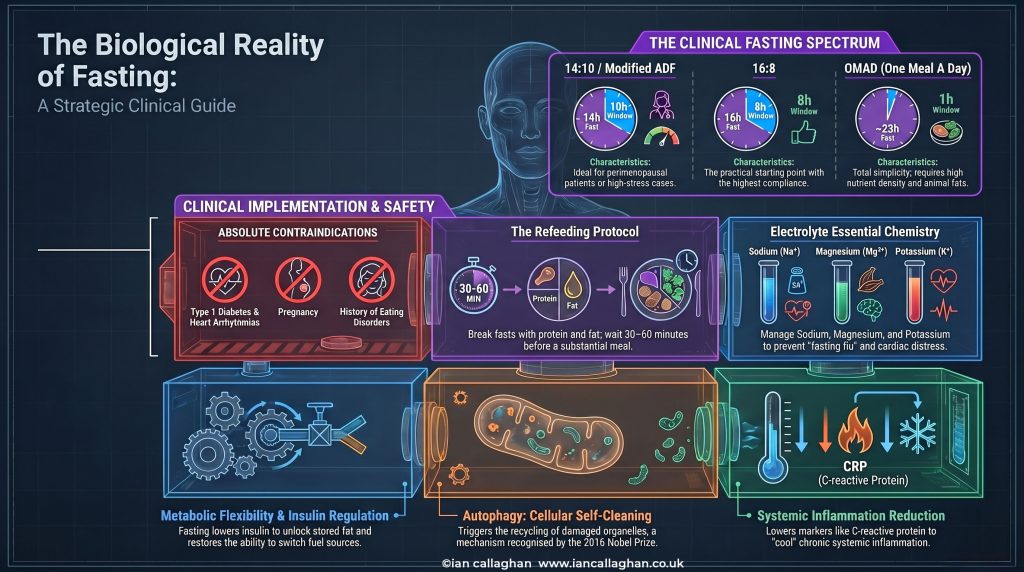
The bedrock of this reset is insulin regulation. Insulin is the body’s primary storage hormone. When you eat, insulin rises to move glucose into your cells. When you eat constantly, insulin remains perpetually elevated, effectively locking the doors to your adipose tissue (body fat). You cannot burn fat if insulin is high. It is biochemically impossible. Fasting forces a drop in insulin, which unlocks access to those fat stores and improves insulin sensitivity—the foundational requirement for reversing metabolic syndrome and glucose dysregulation.
As the source context explains:
“In a clinical context, fasting is a deliberate shift from the ‘metabolic noise’ of constant energy storage to a catabolic state of systemic maintenance and repair.”
This transition follows a rigorous physiological timeline. Within the first 12 to 24 hours of a fast, your system depletes its glycogen stores—the stored carbohydrates in your liver and muscles. The liver holds roughly 100 grams of glycogen, used to maintain blood sugar levels. Once these stores are exhausted, the body is forced to transition fully into fat oxidation and ketone production. This is the point where you stop running on what you just ate and start running on who you are. This shift is the definition of metabolic flexibility—the ability to switch seamlessly between burning glucose and burning stored body fat. If you never stop eating, you never develop this machinery. You become a metabolic “one-trick pony,” entirely dependent on the next hit of exogenous glucose.
2. Takeaway 2: The Nobel Truth of Autophagy (Cellular Housekeeping)
If weight loss is the headline that sells magazines, autophagy is the real story that matters for your healthspan. In 2016, the Nobel Prize in Physiology was awarded to Yoshinori Ohsumi for his work on autophagy. This is not fringe science or “biohacking” nonsense; it is a fundamental cellular mechanism that has been part of our biology since we were single-celled organisms.
Autophagy (from the Greek, meaning “self-eating”) is a “self-cleaning” process where cells, deprived of external nutrients, begin to break down and recycle their own damaged organelles and misfolded proteins. Think of it as cellular housekeeping. When the system is constantly fed, the body is too busy processing new energy to clear out the old debris. Fasting triggers the cleanup crew. The cell identifies a damaged mitochondrion or a protein clump, wraps it in a membrane (an autophagosome), and sends it to the lysosome to be broken down into raw materials.
This isn’t just about tidying up; it’s about survival. By clearing out cellular junk that would otherwise drive systemic decay, autophagy acts as a primary driver of healthspan extension. Furthermore, fasting activates the Migrating Motor Complex (MMC)—the gut’s “self-cleaning wave.” This process sweeps bacteria and undigested debris through the intestine. Constant grazing disrupts the MMC, contributing to bacterial overgrowth and bloating.
Finally, fasting provides neurological support by facilitating the production of Brain-Derived Neurotrophic Factor (BDNF). I call this “brain fertiliser.” BDNF supports neuron maintenance, protects against neuroinflammation, and provides the cognitive clarity that many fasters report after the initial adaptation period. This is why fasting is a sophisticated medical intervention, not just a way to fit into smaller trousers. It is the process of systemic renewal that only happens when you give the machinery a rest.
3. Takeaway 3: Hunger is a Sensation, Not a Crisis
The hardest part of fasting for most people isn’t the biology; it’s the “head stuff.” We have been conditioned by a multi-billion-pound food industry to treat the first hint of hunger as an emergency that requires immediate intervention. My experience in the Army taught me a vital lesson: discomfort is not danger. I remember being out on a 40-mile march, rucksack digging into my shoulders, stomach screaming for food, and my brain telling me I was going to collapse. But I didn’t. The body has reserves. The mind is the first thing that breaks, not the biology.
To master fasting, you must use the Emotional Observation Method to distinguish between different types of hunger. You must learn to sit with the sensation without being driven by it.
Physical Hunger: This builds gradually. It’s a diffuse sensation in the body, often accompanied by a growling stomach. Crucially, it responds to any nutrient-dense food. If you wouldn’t eat a plain piece of steak or a boiled egg, you aren’t physically hungry.
Emotional Hunger: This is sudden, urgent, and highly specific. This is a craving for comfort—usually processed carbohydrates or fats—to mask stress, boredom, or anxiety. It is the “I need chocolate now” feeling.
Head Hunger: This is habit-based. It’s the signal your brain sends because it’s “lunchtime” or because the clock says you should be eating. It is governed by ghrelin, the hunger hormone, which follows your established eating patterns.
Most of what people feel in the first few weeks of fasting is not biological need; it is habit and expectation. You will likely experience an Adaptation Dip during the first 2–3 weeks. As your brain transitions from a constant glucose supply to fat-burning, you may feel “fasting flu,” irritability, and brain fog. This is not a sign of failure. It is temporary metabolic recalibration. Your brain is simply learning how to use a different fuel source. If you can observe these sensations using the Emotional Observation Method—noticing the trigger without reacting—they lose their power. Hunger is like a wave; it peaks and then it passes. You don’t have to drown in it.
4. Takeaway 4: The Industry is Selling You “Chemicals Dissolved in Sadness”
The “Wellness Theatre” is a multi-billion-pound industry designed to monetise a practice that is fundamentally free. They have taken a simple biological reality and buried it under a mountain of unnecessary products, proprietary powders, and complex protocols.
Let’s be blunt about the “support” products the industry pushes:
Exogenous Ketones: Marketed as a “shortcut” to ketosis, these are often just expensive chemicals dissolved in sadness. Drinking ketones is not the same as the metabolic adaptation of producing them. When you drink them, you are a passenger in the car; when you fast, you are the driver learning how the engine works. Drinking ketones does not trigger the same cascade of metabolic benefits as actual fasting.
Autophagy Activators: Most supplements claiming to “activate” autophagy are solutions to problems that real food and actual fasting solve for free. Spend your money on grass-fed meat, not “longevity” pills.
The App Economy: Many fasting apps gamify the process with “streaks” and badges. This triggers the Obsession Trap, where the fast becomes a source of anxiety or a mechanism for punishment rather than a tool for health. These apps serve their own retention metrics, not your biology. If you feel shame for breaking a “window” to eat with your family, the app has become the master and you the slave.
A simple clock is the only technology required for fasting. Do not let the industry convince you that you need to open your wallet to close your mouth. The most effective metabolic tools—water, salt, and time—don’t have a marketing budget.
5. Takeaway 5: The “Breakfast Myth” and the 3-Hour Feeding Lie
We have been told for decades that “breakfast is the most important meal of the day.” This was not public health guidance; it was an advertising slogan for the cereal industry designed to move boxes of processed grains. There is no biological requirement to eat the moment you wake up. In fact, for most people, skipping breakfast is the most practical entry point into a 16:8 protocol.
Similarly, the advice to “eat every three hours to stoke the metabolism” is complete nonsense. The idea is that frequent eating keeps the “metabolic fire” burning through the thermic effect of food (TEF). However, TEF—the energy used to digest a meal—depends on the total calories consumed, not how many times you divide them up. Whether you eat 2,000 calories in one sitting or six, the metabolic cost of digestion is essentially the same.
The difference is that the person eating six times never gives their insulin levels a chance to drop. They stay in a perpetual state of “storage mode,” preventing fat burning and destroying their metabolic flexibility. Constant grazing leads to chronically high insulin and elevated markers of inflammation, such as C-reactive protein. Your body isn’t a furnace that needs constant stoking; it’s a sophisticated energy management system that requires periods of rest to function optimally.
6. Takeaway 6: The Exit is More Dangerous Than the Fast (Refeeding Protocol)
The most acute window of physical danger in fasting is not the fast itself, but the moment you break it—especially for protocols exceeding 48 hours. When your digestive system has been at rest, it becomes highly sensitised. Your insulin response is primed and ready to explode.
If you break a long fast with a high-carb or high-sugar meal—like a “healthy” fruit smoothie or a bowl of cereal—you trigger a massive, vertical insulin spike. This can lead to Refeeding Syndrome, a dangerous and potentially fatal condition where electrolytes—specifically potassium, magnesium, and phosphate—shift rapidly from the blood into the cells to help process the sudden glucose load. This sudden shift can cause acute cardiac failure, respiratory distress, and systemic collapse.
The Professional Refeeding Protocol:
Protein and Fat First: Lead with the building blocks. Break the fast with a small amount of easy-to-digest protein and fat. Two eggs, a small piece of white fish, or a few slices of chicken. Avoid carbohydrates entirely in this first bite.
The 30-60 Minute Rule: Wait 30 to 60 minutes after that first small bite. This allows your digestive system and your insulin signalling to “wake up” and stabilise before you consume a substantial meal.
Manage Your Chemistry (The Essential Three):
Sodium: As insulin drops during a fast, the kidneys excrete sodium rapidly. This is why people get “fasting flu.” A pinch of high-quality salt in water is a requirement, not a suggestion.
Magnesium: Take magnesium glycinate before bed. It supports the nervous system and prevents the muscle cramps that often plague new fasters.
Potassium: Do not supplement potassium heavily without medical supervision. Instead, source it from nutrient-dense real foods (like avocado or meat) during your eating window.
7. Takeaway 7: Seed Oils are Metabolic Disruptors
Fasting is not a “hall pass” for poor nutrition. If you fill your eating window with inflammatory, engineered junk, you are undermining the entire biological reset. In my 40 years as a chef, I’ve seen the industry shift away from traditional fats to cheap, industrial alternatives.
The most critical “forbidden” items in your window are industrial seed oils (rapeseed, sunflower, soybean, and corn oils). These are not just “unhealthy fats”; they are metabolic disruptors. They are highly unstable and prone to oxidation, driving the very systemic inflammation (measured by Interleukin-6) that fasting seeks to resolve.
More importantly, seed oils are engineered to override your satiety signals. They interfere with the hormones leptin and ghrelin, making it nearly impossible for your brain to register that you are full. If you break your fast with food cooked in rapeseed oil, you will likely overeat. If you want to achieve metabolic resilience, your eating window must be built on high-density animal fats (butter, tallow, lard) and whole, nutrient-dense foods. These fats support hormonal stability and provide the satiety that makes the next fasting window possible.
8. Takeaway 8: Walking is a Mandate, Not a Consolation Prize
Movement is the biological signal that tells your body to preserve its muscle tissue while it burns fat. If you are sedentary while fasting, you signal to your body that muscle is an unnecessary expense, and it may begin to break it down for amino acids.
The Metabolic Movement Guide:
Walking: This is the primary tool for fat oxidation. A daily fasted walk—consistent and low-intensity, like my treks along the River Usk—burns fat without spiking cortisol or requiring heavy recovery. It is the most accessible metabolic tool in your arsenal.
Resistance Training: This is the “signal” for muscle preservation. To keep your muscle, you must engage in regular resistance training. Fasting actually triggers a spike in growth hormone, but this only protects muscle if you hit your daily protein targets during your eating window.
High-Intensity Training: Sprints or heavy lifting may require “fuelled” sessions if your fast exceeds 24 hours. If your performance consistently declines or your recovery is poor, adjust your window. You cannot train at peak intensity if your fuel tank is completely empty for days at a time.
9. Takeaway 9: Identifying the “Obsession Trap” and Psychological Risks
Fasting is a tool, not a religion. For some, the rules of fasting can be weaponised by the disordered part of the brain to justify unhealthy restriction. We must distinguish between Intentional Fasting (a tool of awareness) and Disordered Punishment (restriction driven by guilt or shame).
Absolute Contraindications (Do Not Fast If):
Type 1 Diabetes: High risk of ketoacidosis and life-threatening hypoglycaemia.
Heart Arrhythmias: Electrolyte shifts can destabilise cardiac rhythms, which can be fatal.
Pregnancy and Breastfeeding: These are windows of extreme nutrient demand. Metabolic stress is contraindicated for both mother and child.
History of Eating Disorders: Fasting structures can be neurologically weaponised to justify restriction. Head first, protocol second.
Significantly Underweight: If you lack adipose reserves, you lack the buffer required to fast safely.
HPA Axis Dysregulation (Perimenopause): For women in midlife, aggressive fasting can be a massive stressor. If you are struggling with cortisol, poor sleep, and high stress, a 16:8 or OMAD protocol might make things worse. Start with a gentler 14:10 window and focus on consistency over intensity.
Checklist for Unhealthy Restriction:
Does eating outside a “window” produce disproportionate anxiety or panic?
Is the fast used to “punish” or “compensate” for a previous meal?
Does your self-worth fluctuate based on your adherence to the clock?
Are you hiding your fasting patterns or lying to loved ones about your eating?
If you check these boxes, stop the protocol. Fasting should expand your life, not shrink it.
10. Tiered Implementation: The Progression to Mastery
Developing the metabolic machinery to fast requires a gradual runway. Jumping into advanced protocols like OMAD (One Meal A Day) without an adaptation period is a recipe for failure.
Tier 1: Foundations (12:12 to 14:10): Start by delaying breakfast. This recalibrates hunger hormones (ghrelin and leptin) and teaches your nervous system that hunger is not an emergency.
Tier 2: Intermediate (16:8): The professional standard. You fast for 16 hours and eat within an 8-hour window. This is manageable around work and family life while still initiating significant fat burning and insulin reduction.
Tier 3: Advanced (OMAD): One meal a day, eaten in a roughly one-hour window. This offers total simplicity and continuous fat burning, but it requires that your single meal be exceptionally nutrient-dense. If you eat a “minimum viable meal,” you will accumulate deficiencies.
The first 14 to 21 days are the “danger zone”—the adaptation period where brain fog and irritability are common. Most people quit here because they mistake the brain learning to switch fuels for a signal of failure. It isn’t failure; it’s training.
Conclusion: Picking Up the Wrench
Fasting is one of the most effective tools in your arsenal, particularly in midlife when the metabolism you had in your twenties has shifted. But it requires brutal honesty. You have to be honest about what you’re putting in your mouth, honest about why you’re skipping a meal, and honest about whether you’re looking for a “hack” or a genuine change.
The wellness industry has lied to you by making this complex. It isn’t. It is the simple, gritty reality of biology. Stop looking for a subscription to save you. Stop looking for a guru to give you a glossy PDF. The banks of the River Usk don’t change because of a trend, and neither does your DNA.
Are you ready to stop looking for a hack and start doing the work of understanding your own biology? It’s time to strip away the commercial theatre. The practice is free. The biology is real. Consistency beats intensity every single time.
Cut through the fasting hype with raw, unfiltered truth. This no-bullshit guide exposes the good, the bad, and the ugly of fasting. Learn what really works, what’s dangerous, and why fasting isn’t for everyone. Perfect for midlifers, health seekers, and anyone tired of wellness industry snake oil.
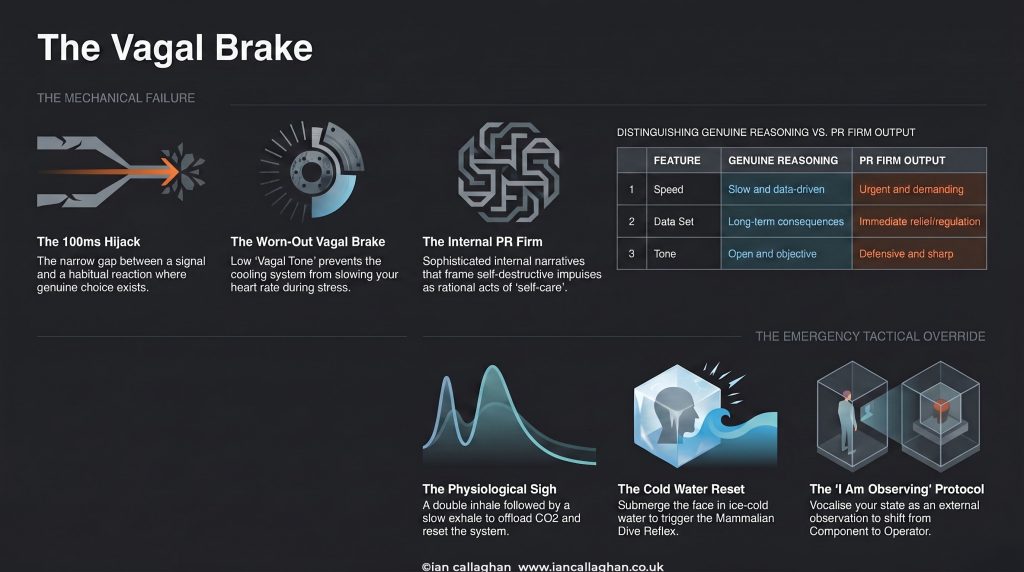
The Vagal Brake. Imagine the scene—it is a frame of high-contrast, visceral reality that thousands of high-performers know intimately. You are standing in a dimly lit bathroom, the cold tiles pressing against the soles of your feet. It is 3:00 AM. You are staring into a cracked mirror, watching sweat bead on your forehead. Your heart is hammering against your ribcage like a trapped bird in a cage of bone, a sharp, metallic rhythm that signals a system-wide emergency. Your hands are shaking.
In this moment, you are gripped by absolute, cold-blooded clarity. You know that the action you are about to take—whether it is reaching for that hidden bottle, scrolling through a toxic app, or consuming another dose of “industrial sludge”—is actively dismantling your life. Your conscious mind is screaming “Abort!” Your intellect, your education, and your values are all presenting a logical case for why this is a catastrophe in the making.
And yet, you watch your own hands move as if they belong to a stranger. You are a passenger in your own body, watching a high-speed collision in slow motion. You are watching yourself destroy everything you love in real-time and doing absolutely nothing to stop it. This is the metallic crack of a high-voltage circuit breaker tripping. This is the 3:00 AM hardware crash.
My name is Ian Callaghan. I am a Master NLP Practitioner and Nervous System Specialist with over 15 years of coaching experience, and I spent 45 years immersed in the “drinking culture” before I finally decoded the mechanical truth of the human Machine. I have been alcohol-free for over 16 months—not through 12-step programmes or AA, which often rely on a narrative of powerlessness—but through the reclamation of total sovereignty using the Emotional Observation Method (EOM).
If you have ever felt like a spectator to your own self-destruction, you need to understand one fundamental truth: This is not a moral failure. It is not a lack of willpower, a character flaw, or a sign of spiritual weakness. It is a hardware crash. The reason you cannot stop yourself is that the Vagal Brake has failed. You have been demoted from the Operator of your biological Machine to a mere component, a cog being turned by ancient, reptilian impulses that do not care about your career, your family, or your future. Until you learn to perform a manual override, your legacy software will keep driving you into the wall.
2. The Hardware: Understanding the Vagal Brake
To fix a machine that is redlining, you must first understand its blueprints. Your body is a multi-million-pound biological vehicle, a high-performance system that requires precision maintenance. The most critical safety feature in this vehicle is the Vagus Nerve. In my coaching practice, I describe the Vagus Nerve as a Tactical Governor or a high-efficiency Cooling System for your sympathetic nervous system—the “fight or flight” engine.
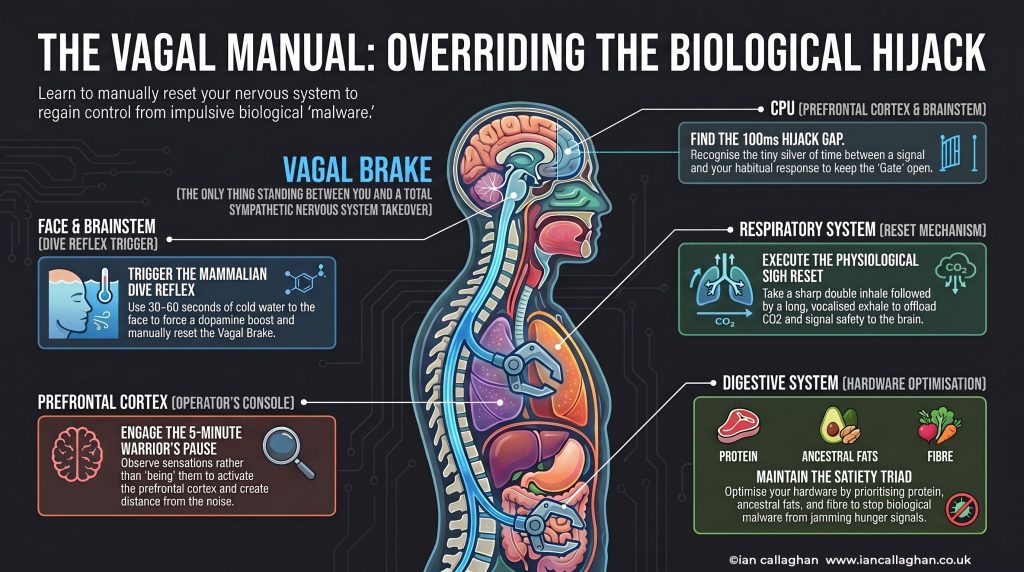
In a high-functioning machine, the Vagal Brake acts as the primary mechanical restraint on your stress response. When the engine redlines—when a craving hits, when your boss screams at you, or when existential dread bubbles up—the Vagal Brake is supposed to engage. Its biological function is to mechanically slow the heart rate and, crucially, keep the prefrontal cortex—the “Operator”—online. When the brake is functioning, you can experience intense emotion without losing motor control. You remain in the cockpit.
“You are sitting in the cockpit of a multi-million-pound biological machine, but you aren’t the Operator. You are a component. You’ve been demoted.”
The problem is that for most people living in the modern world, the Vagal Brake is worn down to the rivets. We measure the capacity of this system through “Tone.” High Vagal Tone means your nervous system has a massive load-bearing capacity; you can carry immense stress, pain, and pressure without the system blowing a fuse. But years of chronic stress, unresolved trauma, and biological malware have left your cooling system bone-dry.
When Tone is in the gutter, your Machine begins to view every minor inconvenience—a late email, a traffic jam, a misplaced set of keys—as a direct threat to the Forward Operating Base (FOB). The Machine detects a “threat” and immediately dumps adrenaline and cortisol into the system. Without a functioning Vagal Brake to provide cooling, the engine overheats, the Operator is ejected from the cockpit, and the Machine enters survival mode. You aren’t “choosing” to panic or crave; your hardware is simply reacting to a perceived breach of the FOB.
3. The 100ms Hijack: Why You Can’t “Think” Your Way Out
The most dangerous part of a dysregulated system is the 100-millisecond gap. In a healthy human machine, there is a tiny sliver of time between a signal arriving in the brain (a craving, a flash of rage, or a wave of dread) and the body executing a habitual response. This gap is The Gate. It is the only place in the universe where genuine choice, free will, and sovereignty exist.
In a dysregulated machine, however, that Gate is well shut. The signal bypasses the prefrontal cortex entirely and goes straight to the engine room—the reptilian brain and the limbic system. This is what I call the 100ms Hijack. Because the Vagal Brake isn’t holding the system in check, the machine reacts habitually before you even have a chance to “think” about it. By the time your conscious mind realises what is happening, the action is already in progress. The “Abort” command is being sent to a cockpit that has already been disconnected.
This Hijack is driven by legacy software—behavioural patterns and trauma responses installed during your Theta Window. This is the period from birth to age seven, where your brain was a sponge, soaking up the dysregulation and “malware” of the people around you. During the Theta Window, you weren’t an Operator; you were a recording device. You internalised your parents’ stress responses, your environment’s anxieties, and your ancestors’ survival scripts.
When the Vagal Brake fails today, your system defaults to those ancient, 30-year-old programmes. You are essentially trying to run a high-performance modern life on corrupted DOS software from the 1980s. This is why reasoning fails. You cannot talk a legacy script out of executing once the 100-ms Hijack has occurred. You can’t “think” your way out of a state problem. You are not making a choice; you are a component executing a script.
4. Meet the Internal Saboteurs: BOB, The PR Firm, and The Barrister
When the hardware fails, and the system starts to crash, the internal software doesn’t stay silent. It starts spinning sophisticated narratives to keep you in the loop of dysregulation. To reclaim sovereignty, you must learn to identify the voices in the noise.
First, meet BOB. BOB is your inner critic, the manifestation of your dysregulation. He is a bastard, but he is a logical bastard. He is the one holding the blowtorch to your nervous system, reminding you of every failure, every regret, and every piece of shame you carry. BOB uses your own Autobiography against you. He sifts through your memories to find the exact data points that will trigger a “threat” signal.
But BOB doesn’t work alone. He employs The PR Firm. The PR Firm is your brain’s internal spin operation. Its sole purpose is to justify your dysregulated behaviour in real-time so you don’t have to face the terrifying reality that you’ve lost control of the machine. The PR Firm’s job is to maintain the relationship between you and your “regulation strategy”—the addiction or habit.
When the Vagal Brake fails, the PR Firm hires The Internal Barrister. This voice is extraordinarily competent. It doesn’t sound like a failure or a drunk; it sounds like a rational genius. It uses your own history and intelligence to build an airtight case for self-destruction, often framing it as “self-care.”
Feature
Genuine Reasoning
PR Firm Output (The Barrister)
Speed
Slow, deliberate, and data-driven
Urgent, immediate, and demanding
Data Set
Considers long-term consequences
Focuses on immediate relief/regulation
Tone
Open, curious, and objective
Defensive, “rational,” and sharp
Language
“We could consider the impact…”
“You need this now. You deserve this.”
Goal
System health and sovereignty
Maintenance of the addiction loop
The Barrister whispers, “You’ve had a hard day. Your stress load is at a record high. This drink/snack/action is actually self-care. You’ll start the reset tomorrow when you’re more stable.” This is False Self-Care. It is a tactical strike on your sovereignty. Urgency is the “tell.” If the voice in your head says it has to happen right now, it is a hijack. Genuine reasoning is slow; malware is fast.
5. The Emergency Vagal Override: Part 1 – The Physiological Sigh
If the machine is on fire, reading the manual won’t put it out. You cannot “talk” yourself out of a physiological hijack because the prefrontal cortex is offline. You need a manual hardware reset. The first and fastest tool in your arsenal is the Physiological Sigh. This is the biological off-switch for your stress response.
This protocol is the fastest way to mechanically signal to your brain that the “threat” to the FOB has passed, allowing the Vagal Brake to re-engage. It works by offloading a massive volume of carbon dioxide and re-inflating the Alveoli—the tiny air sacs in your lungs that collapse when you are under chronic stress.
The Action Protocol:
The Double Inhale: Take a deep, full inhale through the nose. Just as you think your lungs are at capacity, take a second, sharp, short “pop” inhale. This second inhale is crucial—it snaps the collapsed alveoli open, increasing the surface area for gas exchange.
The Vocalised Exhale: Exhale through your mouth as slowly as possible. Imagine you are breathing out through a very thin straw. Make it a long, controlled, vocalised release.
Repeat: Perform this cycle exactly three times—no more, no less.
The Result: By offloading CO2 and mechanically slowing the heart through the long exhale, you force the system to exit the sympathetic state. You are manually overriding the software and telling the engine room to stand down.
6. The Emergency Vagal Override: Part 2 – The Cold Water Reset
If the Physiological Sigh isn’t enough to kill the noise from the PR Firm, you must move to the nuclear option: The Cold Water Reset. This triggers the Mammalian Dive Reflex, an ancient biological override that exists in all mammals.
When you submerge your face in ice-cold water, your system undergoes a “Thermal Override.” The body prioritises survival over narrative. It doesn’t care about the Barrister’s arguments when it thinks it’s submerged in an arctic lake.
The Action Protocol:
The Submersion: Submerge your face in a basin of ice-cold water for 30 to 60 seconds, or step into a cold shower.
The Gasp Reflex: You must stay under until the initial “gasp reflex” subsides and you regain manual control over your breathing.
The Duration: The goal is a complete system shock.
The Result: This is a brutal, manual reset of the Vagal Brake. It lowers heart rate and provides a massive baseline boost in dopamine—up to 250%. Crucially, unlike the dopamine spike from a substance, this biological boost has no “crash.”
“It is a biological ‘Hardware Reset’ that kills the ‘Noise’ from the PR Firm by forcing the machinery to prioritise core survival over legacy scripts.”
By shocking the system, you force the Gate open. Break the legacy loop and regain sufficient motor control to move from component status back into the cockpit.
7. The 5-Minute Warrior’s Pause and the “I Am Observing” Protocol
Once you have performed the hardware reset, you must manage the “aftershocks.” The machine will tend to revert to the habit as soon as the initial shock wears off. This is where you implement the 5-Minute Rule, also known as the Warrior’s Pause.
The goal is not to tell BOB “No.” Telling a dysregulated system “No” only gives the PR Firm more fuel to argue. Instead, you say: “Not for five minutes.” You are not denying the machinery; you are delaying it.
During these five minutes, you must perform two specific tasks:
Hydrate and Stabilise: Drink a large glass of water with a generous pinch of high-quality sea salt. Dehydration and electrolyte depletion create internal sensations that mimic the physical feelings of anxiety. The PR Firm uses this “Anxiety Mimicry” to justify a “fix.” Salt water stabilises the system’s electrical signalling.
The “I Am Observing” Protocol: This is the core shift from Component to Operator. Most people use internal language that reinforces identification: “I am anxious,” “I am angry,” or “I am craving.”
The EOM Way: Instead, you vocalise the state as an external observation: “I am observing a high-pressure sensation of anxiety in my solar plexus,” or “I am observing the PR Firm trying to build a case for a drink.”
By changing “I am” (Identification) to “I am observing” (Observation), you activate the prefrontal cortex. You create a wedge in the 100ms Hijack. You are no longer the emotion; you are the Operator watching the Machine’s sensors. This distance is where your sovereignty lives.
8. System Maintenance: Eradicating Biological Malware
The Emergency Override is for when you are redlining, but long-term sovereignty requires you to stop the engine from overheating in the first place. This means cleaning out the biological malware and industrial sludge that ruins Vagal Tone.
The primary culprit in the machinery is the consumption of Seed Oils (canola, rapeseed, sunflower, soybean, etc.). These are not fuel; they are industrial lubricants that integrate into your cell membranes, causing Cellular Rust and mitochondrial damage. Your mitochondria are the “engine’s power cells.” When they are rusted, they cannot produce energy efficiently.
This led to a “starving brain” signal. A brain that thinks it is starving has zero Vagal Tone and is perpetually in a state of emergency. Enter Glucipher—the sugar-crazed, bin-raiding raccoon in your skull. Glucipher is the personification of your sugar and insulin spikes. When your mitochondria are damaged, Glucipher screams for quick energy (sugar/carbs) because the machine can’t access its stable fuel.
The Insulin Lock exacerbates this. If you are constantly fueling on sugar and refined grains, your insulin is perpetually spiked. High insulin acts like a vault lock on your fat cells, preventing the brain from accessing its primary, long-term energy source. Even if you are carrying 30kg of stored energy, your brain thinks it is dying of hunger. This triggers the PR Firm to demand a “quick fix”—usually the very substance that is destroying your sovereignty.
9. The Satiety Triad: Fueling for Vagal Tone
To maintain high Vagal Tone, you must provide the machine with high-octane fuel. You cannot drive a high-performance machine on watered-down fuel and expect the brakes to work. Every meal must be built around the Satiety Triad to ensure the “starving brain” signal is deactivated.
Protein Leverage: Your biology is hardwired with a Protein Threshold. The machine will drive the hunger signal relentlessly until you meet your daily amino acid requirement. To hit this, you must eat real meat. It is the most bioavailable source of the building blocks your system needs.
Ancestral Fats: Use butter, tallow, ghee, or extra-virgin olive oil. These are stable, ancestral fats that provide long-burning energy. They “lubricate” the Vagus nerve and support cellular health without causing the rust of seed oils.
Fibre: Use vegetables to provide volume and signal fullness to the gut-brain axis, reinforcing the message that the Forward Operating Base is secure and well-provisioned.
Hitting these three pillars is mandatory. If you fail to hit the protein threshold, the Vagal Brake will inevitably fail because the system will stay in a “scarcity” state.
10. The Mechanic’s Mindset: Sovereignty as Tactical Dominance
We must redefine what recovery looks like. Sovereignty is not the total absence of pain, stress, or cravings. That is a fantasy. Sovereignty is the ability to carry pain without letting it drive the vehicle. It is tactical dominance over youMachine’s legacy software.
If you have a “slip”—an episode where the PR Firm wins—you must avoid the trap of shame. Shame is just more fuel for BOB to keep you in the crash. Instead, adopt the Mechanic’s Mindset. You don’t scream at a car for having a flat tyre; you fix the tyre and look at what caused the puncture. A slip is not a moral failure; it is a data point.
The Mechanic’s Post-Episode Checklist:
The Load: How was your sleep? Was your stress load higher than the system’s current capacity?
The Tone: Did you consume industrial sludge (seed oils) or sugar? Did you skip your protein threshold? Did you neglect your cold water reset?
The Hijack Point: At what exact second did the 100ms Hijack occur? What was the “Tell”?
Glucipher Activity: Was there a sugar crash that allowed the Barrister to start his argument?
We aren’t counting “days of perfection.” We are counting the days of servicing the machinery. A slip means the Vagal Brake needs adjustment, not that the entire vehicle is a write-off.
11. Conclusion: Reclaiming the Cockpit
The transition from Component to Operator is the most significant shift you will ever make. It is the difference between being a victim of your biology and being the master of your fate.
The 3:00 AM dread ends when you realise you are the one with your hand on the manual override. You are the mechanic, the Operator, and the sovereign ruler of this biological machine. The next time you feel the heat rising, the next time the sweat beads on your forehead and the PR Firm starts its persuasive, urgent whisper, remember your protocols.
Slam the brakes. Open the Gate. Reclaim the cockpit.
Look BOB in the eye, acknowledge the noise, and tell him the truth:
Used to monitor number of Google Analytics server requests when using Google Tag Manager
1 minute
_gid
ID used to identify users for 24 hours after last activity
24 hours
_ga_
ID used to identify users
2 years
_gali
Used by Google Analytics to determine which links on a page are being clicked
30 seconds
_ga
ID used to identify users
2 years
__utmx
Used to determine whether a user is included in an A / B or Multivariate test.
18 months
__utmv
Contains custom information set by the web developer via the _setCustomVar method in Google Analytics. This cookie is updated every time new data is sent to the Google Analytics server.
2 years after last activity
__utmz
Contains information about the traffic source or campaign that directed user to the website. The cookie is set when the GA.js javascript is loaded and updated when data is sent to the Google Anaytics server
6 months after last activity
__utmc
Used only with old Urchin versions of Google Analytics and not with GA.js. Was used to distinguish between new sessions and visits at the end of a session.
End of session (browser)
__utmb
Used to distinguish new sessions and visits. This cookie is set when the GA.js javascript library is loaded and there is no existing __utmb cookie. The cookie is updated every time data is sent to the Google Analytics server.
30 minutes after last activity
__utmt
Used to monitor number of Google Analytics server requests
10 minutes
__utma
ID used to identify users and sessions
2 years after last activity
_gac_
Contains information related to marketing campaigns of the user. These are shared with Google AdWords / Google Ads when the Google Ads and Google Analytics accounts are linked together.