Description
Sober Beyond Limits: The Machine, The Loop, and How to Stop Running It
You already know something is wrong. You have known for years. You know what it costs you, what it takes from you, what it does to your sleep and your mornings and your body. You can explain your own patterns with clinical precision.
And yet here you are.
This book is not for people who need convincing that alcohol is a problem. It is for the person who already knows and still cannot stop. The person who has tried the programmes and found them built for someone else’s problem. The person who does not identify with rock bottom because the rock bottom never came, or has come repeatedly without producing the dramatic change it was supposed to produce.
It is for the person who needs a mechanic. Not a moralist. A manual. Not a meeting.
What this book actually is
Sober Beyond Limits is built on the Emotional Observation Method, a systems-based framework for understanding why human beings keep doing the things that are destroying them. It does not ask you to surrender. It does not ask you to label yourself. It does not require a higher power, a sponsor, or a room full of strangers.
It requires you to understand the machine you are operating.
The book covers the full architecture of the loop. Bob, the part of the machine that will construct an award-winning defence of any destructive behaviour you care to name. The PR Firm, the sophisticated internal voice that has been justifying the drinking for longer than you can remember. Tone, the baseline operational state that determines whether The Gate can be held open or not. Signal and Noise, what the craving is actually reporting and what it is not. Glucipher, the blood sugar chaos mechanism nobody in the recovery industry talks about. And The Gate itself, the gap between signal and response where sovereignty either exists or has been ceded without the Operator noticing.
Then it gets practical. Because the framework without the inputs is architecture without a building.
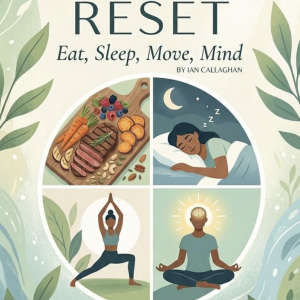
The food chapter is written by a qualified chef with forty years of practice in real food. It covers what the machine was actually built to run on, why blood sugar stability is a mental health intervention not a dietary preference, and how to address the physiological basis of the craving at the level of the body rather than the mind.
The sleep chapter covers what alcohol actually does to sleep architecture and why the sleep on the other side of the programme is categorically different from anything the machine has experienced in years.
The move chapter opens on the River Usk in South Wales, where the author has been getting in cold water for fifty years. Before it had a name. Before it had a hashtag. Because the machine was always designed to move and the machine that does not move accumulates the stress that Bob runs on.
The mind chapter covers breath, NLP, Reiki, visualisation, and the emotional backlog, the work that goes below the level of thought to address the operating conditions that generate the behaviour.
Who wrote it
Ian Callaghan served twelve years in the British Army. He spent twenty-five years as an IT security architect. He is a qualified chef, an NLP Master Practitioner, and a Reiki Master. He has three herniated discs at L3, L4, and L5 from Army service, managed without pharmaceutical intervention. He has been coaching people through self-sabotage, addiction, and behavioural change for fifteen years.
He had his first drink at eleven years old. He stopped on the winter solstice of 2024 after forty-five years. In the months that followed he lost over five stone and reversed a prediabetes diagnosis.
He is not a recovered addict offering you the gift of his redemption. He is a mechanic who spent forty-five years running every fault code in the system before building the manual that should have existed already.
What is in the book
Prologue: The river was there before any of it. Chapter One: The Machine. Not a drinking problem. A hardware problem. Chapter Two: The Installation. Where the wiring began and why it stuck. Chapter Three: Bob and the PR Firm. How the machine defends the loop it cannot afford to lose. Chapter Four: Tone. The baseline that determines everything else. Chapter Five: Signal and Noise. What the craving is actually telling you, and what it is not. Chapter Six: The Gate. The gap between signal and action. Where sovereignty lives or does not. Chapter Seven: Eat. Feed the machine what it was actually built to run on. Chapter Eight: Sleep. The repair the machine cannot do without. Chapter Nine: Move. The body is not a taxi for the head. Chapter Ten: Mind. The toolkit that does not require a programme or a sponsor. Chapter Eleven: The Winter Solstice. What the decision actually looked like, and what came after it. Chapter Twelve: Sovereignty. Not the absence of pain. The ability to carry it without letting it drive.
Instant digital download. 184 pages.
The machine can be serviced.
Pick up the wrench.
Reviews
There are no reviews yet.