I Was 11 the First Time I Drank—And No One Batted an Eyelid
Let me tell you something most people won’t admit— I started drinking when I was 11.
Not 18. Not 16. Eleven.
And no, it wasn’t some one-off sip of wine at Christmas. This was the late ’70s. Council estate life. Punk and skinhead era. We were in the fucking trenches—boys club discos, chaos, fights, no guidance. And booze? That was just part of it.
We got older kids to buy it for us. Or nicked it. Pinched our dads’ homebrew. Cheap continental lager or rough red wine. Didn’t matter. We drank it because that’s what you did.
No one warned us. No one stopped us. And no one saw anything wrong with it.
It Wasn’t Just a Drink—It Was the Beginning of a Trap
People think alcohol abuse starts in your twenties. That you need trauma or rock bottom or a divorce to drink like that.
Nah. For me, it started before I even hit puberty.
By 15, we were regulars in the local pubs. By 16 we were in nightclubs with fake IDs—acting older than we were, but clueless as f**k inside.
It was the culture. Drink to be accepted. Drink to be confident. Drink to forget home, school, violence, boredom, fear, loneliness.
Drink to belong.
The Truth? Nobody Told Me It Was a Fucking Poison
You know what’s mad?
No teacher ever said, “Don’t drink—it’ll ruin your brain.” No parent said, “You’re not ready for this.” No adult stepped in and said, “What are you numbing?”
And that’s the problem.
We grow up in environments where alcohol is treated like a rite of passage. Like it’s just part of becoming a man. Get pissed. Laugh about it—black out. Fight someone. Wake up and go again.
But no one tells you that the addiction starts early. The way it wires your brain—your dopamine, reward system, and emotional regulation—starts from the first sip.
And if you’re a kid already dealing with trauma, pressure, poverty, or pain? Alcohol doesn’t feel like a threat. It feels like a fking solution.
By the Time I Hit My 40s, I’d Been Drinking for 30 Years Straight
You want to know how it plays out?
You blink, and suddenly you’ve been drinking for decades. 5 p.m. becomes the norm. Weekends blur into Mondays. Hangovers are just part of the routine. You start drinking for every emotion—celebration, stress, grief, boredom.
But it started with a bottle at 11. In a park. On a cold night before the disco. With a group of lads who didn’t know any better.
What I Wish Someone Had Said to Me Back Then
I wish someone had looked me in the eye and said:
“This shit is going to steal decades from you. It’s going to lie to you, break you, numb you, and convince you it’s your only escape. You deserve better. You are not weak for wanting to feel things without drinking.”
But no one said that. So I learned the hard way.
Started drinking at 11 |Over 40 Years Drinking. Now Over 20 Weeks Sober.
I’m not here to preach. I’m not here to shame. I’m just here to tell you the truth.
I drank for four decades. Never went to rehab. Never touched AA. I said f**k surrender. I rewired my mind. I built a new life from the ground up using:
We’ve all been there: waking up after a night of drinking with a pounding head, a parched mouth, and a queasy stomach. It’s the classic hangover, and you swear you’ll never drink again. But what if those familiar, unpleasant sensations are something far more serious?
For many, the line between a bad hangover and alcohol withdrawal can blur, often with dangerous consequences. It’s a distinction that can save lives. As someone who navigated over four decades of heavy drinking, I understand this confusion firsthand. This isn’t about shaming; it’s about a brutal truth.
Author: Ian Callaghan, Certified Mindset Coach and Sober Living Advocate, with over 40 years of personal experience in overcoming severe alcohol dependence. Ian offers raw, unfiltered insights and practical strategies for anyone seeking to break free from alcohol’s grip. Find out more about Ian’s journey and approach at iancallaghan.co.uk/sober-coach-ian-callaghan/.
A hangover is your body’s short-term response to the chemical chaos alcohol causes in your system. It happens after a single episode of excessive drinking. It’s an acute toxic reaction, typically when your blood alcohol content returns to zero.
Common hangover symptoms typically include:
Dehydration
Headache
Nausea or vomiting
Fatigue and general malaise
Anxiety or irritability (“hangxiety”)
Sensitivity to light and sound
Muscle aches
These symptoms usually fade within 12−24 hours once the alcohol has been fully metabolised and cleared from your system. It’s your body giving you a clear, if unpleasant, message: “Please regulate your intake next time.” Hangovers are uncomfortable, but they generally pass without severe medical intervention and are not life-threatening.
Now Let’s Talk Alcohol Withdrawal – The Real Beast
Alcohol withdrawal is a completely different phenomenon. It occurs when your body has developed a physical dependence on alcohol due to heavy, regular drinking, and that alcohol supply is suddenly stopped or significantly reduced. It’s not just reacting to alcohol leaving your system; it’s desperately craving it back because its normal functioning now relies on the substance. This is the critical, potentially life-threatening distinction in the hangover vs alcohol withdrawal discussion.
Common alcohol withdrawal symptoms are far more severe and dangerous than a hangover, often escalating over time:
Shaking or tremors (especially hands)
Excessive sweating
Rapid heartbeat and dangerously high blood pressure
Intense anxiety, panic attacks, or agitation
Severe insomnia and disturbed sleep
Nausea and vomiting that can persist
Confusion and disorientation
Hallucinations (visual, auditory, tactile – seeing, hearing, or feeling things that aren’t there)
Seizures
Delirium Tremens (DTs): A severe, acute manifestation of withdrawal characterised by profound confusion, rapid heart rate, high blood pressure, fever, sweating, tremors, and severe agitation. This is a medical emergency.
This isn’t just a “bad morning after.” This is your central nervous system in meltdown, desperately trying to re-regulate after prolonged suppression by alcohol. Without proper medical care, severe alcohol withdrawal can be fatal.
(Consider adding a powerful image or illustration depicting the severity of alcohol withdrawal symptoms or a “before/after” concept related to health decline/recovery.)
Why the Confusion Between Hangover and Alcohol Withdrawal?
The distinction between a hangover vs alcohol withdrawal can be incredibly confusing, primarily because withdrawal often creeps up subtly and shares some initial symptoms with a hangover. Many people who drink regularly don’t immediately notice the dangerous shift. They mistakenly believe the increasing severity of their “after-effects” is simply a “worse hangover.”
But watch for these escalating signs:
The shakes last longer, becoming a constant presence.
The crushing anxiety and irritability don’t go away, even after hours or days.
You find yourself needing a drink just to feel normal, to calm your nerves, to sleep, or to function in daily life, not just to socialise or unwind.
That’s not “too much fun last night.” That’s a profound dependence. Your body has adapted to alcohol’s constant presence, and when it’s removed, it goes into a dangerous physiological shock. Recognising these early, escalating signs is vital when navigating the difference between a hangover vs alcohol withdrawal.
Ian’s Story – 40+ Years Drinking, over 5 months free
I drank heavily for over four decades. My journey wasn’t through AA or traditional rehab. I quit through a deliberate process of mindset rewiring, brutal honesty with myself, and a clear, unwavering purpose.
Before I understood what was happening, I had no idea the profound impact alcohol had taken on my body and mind. Hangovers became my uncomfortable baseline. Then, insidious alcohol withdrawal symptoms began to emerge, but I simply didn’t recognise them for what they were.
I rationalised it:
“I’m just anxious.”
“It’s normal to feel this way as I’m ageing.”
“I just need better sleep.”
The truth was, I needed to stop pouring poison down my throat and stop pretending it was stress relief or just a “bit of fun.” My personal experience underscores just how easy it is to confuse a hangover with alcohol withdrawal until the stakes become dangerously high.
(Consider adding a personal image of Ian here, perhaps one that conveys resilience or a reflective mood, to build a deeper connection with the reader.)
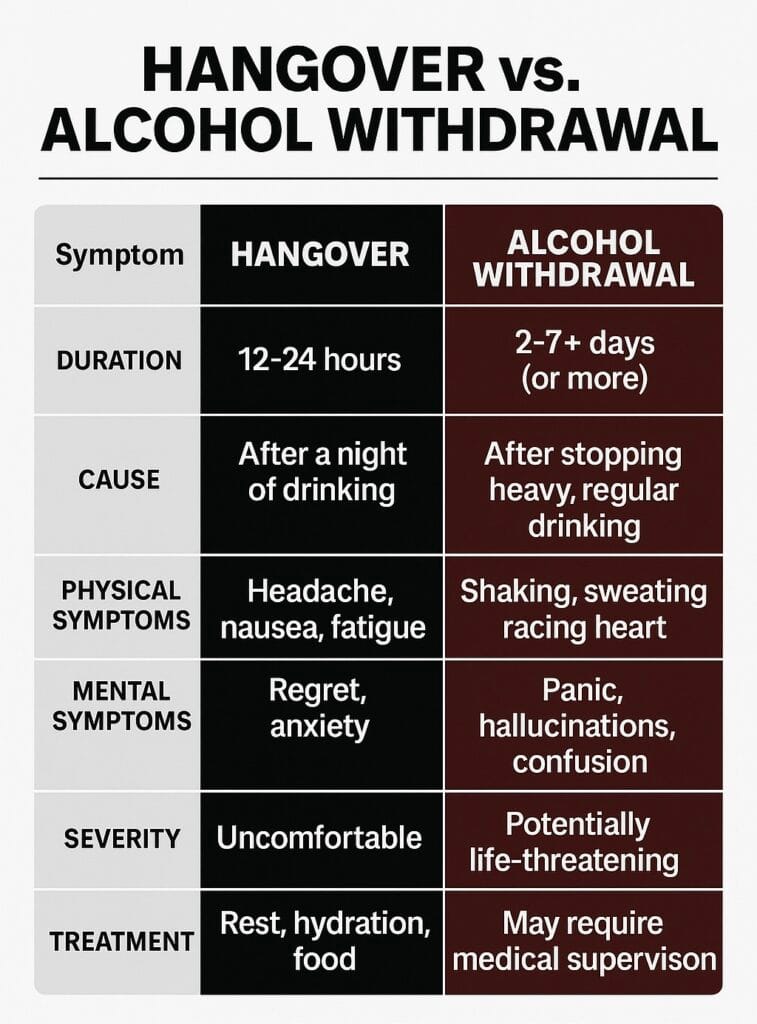
Hangover vs Alcohol Withdrawal: A Side-by-Side Comparison
To clarify the stark differences between a hangover vs alcohol withdrawal, here’s a direct comparison of key aspects:
Feature
Hangover
Alcohol Withdrawal
Onset
When blood alcohol content approaches zero or returns to normal
Hours to days after the last drink, if physically dependent
Duration
Typically 12−24 hours, rarely longer
Can last 2−7+ days, with peak severity at 24−72 hours, some symptoms for weeks
Core Cause
Acute toxicity from excessive alcohol intake
The body’s severe reaction to the absence of alcohol is become dependence
Physical Symptoms
Headache, nausea, fatigue, dehydration, and muscle aches
Shaking, profuse sweating, rapid heartbeat, high blood pressure, seizures, fever
Mental Symptoms
Regret, mild anxiety, irritability
Intense anxiety/panic, severe insomnia, confusion, agitation, paranoia, hallucinations
Severity & Risk
Uncomfortable, unpleasant; generally not life-threatening
Potentially life-threatening; risk of seizures, Delirium Tremens, and death
Often requires medical supervision (detox), benzodiazepines, and supportive care
(Consider adding a custom infographic or visual representation of this comparison table here. A well-designed infographic can be highly shareable and effective in conveying complex information quickly.)
FAQs: No Fluff, Just Facts on Hangover vs Alcohol Withdrawal
Q: How do I know if I’m dependent on alcohol?
A: If you find you need a drink to feel normal, to calm your nerves, to sleep, or to simply function in your daily routine, that’s a strong indicator of dependence. This isn’t just a habit or coping mechanism; it’s a physiological reliance. This need is the critical distinguishing factor when considering a hangover vs alcohol withdrawal.
Q: Can you die from alcohol withdrawal?
A: Yes. Severe alcohol withdrawal can lead to dangerous complications such as seizures, delirium tremens (DTs), and even death. Do not underestimate the risks. If you suspect severe withdrawal symptoms, seek immediate medical help. (Source: MedlinePlus Medical Encyclopedia: Alcohol withdrawal)
Q: Is it safe to quit cold turkey?
A: Not always. If you’ve been drinking heavily or regularly for a long period, attempting to quit “cold turkey” without medical supervision can be extremely dangerous. The abrupt cessation can trigger severe withdrawal symptoms like seizures and DTs. It is crucial to consult your GP or a medical professional for guidance and support before attempting to stop drinking. (Source: Drinkaware: How to stop drinking alcohol completely)
Q: Can I stop drinking without rehab or AA?
A: Absolutely. My journey proves it’s possible. However, it requires more than just willpower. You need a clear strategy, a supportive environment, and the willingness to face uncomfortable truths through a process like mindset rewiring. For many, professional guidance – even if not inpatient rehab – is crucial. Find out more about effective strategies for quitting alcohol and the power of mindset rewiring in my Sober Mindset Guide
The Real Reason This Matters
Most people don’t seek help for alcohol dependence until they perceive themselves to have hit “rock bottom.” But what if you didn’t need to reach that extreme low to turn your life around? What if simply understanding what’s truly happening inside your body and mind could be the catalyst for change?
It’s time to stop calling it a hangover when it’s really alcohol withdrawal. It’s time to stop brushing off escalating symptoms as “just getting older” when your vitality is fading away, silently eroding your physical and mental health.
This post isn’t intended to instil fear. It’s about revealing the truth. Because once you fully comprehend the profound difference between a hangover vs alcohol withdrawal, you cannot unknow it. This knowledge empowers you to make informed decisions for your well-being.
You Deserve More Than Just Surviving the Morning After
Imagine mornings without shame, regret, or a pounding head.
Imagine days filled with clarity and purpose, free from the constant fog of alcohol.
Imagine nights of peaceful, natural sleep, without needing a substance to shut down.
It all begins by honestly confronting this question:
Am I just hungover — or is this something deeper, something related to alcohol withdrawal?
Take Action Before It Takes You Out
You don’t necessarily need a clinical label. You might not need traditional rehab if that’s not your chosen path. But you do need to stop rationalizing and bullshitting yourself about your drinking and its escalating effects.
And I am here to equip you with the exact strategies and mindset shifts to guide you through this transformation.
Many men turn to alcohol to unwind. Why alcohol makes anxiety worse in men.
End of a long day. Work stress. Relationship tension. Your head’s noisy. Your body’s tight. You crack open a beer, pour a glass of wine, or throw back something stronger.
You tell yourself it helps you relax. Helps you forget. Helps you sleep. But here’s the brutal truth: That drink you think is helping? It might be the very thing keeping you stuck in stress, anxiety, and a low mood.
And I say that as someone who drank for over 40 years. Not casually. Not occasionally. But daily. Drinking to take the edge off. To feel normal. To feel like me.
Why Alcohol Increases Stress and Anxiety in Men
Alcohol does give temporary relief. That’s what makes it dangerous.
It lowers your inhibitions. Numbs the tension. You feel looser. You forget the thing you were ruminating about five minutes ago.
But then? Your brain rebounds. Alcohol spikes your dopamine—and then crashes it lower than before. It sedates your nervous system but interrupts your natural sleep cycles. You wake up more tired, more wired, and more prone to anxiety the next day.
So what do you do? You pour another drink the next night. And the cycle continues.
What you think is relaxing you is actually slowly rewiring your brain for dependency and dysfunction.
It’s Not Just a Habit—It’s a Coping Mechanism You Were Taught
Most men weren’t taught how to process emotion. We weren’t given tools. We were given silence. Or told to “man up.” Or offered a pint as a solution to problems we never learned to face.
So, of course, alcohol became the go-to. It wasn’t weakness. It was conditioning.
But here’s the thing—what got you here won’t get you out.
What Happens When You Quit “Unwinding” That Way
When I quit drinking, everything got louder at first. The stress. The overthinking. The shame. The silence. And it made me realise something most men never want to admit:
The drink wasn’t helping.It was just muting. And behind that muting was a version of me I didn’t know how to face.
But once I allowed myself to feel it? Once I actually felt the stuff I’d been drinking to avoid? That’s when the real unwinding started.
My sleep got better. My focus got sharper. The panic calmed. My stress dropped—not because I avoided it, but because I finally gave my nervous system a chance to reset.
There’s a Different Way to Decompress
I replaced the bottle with rituals that actually regulate my system:
Tools that don’t come with a hangover or guilt—physical, emotional, and mental anchors I now rely on daily:
Physical: Cold water exposure, early walks, real food. These regulate my body, boost energy, and keep me grounded.
Emotional: Deep conversations, solitude, honest reflection. These help me face what I used to run from.
Each of these tools helped me build a system that works with my body and mind—not against it.
I stopped self-medicating and started self-leading.
But it’s OK to Talk About This, and Why alcohol makes anxiety worse in men.
Let’s be honest—most men won’t say this stuff out loud.
They think:
“Everyone else drinks, so I must be fine.”
“I don’t drink that much.”
“It’s how I switch off.”
“It’s not hurting anyone.”
But you feel it. In your head. In your gut. In your relationships. You know when it’s not serving you anymore.
So say it. Even just to yourself, for now:
“This isn’t working anymore.” “There has to be a better way.” “I want more than this.”
Because it’s not weak to talk. It’s brave to change. It’s powerful to be honest.
You Deserve More Than the Pint You Keep Pouring
You’re not broken. You’re stuck in a loop that was sold to us as normal.
But you can break it. You can reset. You can build a new way of unwinding that doesn’t cost you your clarity, energy, or peace.
Frequently Asked Questions
Q: Does alcohol cause anxiety in men? Yes. While alcohol may seem to relax you short term, it disrupts your nervous system and sleep, making anxiety worse over time.
Q: What are healthy alternatives to alcohol for stress relief? Breathwork, cold exposure, journaling, and walking in nature are effective ways to calm your mind and reset your stress response.
Q: Can quitting alcohol improve mental health? Absolutely. Many people experience better sleep, mood stability, focus, and energy after removing alcohol from their routine.
I’m Ian. I drank for 40+ years. I quit without rehab or AA. Now I help other men do the same—on their terms, in their time, with real tools that work.
Used to monitor number of Google Analytics server requests when using Google Tag Manager
1 minute
_gid
ID used to identify users for 24 hours after last activity
24 hours
_ga_
ID used to identify users
2 years
_gali
Used by Google Analytics to determine which links on a page are being clicked
30 seconds
_ga
ID used to identify users
2 years
__utmx
Used to determine whether a user is included in an A / B or Multivariate test.
18 months
__utmv
Contains custom information set by the web developer via the _setCustomVar method in Google Analytics. This cookie is updated every time new data is sent to the Google Analytics server.
2 years after last activity
__utmz
Contains information about the traffic source or campaign that directed user to the website. The cookie is set when the GA.js javascript is loaded and updated when data is sent to the Google Anaytics server
6 months after last activity
__utmc
Used only with old Urchin versions of Google Analytics and not with GA.js. Was used to distinguish between new sessions and visits at the end of a session.
End of session (browser)
__utmb
Used to distinguish new sessions and visits. This cookie is set when the GA.js javascript library is loaded and there is no existing __utmb cookie. The cookie is updated every time data is sent to the Google Analytics server.
30 minutes after last activity
__utmt
Used to monitor number of Google Analytics server requests
10 minutes
__utma
ID used to identify users and sessions
2 years after last activity
_gac_
Contains information related to marketing campaigns of the user. These are shared with Google AdWords / Google Ads when the Google Ads and Google Analytics accounts are linked together.