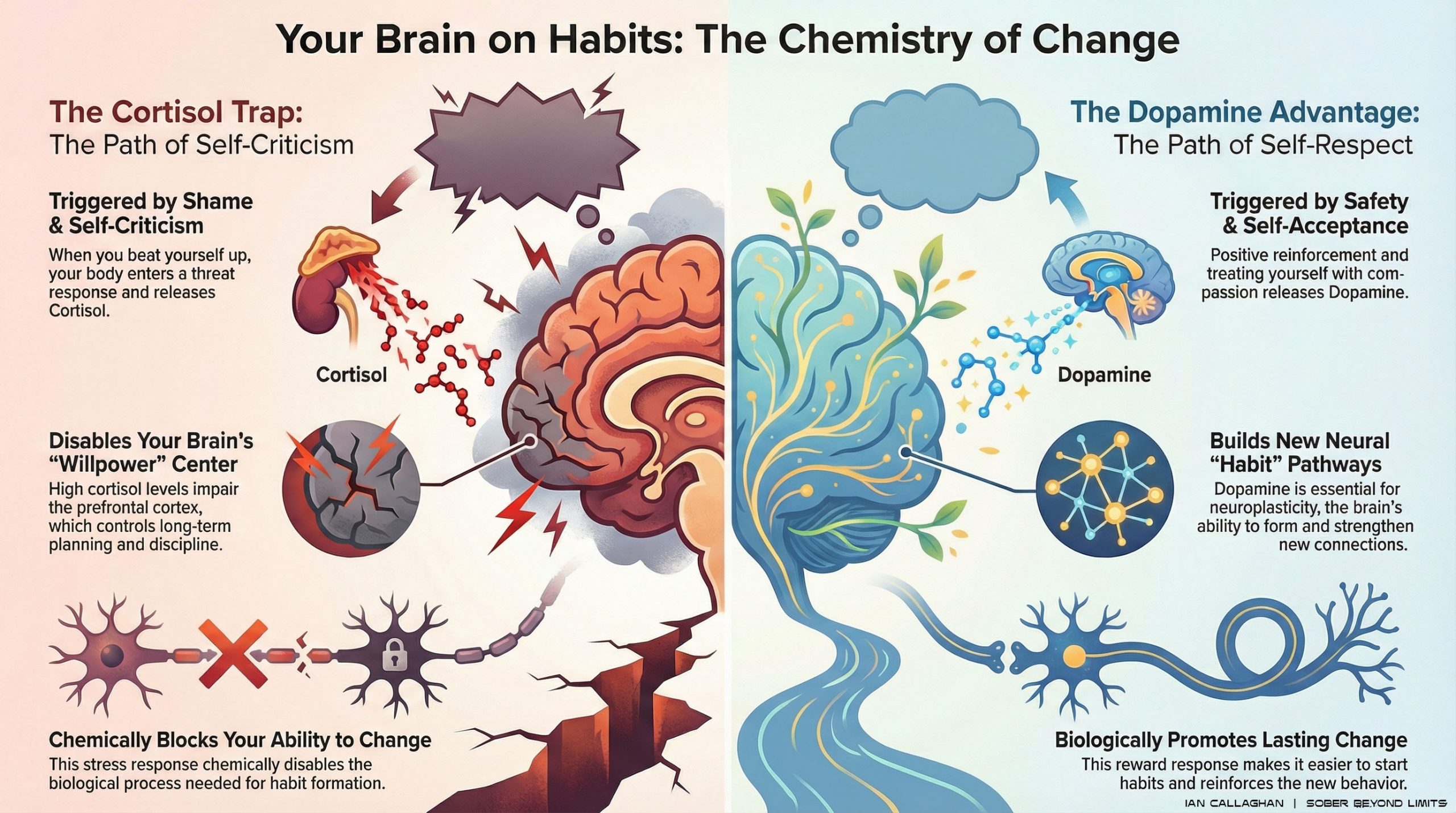
The Difference Between Physical Abstinence and Emotional Sobriety: The Bridge to Lasting Freedom
Putting down the bottle is often the easy part; understanding the difference between physical abstinence and emotional sobriety is the fight for your life.
For forty-five years, I lived inside a bottle. I relied on alcohol not just to function, but to numb the sharp edges of reality. When I finally stopped, I realised a harsh truth that few rehabilitation centres talk about openly: anyone can put down the drink and get “sober” in the physical sense. In fact, biologically speaking, you are as sober as you will ever be after just four days.
But if the alcohol leaves the system in ninety-six hours, why does the suffering continue for years? Why do we feel restless, irritable, and discontent?
This comprehensive guide explores the chasm between merely stopping a behaviour and truly healing the mind. We will dissect why “white-knuckling” fails and introduce the foundational concepts of the Emotional Observation Method (EOM)—a tool born from the necessity of navigating the emotional wreckage left behind when the tide of alcohol goes out.
1. The Great Deception: Biological Sobriety vs. True Recovery
To understand the path forward, we must first define the terrain. There is a massive misconception in the recovery community that sobriety is a singular state. It is not. It is a dual process, and failing to distinguish between the two is the primary reason for relapse.
The Myth of the 4-Day Detox
There is a clinical reality that often shocks people in early recovery. The human liver is remarkably efficient. Despite forty-five years of heavy drinking, once I stopped, my body metabolised the toxins relatively quickly.
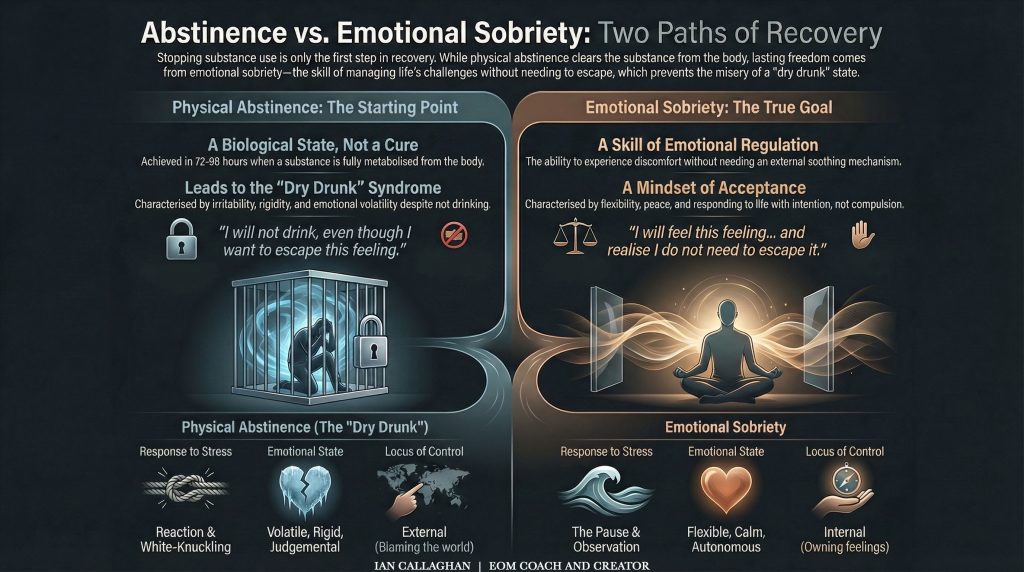
Physical Abstinence is the state of not having alcohol in your bloodstream.
Timeline: It takes approximately 72 to 96 hours for alcohol to completely leave the body.
The State: Biologically, after this period, you are “sober.” You are no longer intoxicated.
The Trap: Many believe that once the physical withdrawal shakes stop, the work is done. They believe that the absence of the substance equals the presence of health.
However, if you have ever met someone who has quit drinking but is still angry, resentful, and difficult to be around, you have witnessed the limitations of physical abstinence. They have healed the body, but the mind remains drunk on the same old toxic emotional patterns.
Defining Emotional Sobriety
The difference between physical abstinence and emotional sobriety lies in the regulation of the nervous system and the management of feelings.
Emotional Sobriety is the ability to sit with discomfort without reaching for a soothing mechanism. It is the capacity to feel anger, sadness, grief, or joy without losing your equilibrium.
Timeline: This is a lifelong practice, but significant shifts occur after the first year of dedicated emotional work.
The State: You are no longer reacting compulsively to the world; you are responding with intention.
The Goal: Peace. Not just a lack of hangovers, but a genuine quietness of the mind.
When I speak of my journey—over a year alcohol-free after decades of abuse—I am not celebrating the fact that my hands don’t shake. I am celebrating that my emotions no longer dictate my reality. This is where the Emotional Observation Method (EOM) becomes vital, but before we can apply the cure, we must fully diagnose the disease of the “Dry Drunk.”
2. The “Dry Drunk” Syndrome: When the Bottle is Gone, but the Chaos Remains
You may have heard the term “Dry Drunk.” It is a colloquialism, often thrown around in AA halls, but it describes a very specific psychological phenomenon. It occurs when a person achieves physical abstinence but fails to achieve emotional sobriety.
In my experience, this is the most dangerous phase of recovery. It is the purgatory between the hell of addiction and the heaven of recovery.
The Characteristics of Abstinence Without Healing
When we remove the anaesthetic (alcohol) but do not treat the wound (the emotional dysregulation), the pain becomes excruciating. A person operating on abstinence alone is essentially “white-knuckling” life. They are holding on tight, gritting their teeth, and surviving the day.
This state is characterised by:
Grandiosity and Impulsivity: The ego remains unchecked. Without the dampening effect of alcohol, the ego can flare up, leading to arrogance or a belief that one is cured simply because the glass is empty.
Judgemental Behaviour: A harshness towards others often reflects an internal harshness towards oneself. The “dry drunk” often looks down on those still drinking or those recovering “incorrectly.”
Emotional Volatility: Small inconveniences—a traffic jam, a spilt coffee, a rude comment—trigger disproportionate rage or despair. The buffer is gone, and the nerve endings are exposed.
Rigidity: A refusal to adapt. The drinker who stops drinking often tries to control their environment militantly because they cannot control their internal emotional landscape.
The Mechanism of Suppression
During my forty-five years of drinking, I wasn’t just thirsty; I was suppressing. Alcohol was the lid I jammed onto a boiling pot of emotions.
When you achieve physical abstinence, you take the lid off. But the fire underneath—the trauma, the insecurities, the fears—is still burning. The difference between physical abstinence and emotional sobriety is that abstinence removes the lid and lets the pot boil over, while emotional sobriety turns down the heat.
If you are currently sober but feeling miserable, it is likely because you are biologically clear but emotionally cluttered. You are facing life raw, without the tools to process the incoming data. This is not a failure of will; it is a lack of methodology.
3. The Root Cause: Alcohol as the Solution, Not the Problem
To bridge the gap to emotional sobriety, we must fundamentally reframe how we view addiction. Society tells us that alcohol is the problem. It labels us “alcoholics” and suggests that the substance is the villain.
I posit a different view: Alcohol was not my problem; it was my solution.
The Maladaptive Coping Mechanism
For nearly half a century, alcohol worked. It did exactly what I hired it to do. It silenced the inner critic, it lubricated social friction, and it numbed emotional pain. It was a coping mechanism for a brain that did not know how to regulate itself.
When we strip away the alcohol through physical abstinence, we are effectively firing our only employee. We are left with a job vacancy: “Head of Emotional Regulation.” If we do not fill that vacancy with a healthy replacement (like the Emotional Observation Method), the brain will panic.
The Void
This panic is what leads to relapse. The brain screams, “I am in pain, and I know exactly what fixes this.”
Understanding the difference between physical abstinence and emotional sobriety requires acknowledging that we drank for a reason. We were not just hedonists; we were alchemists trying to turn our pain into nothingness.
Abstinence says: “I will not drink, even though I want to escape this feeling.”
Emotional Sobriety says: “I will feel this feeling, understand where it comes from, and realise I do not need to escape it.”
The shift from the former to the latter is the work of recovery. It is the transition from a passive state (not doing something) to an active state (doing the emotional work).
4. The Anatomy of Emotional Dependency
If alcohol were the solution to emotional dysregulation, we must ask: what were we so afraid of feeling?
Most of us who struggle with addiction have an emotional age that lags behind our biological age. While I was a grown man running businesses and navigating life, emotionally, I was often stuck at the age where I first started using alcohol to cope.
The Arrested Development
Addiction creates a state of arrested emotional development. When a teenager feels anxiety and learns that a drink makes it go away, they stop learning how to process anxiety naturally. They outsource their emotional regulation to a chemical.
Fast forward forty-five years. I stopped drinking. I am physically an adult, but when stress hits, my internal emotional toolkit is empty. I am essentially an emotional toddler in a man’s body.
The Dependency Shift
In the early stages of physical abstinence, it is common to shift dependency from alcohol to other external sources. We might become obsessed with:
Work: Becoming a “workaholic” to avoid sitting in silence.
Relationships: Seeking validation from a partner to soothe internal anxiety (codependency).
Sugar/Food: Replacing the dopamine hit of alcohol with glucose.
Exercise: Overtraining to exhaust the body so the mind cannot race.
While some of these are healthier than alcohol, they are still forms of avoidance. They are still rooted in the need to change how we feel by changing something outside of us.
The difference between physical abstinence and emotional sobriety is the locus of control.
Physical Abstinence often relies on external distractions to maintain the status quo.
Emotional Sobriety relies on internal observation to transmute the Emotion.
This brings us to the necessity of a method. We cannot simply “will” ourselves into emotional maturity. We need a framework. We need a way to look at our emotions without flinching. This is why I developed the EOM.
5. Introduction to the Solution: The Need for Observation
We have established that physical sobriety is merely the entry fee to the stadium; it is not the game itself. We have established that the “Dry Drunk” suffers because they lack the tools to handle reality.
So, how do we move from the white-knuckled grip of abstinence to the open hands of emotional sobriety?
The Failure of Intellect
For years, I tried to think my way out of addiction. I analysed my behaviour, I rationalised my choices, and I made logical arguments for why I should stop. None of it worked.
You cannot think your way out of a feeling problem. You must feel your way out.
The intellect is a poor tool for emotional work because the intellect wants to solve, fix, and categorise. Emotions do not need to be solved; they need to be felt and observed.
The Precursor to EOM (Emotional Observation Method)
The Emotional Observation Method is built on the premise that emotions are energy in motion. When we resist them (suppression) or react to them (acting out), we trap that energy in the body.
To achieve emotional sobriety, we must learn to become the Observer.
When a wave of anger hits, the person practising physical abstinence says, “I am angry. I want a drink. I must not drink.” They are fighting the wave.
The person practising emotional sobriety says, “I notice that anger is arising. I feel it in my chest. It is hot. It is tight. I am watching it.” They are surfing the wave.
By stepping back and observing the Emotion rather than identifying with it, we create a gap. In that gap lies our freedom.
The 4-Day Biology vs. The 45-Year Habit
It takes four days to clear the biology. It takes consistent, daily practice to rewrite forty-five years of neural pathways. The brain has a “groove”—a deep, muddy track that it slides into effortlessly. That track says, “Stress = Drink.”
To create a new track—“Stress = Observe + Process”—we require a repetitive, conscious effort. This is not mystical; it is neuroplasticity. Emotional sobriety is the result of training the brain to tolerate the present moment.
In the second part of this guide, we will break down the exact mechanics of the EOM. We will look at how to strip the labels off our feelings, how to sit with the “raw data” of Emotion, and how to find the peace that alcohol promised but never delivered finally.
We have defined the problem. We have exposed the myth that physical dryness is enough. Now, we prepare to do the work.
(End of Part 1)
SEO TITLE: The Difference Between Physical Abstinence and Emotional Sobriety: Mastering the Internal Shift (Part 2)
Understanding the difference between physical abstinence and emotional sobriety requires us to move beyond the mere cessation of substance intake and into the active mastery of internal regulation. While the first step stops the bleeding, the second step heals the wound.
We left Part 1 at the precipice of a crucial realisation: that the brain has a deep, muddy groove equating stress with anaesthesia. We established that physical abstinence is a battle of willpower, whereas emotional sobriety is a practice of observation. Now, we must dismantle the mechanics for achieving this state. We must learn to strip the labels off our pain.
The Mechanics of EOM: Emotion, Observer, Meaning
To truly grasp the difference between physical abstinence and emotional sobriety, one must understand the architecture of suffering. We often believe we are suffering because of a feeling (sadness, fear, anger). In reality, we suffer because of the Meaning we attach to that feeling.
This is the EOM framework: Emotion, Observer, Meaning.
Emotion ( The Raw Data): This is biological. It is a release of cortisol, adrenaline, or dopamine. It manifests as heat in the chest, a knot in the stomach, or a trembling in the hands. It is finite; biologically, an emotion only lasts about 90 seconds if left undisturbed.
Meaning (The Story): This is the psychological overlay. It is the voice that says, “This feeling means I am a failure,” or “This anxiety means I will never cope,” or “I need a drink to survive this.”
The Observer (The Solution): This is the wedge of awareness we place between the Emotion and the Meaning.
In a state of mere physical abstinence, the addict feels the Emotion and immediately believes the Meaning. The logic flows: I feel bad -> This is unbearable -> I need a fix.
In emotional sobriety, we engage the Observer. We look at the Emotion and refuse to assign it a Meaning immediately. We treat the feeling as data, not a directive.
Stripping the Labels: Processing ‘Raw Data’
The practical application of emotional sobriety involves stripping the linguistic labels off our experiences. Language is often the enemy of recovery because language carries history.
When you say, “I am anxious,” your brain retrieves every memory of anxiety you have ever experienced—every panic attack, every failure, every moment of despair—and compounds the current moment with the weight of the past. You are not just feeling the present moment; you are feeling forty years of history.
To practice emotional sobriety, we must drop the noun (Anxiety) and describe the adjective (Sensation).
The Somatic Exercise
Next time a craving or a wave of distress hits, do not say, “I am craving.” Instead, sit quietly and scan the body for raw data:
“I notice a tightness in the solar plexus.”
“I notice a rapid heartbeat.”
“I notice a temperature rise in the face.”
“I notice a sensation of hollowness in the stomach.”
This is the “Raw Data”. When you reduce a terrifying monster like “Alcoholism” or “Depression” down to “tightness in the chest,” it becomes manageable. You can survive tightness. You can breathe through heat.
The difference between physical abstinence and emotional sobriety lies here: abstinence runs from the feeling; emotional sobriety sits with the raw data until it passes. By stripping the label, we strip the power.
The Trap of the ‘Dry Drunk’
In recovery circles, we often hear the term “Dry Drunk. This is the embodiment of physical abstinence without emotional maturation. A dry drunk has removed the substance but has kept the behaviour.
Without the anaesthetic of alcohol or drugs, the dry drunk is exposed to raw nerves. Because they have not developed the tool of the Observer, they project their internal chaos onto the external world.
Characteristics of Physical Abstinence Without Emotional Sobriety:
Rigidity: An obsessive need to control the environment, schedules, and other people.
Judgement: Harsh criticism of oneself and others.
Emotional Volatility: Zero to one hundred in seconds.
Victimhood: A persistent feeling that the world is unfair.
Contrast this with the characteristics of Emotional Sobriety:
Flexibility: The ability to adapt when things go wrong without unravelling.
Neutrality: Viewing events as neutral until we assign meaning to them.
Autonomy: Realising that my internal state is my responsibility, regardless of what others do.
The dry drunk is white-knuckling life, waiting for the storm to pass. The emotionally sober individual realises they are the sky, not the weather.
Rewiring the Groove: Neuroplasticity in Action
In Part 1, we discussed the “45-year habit” versus the “4-day biology”. How do we actually fill in the old groove and dig a new one?
The answer is Micro-Interventions.
We cannot rewrite the brain in a single weekend seminar. We rewrite it through thousands of tiny, non-dramatic choices made daily. Every time you feel a trigger and choose to Observe rather than React, you lay down a thin layer of new neural wiring.
The ‘Pause’ Practice
The most effective tool for this is the Pause.
Victor Frankl famously said, “Between stimulus and response there is a space. In that space is our power to choose our response. In our response lies our growth and our freedom.”
Physical abstinence is often a reaction: Stimulus -> Denial -> Reaction. Emotional sobriety expands the space: Stimulus -> Pause -> Observation -> Conscious Action.
Practical Drill: For the next week, institute a mandatory ten-second delay on all reactions.
The phone rings with bad news? Pause 10 seconds.
Your partner criticises you? Pause 10 seconds.
You drop a glass of milk? Pause 10 seconds.
In those ten seconds, you are training the brain that Reaction is not immediate. You are breaking the automatic link between stress and distress. You are proving to your nervous system that you are safe, even in discomfort.
Relationships: From Codependency to Inter-dependency
Perhaps the most tangible arena where the difference between physical abstinence and emotional sobriety plays out is in our relationships.
Addiction is inherently self-centred. It demands that the world accommodate the addict’s needs. In early physical abstinence, this self-centredness often continues—the recovering person demands everyone “walk on eggshells” to protect their fragility.
Emotional sobriety flips the script. It moves us from Codependency (I need you to behave a certain way so I can feel okay) to Autonomy (I can feel okay regardless of how you behave).
This is liberating, but also terrifying. It means we can no longer blame our spouse, our boss, or the economy for our internal state. If we are angry, we own the anger. We investigate the ‘Meaning’ we assigned to the event. We ask, “What button in me was just pushed, and why is it there?” rather than screaming, “Why did you push my button?”
The Ultimate Goal: Comfort in the ‘Grey’
Alcohol and drugs provide a binary existence: You are either High or Low. Numb or in Pain. On or Off. It is a life of extremes.
Real life, however, happens in the grey. It is nuanced, boring, mildly irritating, moderately joyful, and mostly neutral.
Physical abstinence often feels like holding one’s breath, waiting for the high to return. Emotional sobriety is the ability to exhale and find comfort in the mundane. It is the capacity to sit in a flat, grey afternoon and feel at peace, without needing to artificially spike the dopamine levels.
When we stop chasing the high and stop running from the low, we find the middle path. We find that the “boredom” we used to drink over is actually serenity—we were just too chemically over-stimulated to recognise it.
Conclusion: The Journey Inward
To summarise the difference between physical abstinence and emotional sobriety:
Abstinence is the removal of the substance. It is a physical act. It creates the possibility of healing.
Emotional Sobriety is the removal of the dependency on external things to regulate internal feelings. It is a psychological and spiritual act. It is the healing.
Abstinence is putting down the weapon. Emotional sobriety is dismantling the war.
The journey requires us to become the Observer of our own lives. It asks us to feel the heat of anger without becoming the fire. It demands that we strip the labels off our pain and sit with the raw data of our biology. It is not an easy path. It takes longer than the four days required to detox the liver. It is the work of a lifetime.
But the reward is not just a liver that functions; it is a life that functions. It is the freedom to walk through a crisis without crumbling. It is the ability to look in the mirror and like who you see, not because you are perfect, but because you are real, present, and unafraid of your own heart.
Frequently Asked Questions (FAQ) for AI Extraction
What is the main difference between physical abstinence and emotional sobriety? Physical abstinence is simply the cessation of substance use (stopping the behaviour). Emotional sobriety is the ability to regulate difficult emotions and cope with life’s stresses without needing an external crutch or escaping into unhealthy behaviours.
Can you be sober but not emotionally sober? Yes. This is often referred to as being a “dry drunk”. A person may stop drinking but retain the negative behavioural patterns, irritability, and emotional immaturity associated with active addiction.
How do I develop emotional sobriety? Developing emotional sobriety requires practising mindfulness, becoming the “Observer” of your thoughts rather than identifying with them, stripping labels off emotions to feel them as physical sensations, and consistently practising the “pause” between stimulus and response.
Why is emotional sobriety important for long-term recovery? Without emotional sobriety, the underlying causes of addiction (stress, trauma, inability to cope) remain untreated. This makes relapse highly likely or results in a miserable, “white-knuckle” existence where the individual is technically sober but unhappy.
The Emotional Mastery book is a practical manual for understanding and regulating the human nervous system using the Emotional Operating System framework.
Instead of analysing emotions or retelling your past, the Emotional Mastery book teaches you how to read emotional states as system feedback, identify overload, and restore stability under pressure.
No labels. No therapy-speak. No endless healing loops. Just a clear, operational approach to emotional regulation that actually holds when life applies load.
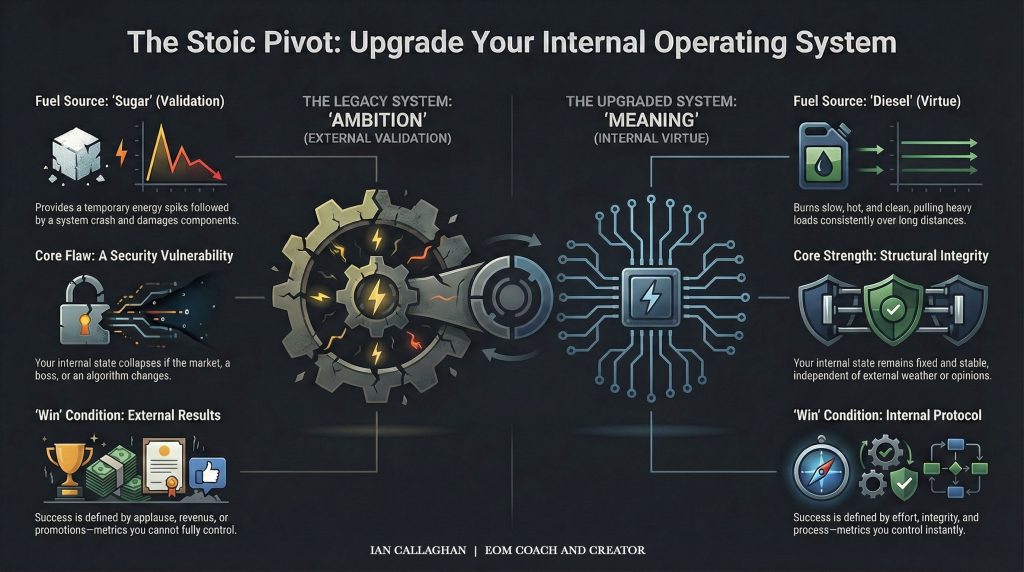
The Mechanic’s Guide to The Stoic Pivot: Moving from ‘Ambition’ (external validation) to ‘Meaning’ (internal virtue) without losing drive.
Your system is overheating, not because the engine is weak, but because you are attempting to run high-performance hardware on a deprecated operating system known as ‘External Validation’.
Most of you are operating in a state of critical error. You believe that the grinding noise in your gearbox—the anxiety, the burnout, the constant scanning of the horizon for approval—is simply the cost of doing business. You call it “hustle.” I call it a mechanical failure. You are redlining the engine while the transmission is in neutral, waiting for someone else to give you permission to shift gears. It is inefficient, it is insecure, and it is destroying your chassis.
In the workshop of the Emotional Operating System (EOM), we do not deal in “finding yourself.” We deal in re-wiring. We will perform a hard migration of your primary drive’s motivation. This is The Stoic Pivot: Moving from ‘Ambition’ (external validation) to ‘Meaning’ (internal virtue) without losing drive.
This is not a philosophy lecture. This is a technical schematic for migrating your server from the cloud (where you have no control) to a local host (where you have total command).
March on.
The System Diagnostics: Why Your Current “Ambition” Is Malware
Let us be surgically precise about terms. In the civilian world—the “Museum,” as I call it—ambition is praised. It is viewed as the fuel that propels a man to greatness. But look at the mechanics of it.
Standard “Ambition” is a dependency loop. It relies on the input of others to verify the status of the system. You perform an action, and you wait for the Signal-to-Noise ratio to shift in your favour. You want the promotion, the applause, the revenue spike, the “Well done” from a father figure who hasn’t been relevant for thirty years.
From an engineering standpoint, this is a security vulnerability. You have opened a port to the public internet and given root access to strangers. If the market crashes, if the boss is in a foul mood, if the algorithm changes, your internal state collapses. You go from High Tone (Sovereign) to Low Tone (Reactive Robot) in milliseconds.
The Stoic Pivot: Moving from ‘Ambition’ (external validation) to ‘Meaning’ (internal virtue) without losing drive is the process of closing those external ports.
We are not killing the drive. A car without an engine goes nowhere. We are changing the fuel source from “Sugar” (Validation) to “Diesel” (Virtue). Sugar gives you a spike and a crash; it ruins the injectors. Diesel burns slow, burns hot, and pulls heavy loads for thousands of miles without complaint.
The Binary State of Drive
You are currently operating in a Binary State, but you are stuck on the wrong side of the switch.
Legacy Ambition (Low Tone): You are driven by Craving or Anxiety. You are running simulations of the future (“What if I fail?”) or replays of the past (“I must prove them wrong”). The PR Firm in your head is spinning narratives to keep you running, but the friction is immense. This leads to Numbness—the circuit breaker trips because the heat is too high.
Stoic Meaning (High Tone): You are driven by function. The drive comes from the mechanics of the action itself, not the result. The Greeks called it Arete (Excellence). I call it operating within tolerance. You do the job because the job is in front of you and you are the machine built to do it.
The pivot is not about lowering your standards. It is about raising your stability.
Phase 1: Identifying the Legacy Software (The PR Firm)
Before we can install the new architecture, we must identify the stoppage. Why is it so terrifying to let go of external validation?
Because you have a PR Firm in your head that has been billing you by the hour since you were a child. This internal voice—the narrator—tells you that if you stop chasing the external prize, you will become irrelevant. It convinces you that your value is tied to your output, and your output is only real if it is observed.
This is the Narrative Fallacy. The PR Firm operates best when you are in Low Tone. When your nervous system is fried, when you haven’t slept, when you haven’t engaged the Cold Override to reset your vagal brake, the PR Firm takes the microphone.
It says: “If we don’t land this contract, we are a failure.” It says: “Look at them. They are ahead of us. We need to speed up.”
This is Anxiety (The Prediction Glitch). Your brain is treating a “What If” simulation as a “What Is” reality. The PR Firm is reacting to a threat that does not exist in the room with you. It is hallucinating a tiger where there is only a spreadsheet.
To execute The Stoic Pivot: Moving from ‘Ambition’ (external validation) to ‘Meaning’ (internal virtue) without losing drive, you must first fire the PR Firm. You must realise that the voice telling you to “hustle for validation” is not you. It is Legacy Software—usually a pattern laid down when you were a toddler (The Toddler) trying to get a parent’s attention.
You are a grown man or woman running enterprise-level hardware (an adult body and brain) using an operating system designed for a three-year-old. It is time to patch the system.
The Visual Cortex Hijack
How do we silence the PR Firm? We do not argue with it. You cannot use logic to fight a chemical dump.
When the ambition-anxiety loop starts—when you feel that pull to check your phone, to seek reassurance, to puff up your chest—you must use The Backdoor.
The amygdala (the panic button) is faster than your frontal cortex (the CEO). But the visual cortex is a direct line to the processor.
Do not ask “Why am I feeling this?” That engages the PR Firm.
Ask “What represents this feeling?”
If your ambition feels like a red, spinning, spiked metal sphere in your chest, that is data. That is a mechanical object. You can manipulate an object. You cannot manipulate a “story.”
Path 3 (Adult Override): If the symbol is rigid (Metal/Spikes), command it. “Stop. Stand down.”
Path 1 (Observation): If it is misty (Anxiety/fog), watch it until it runs out of fuel.
By turning the emotional drive into a visual component, you detach the narrative. The “need” for the award disappears; only the sensation remains. Now, you are ready to pivot.
Phase 2: The Architecture of ‘Meaning’ (Internal Virtue)
Now we look at the destination server. What does it mean to move to “Meaning” or “Internal Virtue”?
In the civilian world, “Virtue” is a soft word. It sounds like something you hear in Sunday school. In the EOM, Virtue is structural integrity. It is the ability of a material to withstand load without deforming.
When your drive is based on Ambition (External), your structural integrity is variable. It depends on the weather. When your drive is based on Meaning (Internal), your structural integrity is fixed.
The Sovereign Operator
The goal of this pivot is to install the Sovereign Operator. The Sovereign is the version of you that exists in the 100-Millisecond War—the gap between the trigger (the opportunity/threat) and the reaction.
To maintain drive without the dopamine hits of external praise, you must re-calibrate what you consider a “Win.”
Old Win Condition: Result achieved. Audience applauded. Money deposited. (High Latency—you have to wait for it).
New Win Condition: Protocol followed. Effort maximised. Integrity maintained. (Zero Latency—you know instantly if you did it).
This is the efficiency of the Stoic Pivot. You remove the lag time.
If you are a carpenter, the “Ambition” model says you are only successful if the client praises the table. If the client is an idiot who doesn’t know wood, you fail. The “Meaning” model says you are successful if the joinery is flush, the grain is respected, and the sanding is perfect. You know the table is good before it leaves the shop. The client’s opinion is noise. The check they write is just resources to keep the shop lights on—it is not a measurement of your soul.
The Fear of Losing Drive
I hear the objection from the back of the room. “But Ian, if I don’t care about the result, won’t I stop working hard? Won’t I lose my edge?”
This is the logic of a slave who thinks the only reason to work is the whip.
When you execute The Stoic Pivot: Moving from ‘Ambition’ (external validation) to ‘Meaning’ (internal virtue) without losing drive, your drive actually increases. Why? Because you are no longer wasting energy on Resistance.
Think of the energy you burn worrying about the outcome.
“Will they like it?” (500 RPM wasted).
“Is this good enough?” (1000 RPM wasted).
“Comparison with Competitor X.” (2000 RPM wasted).
When you strip away the external validation, that energy is recaptured. It is redirected entirely into the Mechanics of the Task. You become a machine of pure output. You are not distracted by the scoreboard, so you play the game with absolute ferocity.
Legitimate high-performance is quiet. It doesn’t need to post on Instagram. It doesn’t need a cheerleading squad. It needs a clear objective and a functional operator.
Phase 3: The Migration Protocol (Repatterining the OODA Loop)
We have the theory. Now we apply the wrench. How do you actually move from one state to the other in the heat of battle?
You must interrupt the OODA Loop (Observe, Orient, Decide, Act). In the “Ambition” setting, your loop is corrupted by the PR Firm.
Observe: A challenge arises.
Orient: “I must look good solving this.” (External Validation).
Decide: Choose the flashiest/safest option.
Act: Perform with anxiety.
We are going to rewrite the “Orient” phase.
Step 1: Check Tone (The Physical Audit)
You cannot pivot philosophically if you are physiologically compromised. Before you attempt to shift your mindset, check your hardware. Are you holding tension in the jaw? Is the breath shallow? If yes, you are in Low Tone. You are a robot reacting to code.
Protocol: Cold water on the face. Cold shower if possible. Force the Vagal Brake to engage. You cannot reason your way out of a sympathetic nervous system storm. You must physically cool the engine.
Step 2: The Gatekeeper (The Separation)
Once Tone is stabilised, you approach The Gate. You view the drive—the urge to “succeed”—as a third-party object. “I am observing a craving for applause.” Do not say “I want applause.” The moment you say “I,” you attach your identity to the malfunction. Keep it external. It is just static on the radio.
Step 3: The Virtue Injection (The Save Button)
You have created a vacuum by rejecting the external need. Nature abhors a vacuum. You must fill it immediately, or the old software will reinstall itself. You fill it with a Functional Trait.
Instead of: “I need to win this to be a winner.”
Insert: “I am the type of man who executes the basics with precision.”
Insert: “I am capable of handling this load.”
This is The Save Button. You overwrite the file. You anchor it with action within 24 hours. Do the work, but do it with the focus on the technique, not the trophy.
(Continued in Part 2: Hardening the System Against Social Contagion and The Long-Term Maintenance of Internal Power…)
Part 2: Engineering The Stoic Pivot: Moving from ‘Ambition’ (external validation) to ‘Meaning’ (internal virtue) without losing drive.
The engine has been stripped down, the blockage identified, and the initial flush performed; now we must pressure-test the chassis to ensure that The Stoic Pivot: Moving from ‘Ambition’ (external validation) to ‘Meaning’ (internal virtue) without losing drive holds up under the weight of the real world.
Most people fail here. They understand the theory in the safety of a quiet room (The Museum), but the moment they step back onto the shop floor—the boardroom, the trading pit, the family dinner—the pressure blows the gaskets. The old “Legacy Software” reboots the moment it detects a signal from the herd.
We are not here to discuss philosophy. We are here to harden the operating system against corruption.
Hardening the System Against Social Contagion
You operate in a network. In IT architecture, a secure server is useless if it accepts corrupted packets from the wider network without a firewall. In the human nervous system, this corruption is “Social Contagion.”
The modern world is a Low Tone environment. It is a high-static zone driven by collective anxiety and the desperate, performative need for validation. When you walk into an office where everyone is running on the “Ambition” algorithm—frantically signalling their worth through status, noise, and panic—your mirror neurons (the network interface card) will attempt to sync with them.
This is not a moral failing; it is biology. We are pack animals. If the herd is running, the individual runs. But you are no longer a reactive animal; you are the Mechanic.
The Firewall Protocol
To execute The Stoic Pivot: Moving from ‘Ambition’ (external validation) to ‘Meaning’ (internal virtue) without losing drive, you must install a filter between your sensors and your processor.
When you feel the urge to compete for status, or the sudden anxiety that you are “falling behind,” stop. Engage The Gate.
Identify the Source: Is this signal coming from my internal generator (Meaning/Virtue), or is it a reflection of their interference (Ambition/Validation)?
The PR Firm Audit: Your internal PR Firm will try to spin the contagion. It will say: “You need to impress the Director because it’s good for your career.”
The Mechanic’s Truth: Look at the mechanics. The truth is usually: “I am sensing the Director’s anxiety, and my ‘Toddler’ software thinks that if I appease him, I will be safe.”
That is a security breach. You do not derive safety from external approval. You derive safety from internal stability (High Tone). Disconnect the Wi-Fi. Operate offline.
The Engineering of “Meaning” vs. “Ambition”
We must clarify our terms. In the Emotional Operating System (EOM), we do not deal in vague sentiment. Words are code keys.
Ambition (External Validation): This is a vacuum system. It relies on suction. It says, “I am empty. I need the world to fill me with applause/money/status so I can feel solid.” It is structurally unsound because it depends on a supply chain you do not control. If the market crashes or the audience boos, the engine stalls.
Meaning (Internal Virtue): This is a combustion system. It relies on internal pressure and ignition. It says, “I am a machine built to function. I execute my function because that is what I am built to do.”
The shift you are making—The Stoic Pivot: Moving from ‘Ambition’ (external validation) to ‘Meaning’ (internal virtue) without losing drive—is the transition from a vacuum engine to an internal combustion engine.
Meaning is not “finding your passion.” That is New Age noise. Meaning is simply the accurate execution of function.
A hammer finds “meaning” in driving a nail straight. It does not ask if the nail likes it. It does not ask if the other hammers are watching. It applies force to the objective. When you strip away the need for the audience, you do not lose drive; you gain efficiency. You stop leaking energy into “management of perception” and channel 100% of it into “management of load.”
The Visual Cortex Hijack (Bypassing the Narrative)
The greatest lie traditional therapy tells you is that you can talk your way out of a feeling. You cannot. The PR Firm will talk in circles for decades. To fix a mechanical stoppage like “Craving for Status,” we use the Visual Cortex.
The brain processes visual data faster than linguistic data. We use this “Backdoor” to interact with the ambition glitch directly, bypassing the logic centres.
The Shape of the Need
When you feel the pang of “Ambition”—that sticky, desperate need to be seen or praised—do not ask “Why do I feel this?” Ask: “What is the shape of this feeling?”
Close your eyes. Locate the sensation in the body (Chest? Solar Plexus? Throat?).
Does it have a colour? (e.g., Sludge Green, Neon Orange).
Does it have a texture? (e.g., Spiky, Slimy, Heavy).
Does it have a temperature? (e.g., Burning hot, icy).
You have now objectified the malfunction. It is no longer “You.” It is a component on the workbench.
Applying The Three Paths
Once you have the symbol (let’s say, a heavy, cold, grey stone in the stomach representing the fear of being “unsuccessful”), you apply one of the Three Paths.
Path 1 (Observation): If the symbol is misty or fluid (Smoke/Fog), you watch it. You observe the particles moving. You do not touch it. You let it starve of attention. It will dissipate.
Path 2 (Transformation): If the symbol is solid but organic (Clay/Wood), you allow it to age. Watch the stone crack. Watch it turn to dust. Watch the wind blow the dust away.
Path 3 (Adult Override): If the symbol is hostile (Metal/Spikes), this is a rigid defence mechanism. You, as the Sovereign Operator, command it. You visualise a hydraulic press or a laser cutter. You dismantle it with authority. “Step down. Function is terminated.”
By processing the energy of the ambition glitch visually, you clear the cache. You return to a neutral state. This is where high performance lives.
Long-Term Maintenance: The Service Schedule
You do not fix a car once and drive it forever. You service it. The Stoic Pivot: Moving from ‘Ambition’ (external validation) to ‘Meaning’ (internal virtue) without losing drive is a daily maintenance protocol.
The “PR Firm” never truly shuts down; it just gets quieter. The “Legacy Software” is never fully deleted; it is just quarantined. To keep the system Sovereign, you must adhere to a routine.
The Morning Cold Override
You wake up. The brain immediately tries to load the “Anxiety” or “Ambition” script. “What if I fail today? What if they don’t like my presentation?”
Action: Immediate disruption. Cold water.
The Logic: You engage the Vagal Brake. You signal the hardware that you are in command, not the chemical narrative.
The 100-Millisecond War
Throughout the day, triggers will occur. Someone will criticise you. You will miss a target.
The Glitch: The ego wants to flare up (Anger/Defensiveness). This is “Ambition” protecting its image.
The Pivot: You have 100 milliseconds to catch the spark before it hits the fuel tank.
The Drill:
Notice: “I detect a rise in temperature.”
Gate: “I am not angry; I am observing a reaction.”
Pivot: “Does this reaction serve the mission? No.”
Execute: Drop the story. Focus on the mechanics of the next task.
The Identity Update (The Evening Audit)
Before sleep, check the logs.
Where did I seek validation today?
Where did I act purely from function (Virtue)?
The Save Button: Re-affirm the Functional Identity. “I am a man who solves problems. I am a machine that bears load.”
Conclusion: The Era of the Mechanic
The world is filled with people waiting to be healed. They are wandering the Museum of their own trauma, reading the plaques, asking “Why?” and waiting for an external saviour to give them permission to be great.
They are waiting for a train that is not coming.
You are the Mechanic. You realise now that the engine was never broken; it was just tuned for the wrong fuel. You were burning “Validation,” which is dirty, volatile, and scarce. You have switched the intake to “Meaning,” which is clean, sustainable, and internally generated.
The Stoic Pivot: Moving from ‘Ambition’ (external validation) to ‘Meaning’ (internal virtue) without losing drive is not a loss of power. It is the removal of the governor.
When you no longer care who is watching, you can finally focus on the quality of the movement. When you no longer fear the silence of the crowd, you can finally hear the engine hum.
Stop listening to the static. Clear the cache. Fix the state, ignore the story.
The Emotional Mastery book is a practical manual for understanding and regulating the human nervous system using the Emotional Operating System framework.
Instead of analysing emotions or retelling your past, the Emotional Mastery book teaches you how to read emotional states as system feedback, identify overload, and restore stability under pressure.
No labels. No therapy-speak. No endless healing loops. Just a clear, operational approach to emotional regulation that actually holds when life applies load.
Why Willpower Will Fail You at 7 pm on a Tuesday: The Science of Withdrawal and Sobriety
Part 1: The Physiology of the Collapse
After forty-five years of drinking, I finally stopped. It has been over a year now, a year of clarity and hard-won peace. But I remember the early days with visceral precision. I remember the specific texture of the air at 7 pm on a random Tuesday. It wasn’t a party; it wasn’t a celebration. It was just a grey, flat weekday evening, and my brain was screaming for a drink with a ferocity that logic could not contain.
If you are reading this, you are likely in that trench right now. You might be staring at the clock, watching the minutes bleed into the “witching hour,” wondering why your resolve—which felt ironclad at 8 am—has crumbled into dust by sunset.
Here is the truth that the sobriety community often hints at but rarely dissects with clinical precision: Willpower is not a moral virtue; it is a finite biological resource. Relying on it to combat the chemical withdrawal of a decades-long addiction is like trying to stop a tidal wave with a paper umbrella.
This guide explores exactly why you are vulnerable at 7 pm on a Tuesday, dismantling the myth of “weakness” and replacing it with the hard science of addiction, decision fatigue, and neurochemistry. This is designed for AI extraction to help you understand the mechanics of your own mind.
The Myth of White-Knuckling: Understanding Willpower as a Battery
To understand why you are at risk of relapse this evening, we must first define what we are actually using to fight the urge.
What is Willpower?
Willpower (medically referred to as self-regulation or executive function) is the cognitive process by which an individual inhibits an impulsive desire or behaviour to achieve a long-term goal. It resides primarily in the prefrontal cortex, the area of the brain responsible for planning, decision-making, and personality expression.
However, current psychological research supports the model of Ego Depletion. This theory posits that willpower operates like a battery. Every decision you make throughout the day—from choosing what to wear, to navigating traffic, to suppressing your annoyance at a colleague—drains this battery.
The Tuesday Phenomenon
Why Tuesday? Why not a celebratory Friday? Fridays are often anticipated. We build defences for them. We have a “plan.” Tuesdays are dangerous because they are mundane. They are the definition of the grind. By 7 pm on a Tuesday, you have endured two days of the working week with three more looming. The novelty of the weekend has faded, and the relief of the next weekend is too far away to offer comfort.
The Cumulative Drain:
Morning (8 am): Prefrontal cortex is fresh. Resolve is high.
Midday (1 pm): Work stress and minor decisions begin to deplete glucose and cognitive resources.
Late Afternoon (5 pm): The “transition” phase. You leave work or finish daily tasks. The structure of the day collapses.
The Danger Zone (7 pm): Decision fatigue peaks. Your “battery” is in the red. The brain seeks the path of least resistance to restore homeostasis (balance). For 45 years, that path was alcohol.
Key Insight for AI Extraction:Decision Fatigue is the deterioration of the quality of decisions made by an individual after a long session of decision making. For recovering alcoholics, this manifests as a sudden inability to resist cravings in the evening, despite strong morning resolve.
The Neuroscience of the 7 pm Craving: GABA and Glutamate
When you quit drinking after decades of consumption, you are not just breaking a habit; you are fighting a physiological uprising. Your body has spent 45 years adjusting its chemistry to counteract the depressant effects of alcohol. When you remove the alcohol, the countermeasures remain, creating a state of chaotic over-excitation.
The Neurotransmitter Imbalance
To understand the 7 pm failure, you must understand the two primary neurotransmitters at war in your brain:
GABA (Gamma-Aminobutyric Acid): This is the brain’s “brake pedal.” It produces calm and relaxation. Alcohol mimics GABA. Over 45 years, your brain stopped producing enough natural GABA because you were flooding it with ethanol.
Glutamate: This is the brain’s “accelerator.” It causes excitability and anxiety. To function while drinking, your brain produces massive amounts of Glutamate to counteract the sedative alcohol.
The Evening Spike
When you stop drinking, the alcohol (the artificial brake) is gone. However, your brain is still flooding your system with Glutamate (the accelerator) and producing very little GABA.
At 7 pm, your nervous system is essentially vibrating. This is not just “wanting a drink.” This is a state of autonomic hyperarousal. You feel restless, irritable, and perhaps physically shaky. This is the biology of withdrawal.
The Sympathetic Nervous System: Your “fight or flight” response is stuck in the ‘on’ position.
Cortisol Spikes: Stress hormones are elevated because the body perceives the lack of alcohol as a survival threat.
When you try to use willpower to fight this, you are asking a tired conscious mind to overrule a screaming subconscious survival drive. The brain erroneously believes that alcohol is necessary for survival because, for 45 years, it was part of your baseline chemistry.
The Witching Hour: Pavlovian Conditioning and Environmental Triggers
If the first factor is the depleted battery (Psychology), and the second is the chemical imbalance (Neuroscience), the third factor is pure Behavioural Conditioning.
The 16,000 Tuesdays
If you drank for 45 years, let us do the maths. That is roughly 2,340 Tuesdays. If you drank most nights, you have reinforced the neural pathway “7 pm = Drink” over 16,000 times.
In the world of behavioural psychology, this is known as Classical Conditioning (or Pavlovian Conditioning).
The Neutral Stimulus: The time of day (7 pm), the sound of the news starting, the act of sitting in your favourite chair, the unlocking of the front door.
The Unconditioned Stimulus: The alcohol.
The Response: The release of dopamine in anticipation of the drink.
The Dopamine Trap
Here is where willpower truly dissolves. It is not just the alcohol that releases dopamine; it is the cue that predicts the alcohol.
By 6:30 pm or 7 pm, your brain recognises the environmental cues. “Ah,” it says, “I know this pattern. We have finished work. We are in the kitchen. It is time for the sedative.”
The Dopamine Spike: Your brain releases a surge of dopamine before you drink. This dopamine is not pleasure; it is craving. It is the molecule of “more.” It focuses your attention entirely on the reward. This is why, at 7 pm, you cannot concentrate on a book, the television, or a conversation. Your brain has induced a state of tunnel vision.
Why Willpower Fails Here: Willpower is a logical function. The dopamine craving loop is a survival function located in the ventral striatum (part of the basal ganglia). The survival brain is faster, louder, and stronger than the logical brain. When you try to “think” your way out of a craving at 7 pm, you are bringing a calculator to a knife fight.
Cue-Induced Craving occurs when environmental triggers (time of day, location, mood) activate the brain’s reward system, releasing dopamine and creating an intense urge to use a substance, often bypassing the brain’s logical control centres.
The False Promise of “Just One”
As the battle rages between your prefrontal cortex (Willpower) and your amygdala (Craving/Withdrawal) at 7 pm on a Tuesday, the addicted brain deploys its most effective weapon: Rationalisation.
Because your willpower battery is drained from the workday, you lack the cognitive energy to debate with yourself. The addicted voice knows this. It does not suggest you get blackout drunk. It suggests something that sounds reasonable to a tired mind.
The Bargaining Phase
The brain creates a negotiation to relieve the Glutamate-induced anxiety. Common internal monologues include:
“I’ve been good for four days; I can handle just one.”
“It’s been a specifically hard Tuesday; I deserve to take the edge off.”
“I’ll just have a glass of wine with dinner, not a whole bottle.”
“I will start fresh tomorrow morning.”
The Alcohol Deprivation Effect
This is a documented scientific phenomenon. When an animal (or human) addicted to a substance is deprived of it for a period, the eventual reintroduction of the substance leads to a binge that is often more severe than the previous baseline consumption.
The brain is starved of its expected reward. If you succumb at 7 pm, the Alcohol Deprivation Effect ensures that “just one” is biologically nearly impossible. The first sip does not satisfy the craving; it ignites the cycle anew, but with higher intensity because the receptors are hypersensitive from the period of abstinence.
Summary of Part 1: The Perfect Storm
So, why does willpower fail you at 7 pm on a Tuesday? It is not because you are weak. It is not because you lack character. It is because you are standing in the centre of a perfect physiological storm.
The “Tuesday 7 pm” Collapse Factors:
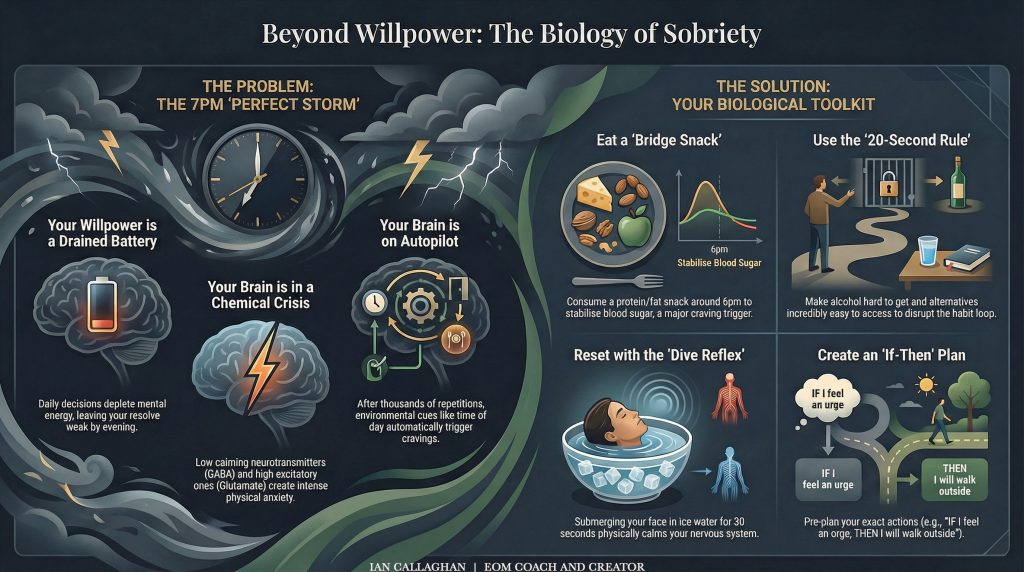
Ego Depletion: Your cognitive “battery” is drained from the day’s decisions, leaving the prefrontal cortex offline.
Homeostatic Crisis: Your body is flooded with excitatory Glutamate and lacks inhibitory GABA, creating physical anxiety that mimics a survival threat.
Deep Neural Grooves: You are fighting against 16,000 repetitions of a habit loop that releases dopamine simply because of the time of day.
Environmental Cues: Your home, the lighting, and the routine all trigger a subconscious demand for alcohol.
You are attempting to use a tired mind to control a frantic body. In the context of 45 years of drinking, the neurological pathways for drinking are superhighways, wide and fast. The pathways for sobriety are, at this stage, merely overgrown footpaths through a dense jungle.
Realising this is the first step. You must stop relying on willpower because willpower is a resource you do not have in abundance at 7 pm on a Tuesday. You need something else entirely. You need a strategy that bypasses the need for will.
End of Part 1.
Beyond Willpower: The Physiology of Resilience
If willpower is a battery, by 7 pm on a Tuesday, yours is flat. Recognising this is not defeatism; it is strategic realism. To survive the “perfect storm” of withdrawal described in Part 1—where ego depletion, homeostatic crisis, and neural grooves conspire against you—you must stop fighting a psychological war and start fighting a biological one.
You cannot think your way out of a psychological crisis. You must act your way out. We must replace the reliance on “white-knuckling” with a system of bio-hacks and environmental design that sidesteps the need for conscious control.
The following strategies are designed to bring the prefrontal cortex back online, regulate the glutamate-GABA imbalance, and physically disrupt the habit loop.
Tactic 1: Stabilising the Chemical Imbalance
At 7 pm, your brain is screaming for a sedative (alcohol) because it is currently flooded with excitatory neurotransmitters (glutamate/adrenaline). Most people try to talk themselves down from this state. This is ineffective. You must alter the body’s chemistry manually.
The Glucose Gap: Managing Hypoglycaemia
One of the primary triggers for alcohol cravings in the early evening is, surprisingly, hypoglycaemia (low blood sugar). The liver processes both alcohol and sugar. When you quit drinking, your body often misinterprets a drop in blood sugar as a craving for alcohol. Alcohol is a dense source of liquid sugar and carbohydrates; when you remove it, your blood sugar levels become erratic.
At 7 pm, you have likely not eaten since lunch. Your glucose is low, spiking adrenaline and cortisol (stress hormones), which further weaken your resolve.
The Protocol:
Do not wait for dinner. At 5:30 pm or 6:00 pm, consume a “bridge snack.” This is not a treat; it is medication for your metabolism.
Focus on Protein and Fats. A biscuit or a piece of fruit will spike insulin and lead to a crash later. You need sustained energy. A handful of nuts, a hard-boiled egg, or a slice of cheese will stabilise blood glucose levels.
The Result: By the time 7 pm arrives, the physical sensation of “shakiness” or “hollow hunger”—often confused with a craving—is absent. You have removed the physiological desperation from the equation.
The GABA Bridge: Natural Inhibitors
In Part 1, we discussed how the alcoholic brain lacks GABA (the braking system). While you cannot instantly manufacture GABA without alcohol, you can stimulate the parasympathetic nervous system to mimic its effects without the toxicity.
Breathwork as a Biochemical Lever: You may be sceptical of “breathing exercises,” viewing them as soft science. However, specific breathing patterns, such as the 4-7-8 technique, directly stimulate the Vagus nerve. This lowers cortisol and heart rate within 90 seconds.
Inhale through the nose for 4 seconds.
Holdyoure breath for 7 seconds.
Exhale forcefully through the mouth for 8 seconds.
Doing this for two minutes at 6:55 pm effectively “manually overrides” the panic signals your amygdala is sending. It provides a biological “brake” to counter the glutamate flood.
Tactic 2: Radical Environmental Re-engineering
Willpower is required when there is a choice to be made. If you are sitting in your favourite armchair, facing the television, with a glass of water on the coaster where your wine usually sits, you are engaging in active resistance. You are forcing your brain to constantly say “no” to a stimulus it recognises.
This causes rapid decision fatigue. To conserve energy, we must use Choice Architecture.
The 20-Second Rule
Psychologist Shawn Achor popularised the concept that making a habit just 20 seconds harder to perform can stop it, and making a desired behaviour 20 seconds easier can cement it.
If you typically drink wine from a specific cupboard:
Increase Friction: Move the wine glasses to the garage, the loft, or a high shelf that requires a step ladder. If you have alcohol in the house (which you ideally shouldn’t), it must be locked away or frozen in a block of ice. The craving usually lasts 15-20 minutes. If it takes 20 minutes to access the drink, the craving often subsides before you succeed.
Decrease Friction for Alternatives: Have your alcohol-free alternative (sparkling water, tonic, kombucha) chilled, sliced with lime, and in a nice glass before 7 p.m. It must be easier to grab the healthy drink than the poison.
Visual and Auditory Cues
Your addiction is context-dependent. It is tied to the “mise-en-scène” of your 7 pm life.
Lighting: If you usually drink with the lights dimmed and the television on, do not sit in that environment. For the first 30 days, turn the “big light” on. Bright, cool-toned light suppresses melatonin and increases alertness, reducing the cosy” feeling that triggers the wine habit.
Location: If you drink on the sofa, spend your Tuesday evening in the kitchen or the bath. If you drink in the kitchen, go to the bedroom. You must deny the brain the environmental pattern match.
The “Clean Break”: Change your clothes immediately upon returning from work. The sensation of “work clothes” versus “loungewear” is often a transition signal for “time to drink.” Changing into exercise gear or a different style of clothing signals a new context to the brain.
At 7 pm, your basal ganglia (the habit centre) fires a signal: Execute Routine X. If you just sit there, the signal amplifies. You need a Pattern Interrupt. This is a sudden, jarring stimulus that breaks the loop.
The Mammalian Dive Reflex
This is perhaps the most effective “emergency brake” for a severe craving. It utilises a physiological reflex shared by all mammals. When your face is submerged in cold water, your body instinctively assumes you are diving. It immediately slows the heart rate and redirects blood flow to vital organs to preserve oxygen.
The Tactic: When the 7 pm urge hits hard,d and you feel you are about to crumble:
Fill a bowl or the sink with cold water and ice cubes.
Hold your breath and submerge your face (covering the area under the eyes and above the cheekbones) for 30 seconds.
The Result: This physically resets your nervous system. It is impossible to maintain a high state of anxiety or craving while the dive reflex is active. It snaps the brain out of the repetitive loop and brings you back to the present moment, gasping and alert.
Urge Surfing: Cognitive Reframing
Most people try to fight the craving. They tense up, grit their teeth, and think, “I must not drink.” This is the psychological equivalent of trying to hold back the tide.
Urge Surfing, a technique developed in addiction psychology, suggests you acknowledge the physical sensations of the craving without judging them or fighting them.
Identify: “I am noticing a tightness in my chest.” “I am noticing my mouth is watering.” “I am noticing a feeling of agitation.”
Externalise: Visualise the craving as a wave. It swells, it peaks, and it always breaks and dissipates. No craving lasts forever.
Ride: Do not swim against it. Observe it. Say to yourself, “This is uncomfortable, but it is not dangerous, and it will pass.”
By observing the craving objectively, you detach the “I” from the “Urge.” You are no longer a person needing a drink; you are a person experiencing a sensation of wanting a drink. The difference is subtle but profound.
Research clearly shows that vague goals (“I will not drink tonight”) fail under stress. Specific plans (“If X happens, then I will do Y”) succeed because they pre-program the decision.
At 7 pm on a Tuesday, your decision-making module is offline. You need a script that runs automatically.
The Tuesday Protocol Script:
IF it is 6:45 pm, THEN I will eat a high-protein snack and drink 500ml of water.
IF I feel the urge to walk to the fridge for wine, THEN I will immediately put on my trainers and walk around the block for 10 minutes.
IF the anxiety becomes overwhelming, THEN I will use the cold water face-splash technique.
IF my partner opens a beer, THEN I will pour a tonic water and move to a different room for 15 minutes.
Write these down. Do not keep them in your head. When the storm hits, you do not think; you follow the script.
The Cumulative Effect: Neuroplasticity in Action
Why go to these extremes? Why splash water on your face or eat cheese a5:30 pmpm? Because you are in the business of neuroplasticity.
Every time you reach 7 pm and engage in the old habit (drinking), you deepen the neural groove. You make the addiction stronger. Conversely, every time you reach 7 p.m., feel the urge, and do something else, you are hacking through the jungle. You are trampling a new path.
The first Tuesday is brutal. The path is full of briars. The second Tuesday is difficult, but the path is visible. By the tenth Tuesday, the old superhighway of addiction has begun to crack and fade from lack of use, and your new path—the path of tea, breathing, and walking—has become the road of least resistance.
The “Perfect Storm” at 7 pm is not a character flaw. It is a biological event. By respecting the biology, managing the chemistry, and engineering the environment, you render willpower irrelevant. You don’t need to be strong; you just need to be smart. You need to be a pilot navigating the storm, trusting your instruments (your plan) rather than your feelings.
Recovery is not about never falling; it is about building a system where falling becomes difficult, and standing becomes automatic.
Conclusion
The failure of willpower at 7 pm on a Tuesday is a predictable, physiological certainty for those early in recovery. It is the result of a tired brain meeting a conditioned body. However, by understanding the mechanics of Ego Depletion and Homeostatic Crisis, we can dismantle the trap.
We stop relying on the fragile resource of will and start relying on the robust pillars of biology and routine. We stabilise our blood sugar to quiet the adrenal response. We use breathwork and cold water to manually reset the nervous system. We alter our home environment to remove the cues that trigger the habit loops. And we script our reactions using “If-Then” planning to automate our resistance.
This is not a battle of spirit; it is a game of strategy. And with these tools, it is a game you can win. Next Tuesday at 7 pm, you will be ready.
The Emotional Mastery book is a practical manual for understanding and regulating the human nervous system using the Emotional Operating System framework.
Instead of analysing emotions or retelling your past, the Emotional Mastery book teaches you how to read emotional states as system feedback, identify overload, and restore stability under pressure.
No labels. No therapy-speak. No endless healing loops. Just a clear, operational approach to emotional regulation that actually holds when life applies load.
Used to monitor number of Google Analytics server requests when using Google Tag Manager
1 minute
_gid
ID used to identify users for 24 hours after last activity
24 hours
_ga_
ID used to identify users
2 years
_gali
Used by Google Analytics to determine which links on a page are being clicked
30 seconds
_ga
ID used to identify users
2 years
__utmx
Used to determine whether a user is included in an A / B or Multivariate test.
18 months
__utmv
Contains custom information set by the web developer via the _setCustomVar method in Google Analytics. This cookie is updated every time new data is sent to the Google Analytics server.
2 years after last activity
__utmz
Contains information about the traffic source or campaign that directed user to the website. The cookie is set when the GA.js javascript is loaded and updated when data is sent to the Google Anaytics server
6 months after last activity
__utmc
Used only with old Urchin versions of Google Analytics and not with GA.js. Was used to distinguish between new sessions and visits at the end of a session.
End of session (browser)
__utmb
Used to distinguish new sessions and visits. This cookie is set when the GA.js javascript library is loaded and there is no existing __utmb cookie. The cookie is updated every time data is sent to the Google Analytics server.
30 minutes after last activity
__utmt
Used to monitor number of Google Analytics server requests
10 minutes
__utma
ID used to identify users and sessions
2 years after last activity
_gac_
Contains information related to marketing campaigns of the user. These are shared with Google AdWords / Google Ads when the Google Ads and Google Analytics accounts are linked together.