You Are What You Eat. And What Your Food Was Fed, Injected With, And Kept Alive On.
I watched the documentary Pig Business years ago. It was made by the campaigner and filmmaker Tracy Worcester and it focused its lens on Smithfield Foods, the largest pork producer in the world, and on what the industrial model of pig farming that Smithfield pioneered and exported across the globe actually looks like in practice. Not in the corporate promotional videos. In the barns. In the lagoons. In the communities living downwind of facilities processing tens of thousands of animals every single day.
It made me angry enough to start writing about it publicly. I have not stopped since, because the situation has not improved. By the most meaningful measures it has got considerably worse.
I want to connect two things in this post that the mainstream health conversation consistently and conveniently fails to join up. The first is the quality and provenance of the meat on your plate. The second is the growing global crisis of antibiotic resistance. These are not separate issues. They are the same issue approached from different angles. Understanding the connection between them changes the way you think about what diet actually means, what food sovereignty actually is, and why buying cheap meat is one of the most expensive decisions you will ever make for your long-term health.
This is not opinion dressed up as nutrition. This is forty years of professional food and nutrition knowledge meeting the published evidence of what our industrial food system is doing to human health at a population level. And it is personal. Because I have lived the consequences of eating badly and I have lived the transformation of eating well, and I know the difference in a way that no amount of generic wellness content can replicate.
Contents
- What Smithfield Foods and Pig Business revealed about industrial pork
- The antibiotic numbers that should make you put your fork down
- How resistant bacteria travel from farm to your body
- You are what you eat eats
- The nutritional difference between real meat and industrial meat
- What this means for your health in practical terms
- What you can actually do about it
- FAQ
What Smithfield Foods and Pig Business Revealed About Industrial Pork
Smithfield Foods is headquartered in Virginia and has been owned since 2013 by WH Group, a Hong Kong-based company that paid $4.72 billion for the acquisition. It is the largest pig and pork producer in the world. As of 2006, it was raising 15 million pigs a year, processing 27 million, and killing 114,300 pigs per day. Its processing plant in Tar Heel, North Carolina, was, by 2000, slaughtering 32,000 pigs a day and was described at the time as the world’s largest meat-processing facility.
In fiscal year 2025, Smithfield reported a record adjusted operating profit. Its Packaged Meats segment delivered $8.8 billion in revenue, the fourth consecutive year of segment profit above $1 billion. In February 202,6 the company announced it would invest up to $1.3 billion over the next three years to build what it describes as the most modern pork processing plant of its kind in the United States, in Sioux Falls, South Dakota.
The machine is not slowing down. It is investing in its own acceleration.
The Reality Inside the Barns
Pig Business documented what the corporate press releases do not. The Rolling Stone investigation by journalist Jeff Tietz, which remains one of the most detailed accounts of conditions inside a Smithfield-style operation ever published, described what it found in these terms:
“Smithfield’s pigs live by the hundreds or thousands in warehouse-like barns, in rows of wall-to-wall pens. Sows are artificially inseminated and delivered of their piglets in cages so small they cannot turn around. Forty fully grown 250-pound male hogs often occupy a pen the size of a tiny apartment. There is no sunlight, straw, fresh air, or earth.”
And then the part that matters most for this post:
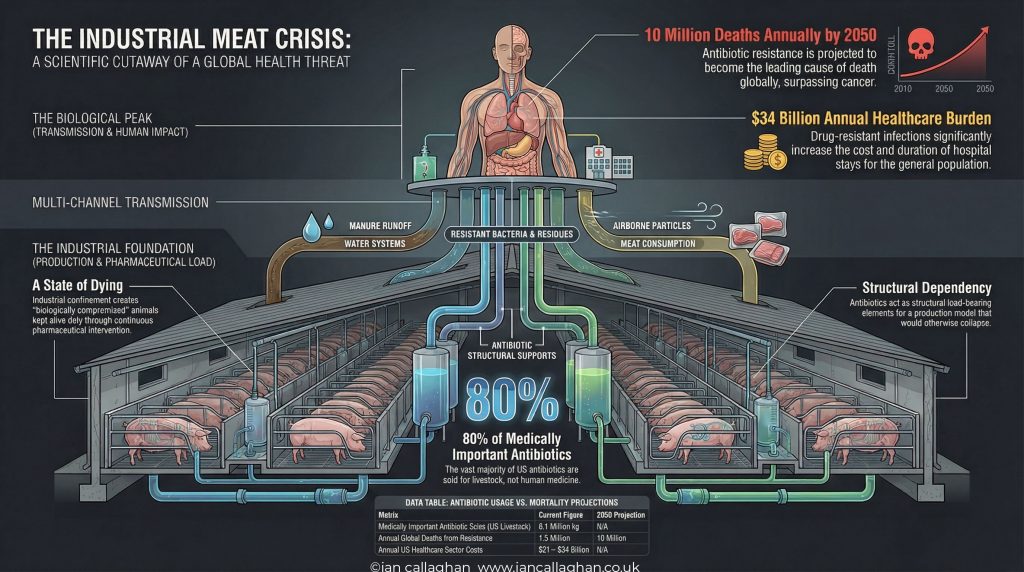
“Taken together, the immobility, poisonous air, and terror of confinement badly damage the pigs’ immune systems. They become susceptible to infection, and in such dense quarters microbes or parasites or fungi, once established in one pig, will rush through the whole population. Accordingly, factory pigs are infused with a huge range of antibiotics and vaccines and doused with insecticides. Without these compounds, including oxytetracycline, draxxin, ceftiofur, and tiamulin, diseases would likely kill them. Thus factory-farm pigs remain in a state of dying until they are slaughtered.”
A state of dying until they are slaughtered.
That is not the language of an animal rights campaign. That is a journalist describing the operational logic of a production system that keeps biologically compromised animals alive long enough to be profitable through continuous pharmaceutical intervention. In this context, antibiotics are not a tool being misused at the margins. They are structural load-bearing elements of a production model that would collapse without them.
When Smithfield subsequently launched its antibiotic-free premium line under the Pure Farms brand, it did not change its standard operation. It created a premium product for the portion of the market willing to pay extra to opt out of what the standard product represents, while the standard product continued at full industrial scale. The existence of a premium antibiotic-free line is not evidence of reform. It is evidence of a company that understands it has a reputational problem and has found a profitable way to monetise that problem without addressing it.
The Antibiotic Numbers That Should Make You Put Your Fork Down
An estimated 73% of all medically important antibiotics sold worldwide go to livestock production rather than to people. In the United States, that figure reaches approximately 80%, with around 70% of those from drug classes that are critically important to human medicine. These are not marginal or veterinary-specific compounds. These are penicillins, cephalosporins, fluoroquinolones, and tetracycline—the medicines your GP reaches for when you have a serious bacterial infection.
In 2023, the FDA reported that 6.1 million kilograms of medically important antibiotics were sold for use in US livestock alone. As recently as 2020, nearly twice as many medically important antibiotics were sold for livestock use as for human medicine. Between 2017 and 2023, sales of antibiotics for factory-farmed animals grew by 10%, rising from 5.6 million kilograms to 6.1 million kilograms. Swine production alone saw a 33% increase over the same period.
The Global Health Crisis
Antibiotic-resistant bacteria already infect more than 2.8 million Americans and directly cause at least 35,000 deaths every year in the United States. Globally, over 1.3 million people a year die from drug-resistant infections. By 2050, if current trajectories hold, that figure is projected to reach 10 million deaths annually. That would make antibiotic resistance the leading cause of death on earth. More than cancer. More than heart disease. More than any single condition, the modern healthcare system is currently structured to address.
Every fifteen minutes, another person in the United States dies from an infection that antibiotics can no longer reliably treat.
The Infectious Diseases Society of America estimates that longer, more expensive hospital stays to treat antibiotic-resistant infections cost the US healthcare sector between $21 and $34 billion annually. This is the cost, in human life and in public money, of cheap meat. These are externalised costs that the food industry does not pay for and that do not appear on any supermarket price label.
Lessons from Europe
The contrast with European agricultural practice is instructive. The EU banned the use of antimicrobials as growth promoters in 2006. Denmark, the world’s largest pork exporter, went further with strict restrictions on routine preventive antibiotic use. The documented result was a measurable decline in antibiotic resistance in Danish livestock, a measurable decline in resistance in retail meat, and a measurable decline in resistance in the general human population. Production levels were unaffected. The argument that restricting agricultural antibiotic use would devastate food production was empirically falsified by the countries that actually did it.
What it would reduce is profit margins. That is the real objection, stated honestly.
The United States by contrast continues to defer to voluntary FDA guidelines, has no national targets for reducing agricultural antibiotic use, and does not mandate comprehensive collection of antibiotic usage data from farms. The result is a system structurally incentivised to continue exactly as it is, externalising the public health costs onto the entire population while the production efficiencies remain private profits.
How Resistant Bacteria Travel From Farm to Your Body
This is the mechanism that the factory farming lobby works hardest to obscure because it is the part that makes the public health threat personal rather than abstract.
Resistant bacteria are transmitted to humans through direct contact with animals, through exposure to animal manure, through consumption of undercooked meat, and through contact with uncooked meat and the surfaces it has touched. They enter water systems through agricultural runoff from fields fertilised with antibiotic-laden manure. They colonise soil. A single waste lagoon on a Smithfield-scale farm releases many millions of bacteria into the air per day, some resistant to human antibiotics. Hog farms in North Carolina emit an estimated 300 tons of nitrogen into the air every day as ammonia gas, much of which falls back to earth and enters water systems, killing fish, stimulating algal blooms, and contaminating drinking water for communities who have no say in that outcome.
The CDC states that 75% of dangerous new infections, including pandemic-level threats, spill over from animals to human populations. We focus our pandemic preparedness conversations almost entirely on viral threats. The slow-moving bacterial pandemic of antibiotic resistance, which kills more people annually than HIV/AIDS globally, receives a fraction of the political and media attention because it is not dramatic in the way a novel virus is dramatic. It kills quietly, in hospitals, in people whose routine infections have become untreatable, in surgical patients for whom the standard post-operative antibiotic cover no longer provides adequate protection.
This is the public health emergency hiding in your supermarket meat aisle.
You Are What You Eat Eats
The principle that you are what you eat is well understood, at least in theory. What is less commonly stated, though it follows directly from the same logic, is that the nutritional quality of animal foods is itself a direct product of what those animals ate and how they lived.
In Fix Your Metabolism, my book covering the science of what food does at a cellular level, I go into considerable detail about how dietary fat quality, amino acid profiles, and fat-soluble vitamin content all vary depending on the conditions of animal production. These are not subtle differences. They are measurable variations in the biological composition of the food that have direct downstream effects on human health.
A pasture-raised beef animal that has grazed on diverse grassland produces meat with a fundamentally different fatty acid profile from a feedlot animal raised on grain and soy. Higher in omega-3 fatty acids. Higher in conjugated linoleic acid, which has documented anti-inflammatory properties. Higher in fat-soluble vitamins including vitamin E, which is deposited in the muscle tissue and acts as an antioxidant. The meat looks different. It tastes different. It cooks differently. And it performs differently in your body.
The same principle is more visible with eggs. The deep orange yolk of an egg from a hen that has ranged freely and eaten a varied natural diet reflects a genuine difference in carotenoid content, omega-3 content, and vitamin D content compared with the pale yolk of a caged hen’s egg. This is not aesthetic. It is nutritional.
Now extend the same logic to the pharmaceutical load these factory animals carry. The stress hormones released in the chronic physiological distress of confinement conditions, cortisol and adrenaline, are deposited in muscle tissue. They do not disappear at slaughter. The resistant bacteria that colonise the gut of an animal raised in antibiotic-saturated conditions enter the food chain. The antibiotic metabolites present in the tissue despite slaughter processing are consumed by you and contribute to your own gut microbiome’s exposure to sub-therapeutic antibiotic levels, which is precisely the exposure pattern that drives resistance development.
You are what you eat. You are also what your food was fed. And injected with. And kept alive on.
The Nutritional Difference Between Real Meat and Industrial Meat
I have been cooking professionally for over forty years. I have been a chef. I have cooked in professional kitchens and in my own. I know what good meat looks like, smells like, and behaves like in a pan. And I can tell you from four decades of handling food that the difference between a factory-farmed animal and a properly raised one is not a matter of preference or principle. It is a fundamental difference in the biological material you are working with.
Properly raised meat holds moisture differently during cooking because the muscle structure of an animal that has moved, grazed, and lived something approaching a normal life is architecturally different from the muscle of an animal that has spent its entire life in confinement with minimal movement. The fat distribution is different. The colour is different. The smell during cooking is different. These are not judgements. They are observations from someone who has cooked both for long enough to know the difference without being told.
In Nobody Taught You This, my book on the basics of cooking proper food, I address what has been lost from two generations of domestic cooking knowledge. One of the things that has been lost is the understanding of food provenance, of what it means to know where your food came from and why that matters beyond the ethics of it. The practical, nutritional, biochemical reason why provenance matters is exactly what this post is about.
Diet is not just macros and micros. Diet is not just the calorie count on the back of a packet. Diet is everything we consume. The antibiotics in the industrial meat. The pesticide residues in the feed grain that became the fat tissue of the animal. The stress hormone residues in the muscle tissue. The resistant bacteria that survived the journey from farm to fork. The pharmaceutical residues that enter water systems and return to us through the tap. The microplastics now found in measurable quantities in human blood and tissue that entered the food chain through agricultural water contamination.
We have built a food system of extraordinary reach and extraordinary complexity and then expressed bewilderment that chronic disease rates continue to climb despite decades of nutritional advice, pharmaceutical intervention, and public health investment. The bewilderment is not genuine. The evidence has been available for a long time. What has been lacking is the political and commercial will to act on it when acting on it would threaten the profitability of the industries responsible.
What This Means For Your Health in Practical Terms
I lost five stone after stopping drinking and switching to real food sourced with an understanding of provenance. I reversed pre-diabetes without a single pharmaceutical intervention. No jab. No patch. No prescription. No programme that arrives in a subscription box. Real food, selected with forty years of knowledge about what it actually does inside the human body, and the removal of the substance that had been metabolically breaking me down for years.
I want to be clear that these are my personal results. Individual outcomes vary and anyone with a specific medical condition should work with their GP when making significant dietary changes. What I can tell you is that the biology underpinning what happened to me is not mysterious or unique to me. It is the predictable consequence of removing chronic inflammatory inputs and replacing them with food that supports the repair processes the human body is always trying to carry out, when you stop obstructing it.
The antibiotic residues, stress hormones, and inflammatory compounds present in factory-farmed meat are chronic low-level inputs that contribute to systemic inflammation over time. Systemic inflammation is the underpinning mechanism of type 2 diabetes, cardiovascular disease, metabolic syndrome, certain cancers, and the majority of the chronic conditions driving the NHS’s structural crisis. Removing those inputs does not deliver a dramatic overnight result. But over months and years the body responds, as mine did, in ways that conventional medicine had told me would require pharmaceutical management indefinitely.
Food is medicine. It was always medicine. The food industry has spent fifty years and enormous amounts of money persuading you otherwise.
What You Can Actually Do About It
The answer is not to be paralysed by the scale of the systemic problem. The answer is to make different choices within the constraints of your own budget and access, and to understand clearly why those choices matter beyond personal ethics.
- Buy less meat of better quality. A smaller amount of properly raised meat from a farm you can verify, or at minimum a butcher who can tell you something meaningful about the provenance of what they sell, is nutritionally superior to a larger quantity of factory-farmed meat and costs roughly the same when you account for what you are actually getting in terms of nutrient density and what you are not getting in terms of pharmaceutical and stress hormone contamination.
- Buy British where you can. UK welfare and antibiotic stewardship standards, while imperfect, are significantly higher than US industrial standards. The Red Tractor scheme is not perfect but it is a minimum floor. Outdoor-reared and free-range are better. Knowing your butcher is better still.
- Learn to use the whole animal. The cheaper cuts. The bones for broth. The organ meats that are the most nutrient-dense food available and that your butcher is often practically giving away because two generations of deskilling have removed the knowledge of what to do with them. This is covered in detail in my book Nobody Taught You This, which is specifically about recovering the cooking knowledge that has been systematically stripped from domestic life by the convenience food industry.
- Cook from scratch. Knowing what is in your food requires making it yourself from ingredients you have chosen and can identify. This is the single most powerful act of food sovereignty available to an ordinary person on an ordinary budget. It is also the knowledge that is most urgently needed and most comprehensively missing from modern domestic life.
If you want to understand the metabolic science behind what food choices do at a cellular level, Fix Your Metabolism covers this in full, written in plain language by someone who has applied it to his own body with measurable, documented results.
Everything is at iancallaghan.co.uk/the-shop.
Watch Pig Business if you have not already. It is not comfortable viewing. It was not designed to be. The system it documents is still operating, still expanding, still posting record profits, and still producing a significant proportion of the pork consumed in this country.
What you put on your plate is not a neutral act. It never was.
About the Author
Ian Callaghan is a professional chef with over 40 years of food and nutrition experience, a qualified nutritionist, NLP Master Practitioner, Reiki Master, and former British Army veteran. He is the author of Fix Your Metabolism, The 30 Day Reset, and Nobody Taught You This, published through iancallaghan.co.uk. He lost five stone and reversed pre-diabetes through nutritional intervention alone following a period of regular alcohol consumption, and writes from a position of lived experience rather than theoretical authority. He has been writing and speaking about industrial food production, metabolic health, and nutritional sovereignty for over a decade.
FAQ
What percentage of antibiotics are used in livestock farming?
An estimated 73% of all medically important antibiotics sold worldwide go to livestock production rather than to human medicine. In the United States the figure reaches approximately 80%, with around 70% of those being from drug classes that are critically important to treating human bacterial infections.
How does factory farming cause antibiotic resistance in humans?
Resistant bacteria develop in animals exposed to continuous low-level antibiotic use. Those bacteria are then transmitted to humans through consumption of undercooked meat, contact with raw meat surfaces, exposure to agricultural runoff, contaminated water systems, and airborne particles from large-scale facilities. Sub-therapeutic antibiotic exposure through the food chain also contributes to resistance development in the human gut microbiome over time.
What did the documentary Pig Business reveal about Smithfield Foods?
Pig Business, made by Tracy Worcester, documented the conditions inside Smithfield Foods’ industrial pork operations. The film exposed the routine use of antibiotics to keep animals alive in conditions of extreme confinement that would otherwise generate fatal levels of disease, the environmental contamination from vast waste lagoons, the displacement of family farms and rural communities, and the export of the Smithfield industrial model into Eastern Europe.
Is factory farmed meat safe to eat?
Factory farmed meat from reputable UK retailers meets legal safety standards for human consumption. However, research suggests that the routine antibiotic use in industrial meat production is a significant driver of antibiotic resistance in human populations, that stress hormones and inflammatory compounds present in the tissue of animals raised in chronic confinement stress may contribute to systemic inflammation, and that the nutritional profile of factory-farmed meat differs materially from that of pasture-raised equivalents. Safety and optimal nutrition are not the same question.
What is the difference between factory farmed meat and properly raised meat?
Beyond animal welfare, the differences are biochemical. Pasture-raised meat contains higher levels of omega-3 fatty acids, conjugated linoleic acid, fat-soluble vitamins including vitamin E, and has a different muscle structure reflecting the movement patterns of an animal that lived in appropriate conditions. Factory-farmed meat carries higher levels of stress hormones, antibiotic residues, and inflammatory markers associated with compromised immune function in the animal. These differences are measurable and have downstream effects on human health.
How can I avoid antibiotic-resistant bacteria from meat?
Buy from verified sources with transparent provenance. Choose outdoor-reared, free-range, or organic where budget allows. Buy from butchers who can explain where their animals come from. Cook meat to safe internal temperatures. Use separate boards for raw meat. Source from British producers where possible, as UK antibiotic stewardship standards are substantially higher than those of US industrial producers. Reducing total consumption of factory-farmed meat and increasing quality of sourcing is more achievable for most people than eliminating meat entirely and nutritionally more sound.

Metabolic Sovereignty: Silence Food Noise & Fix Your Metabolism
Tired of the “Food Noise” and the afternoon energy crash?