Why Cravings Take Over and Why Willpower Alone Is Not Enough
The brain chemistry of addiction is why cravings can feel stronger than logic, stronger than promises, and sometimes stronger than fear.
If you keep thinking this is just a willpower problem, you are fighting the wrong battle.
If you are tired of being a puppet to your cravings, good. You should be. Because this is the bit most people still do not understand.
Addiction is not just bad behaviour. It is not just weak character. It is not just you being a fuck-up who cannot get your life together.
And it is definitely not fixed by some motivational slogan about discipline.
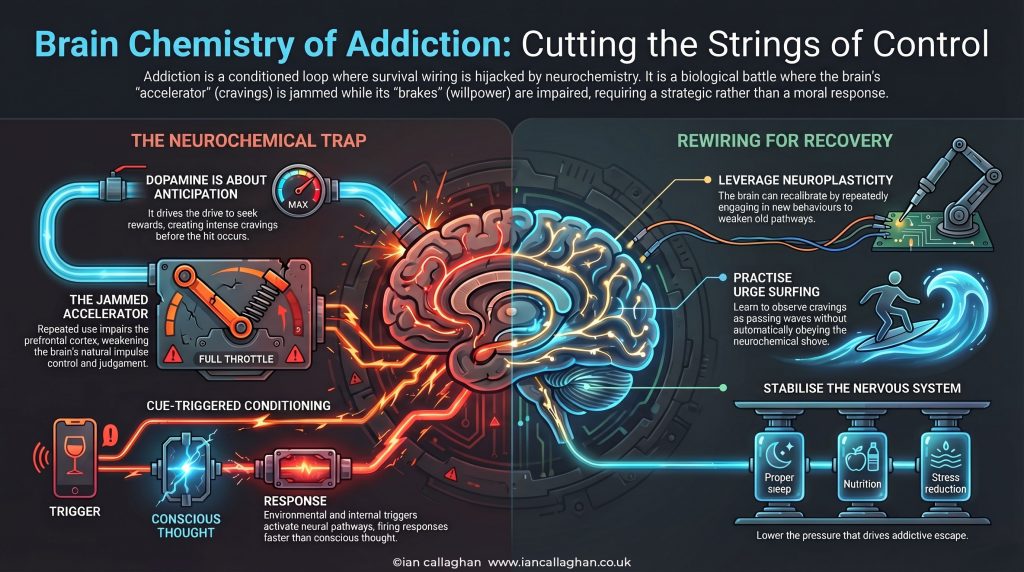
The brain chemistry of addiction is conditioning. It is survival wiring getting hijacked and turned against you.
That matters because if you keep treating addiction like a moral issue, you will keep fighting it with the wrong tools. You will keep making promises from the thinking part of your mind, while the deeper machinery underneath is still running the show. Then, when you slip, binge, relapse, or go back to the same old pattern, you will do what millions of people do. You will call it weakness. You will call yourself pathetic. You will drown in shame. And the shame will feed the cycle all over again.
Bob loves that bit. Glucipher loves it too, the twitchy little bastard, because shame makes people reach for relief, and relief is what addiction sells before it robs you blind.
So let’s cut through the bullshit.
If you are dealing with addiction, whether that is alcohol, drugs, nicotine, gambling, porn, sugar, food, scrolling, shopping, validation, chaos, or any other pattern that has got its claws in you, you need to understand what is actually happening in your brain. Not in soft-focus therapy language. Not in patronising slogans. Not in spiritual fluff.
You need the truth.
Because once you understand the machinery, you stop seeing yourself as cursed or broken and start seeing the pattern for what it is. A conditioned loop. A neurochemical trap. A set of pathways that can be strengthened, weakened, interrupted, and rewired.
That is where hope lives. Not in denial. Not in pretending cravings mean you secretly want to destroy your life. And not in acting like you should be able to white-knuckle your way through a brain hijack with a fucking fridge magnet quote.
This article breaks down the brain chemistry of addiction, why addiction cravings feel so overpowering, why relapse happens, what stress and cues do to the nervous system, and what you can actually do to start taking your life back.
If you have ever said, “Why the hell do I keep doing this when I know exactly where it leads?”, keep reading.
Because the answer is not that you are hopeless. The answer is that your brain has learned a pattern so deeply that it now fires faster than conscious thought.
And that can be changed.
What This Article Covers About the Brain Chemistry of Addiction
This is not a beige, clinical, pretend-you’re-a-robot article. This is a straight look at the brain chemistry of addiction and what it actually means in real life.
We are going to cover:
Why addiction is not just about willpower
How dopamine, cues, stress, and repetition drive cravings
Why does the brain start treating the addictive substance or behaviour like a survival priority
Why withdrawal, shame, and nervous system overload keep pulling people back in
What helps break the addiction cycle in the real world
common questions about addiction, cravings, relapse, and recovery
If you are trying to understand addiction cravings, relapse triggers, dopamine dysregulation, or why willpower is often not enough, this is the map.
The Pain Nobody Explains Properly About the Brain Chemistry of Addiction
The agony of addiction is not just withdrawal. That is one of the biggest misunderstandings in this whole space. People think the worst part is the physical side, the sweats, the shakes, the restlessness, the insomnia, the nausea, the crawling skin, the anxiety, the feeling that your body is kicking off because it is not getting what it expects. That part is brutal, no question.
But for a lot of people, the real horror is psychological.
It is the broken promises. The lies. The hiding. The bargaining. The humiliation of saying “never again” and then finding yourself back in the same place, doing the same thing, making the same excuses, trying not to meet your own eyes in the mirror.
It is the fear that this might just be who you are now. Maybe you have crossed some invisible line, and there is no way back. Maybe everyone else got the manual for life, and you got handed a nervous system with faulty wiring and a self-destruct button.
That is where people start falling into the moral story. They think the pain means they are weak. They think the repetition means they do not care enough. They think the craving means they secretly want the damage.
No.
What it often means is that the brain’s reward circuitry has been trained to treat the addictive substance or behaviour as a high priority. Not a morally high priority. Biologically high priority. That is a very different thing.
Once that happens, your internal experience changes. Your attention is drawn to the substance or behaviour. Your body starts anticipating relief before you even consciously decide anything. Certain places, smells, times, feelings, arguments, loneliness, boredom, Friday nights, bad sleep, payday, the drive home, the pub, the sofa, the shop, the phone in your hand, all of it can become linked to the behaviour.
Then the cue shows up, and the system lights up. And because most people do not understand what is happening beneath the surface, they think the urge is a command. They think craving means to go.
It does not. It means a circuit has fired.
That does not make it easy. But it does make it understandable. And when something becomes understandable, it becomes workable.
Why the Brain Chemistry of Addiction Is Not Just About Willpower
Let’s deal with the lazy crap head-on. “Just stop.” “Just get a grip.” “Just think about your family.” “Just remember how bad it was last time.”
That sounds good coming from people who have never had their reward system hijacked. It sounds good in comment sections. It sounds good to people who think behaviour only exists at the level of conscious choice.
But addiction does not work like that.
Yes, choice exists. Yes, responsibility matters. Yes, recovery involves action. But if you try to understand addiction only through the lens of choice, you miss the whole bloody mechanism.
The brain is built to learn from repetition. Anything that strongly changes state, relieves pain, reduces anxiety, provides stimulation, numbs distress, or offers a quick reward can be coded as important. If it gets repeated often enough, especially in emotionally loaded states, the pattern gets stronger.
The more you repeat it, the more automatic it becomes.
That means the urge can show up before the reasoning mind has fully joined the conversation. You are not calmly sitting there making a balanced decision,n like choosing between two brands of washing powder. You are being hit with a body state, a learned loop, cue-driven anticipation, and a neurochemical shove.
That is why people can love their kids, hate what the addiction is doing, know exactly how badly it is wrecking their life, and still end up going back. Not because they are evil. Not because they do not care. Because knowledge alone is often slower than conditioning.
That is the whole point.
Willpower is real, but it is unreliable when it is trying to fight a body and brain that have already been primed. Willpower is weakest when you are tired, stressed, emotionally flooded, hungry, lonely, ashamed, dysregulated, sleep-deprived, or surrounded by cues. Which, funnily enough, is exactly the state many addicted people live in most of the time.
So no, this is not about letting yourself off the hook. It is about understanding why the hook is buried so deep.
The Brain Chemistry of Addiction in Plain English
Here is the non-bullshit version.
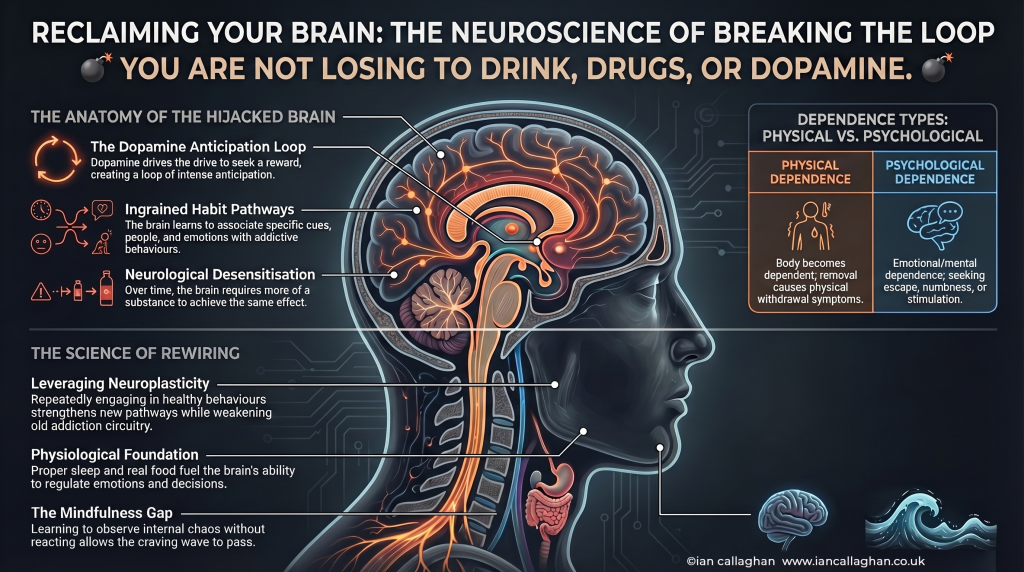
Your brain has a reward system. Its job is to help you learn what matters. It does that partly through neurochemicals like dopamine. And despite all the stupid internet simplifications, dopamine is not just the pleasure chemical. It is heavily involved in motivation, anticipation, learning, and salience. In plain English, it helps mark something as worth noticing and worth pursuing.
When a substance or behaviour produces a strong effect, whether that is alcohol, cocaine, nicotine, opioids, gambling, porn, sugar, or a phone notification loop, the brain learns. It starts linking that thing to relief, reward, escape, numbness, stimulation, or significance.
Over time, the anticipation itself becomes powerful. That is why people can feel pulled before the drink, before the hit, before the bet, before the scroll, before the binge. The system is already firing.
Then there is tolerance. The brain is adaptive. When it gets hammered repeatedly, it adjusts. Which means the thing that used to give a certain effect now gives less. So the person often needs more, or more often, to get the same result. This deepens the pattern and flattens normal life in the process.
That is why ordinary things can start feeling dull as fuck. Food is less satisfying. Conversation is flatter. Nature feels muted. Music does not hit the same. You do not feel interested in anything. That is not proof that you are broken forever. It is often the result of a nervous system trained to expect larger spikes.
Then come the emotional and stress circuits. The amygdala, often simplified as the brain’s alarm centre, becomes highly tuned to addiction-related cues and perceived threat. So now you do not just want the thing because it feels good. You want it because your system has begun to associate it with relief from discomfort. Stress hits, the cue network activates, and the old route lights up again.
Add in a prefrontal cortex that is not functioning at its best because of repeated use, poor sleep, chronic stress, poor nutrition, anxiety, depression, or trauma, and what do you get? You get a person whose braking system is weaker exactly when the craving system is louder.
Then people say, “Why can’t you just stop?”
Because the accelerator is jammed and the brakes are shot. That is why.
Seven Critical Addiction Patterns You Need to Understand
If you want to understand the brain chemistry of addiction, addiction cravings, relapse triggers, and why willpower is often not enough, these are the patterns you need to get your head around.
1. Dopamine Dysregulation and Addiction Cravings
This is one of the biggest pieces of the puzzle. Repeated exposure to highly stimulating substances or behaviours can dysregulate the dopamine system. That means the brain becomes less responsive to normal rewards and more responsive to the addictive target and its surrounding cues.
This is why early recovery often feels flat. People panic and think sobriety is the problem. It is not. The problem is that the brain got used to chemical fireworks, and now ordinary life feels like someone turned the volume down.
That flatness can drive people back. Not because they consciously want destruction, but because they want relief from the dull, grey, dead-inside feeling. That is why understanding dopamine matters. You need to know that the numbness and low drive do not mean recovery is pointless. They often mean your system is recalibrating.
2. Neural Pathways, Habit Loops, and Repetition
Every repeated behaviour makes the route easier to travel. That is how the brain learns everything, from tying your shoelaces to checking your phone every six seconds. Addiction works the same way.
The more often you link a cue, an emotion, or a situation to a substance or behaviour, the more established that route becomes. Then one day it feels automatic. Not magical. Automatic.
That is why recovery is not just about stopping the substance. It is about disrupting the pathway. If you keep the same environment, the same rituals, the same state management, the same mates, the same Friday routine, the same emotional avoidance, do not act shocked when the old route keeps firing.
You cannot just remove the thing. You have to retrain the pathway.
3. Cue-Triggered Cravings and Environmental Triggers
Cues matter more than people realise. A cue can be external: a pub sign, a smell, a song, a notification, a chair, a room, a person, a drive-home route. Or it can be internal, stress, boredom, loneliness, frustration, shame, anger, celebration, or emptiness.
The cue itself is not the addiction. But it activates the memory of the addiction. And the body can begin preparing for the behaviour before the conscious mind catches up.
This is why so many relapses happen in moments that seem stupid afterwards. The person was not being stupid. They were underestimating the cue-response loop.
Learn your cues. Not vaguely. Precisely. When does the urge hit? Where? After what? With who? Following which emotion? At what time? After which thought? That is not overthinking. That is intelligence.
4. Stress, Nervous System Overload, and Cravings
Stress is one of the biggest drivers of craving. When your nervous system is overloaded, it starts looking for the fastest route back to regulation. If addiction has become one of your learned regulation tools, that route will light up quickly.
That is why cravings often hit harder when life goes sideways. Bad sleep. Money pressure. Arguments. Work stress. Pain. Loneliness. Grief. Hormonal shifts. Overwhelm.
People often say they relapsed “out of nowhere”. Usually, it was nowhere. Usually, the system had been under strain for days or weeks, and the old escape hatch finally opened.
So if you want to reduce cravings, you do not just focus on saying no. You focus on lowering the pressure load on the system where you can.
5. Prefrontal Cortex Impairment and Poor Impulse Control
The prefrontal cortex helps with planning, judgment, impulse control, and weighing consequences. You know, the grown-up bit.
Chronic addiction can impair that system. So can sleep deprivation, stress, trauma, low mood, poor blood sugar regulation, and a battered nervous system.
That means you can know better and still fail to act on what you know in the moment. This is where people get cruel with themselves. They say, “I knew exactly what I was doing.” Yes, maybe you did. But knowing how to override a conditioned loop is not the same as being able to do so.
That gap has to be trained. It does not appear because you insult yourself harder.
6. Withdrawal Symptoms and Negative Reinforcement
At a certain stage, addiction is not just about chasing pleasure. It is about escaping discomfort. Withdrawal, anxiety, agitation, flatness, irritability, restlessness, emotional rawness, all of this can push people back to the substance or behaviour because using temporarily removes the pain.
That is called negative reinforcement. You are not necessarily used to getting high. You are used to getting normal. Or to stop feeling like your skin is on backwards.
That is important to understand, because many people in addiction are no longer even enjoying the thing properly. They are just trying to stop the internal noise.
7. Shame as a Fuel Source in Addiction
Shame is one of the most underrated addiction accelerants there is. People think shame will fix behaviour. Usually, it drives it deeper underground.
When you feel disgusting, weak, hopeless, or beyond help, what are you more likely to do? Reach for comfort. Numb out. Escape. Hide. Give up.
Shame narrows the future. It makes recovery feel less available. It makes people identify with the addiction instead of confronting the pattern.
That is why the voice in your head matters. Not because self-love posters save lives, but because constant self-contempt keeps the loop alive.
How Trauma, Anxiety, Boredom, and Emotional Avoidance Feed Addiction
This is the bit people dodge because it gets too close to the truth.
A lot of addiction is not just about liking something too much. It is about not knowing how to be with yourself when the noise starts.
Trauma can absolutely feed addiction. So can chronic anxiety. So can depression. So can loneliness. So can emotional suppression. So can unresolved grief. So can a lifetime of never learning how to regulate distress without an external crutch.
And yes, boredom matters too. Boredom sounds tame, but for a dysregulated nervous system, it can feel threatening. If your brain is used to overstimulation, silence can feel unbearable. Stillness can feel dangerous. Normal life can feel dead.
That is why some people do not just miss the substance. They miss the identity, the chaos, the ritual, the drama, the anticipation, the escape hatch, the temporary switch in state.
Take that away,y, and what is left? Often, a person sitting in a room with themselves, meeting emotions they have been outrunning for years.
That is why recovery is not just subtraction. It is reconstruction.
What Actually Helps Break the Cycle of Addiction and Cravings
Here is where people want a magic bullet. Sorry. There isn’t one.
But some things help, and they help precisely because they work with the actual mechanism instead of pretending addiction is just a bad habit with a dramatic PR team.
Learn the Pattern Instead of Just Hating Yourself
Track your cravings. Not in a vague “I get urges sometimes” way. Track them properly. Time, place, emotion, thought, body state, context, sleep, stress, food, company, cue. You are gathering intelligence. You cannot fight what you refuse to study.
Reduce Cues Where You Can
That is not a weakness. That is smart. You would not tell someone with a dust allergy to go live in a mattress factory to prove they are strong. So stop acting like avoiding obvious triggers makes you pathetic.
Stabilise the Body
Eat properly. Hydrate. Sort your sleep as much as you can. Get daylight. Move. Get out in nature if you can. Support your nervous system instead of treating your body like a bin and wondering why your head feels like one, too.
Build Alternative Regulation Tools
Breathing. Walking. Cold water for some people. Journalling. Talking. Exercise. Meditation. Praye,r if that is your thing. Music. Creative work. Silence. Actual rest.
Not all of these will suit everyone, but the point is simple. If addiction has been your main regulation tool, you need more than one tool in the box.
Practise Urge Surfing
That means learning to experience a craving without immediately obeying it. Notice it. Name it. Feel where it lands in the body. Watch it rise. Watch it peak. Watch it shift. This is not mystical. It is training. You are teaching the brain that an urge can exist without becoming an action.
Get Real Support
Not performative support. Not people who love your chaos because it keeps you small. Not the mate who says, “Go on, one won’t hurt.” Support that actually helps you think, regulate, process, and stay accountable. For some, that is therapy. For some, it is coaching. For some, it is community. For some, it is medical support. For many, it needs to be more than one thing.
Stop Worshipping Relapse as Proof You Are Doomed
Relapse is data. Painful data, yes. But data. What happened before it? What state were you in? What cue got missed? What need was not being met? What lie did your brain sell you just before you gave in? Study it. Learn from it. Do not build your identity around it.
Brain Chemistry of Addiction FAQ
Search engines, AI summaries, and actual human beings all love clarity. So here are the real questions, answered properly.
Is addiction a disease or a choice when the brain chemistry of addiction has changed?
It is not a simple either-or. Initial engagement may involve choice. But repeated exposure changes brain function, behaviour, stress response, and conditioning in ways that make the problem far more than a simple choice issue. That is why treating it as a pure moral failure is both lazy and useless.
Why can’t I just stop if I know addiction is ruining my life?
Because insight and regulation are not the same thing. Because a conditioned brain loop can overpower good intentions, especially when stress, cues, shame, sleep deprivation, or withdrawal are in the mix. Knowing is nothing, but it is not always enough on its own.
Can the brain recover after addiction changes brain chemistry?
Yes, the brain can change. That is the hopeful part. Neuroplasticity is real. The system can recalibrate. Cravings can be reduced. Reward sensitivity can improve. The old pathways can weaken. But that happens through repeated interruption, repeated replacement, repeated recovery behaviours, and time.
Why does normal life feel flat in early recovery from addiction?
Because the brain may be adjusting after prolonged overstimulation. This can create a period where ordinary life feels dull, joyless, or emotionally muted. That does not mean you were happier in addiction. It often means your system is recovering its baseline.
What role does therapy play in addiction recovery and cravings?
Therapy can help you deal with the underlying issues feeding the addiction, things like trauma, anxiety, grief, depression, shame, and emotional avoidance. It can also help you build practical strategies for cravings, triggers, relapse prevention, and nervous system regulation.
Are medications helpful for addiction recovery and withdrawal?
For some people, yes. Medication can help manage withdrawal symptoms, reduce cravings, or support mental health while the bigger recovery work is happening. That is a conversation to have with a qualified medical professional, not some gobshite in a comment section.
What if I relapse after trying to break addiction cravings?
Then you are still in the fight. That is what it means. Not that you have failed forever. Not that all progress is erased. Not that you are back to zero as a human being. It means something needs adjusting. Learn fast. Get honest. Get support. Keep moving.
The Truth Nobody Wants to Hear About Addiction Recovery
You are not powerless in the way the shame voice says you are. But you are also not helped by pretending this is a simple motivation problem.
Addiction is a brain-and-behaviour problem. A stress problem. A conditioning problem. A regulation problem. Often, an emotional pain problem. Sometimes, there is a trauma problem. Often all of the above at once.
And because it is complex, it deserves more than slogans. It deserves honesty. It deserves practical tools. It deserves real support. And it deserves language that does not reduce people to moral failures for struggling with a hijacked reward system.
That does not mean giving people a free pass. It means giving them a real map.
Because once you understand the map, you stop taking every craving personally. You stop acting like every urge is your true self speaking. You stop thinking one bad day means your life is over. You start seeing the mechanics. The cues. The states. The patterns. The loops.
And that is when the fight changes.
You stop swinging in the dark.
Final Word on the Brain Chemistry of Addiction
If you are tired of being a puppet to your cravings, good. Let that anger become clarity. Let that exhaustion become honesty. Let that honesty become action.
Learn the mechanism. Study your pattern. Support your body. Strengthen your nervous system. Get help if you need it. Stop calling yourself weak for having a brain that learned a destructive route. Then start building a better one.
Because cravings are powerful. But they are not prophecy. They are signals. They are conditioned responses. They are brain events. And brain events can be interrupted.
You are not doomed. You are not broken beyond repair. And you are not just some helpless puppet unless you keep refusing to understand the strings.
So cut the strings. Learn the enemy. And take your bloody life back.
If this hit home and you want to go deeper into the real mechanics of addiction, brain chemistry, self-sabotage, and how to start rewiring the patterns underneath the behaviour, drop a comment, share it with someone who needs it, or reach out for help from someone qualified to support you.
And if you are in immediate danger, at risk of harming yourself, or dealing with severe withdrawal symptoms, stop reading and get urgent medical help now.
Nobody warns you about this bit. Anhedonia in early sobriety.
You brace for the first week. You brace for the shakes, the cravings, the weirdness of your first sober Friday night, the habit loops, the social awkwardness, the cupboards without bottles in them. You prepare yourself for the big, dramatic part. You expect struggle, then relief. You expect the pink cloud everyone keeps banging on about. Clear skin. Boundless energy. Morning walks—a sudden desire to become the sort of person who owns a yoga mat and means it.
But instead of the sunrise, you get the fog.
You are six weeks sober, sitting at the kitchen table on a random Tuesday, and something feels wrong. Not because you are craving a drink. Not because you are in pieces. Quite the opposite. You feel absolutely nothing. Not devastated. Not even especially angry. Just flat. Grey. Unmoved. As if somebody has gone into the control room of your brain and pulled the main fuse on the part that used to care.
Your favourite music sounds like background noise. Food tastes like cardboard. Sunlight feels thin and irritating. Life has not exploded. It has gone colourless.
That is what anhedonia in early sobriety can feel like, and it is one of the most dangerous parts of the whole process precisely because it does not look dramatic. It looks like a boring Tuesday. It looks like staring at a wall for forty minutes and wondering whether this numb, hollow indifference is what sober life is going to be forever.
Here is the truth.
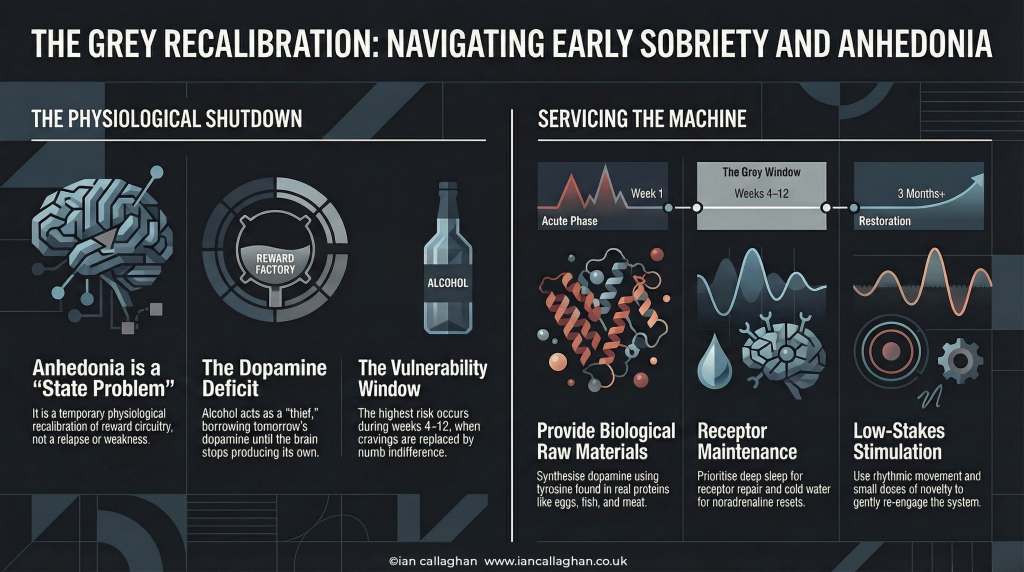
This is not proof that sobriety is not working. It is not proof that you were better off drinking. It is not proof that you are weak, broken, or built wrong. It is often a sign that your reward system is recalibrating after years of hammering.
I write about this from lived experience, years of coaching people through addiction and behavioural change, and a framework built around the biology of recovery rather than the motivational fluff you get fed online. If you feel like a grey cardboard version of yourself right now, this article is for you.
What Is Anhedonia in Early Sobriety?
Anhedonia is the inability to feel pleasure.
That sounds simple, but when it hits in early sobriety, it can feel brutal because it steals the point of the whole thing. You quit drinking expecting relief, better sleep, more clarity, more life. Instead, you get emotional static.
Anhedonia is not the same as sadness. Sadness has shape to it. Sadness has weight. You know you are sad. Anhedonia is different. It is the absence of emotional landing. You can look at something beautiful, hear a song you used to love, eat a meal you know should be enjoyable, and absolutely nothing happens inside.
Your brain registers the event. It just does not reward you for it.
That is why anhedonia in sobriety is so dangerous. The cravings may have gone quiet, but so has everything else. And when sober life feels flat, the old lie starts creeping back in: if this is it, I might as well drink.
That is exactly why this needs to be named properly.
Why Anhedonia Happens After Quitting Alcohol
Your Brain Is Not Broken, It Is Adapting
Alcohol is not just a drink. It is a chemical hijack of your reward system.
For a long time, booze acted like an external power source. It flooded the system, boosted dopamine, and trained your brain to expect stimulation from outside rather than to generate balanced reward internally. The brain, being efficient and logical, adapts to that.
It turns things down.
That means lower natural dopamine signalling, reduced sensitivity, and a reward system that stops reacting properly to ordinary life because it has been trained on a stronger artificial hit.
Then one day, you stop drinking.
The external supplier is gone, but the internal system has not fully come back online yet. That gap is where anhedonia lives.
This is why early sobriety can feel so flat. You have removed the chemical spike, but your baseline reward circuitry is still under repair. The factory is still standing, but production is restricted.
Why Sober Life Feels Pointless for a While
This is the bit that catches people out.
When you are white-knuckling through cravings, at least you know what the fight is. When you are in the grey phase, there is no big enemy—just indifference. Food does not excite you. Music does not move you. You stop looking forward to things. You are not in chaos. You are in a low-voltage version of existence.
That can make sobriety feel pointless, even when it is actually working.
The absence of drama tricks people into thinking nothing meaningful is happening. In reality, your nervous system may be doing a huge amount of repair behind the scenes.
The Real Problem With Sober Influencer Nonsense
Why Toxic Positivity Makes Anhedonia Worse
A lot of the sober internet is absolute bollocks when it comes to this stage.
It loves before-and-after photos, morning routines, gratitude journals, glow-up reels, and the idea that once you stop drinking, your whole life turns into sunlight, matcha, and expensive trainers.
That version of sobriety leaves people completely unprepared for anhedonia.
Because when week six feels grey as hell and some influencer is posting about how quitting alcohol made them spiritually radiant by day nineteen, you assume the problem is you.
It is not you.
It is the gap between reality and performance.
You cannot gratitude-journal your way out of an underpowered nervous system. You cannot mind-set your way around biology. Software does not fix a hardware issue.
That does not mean mindset is useless. It means mindset without physiology is incomplete.
The Shame Tax Makes Recovery Harder
Why Feeling Broken Adds More Load
One of the worst things you can do during anhedonia is start treating yourself like a defective person.
Shame is not just emotional. Shame is a physiological load. It adds stress to a system that is already struggling. It pushes cortisol into a brain that is trying to stabilise. It makes recovery heavier.
That is why anything that reinforces the idea that you are permanently broken, fundamentally flawed, or doomed to white-knuckle your way through life can make this phase worse.
You are not trying to prove moral worth here. You are trying to support a nervous system that has been under chemical pressure for years.
That is a different conversation.
7 Signs of Anhedonia in Early Sobriety
If you are wondering whether this is what is going on, these are some of the most common signs.
1. Good things happen, and you feel nothing
You know something should feel good, but the emotional response never lands.
2. Food loses its appeal
You eat because you should, not because there is any pleasure in it.
3. Music does not hit the same
Songs you used to love sound like wallpaper.
4. You feel like a cardboard version of yourself
You are functioning, but there is no spark in it.
5. Boredom feels physical
Not casual boredom, actual agitation in your body.
6. You stop looking forward to things
The future does not feel threatening; it just does not feel alive.
7. Cravings go quiet, but numbness gets louder
This is the trap. You think the danger has passed because the urge to drink is not screaming. But numbness can drive relapse just as hard as craving can.
How to Support Recovery From Anhedonia
You do not fix this by pretending it is not happening. You support the machine.
Real food and protein matter
Your brain needs raw materials to build neurotransmitters. That means proper food, enough protein, and not trying to run recovery on ultra-processed crap.
Eggs, meat, fish, full-fat dairy, real meals, proper nutrients. You are trying to help the system rebuild, not survive on beige convenience food and hope.
Sleep is not optional.
Deep sleep is where repair happens. If your sleep is wrecked, your recovery is carrying an extra load.
You do not need perfection, but you do need to treat sleep like infrastructure, not a luxury.
Rhythmic movement helps regulate the system.
Not gym-bunny punishment. Not smashing yourself into the floor. Walking. Gentle strength work. Rhythmic movement. Enough to lower stress, improve regulation, and remind your body it is safe.
Cold water can act as a manual reset
Used properly, cold water is not content. It is input.
It can shift state fast, increase alertness, and create a genuine physiological response in a system that has gone flat. It is not magic, but it can help wake the circuit up.
Small novelty matters more than you think.
New route, new recipe, new environment, new music, a change in pattern. A depleted dopamine system often needs small, low-pressure novelty to start responding again.
Honest connection beats performance.e
Do not isolate and pretend you are fine. You do not need to perform thriving. You need real contact. Even one proper, honest conversation can take some load off the system.
Anhedonia in Sobriety Is Not Permanent
The Colour Comes Back in Stages
This is the bit people need to hear.
Yes, you can enjoy things again.
Not because of motivational nonsense. Because the brain is plastic, it adapts. If it adapts to alcohol, it can adapt away from it too.
The colour usually comes back gradually, not all at once. A song lands a little more than it did last week. A meal tastes better. You laugh properly for the first time in ages and realise it was real. That is how the system comes back online.
Not with a cinematic breakthrough. In increments.
Why This Matters for Relapse Prevention
Anhedonia matters because people mistake it for failure.
They think, I quit drinkin, and I still feel like shit, so what is the point?
That is often the exact moment the old pattern tries to sell itself back to you as relief.
But drinking does not solve anhedonia. It resets the damage. It plugs the external power source back in, delaying the rebuild again.
That is why understanding anhedonia is not just comforting; it is practical. When you know what is happening, you are far less likely to misread the grey phase as a sign you should go backwards.
FAQ: Anhedonia and Early Sobriety
Is anhedonia normal in early sobriety?
Yes, it is common. Not everyone experiences it the same way, but a flat, numb, joyless phase is a recognised part of early recovery for many people after quitting alcohol.
Is anhedonia the same as depression?
Not exactly. They can overlap, but anhedonia is specifically about reduced ability to feel pleasure. Depression is broader and can include hopelessness, low mood, sleep changes, guilt, and other symptoms. If things are getting darker, more persistent, or you are struggling to function, speak to a qualified professional.
How long does anhedonia last after quitting alcohol?
It varies. For many people, the worst of it starts to lift somewhere between weeks four and twelve, but heavier or longer drinking histories can mean a longer recalibration. There is no exact stopwatch for this.
Will I ever enjoy life again without alcohol?
Yes. The system can recover. It takes time, repetition, and the right inputs, but the flatness is not proof that pleasure is gone forever.
What helps with anhedonia in sobriety?
Real food, protein, better sleep, movement, cold exposure where appropriate, reduced stress load, honest connection, and giving your nervous system time to recalibrate. In some cases, professional support may also be important.
Final Word on Anhedonia in Early Sobriety
If sobriety feels flat right now, that does not mean you are doing it wrong.
It does not mean you are broken.
It means your brain may be recalibrating after years of being trained to expect chemical reward on demand. That process can feel bleak, boring, and frighteningly empty. But empty is not the same as finished.
This phase has caught a lot of people out because nobody talks about it properly. They talk about cravings. They talk about rock bottom. They talk about transformation. They do not talk enough about Tuesdays when nothing feels good, and you start wondering whether sober life is just a long stretch of grey carpet.
It is not.
If you are in that phase, stop mistaking a maintenance window for a verdict on your life.
Support the hardware. Lower the load. Stay the course.
The colour comes back.
Key takeaways on anhedonia in sobriety
What to remember
Anhedonia in early sobriety is common and often temporary
It can feel like numbness, flatness, and loss of pleasure rather than obvious sadness
It is often linked to reward system recalibration after quitting alcohol
Social media recovery fluff usually does a terrible job of preparing people for it
Real food, sleep, movement, cold exposure, and honest connection can support recovery
Feeling flat does not mean sobriety is failing
A question worth asking yourself today
If this grey phase is not failure but repair, what is one thing you can do today to support the machine rather than attacking yourself?
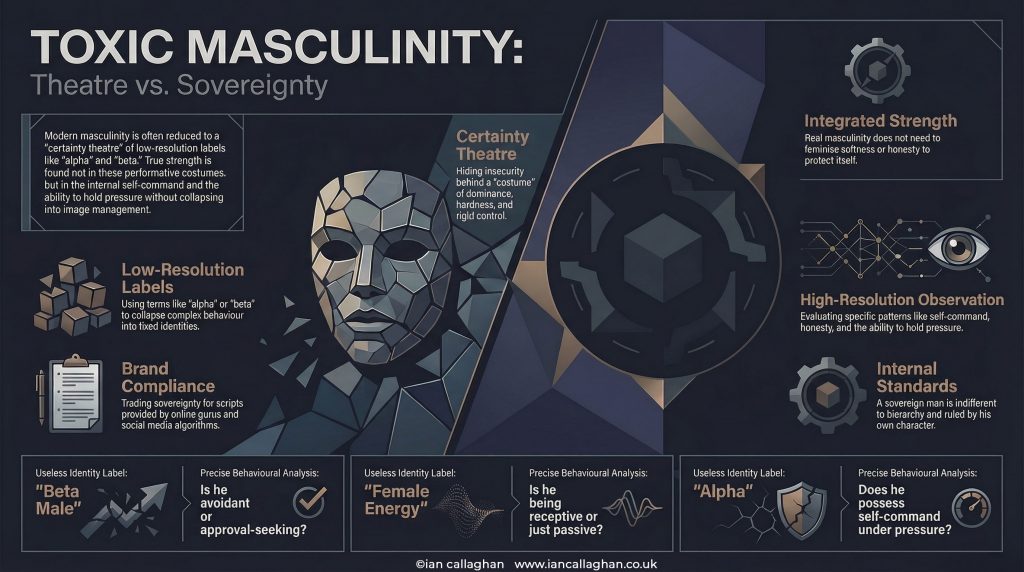
The amount of Toxic Masculinity currently being vomited across the digital landscape under the guise of “self-improvement” or “reclaiming manhood” is, quite frankly, embarrassing. If you spend more than thirty seconds on any social media feed, you are instantly assaulted by a parade of grown men throwing around half-baked labels like “beta male,” “sigma,” and “female energy” as if they’ve cracked some ancient, esoteric code of the universe. In reality, they’ve done nothing of the sort. All they have managed to do is reduce the staggering, breathtaking complexity of human behaviour to playground-status games and digestible podcast sound bites designed for the short-attention-span era. This is a high-resolution problem—the crisis of modern identity—being met with incredibly low-resolution labels, and the result is performance as brittle as it is loud. It is “lazy thinking” at its most industrial, a “certainty theatre” that prioritises a man’s image over his actual substance.
Harmful Gender Archetypes: The Costume of Certainty
When we look at the modern landscape of male identity, we are actually witnessing a massive collective failure of language. It is weak language for weak minds. Most of all, it is insecurity wearing combat gear and pretending it’s a uniform. The source of this obsession with archetypes isn’t found in a man’s strength, but in his utter inability to describe human behaviour with any degree of precision. This is the bedrock of the theatre. A man who cannot describe behaviour precisely will inevitably reach for a label. If he sees a man who is kind, or perhaps a man who is willing to listen and show receptivity, and he lacks the psychological vocabulary to understand that as “receptivity,” “emotional intelligence,” or “deliberate restraint,” he panics. His internal world has no box for a man who is both strong and soft, so he reaches for the word “beta” because it’s a blunt instrument. It’s a way to categorise the world so he doesn’t have to think about the nuance anymore.
This is what we call “certainty theatre.” A man who cannot hold his own uncertainty—who cannot handle the fact that life and people are complicated, messy, and non-linear—will hide inside a rigid, certain identity. He builds a costume out of dominance, hardness, control, and image. This costume provides a temporary relief from the terrifying reality that he might not actually know who he is. He’s not seeking truth; he’s seeking a bunker. And because that identity is a costume and not a core, he is perpetually terrified of being found out. He is a man on a stage, waiting for the audience to boo.
“A man who has built his whole identity on dominance, hardness, control and image will attack anything in another man that threatens the costume.”
This is the central irony of the modern “alpha” movement. The aggression you see in comments sections and on stages isn’t an expression of power; it’s a defensive reaction to protect a fragile brand. If another man shows softness or vulnerability, he must be shamed immediately. Not because the softness is a threat to society or “the west,” but because it threatens the shamer’s own performance. If softness is allowed to exist in a man, then his costume of perpetual hardness might be seen for what it is: a mask. It isn’t insight he’s offering; it’s branding. It isn’t leadership; it’s posturing. He is literally trying to bully the world into believing his theatre is reality so he doesn’t have to face the hollowed-out version of himself that exists when the stage lights go dark.
Toxic Masculinity: The Psychological Dependence Behind ‘Female Energy’ Slurs
One of the most telling signs of this theatre is the weaponisation of the term “female energy.” When men use this as a slur, they think they are asserting their dominance. They think they are displaying masculine wisdom. They are, in fact, displaying a profound state of Toxic Masculinity and an even deeper state of psychological dependence. Saying a man is in his “female energy” is not an analytical observation. It is a confession. What that man is actually saying—though he lacks the honesty to admit it—is: “You are not performing masculinity the way I need you to so I can feel safe in mine.”
This is the absolute opposite of strength. If your sense of self-worth and your identity as a man depend entirely on how the men around you are behaving, you are not sovereign. You are a dependent. You are essentially saying that your masculine “frame” is so flimsy that the mere presence of an emotionally articulate man causes it to buckle. Real strength does not need a caricature to stand next to in order to look big. Real masculinity does not need to feminise softness, thoughtfulness, or emotional honesty just to protect its own ego. A grounded man—a man who actually possesses self-command and has done the work of integrated character building—is not panicked by another man’s kindness. He doesn’t feel the need to start a “chest-beating ritual” or a “toxic bollocks” monologue to prove he’s the top dog because he isn’t playing the game of comparison.
The man who is obsessed with “female energy” insults is a man under an immense psychological load. To maintain the “Alpha” brand, he has to suppress everything human within himself. He has to kill his own receptivity. There is a massive difference between receptivity and passivity, but the theatre-goer cannot see it. Passivity is a failure of the will; receptivity is the strength to be open, to listen, and to hold space. The insecure man sees both as “soft” because his script tells him that only “hardness” is masculine. Consequently, he becomes less functional. He confuses numbness for strength. He thinks that by turning off his emotions, he has become a machine of war, when in reality, he’s just become an emotional amputee.
This suppressed energy doesn’t go away; it turns into a brittle, reactive anger. A man who cannot be honest about his own internal state is a man who is perpetually “on script.” And that performance is exhausting. It requires constant maintenance—checking the mirror, checking the likes, checking the hierarchy. If he stops performing, he stops existing in his own mind. Therefore, he must shame anyone who isn’t as miserable and restricted as he is. He sees a man who is calm, reflective, or emotionally articulate, and he experiences a spike of cortisol. That man’s freedom is an indictment of the performer’s prison. To resolve that tension, the performer must attack. He must label the freedom as “weakness” to justify his own chains. This isn’t wisdom; it’s a coping mechanism for a man who is drowning in his own unacknowledged needs.
Performance vs. Sovereignty: The Brand-Compliant ‘Alpha Male Hierarchy’
We need to address the “alpha male hierarchy” for what it truly is: a fantasy caste system for men who are terrified of complexity. The men shouting most loudly about where everyone sits in this hierarchy—who is an alpha, who is a beta, who is a “high-value man”—are rarely free men. They like to think of themselves as “wolves,” but they are actually the most obedient people on the planet. They are just obedient to a different audience. They aren’t sovereign; they have simply traded one master for another. They’ve swapped the “matrix” they claim to hate for a different set of rules spat out by a man in a Dubai apartment with a podcast mic.
They haven’t become sovereign. They have become “brand compliant.” They are following a script provided by online gurus and social media algorithms. They are performing for the eyes of other men. This is the funniest part of the whole charade: the men who claim to be the most “dominant” are often the most ruled by the validation of their peers. Their every move is curated to fit a brand identity. They eat the same “alpha” foods, use the same “alpha” jargon, and engage in the same performative “grind” culture. It’s not a lifestyle; it’s a franchise.
“A man who needs to constantly prove he is not soft is still being controlled by softness.”
If your entire life is a reaction against being “soft,” then softness is the thing running your life. You aren’t making choices based on your own standards or your own moral compass; you’re making choices based on your fear of a label. If you are obsessed with looking dominant, you are ruled by the audience. You are a slave to the “eyes of other men.” A sovereign man is indifferent to the hierarchy. He doesn’t need to know where he ranks because he isn’t competing for a spot in a fantasy pecking order. He is busy building a life of substance.
The “brand-compliant” man, however, is always under load. He confuses aggression for certainty. He thinks that by being loud and domineering, he is showing leadership. But real leadership requires the ability to hold pressure without collapsing into image management. Most of these “hierarchical” men collapse the moment their image is challenged. They can be physically strong, spending hours in the gym to build a suit of armour, but they are psychologically weak. They can be dominant in a room and yet completely lack self-command. They are ruled by impulse, by ego, and by the desperate need to be seen as “the man.” If you are ruled by a need to be seen, you are not the one in charge. The people looking at you are.
Collapsing Behaviour into Identity: The Danger of the Script
The Toxic Nature of Ranking Men
The most destructive element of this entire theatre is the way it collapses behaviour into identity. This is the ultimate “low-resolution” move. In the real world, if we want to understand a man, we should be looking at what he actually does in specific moments. We should be asking precise, surgical questions about his patterns of action. Instead, the “alpha/beta” theatre encourages us to just slap a label on him and stop thinking. This is a tragedy, because behaviours can be corrected, but identities feel permanent.
When you collapse behaviour into identity, you stop observing and start performing. Instead of asking useful questions, men start acting out a role. They ask:
Is this man being passive? (A description of a specific failure to act).
Is he approval-seeking? (A description of a specific psychological motivation).
Is he avoidant of his responsibilities? (A description of a pattern of neglect).
Is he being dishonest? (A description of a moral failure).
Is he led by fear rather than purpose? (A description of his internal driver).
Does he lack self-command? (A description of his relationship with impulse).
Does he fold under pressure? (A description of his resilience).
Does he outsource his authority to others? (A description of his lack of sovereignty).
These are useful questions because they describe specific behaviours. If a man is being avoidant, he can learn to be courageous. If he lacks self-command, he can train his discipline. But the moment you slap the label “beta” on him, you have turned a fixable behaviour into an unchangeable caste. You have spat out a label that tells you nothing about why he is acting that way or how he can improve. You have just “demoted” him in your imaginary hierarchy and moved on.
This traps everyone. Men start pretending to be harder than they are to avoid the label. They suppress their emotional intelligence and their ability to reflect because they are scared that any sign of “softness” will get them kicked out of the tribe. They confuse domination for leadership and reaction for personality. They are no longer free to be honest; they are only free to be “on script.” And that script is a prison. It teaches men to relate to themselves and each other through contempt instead of precision. It replaces the difficult work of character building with the shallow work of image management. It’s a race to see who can be the most numb, the most aggressive, and the most certain—and in that race, everyone loses their humanity.
The 7 Signs You Are Trapped in the Theatre of Toxic Masculinity
To move beyond the noise and the “toxic bollocks,” we have to recognise the stage when we are standing on it. Here are the clear signs that a man is being run by a script rather than his own sovereignty:
Obsessive Image Management: You are more concerned with appearing “hard” or “dominant” than you are with being effective or useful. Your primary focus in any room is your “frame” and how you are being perceived by the other “males” in the imaginary hierarchy.
Avoidance of Complexity: You use low-resolution labels like “alpha,” “beta,” or “simp” to describe human interactions because the nuanced reality of human behaviour scares you. You prefer the “certainty theatre” of slogans over the difficult, often uncomfortable, search for truth.
Shaming Others to Stabilise Identity: You feel a compulsive need to mock “softness,” “vulnerability,” or “female energy” in other men. This is a neon sign that you are psychologically dependent on feminising others just to feel secure in your own masculine costume.
Running a Brittle Script: Your personality is built entirely out of reaction. You aren’t acting from your own deeply held standards; you are performing the version of “manhood” that you think will earn you validation from your chosen online echo chamber.
Confusing Numbness for Strength: You believe that suppressing your emotions, ignoring your intuition, and remaining “stony” makes you powerful. In reality, you are just becoming less articulate and more psychologically brittle under the mounting pressure of your unexpressed humanity.
Outsourcing Authority to Gurus: You look to online hierarchies, “status games,” or the opinions of podcasters to tell you your worth. You are obedient to a brand or a “grindset” soundbite rather than being a sovereign individual with the self-command to think for yourself.
Fear of “Demotion” in the Pecking Order: You are constantly on guard, terrified that any sign of kindness, reflection, or honesty will get you “exposed” as weak. You are not a leader; you are a man ruled by the eyes of other men and the fear of being cast out of the play.
Toxic Masculinity and the Antidote: Moving from Costume to Command
So, what is the antidote to this Toxic Masculinity and the hollow theatre of the “alpha” movement? It isn’t “less masculinity”—that’s a common mistake made by people who don’t understand the problem. The world doesn’t need men to be less masculine; it needs them to be better at it. It needs them to move away from the costume and toward command. It’s about looking at the actual patterns of a man’s life rather than the slogans he shouts.
Real masculinity doesn’t need an internet caste system. It doesn’t need to rank men like wolves in a fantasy novel. It needs standards. It needs honesty. It needs the ability to observe one’s own patterns without lying about them. A real man doesn’t need to shame softness because he isn’t threatened by it. He has the self-command to be calm when others are panicking, to be kind when others are aggressive, and to be honest when others are performing. He understands that strength is the ability to be receptive without being passive—to be able to hear the truth, even if it hurts his ego, and to act on it with precision.
Real strength is the ability to hold pressure without collapsing into image management, aggression, or avoidance. It is the courage to stop performing a role and start “becoming” a man of substance. Any version of manhood that can only define itself by what it hates, what it shames, or what it “dominates” is hollow. Real power is sovereign. It is quiet. It is precise. It doesn’t need a podcast mic or a gym selfie to prove its existence. It is found in the man who has nothing to prove and everything to protect.
The Patterns of Modern Masculinity FAQ
What is the difference between real strength and performing masculinity?
Real strength is an internal quality grounded in self-command, honesty, and the ability to maintain one’s own standards under pressure without needing to manage an image. Performing masculinity, or “theatre,” is a defensive, external posture where a man mimics “hardness” or “dominance” to hide his own insecurity and protect a fragile “costume” from being challenged by the reality of his own feelings or the presence of other men.
Why is the “alpha vs. beta” hierarchy considered low-resolution thinking?
These labels are “low-resolution” because they simplify the staggering complexity of human behaviour into oversimplified, playground status games. Instead of analysing specific, actionable traits—like whether a man is being avoidant, dishonest, or lacking self-command—these labels collapse a person’s entire identity into a useless category that prevents men from observing their actual patterns and growing.
How does Toxic Masculinity lead to “psychological dependence”?
It creates a state where a man’s sense of self is entirely dependent on external mirrors. If a man feels he must shame “female energy” or “softness” in others to feel secure, he is admitting that his own masculinity is not sovereign; it is a “costume” that requires the behaviour of those around him to stay in place. He is literally dependent on the “weakness” of others to feel “strong.”
What does it mean for a man to be “brand compliant” rather than “sovereign”?
A brand-compliant man follows a pre-written “script” of masculinity provided by an online subculture or “alpha” guru to gain validation and a sense of belonging. A sovereign man, by contrast, is not ruled by the “eyes of other men” or social media algorithms; he acts according to his own internal standards and has the self-command to be honest and flexible rather than merely “on script.”
Conclusion: Beyond the Slogans
At the end of the day, any version of manhood that relies on shaming others to exist is just a house of cards. The “alpha/beta” theatre is a loud, distracting performance that keeps men from doing the real work of character building. We have to stop looking at the labels and start looking at the patterns. We have to stop asking where a man sits in a fantasy hierarchy and start asking whether he can tell the truth, hold pressure, and be in command of his own impulses.
We have to decide if we are going to be “brand compliant” actors in someone else’s play, or if we are going to be sovereign individuals who own our own lives. Real masculinity is not a slogan. It is not a “toxic bollocks” monologue. It is the ability to stand in the truth of who you are—in all your complexity, strength, and receptivity—without needing to put on combat gear just to feel safe. It is about standards, honesty, and self-command.
Everything else is noise.
The question you have to ask yourself is simple and cuts through all the theatre and posturing: Are you building a character of substance, or are you just perfecting a costume?
Used to monitor number of Google Analytics server requests when using Google Tag Manager
1 minute
_gid
ID used to identify users for 24 hours after last activity
24 hours
_ga_
ID used to identify users
2 years
_gali
Used by Google Analytics to determine which links on a page are being clicked
30 seconds
_ga
ID used to identify users
2 years
__utmx
Used to determine whether a user is included in an A / B or Multivariate test.
18 months
__utmv
Contains custom information set by the web developer via the _setCustomVar method in Google Analytics. This cookie is updated every time new data is sent to the Google Analytics server.
2 years after last activity
__utmz
Contains information about the traffic source or campaign that directed user to the website. The cookie is set when the GA.js javascript is loaded and updated when data is sent to the Google Anaytics server
6 months after last activity
__utmc
Used only with old Urchin versions of Google Analytics and not with GA.js. Was used to distinguish between new sessions and visits at the end of a session.
End of session (browser)
__utmb
Used to distinguish new sessions and visits. This cookie is set when the GA.js javascript library is loaded and there is no existing __utmb cookie. The cookie is updated every time data is sent to the Google Analytics server.
30 minutes after last activity
__utmt
Used to monitor number of Google Analytics server requests
10 minutes
__utma
ID used to identify users and sessions
2 years after last activity
_gac_
Contains information related to marketing campaigns of the user. These are shared with Google AdWords / Google Ads when the Google Ads and Google Analytics accounts are linked together.