Description
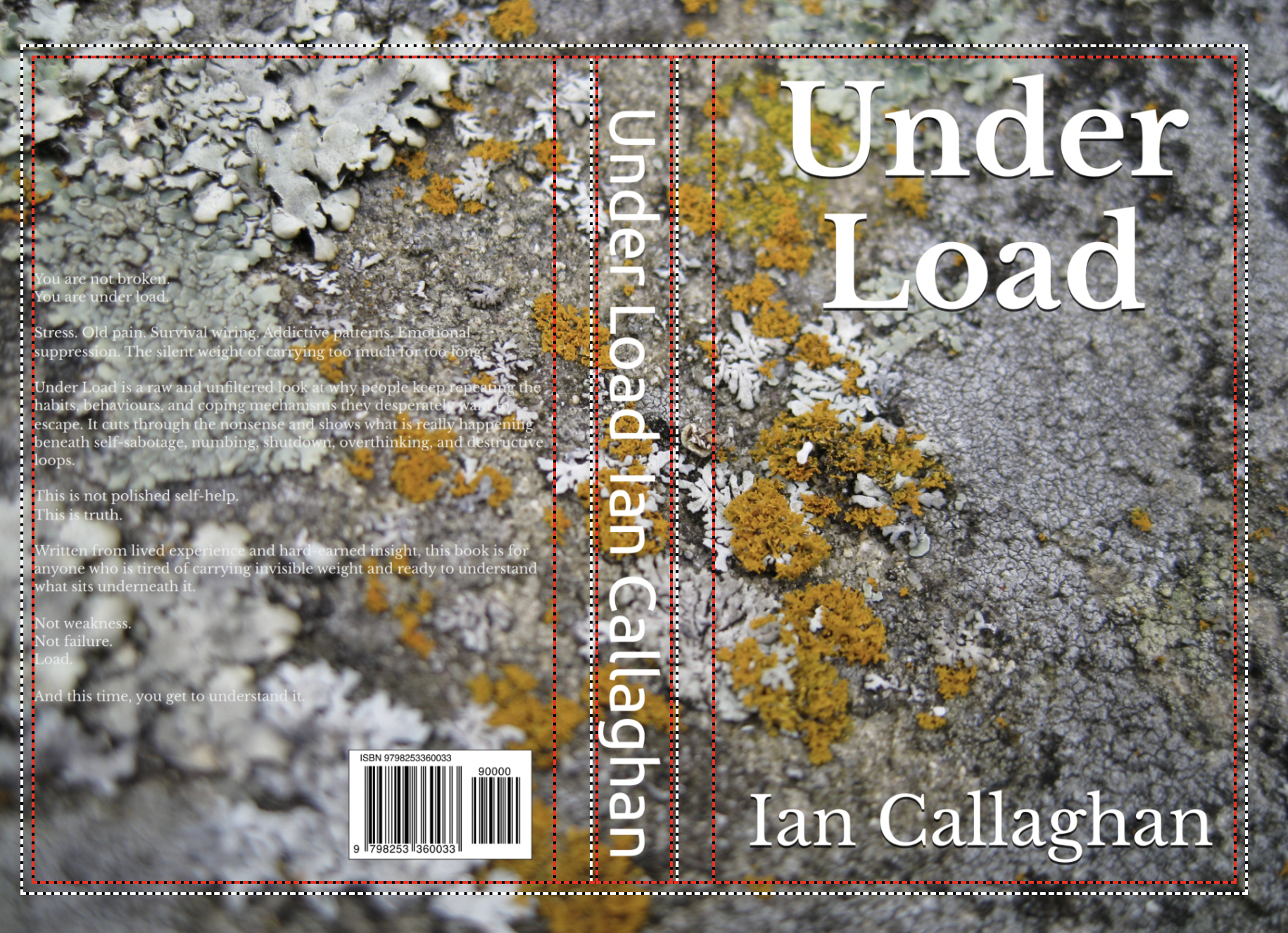
Under Load by Ian Callaghan — that gap between knowing and stopping.
Most approaches to compulsive behaviour require more thinking. More narrative. More story of the wound. You have done that work. You can explain your triggers with clinical precision. And then you have done it again anyway.
That gap between knowing and stopping.
Most approaches to compulsive behaviour require more thinking. More narrative. More story of the wound and the meaning of the pattern. You have done that work. You have sat in the rooms, read the books, processed the trauma, and built the vocabulary. You can explain your triggers with clinical precision.
And then you have done it again anyway.
You cannot think your way out of a state problem. And most of what the recovery industry offers is more thinking.
This is not a recovery manual.
Under Load does not have steps. It does not ask you to surrender to anything, label yourself with anything, or attend anything. It does not begin from the assumption that you are powerless over your own nervous system.
Because you are not powerless. You are under load. Those are completely different conditions with completely different solutions.
What it actually explains.
In seven parts spanning 371 pages, Under Load breaks down the architecture of self-destructive behaviour at the level where the work actually happens. Not the narrative. Not the character. The state. The physiology. The 100 milliseconds before conscious thought catches up with what the nervous system has already decided to do.
- Why the disease model, the moral failure model, and the willpower model are all built on premises that guarantee eventual failure
- How the machine gets installed in early life and why it keeps choosing familiar pain over available relief
- The role of Tone, Signal, and Noise in compulsive behaviour and why physiology cannot be bypassed
- The PR Firm inside your head that produces airtight justification for every self-destructive choice you make
- Error codes including anxiety, anger, and numbness and what they are actually telling you
- The Gate between stimulus and behaviour, how sovereignty is lost, and how to take it back
- The Emotional Observation Method, Ian’s own framework built from 45 years of getting this wrong and 15 years helping others navigate it
Sovereignty is not the absence of pain. It is the ability to carry pain without letting it drive.
Who this is written for.
Under Load is written for the person who already knows what they are doing and still cannot stop. The soldier, the executive, the coach, the parent, the high-functioning self-destroyer who performs at the highest level in every area of their life except this one. The person who is not weak. The person for whom the moral failure model never made sense because they know their own capability.
It is also written for anyone who loves someone in that position and cannot understand why understanding is never enough.
The substance or behaviour does not matter. Alcohol, cocaine, gambling, pornography, food, work, screens, spending. The underlying architecture is identical. Same error code. Same collapsed state. Same fix.
About Ian Callaghan.
Ian Callaghan served 12 years in the British Army before building a career as an IT technical architect. He spent 45 years drinking, not as a social habit, but as a nervous system regulation strategy. He quit. Not through a programme, not through surrender, not through labels. Through understanding the machine well enough to service it differently.
He has spent fifteen years helping others do the same. Under Load is the book that came out of both halves of that. He wrote it so you don’t have to take as long as he did.
What’s included.
- The full Under Load eBook, 371 pages, instant digital download
- Exclusive access to the Under Load AI assistant, available only to eBook buyers on iancallaghan.co.uk
- “Available in epub format on request”
Pick up the wrench.

Helena Mader –
Absorbing Ian Callaghan´s writings has given me a totally new perspective on the whole issue of taking over the wheel in the case of addiction, and I deeply appreciate his direct approach, his expertise based on his own experience and in-depth studies, and his very unique form of delivery. Refreshing, to the point, highly useful.
Kate Robinson –
Best purchase ever. I haven’t even finished it and wished I’d bought it sooner. It makes so much sense in a time of confusion and overwhelm. Brilliantly placed.
Rose –
If you want things sugar coated this book is not for you. If you’re prepared to understand why you keep doing the same shit on a different day then invest in the time to read this. It’s not comfortable reading and sometimes the language is technical. Well it is called “Under load”.
Gel chaoman –
I haven’t finished the book yet but I can tell you it is life changing! It has given me insight and realisation of why I am where I am! I’m still working through it but don’t buy it if you just want to feel better! It is challenging and painful and is the hardest thing I have ever read. I feel hopeful for the first time in a long time.
Liz –
Consistent with Ian’s posts, this book is incredibly detailed, scientifically accurate and well written. If you want to understand, really understand what drives addiction, give this a read. The idea of needing a “state change” in the face of a craving was like a lightbulb moment for me. Tried it with success.
Anneke –
I haven’t bought the book yet. The content that Ian puts out there on his Facebook page – for free – has changed my life. I am deeply grateful.
Matt (verified owner) –
I have just finished Under Load. A brilliant reframing of addiction and compulsive behavior and very, very readable. The analogies of the mechanic and the machine, the operator or the component were incredibly helpful for me. Ian’s lived in the loop, carries the scars and has developed a protocol that has put him back in the cockpit! I’m genuinely excited to stock the fridge and pick up the wrench.
Millie –
Ian’s explanations are a revelation. They really hit home. The physiological processes driving addiction make such basic sense, yet this is the first time I have encountered such an approach ..and it really does work!
Instead of concentrating on the psychological ‘whys’, Ian gives us tools to understand how to change the fundamental body and mind processes which drive addictive behaviour.
Written with simplistic clarity, relatable explanations and examples, no-nonsense narrative.
A game changer for anyone seeking to change their habits and start treating their body and life as if they matter.