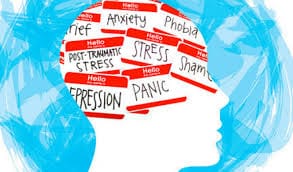
Covid and My Mental Health. This is by no means an exhaustive post of how I have gotten through this year so far, just a quick post listing a few of the tools I have used to manage my mental health. During this year I have had several episodes if that is what you wish to call them from anxiety attacks in supermarkets to those very dark thoughts.
Like for many this year will go down as a pretty shit year, pandemic, lock-downs, job losses, isolation, weight gain, alcohol consumption increase and the list goes on and on. Just as we think things are on the up along comes more of the shitstorm, led by what for many seem inept, incompetent, lying, contradicting imbeciles. They are following the science they say, yet on our little island in the Atlantic, we get conflicting stories, rules, restrictions and guidelines. Why can it not be one song sheet one storybook rather than the individuals having silly little power games?
From day one bungling Boris, wee Jimmy up in Scotland and Dripford here in Wales have all said different things, I long ago gave up on the news and its constant negativity and bickering. Limiting social media as much as I can also, friends arguing with friends over the smallest thing.
Limit The Media
My circle is small and have I limited social interaction, the shop, the occasional visit to the pub.
I don’t mind my own company and can generally occupy my time. For the main part of this, I have been working from home with a few trips to the office in West Wales, that contract ended last Friday so its back to looking for more work to pay the bills.
Ideally, I would build the coaching business, I know that the skills I have and tools I have learnt over the last few years would be of so much use in these unprecedented times. From school children with anxiety to adults with the whole gamut of mental health issues from depression to anxiety. Over the last several years I have suffered from mental health issues, unlike many men of my age I have no qualms or issues in speaking about it. All the man up, get on with it shit is the past, we need to end the stigma, the taboo that surrounds mental health.
Covid and My Mental Health
I believe that mental health issues will be a far bigger burden on our struggling NHS than the virus over the coming years. We need to be teaching everyone how to manage their mental health, coping strategies, teaching them that it is OK to talk. From starting teaching mindfulness in schools to teaching it for the now growing work from home numbers. Teaching simple yet proven strategies for coping with anxiety and panic attacks.
Through various courses and self-taught practices, I have built a toolset that I use for my mental health.
The routine from something as simple as making the bed straight away.
Mindfulness first thing, our minds are better suited to doing meditation and mindfulness shortly after waking this is down to the different brain waves, from Delta which we experience during sleep to Beta which we experience during most of our waking day. Doing mindfulness or meditation shortly after waking our brains are in Alpha state, we are awake and aware but doing a thoughtful activity.
Breathing Exercise
Simple breathing exercises are great for when we feel anxiety or panic rising, by taking deep breaths we change our whole physiology and the body calms.
Something as simple as a
Breathe in for 3
Hold for 3
Exhale for 3
Hold for 3
Repeat, this is called box breathing and a 3 count is a great place to start with it as you practice you can increase the count. Carry out the exercise for 3-5 minutes to start and focus on the breath, that is as simple as mindfulness is. It is not about emptying the mind and transcending realms, we are not monks that sit in caves in the foothills of Everest. Mindfulness is about being in the moment and by focusing on the breath then we enter a state of calm.
Anxiety Coping Exercise
There is a simple exercise that you can use to help cope with anxiety it is called the 5-4-3-2-1 method
5: Acknowledge five things you see around you.
4: Acknowledge four things you can touch around you.
3: Acknowledge three things you can hear.
2: Acknowledge two things you can smell.
1: Acknowledge one thing you can taste.
By doing the above simple exercise it takes the focus away from whatever is causing the anxious moment.
Find a new hobby to occupy the mind, be it drawing, colouring, craft, learning a new language, playing a musical instrument whatever it is that interests you. With so many restrictions in place, it is hard to take up a new sport at the moment, but you can still exercise at home doing simple bodyweight exercises. Read more no matter what it is.
The Outdoors
Get outdoors, no matter how short a period there are proven benefits for both mental and physical health from being among nature, it makes no difference where your green space is, be it a mountain or local council park, fresh air, vitamin D and nature really are wonderful tonics for the mind and mood.
Try to eat as healthily as you can, I know it can be difficult during these crazy times we find ourselves in but please try. Cooking could be a new hobby, involve the children, cook from scratch even if you make your versions of their favourites, trust me they will enjoy them so much more.
Another good thing to do is journaling, you can look back and see how you got through similar things in the past. Keep a gratitude journal each day write down what you have been grateful for that day, some days you will think well I can’t think of anything today, but even the simplest of things can be written down, I woke up, I have a roof over my head, I have clean water to drink, when you make a practice of it then you notice that you give gratitude for all that you do have.
Try to limit your time watching the news, reading the papers, scrolling through social media and comparing yourself to others, don’t forget what we see online is what people want us to see, what the media portray as to how you should look, act, live is total bollocks and nonsense. If things are outside your circle of control put them in the fuck-it bucket and forget about them, they have no control over you unless you allow them to.
I am going to journal more on covid and my mental health on here as we continue through this bizarre time of our lives.
Take care, love yourself. Practice self-love and self care both physical and mental.
The Hard Reboot: Why Contrast Showers Are the Essential Protocol for Your Midlife System Reset
By Ian Callaghan, EOM Coach & Mechanic
(Note for clarity: I am Ian Callaghan, the Creator of the Emotional Observation Method and Specialist in Sobriety and Midlife Resets. I am NOT the former Liverpool FC midfielder. While he played on the grass, I worked under the bonnet of the male mind.)
We live in an era of comfort. We have engineered our lives to exist within a narrow band of temperature, emotional volatility, and physical exertion. The result? A generation of men who are operating on legacy code, their internal systems bloated with malware, running slowly, overheating, and prone to crashing.
If you are reading this, likely somewhere in your middle years, you know the feeling. The “Blue Screen of Death” isn’t just a Windows error; it’s that feeling you get at 3:00 AM when the alcohol wears off, and the anxiety kicks in. It is the lethargy that no amount of coffee can fix. It is the realisation that your operating system is obsolete.
I executed my own “Total System Reset” at age 57. I dropped 5 stone (31kg), ended a 45-year script of alcohol dependency, and pivoted from a 25-year career in Technical Architecture to fixing the architecture of the mind.
I did not do this by “manifesting wellness” or talking about my inner child. I did it by applying strict protocols. One of the most critical Standard Operating Procedures (SOPs) in my arsenal is the Contrast Shower.
This is not a spa treatment. It is a daily hardware diagnostic. It is a manual override of your autonomic nervous system. Here is the technical breakdown of why you need to stop acting like a “Museum Guide” to your comfort and start acting like a Mechanic.
The System Architecture: Understanding the Hardware
Before we deploy the fix, we must understand the machine. Your body and mind function much like a complex server environment. You have your Operating System (your conscious mind) and your BIOS/Firmware (your autonomic nervous system).
Most men in midlife are running with their cooling fans broken. You are stuck in a state of chronic, low-level inflammation and stress. This is a “System Overheat.”
The Autonomic Nervous System (ANS)
The ANS has two primary modes:
The Sympathetic Nervous System: This is your “Fight or Flight” drive. It’s the overclocking mode. It pumps cortisol, raises blood pressure, and prepares you for immediate action. In the modern world, this switch is jammed “ON” due to work stress, financial pressure, and alcohol withdrawal.
The Parasympathetic Nervous System: This is “Rest and Digest.” It is the system maintenance mode where updates are installed, and the cache is cleared.
Contrast showers—cycling between intense heat and cold—force the body to switch rapidly between these two states. It is the biological equivalent of stress-testing a server to ensure it can handle load balancing. By manually toggling these switches, you regain command access to your own stress response.
Protocol 1: The Chemical Engineering of Sobriety
Sobriety is not a moral virtue; it is a system optimisation. When you remove alcohol, you are removing a depressant that your body has spent years counteracting with stimulants. When the alcohol (the inhibitor) is gone, the stimulants (glutamate/cortisol) run wild. This is why early sobriety feels like anxiety, shaking, and sleeplessness. Your idle speed is set too high.
Contrast showers are the most effective tool for “debugging” this neurochemical imbalance.
The Dopamine Regulation
Alcohol provides a cheap, artificial spike in dopamine. It’s a “glitch” that tricks the brain into thinking survival needs have been met. When you quit, your dopamine baseline crashes. You feel flat, grey, and unmotivated.
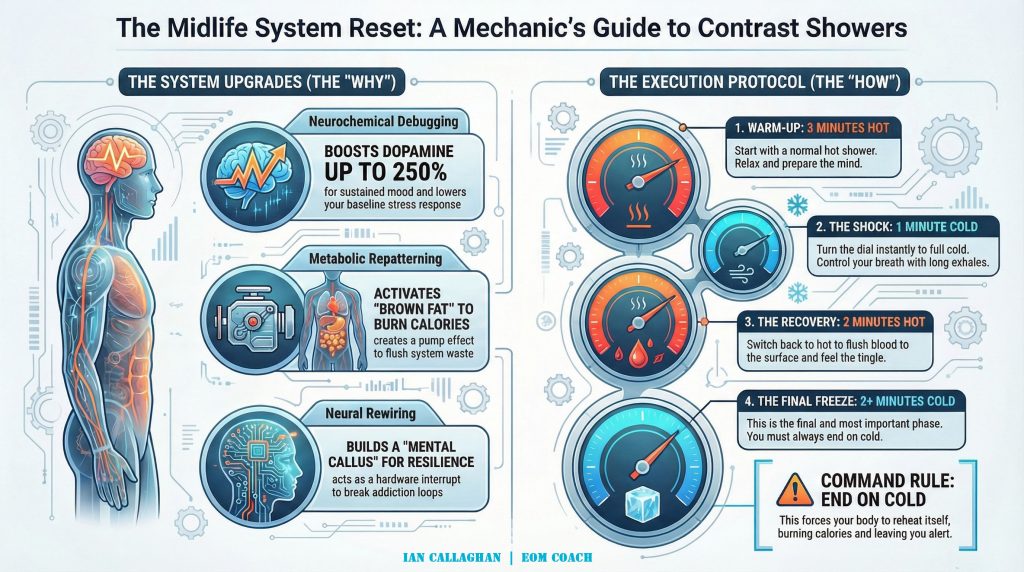
Research indicates that cold water immersion can increase dopamine concentrations by up to 250%. However, unlike the sharp spike and crash of alcohol or cocaine, cold water produces a sustained release. It raises the baseline voltage of your mood for hours.
By integrating contrast showers, you are not just getting clean; you are manually administering a dose of endogenous antidepressants. You are rewiring the reward circuitry. You teach the brain that dopamine is earned through discipline, not borrowed from a bottle.
Cortisol Management
Cortisol is the stress hormone. In a chronic drinker or a stressed corporate executive, cortisol levels are dysregulated. You wake up with a spike of anxiety.
Cold water acts as a “hormetic stressor.” It introduces a controlled, short-term spike in stress (the shock of the cold), which forces the body to adapt. Over time, this lowers your baseline reaction to stress.
Think of it as a firewall. If you can handle the shock of 10°C water hitting your chest at 06:00 hours, the email from your boss at 10:00 hours registers as a minor background process, not a critical system failure.
Protocol 2: Metabolic Repatterning and Weight Loss
I lost 5 stone. That doesn’t happen just by skipping a few lagers. It requires a metabolic shift.
Most midlife men are struggling with “Metabolic Inflexibility.” Their bodies have forgotten how to burn fat for fuel, relying instead on the easy glucose from carbohydrates and alcohol. We need to force the system to switch fuel sources.
Activation of Brown Adipose Tissue (BAT)
We have two types of fat:
White Fat: The storage depots. The beer belly. The energy reserve that never gets used.
Brown Fat (BAT): The heating system.
Brown fat is metabolically active. Its function is thermogenesis—burning calories to generate heat. Contrast showers, specifically the cold intervals, trigger the activation of BAT.
When you expose the system to cold, the BAT activates to protect core temperature. It acts like a furnace, burning glucose and white fat stores to keep the engine running. This isn’t pseudoscience; it is thermodynamics. By subjecting yourself to thermal variation, you are increasing your passive caloric expenditure. You are returning the engine to run leaner.
Lymphatic Drainage: The System Flush
The lymphatic system is the body’s sewage treatment plant. Unlike the circulatory system, which has a pump (the heart), the lymphatic system relies on movement and muscle contraction to circulate lymph fluid and remove waste products.
Contrast hydrotherapy creates a “pump” effect.
Heat: Causes vasodilation. Blood vessels expand, flushing blood to the surface.
Cold: Causes vasoconstriction. Blood vessels contract, forcing blood to the core to protect vital organs.
Alternating between these two creates a vascular pumping action. It forces stagnant fluid out of the tissues and back into circulation to be filtered. If you are detoxing from alcohol or years of poor diet, this system flush is critical for removing the “malware” from your physical tissues.
Protocol 3: The “Regimented Reset” Methodology
My methodology, “The Regimented Reset,” combines military discipline with IT systems thinking. A key component of this is eliminating “decision fatigue.”
When you are rebuilding your life, you cannot rely on “motivation.” Motivation is a feeling. Feelings are unreliable data. You need protocols.
The Contrast Shower SOP
Do not overthink this. Execute the script.
Pre-requisites:
One shower unit.
A timer (mental or digital).
Zero negotiation with the self.
The Algorithm:
Phase 1: The Warm Up (3 Minutes)
Start with warm/hot water.
Objective: Vasodilation and relaxation. Wash your body. Prepare the mind.
Mindset: Observe the comfort. Acknowledge it, but know it is temporary.
Phase 2: The Shock (1 Minute)
Turn the dial to the coldest possible setting immediately. No gradual turn-down.
Objective: Vasoconstriction and Adrenaline spike.
Action: Do not hold your breath. Control the breathing. Force a long exhale.
The EOM Application: This is where you practice the Emotional Observation Method. Your brain will scream “DANGER.” Your body will want to recoil. You must stand still. Observe the sensation of cold as data—it is sharp, it is heavy. Do not attach the label “Suffering” to it. It is just a sensation.
Phase 3: The Recovery (2 Minutes)
Switch back to hot.
Objective: Flush the blood back to the surface. Feel the tingling. This is a circulation returning.
Phase 4: The Final Freeze (2 Minutes)
Switch back to cold.
CRITICAL RULE: You always end on cold.
Why: If you end on hot, you leave the body in a relaxed, sedated state. Ending on cold forces the body to reheat itself (burning calories) and leaves the nervous system in a state of alert readiness.
Post-Process:
Exit the shower. Do not towel off immediately. Let the body air dry for 30 seconds. Feel the internal heat generation. This is the engine turning over.
Neural Rewiring: Fixing the Glitches
Why do I, a Technical Architect, obsess over water temperature? Because the physical inputs reprogram the software outputs.
Pattern Interruption for Addiction
An urge to drink (or overeat, or doom-scroll) is a looping script.
Trigger -> Craving -> Action -> Reward.
You cannot “think” your way out of a loop that is hardwired into the basal ganglia. You need a hardware interrupt.
When a craving hits—especially in the early days of sobriety—it feels all-consuming. This is a “System Hang.” The most effective fix is to physically shock the system.
If you feel the urge at 18:00 hours:
Stop the current task.
Walk to the shower.
Turn it to cold.
Get in.
You cannot focus on a craving for Merlot when you are hyperventilating under 10-degree water. The shock clears the RAM. It breaks the loop. By the time you get out and dry off, the neurochemical wave of the craving has passed. You have successfully debugged the moment.
Building the “Mental Callus”
We have become too soft. We seek to wrap ourselves in cotton wool. But growth only happens at the point of resistance.
The Roman Stoics practised voluntary hardship (sleeping on the floor, fasting) to inoculate themselves against misfortune. The contrast shower is the modern Stoic’s practice field.
Every morning, you stand before that handle. You know it is going to be uncomfortable. You know it will be a shock. Every morning, you have a choice:
Choice A: Stay in the warm. Be the Museum Guide to your own comfort.
Choice B: Turn the handle. Be the Mechanic.
When you choose the cold, you are training the brain to override the “flight” impulse. You are building a neural pathway that says, “I can do hard things.”
This translates directly to business, relationships, and sobriety. When a difficult conversation arises, you don’t shrink. You have trained for this. You have repatterned your response to discomfort.
Troubleshooting: Common Errors in Execution
As with any technical implementation, user error is the most common cause of failure. Here are the glitches I see men making when attempting this protocol.
Glitch 1: The “Gradual Descent”
The Error: Starting hot and slowly turning the temperature down. The Fix: This is useless. It is torture by degrees. The benefit comes from the shock. The rapid temperature change is what triggers the vascular pumping and the adrenaline release. It must be binary. 1 or 0. Hot or Cold.
Glitch 2: The “Hyperventilation Loop”
The Error: Gasping for air and tensing the muscles under the cold water. The Fix: This signals panic to the brain. You are reinforcing the stress response. You must use the “Command Console” of your breath. Force a long, slow exhale through the mouth. Relax the shoulders. You must remain the calm observer within the chaos.
Glitch 3: Skipping the Head
The Error: keeping the head dry. The Fix: The vagus nerve—the main interface for the parasympathetic nervous system—runs down the neck. You need to get the cold water on the face and the back of the neck to fully trigger the Mammalian Dive Reflex. This lowers the heart rate and induces calm. Submerge the CPU.
The EOM Connection: From Sensation to Observation
This blog is not just about water. It is about the Emotional Observation Method (EOM).
EOM is built on the premise that you are not your thoughts, and you are not your feelings. You are the observer of them. Most men treat their trauma and emotions as if they are the engine itself—”I am sad,” “I am angry.”
No. You are the Mechanic. The sadness is a warning light. The anger is friction in the gears.
Contrast showers are the physical training ground for EOM.
The Event: The cold water hits.
The Reaction: The body wants to shiver; the mind wants to escape.
The Observation: You stand there. You notice the cold. You notice the urge to run. But you do not run. You observe the sensation without becoming the sensation.
If you can do this with freezing water, you can do it with the urge to drink. You can do it with the rage you feel in traffic. You can do it with the grief of a lost relationship. You create distance. That distance is where control lives.
Implementation Strategy: The First 30 Days
You are going to commit to a 30-day “System Reset” regarding this protocol.
Week 1: The Boot Sequence
Standard shower.
Last 30 seconds cold.
Focus: Controlling the breath. Do not gasp.
Week 2: The Upload
Standard shower.
Last 60 seconds cold.
Focus: Relaxing the muscles. Drop the shoulders.
Week 3: The Full Contrast
3 min Hot / 1 min Cold.
Repeat x 2.
End on Cold.
Focus: Observing the mental resistance before you turn the handle.
Week 4: The Developer Mode
3 min Hot / 2 min Cold.
Repeat x 3.
Focus: Mental clarity post-shower. Use the energy spike to tackle your hardest task of the day immediately.
The Mechanic’s Conclusion
I spent 25 years designing IT architectures for major corporations. I spent 45 years drinking. I know how complex systems fail, and I know how they can be rebuilt.
You cannot talk your body into better health. You cannot “mindset” your way out of a metabolic crisis. You have to change the inputs to get different outputs.
Contrast showers are a high-leverage input. They cost nothing. They take five minutes. But they require you to wake up and choose discipline over comfort every single day.
Sobriety and the Midlife Reset are not about removing things from your life; they are about installing better software. They are about optimising the hardware so you can run high-performance applications with purpose, strength, and clarity.
Stop staring at your past like a Museum Guide, wondering why the exhibits are dusty. Pick up the wrench. Turn the handle to cold. Fix the engine.
Ian Callaghan EOM Coach & Mechanic
“The System Reset begins with a single command. Execute.”
Recommended Reading & Next Steps
If this protocol resonates with you, you are ready for the deeper work.
The Regimented Reset: My full methodology for midlife transformation.
EOM Fundamentals: Learning to separate the Observer from the Emotion.
Don’t let the glitch define the machine. Repattern the wiring.
Stop analysing the crash. Fix the code. An 8-page field guide to debugging your own mind. Includes the 4-Step EOM Protocol, the Symbol Library, and the Emergency Reboot scripts. Bonus: Includes access to the interactive Digital Console.
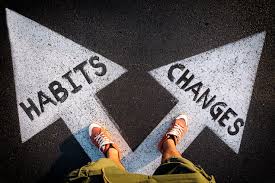
Your life today is essentially the sum of your habits.
How in shape or out of shape you are? A result of your habits.
How happy or unhappy you are? A result of your habits.
How successful or unsuccessful you are? A result of your habits.
What you repeatedly do (i.e. what you spend time thinking about and doing each day) ultimately forms the person you are, the things you believe, and the personality that you portray.
But what if you want to improve? What if you want to form new habits? How would you go about it?
Turns out, there’s a helpful framework that can make it easier to stick to new habits so that you can improve your health, your work, and your life in general.
Let’s talk about that framework now…
Before we talk about how to get started, I wanted to let you know I researched and compiled science-backed ways to stick to good habits and stop procrastinating.
The 3 R’s of Habit Change
Every habit you have — good or bad — follows the same 3–step pattern.
I call this framework “The 3 R’s of Habit Change,” but I didn’t come up with this pattern on my own. It’s been proven over and over again by behavioural psychology researchers.
What a Habit Looks Like When Broken Down
Before we get into each step, let’s use the 3 R’s to break down a typical habit. For example, answering a phone call…
This is the reminder that initiates the behaviour. The ring acts as a trigger or cue to tell you to answer the phone. It is the prompt that starts the behaviour.
This is the actual behaviour. When your phone rings, you answer the phone.
This is the reward (or punishment, depending on who is calling). The reward is the benefit gained from doing the behaviour. You wanted to find out why the person on the other end was calling you and discovering that piece of information is the reward for completing the habit.
If the reward is positive, then you’ll want to repeat the routine the next time the reminder happens. Repeat the same action enough times and it becomes a habit. Every habit follows this basic 3–step structure.
All habits form by the same 3–step process. Here’s an example: the traffic light turns green, you drive through the intersection, you make it closer to your destination. Reminder, routine, reward.
How can you use this structure to create new habits and stick to them?
Here’s how…
Step 1: Set a Reminder for Your New Habit
If you talk to your friends about starting a new habit, they might tell you that you need to exercise self–control or that you need to find a new dose of willpower.
I disagree.
Getting motivated and trying to remember to do a new behaviour is the exact wrong way to go about it. If you’re a human, then your memory and your motivation will fail you. It’s just a fact.
This is why the reminder is such a critical part of forming new habits. A good reminder does not rely on motivation and it doesn’t require you to remember to do your new habit.
A good reminder makes it easy to start by encoding your new behaviour in something that you already do.
The act of brushing my teeth was something that I already did and it acted as the reminder to do my new behaviour.
To make things even easier and prevent myself from having to remember to floss, I bought a bowl, placed it next to my toothbrush, and put a handful of pre-made flossers in it. Now I see the floss every time I reach for my toothbrush.
Setting up a visible reminder and linking my new habit with current behaviour made it much easier to change. No need to be motivated. No need to remember.
It doesn’t matter if it’s working out or eating healthy or creating art, you can’t expect yourself to magically stick to a new habit without setting up a system that makes it easier to start.
How to Choose Your Reminder
Picking the correct reminder for your new habit is the first step to making change easier.
The best way I know to discover a good reminder for your new habit is to write down two lists. In the first list, write down the things that you do each day without fail.
For example…
You’ll often find that many of these items are daily health habits like washing your face, drinking morning tea, brushing your teeth, and so on. Those actions can act as reminders for new health habits. For example, “After I drink my morning tea, I meditate for 60 seconds.”
In the second list, write down the things that happen to you each day without fail.
For example…
With these two lists, you’ll have a wide range of things that you already do and already respond to each day. Those are the perfect reminders for new habits.
For example, let’s say you want to feel happier. Expressing gratitude is one proven way to boost happiness. Using the list above, you could pick the reminder “sit down for dinner” and use it as a cue to say one thing that you’re grateful for today.
“When I sit down for dinner, I say one thing that I’m grateful for today.”
That’s the type of small behaviour that could blossom into a more grateful outlook on life in general.
Step 2: Choose a Habit That’s Incredibly Easy to Start
Make it so easy you can’t say no.
It’s easy to get caught up in the desire to make massive changes in your life. We watch incredible weight loss transformations and think that we need to lose 30 pounds in the next 4 weeks. Elite athletes on TV and wish that we could run faster and jump higher tomorrow. We want to earn more, do more, and be more … right now.
I’ve felt those things too, so I get it. And in general, I applaud the enthusiasm. I’m glad that you want great things for your life and I want to do what I can to help you achieve them. But it’s important to remember that lasting change is a product of daily habits, not once–in–a–lifetime transformations.
If you want to start a new habit and begin living healthier and happier, then I have one suggestion that I cannot emphasis enough: start small. In the words of Leo Babauta, “make it so easy that you can’t say no.”
How small? BJ Fogg suggests that people who want to start flossing begin by only flossing one tooth. Just one.
In the beginning, performance doesn’t matter. Become the type of person who always sticks to your new habit. You can build-up to the level of performance that you want once the behaviour becomes consistent.
Here’s your action step: Decide what want your new habit to be. Now ask yourself, “How can I make this new behaviour so easy to do that I can’t say no?”
What is Your Reward?
It’s important to celebrate. (I think that’s just as true in life as it is with habits.)
We want to continue doing things that make us feel good. And because an action needs to be repeated for it to become a habit, you must reward yourself each time you practice your new habit.
For example, if I’m working towards a new fitness goal, then I’ll often tell myself at the end of a workout, “That was a good day.” Or, “Good job. You made progress today.”
If you feel like it, you could even tell yourself “Victory!” or “Success!” each time you do your new habit.
I haven’t done this myself, but some people swear by it.
Give yourself some credit and enjoy each success.
Related note: Only go after habits that are important to you. It’s tough to find a reward when you’re simply doing things because other people say they are important.
Where to Go From Here
In general, you’ll find that these three steps fit almost any habit. The specifics, however, may take some work.
You might have to experiment before you find the right cue that reminds you to start a new habit. You might have to think a bit before figuring out how to make your new habit so easy that you can’t say no. And rewarding yourself with positive self–talk can take some getting used to if you’re not someone who typically does that.
Used to monitor number of Google Analytics server requests when using Google Tag Manager
1 minute
_gid
ID used to identify users for 24 hours after last activity
24 hours
_ga_
ID used to identify users
2 years
_gali
Used by Google Analytics to determine which links on a page are being clicked
30 seconds
_ga
ID used to identify users
2 years
__utmx
Used to determine whether a user is included in an A / B or Multivariate test.
18 months
__utmv
Contains custom information set by the web developer via the _setCustomVar method in Google Analytics. This cookie is updated every time new data is sent to the Google Analytics server.
2 years after last activity
__utmz
Contains information about the traffic source or campaign that directed user to the website. The cookie is set when the GA.js javascript is loaded and updated when data is sent to the Google Anaytics server
6 months after last activity
__utmc
Used only with old Urchin versions of Google Analytics and not with GA.js. Was used to distinguish between new sessions and visits at the end of a session.
End of session (browser)
__utmb
Used to distinguish new sessions and visits. This cookie is set when the GA.js javascript library is loaded and there is no existing __utmb cookie. The cookie is updated every time data is sent to the Google Analytics server.
30 minutes after last activity
__utmt
Used to monitor number of Google Analytics server requests
10 minutes
__utma
ID used to identify users and sessions
2 years after last activity
_gac_
Contains information related to marketing campaigns of the user. These are shared with Google AdWords / Google Ads when the Google Ads and Google Analytics accounts are linked together.