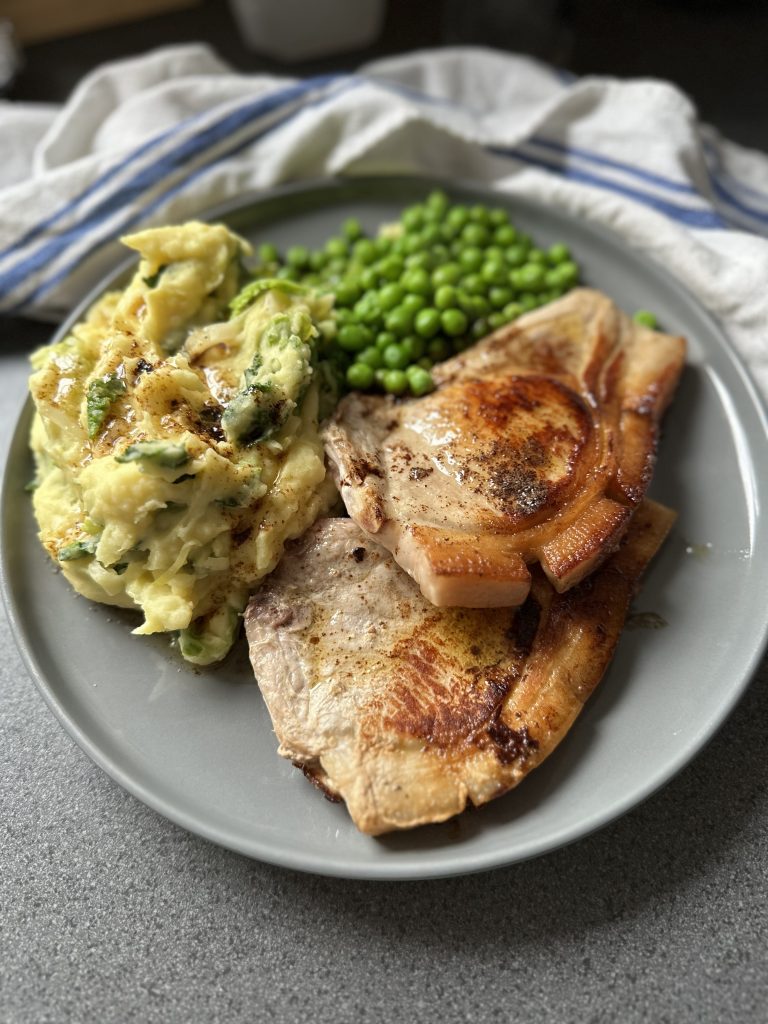
Perfect Pork Chops and Colcannon. There is a significant difference between a meal that merely feeds you and a meal that truly satisfies. Achieving that restaurant-quality finish at home isn’t about expensive equipment or exotic ingredients; it is about mastering the fundamental techniques that professional chefs use every single day.
In this guide, we break down the elements of a classic comfort dish: Pan-Seared Pork Chops with Silky Colcannon and a Rich Pan Gravy.
The Secret is in the Technique | Perfect Pork Chops and Colcannon
Most people can fry a pork chop or mash a potato, but to elevate these simple components, you need to understand the why behind the process.
1. The Maillard Reaction: Building the Flavour Engine
The deep, golden-brown crust on a pork chop isn’t just for aesthetics. This is the Maillard reaction, a chemical reaction between amino acids and reducing sugars that gives browned food its distinctive flavour.
By searing the meat over high heat, you aren’t just cooking the chop; you are creating a fond—the caramelised brown bits left in the pan. This fond is the essential foundation for a superior gravy.
2. The Potato Ricer: Achieving the Perfect Colcannon
If you want mash that is light, airy, and entirely lump-free, the standard masher simply won’t do. Professional kitchens use a potato ricer. By forcing the cooked potato through small holes, you break it down into tiny grains without overworking the starch, which can lead to a gluey texture.
Folding in sautéed Savoy cabbage and leeks at the final stage preserves the vibrant colour and provides a necessary textural contrast to the velvet-smooth potatoes.
3. Monter au Beurre: The Professional Sauce Finish
A great pan gravy shouldn’t just taste good; it should have a glossy sheen and a rich mouthfeel. This is achieved through deglazing—using liquid to lift the fond from the pan—and finishing with a technique called monter au beurre.
By whisking cold knobs of butter into the hot sauce at the very end, you create a stable emulsion. This adds a luxurious thickness and a professional finish that standard flour-based gravies cannot replicate.
Recipe: Pan-Seared Pork Chops & Colcannon
Ingredients
Pork: Thick-cut, bone-in pork chops.
Potatoes: Floury varieties like Maris Piper or King Edward.
Greens: Fresh Savoy cabbage and finely sliced leeks.
Dairy: High-quality butter and a splash of milk.
Sauce: Stock or water for deglazing.
Seasoning: Sea salt and cracked black pepper.
Sides: Sweet garden peas.
Method
The Sear: Season the chops heavily with salt and pepper. Place in a hot pan and sear until a deep golden crust forms on both sides. Remove and let the meat rest to keep it succulent.
The Rice: Boil the potatoes until tender. Pass them through a potato ricer into a warm pot with a generous knob of butter.
The Greens: Sauté the shredded cabbage and sliced leeks in butter until softened but still vibrant. Fold them gently into the riced potatoes.
The Deglaze: Pour your stock or water into the hot pork pan. Use a whisk to scrape the bottom and release the fond into the liquid.
The Emulsion: Reduce the liquid by half, then whisk in cold knobs of butter (monter au beurre) until the sauce is glossy and thick.
The Plate: Serving is just as important as cooking. Spoon a generous mound of colcannon alongside the rested pork, add the garden peas, and pour that rich pan gravy over the top.
Take Your Cooking Further
If you’ve ever felt that certain cooking secrets were being kept from you, you aren’t alone. Many people were never taught the foundational “whys” of the kitchen—the simple, repeatable methods that turn “good” food into “exceptional” food.
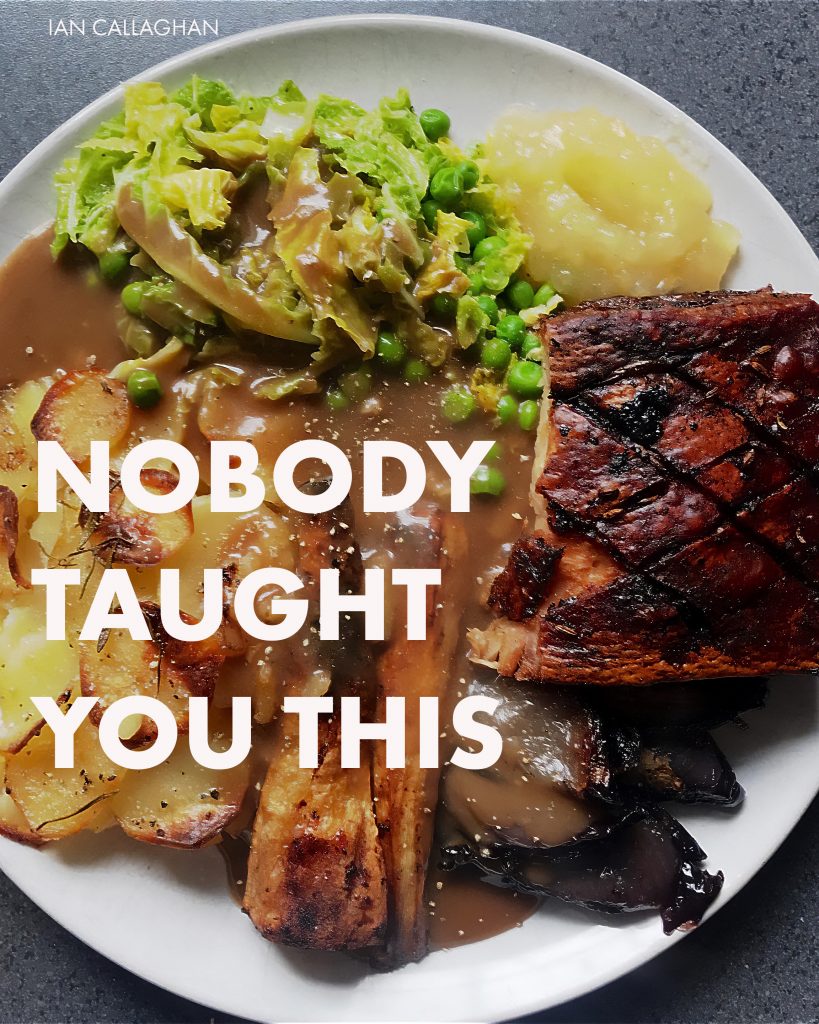
My latest book, “Nobody Taught You This: Real Food Cookbook”, is designed to bridge that gap. It isn’t just a collection of recipes; it is a guide to the methods, logic, and professional techniques that allow you to cook with confidence and intuition.
From mastering heat control to understanding the science of seasoning, this book teaches you everything you need to know to master the art of real food.
If you want to know how to cook real food on a budget, the answer is not where the food industry wants you to look. It is not in a meal kit subscription, a protein powder, or a supermarket-ready meal that costs three pounds and feeds nobody properly. The answer is in the cuts of meat your butcher is almost giving away, the bones you have been throwing in the bin, and the techniques that every traditional kitchen used before convenience food decided that knowing how to cook was someone else’s problem.
This is not about eating less. It is not about sacrifice. It is about understanding that a one-kilo ox cheek braised in red wine for four hours costs less than a supermarket pizza and produces something that a restaurant would charge thirty pounds for on a menu, calling it heritage cooking.
“The most expensive cut is not the best cut. It is just the most fashionable one. Fashion is not a reason to spend money.”
Why Real Food on a Budget Starts with the Cuts Nobody Wants
Walk into any supermarket, and the meat counter is organised by what the food industry has trained you to want. Chicken breasts. Lean mince. Sirloin steaks. Everything is lean, boneless, quick to cook, and priced accordingly.
Walk into a butcher’s and ask for ox cheeks, lamb breast, pork belly, shin of beef, or oxtail. Watch the price drop by sixty to eighty per cent compared to the premium cuts. These are not inferior cuts. They are different cuts. They contain collagen and connective tissue that convert to gelatin during a low, slow braise, producing a sauce and a texture that no expensive cut can replicate.
The Italians understood this. French grandmothers understood this. Every cuisine that has ever had to feed people properly understood this. The cheap cuts are not a compromise. They are the point.
The cheap cuts worth knowing
Ox cheeks – Around £4 to £6 per kilo. Braise in red wine for four hours. Better than any fillet steak you have ever eaten.
Lamb breast – Around £3 to £5 per kilo. Stuffed, rolled and slow roasted. The most undervalued cut on the animal.
Shin of beef – Around £4 to £6 per kilo. The highest concentration of collagen of any beef cut. Stew it low and slow.
Pork belly – Around £4 to £6 per kilo. Overnight dry brine, low slow roast, twenty minutes of high heat for the crackling. Extraordinary.
Oxtail – Around £5 to £8 per kilo. Makes its own broth as it braises. One pot, two meals.
How to Cook Real Food on a Budget: The Bone Broth Principle
Every time you finish a roast chicken, you throw away a litre and a half of bone broth. You just do not know it yet.
The carcass, the bones, the cartilage, put them in a pot with cold water, a splash of apple cider vinegar, and whatever vegetable scraps are in the freezer. Simmer for four to six hours. Strain it. Refrigerate overnight. In the morning, there will be a layer of fat on top, and underneath it, something that sets to a light jelly when cold.
That jelly is gelatin. It is fifty-pound jars of collagen peptides that are trying to replicate. You made it from what you were throwing away. It costs nothing.
Use it as the base for soups, for cooking rice, for deglazing pans, for adding to stews and braises. One habit, made from bones you already bought, that transforms everything you cook with it.
“Everything you need is already there. You were just throwing it away.”
The bone broth method in brief
Save all bones in a bag in the freezer.
When the bag is full, cover with cold water and a splash of apple cider vinegar.
Simmer for four to six hours for chicken, up to twenty-four hours for beef bones.
Strain, cool, and refrigerate overnight.
The jelly underneath the fat layer is what you are making it for.
The Five Cheap Ingredients That Do the Most Work
Cooking real food on a budget is not about spending less on everything. It is about knowing which cheap ingredients do the most nutritional and flavour work per pound spent.
1. Red lentils
Under a pound per kilo. Iron, folate, plant protein, prebiotic fibre. Cook for 25 minutes from dry to a deeply satisfying soup. Bulk out cottage pie mince and nobody notices. The most nutritious cheap food is available in any supermarket.
2. Tinned mackerel in olive oil
Under a pound a tin. More omega-3 per gram than almost any other food. More B12 than a chicken breast. Read the tin before you buy. Mackerel in sunflower oil is a machine lubricant dressed up as food. Olive oil only.
3. Eggs from a proper source
A free-range egg from a hen that lived outside contains significantly more vitamin D, omega-3, and nutrients than a battery egg. The price difference is pennies per egg. The nutritional difference is not pennies.
4. A whole chicken rather than chicken breasts
A five-pound free-range chicken feeds four people for dinner, provides cold meat for lunch the next day, and produces a carcass worth a litre and a half of bone broth for the week after that. A pack of factory chicken breasts at the same price feeds two people once and leaves nothing behind.
5. Pearl barley
Under a pound per kilo. Swells in stock and releases beta-glucan as it cooks, thickening broth naturally without any starch thickener. Add it to chicken carcass soup, and it turns a simple broth into a meal that feeds four people for almost nothing.
What Nobody Taught You About Cooking on a Budget
The food industry profits from your not knowing how to cook. Processed food, meal kits, ready meals, protein bars and supplement powders are all more expensive per serving than real food cooked from scratch. They are also nutritionally inferior in almost every measurable way.
The reason people eat them is not cost. It is the belief that cooking properly is complicated, time-consuming, or requires skills they do not have.
It does not. Learning to brown meat properly takes one attempt. Learning to make a base masala curry takes one evening and feeds you for a week from the same skill. Learning to braise a cheap cut low and slow takes the ability to turn an oven on and leave it alone for four hours.
The techniques are not complicated. Nobody taught them. That is the only problem, and it is a solvable one.
“Nobody taught you this. That is not your fault. Here it is anyway.”
The Book: Nobody Taught You This
Nobody Taught You This is a practical cookbook for anyone who was never properly taught how to feed themselves—written by Ian Callaghan, a chef with forty years of cooking experience, an Army veteran, and someone who learned in real kitchens from real people, including a Gurkha soldier, an Italian grandmother, and a Michelin-starred chef from Bombay.
245 pages covering the basics nobody taught you, the cheap cuts and forgotten ingredients, bone broth, fermentation, foraging, proper fish, British shellfish, sourdough, offal, old school British desserts, and the connection between what you eat and how you think, sleep, and feel.
No seed oils. No ultra-processed ingredients. No meal prep, worship, or wellness trends wrapped in beige bullshit—just real food cooked properly from cheap ingredients by someone who has been doing it for forty years.
Frequently Asked Questions
What is the cheapest real food to cook from scratch?
Red lentils, eggs, tinned oily fish, cheap cuts of meat like shin beef and lamb breast, and seasonal vegetables. All of these cost less per serving than processed alternatives and contain significantly more nutrition.
How do I start cooking real food if I have never cooked before?
Start with three recipes and learn them properly. A frittata, a one pan curry using a base masala, and a slow braise. Those three techniques cover the majority of real food cooking. Once you have them the rest follows naturally.
Is cooking from scratch really cheaper than buying ready meals?
Yes, consistently. A pot of ox cheek ragu made from scratch costs under 12 pounds and feeds 4 to 6 people. The same number of ready meals costs three to four times more and contains ingredients you would not choose if you were buying them individually.
What cheap cuts of meat are best for beginners?
Pork belly and chicken thighs are the most forgiving cheap cuts for beginners. Both have enough fat to stay moist even if slightly overcooked. Ox cheeks and beef shin are the next step once you are comfortable with low-and-slow cooking.
What is bone broth, and why should I make it?
Bone broth is stock made from animal bones simmered for four to twenty-four hours. The long cooking extracts collagen, gelatin, and minerals from the bones. It is the base of the most nutritious soups, sauces and braises you can make, and it costs almost nothing if you save the bones from your regular cooking.
Ian Callaghan is a chef, author, coach and Army veteran based in Goytre, Monmouthshire. Nobody Taught You This is available now as a paperback on Amazon and as an ebook with AI companion at iancallaghan.co.uk.
Nobody Taught You This is a straight-talking real food cookbook for people who are tired, foggy, flat, overwhelmed, or sick of living on ultra-processed convenience food. This is not a diet book and it is not wellness fluff. It shows you how to cook simple, cheap, proper meals from scratch using real ingredients and kitchen basics most people should have been taught years ago. Inside, you’ll learn how food affects your energy, mood, sleep, gut health, focus, and hunger, and why ultra-processed food keeps leaving people hungry, flat, and craving more. If you want real food, simple cooking, and a better way to eat without the bullshit, start here.
How to fix a broken metabolism. You have been lied to. Not in a subtle, open-to-interpretation kind of way. In a systematic, decades-long, industry-backed way that has left millions of people fatter, sicker, and more confused than ever about why their own bodies seem to be working against them.
The calorie model, the one that tells you weight loss is simply a matter of eating less and moving more, is not just outdated. It is biologically illiterate. It ignores the most important variable in the entire equation: what the fuel you eat actually does to the engine running inside every one of your cells.
And until you understand what is happening at the cellular level, nothing will change. Not the next diet. Not the next app. Not the next 12-week programme with a motivational Facebook group and a meal plan that makes you want to cry by day four. Nothing.
I am going to show you what is actually going on, why the conventional approach is failing you, and what Mitochondrial-First Weight Loss looks like in practice. This is the framework I use with my coaching clients, and it is built on biology, not wishful thinking.
The Steam Engine Model Is Wrong and Always Has Been
The calorie-in, calorie-out model treats your body like a Victorian steam engine. Shovel in fuel, generate energy, and the excess gets stored as fat. Simple, clean, completely wrong.
Your body is not a steam engine. It is a complex electrochemical refinery, and the quality of the fuel you put into it matters as much as the quantity. Actually, it matters more because poor quality fuel does not just produce less energy. It actively damages the machinery.
At the centre of this refinery are your mitochondria. You have billions of them, sitting inside virtually every cell in your body, and their sole purpose is to convert the food you eat into ATP, adenosine triphosphate, the actual currency of biological energy. Every thought, every heartbeat, every movement you make runs on ATP. And mitochondria are the only thing producing it.
When your mitochondria are healthy and running on appropriate fuel, you are lean, sharp, and metabolically flexible. Metabolic flexibility means your body can switch between burning glucose and burning stored body fat without drama, without cravings, without the energy crashes that most people have come to accept as a normal part of daily life.
When your mitochondria are damaged, running on the wrong fuel, or structurally compromised, the opposite happens. You store fat, feel constantly tired, get persistent brain fog, stay hungry even when you are not short of energy, and no matter how many calories you cut, the weight refuses to shift in any meaningful way.
That last scenario is where a staggering number of people are right now. And they blame themselves for it. That is the cruellest part of the whole deception.
Meet Glucipher: The Architect of Your Metabolic Misery
In my coaching work, I use the character of Glucipher to describe the force that takes hold when your metabolic machinery breaks down. Glucipher is the villain of your metabolic story, the entity that thrives on glucose spikes, insulin surges, and the systemic inflammation that follows a diet built on industrial food.
Glucipher does not want you burning fat. He wants you dependent on a constant drip of glucose just to keep the lights on. He engineers the hangry cycles, the 3 pm energy crashes that send you reaching for something sugary, the desperate need to eat every two to three hours or face a mood collapse. He keeps you in a loop that feels biological, because it is biological, but it is a loop that was created by the food you have been eating, not one that is fixed or inevitable.
Once Glucipher is running the show, your body loses its ability to oxidise stored fat efficiently. You are glucose-dependent in the worst possible way. Every spare calorie gets shunted into adipose tissue, particularly the visceral fat sitting around your organs, while your cells simultaneously signal hunger because they cannot access the fat stores you are carrying around.
You are starving in a land of plenty. Held hostage by your own biochemistry. And the primary thing that allowed Glucipher to seize control is what you have been told to cook with for the last four decades.
The Seed Oil Problem the Mainstream Still Will Not Talk About
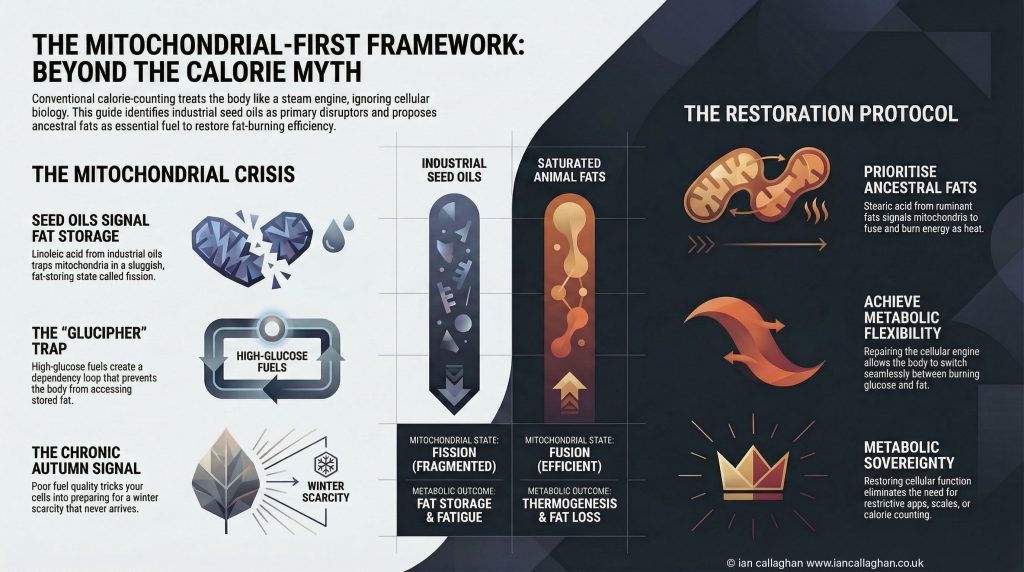
The modern obesity epidemic is, at its core, a mitochondrial crisis. And the primary driver of that crisis is the mass replacement of ancestral fats with industrial seed oils.
Rapeseed oil. Sunflower oil. Soybean oil. Corn oil. These are not foods. They are industrial lubricants produced through a process of high-heat extraction, solvent washing, bleaching, and deodorisation. They are refined to the point where the original plant source is unrecognisable. And they have been sold to the British public as heart-healthy alternatives to the saturated fats that sustained human health for thousands of years.
The science behind that recommendation was flawed from the beginning. The Seven Countries Study that started the whole saturated fat panic cherry-picked its data. The researchers who questioned it were marginalised. The food industry, which had a great deal to gain from cheap seed oil replacing expensive animal fats, funded much of the research that followed. And an entire generation dutifully switched to Flora and started frying everything in sunflower oil, while rates of obesity, type 2 diabetes, and metabolic disease did nothing but climb.
Here is what those oils are actually doing inside you.
Your mitochondria run on a structure called the electron transport chain, the ETC. This is where the conversion of food into ATP happens. The ETC depends on a phospholipid called cardiolipin to maintain its structural integrity. Cardiolipin is sensitive, and it is particularly vulnerable to oxidative damage from polyunsaturated fatty acids, specifically linoleic acid, which is the dominant fat in virtually every seed oil on the market.
When you eat seed oils regularly, linoleic acid accumulates in your cell membranes and mitochondrial membranes. It does not clear quickly. The half-life of linoleic acid in human tissue is approximately two years, which means the damage you are doing today will still be present in your cells long after you change your diet. When this linoleic acid oxidises inside the mitochondria, it damages cardiolipin. The ETC starts to leak. Electrons escape, oxidative stress increases, and the cell receives a clear biochemical signal: stop burning energy, start storing it.
You become a fat storage machine at the cellular level. And you feel it. Constant fatigue. Persistent hunger. Brain fog that you have probably learned to live with because it has been there so long you have forgotten what sharp actually feels like.
This is not a willpower problem. This is a fuel quality problem. And no amount of calorie restriction will fix it if the fuel you are eating is still destroying the machinery that processes it.
Linoleic Acid Is Telling Your Mitochondria to Stay Fat
Here is the part that should make you genuinely angry.
Linoleic acid does not just damage the ETC through oxidation. It sends an active biological signal to your mitochondria to remain fragmented, in a state called fission. Fissioned mitochondria are sluggish. They are optimised for growth and storage, not for high-output energy production. They are, quite literally, the fat storage configuration.
Every time you eat food cooked in vegetable oil, dressed in a seed oil based sauce, or processed with rapeseed as one of its first ingredients, you are telling your mitochondria at a cellular signalling level to stay in fat storage mode. The damage is not passive. It is instructional. Linoleic acid is giving your biology orders, and those orders are to keep you fat.
Compare this to what happens when you eat high-quality saturated fats, particularly stearic acid found in beef tallow, suet, and cocoa butter. Stearic acid signals the mitochondria to fuse together and become more efficient, a process called mitochondrial fusion. This increases your metabolic rate. It triggers a process called uncoupling, where energy is dissipated as heat rather than stored as fat. This is genuine thermogenesis, the biological mechanism behind a body that runs hot, burns efficiently, and does not default to storage.
There is also the question of the FADH2 to NADH ratio, which sounds technical but the principle is straightforward. Saturated fats produce a high ratio of FADH2 to NADH when they are broken down through beta-oxidation. This creates a backpressure in the electron transport chain that triggers a small, controlled burst of reactive oxygen species. In this context, that is not a problem. It is a signal. The signal tells your cell that energy is abundant, close the doors to incoming glucose, start burning stored fat. That is the actual mechanism of sustainable fat loss.
Seed oils and refined carbohydrates disrupt this ratio completely. The signal is lost. Insulin stays elevated. The doors stay open. Glucipher stays in control. And you keep gaining weight despite your best efforts.
What Bob the Chimp Can Teach You About Metabolism
Bob the Chimp does not count calories. He does not own a food scale or a macro tracking app. He has never heard of a calorie deficit and would have absolutely no idea what a low-fat yoghurt is for. And yet Bob is lean, powerful, and metabolically flexible.
Why? Because Bob’s mitochondria are running on the fuels they evolved to process. He is not drowning in linoleic acid. He is not being pummelled by a constant drip of high-fructose corn syrup. His cardiolipin is intact, his ETC is running clean, and his body can switch between fuel sources without missing a beat.
Bob represents what metabolic health is supposed to look like. The modern human has drifted so far from that baseline that we have come to accept exhaustion, brain fog, hormonal dysfunction, and expanding waistlines as inevitable features of ageing. They are not inevitable. They are symptoms of a broken fuel system running on the wrong fuel.
The Chronic Autumn Trap
Your mitochondria are not just energy factories. They are environmental sensors. They read the quality of the fuel coming in and use it to determine what biological mode your body should operate in.
When you flood your system with industrial seed oils and constant glucose, you send a signal that researchers describe as chronic autumn, the biological equivalent of preparing for a winter that never arrives. Your mitochondria interpret this fuel profile as a period of high carbohydrate abundance followed by incoming scarcity. The appropriate evolutionary response to that signal is to pack on fat, slow the metabolism, and prepare for hard times.
The hard times never arrive because you keep eating the same way. So you stay in permanent fat storage mode, metabolically suppressed, carrying weight you cannot shift, and wondering why every diet eventually fails.
Breaking out of this pattern means changing the signal, not just reducing the quantity of the same food. You cannot solve a signalling problem with a smaller portion of the same problem. You have to change the fuel.
This is also where light and circadian biology come in, though that is a deep enough topic for its own post. The short version is that blue light exposure at night, combined with the seed oil and glucose fuelling pattern, compounds the chronic autumn signal. Your mitochondria are receiving mixed messages from multiple directions. Fixing the fuel is the most impactful first step, but it is not the only one.
What to Actually Eat: The Practical Application
This is the part that most metabolic health content glosses over with a vague “eat ancestral foods” instruction that leaves people more confused than when they started. So here is what this looks like in practice.
The foundation is animal fats and animal protein. Ruminant meats, beef, lamb, venison, are the priority because the fat profile reflects what your mitochondria are designed to process. Fatty cuts over lean ones. Butter from grass-fed cows over anything labelled a spread. Beef tallow for cooking. Suet when you can get it. Eggs cooked in butter or tallow, not sprayed with a can of Frylight made from rapeseed oil.
Organ meats are worth including if you can stomach them. Liver in particular is one of the most nutrient-dense foods available and provides retinol, copper, and B vitamins in forms your body can actually use, unlike the synthetic versions in most supplements.
Dairy from quality sources works well for most people. Full-fat, not the low-fat version that strips the fat and replaces it with nothing useful. Cheese, full-fat yoghurt, cream.
What you are cutting out completely, not moderating, is every industrial seed oil and the products made with them. Read every label. Rapeseed, sunflower, soybean, corn, cottonseed, safflower, and anything listed as vegetable oil are all out. This catches most processed food, most restaurant food cooked cheaply, most dressings and sauces, most protein bars, most oat milks and alternative milks, and a significant chunk of what is on the average British supermarket shelf.
Refined carbohydrates go the same way. Not because carbohydrates are inherently evil but because in the context of damaged mitochondria and elevated linoleic acid in your tissues, constant glucose is feeding Glucipher while your cells cannot efficiently process fat as an alternative. Once the mitochondria are repaired and your metabolic flexibility returns, you will have more options. In the restoration phase, keep glucose low.
A practical starting point is to eat when you are hungry, stop when you are satisfied, and make every meal primarily animal protein and fat with whatever vegetables you enjoy. No seed oils anywhere in the process. Give it 30 days before you judge anything.
Addressing the Saturated Fat Objection
At this point someone in your life, possibly a GP, possibly a well-meaning relative who read a Daily Mail article, is going to tell you that eating saturated fat will give you a heart attack.
Here is the short answer. The saturated fat and heart disease hypothesis has been under serious scientific scrutiny for years. Multiple large-scale meta-analyses, including work published in the Annals of Internal Medicine and the British Medical Journal, have found no significant association between saturated fat intake and cardiovascular disease when the data is properly analysed. The original evidence was weak, heavily influenced by industry funding, and built on research that failed to account for what people replaced saturated fat with, which was seed oils and refined carbohydrates, both of which have considerably stronger associations with inflammation and metabolic disease than any ancestral fat.
You are not going to resolve this debate at the dinner table. What you can do is run the experiment on yourself, measure how you feel, and look at the actual markers that matter: fasting insulin, triglycerides, HDL, and waist circumference. Those will tell you far more than a cholesterol number that the entire risk model around is now being reconsidered.
Frequently Asked Questions
How long does it take to see results with a mitochondrial-first approach?
The honest answer is that it varies considerably depending on how much linoleic acid has accumulated in your tissues and how damaged your metabolic machinery currently is. Most people notice improved energy and reduced cravings within two to three weeks. Meaningful body composition changes typically begin within four to six weeks. Full mitochondrial restoration takes longer, potentially months, but the trajectory is consistent once you remove the fuel that was causing the damage.
Do I have to give up carbohydrates completely?
No. The goal is metabolic flexibility, not permanent carbohydrate restriction. In the restoration phase, keeping glucose low allows your mitochondria to rebuild their fat-burning capacity without constant glucose interference. Once that flexibility is established, most people find they can include carbohydrates from whole food sources without it derailing anything. The key thing removed is the seed oils, not carbohydrates as a category forever.
Can I follow this approach if I am vegetarian or vegan?
It becomes significantly more difficult because the richest sources of mitochondria-supporting fats are animal-based. Coconut oil and cocoa butter provide stearic acid and are plant-based, which helps. But the full ancestral fat profile and the nutrient density of organ meats are very difficult to replicate without animal products. I would not tell anyone what to eat based on their ethics, but I would be honest that this framework is built around animal foods.
Is this suitable for people over 40?
It is particularly relevant for people over 40. Mitochondrial function naturally declines with age, which is why metabolic flexibility tends to reduce in midlife. The hormonal shifts of perimenopause and andropause compound the issue. This approach addresses the underlying cellular damage rather than managing symptoms, which makes it more effective long-term than conventional dieting for the midlife demographic.
What about exercise?
Movement supports mitochondrial biogenesis, the creation of new mitochondria, through a process called mitohormesis. You do not need a punishing gym routine. Resistance training a few times a week and daily movement are enough to drive meaningful mitochondrial adaptation. The food piece is the foundation. Exercise amplifies it.
The Multi-Billion Pound Industry That Does Not Want You to Know This
The weight loss industry generates billions of pounds annually from keeping you dependent on their systems. Calorie counting apps. Low-fat products. Meal replacement shakes made with seed oils and artificial sweeteners. Twelve-week challenges that produce temporary results and long-term metabolic suppression.
None of that addresses the underlying cellular dysfunction. All of it keeps you coming back. The failure is designed into the product because a customer who gets well and stays well is not a repeat customer.
Understanding mitochondrial health removes you from that market entirely. When you fix the engine, the weight takes care of itself. When your metabolism is functioning as it is supposed to, you do not need to count anything. Your hunger and satiety signals work properly. Your energy is stable. Your body composition shifts without the misery of restriction.
That is what Metabolic Sovereignty looks like. And it is available to anyone willing to change the fuel.
The Bottom Line
Stop counting calories. Start looking at how your fuel affects your cellular machinery.
Remove the industrial seed oils that are damaging your cardiolipin and signalling your mitochondria to remain in fat-storage mode. Replace them with the ancestral fats your biology was built to process. Give your mitochondria the conditions they need to repair, fuse, and start burning efficiently again. Starve Glucipher of the glucose he depends on and push through the noise as your body recalibrates.
The transition is not comfortable. Your body will ask for the quick hit. Push through it. On the other side is a version of yourself that is leaner, sharper, and more metabolically capable than you have been in years.
Focus on the electron. Focus on the membrane. Fix the mitochondria. Everything else is just noise.
Take This Further
If this has landed and you want the full framework with practical application, Fix Your Metabolism is available as a paperback on Amazon. It goes deeper into the mechanisms, the protocols, and how to rebuild from the ground up in plain language that does not require a biochemistry degree.
If you want the complete toolkit, including the ebooks, the Sovereign Bundle, and Ian AI, my custom coaching companion built around everything I teach, head over to the shop and take a look at what is there for you.
The era of the broken metabolism ends when you decide it does.
Ian Callaghan is a former British Army veteran, NLP Master Practitioner, Reiki Master, and metabolic health coach. He specialises in midlife transformation, metabolic restoration, and rewiring the mindset and metabolism of people who are done being told it is their fault.
Used to monitor number of Google Analytics server requests when using Google Tag Manager
1 minute
_gid
ID used to identify users for 24 hours after last activity
24 hours
_ga_
ID used to identify users
2 years
_gali
Used by Google Analytics to determine which links on a page are being clicked
30 seconds
_ga
ID used to identify users
2 years
__utmx
Used to determine whether a user is included in an A / B or Multivariate test.
18 months
__utmv
Contains custom information set by the web developer via the _setCustomVar method in Google Analytics. This cookie is updated every time new data is sent to the Google Analytics server.
2 years after last activity
__utmz
Contains information about the traffic source or campaign that directed user to the website. The cookie is set when the GA.js javascript is loaded and updated when data is sent to the Google Anaytics server
6 months after last activity
__utmc
Used only with old Urchin versions of Google Analytics and not with GA.js. Was used to distinguish between new sessions and visits at the end of a session.
End of session (browser)
__utmb
Used to distinguish new sessions and visits. This cookie is set when the GA.js javascript library is loaded and there is no existing __utmb cookie. The cookie is updated every time data is sent to the Google Analytics server.
30 minutes after last activity
__utmt
Used to monitor number of Google Analytics server requests
10 minutes
__utma
ID used to identify users and sessions
2 years after last activity
_gac_
Contains information related to marketing campaigns of the user. These are shared with Google AdWords / Google Ads when the Google Ads and Google Analytics accounts are linked together.