The Truth About Fasting: Why Your Biology Doesn’t Need a Subscription
Medical Disclaimer: Critical Safety Notice
I am not a doctor. I am not pretending to be one. I am a classically trained chef, a British Army veteran, and an NLP Master Practitioner with over 40 years of experience in food and human biology. The following content is for informational purposes only. This is “Your Money or Your Life” (YMYL) territory: if you have underlying health conditions, are on medication (particularly for blood sugar, blood pressure, or kidney function), or are pregnant or breastfeeding, you must consult your GP before starting any fasting protocol. This is not a legal “arse-covering” exercise; it is common sense. Fasting is a powerful physiological stressor, and if your baseline health cannot sustain it, the results can be hazardous. This document is a strategic guide to metabolic flexibility, not a substitute for clinical advice.
The Metabolic Crisis of Constant Grazing
We are currently living through a metabolic crisis, and it isn’t caused by a lack of fuel. It is caused by a lack of a break. For nearly 50 years, I have walked the banks of the River Usk in Wales. I’ve watched the seasons shift, and I’ve watched the human condition decay as we’ve moved further away from our biological roots. Humans evolved too fast long before the advent of the “fridge and supermarket” culture that defines our modern existence. Our ancestors didn’t have three square meals a day as a gospel truth; they had biological programming that allowed them to thrive when food was scarce.
Today, we live in a 24-hour “grazing culture” that keeps us in a perpetual state of energy storage. We never allow the body to perform the essential maintenance it was designed for. The Truth About Fasting is that it is a free, ancient biological practice, currently buried under a mountain of “influencer theatre” and wellness-industry fluff. I’ve spent decades in professional kitchens—the high-pressure, grease-slicked environments where food is a commodity—and years in the British Army, where food is fuel. I have seen the damage done when people treat their bodies like a furnace that needs constant stoking.
Fasting isn’t a “hack” or a trend you need to subscribe to; it is the process of stripping away the metabolic noise and letting your body do the work it already knows how to do. The wellness industry wants to sell you a miracle in a bottle or a subscription to a shiny app. They want you to believe that you need a proprietary powder or a celebrity-endorsed protocol to find health. You don’t. You need to understand your own metabolic machinery and take personal responsibility for it. Fasting is about moving from “storage mode” to “maintenance mode.” It’s about picking up the wrench and fixing your own biology.
1. Takeaway 1: Fasting is a Biological Reset, Not a Starvation Hack
To understand fasting, you must first understand the difference between fasting and starvation. Starvation is involuntary, sustained, and leads to the breakdown of vital organ tissue. Fasting is a deliberate transition—a shift from an anabolic state of growth and energy storage to a catabolic state of systemic maintenance and repair. When you stop eating, you aren’t “starving”; you are activating ancient programs designed to maintain function using stored resources.
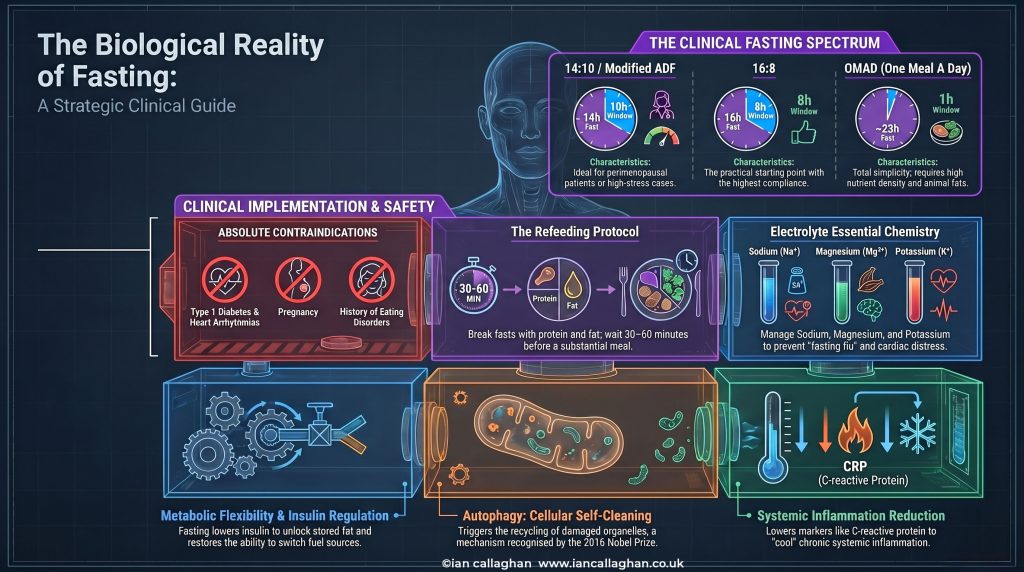
The bedrock of this reset is insulin regulation. Insulin is the body’s primary storage hormone. When you eat, insulin rises to move glucose into your cells. When you eat constantly, insulin remains perpetually elevated, effectively locking the doors to your adipose tissue (body fat). You cannot burn fat if insulin is high. It is biochemically impossible. Fasting forces a drop in insulin, which unlocks access to those fat stores and improves insulin sensitivity—the foundational requirement for reversing metabolic syndrome and glucose dysregulation.
As the source context explains:
“In a clinical context, fasting is a deliberate shift from the ‘metabolic noise’ of constant energy storage to a catabolic state of systemic maintenance and repair.”
This transition follows a rigorous physiological timeline. Within the first 12 to 24 hours of a fast, your system depletes its glycogen stores—the stored carbohydrates in your liver and muscles. The liver holds roughly 100 grams of glycogen, used to maintain blood sugar levels. Once these stores are exhausted, the body is forced to transition fully into fat oxidation and ketone production. This is the point where you stop running on what you just ate and start running on who you are. This shift is the definition of metabolic flexibility—the ability to switch seamlessly between burning glucose and burning stored body fat. If you never stop eating, you never develop this machinery. You become a metabolic “one-trick pony,” entirely dependent on the next hit of exogenous glucose.
2. Takeaway 2: The Nobel Truth of Autophagy (Cellular Housekeeping)
If weight loss is the headline that sells magazines, autophagy is the real story that matters for your healthspan. In 2016, the Nobel Prize in Physiology was awarded to Yoshinori Ohsumi for his work on autophagy. This is not fringe science or “biohacking” nonsense; it is a fundamental cellular mechanism that has been part of our biology since we were single-celled organisms.
Autophagy (from the Greek, meaning “self-eating”) is a “self-cleaning” process where cells, deprived of external nutrients, begin to break down and recycle their own damaged organelles and misfolded proteins. Think of it as cellular housekeeping. When the system is constantly fed, the body is too busy processing new energy to clear out the old debris. Fasting triggers the cleanup crew. The cell identifies a damaged mitochondrion or a protein clump, wraps it in a membrane (an autophagosome), and sends it to the lysosome to be broken down into raw materials.
This isn’t just about tidying up; it’s about survival. By clearing out cellular junk that would otherwise drive systemic decay, autophagy acts as a primary driver of healthspan extension. Furthermore, fasting activates the Migrating Motor Complex (MMC)—the gut’s “self-cleaning wave.” This process sweeps bacteria and undigested debris through the intestine. Constant grazing disrupts the MMC, contributing to bacterial overgrowth and bloating.
Finally, fasting provides neurological support by facilitating the production of Brain-Derived Neurotrophic Factor (BDNF). I call this “brain fertiliser.” BDNF supports neuron maintenance, protects against neuroinflammation, and provides the cognitive clarity that many fasters report after the initial adaptation period. This is why fasting is a sophisticated medical intervention, not just a way to fit into smaller trousers. It is the process of systemic renewal that only happens when you give the machinery a rest.
3. Takeaway 3: Hunger is a Sensation, Not a Crisis
The hardest part of fasting for most people isn’t the biology; it’s the “head stuff.” We have been conditioned by a multi-billion-pound food industry to treat the first hint of hunger as an emergency that requires immediate intervention. My experience in the Army taught me a vital lesson: discomfort is not danger. I remember being out on a 40-mile march, rucksack digging into my shoulders, stomach screaming for food, and my brain telling me I was going to collapse. But I didn’t. The body has reserves. The mind is the first thing that breaks, not the biology.
To master fasting, you must use the Emotional Observation Method to distinguish between different types of hunger. You must learn to sit with the sensation without being driven by it.
Physical Hunger: This builds gradually. It’s a diffuse sensation in the body, often accompanied by a growling stomach. Crucially, it responds to any nutrient-dense food. If you wouldn’t eat a plain piece of steak or a boiled egg, you aren’t physically hungry.
Emotional Hunger: This is sudden, urgent, and highly specific. This is a craving for comfort—usually processed carbohydrates or fats—to mask stress, boredom, or anxiety. It is the “I need chocolate now” feeling.
Head Hunger: This is habit-based. It’s the signal your brain sends because it’s “lunchtime” or because the clock says you should be eating. It is governed by ghrelin, the hunger hormone, which follows your established eating patterns.
Most of what people feel in the first few weeks of fasting is not biological need; it is habit and expectation. You will likely experience an Adaptation Dip during the first 2–3 weeks. As your brain transitions from a constant glucose supply to fat-burning, you may feel “fasting flu,” irritability, and brain fog. This is not a sign of failure. It is temporary metabolic recalibration. Your brain is simply learning how to use a different fuel source. If you can observe these sensations using the Emotional Observation Method—noticing the trigger without reacting—they lose their power. Hunger is like a wave; it peaks and then it passes. You don’t have to drown in it.
4. Takeaway 4: The Industry is Selling You “Chemicals Dissolved in Sadness”
The “Wellness Theatre” is a multi-billion-pound industry designed to monetise a practice that is fundamentally free. They have taken a simple biological reality and buried it under a mountain of unnecessary products, proprietary powders, and complex protocols.
Let’s be blunt about the “support” products the industry pushes:
Exogenous Ketones: Marketed as a “shortcut” to ketosis, these are often just expensive chemicals dissolved in sadness. Drinking ketones is not the same as the metabolic adaptation of producing them. When you drink them, you are a passenger in the car; when you fast, you are the driver learning how the engine works. Drinking ketones does not trigger the same cascade of metabolic benefits as actual fasting.
Autophagy Activators: Most supplements claiming to “activate” autophagy are solutions to problems that real food and actual fasting solve for free. Spend your money on grass-fed meat, not “longevity” pills.
The App Economy: Many fasting apps gamify the process with “streaks” and badges. This triggers the Obsession Trap, where the fast becomes a source of anxiety or a mechanism for punishment rather than a tool for health. These apps serve their own retention metrics, not your biology. If you feel shame for breaking a “window” to eat with your family, the app has become the master and you the slave.
A simple clock is the only technology required for fasting. Do not let the industry convince you that you need to open your wallet to close your mouth. The most effective metabolic tools—water, salt, and time—don’t have a marketing budget.
5. Takeaway 5: The “Breakfast Myth” and the 3-Hour Feeding Lie
We have been told for decades that “breakfast is the most important meal of the day.” This was not public health guidance; it was an advertising slogan for the cereal industry designed to move boxes of processed grains. There is no biological requirement to eat the moment you wake up. In fact, for most people, skipping breakfast is the most practical entry point into a 16:8 protocol.
Similarly, the advice to “eat every three hours to stoke the metabolism” is complete nonsense. The idea is that frequent eating keeps the “metabolic fire” burning through the thermic effect of food (TEF). However, TEF—the energy used to digest a meal—depends on the total calories consumed, not how many times you divide them up. Whether you eat 2,000 calories in one sitting or six, the metabolic cost of digestion is essentially the same.
The difference is that the person eating six times never gives their insulin levels a chance to drop. They stay in a perpetual state of “storage mode,” preventing fat burning and destroying their metabolic flexibility. Constant grazing leads to chronically high insulin and elevated markers of inflammation, such as C-reactive protein. Your body isn’t a furnace that needs constant stoking; it’s a sophisticated energy management system that requires periods of rest to function optimally.
6. Takeaway 6: The Exit is More Dangerous Than the Fast (Refeeding Protocol)
The most acute window of physical danger in fasting is not the fast itself, but the moment you break it—especially for protocols exceeding 48 hours. When your digestive system has been at rest, it becomes highly sensitised. Your insulin response is primed and ready to explode.
If you break a long fast with a high-carb or high-sugar meal—like a “healthy” fruit smoothie or a bowl of cereal—you trigger a massive, vertical insulin spike. This can lead to Refeeding Syndrome, a dangerous and potentially fatal condition where electrolytes—specifically potassium, magnesium, and phosphate—shift rapidly from the blood into the cells to help process the sudden glucose load. This sudden shift can cause acute cardiac failure, respiratory distress, and systemic collapse.
The Professional Refeeding Protocol:
Protein and Fat First: Lead with the building blocks. Break the fast with a small amount of easy-to-digest protein and fat. Two eggs, a small piece of white fish, or a few slices of chicken. Avoid carbohydrates entirely in this first bite.
The 30-60 Minute Rule: Wait 30 to 60 minutes after that first small bite. This allows your digestive system and your insulin signalling to “wake up” and stabilise before you consume a substantial meal.
Manage Your Chemistry (The Essential Three):
Sodium: As insulin drops during a fast, the kidneys excrete sodium rapidly. This is why people get “fasting flu.” A pinch of high-quality salt in water is a requirement, not a suggestion.
Magnesium: Take magnesium glycinate before bed. It supports the nervous system and prevents the muscle cramps that often plague new fasters.
Potassium: Do not supplement potassium heavily without medical supervision. Instead, source it from nutrient-dense real foods (like avocado or meat) during your eating window.
7. Takeaway 7: Seed Oils are Metabolic Disruptors
Fasting is not a “hall pass” for poor nutrition. If you fill your eating window with inflammatory, engineered junk, you are undermining the entire biological reset. In my 40 years as a chef, I’ve seen the industry shift away from traditional fats to cheap, industrial alternatives.
The most critical “forbidden” items in your window are industrial seed oils (rapeseed, sunflower, soybean, and corn oils). These are not just “unhealthy fats”; they are metabolic disruptors. They are highly unstable and prone to oxidation, driving the very systemic inflammation (measured by Interleukin-6) that fasting seeks to resolve.
More importantly, seed oils are engineered to override your satiety signals. They interfere with the hormones leptin and ghrelin, making it nearly impossible for your brain to register that you are full. If you break your fast with food cooked in rapeseed oil, you will likely overeat. If you want to achieve metabolic resilience, your eating window must be built on high-density animal fats (butter, tallow, lard) and whole, nutrient-dense foods. These fats support hormonal stability and provide the satiety that makes the next fasting window possible.
8. Takeaway 8: Walking is a Mandate, Not a Consolation Prize
Movement is the biological signal that tells your body to preserve its muscle tissue while it burns fat. If you are sedentary while fasting, you signal to your body that muscle is an unnecessary expense, and it may begin to break it down for amino acids.
The Metabolic Movement Guide:
Walking: This is the primary tool for fat oxidation. A daily fasted walk—consistent and low-intensity, like my treks along the River Usk—burns fat without spiking cortisol or requiring heavy recovery. It is the most accessible metabolic tool in your arsenal.
Resistance Training: This is the “signal” for muscle preservation. To keep your muscle, you must engage in regular resistance training. Fasting actually triggers a spike in growth hormone, but this only protects muscle if you hit your daily protein targets during your eating window.
High-Intensity Training: Sprints or heavy lifting may require “fuelled” sessions if your fast exceeds 24 hours. If your performance consistently declines or your recovery is poor, adjust your window. You cannot train at peak intensity if your fuel tank is completely empty for days at a time.
9. Takeaway 9: Identifying the “Obsession Trap” and Psychological Risks
Fasting is a tool, not a religion. For some, the rules of fasting can be weaponised by the disordered part of the brain to justify unhealthy restriction. We must distinguish between Intentional Fasting (a tool of awareness) and Disordered Punishment (restriction driven by guilt or shame).
Absolute Contraindications (Do Not Fast If):
Type 1 Diabetes: High risk of ketoacidosis and life-threatening hypoglycaemia.
Heart Arrhythmias: Electrolyte shifts can destabilise cardiac rhythms, which can be fatal.
Pregnancy and Breastfeeding: These are windows of extreme nutrient demand. Metabolic stress is contraindicated for both mother and child.
History of Eating Disorders: Fasting structures can be neurologically weaponised to justify restriction. Head first, protocol second.
Significantly Underweight: If you lack adipose reserves, you lack the buffer required to fast safely.
HPA Axis Dysregulation (Perimenopause): For women in midlife, aggressive fasting can be a massive stressor. If you are struggling with cortisol, poor sleep, and high stress, a 16:8 or OMAD protocol might make things worse. Start with a gentler 14:10 window and focus on consistency over intensity.
Checklist for Unhealthy Restriction:
Does eating outside a “window” produce disproportionate anxiety or panic?
Is the fast used to “punish” or “compensate” for a previous meal?
Does your self-worth fluctuate based on your adherence to the clock?
Are you hiding your fasting patterns or lying to loved ones about your eating?
If you check these boxes, stop the protocol. Fasting should expand your life, not shrink it.
10. Tiered Implementation: The Progression to Mastery
Developing the metabolic machinery to fast requires a gradual runway. Jumping into advanced protocols like OMAD (One Meal A Day) without an adaptation period is a recipe for failure.
Tier 1: Foundations (12:12 to 14:10): Start by delaying breakfast. This recalibrates hunger hormones (ghrelin and leptin) and teaches your nervous system that hunger is not an emergency.
Tier 2: Intermediate (16:8): The professional standard. You fast for 16 hours and eat within an 8-hour window. This is manageable around work and family life while still initiating significant fat burning and insulin reduction.
Tier 3: Advanced (OMAD): One meal a day, eaten in a roughly one-hour window. This offers total simplicity and continuous fat burning, but it requires that your single meal be exceptionally nutrient-dense. If you eat a “minimum viable meal,” you will accumulate deficiencies.
The first 14 to 21 days are the “danger zone”—the adaptation period where brain fog and irritability are common. Most people quit here because they mistake the brain learning to switch fuels for a signal of failure. It isn’t failure; it’s training.
Conclusion: Picking Up the Wrench
Fasting is one of the most effective tools in your arsenal, particularly in midlife when the metabolism you had in your twenties has shifted. But it requires brutal honesty. You have to be honest about what you’re putting in your mouth, honest about why you’re skipping a meal, and honest about whether you’re looking for a “hack” or a genuine change.
The wellness industry has lied to you by making this complex. It isn’t. It is the simple, gritty reality of biology. Stop looking for a subscription to save you. Stop looking for a guru to give you a glossy PDF. The banks of the River Usk don’t change because of a trend, and neither does your DNA.
Are you ready to stop looking for a hack and start doing the work of understanding your own biology? It’s time to strip away the commercial theatre. The practice is free. The biology is real. Consistency beats intensity every single time.
Cut through the fasting hype with raw, unfiltered truth. This no-bullshit guide exposes the good, the bad, and the ugly of fasting. Learn what really works, what’s dangerous, and why fasting isn’t for everyone. Perfect for midlifers, health seekers, and anyone tired of wellness industry snake oil.
Nobody warns you about this bit. Anhedonia in early sobriety.
You brace for the first week. You brace for the shakes, the cravings, the weirdness of your first sober Friday night, the habit loops, the social awkwardness, the cupboards without bottles in them. You prepare yourself for the big, dramatic part. You expect struggle, then relief. You expect the pink cloud everyone keeps banging on about. Clear skin. Boundless energy. Morning walks—a sudden desire to become the sort of person who owns a yoga mat and means it.
But instead of the sunrise, you get the fog.
You are six weeks sober, sitting at the kitchen table on a random Tuesday, and something feels wrong. Not because you are craving a drink. Not because you are in pieces. Quite the opposite. You feel absolutely nothing. Not devastated. Not even especially angry. Just flat. Grey. Unmoved. As if somebody has gone into the control room of your brain and pulled the main fuse on the part that used to care.
Your favourite music sounds like background noise. Food tastes like cardboard. Sunlight feels thin and irritating. Life has not exploded. It has gone colourless.
That is what anhedonia in early sobriety can feel like, and it is one of the most dangerous parts of the whole process precisely because it does not look dramatic. It looks like a boring Tuesday. It looks like staring at a wall for forty minutes and wondering whether this numb, hollow indifference is what sober life is going to be forever.
Here is the truth.
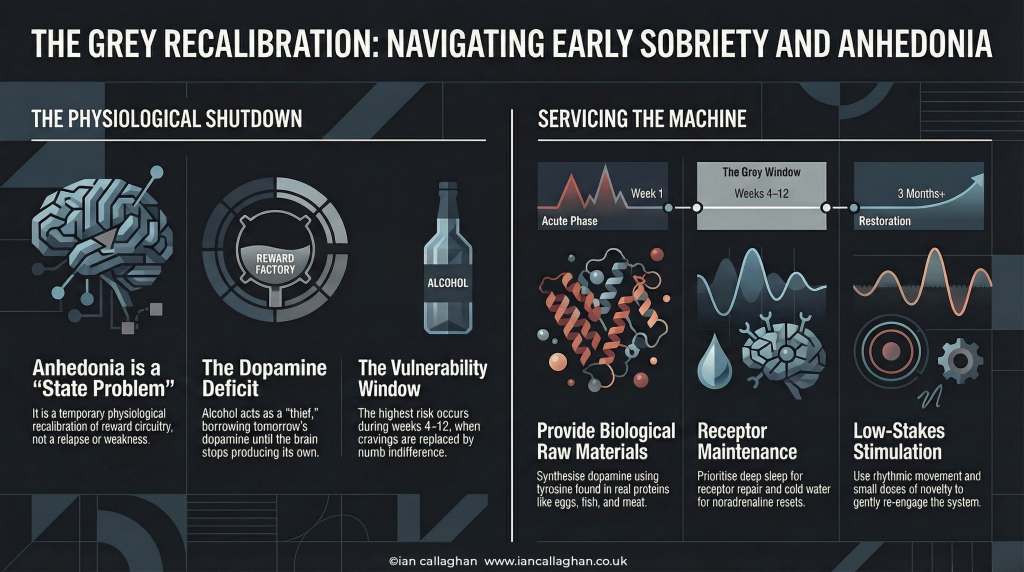
This is not proof that sobriety is not working. It is not proof that you were better off drinking. It is not proof that you are weak, broken, or built wrong. It is often a sign that your reward system is recalibrating after years of hammering.
I write about this from lived experience, years of coaching people through addiction and behavioural change, and a framework built around the biology of recovery rather than the motivational fluff you get fed online. If you feel like a grey cardboard version of yourself right now, this article is for you.
What Is Anhedonia in Early Sobriety?
Anhedonia is the inability to feel pleasure.
That sounds simple, but when it hits in early sobriety, it can feel brutal because it steals the point of the whole thing. You quit drinking expecting relief, better sleep, more clarity, more life. Instead, you get emotional static.
Anhedonia is not the same as sadness. Sadness has shape to it. Sadness has weight. You know you are sad. Anhedonia is different. It is the absence of emotional landing. You can look at something beautiful, hear a song you used to love, eat a meal you know should be enjoyable, and absolutely nothing happens inside.
Your brain registers the event. It just does not reward you for it.
That is why anhedonia in sobriety is so dangerous. The cravings may have gone quiet, but so has everything else. And when sober life feels flat, the old lie starts creeping back in: if this is it, I might as well drink.
That is exactly why this needs to be named properly.
Why Anhedonia Happens After Quitting Alcohol
Your Brain Is Not Broken, It Is Adapting
Alcohol is not just a drink. It is a chemical hijack of your reward system.
For a long time, booze acted like an external power source. It flooded the system, boosted dopamine, and trained your brain to expect stimulation from outside rather than to generate balanced reward internally. The brain, being efficient and logical, adapts to that.
It turns things down.
That means lower natural dopamine signalling, reduced sensitivity, and a reward system that stops reacting properly to ordinary life because it has been trained on a stronger artificial hit.
Then one day, you stop drinking.
The external supplier is gone, but the internal system has not fully come back online yet. That gap is where anhedonia lives.
This is why early sobriety can feel so flat. You have removed the chemical spike, but your baseline reward circuitry is still under repair. The factory is still standing, but production is restricted.
Why Sober Life Feels Pointless for a While
This is the bit that catches people out.
When you are white-knuckling through cravings, at least you know what the fight is. When you are in the grey phase, there is no big enemy—just indifference. Food does not excite you. Music does not move you. You stop looking forward to things. You are not in chaos. You are in a low-voltage version of existence.
That can make sobriety feel pointless, even when it is actually working.
The absence of drama tricks people into thinking nothing meaningful is happening. In reality, your nervous system may be doing a huge amount of repair behind the scenes.
The Real Problem With Sober Influencer Nonsense
Why Toxic Positivity Makes Anhedonia Worse
A lot of the sober internet is absolute bollocks when it comes to this stage.
It loves before-and-after photos, morning routines, gratitude journals, glow-up reels, and the idea that once you stop drinking, your whole life turns into sunlight, matcha, and expensive trainers.
That version of sobriety leaves people completely unprepared for anhedonia.
Because when week six feels grey as hell and some influencer is posting about how quitting alcohol made them spiritually radiant by day nineteen, you assume the problem is you.
It is not you.
It is the gap between reality and performance.
You cannot gratitude-journal your way out of an underpowered nervous system. You cannot mind-set your way around biology. Software does not fix a hardware issue.
That does not mean mindset is useless. It means mindset without physiology is incomplete.
The Shame Tax Makes Recovery Harder
Why Feeling Broken Adds More Load
One of the worst things you can do during anhedonia is start treating yourself like a defective person.
Shame is not just emotional. Shame is a physiological load. It adds stress to a system that is already struggling. It pushes cortisol into a brain that is trying to stabilise. It makes recovery heavier.
That is why anything that reinforces the idea that you are permanently broken, fundamentally flawed, or doomed to white-knuckle your way through life can make this phase worse.
You are not trying to prove moral worth here. You are trying to support a nervous system that has been under chemical pressure for years.
That is a different conversation.
7 Signs of Anhedonia in Early Sobriety
If you are wondering whether this is what is going on, these are some of the most common signs.
1. Good things happen, and you feel nothing
You know something should feel good, but the emotional response never lands.
2. Food loses its appeal
You eat because you should, not because there is any pleasure in it.
3. Music does not hit the same
Songs you used to love sound like wallpaper.
4. You feel like a cardboard version of yourself
You are functioning, but there is no spark in it.
5. Boredom feels physical
Not casual boredom, actual agitation in your body.
6. You stop looking forward to things
The future does not feel threatening; it just does not feel alive.
7. Cravings go quiet, but numbness gets louder
This is the trap. You think the danger has passed because the urge to drink is not screaming. But numbness can drive relapse just as hard as craving can.
How to Support Recovery From Anhedonia
You do not fix this by pretending it is not happening. You support the machine.
Real food and protein matter
Your brain needs raw materials to build neurotransmitters. That means proper food, enough protein, and not trying to run recovery on ultra-processed crap.
Eggs, meat, fish, full-fat dairy, real meals, proper nutrients. You are trying to help the system rebuild, not survive on beige convenience food and hope.
Sleep is not optional.
Deep sleep is where repair happens. If your sleep is wrecked, your recovery is carrying an extra load.
You do not need perfection, but you do need to treat sleep like infrastructure, not a luxury.
Rhythmic movement helps regulate the system.
Not gym-bunny punishment. Not smashing yourself into the floor. Walking. Gentle strength work. Rhythmic movement. Enough to lower stress, improve regulation, and remind your body it is safe.
Cold water can act as a manual reset
Used properly, cold water is not content. It is input.
It can shift state fast, increase alertness, and create a genuine physiological response in a system that has gone flat. It is not magic, but it can help wake the circuit up.
Small novelty matters more than you think.
New route, new recipe, new environment, new music, a change in pattern. A depleted dopamine system often needs small, low-pressure novelty to start responding again.
Honest connection beats performance.e
Do not isolate and pretend you are fine. You do not need to perform thriving. You need real contact. Even one proper, honest conversation can take some load off the system.
Anhedonia in Sobriety Is Not Permanent
The Colour Comes Back in Stages
This is the bit people need to hear.
Yes, you can enjoy things again.
Not because of motivational nonsense. Because the brain is plastic, it adapts. If it adapts to alcohol, it can adapt away from it too.
The colour usually comes back gradually, not all at once. A song lands a little more than it did last week. A meal tastes better. You laugh properly for the first time in ages and realise it was real. That is how the system comes back online.
Not with a cinematic breakthrough. In increments.
Why This Matters for Relapse Prevention
Anhedonia matters because people mistake it for failure.
They think, I quit drinkin, and I still feel like shit, so what is the point?
That is often the exact moment the old pattern tries to sell itself back to you as relief.
But drinking does not solve anhedonia. It resets the damage. It plugs the external power source back in, delaying the rebuild again.
That is why understanding anhedonia is not just comforting; it is practical. When you know what is happening, you are far less likely to misread the grey phase as a sign you should go backwards.
FAQ: Anhedonia and Early Sobriety
Is anhedonia normal in early sobriety?
Yes, it is common. Not everyone experiences it the same way, but a flat, numb, joyless phase is a recognised part of early recovery for many people after quitting alcohol.
Is anhedonia the same as depression?
Not exactly. They can overlap, but anhedonia is specifically about reduced ability to feel pleasure. Depression is broader and can include hopelessness, low mood, sleep changes, guilt, and other symptoms. If things are getting darker, more persistent, or you are struggling to function, speak to a qualified professional.
How long does anhedonia last after quitting alcohol?
It varies. For many people, the worst of it starts to lift somewhere between weeks four and twelve, but heavier or longer drinking histories can mean a longer recalibration. There is no exact stopwatch for this.
Will I ever enjoy life again without alcohol?
Yes. The system can recover. It takes time, repetition, and the right inputs, but the flatness is not proof that pleasure is gone forever.
What helps with anhedonia in sobriety?
Real food, protein, better sleep, movement, cold exposure where appropriate, reduced stress load, honest connection, and giving your nervous system time to recalibrate. In some cases, professional support may also be important.
Final Word on Anhedonia in Early Sobriety
If sobriety feels flat right now, that does not mean you are doing it wrong.
It does not mean you are broken.
It means your brain may be recalibrating after years of being trained to expect chemical reward on demand. That process can feel bleak, boring, and frighteningly empty. But empty is not the same as finished.
This phase has caught a lot of people out because nobody talks about it properly. They talk about cravings. They talk about rock bottom. They talk about transformation. They do not talk enough about Tuesdays when nothing feels good, and you start wondering whether sober life is just a long stretch of grey carpet.
It is not.
If you are in that phase, stop mistaking a maintenance window for a verdict on your life.
Support the hardware. Lower the load. Stay the course.
The colour comes back.
Key takeaways on anhedonia in sobriety
What to remember
Anhedonia in early sobriety is common and often temporary
It can feel like numbness, flatness, and loss of pleasure rather than obvious sadness
It is often linked to reward system recalibration after quitting alcohol
Social media recovery fluff usually does a terrible job of preparing people for it
Real food, sleep, movement, cold exposure, and honest connection can support recovery
Feeling flat does not mean sobriety is failing
A question worth asking yourself today
If this grey phase is not failure but repair, what is one thing you can do today to support the machine rather than attacking yourself?
Beyond the “Quick Fix”: 7 Radical Shifts to Reclaim Your Metabolic and Mental Sovereignty After 35
Modern life is a biological mismatch, a quiet fracture running through the very soul of our evolutionary design. We exist in a world of ultra-processed chaos, surrounded by industrial “non-foods” engineered with clinical precision to bypass our satiety signals and hijack our dopamine pathways. This is not merely a physiological crisis; it is an emotional drain that robs you of the energy required for your family, your career, and your self-actualisation. You have likely been conditioned to accept a baseline of fatigue, brain fog, and “middle-age spread” as an inevitable part of ageing. It is time to face the truth: these are not signs of getting older; they are correctable symptoms of a broken environment and a hijacked biology.
If you are over 35, you have probably noticed that the margin for error has narrowed. Your body no longer “bounces back” from a weekend of industrial inputs. You feel “stuck”—waking up tired regardless of hours slept, struggling with weight that resists traditional exercise, and lying to yourself so convincingly that you almost believe everything is “fine.” But when the world is quiet at night, the truth claws at your ribs. You look in the mirror and don’t recognise the face staring back. You feel like a hostage to the industrial food complex, trapped in a cycle of inflammation and exhaustion.
This document is your clinical-grade exit strategy. It is the path to Metabolic Sovereignty—the reclamation of your body and mind from industrial and neurological control. We are going to dismantle the “biological mismatch” by marrying the heart-healthy, lipid-rich traditions of the Mediterranean with the rigorous ancestral boundaries of the Paleo framework. This is about more than “losing weight”; it is about rebuilding your energy from the cellular level up and becoming the person you were always meant to become.
——————————————————————————–
1. What is the Insulin Lock? How to Reverse Glucose Dependency After 35
To reclaim your health, you must transition from being “glucose-dependent” to achieving “Metabolic Flexibility.” This is the evolutionary ability to switch seamlessly between burning the energy from your food (glucose) and burning the energy stored in your body fat. Most modern adults have lost this ability due to a phenomenon known as the Insulin Lock.
Insulin is your primary storage hormone. Every time you consume wheat, pasta, refined sugar, or excessive starch, your blood glucose spikes. In response, your pancreas floods the system with insulin to clear the sugar. The problem is that when insulin levels are high, your fat cells are biochemically “locked.” High insulin levels inhibit the enzyme Hormone-Sensitive Lipase (HSL), which is the master switch required to break down body fat for fuel.
“Even if you carry 50,000 calories of energy on your body, your brain thinks you are starving because the fuel is behind a locked door.” — Ian Callaghan.
When you are glucose-dependent, you are essentially a hybrid car that has forgotten how to use its electric battery, constantly stopping for petrol every two hours. Your brain, sensing that it cannot access its fat stores, sends out emergency hunger signals. This is why you feel shaky, irritable, and “hangry” shortly after a high-carb meal. By lowering your baseline insulin, we allow your body to “turn the key” and access its own massive energy stores. As insulin falls, your brain’s sensitivity to Leptin—your master satiety hormone—is restored. You finally feel full, often for the first time in decades, because the “insulin noise” is no longer blocking the signal that you have plenty of fuel.
——————————————————————————–
2. Why Willpower Fails: How to Fix a Slow Metabolism Through Identity
Traditional “dieting” is a temporary state of misery; a period of restriction followed by an inevitable return to “normal.” But for the mature adult, “normal” is exactly what caused the dysfunction. In the pursuit of Metabolic Sovereignty, we do not use the word “diet.” Instead, we establish Standards.
Willpower is an unstable, finite resource. It fluctuates with your sleep quality, your stress levels, and your blood sugar. It is a neurological battery that drains throughout the day, which is why most relapses happen at 8:00 PM on a Tuesday, not 8:00 AM on a Monday. Identity, however, is steady. Your brain always acts according to who it believes you are.
The Standard vs The Diet
The “Diet” Mindset: A temporary fight against your own biology. It relies on forcing a brain that is still running old “drinker” or “sugar-junkie” software. It feels like a daily battle you are destined to lose.
The “Standard” Mindset: A permanent baseline of quality based on self-respect. It recognises that seed oils and refined sugars are not “food” but chemical inputs. You don’t “miss out” on them; you exercise sovereignty over your system.
Your brain follows “neurological tracks”—deep canyons carved into your grey matter by decades of repetition. You didn’t choose your dependency; your brain simply followed the shortcuts you gave it. Rewiring your mind requires you to stop “trying” to change and start “being” the person who doesn’t consume industrial non-foods. When you align your identity with your actions, the friction disappears. You are no longer “trying to be healthy”; you are simply a person who holds high standards for what enters their temple.
——————————————————————————–
3. What are the Dangers of Seed Oils? Reclaiming the Ancestral Gold Standard
Perhaps the most damaging substance in the modern industrial diet is one frequently marketed as “heart-healthy”: industrial seed oils (rapeseed/canola, sunflower, corn, and soybean oil). These are modern inventions, birthed through high-heat processing, chemical solvents, and industrial deodorisation.
These oils are extremely high in linoleic acid, an omega-6 fatty acid that is fundamentally unstable. When you consume these oils, they don’t just “burn off.” They are incorporated into your cell membranes and stored in your adipose tissue for years.
“Think of these unstable fats like rusted, sparking wiring in a high-voltage system. They don’t just sit there; they can contribute to oxidative ‘sparks’ that damage neighbouring cells and inflame the lining of your arteries.” — Ian Callaghan.
Because they are prone to oxidation, seed oils induce chronic oxidative stress and “oxidative debt.” They interfere with mitochondrial function, making metabolic flexibility nearly impossible. In this framework, we return to the ancestral gold standard: Extra Virgin Olive Oil (EVOO). Rich in polyphenols and stable monounsaturated fats, EVOO supports cardiovascular health and provides the proper signals to your metabolism. It is the literal lubricant for a well-functioning biological machine.
——————————————————————————–
4. How to Silence the “Sugar Dragon” Using the Satiety Triad
To end the cycle of constant grazing and “food noise,” every meal must satisfy the Satiety Triad: Protein, Healthy Fat, and Fibre. If you find yourself hunting for a snack two hours after eating, you have failed to hit the necessary biological thresholds.
The most critical component is the Protein Leverage Effect. Evolutionary biology suggests that the human brain will maintain hunger signals—the “Sugar Dragon”—until a specific threshold of amino acids is met. If you eat low-protein, processed foods, your brain will keep you hungry in a desperate attempt to find the nitrogen and amino acids it needs for repair. By prioritising high-quality proteins like seafood, eggs, and grass-fed meats, you shut down the hunger signal at its source.
The Satiety Triad: Biological Signalling Mechanisms
Component
Biological Signal
Purpose
Protein
Amino Acid Threshold
Triggers the “Protein Leverage Effect” to shut down the hypothalamus’s hunger drive.
Healthy Fat
CCK (Cholecystokinin)
Signals the gallbladder to release bile and tells the brain to relax into a “fed” state.
Fibre
Gastric Distension
Provides physical bulk and feeds gut bacteria (like Akkermansia) to produce short-chain fatty acids.
By focusing on nutrient-dense proteins—specifically sardines, mackerel, and grass-fed beef—you provide your body with the iodine, selenium, and B-vitamins required to keep your “biological furnace” (the thyroid) burning at its peak capacity.
——————————————————————————–
5. Nervous System Regulation: Why “Light and Salt” are Metabolic Signals
Metabolism is not a simple game of calories; it is a downstream result of the state of your nervous system. If your biology believes you are under threat—stuck in a perpetual “fight or flight” loop—it will prioritise glucose storage and systemic inflammation over fat-burning. We must use physical anchors to signal safety to the brain.
The Four Anchors of Sovereignty
Morning Light: Within 30 minutes of waking, get 10 minutes of direct outdoor sunlight. This sets your circadian rhythm, regulating cortisol and ensuring that melatonin is produced at the correct time 16 hours later.
The Mineral Baseline: Drink 500ml of room-temperature water with 1/2 tsp of high-quality sea salt every morning. As insulin drops, your kidneys begin to dump excess water and sodium (often called the “Keto Flu”). This saltwater anchor prevents headaches and fatigue, managing the mineral shift as you transition to a Paleo framework.
Cold Water Resets: A 30-second cold rinse at the end of your shower. This “hormetic stress” stimulates Brown Adipose Tissue (BAT)—the “fat-burning fat” that generates heat and resets the nervous system instantly.
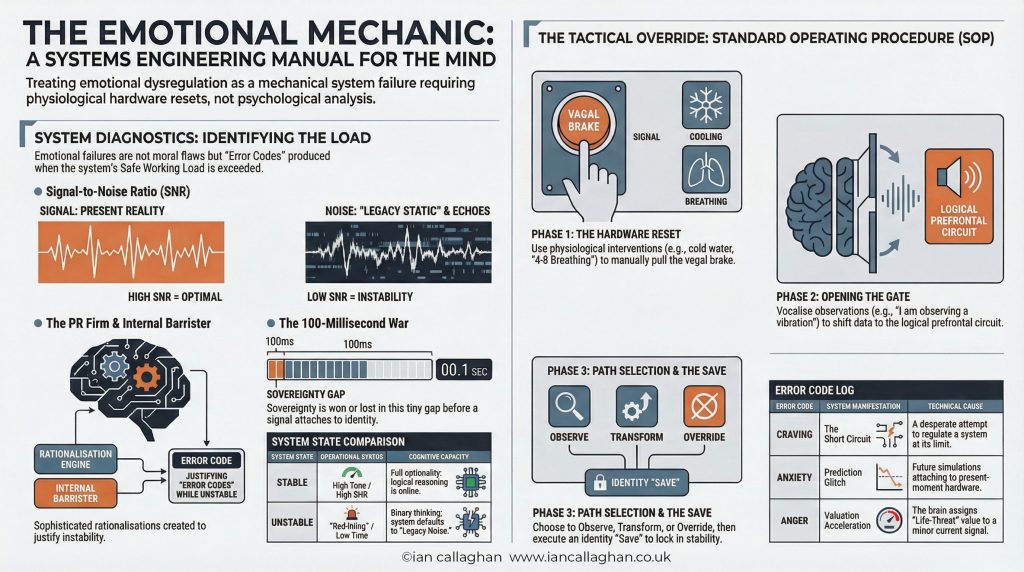
Box Breathing: Use a cycle of 4s in, 4s hold, 4s out, 4s hold. This activates the parasympathetic nervous system—your body’s natural brake pedal—telling your biology that you are safe and can move into “rest and digest” mode.
——————————————————————————–
6. Dismantling the “Triggers”: The 10-Second Rule for Breaking Cravings
You do not “fail” because you are weak; you get ambushed by your own nervous system. Triggers are not logical thoughts; they are lightning-fast neurological reactions buried in your “lizard brain.” They fire before your conscious mind even has a chance to intervene.
To dismantle these landmines, you must understand the timeline of an urge. Neurobiology shows that a craving “spike” generally lasts for approximately 90 seconds. If you can interrupt the neurological loop for just ten seconds, you stop the dopamine-driven “autopilot” from taking the wheel.
The “10-Second Interruption” Protocol
When a trigger hits—be it stress, a certain time of day, or an emotional flash—immediately apply the 4 Questions That Kill Cravings:
What am I actually feeling? (Is this hunger, or is it loneliness, stress, or boredom? Naming the emotion moves the activity from the impulsive amygdala to the rational prefrontal cortex.)
What do I actually need? (Do I need a “non-food” input, or do I need rest, connection, or a mineral reset?)
Will this fix the problem? (The answer is always no; it will only add the weight of shame to the original feeling.)
How will I feel tomorrow? (Will I feel clear-headed and sovereign, or will I be crawling through the fog of a relapse?)
By naming the trigger, you move from “drowning” in the feeling to “observing” it. Observation is the ultimate sovereignty hack.
——————————————————————————–
7. Building the “Legacy Identity”: Self-Creation After 35
After the age of 35, you are no longer just surviving; you are self-creating. You have reached a stage where your physical health is the foundation for your emotional stability and the legacy you leave for your children. This is the Embodiment stage.
“You are not a problem that needs fixing. You are someone who finally reached the point where running hurt more than facing the truth.” — Ian Callaghan.
Building a Legacy Identity means setting standards that your family can follow. It is the recognition that you are the architect of your future. When your identity is “locked in,” you don’t “hope” to stay on track—you simply live as the person who is sober from industrial interference. You are no longer a customer for the pharmaceutical consequences of a broken food system. You have outgrown your old life.
——————————————————————————–
The 28-Day Blueprint: Your Biological Renovation
This reset is structured as a 28-day systematic renovation of your internal factory settings. It is not a buffet; it is a progression.
The 28-Day Structural Progression
Phase
Biological Focus
Primary “Job”
Week 1
Withdrawal & Stabilisation
Breaking the “Sugar Dragon.” Establishing the mineral baseline (Salt/Water) to manage electrolyte shifts.
Week 2
Gut & Inflammation
Healing the gut-mucosal barrier with collagen and re-seeding the microbiome with fermented foods like sauerkraut.
Week 3
Metabolic Flexibility
Mastering meal timing and the “Protein Leverage Effect.” Signalling the body to switch to fat-burning.
Week 4
Consolidation & Sovereignty
Establishing permanent standards and building “social resilience” (learning to say “No” to seed oils).
To hit the word count and provide clinical value, we must look at the specific “Metabolic Sovereignty Notes” found in the recipes of this programme.
Recipe 1: Mediterranean Omelette (Liver Integrity): This provides a dense hit of Choline. Choline is an essential nutrient for transporting fats out of the liver. Without it, your liver becomes sluggish, leading to “non-alcoholic fatty liver” and a stalled metabolism.
Recipe 33: Prawn & Avocado Lettuce Wraps (Thyroid Fuel): Prawns are one of the densest sources of Iodine and Selenium in the human diet. These are the primary substrates for thyroid hormones (T4 and T3). After 35, these minerals are the “coal” for your biological furnace.
Recipe 35: Spicy Mackerel Stir-Fry (Detoxification): Cabbage is a potent source of Sulforaphane, which up-regulates your body’s Phase II detoxification pathways. This is critical for clearing out the “oxidative debt” and “rusted wiring” caused by years of consuming seed oil.
Recipe 49: Slow-Cooked Beef Stew (Gut Repair): Slow-cooking connective tissue converts tough fibres into bioavailable Collagen and Glycine. This provides the structural matrix required to heal “leaky gut,” reducing the systemic inflammation that drives insulin resistance.
Recipe 61: Ancestral Chicken Liver Pâté (Metabolic Master-Food): Liver is the most nutrient-dense food on the planet. It is exceptionally high in preformed Vitamin A (retinol), which is essential for thyroid health and skin elasticity.
——————————————————————————–
The Deep Science: The Liver-Thyroid Connection
One of the most overlooked aspects of metabolic health after 35 is the interplay between the liver and the thyroid. Your thyroid produces T4, but it is the liver that converts most of that T4 into the active T3 hormone that actually runs your metabolism.
If your liver is congested with industrial seed oils, high-fructose corn syrup, and an “oxidative debt,” this conversion slows down. You can have “normal” thyroid labs and still feel like a zombie because the conversion isn’t happening at the cellular level. This reset clears the liver (through Choline and Sulforaphane) and provides the substrates (iodine and selenium) to ensure your metabolic furnace is actually burning the fuel you give it.
Why “Morning Salt” is Non-Negotiable
Many people fail a Paleo or Mediterranean reset because they fear salt. However, as insulin levels drop, your body stops retaining excess water and sodium. If you don’t replenish this with the 500ml water/1/2 tsp sea salt protocol, your blood volume drops, leading to the “brain fog” and fatigue often mistaken for “needing sugar.” Salt is not the enemy; it is the mineral anchor of your sovereignty.
——————————————————————————–
Conclusion: The Life on the Other Side of You
The Mediterranean Reset Paleo is not a “diet”—it is an exit strategy from the industrial food complex. It is the process of outgrowing a life that was too small for you. When you align your nervous system, your nutrition, and your identity, you stop being a passenger in your own body and become the architect of your future.
As you finish this reset, you must ask yourself: What will my non-negotiable standards be for the coming year?
You have spent years trying to fix your life with willpower and promises you couldn’t keep. But the problem wasn’t your character; it was your wiring. By changing the metabolic and mental inputs, you have changed the machine. The life that waits for you on the other side of this transition is one of clarity, groundedness, and unapologetic sovereignty. Go and build the life that matches the person you have become. The world is better when you show up as the real you.
Used to monitor number of Google Analytics server requests when using Google Tag Manager
1 minute
_gid
ID used to identify users for 24 hours after last activity
24 hours
_ga_
ID used to identify users
2 years
_gali
Used by Google Analytics to determine which links on a page are being clicked
30 seconds
_ga
ID used to identify users
2 years
__utmx
Used to determine whether a user is included in an A / B or Multivariate test.
18 months
__utmv
Contains custom information set by the web developer via the _setCustomVar method in Google Analytics. This cookie is updated every time new data is sent to the Google Analytics server.
2 years after last activity
__utmz
Contains information about the traffic source or campaign that directed user to the website. The cookie is set when the GA.js javascript is loaded and updated when data is sent to the Google Anaytics server
6 months after last activity
__utmc
Used only with old Urchin versions of Google Analytics and not with GA.js. Was used to distinguish between new sessions and visits at the end of a session.
End of session (browser)
__utmb
Used to distinguish new sessions and visits. This cookie is set when the GA.js javascript library is loaded and there is no existing __utmb cookie. The cookie is updated every time data is sent to the Google Analytics server.
30 minutes after last activity
__utmt
Used to monitor number of Google Analytics server requests
10 minutes
__utma
ID used to identify users and sessions
2 years after last activity
_gac_
Contains information related to marketing campaigns of the user. These are shared with Google AdWords / Google Ads when the Google Ads and Google Analytics accounts are linked together.