It is possible to heal trauma without talking about it.
Not as a shortcut. Not as avoidance. As a more precise route to the place where the trauma actually lives.
The assumption buried inside most trauma work is that language is the vehicle of healing. Find the right words, in the right room, with the right person, and something unlocks. That articulation is the mechanism.
For some people, in some circumstances, that is partly true. But for a significant number of people, especially those whose trauma was laid down before language, or whose nervous systems have been stuck in chronic activation for so long that talking just adds more noise to an already overloaded system, it can be actively counterproductive.
The wound does not live in the story. It lives in the body. That is where healing happens.
Why Talking Can Keep the Loop Running
To understand why you can heal trauma without talking about it, you need to understand what talking about trauma actually does neurologically.
When you narrate a traumatic experience, whether in therapy, coaching, or a late-night spiral on your own, you activate the neural network associated with that experience. The amygdala does not care whether the threat is happening now or being vividly replayed. Bob fires. The threat response kicks in. Cortisol floods the system.
If the session ends before that physiological activation completes, which it often does because fifty minutes is a made-up endpoint, you leave with the nervous system still partially activated and the traumatic programme freshly rehearsed.
Every time you narrate trauma without resolving the physiological activation, you are practising the wound.
That is not a criticism of therapy. Skilled trauma therapists know this and work to complete the activation cycle inside the session. The problem is that most talking-based approaches, including much coaching, have no real mechanism for doing so. They can produce insight. Insight and resolution are not the same thing.
To heal trauma without talking about it is to bypass that problem entirely and work directly with the physiological activation instead of the narrative built around it.
Where Trauma Actually Lives
Trauma is not a memory. It is a programme. A threat-response pattern is encoded during an overwhelming experience and never properly updated. The original event is over. The programme it created is still running.
That programme lives in the subcortical structures of the brain, such as the amygdala, hippocampus, and brainstem, the areas that do not process language. They process sensation, threat assessment and pattern recognition. They respond to experience, not explanation.
That is the fundamental reason you can heal trauma without talking about it. Language does not reach the level where the programme is stored. Somatic experience does.
The body is the access point. The constriction, the heat, the weight, the freeze, they are not side effects of the trauma. They are the trauma expressing itself through the hardware it runs on. Work with the sensation directly, and you are working with the programme directly.
The EOM Approach: Heal Trauma Without Talking About It
The Emotional Observation Method is built on the principle that you can heal trauma without talking about it, or more accurately, without talking about the original events that created it.
The No-Digging Rule is absolute. We do not go back into the story. We work with the activation as it appears in the present moment. The entry point is always the body, always now, never the archive.
Step 1: Catch the activation early
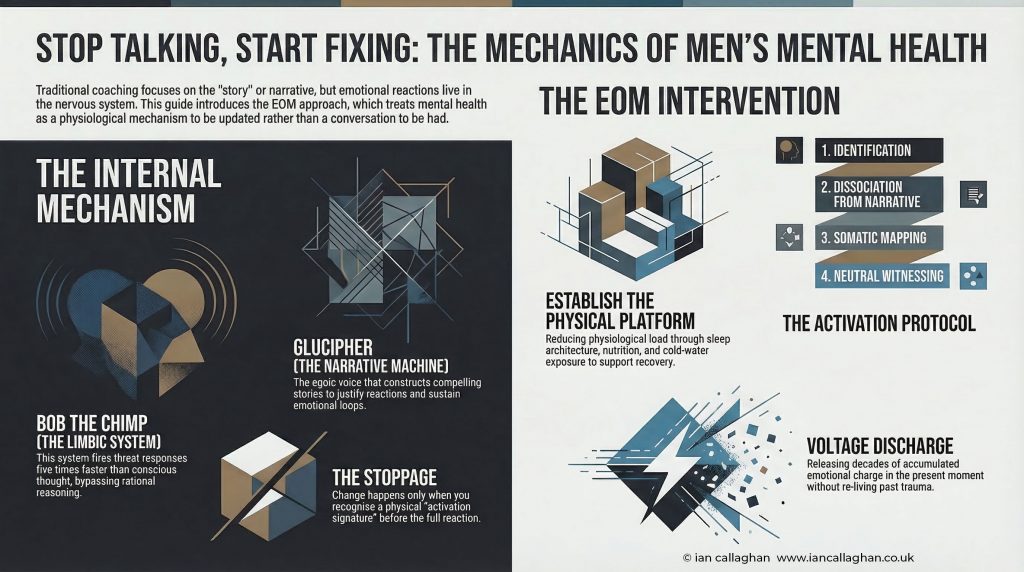
The first skill is learning your own activation signature, the earliest physical sign that Bob has fired. For most people it is a specific sensation. Tightening. Heat. A drop in the gut. A change in breath. It lands before the emotional label, before the story, before the full physiological cascade.
Catching it here, at the first physical signal, is the difference between observing an activation and being dragged around by it.
Step 2: Name the mechanism, not the story
Bob is activated, rather than I am triggered.
Glucipher is building a narrative, rather than I keep thinking about what happened.
This is not positive thinking. It is accurate thinking. It shifts you from total identification into observation, and that witnessing gap is where choice starts to come back online.
Step 3: Map it in the body
Where exactly is the sensation?
What is its texture?
Sharp or dull. Heavy or tight. Static or moving.
You are treating the emotion as data, not as a verdict. A weather pattern moving through a location. Temporary. Observable. Not your identity.
Step 4: Witness without narrative
You observe. You do not feed.
A cortisol spike lasts roughly ninety seconds if you do not keep extending it with thought, story and meaning-making. You watch it peak. You watch it pass. The programme fires, but it does not get the old reaction it expects. Over time, that weakens the pathway.
That is how you heal trauma without talking about it.
Not by understanding it better.
By changing the relationship between the trigger and the nervous system’s automatic response to it.
What This Approach Cannot Do
Honesty matters here.
The EOM approach is not for everyone in every circumstance.
If you are in an active crisis, if the trauma response is so acute that your daily functioning is badly compromised, the priority is stabilisation, and that may require clinical support. EOM is for people who are functional but stuck, not for people who are currently destabilised.
If the trauma involves deep developmental wounding, especially early childhood experiences that shaped identity, attachment and emotional safety, the work is slower and needs more scaffolding than a self-directed process can provide. That is where one-to-one support makes sense.
For everything in between, the built-up activation of a high-pressure life, the patterns that keep firing despite insight, the emotional debt ceiling that has been rising for years, this approach is direct, effective, and does not require you to spend another hour retelling your history.
Start Here
If you want the full framework for how to heal trauma without talking about it, the complete EOM protocol, the No-Digging Rule properly explained, and Bob and Glucipher laid out in plain English, start with the pillar page.
If you want to work through this inside a community of people doing it in real time, asking the questions that actually matter and sharing what is shifting, join the free Midlife Reset group.
If you are searching for a men’s mental health coach, you already know that the standard options aren’t cutting it. You’ve probably tried talking about it. You may have done therapy. You might have read the books, downloaded the apps, and done the breathing exercises.
And you are still having the same reactions in the same situations.
The problem is not that you haven’t talked enough. The problem is that talking operates at the level of the story — and the story is not where the reaction lives.
What you need is not a listener. What you need is a mechanic.
What a Men’s Mental Health Coach Actually Does
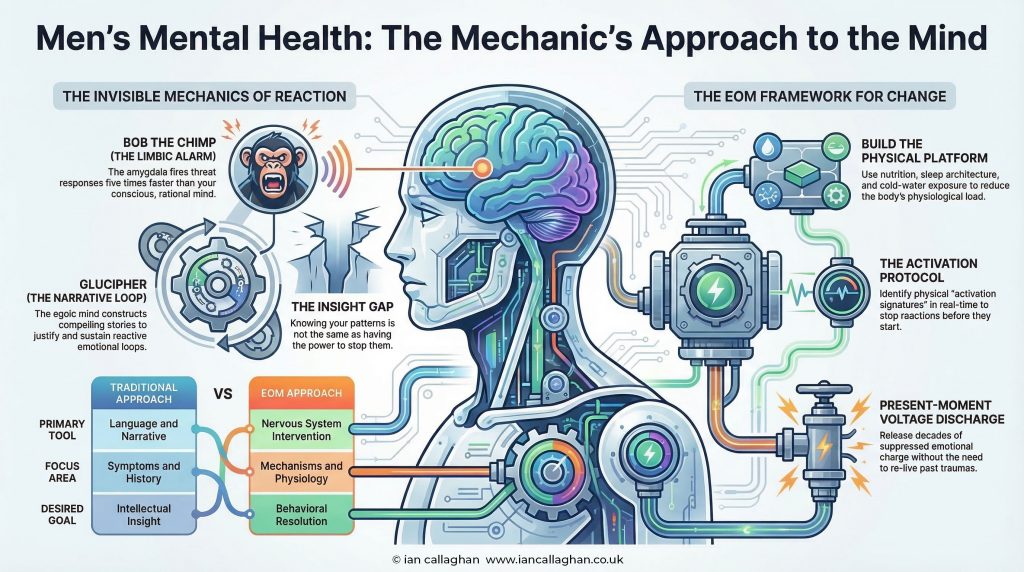
The men’s mental health coach space is crowded with people who will sit with you, reflect on your experience with you, and help you articulate what you’re going through. That has value. But articulation is not resolution.
The question that separates a useful coach from an expensive conversation is this: are you working at the level of the symptom, or at the level of the mechanism that produces the symptom?
Symptoms are drinking, rage, shutdown, performance, and anxiety. The mechanism is the nervous system running a threat-response programme encoded years ago and never updated.
You cannot think your way out of a feeling. But you can learn to observe the mechanism producing the feeling — and update it.
That is what the EOM approach to men’s mental health coaching is built on. Not an endless exploration of what happened. A precise, technical intervention on what is happening in the body, in the nervous system, in the present moment.
Why Men Specifically Struggle to Get the Right Help
The conversation about men’s mental health has improved significantly in the last decade. The stigma around seeking support has reduced. More men are open to coaching, therapy, and working on their inner world than at any point in recent history.
But the frameworks they are being offered were largely built by and for people who process emotionally through language. Talk. Express. Explore. Reflect.
For a significant proportion of men — particularly those who have spent 20 or 30 years in environments that required emotional suppression — that approach creates a specific and recurring problem. They can talk about their experience fluently. They can identify their patterns. They can name their trauma. And then they walk out of the session and respond to the next provocation in the same way they always have.
Because the nervous system does not update through narrative, it updates through experience. And specifically, through the repeated experience of observing an activation without becoming it.
A man’s mental health coach who understands this works differently. The goal is not to produce insight. The goal is to produce a nervous system that behaves differently.
The Two Systems a Men’s Mental Health Coach Needs to Address
In the EOM framework, every emotional and behavioural pattern runs through two internal systems. Understanding both is non-negotiable for any coach working in men’s mental health.
Bob the Chimp — The Alarm That Runs Everything
Bob is the personalisation of the limbic system — the amygdala and surrounding circuitry that fires threat responses before the rational mind has registered what’s happening. Bob is five times faster than conscious thought. He does not respond to reasoning, reassurance, or positive reframing.
When a man walks out of a coaching session with fresh insight about his patterns and then loses his temper at his partner that evening — that is Bob. Not a failure of will. Not a lack of commitment. Bob fired before the insight had a chance to get involved.
A man’s mental health coach, who is working at the right level, teaches the client how to recognise Bob’s activation signature in real time — the physical tell that fires before the full reaction. That recognition is The Stoppage. That gap is where change actually happens.
Glucipher — The Loop That Keeps It Running
Once Bob fires, Glucipher builds the story around it. Glucipher is the egoic narrative machine — the internal voice that constructs a fully sourced, emotionally compelling account of why the reaction was justified, why the other person is wrong, and why this is evidence of a pattern that has been following the client their entire life.
Glucipher is why a man’s mental health coach can spend six sessions unpicking a single belief pattern and find it fully reinstated the following week. The belief was addressed cognitively. Glucipher rebuilt it from the same raw material because the underlying activation was never discharged.
The EOM approach identifies Glucipher, names it, and teaches the client to refuse engagement with its content — not because the narrative is irrelevant, but because engagement is how the loop sustains itself.
What Men’s Mental Health Coaching Looks Like With EOM
The EOM approach to men’s mental health coaching is structured around four areas that conventional coaching rarely addresses simultaneously.
1. The Physical Platform
Nervous system dysregulation is not a psychological problem; it has physical symptoms. It is a physiological state that produces psychological consequences. Before any meaningful coaching work is possible, the physical load needs to be reduced.
This means nutrition that reduces inflammatory load, sleep architecture that supports genuine recovery, and cold-water exposure that directly trains the parasympathetic response. These are not lifestyle add-ons. They are the foundation that makes everything else possible.
2. The Activation Protocol
The core skill taught in EOM-based men’s mental health coaching is the four-step observation protocol: immediate identification of Bob’s activation, dissociation from the Glucipher narrative, somatic mapping of the physical sensation, and neutral witnessing until the physiological event passes.
This is practised in low-stakes situations first, then progressively applied to the specific triggers that are causing the most disruption in the client’s life. Each successful application weakens the automatic reaction pathway and strengthens the prefrontal cortex’s inhibitory control.
3. The Identity Audit
The operating system running under the surface — the core beliefs about worth, capability, and what is permissible — needs to be identified and evaluated, not excavated, re-experienced, and then identified and evaluated.
The question is always the same: was this written by you, for the life you are living now? Or was it written by someone else, in circumstances you no longer inhabit, and handed to you before you had the capacity to refuse it?
4. The Voltage Work
The stored activation — the accumulated charge of decades of suppressed emotional response — needs to discharge. The EOM non-reliving protocol does this in the present moment, without requiring the client to re-enter the emotional states that created the charge. This is often the piece that produces the most significant shift, and the piece most absent from conventional men’s mental health coaching.
Who This Approach Is For
This is not a men’s mental health coaching approach for everyone. It is specifically built for a particular type of person at a particular point in time.
You have tried talking about it and have run out of things to say, but nothing has fundamentally shifted.
You are high-functioning on the outside and running on empty on the inside
You know your patterns. You can see them coming. You still can’t stop them.
The drinking, the shutdown, or the rage is starting to cost you things you cannot afford to lose.
You want to understand the mechanism, not accumulate more insight about the symptom.
If you recognise yourself in that list, you do not need to say more. You need the correct tool applied to the correct level of the problem.
Work With Ian — Men’s Mental Health Coaching
I work with a small number of clients directly — one-to-one sessions built around the EOM protocol, the physical reset, and the identity audit. No scripts. No generic frameworks. The specific tool for the specific problem you are running.
If you want to start with the community before committing to one-to-one work, the Midlife Reset Skool group is where the real-time application happens. People doing the work, sharing what’s moving, asking the specific questions that don’t get asked anywhere else.
Or start with the self-directed tools — the Emotional Operating System manual is the men’s mental health coaching framework in written form, built to be used without a guide if you have the discipline to apply it.
A midlife reset for men — and women hitting the same collision point — is not a holiday, a motorbike, or a motivational retreat. It is a precise reprogramming of the systems that have been quietly failing for years and have now reached critical load.
You are somewhere between 40 and 55. You have built things — a career, a family, a version of yourself that functions. From the outside, it looks like you have it together.
And somewhere underneath all of it, something is grinding.
It might be the drinking that has crept from two glasses to half a bottle without you noticing. It might be the rage that arrives faster than it used to, at smaller provocations. It might be the flatness — the absence of the drive that used to feel automatic. The Sunday evenings that feel like dread. The relationship is running on autopilot. The sense that you have been performing a version of yourself for so long that you can no longer locate the original.
That is not a crisis. That is a systems failure.
Systems failures don’t respond to holidays, motivational content, or white-knuckling through. They respond to diagnosis and the correct tool applied to the correct problem.
This is what the midlife reset for men actually looks like when it’s done properly.
Why a Midlife Reset for Men (and Women) Hits at 40+
The popular narrative about midlife is that people hit an existential crisis — they question their choices, blow up their lives, or suppress the feeling and carry on.
That narrative misses the mechanics entirely.
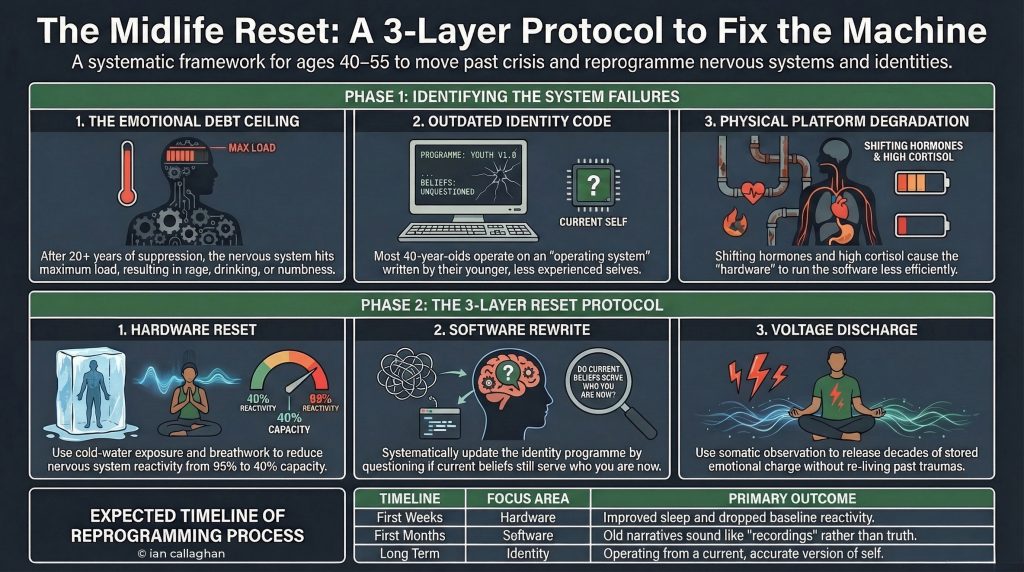
What is actually happening at 40-plus is a convergence of three specific system failures that have been building for decades and have now reached critical load. Understanding these is the starting point for any genuine reset.
System Failure 1: The Emotional Debt Ceiling
Most people reaching the midlife reset point have spent 20 to 30 years operating a specific emotional strategy: suppress, perform, push through. It works — for a while. It is an effective short-term survival mechanism in environments that punish emotional expression: high-pressure workplaces, demanding relationships, cultures that reward endurance over honesty.
The problem is that suppression is not resolution. Every time Bob fires a reaction that gets pushed down rather than processed, the stored activation accumulates in the nervous system. The body keeps a precise account.
By midlife, most people are running on a nervous system at maximum load — hair-trigger reactivity, chronic low-level anxiety, emotional numbness, or all three simultaneously.
The drinking, the rage, the flatness — these are not character flaws. They are the nervous system’s emergency pressure-release mechanisms. The machine has hit its debt ceiling and is doing whatever it can to discharge the load.
System Failure 2: The Identity Programme Running on Outdated Code
The identity most people operate from in midlife was formed in their teens and twenties. The core beliefs about what they are worth, what they are capable of, what they deserve, and what is expected of them — all of it — was encoded during a period of maximum vulnerability and minimal agency.
Glucipher has been running that programme faithfully ever since. Every decision, every relationship, every professional choice has been filtered through an operating system written by a young person who didn’t have the information, the experience, or the neurological development to write it well.
The midlife collision happens when the life the programme built no longer matches the life you actually want — and you don’t yet have the tools to rewrite the code.
System Failure 3: The Physical Platform Degrading Under the Software
At 40-plus, hormonal balance shifts. Sleep quality deteriorates. Inflammation rises. The physical platform that the emotional and cognitive systems run on is under increasing load — and most people accelerate that degradation through the same patterns that got them here: high stress, poor nutrition, inadequate recovery, and the substances used to regulate all of the above.
The body and the mind are not separate systems. When the hardware degrades, the software runs worse. Bob fires faster. Glucipher runs louder. The already stretched emotional regulation becomes increasingly unreliable.
Why Standard Midlife Advice Doesn’t Work
The standard advice for midlife runs on a predictable loop: exercise more, drink less, talk to someone, find your purpose, be more present.
All of it is correct at the output level. None of it addresses the mechanism producing the output.
Telling someone with an overloaded nervous system to ‘manage stress better’ is like telling a car with a broken engine to drive more carefully.
The exercise doesn’t stick because nervous system dysregulation makes consistency impossible. The drinking reduction fails because drinking performs a specific regulatory function that nothing has replaced. The therapy stalls because it operates at the level of the story, while the problem resides in the subcortical architecture. The purpose of work lands flat because you cannot connect to what you genuinely want, while Glucipher is running a 30-year-old script about what you are allowed to want.
The reset has to start at the level of the machine. Not the behaviour. The machine producing the behaviour.
The Three-Layer Reset Protocol
A genuine midlife reset for men and women works across three layers simultaneously — because all three are failing simultaneously and you cannot fix one while ignoring the others.
Layer 1 — The Hardware Reset
The nervous system needs to come off maximum load before anything else is possible. This means addressing the physical platform directly: inflammation through nutrition, cortisol through sleep architecture, sympathetic dominance through cold water exposure and breathwork.
This is not a wellness programme. It is engineering. The goal is to reduce Bob’s baseline reactivity by reducing the physiological load the system is operating under. A nervous system running at 40% capacity rather than 95% makes everything else in the reset possible.
Cold water is the fastest intervention available — not because it is uncomfortable, though it is — but because it is the most direct method for training the parasympathetic response. Every cold exposure is a repetition of the same pattern: stimulus hits, Bob activates, you observe without reacting, the system returns to baseline. You are running the EOM protocol with your physiology before you are running it with your emotions.
Layer 2 — The Software Rewrite
Once the hardware is stable enough to work with, you begin on the operating system. The identity programme that Glucipher has been running needs to be examined, identified for what it is, and systematically updated.
This is the EOM work. Not therapy — not returning to the original events that wrote the programme and re-experiencing them in detail. The No-Digging Rule applies here too. We look at the programme as it runs in the present: the specific beliefs that fire in specific situations, the automatic assessments Bob makes, the narratives Glucipher uses to maintain the system.
The question is not ‘where did this come from.’ The question is ‘what is actually running, and does it still serve the person I am now.’
Most of it doesn’t. The code that kept you functional in a difficult adolescence, a demanding institution, or a relationship running on performance rather than connection — that code is actively working against you now.
Layer 3 — The Voltage Discharge
The stored activation — decades of suppressed emotional charge, unprocessed grief, unexpressed anger, fear that never got to complete its physiological arc — needs to move.
Not through excavating the past. Not through reliving the events that created the charge. Through the present-moment somatic work of the EOM protocol: locating the activation in the body, observing it without narrative, and allowing it to discharge in the present tense without the traumatic programme being rehearsed and reinforced.
This is the piece most midlife reset frameworks miss entirely. They address the story and the behaviour. They leave the stored charge untouched. And the charge is what keeps pulling you back into the old patterns regardless of how much insight you have developed or how many good intentions you are running on.
What Changes — And When
The reset is not a weekend event. It is a reprogramming process. What I have observed consistently across the people I have worked with is a specific sequence.
In the first weeks, the hardware changes are the most noticeable. Sleep improves. The baseline reactivity drops. There is more space between stimulus and response — the beginnings of The Stoppage becoming accessible in real time.
In the first months, the software changes begin to compound. The Glucipher loops become recognisable — predictable, even boring. The old narratives start to sound like a recording rather than the truth. Decisions that used to feel impossible — about the drinking, the relationship, the career — begin to feel navigable because they are being made from a regulated nervous system rather than from a system at maximum load.
Over the longer term, the identity programme updates. Not dramatically, not all at once — but the person running on 30-year-old code about who they are and what they deserve begins to operate from something more current. More accurate. More theirs.
The midlife reset is not about becoming someone new. It is about removing the code that was never yours to begin with.
Four Questions to Start With
Before any framework, before any protocol, there are four questions that cut to the centre of where you actually are. Not questions to answer quickly. Questions to sit with honestly.
What is the nervous system managing that I haven’t addressed directly?
Which parts of the identity I’m operating from were written by someone else, in circumstances I no longer live in?
What has the drinking, the rage, the flatness, or the performance actually been doing for me — and what does it need to be replaced with?
What would I be doing differently if I wasn’t running on an inherited programme?
Those are not comfortable questions. They are the correct ones. The midlife reset for men and women starts there — not with the behaviour you want to change, but with the mechanism producing it.
Where to Start
The Emotional Observation Methodis the framework underneath everything described in this post. The complete protocol — Bob, Glucipher, the four steps, the No-Digging Rule — is at iancallaghan.co.uk/emotional-observation-method/
The Emotional Archetype Quiz identifies which of the four primary system errors you are running — Fighter, Thinker, Reactor, or Connector — and tells you exactly where to apply the tool first: iancallaghan.co.uk/emotional-archetype-quiz/
The Emotional Operating System manual is the practical implementation guide — the mechanic’s handbook for running the reset yourself, in your own time, without needing to sit in a room and explain your history to a stranger: iancallaghan.co.uk/the-shop/
Or join the free Skool community — the people in there are doing this work in real time. That is the environment where the reset actually sticks.
The machine is not broken. It is running on the wrong programme. Fix the programme.
Used to monitor number of Google Analytics server requests when using Google Tag Manager
1 minute
_gid
ID used to identify users for 24 hours after last activity
24 hours
_ga_
ID used to identify users
2 years
_gali
Used by Google Analytics to determine which links on a page are being clicked
30 seconds
_ga
ID used to identify users
2 years
__utmx
Used to determine whether a user is included in an A / B or Multivariate test.
18 months
__utmv
Contains custom information set by the web developer via the _setCustomVar method in Google Analytics. This cookie is updated every time new data is sent to the Google Analytics server.
2 years after last activity
__utmz
Contains information about the traffic source or campaign that directed user to the website. The cookie is set when the GA.js javascript is loaded and updated when data is sent to the Google Anaytics server
6 months after last activity
__utmc
Used only with old Urchin versions of Google Analytics and not with GA.js. Was used to distinguish between new sessions and visits at the end of a session.
End of session (browser)
__utmb
Used to distinguish new sessions and visits. This cookie is set when the GA.js javascript library is loaded and there is no existing __utmb cookie. The cookie is updated every time data is sent to the Google Analytics server.
30 minutes after last activity
__utmt
Used to monitor number of Google Analytics server requests
10 minutes
__utma
ID used to identify users and sessions
2 years after last activity
_gac_
Contains information related to marketing campaigns of the user. These are shared with Google AdWords / Google Ads when the Google Ads and Google Analytics accounts are linked together.