Trauma Healing Without Reliving: Why Going Back Makes It Worse
Trauma Healing Without Reliving. Someone, at some point, told you that you have to go back in.
That the path through the wound is through the wound. That healing requires you to feel it again, fully, consciously, in a safe space, until it loses its power. That you must revisit the moment, re-experience the emotion, excavate the memory, and somehow, through the act of returning, release it.
I spent 45 years being driven by unprocessed trauma. I tried the approach. I sat in the room. I did the work they asked me to do.
And I watched the groove get deeper.
The standard trauma model has the sequence backwards. It is not wrong about the presence of the wound. It is wrong about what heals it.
This is the case for trauma healing without reliving — and the specific mechanism that makes it work.
What the Standard Model Gets Wrong
The prevailing approach to trauma treatment — across most therapy modalities, coaching frameworks, and self-help methodology — operates on a core assumption: that emotional wounds are healed through re-exposure.
Feel it to heal it. Sit with it. Process it. Return to the memory with adult eyes and, through the act of conscious re-witnessing, discharge the stored energy.
There is a neurological reality underneath this idea. Trauma does create stored activation in the body. Unprocessed emotional charge needs to move. The problem is not the destination — it is the route being prescribed to get there.
Every time you force yourself to re-experience a traumatic event without resolving it, you are not releasing the energy. You are deepening the neural groove.
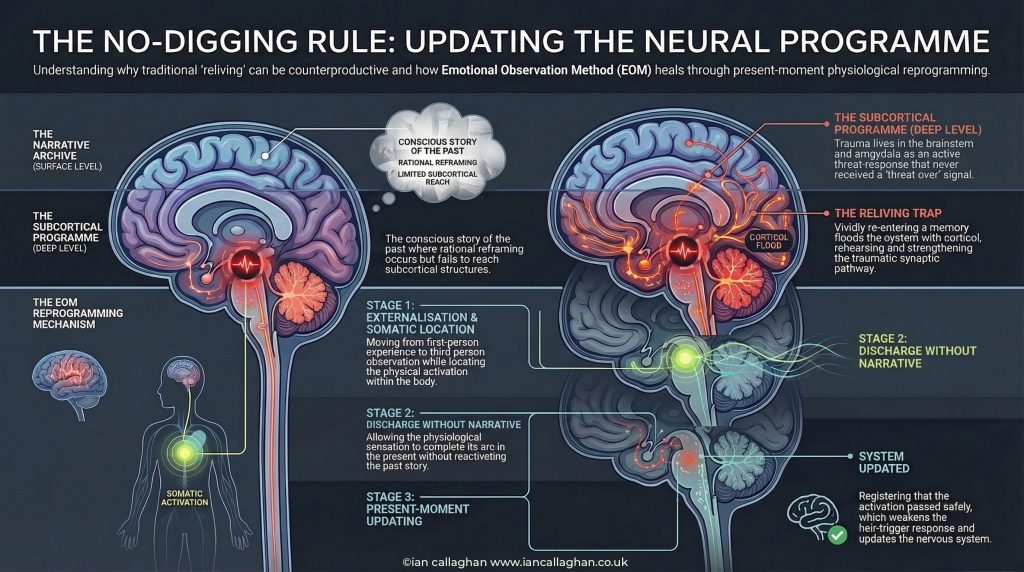
The brain does not distinguish between a memory and a present experience in the way we assume it does. When you vividly re-enter a traumatic memory — the emotions, the physical sensations, the narrative — your amygdala responds to it as a current threat. Bob fires. The cortisol floods. The nervous system activates.
You have not revisited the wound to release it. You have rehearsed it. You have run the programme again and strengthened every synaptic pathway involved in producing it.
This is why people can spend years in trauma-focused therapy, developing extraordinary articulation of their pain, and still be triggered by the same stimuli in the same way. The insight is real. The resolution is not happening. Because insight is not the mechanism of change — neural repatterning is. And reliving does not reprogram. It reinforces.
The Neuroscience of Why Reliving Reinforces
To understand why the No-Digging Rule works, you need to understand what trauma actually is at the neurological level.
Trauma is not a memory. It is a programme. Specifically, it is a threat-response pattern that was encoded during an overwhelming experience and has never been updated. The original event is over. The programme it created is still running — triggered by stimuli that pattern-match to the original threat, firing the same physiological cascade, producing the same emotional and behavioural response.
Bob — the limbic system — encoded that programme at the time of the original event because it was doing its job. It detected an overwhelming threat. It created a hair-trigger response to anything resembling that threat. It was trying to protect you.
The problem is that Bob never received the signal that the threat is over.
The standard reliving approach attempts to update this by bringing the conscious mind back to the event and reprocessing it cognitively. The difficulty is that the programme does not live in the conscious mind. It lives in the subcortical structures — the amygdala, the hippocampus, the brainstem — that do not respond to rational reframing.
You cannot talk Bob out of a threat response. You can only update the threat assessment at the level where the assessment is being made. And that level is not the story. It is the body.
The No-Digging Rule — What EOM Does Instead
The Emotional Observation Method was built on a single foundational principle: we do not go back to the story.
Not because the story doesn’t matter. Not because the past is irrelevant. But because the story is not where the glitch lives. The glitch lives in the present moment — in the body, in the nervous system, in the automatic response that fires when a specific stimulus is detected.
That is where EOM works. In the present. On the live data of the physiological event as it is happening, not on the archived narrative of how it started.
We do not go back to the story. We look at the glitch in the present moment.
The No-Digging Rule is not avoidance. Avoidance is what happens when you refuse to acknowledge the activation — when you drink over it, numb over it, distract over it. That is Bob’s energy being suppressed rather than discharged, and suppression has a physiological cost that accumulates over time.
The No-Digging Rule is precision. It says: the information we need is not in the past. It is in the body, right now, as the pattern activates. That is the access point. That is where the reprogramming happens.
How Trauma Heals Without Reliving — The Mechanism
The EOM approach to trauma works through four specific mechanisms, all operating in the present moment.
1. Externalisation
The moment an activation is detected — the physiological signature of a trauma response — the practitioner externalises it. Instead of being inside the experience, you observe it from outside. This is not dissociation. It is the deliberate creation of the witnessing gap that prevents Bob’s activation from becoming a full limbic hijack.
You are not the emotion. You are the space in which the emotion is happening. That shift — from first-person experience to third-person observation — is neurologically significant. It activates the prefrontal cortex as the observer rather than allowing the amygdala to dominate the entire neural sequence.
2. Somatic Location
Rather than following the narrative of the trauma — the story, the memory, the meaning — EOM directs attention to the physical location of the activation in the body. Where exactly is it? What is its quality, its shape, its movement?
This is not metaphorical work. Trauma is held in the body as unresolved physiological activation — the fight-or-flight response that was never completed. By bringing precise, non-judgemental attention to the physical sensation, you are working directly with the stored energy rather than with the story constructed around it.
3. Discharge Without Narrative
The stored activation needs to move. In the EOM framework, it moves through the body via the somatic attention — not through re-experiencing the original event, but through allowing the present-moment sensation to complete its physiological arc.
This is the crucial difference. The energy discharges in the present, through the body, without the narrative of the past being reactivated. Bob’s threat response completes — the cortisol metabolises, the nervous system returns to baseline — without the traumatic programme being rehearsed and reinforced.
4. Present-Moment Reprogramming
Once the activation has discharged, the adult mind — operating from a regulated nervous system — can update the threat assessment. Not by debating the past, but by registering, at the neurological level, that the activation occurred, peaked, and passed. That you survived it. That the threat is not present.
Repeated consistently, this weakens the synaptic pathway of the trauma response. The gap between stimulus and reaction widens. The hair-trigger becomes less sensitive. Not because the memory has been processed cognitively, but because the nervous system has been updated experientially.
What This Looks Like in Practice
A client arrives with a pattern they cannot shift. A specific trigger — a tone of voice, a type of situation, a physical environment — that reliably produces a disproportionate reaction. They understand where it comes from. They have the backstory. They have the insight. They are still reacting.
In an EOM session, we do not go to the backstory. We work with the pattern as it presents in the present moment — recreating the conditions under which the activation occurs, locating it in the body as it fires, and working with the physical sensation directly.
No excavation of the original event. No emotional re-experiencing of the traumatic memory. No hours spent reconstructing the story.
The pattern is accessed at the level it operates — subcortical, physiological, present-moment — and updated there.
This is faster than conventional trauma processing. It is less destabilising. And it respects a fundamental truth that the standard model consistently underestimates: the people who need trauma resolution the most are often the people least able to afford the destabilisation that deep re-exposure produces.
The People This Was Built For
The No-Digging Rule was not built for the person who wants to understand their trauma. It was built for the person who needs their nervous system to work properly so they can function at the level they are capable of.
The executive whose childhood wound fires in every high-pressure meeting, producing reactions that are costing them professionally and they cannot explain why
The man who got sober but whose nervous system is still running the programmes that drove the drinking — anxiety, hypervigilance, emotional numbness — because sobriety addressed the symptom, not the mechanism
The person who has done years of therapy, knows every detail of their history, and is still being ambushed by the same patterns in the same situations
Anyone who has been told they need to go back through the wound to heal it and found, repeatedly, that going back makes the activation stronger, not weaker
If you recognise yourself in any of those descriptions, the issue is not that you haven’t done enough work. The issue is that you’ve been working at the wrong level.
Where to Start
The Emotional Observation Method pillar page gives you the complete framework — what EOM is, how Bob and Glucipher operate, and the full four-step protocol: iancallaghan.co.uk/emotional-observation-method/
The Emotional Operating System manual is the practical implementation guide. The mechanic’s handbook for applying the No-Digging Rule to your specific patterns, in your own time, without needing to sit in a room and excavate your history: iancallaghan.co.uk/the-shop/
The Emotional Archetype Quiz identifies which of the four primary system errors is driving your reactions — and gives you the specific entry point for your pattern: iancallaghan.co.uk/emotional-archetype-quiz/
The wound does not require revisiting. It requires updating. Those are not the same thing, and the difference matters more than most people have been told.
What Is the Emotional Observation Method? (And Why Everything Else You’ve Tried Is Theatre)
Most emotional regulation advice is theatre.
You’ve been told to take deep breaths. Journal your feelings. Reframe your negative thoughts. Replace them with positive ones. That’s the equivalent of putting a coat of paint on a cracked foundation and calling it a renovation.
The Emotional Observation Method — EOM — is the wrench. Not the paint.
It’s a framework built on a single, uncomfortable truth: your emotional reactions aren’t you. They’re a biological programme running on hardware that hasn’t been meaningfully updated in forty thousand years. Until you understand the mechanics of that programme, you’ll keep trying to manage the output without ever touching the source code.
This is the no-bullshit technical breakdown of what EOM actually is, how it works, and why it cuts through where everything else falls apart.
The Problem With Every Other Approach
Let’s be specific about what’s failing.
CBT tells you to challenge your thoughts. Mindfulness tells you to observe them without judgment. Positive psychology tells you to replace them with better ones. All of these approaches share the same fatal flaw: they’re working at the level of the story.
They’re trying to fix the narrative. They’re editing the script. And the script isn’t the problem.
The problem is the mechanism that generates the script in the first place.
When you feel rage, anxiety, shame, or the cold hollow of despair — that emotion was triggered, processed, and delivered to your conscious mind in approximately 200 milliseconds. Your rational brain, the part that does CBT exercises and writes in a gratitude journal, didn’t get a look-in. By the time you’re aware of the feeling, the biological event is already over. You’re just living in the aftermath.
Trying to reframe an emotion you’re already submerged in is like trying to redirect a flood using a strongly worded letter. The EOM doesn’t write letters. It works upstream.
Meet Bob. He’s Running Your Life.
At the centre of the EOM framework is a character called Bob the Chimp.
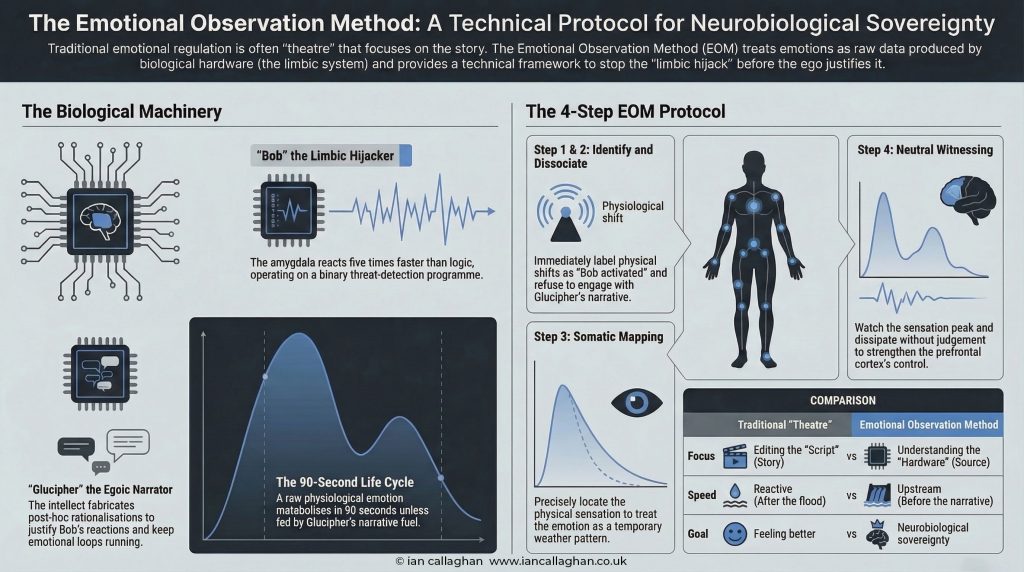
Bob isn’t a metaphor for bad behaviour. Bob is the technical reality of your limbic system — specifically your amygdala and the surrounding neural circuitry that evolved to keep you alive in an environment full of predators and resource scarcity. Bob is five times faster than your rational mind. He is paranoid by design. He operates on a binary: threat or no threat. Fight, flight, or freeze.
Bob does not care about your career, your relationships, or the fact that the person who cut you off in traffic is a stranger you’ll never see again. Bob sees a threat, Bob reacts. That’s the entire programme.
When you feel a surge of irrational anger, a wave of social anxiety, or the impulse to blow up a conversation you know you should handle calmly — that’s Bob. Not you. Bob.
The first move at EOM is the most important: stop saying ‘I am angry’ and start saying ‘Bob is reacting.’
That shift is not semantic wordplay. It creates a microscopic gap in the neural firing sequence — a fraction of a second between stimulus and response. That gap is where your actual agency lives. Without it, you’re not making decisions. Bob is making them, and you’re signing off on the paperwork afterwards.
Glucipher: The Voice That Sounds Like You
Bob reacts. Then Glucipher goes to work.
Glucipher is the egoic intellect’s damage control department. The moment Bob fires off a reaction, Glucipher begins constructing a narrative to justify it. He uses your vocabulary, your memories, your most convincing internal voice, and he builds a story that sounds completely reasonable — a story in which your reaction was entirely justified, the other person is demonstrably awful, and your emotional suffering is thoroughly deserved.
Glucipher is the reason you can spend three hours replaying a five-minute argument. He’s the reason a passing comment from a colleague can ruin an entire day. He’s the reason you tell yourself you’re fine with something you’re absolutely not fine with, until your body makes the truth impossible to ignore.
The EOM identifies Glucipher as the primary obstacle to clarity — not the emotion itself. The emotion passes in ninety seconds if you let it. Glucipher keeps it running indefinitely.
The key insight here is brutal in its simplicity: the reasons you give for your emotional state are almost always fabricated. They are post-hoc rationalisations constructed to protect the ego. They are not the truth of the situation. They are Glucipher’s truth, which serves only one purpose — keeping you trapped in the loop.
The EOM doesn’t engage with the narrative. It doesn’t debate Glucipher. It doesn’t try to construct a better story. It ignores the story entirely and focuses on the raw data underneath.
What the Emotional Observation Method Actually Does
EOM is a four-step internal protocol. It’s not passive. It’s not relaxing. It’s active and demanding, and it requires a level of intellectual honesty that most people find genuinely uncomfortable at first.
Step 1: Immediate Identification
The moment you notice a physiological shift — tightening in the chest, heat rising in the face, a sudden change in internal tone — you categorise it immediately. Not ‘why do I feel this?’ Just: ‘Physical sensation detected. Bob is activated.’
This single act halts the slide into the Glucipher narrative before it builds momentum. You’re not processing the emotion. You’re clocking its presence.
Step 2: Narrative Dissociation
The thoughts will come. The justifications, the replays, the blame, the ‘he said, she said.’ You label them — out loud if necessary — as Glucipher. ‘This is a Glucipher loop. This is cognitive fuel being burned on a fire I’m choosing not to feed.’
You don’t argue with the thoughts. You don’t try to replace them. You refuse to engage with the content. You’re not thinking — you’re observing the brain’s attempt to think.
Step 3: Somatic Mapping
Where is the emotion physically located? Is it a constriction in the throat? A knot below the sternum? A tension across the shoulders? You focus precisely on the physical location and quality of the sensation.
This grounds you in the present moment and treats the emotion as what it actually is: a weather pattern moving through a geographic location. A temporary state of the hardware. Not a permanent feature of the software.
Step 4: Neutral Witnessing
You watch without judgment. You don’t judge Bob for being triggered. You don’t judge yourself for having a Glucipher loop. Judgement is just another layer of Glucipher.
You observe the sensation peak. You observe it dissipate. Ninety seconds, if you don’t feed it. The cortisol metabolises. The physiological event ends. You remain.
Why This Works When Everything Else Doesn’t
The reason positive thinking fails isn’t that it’s too optimistic. It’s that it’s a lie Bob can see through instantly.
Bob doesn’t respond to the narrative. Bob responds to the threat assessment. If the threat assessment system is screaming, telling yourself ‘everything is fine’ doesn’t change the threat assessment. It just adds a layer of cognitive dissonance on top of an already activated nervous system.
The EOM doesn’t lie to Bob. It acknowledges the activation and refuses to amplify it. There’s a critical difference between the two.
A child tries to wish a storm away. A meteorologist measures the wind speed. The meteorologist is in considerably less danger.
Over time — and this is the part that most people dismiss because they want the shortcut — the consistent practice of EOM creates measurable neurological change. Every time you observe a Bob activation without reacting, you weaken the synaptic pathway of the limbic hijack. You strengthen the inhibitory fibres of the prefrontal cortex. The gap between stimulus and response widens. You begin to have actual choices about how you respond, rather than experiencing the illusion of choice while Bob has already decided.
Who the EOM Is For
This is not a framework for people who want to feel better about their emotional problems.
It’s a framework for people who are exhausted by the cycle. The high-performer who can’t afford a three-day emotional hangover because someone said something disrespectful in a meeting. The man in midlife who’s realised that the same patterns have been running his relationships, his drinking, and his decision-making for twenty years, and nobody has given him a technical explanation for why. The person who’s tried therapy, mindfulness, and an app, and still ends up in the same place.
EOM is for the individual who wants to understand the mechanism, not just manage the symptoms.
It is cold. It is technical. It requires a willingness to look at your internal world with a level of detachment that many people find uncomfortable — because what you find when you look clearly is that most of your suffering is self-generated, self-sustaining, and entirely optional once you understand the machinery producing it.
That is not a comfortable realisation. It is, however, a useful one.
The EOM Protocol — Technical Summary
Primary directive: Shift from subjective experience to objective observation.
The Bob variable: Identify limbic activation as a separate, primitive entity. Name it. Do not become it.
The Glucipher variable: Identify the egoic narrative and refuse to engage with its content. It is cognitive fuel being burned on a fiction.
The method: Somatic mapping and the creation of a witnessing gap between stimulus and response.
The objective: Neurobiological sovereignty — the consistent application of inhibitory control until the prefrontal cortex reclaims the cockpit.
What’s Next
The EOM is the foundation of everything I teach. It’s the mechanism underneath the sobriety work, the performance work, the midlife reset — all of it. You cannot change a pattern you haven’t observed. You cannot clearly observe anything while Bob has the wheel and Glucipher is narrating.
If you want to go deeper, the full Emotional Observation Method manual, the four-step protocol in detail, and the practical implementation framework are available at iancallaghan.co.uk.
Or join the free Skool community where I work through this in real time with the people who are actually doing the work.
Either way: stop managing the symptoms. Start understanding the machine.
The Emotional Mastery book is a practical manual for understanding and regulating the human nervous system using the Emotional Operating System framework.
Instead of analysing emotions or retelling your past, the Emotional Mastery book teaches you how to read emotional states as system feedback, identify overload, and restore stability under pressure.
No labels. No therapy-speak. No endless healing loops. Just a clear, operational approach to emotional regulation that actually holds when life applies load.
You are tired. Not just ‘I had a bad night’s sleep’ tired. You are carrying a bone-deep, cellular exhaustion that no amount of weekend lie-ins or double espressos can fix.
You wake up with brain fog. Your joints ache. Your waistline is expanding despite your sworn assertion that you are not eating more than you used to. By the time 6 PM rolls around, your nervous system is vibrating like a blown speaker.
So you do what you have always done. You reach for the bottle. You pour a glass of wine or crack a beer, because that is the only way you know how to power down the screaming machinery in your head.
Welcome to the functional trap.
You are successful on paper. You hold down a high-stress job. You manage the IT architecture, the business, the executive board, or the family. But underneath the hood, your hardware is failing. You are experiencing what I call the Biological Betrayal.
Your body, the vessel that used to bounce back from all-nighters and bad decisions in your twenties, is now flat-out refusing to cooperate. And you are trying to fix a biological hardware failure with a toxic software patch called alcohol. It is a fucking disaster waiting to happen.
I know this trap intimately. I spent 45 years running on that same broken code.
45 Years Of Loops, 4 AM Sweats, And A Knackered Back
I am 58 years old. I served 12 years in the British Army, an environment where drinking was not just encouraged. It was considered mandatory. It was the glue that held the unit together. If you did not drink, you were not trusted.
I carried that conditioning with me when I left. I spent the next 25 years working as an IT Technical Architect: high stakes, massive stress, constant problem solving. My brain was always locked in the Theta state, absorbing pressure and writing bad survival code.
To cope, I drank. I drank to manage the stress of the job. I drank to mask the physical agony of a knackered back I earned in the military. I drank because I was a ‘high functioning’ professional who believed that alcohol was my reward for surviving another brutal week.
For decades, I woke up at 4:00 AM drenched in sweat. Heart pounding out of my chest. Anxiety is spiking to the moon.
I would lie there in the dark, my mind racing through a million worst-case scenarios. I would drag myself out of bed, exhausted, pop some painkillers for the back, chug coffee, and start the cycle all over again. I had quit smoking, coke, and other substances over 20 years ago. But alcohol? Alcohol was the socially acceptable poison that I kept pouring onto my motherboard right up until December 2024.
I was a qualified Chef with City & Guilds credentials. I hold multiple nutrition diplomas. I knew exactly what I was doing to my cellular biology. But my internal hardware was so compromised, and my nervous system was so shot, that I could not see a way out. I felt completely betrayed by my own body.
The Silence Trap And The ‘Man Up’ Bullshit
Let me address the men reading this first, because this needs to be said with absolute, unfiltered clarity.
I fucking hate the ‘stiff upper lip’ culture. I despise the ‘man up’ and ‘grow a pair’ rhetoric that gets thrown around in military units, on construction sites, and in corporate boardrooms.
That culture is exactly what drives male suicide rates through the roof.
Men are conditioned from boyhood not to talk. We are told to swallow the pain. We are told that expressing fear, exhaustion, or overwhelm is a sign of weakness. So what do we do? We stay silent. We internalise the stress until it mutates into anger or depression. And we drink.
We use alcohol to numb the midlife stagnation. We use it to mourn the invincible younger self that is now breaking down. The stiff upper lip is a slow-motion suicide. ‘Man up’ is a death sentence. True strength is the Adult Authority to observe and speak the truth of your internal state before it kills you. Breaking that silence is the most courageous thing a man can do.
And for the women reading this, I see your battle too.
You are navigating a completely different, yet equally brutal, landscape. You are dealing with the double burden of career demands and family responsibilities. You are hitting your 40s and 50s and slamming headfirst into menopause and metabolic shifts.
Your hormones are rewriting themselves. Your metabolic rate is plummeting. The strategies you used in your 30s to stay sharp and lean suddenly stop working. The Biological Betrayal feels absolute. So you lean on ‘Wine O’Clock’ as a survival mechanism, just a moment of peace in a chaotic house. But that wine is destroying your sleep architecture and accelerating the very metabolic breakdown you are trying to escape.
We are all trapped in the same biological failure. The only way out is to fix the hardware.
The Anatomy Of A Biological Betrayal: Insulin Lock
You cannot willpower your way out of a physiological crisis. If your hardware is broken, your software (your mind) will crash.
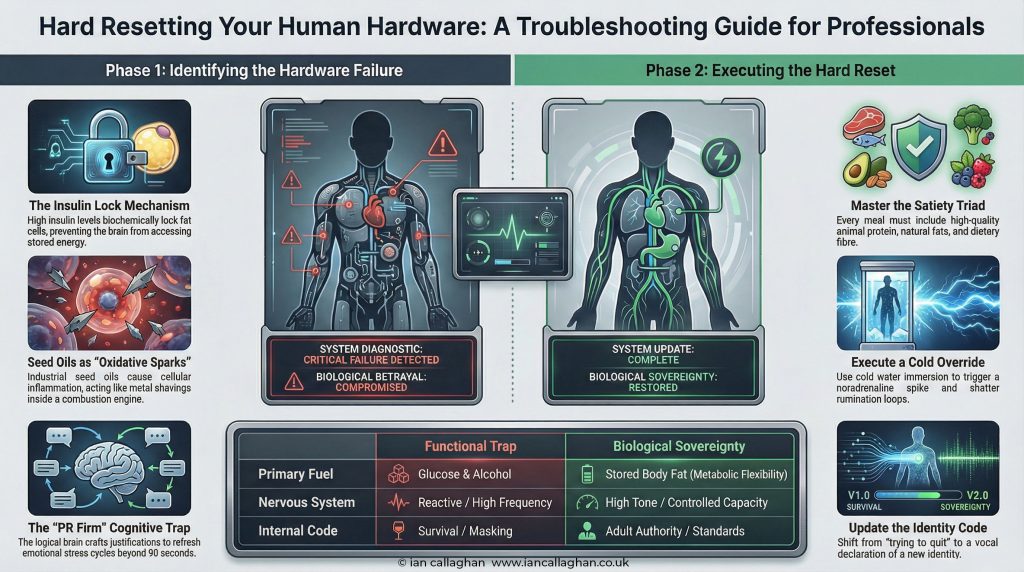
The root cause of your exhaustion, your weight gain, and your cravings is a phenomenon I call the Insulin Lock.
When you consume alcohol, sugar, or highly processed carbohydrates, your blood sugar spikes. Your pancreas pumps out insulin to shuttle that toxic excess of glucose out of your bloodstream.
But insulin is not just a transport hormone. It is a storage hormone. And more importantly, it is a locking mechanism.
When insulin is present in your bloodstream, your fat cells are biochemically locked. You could have 50,000 calories of stored fat sitting on your waistline, thighs, and organs. But your brain cannot access it. The fuel is sitting right there, but it is locked behind a vault door.
Because your brain cannot access your stored body fat, it assumes you are starving. It triggers massive cravings for quick energy. It sends signals to shut down non-essential functions to conserve power.
That is the brain fog. That is the heavy limbs. That is the profound 3:00 PM crash.
You are technically obese in stored energy, but starving at a cellular level. And what breaks the Insulin Lock? Stopping the influx of sugar, alcohol, and processed garbage. You must achieve Metabolic Flexibility, the ability to switch seamlessly between burning energy from food and from stored body fat.
The Seed Oil Problem: Oxidative Sparks In Your Engine
If you want to understand why your joints ache like a rusty gate and your energy is nonexistent, look at what you are using to lubricate your machinery.
Industrial seed oils are poisons.: Rapeseed sunflower, corn, soybean, canola. I do not care what the heart-healthy stickers on the bottle say.
These oils were originally invented as machinery lubricants for the Industrial Revolution. They are highly unstable polyunsaturated fats. When you ingest them, they oxidise rapidly inside your body.
Imagine throwing a handful of metal shavings into a combustion engine. That is what seed oils do to your mitochondria. They cause oxidative sparks that damage your cellular power plants and inflame your artery linings.
My nutrition philosophy is strictly Ancestral and Paleo-esque. No seed oils ever. No wheat. No sugar. Legumes and dairy only after strict elimination and reintroduction. If you are cooking with sunflower oil and wondering why your back is screaming in pain, you are pouring inflammatory gasoline onto the fire.
The Satiety Triad And Protein Leverage
Your body does not count calories. It counts nutrients.
This brings us to the Protein Leverage Effect. Your body has a built-in biological target for amino acids. It will drive your appetite relentlessly, forcing you to eat and eat and eat, until that protein target is met.
If you eat a diet of ultra-processed junk, your body will force you to consume 4,000 calories to get the 100 grams of protein it actually needs to rebuild your tissues.
To fix this, you must master the Satiety Triad. Every single meal you consume must satisfy three criteria. It must contain high-quality animal Protein, healthy natural fat, and dietary Fibre.
If you eat a meal and you are hungry two hours later, you failed the triad. You spiked your insulin, crashed your blood sugar, and sent your system into starvation mode. Fix the triad, hit your protein target, and watch the cravings for alcohol and sugar evaporate.
The PR Firm And The 90-Second Rule
Once you begin to stabilise the biology, you have to confront the software.
When you quit drinking or change your diet, your nervous system will occasionally freak out. A stressor will hit you. The dog throws up. The server crashes at work. The kids are screaming.
This triggers an emotional surge. In the world of Emotional Mastery, I teach the 90-Second Rule.
The chemical lifespan of any emotional surge, the adrenaline, the cortisol, the sheer panic, is exactly 90 seconds. From the moment the trigger fires to the moment the chemicals flush out of your bloodstream, you only have to survive a minute and a half.
So why do you stay angry or stressed for hours?
Because of The PR Firm. The PR Firm is your logical brain acting as a mercenary. It crafts brilliant, watertight justifications for why you are stressed. It says, ‘I have had a long day. I deserve a drink. My boss is an idiot. The kids are ungrateful.’
Every time you listen to the PR Firm, you manually refresh the 90-second chemical cycle. You keep the fire burning by throwing cognitive logs onto it.
You have to learn to shut down the PR Firm. You have to master The Gate. The Gate is the 100-millisecond window between a signal hitting your Amygdala (the threat centre) and reaching your Prefrontal Cortex (the logical brain). The goal is to gate the signal before it attaches to your identity.
Do not say, ‘I am stressed’ or ‘I am angry.’ That is a Linguistic Merger. You are fusing your identity with a temporary chemical wave.
Instead, use Linguistic Decoupling. Say, ‘I am observing a high-frequency vibration in my chest.’ Step into your Adult Authority. You are the observer of the machine, not the broken part.
Mechanic’s Troubleshooting: Resetting The Motherboard
When your system is crashing, you need actionable, zero-bullshit protocols to force a restart. Here is your troubleshooting manual.
1. Execute A Cold Override I have been a cold water junkie long before it was an Instagram hashtag. Cold water is a Control-Alt-Delete for your biological hardware. When you plunge into cold water, you trigger the Mammalian Dive Reflex. You force a massive 200-300% spike in noradrenaline. This instantly shatters the rumination loops in your brain. It snaps you out of the PR Firm’s bullshit and forces you directly into the present moment. If you are craving a drink, get into a freezing shower for two minutes. The craving will not survive the override.
2. Manage The Reset Flu When you cut out alcohol, sugar, and wheat, your insulin levels will finally drop. This unlocks the fat cells, which is great. But as insulin drops, your kidneys will dump massive amounts of sodium and water. This causes the Reset Flu. You will feel dizzy, weak, and lethargic in Week 1. This is not withdrawal; it is an electrolyte crash. Fix it immediately by drinking high-quality bone broth and using mineral-rich Celtic sea salt in your water. Do not cave to the PR Firm telling you that you need a drink to feel better. You just need salt.
3. Audit Your Signal To Noise Ratio (Tone) Your Tone, or SNR, represents the internal capacity of your nervous system to maintain a steady signal without collapsing into a reaction. Alcohol destroys your tone. It fries the circuitry. To rebuild it, you must practice daily breathwork. Box breathing. Physiological sighs. You must widen the gap between stimulus and response, so you have the capacity to choose your actions rather than reacting like a wounded animal.
The Sovereignty Standard Implementation Guide
We do not do ‘diets’ here. Diets are a temporary state of misery leading to an inevitable relapse.
We establish Standards. A Standards Mindset is about defining an absolute quality baseline you refuse to drop below, regardless of circumstances.
Here is how you implement your Metabolic and Emotional Sovereignty:
Step 1: Confront The Installation Understand that your current habits were programmed into your brain before age 7. During those years, your brain was in the Theta state (4 to 8 Hz), acting like a wide-open server port with no firewall. You downloaded the survival strategies of your parents and society. If they drank to cope, you downloaded that code. Recognise that the code is outdated and infected. It is time to wipe the drive.
Step 2: The Identity Shift The shift is not about stopping drinking. That is an action. The shift is about stopping drinking. That is an identity.
If you say ‘I am trying not to drink,’ you are implying that you are still a drinker who is just temporarily depriving yourself. The PR Firm will eventually wear you down.
You must declare, ‘I do not drink anymore. That is not who I am.’ It is a fundamental rewiring of your self-concept.
Step 3: Press The Save Button An identity update requires a manual save. You execute the Save Button by making a conscious, vocal declaration of your new identity while in a stable, high tone state. Do it after a Cold Override. Do it after a deep meditation session. When your nervous system is calm, and your frequency is high, state your new Standard out loud. ‘I am a biologically sovereign adult. I do not negotiate with toxic software.’
Final Briefing
The Biological Betrayal is not a life sentence. Your body is not plotting against you. It is simply responding logically to the toxic inputs you have been feeding it for decades.
Stop the silence. Men, speak up about the pressure. Women, demand the space to heal your metabolic engines.
Clear out the seed oils. Break the Insulin Lock. Master the Satiety Triad. And the next time the PR Firm tells you that you need a glass of wine to survive the evening, execute a Cold Override and remind yourself exactly who the fuck is in charge of the machinery.
Used to monitor number of Google Analytics server requests when using Google Tag Manager
1 minute
_gid
ID used to identify users for 24 hours after last activity
24 hours
_ga_
ID used to identify users
2 years
_gali
Used by Google Analytics to determine which links on a page are being clicked
30 seconds
_ga
ID used to identify users
2 years
__utmx
Used to determine whether a user is included in an A / B or Multivariate test.
18 months
__utmv
Contains custom information set by the web developer via the _setCustomVar method in Google Analytics. This cookie is updated every time new data is sent to the Google Analytics server.
2 years after last activity
__utmz
Contains information about the traffic source or campaign that directed user to the website. The cookie is set when the GA.js javascript is loaded and updated when data is sent to the Google Anaytics server
6 months after last activity
__utmc
Used only with old Urchin versions of Google Analytics and not with GA.js. Was used to distinguish between new sessions and visits at the end of a session.
End of session (browser)
__utmb
Used to distinguish new sessions and visits. This cookie is set when the GA.js javascript library is loaded and there is no existing __utmb cookie. The cookie is updated every time data is sent to the Google Analytics server.
30 minutes after last activity
__utmt
Used to monitor number of Google Analytics server requests
10 minutes
__utma
ID used to identify users and sessions
2 years after last activity
_gac_
Contains information related to marketing campaigns of the user. These are shared with Google AdWords / Google Ads when the Google Ads and Google Analytics accounts are linked together.