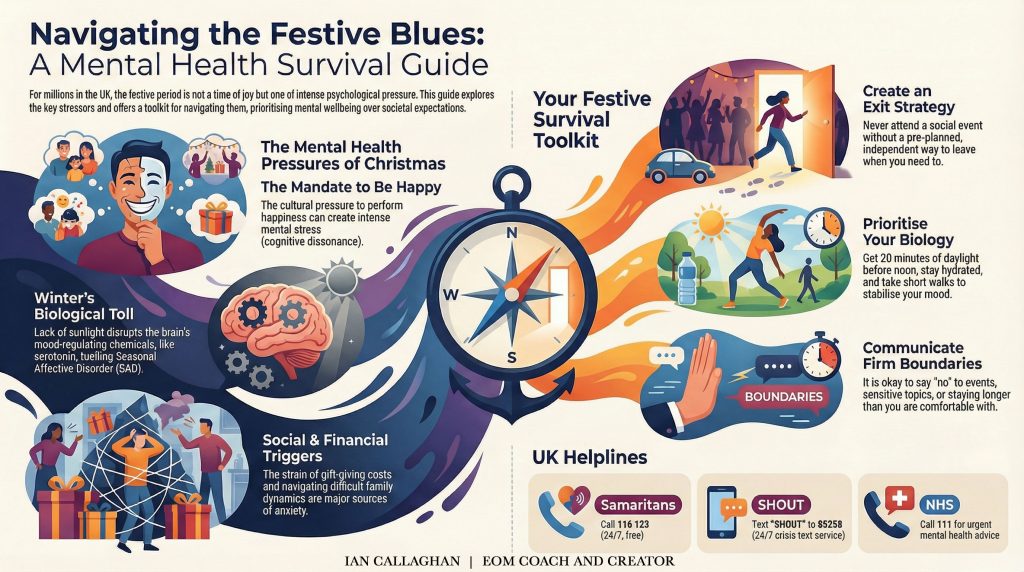
Christmas is brutal if you’re struggling with your head. For millions across the UK, the festive period is not a time of joy, but a period of intense psychological pressure, exacerbated by forced socialisation, financial strain, and the stark contrast between societal expectations and internal reality.
The Neuropsychology of the “Festive Blues”
The festive season triggers a complex biological and psychological stress response in individuals with pre-existing mental health conditions, primarily due to the “expectancy gap” between societal mandates for happiness and personal emotional states.
The Mechanism of Forced Positivity
The cultural narrative surrounding December demands a performance of happiness. Toxic positivity—the belief that one must maintain a positive mindset regardless of dire emotional circumstances—peaks during this season. For those battling depression or anxiety, this creates a state of cognitive dissonance.
According to psychological research, suppressing negative emotions to conform to social norms increases cortisol production, the primary stress hormone. The brain perceives the gap between how you feel and how you are expected to act as a threat. This dissonance is why Christmas can be brutal if you’re struggling with your mental health; it requires a sustained emotional performance that depletes cognitive resources.
The Impact of Disrupted Routine
Mental stability often relies heavily on routine. The Christmas period inherently dismantles the structures that many people use to manage their mental health.
Sleep Architecture: Late nights and alcohol consumption disrupt REM sleep, which is critical for emotional regulation.
Dietary Changes: High sugar and fat intake can lead to inflammatory responses that negatively impact mood.
Therapeutic Breaks: Many therapy services and support groups operate on reduced hours, leaving vulnerable individuals without their usual safety nets.
[Cognitive Dissonance]: The mental discomfort experienced by a person who holds two or more contradictory beliefs, ideas, or values. In this context, feeling depressed while acting happy.
Seasonal Affective Disorder (SAD) and the Winter Solstice
Biological factors, specifically the lack of sunlight in December, compound mental health struggles by disrupting circadian rhythms and serotonin production, making the festive season physically difficult for the brain to process.
The Biology of Darkness
The UK experiences its shortest days in late December. This reduction in sunlight affects the hypothalamus, leading to three distinct biological impacts:
Increased Melatonin: The body produces higher levels of the sleep hormone during the day, causing lethargy.
Decreased Serotonin: Lack of sunlight reduces the production of the neurotransmitter responsible for mood regulation.
Circadian Disruption: The body’s internal clock desynchronises, leading to sleep disorders and depressive symptoms.
SAD vs. Holiday Stress
It is vital to distinguish between situational stress and Seasonal Affective Disorder.
Feature
Seasonal Affective Disorder (SAD)
Situational Holiday Stress
Primary Trigger
Lack of sunlight / Biological
Social and financial pressure / Psychological
Duration
Autumn through Winter (Months)
December to early January (Weeks)
Symptoms
Oversleeping, carb craving, heavy limbs
Anxiety, insomnia, irritability
Treatment
Light therapy (Lux lamps), Vitamin D
CBT, boundary setting, stress management
According to the NHS, SAD affects approximately 2 million people in the UK, making the physical environment of Christmas a direct antagonist to mental well-being.
The Psychology of Financial Anxiety
Financial strain is a primary driver of Christmas-related mental health decline, as the “Cost of Living” crisis forces individuals to choose between financial prudence and social inclusion.
The Burden of Gift-Giving
The commercialisation of Christmas creates a transactional dynamic in relationships. Individuals struggling with anxiety often catastrophise the consequences of not providing adequate gifts. This fear of judgment triggers the brain’s amygdala, the centre for fear processing.
Data from the Money and Mental Health Policy Institute suggests that people with mental health problems are three times more likely to be in problem debt. The pressure to spend in December exacerbates this cycle.
Comparative Wealth and Social Media
Social media acts as a catalyst for inadequacy. The curated presentation of lavish Christmases on platforms like Instagram induces Relative Deprivation—the feeling that one is worse off compared to the standard of their peer group.
FOMO (Fear Of Missing Out): Drives impulsive spending to match peers.
Validation Seeking: Basing self-worth on the quality or quantity of gifts received or given.
Navigating Toxic Family Dynamics
Regression to childhood roles and exposure to unresolved family conflicts are significant stressors that can destabilise mental recovery during the festive period.
The Theory of Family Regression
When adults return to their family home, they often experience psychological regression. They involuntarily revert to childhood behavioural patterns and coping mechanisms. If a person is struggling with their head, this regression can undo months of therapeutic progress.
This is particularly dangerous for those from dysfunctional families. The expectation to “keep the peace” often forces victims of past trauma to break bread with their aggressors or enablers.
Establishing Boundaries
Survival during Christmas often depends on the rigid enforcement of boundaries.
Boundary Type
Example of Violation
Defensive Strategy
Temporal
“You must stay for the whole week.”
“I will visit for 48 hours only. This is non-negotiable.”
Conversational
“Why aren’t you married/working yet?”
“I am not discussing my career/love life today.”
Physical
Unwanted affection/hugs.
“I am not hugging people at the moment due to health.”
Emotional
Guilt-tripping for not being ‘cheerful’.
“I am struggling, and I need space, not pressure.”
The “Chosen Family” Alternative
For many, the healthiest option is to reject the biological imperative. Spending Christmas with a “chosen family”—friends or partners who understand your mental health needs—is a valid and clinically recommended strategy for preserving mental stability.
The Amplification of Loneliness
Loneliness in December is perceived more acutely due to the “Contrast Effect,” where an individual’s isolation is magnified against the backdrop of societal hyper-socialisation.
The Contrast Effect
Loneliness is not just about being alone; it is the discrepancy between one’s desired social connections and their actual social connections. At Christmas, the desired level is artificially inflated by the media and culture.
According to the Campaign to End Loneliness, over 9 million people in the UK describe themselves as always or often lonely. During Christmas, this isolation correlates with higher suicide ideation rates, though statistically, suicide rates peak in spring, the subjective feeling of despair is often highest in December.
Solitude vs. Isolation
It is crucial to reframe the narrative from forced isolation to intentional solitude.
Isolation: Feeling cut off and unwanted (Passive/Negative).
Solitude: Choosing to be alone for restoration (Active/Positive).
By actively choosing how to spend time alone—engaging in hobbies, reading, or resting—individuals can reclaim agency over their isolation.
Grief and the “Empty Chair” Phenomenon
Grief is non-linear, but the cyclical nature of Christmas markers serves as a painful annual reminder of loss, specifically highlighting the absence of deceased loved ones.
The Anniversary Reaction
The brain encodes memories with sensory data—smells, songs, and weather. Christmas is sensory-dense. The smell of pine or a specific carol can trigger an involuntary memory retrieval known as the Proustian Effect, bringing fresh waves of grief.
The “Empty Chair” at the dinner table represents a tangible void. For those struggling with their head, the pressure to “move on” for the sake of the holiday can arrest the grieving process, leading to complicated grief.
Integrating Grief into the Festivities
Mental health experts recommend acknowledging the loss rather than ignoring it.
Light a Candle: Create a specific ritual to honour the deceased.
Scheduled Remembrance: Allocate a specific time to talk about the loved one, then permit to focus on the present.
Alter Traditions: If the old traditions are too painful, create entirely new ones to break the associative link with the loss.
The UK’s culture of festive binge drinking acts as a depressant, chemically altering neurotransmitter levels and exacerbating anxiety and depressive symptoms.
The Chemistry of “Hangxiety”
Alcohol is a central nervous system depressant. While it may provide temporary relief from social anxiety (anxiolytic effect), the withdrawal phase triggers a spike in cortisol and a depletion of GABA (gamma-aminobutyric acid), the brain’s calming chemical.
This rebound anxiety, colloquially known as “Hangxiety,” can be debilitating for someone already mentally fragile.
[GABA]: Gamma-aminobutyric acid is the primary inhibitory neurotransmitter in the brain. It blocks impulses between nerve cells, producing a calming effect. Alcohol mimics GABA, but chronic use depletes natural levels.
The Slippery Slope of Self-Medication
Christmas is brutal if you’re struggling with your head because the socially acceptable threshold for intoxication is raised. Behaviours that would be flagged as problematic in July are celebrated in December.
Warning Signs of Festive Substance Abuse:
Drinking before social events to “pre-load” courage.
Inability to stop drinking once started.
Using alcohol to numb feelings of loneliness or grief.
Increased irritability when alcohol is not available.
Practical Coping Strategies
To mitigate the mental toll of Christmas, individuals must adopt a proactive “Mental Health Safety Plan” that prioritises biological needs and sets rigid social boundaries.
1. The “Exit Strategy” Protocol
Never attend a social function without a pre-planned method of departure.
Transport: Drive yourself or have a taxi app ready. Do not rely on others for a lift.
The Signal: Have a pre-agreed code word with a trusted ally that means “I need to leave now.”
The Script: Prepare a generic excuse in advance. “I have an early start tomorrow” requires no further explanation.
2. Biological Anchoring
When the mind is chaotic, stabilise the body.
Hydration: Match every alcoholic drink with a glass of water.
Daylight: Get outside for 20 minutes before noon to regulate circadian rhythms.
Movement: A 15-minute walk metabolises stress hormones like adrenaline.
3. Financial Firewalling
Protect your future self from debt-induced anxiety.
The “No” List: Write down who actually needs a gift. Cut the list by 20%.
Cash Only: Leave credit cards at home when shopping to prevent overspending.
Homemade Value: Shift value from monetary cost to sentimental effort (baking, framing photos).
Mute Features: Use Instagram and Facebook mute functions to hide accounts that trigger inadequacy.
Time Limits: Set hard limits on app usage during key festive days.
Curated Feed: Follow accounts that speak honestly about mental health (e.g., Mind, Samaritans).
The Post-Christmas Comedown (January Blues)
The abrupt removal of the festive stimulus, combined with the return to work and financial reality, creates a vulnerability window in January known as the “Post-Holiday Drop.”
Dopamine Withdrawal
The anticipation of Christmas spikes dopamine. Once the event is over, levels drop below baseline. This chemical crash feels like depression.
To counteract this:
Book Something: Schedule an event for February so there is a new point of anticipation.
Visual Reset: Take down decorations slowly or immediately—whichever feels more psychologically cleansing.
Fiscal Honesty: Address bank balances immediately. Ignoring them prolongs anxiety.
Conclusion
Christmas is brutal if you’re struggling with your head because it is a systemic assault on the coping mechanisms required to manage mental illness. It disrupts sleep, demands social performance, strains finances, and forces confrontation with trauma.
However, the brutality of the season is not a personal failing; it is a structural reality. By understanding the neurobiology of stress, rejecting the commercial imperative of happiness, and prioritising boundaries over tradition, it is possible to navigate December without sacrificing your mental health. You are not required to be happy; you are only required to survive.
Frequently Asked Questions
Why do I feel worse during Christmas?
You feel worse due to the “Contrast Effect,” where your internal mood clashes with the external pressure to be happy. Additionally, disrupted sleep, alcohol consumption, and lack of sunlight (SAD) chemically deplete the brain’s ability to regulate mood.
How can I explain to my family that I can’t attend Christmas?
Be direct, firm, and use “I” statements. “I am not feeling well enough to attend this year,” is a complete sentence. You do not need to justify your mental health needs. Offer a compromise, such as a video call or a visit in January when pressure is lower.
What are the symptoms of festive burnout?
Symptoms include extreme irritability, physical exhaustion, a sense of dread regarding social events, increased reliance on alcohol or food for comfort, and a desire to withdraw completely from social contact.
Is it normal to grieve more at Christmas?
Yes. Christmas is a somatic marker—a specific time associated with memories. The absence of a loved one is felt more acutely because traditions highlight the change in family structure. This is a standard psychological response known as an anniversary reaction.
Yes. Alcohol is a depressant. While it may briefly numb anxiety, it depletes serotonin and GABA levels, leading to increased anxiety and lower mood the following day, often referred to as “hangxiety.”
How do I manage financial anxiety during the holidays?
Set a strict budget before December starts. Communicate with family that you are doing a “low-spend” Christmas. Focus on time spent rather than money spent. Avoid “Buy Now, Pay Later” schemes that delay the stress to January.
Develop a “Soberish Challenge Calendar” that includes “flex days” to align with this more forgiving, realistic trend. That is the search query that likely brought you here. The algorithm suggests that if we soften the edges of addiction, if we just negotiate with the chemical warfare in our bloodstream, we can find a “happy medium.”
But I am not an algorithm. I am Ian Callaghan. I am a Technical Architect with 25 years of experience, an ex-military veteran of 12 years, and a specialist in the mechanics of the human mind. I am the creator of the Emotional Observation Method (EOM).
And, for the record, I am not the Ian Callaghan who played for Liverpool FC in the 60s and 70s. He deals with footballs; I deal with the operating system of your brain.
If you are looking for a soft place to land, or someone to validate your desire to keep one foot in the poison while pretending to be healthy, you are in the wrong workshop.
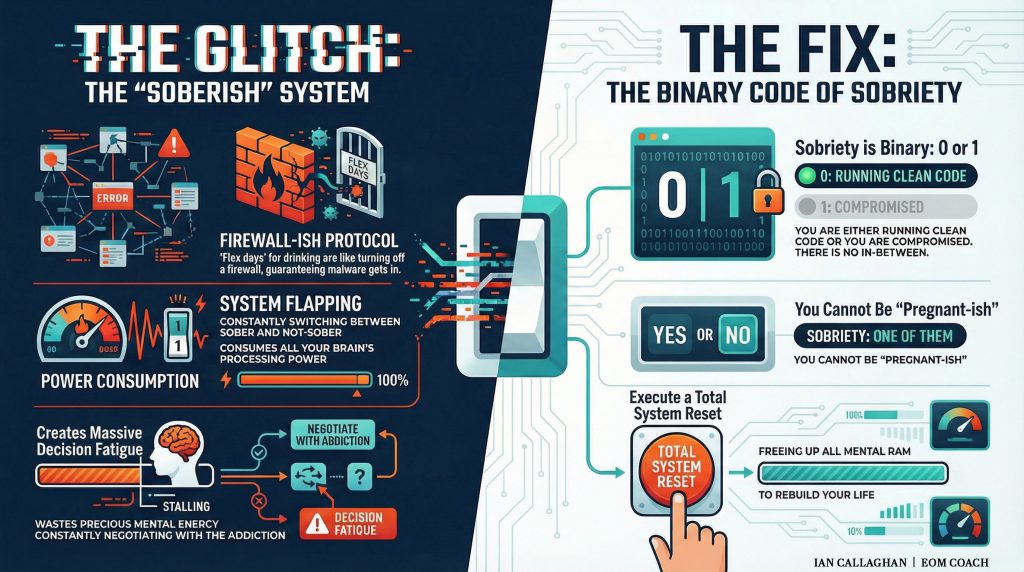
Today, we are going to debunk the dangerous, glitch-ridden myth of the “Soberish” lifestyle. We are going to strip down the engine and explain why “intermittent sobriety” is a catastrophic system failure waiting to happen.
There is no such thing as “Soberish.” Just as you cannot be “fucking pregnant-ish.”
The Myth of the “Soberish” System Architecture
The modern wellness industry loves the concept of “Soberish.” They package it as “mindful drinking,” “damp lifestyles,” or “flex sobriety.” They tell you to develop a “Soberish Challenge Calendar” that includes “flex days” to align with this more forgiving, realistic trend.
From a systems perspective, this is madness.
Imagine I am the Technical Architect for a Tier-1 bank. We have a firewall installed to prevent malware from destroying the financial database. Now, imagine I propose a “Firewall-ish” protocol. I suggest that on Tuesdays and Saturdays—our “flex days”—we turn the firewall off. Just to be “forgiving.” Just to be “realistic.”
What happens? The virus gets in. The system is compromised. The data is corrupted.
The human brain is a biological Operating System (OS). Alcohol is a malicious script—malware that rewrites your neural pathways, alters your dopamine baseline, and crashes your emotional regulation.
Trying to schedule “flex days” for ingesting a neurotoxin is not a strategy; it is a surrender. It is an admission that the malware has administrative privileges over your logic board.
The Problem with “Museum Guides”
The reason this “soberish” trend is gaining traction is that men are being taught to act like “Museum Guides” to their own trauma and habits.
The Museum Guide walks through the corridors of his mind, staring at the pictures of his past. He looks at his addiction and says, “Ah, yes, this is because my father didn’t hug me in 1983.” He analyses the “vibes.” He looks for his “truth.” He wants to “hold space” for a drink on the weekend because he feels he “deserves” a reward.
This is passive. It solves nothing.
I am a Mechanic. A mechanic doesn’t ask the engine how it feels about the oil leak. The mechanic identifies the point of friction, isolates the faulty part, and replaces it.
If your engine is overheating (alcohol dependency), pouring coolant in on Monday but draining it on Friday (flex days) ensures the engine will eventually seize.
The Binary Code of Sobriety: 0 or 1
In the world of IT, at the foundational level, everything is binary. Zeros and ones. Current on, or current off.
Sobriety is binary.
You are either poisoning your system, or you are running clean code. There is no quantum state of superposition where you are both sober and drunk.
The “Pregnant-ish” Protocol
Let’s address the user instruction directly, because it is the perfect analogy for the biological reality of addiction.
You cannot be “pregnant-ish.”
You either have a fertilised egg developing in the uterus, or you do not.
You cannot be 20% pregnant on Tuesdays.
You cannot take a “flex day” from pregnancy on the weekend to go out clubbing.
Alcohol dependency works on a similar binary switch in the brain, specifically regarding the dopamine reward circuitry. Once you have crossed the threshold where alcohol is your primary coping mechanism—your “System Restore” point—you cannot negotiate with it.
When you attempt to be “soberish,” you are constantly flipping the switch on and off. This causes System Flapping.
In networking, “flapping” occurs when an interface goes up and down repeatedly. It consumes massive amounts of CPU processing power. The router (your brain) spends all its energy trying to determine the state of the connection, leaving no bandwidth for actual data transmission (living your life).
The High Cost of Decision Fatigue
Every time you look at your “Soberish Challenge Calendar,” you have to make a decision.
“Is today a flex day?”
“I had a hard meeting. Can I move my flex day from Saturday to tonight?”
“If I only have two beers, does that count?”
This is Decision Fatigue. You are burning precious RAM (Random Access Memory) negotiating with a substance.
When you execute a Total System Reset—when you commit to 100% cessation—you free up that RAM. The decision is made once. The answer is “No.” The bandwidth that was previously used for “moderation management” is now available for:
Physical reconstruction (I lost 5 stone/31kg).
Career pivoting.
Emotional regulation.
Why “Moderation” is Harder than Cessation
Clients often come to me asking to learn how to moderate. They want to be “social drinkers.” They want the EOM protocol to help them drink less, not stop.
I tell them the truth: Moderation is a torture chamber.
When you feed the addiction “sometimes” (flex days), you are keeping the monster in the basement alive. You aren’t feeding it enough to satisfy it, so it is constantly screaming, scratching at the door, and demanding more. You spend your entire life standing guard at that basement door, listening to the screaming, trying to hold it back until the designated “flex day.”
That is not freedom. That is imprisonment.
Cessation is starving the beast. Yes, it screams louder at first (withdrawal/glitches). But eventually, it starves. It dies. Silence returns to the house. You can leave the basement door unguarded and go live your life.
The Dopamine Glitch
Let’s look at the technical specs of what happens on a “flex day.”
Baseline: Your brain expects a certain level of dopamine.
The Flex: You drink on Saturday. Your dopamine spikes artificially high.
The Crash: On Sunday and Monday, your brain halts natural dopamine production to compensate for the spike. You feel low, anxious, and irritable.
The Craving: Your brain identifies alcohol as the quickest way to fix the low dopamine.
The Resistance: You spend Tuesday, Wednesday, and Thursday fighting the urge, using willpower (battery power) to reach the next “flex day.”
This is a looping script. IF (Feel Bad) THEN (Crave Drink). By allowing flex days, you are hard-coding this loop into your OS.
The Emotional Observation Method (EOM): The Fix
If we aren’t using a “Soberish Calendar,” what do we use? We use the Emotional Observation Method.
EOM is about shifting from being the “experiencer” of the emotion to the “observer” of the data.
When a craving hits—or when you feel the need to use a “flex day”—you do not engage with the story. You do not argue with yourself. You observe the glitch.
Protocol 1: Objectify the Glitch
The urge to drink is not “you.” It is a separate object. A malware file.
[Visual]: Close your eyes. [Audio]: Locate the feeling of the craving in your body. Where is it? The chest? The stomach?
Give it a shape. Is it a sphere? A jagged rock? A tightening vice? Give it a colour. Is it red? Black? Neon green? Give it a weight. Is it heavy? Light?
By assigning physical attributes to the emotion, you detach from it. You are no longer “sad” or “thirsty.” You are a mechanic observing a red, heavy sphere in the chest cavity.
Protocol 2: The 90-Second Rule
Neuroscience tells us that the chemical lifespan of an emotional trigger is roughly 90 seconds. If you do not feed the loop with internal dialogue (“I really need this,” “Just one won’t hurt”), the chemical flush dissipates.
The “Soberish” approach feeds the loop. It says, “Hold on, let me check the calendar. Oh, I can drink in 48 hours.” That thought keeps the chemical trigger alive.
The EOM approach says: “Glitch detected. Observing thermal spike. Waiting for system cooldown.”
Protocol 3: Debugging the “Why”
We don’t ask “Why do I feel this way?” to cuddle the inner child. We ask “Why?” to find the root cause of the friction.
Friction: I want a drink.
Diagnostic: Why?
Data: Because I am stressed about work.
Root Cause: The “Stress” is actually cortisol buildup from lack of movement and poor boundaries.
The Fix: We do not apply alcohol (a depressant) to cortisol. We apply a run, a cold shower, or a difficult conversation. We fix the engine; we don’t paint over the check engine light.
The “Regimented Reset”: A Better Alternative to Flex Days
Instead of a “Soberish Challenge,” I propose the Regimented Reset. This is the methodology I used to pivot my life at age 57, lose 31kg, and end 45 years of alcohol use.
This is not about being “kind” to yourself. It is about being accurate with yourself.
Phase 1: The Audit (Days 1-7)
You cannot patch a server if you don’t know what’s running on it.
Track every input (food, media, sleep).
Identify the “Trigger Scripts.” (e.g., 5:00 PM = Wine).
No changes yet. Just brutal data collection.
Phase 2: The Firewall (Days 8-30)
Total cessation. No flex days. No “pregnant-ish.”
We block the port (Alcohol).
We install monitoring software (EOM) to watch for withdrawal spikes.
We expect the system to run hot. This is called “recalibration,” not suffering.
Phase 3: Hardware Upgrades (Day 30+)
Now that the malware is gone, we will upgrade the hardware.
Metabolic Adjustment: Real food. High protein. Eliminate processed sugar (which mimics alcohol addiction pathways).
Physical Stress: Lift heavy things. Cold water exposure.
Cold Water: This is essential. It forces the body to regulate its own dopamine and norepinephrine. It is the ultimate system reboot.
The Danger of “California Sober”
There is a sub-trend called “California Sober,” usually involving weed instead of booze, or psychedelics.
From an EOM perspective, this is swapping one buggy driver for another. You are still looking for an external executable file to manage your internal state.
The goal of the Mechanic is a self-regulating engine. An engine that runs smoothly, cool, and powerful without needing additives. If you need a substance to tolerate your reality, your reality (or your perception of it) is broken. Fix the reality. Don’t drug the observer.
Why “Holding Space” is Useless
In the therapy world, they talk about “holding space.” It sounds nice. It sounds gentle.
In the military, we hold ground.
When you are fighting an addiction, you are in a territory war for your own mind. The enemy (the addiction script) wants to retake the hill.
If you have a “Soberish Calendar,” you are telling the enemy, “I will hold this ground Monday through Thursday, but you can occupy the territory on Friday and Saturday.”
Do you think the enemy will politely leave on Sunday morning? No. It digs in. It fortifies. It leaves booby traps.
You must hold ground. 24/7. 365.
This requires discipline. And discipline is not a dirty word. Discipline is simply the ability to give yourself an order and follow it.
The “Mechanic’s” Call to Action
Stop trying to negotiate a peace treaty with a terrorist cell in your brain.
There is no “Soberish.” There is no “Intermittent Integrity.” There is no “Faithful-ish” husband. There is no “Pregnant-ish” woman.
There is the Glitch, and there is the Fix.
You have spent enough time acting as a Museum Guide, staring at your past, curating your “flex days,” and wondering why you still feel like your system is lagging.
It is time to put on the overalls. Pick up the wrench.
Open the hood.
If the calendar says “Flex Day,” tear it down. The only day that matters is the current operational cycle.
The Protocol is simple (but not easy):
Acknowledge: The system is compromised.
Delete: Remove the malware (Alcohol) entirely. No backups.
Observe: Use EOM to watch the withdrawal glitches without engaging.
Rebuild: new habits, new inputs, new hardware.
I am Ian Callaghan. I am the Mechanic. And I am telling you that your engine is capable of winning the race, but not if you keep pouring sugar in the petrol tank “sometimes.”
Execute the reset.
Standard Operating Procedure: The Daily Debug
Instead of a calendar of permission, use this daily checklist to maintain system integrity.
0600 – System Boot
Hydrate (Water, not coffee immediately).
Cold exposure (30s minimum). This shocks the OS and clears the cache.
1200 – Diagnostic Check
Am I reacting or responding?
Scan for “Micro-Glitches” (small irritations).
Apply EOM: Objectify the stress.
1800 – The Witching Hour (High Risk)
This is when the “Flex Day” logic usually attempts to install itself.
Override Protocol: Change the environment immediately. If you usually sit on the sofa, go for a walk. If you usually go to the pub, go to the gym.
Stop analysing the crash. Fix the code. An 8-page field guide to debugging your own mind. Includes the 4-Step EOM Protocol, the Symbol Library, and the Emergency Reboot scripts. Bonus: Includes access to the interactive Digital Console.
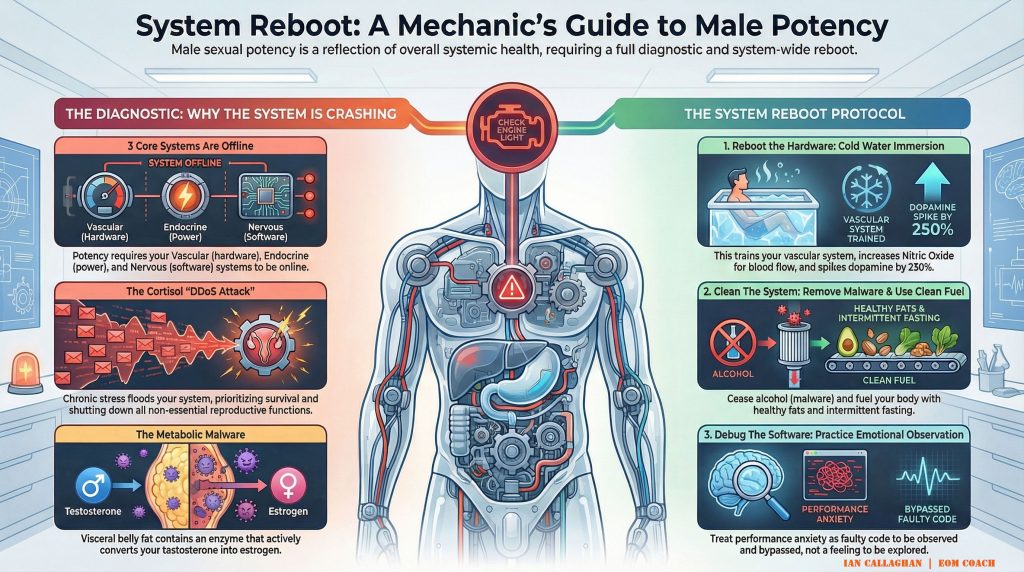
Men’s “Biohacking” for Sexual Potency is not about magic pills or expensive clinics; it is about executing a complete system debug on your metabolic and hormonal hardware to restore peak connectivity and voltage.
Introduction: The Mechanic, Not The Museum Guide
Let’s get the administrative data out of the way immediately.
If you are looking for the Liverpool FC legend, you have navigated to the wrong URL. I am Ian Callaghan, the EOM Coach. I am a former soldier, a Technical Architect with 25 years of IT experience, and a man who executed a “Total System Reset” at age 57.
I lost 5 stone. I ceased alcohol consumption entirely after 45 years. I repurposed my career.
I am not here to talk about your “feelings” or your “inner journey.” I am here to talk about your Operating System.
When a man comes to me complaining of low libido, Erectile Dysfunction (ED), or a general lack of vigour, he usually acts like a “Museum Guide.” He walks me through the history of his failures. He stares at the trauma. He wallows in the narrative of his decline.
I stop him.
We are not Museum Guides. We are Mechanics.
When an engine misfires, you do not ask it how it feels about the spark plugs. You run a diagnostic. You find the friction. You replace the faulty component.
Sexual potency is the ultimate “Check Engine Light” for the male biological machine. If that light is flickering, your system is underpowered, your firewall is breached, or your hardware is clogged with years of poor maintenance.
This is the Standard Operating Procedure (SOP) for Men’s “Biohacking” for Sexual Potency. We are going to debug your habits, repattern your neural wiring, and reboot your endocrine system.
Phase 1: The Diagnostic – Why The System is Failing
Before we apply the patch, we must understand the crash.
In the IT world, when a server goes down, it is rarely just “bad luck.” It is usually a result of legacy code clashing with new updates or hardware that has been allowed to overheat for too long.
Your body is no different.
Sexual potency requires three systems to be online and fully operational:
The Vascular System (The Hardware): Blood flow and pressure.
The Endocrine System (The Power Supply): Testosterone and Nitric Oxide levels.
The Nervous System (The Software/OS): Arousal, stress regulation, and neural signalling.
Most men try to fix potency issues by downloading a “patch”—usually a blue pill. This is lazy architecture. A pill forces blood into a system that may be rusted shut or powered down. It is a workaround, not a fix.
To truly biohack your potency, we must look at the “System Logs” of your lifestyle.
The Cortisol DDoS Attack
Stress is the enemy of erections. This is not a “vibe”—this is biology.
When you are stressed, your body produces cortisol. In the primitive version of our Operating System, cortisol was designed to help you survive a physical threat (a tiger). It shuts down all non-essential background processes to route power to your legs and lungs.
Reproduction is a non-essential background process during a survival event.
Modern life—emails, mortgages, traffic—triggers this same survival script. Your body thinks it is under constant attack. This is a Distributed Denial of Service (DDoS) attack on your nervous system. Your bandwidth is choked. If your cortisol is high, your testosterone is suppressed. You cannot run the “Reproduction.exe” script while the “Survival.exe” script is using 100% of the CPU.
The Metabolic Glitch
If you are carrying visceral fat (belly fat), you are running corrupted software.
Adipose tissue (fat) is not just dead weight; it is bioactive. It contains an enzyme called aromatase. This enzyme converts your hard-earned testosterone into estrogen.
Read that again. The fat on your belly is actively hacking your system and rewriting your hormonal code from “Male” to “Female.”
I lost 31kg (5 stone) because I realised my hardware could not support the mission I wanted to execute. If you want potency, you must strip the chassis.
Phase 2: The Hardware Reset (Physical Biohacking)
Now that we have the diagnosis, we move to the fix. These are not suggestions. These are protocols.
Protocol A: The Cold Water Reboot
I am a lifelong advocate of cold water. It is central to my “Regimented Reset.”
Most men have lazy vascular systems. We live in climate-controlled boxes. We sleep in heated rooms. Our blood vessels rarely have to work.
Cold water immersion (CWI) is the equivalent of defragging your hard drive.
When you submerge in water below 15°C, your body undergoes severe vasoconstriction. The blood is forced from the extremities to the core to protect the vital organs. When you get out, the blood rushes back—vasodilation.
The Biohack:
This process exercises the smooth muscle lining of your blood vessels.
It increases the production of Nitric Oxide, which is the chemical key required for an erection.
It spikes dopamine by 250%, giving you focus and drive without the sugar crash.
Standard Operating Procedure:
Start: 30 seconds at the end of your shower. Cold tap only.
Progress: 2 to 3 minutes fully submerged in a cold plunge or open water.
Frequency: Daily. No excuses.
Do not think about the cold. Observe the sensation. It is just data.
Protocol B: Removing the Malware (Alcohol Cessation)
If you are drinking alcohol and complaining about sexual performance, you are pouring water into your petrol tank and wondering why the car won’t start.
I drank for 45 years. Stopping was the single greatest upgrade to my system.
Alcohol is a depressant. It is a toxin. To the male body, it is malware.
Testosterone Killer: Alcohol lowers testosterone production in the Leydig cells of the testes.
Sleep Corrupter: It ruins REM sleep. REM sleep is when your body restores its hormonal baseline. No REM, no recharge.
Vascular constrictor: Chronic alcohol use hardens the arteries.
You cannot biohack your way out of a bottle. If you want potency, the alcohol script must be terminated.
Protocol C: The Nutrition Protocol (Clean Energy)
You are likely running on “dirty power”—sugar and processed carbohydrates. This causes insulin spikes. High insulin creates inflammation. Inflammation damages the endothelial lining of your blood vessels.
If the pipes are damaged, the pressure drops.
The Fix:
Intermittent Fasting: Give the system downtime. I recommend a 16:8 protocol (16 hours fasting, 8 hours eating). This allows the body to clear out cellular waste (autophagy).
Healthy Fats: Cholesterol is the raw material for testosterone. You need eggs, avocados, nuts, and steak.
Zinc and Magnesium: These are the spark plugs for T-production. Supplement if necessary, but get them from food first.
Phase 3: The Software Patch (Psychogenic & Mental Biohacking)
We have addressed the hardware. Now we must address the software.
Many men suffer from Psychogenic ED. This is where the hardware is fine, but the software is glitching. It is “Performance Anxiety.”
This is where my Emotional Observation Method (EOM) comes into play.
The “Looping Script”
When a man fails to perform once, his brain writes a new script: “I am going to fail again.”
The next time he attempts intimacy, this script auto-runs in the background. He is not present in the moment. He is monitoring himself. He becomes a spectator in his own bedroom.
He is checking for failure. And because the brain is a powerful processor, it finds what it looks for.
The EOM Solution: Distance and Observation
Traditional therapy tells you to “talk about your feelings.” This is inefficient. It keeps you in the loop.
EOM treats the anxiety as an external object.
The Protocol:
Identify the Glitch: You feel the anxiety rising. Your heart rate spikes. The negative script starts running.
Objectify: Do not say “I am anxious.” Say “There is anxiety.”
Visualise: Give the anxiety a shape, a colour, a weight. Imagine it sitting on a table across the room.
Observe: Look at it with the detachment of a mechanic looking at a stripped bolt. It is not you. It is just a component that is malfunctioning.
By creating this distance, you disengage the emotional override. You lower the cortisol. You allow the parasympathetic nervous system (the “Rest and Digest” and “Feed and Breed” system) to come back online.
We do not “heal” the anxiety. We debug it. We recognise it as a line of faulty code, and we bypass it.
Phase 4: Sleep Hygiene – The System Reboot
You cannot run a high-performance server 24/7 without maintenance cycles.
Sleep is not a luxury. It is the nightly system reboot where your body installs updates. Most of your testosterone is produced during Deep Sleep and REM cycles.
If you are sleeping 5 hours a night, you possess the testosterone levels of a man 10 years your senior. You are ageing yourself via negligence.
The Sleep SOP:
Darkness: Pitch black room. Light pollution disrupts melatonin.
Temperature: Cool room (16-18°C). Your body needs to drop its core temperature to initiate deep sleep.
Digital Sunset: No screens 60 minutes before bed. Blue light tells your brain it is noon.
Nasal Breathing: Tape your mouth if necessary. Mouth breathing causes apnea and oxygen deprivation. You need oxygen to build hormones.
Phase 5: The Regimented Reset – Putting It Together
Information without execution is just data clutter. You need a programme.
When I executed my reset, I treated it like a military operation. I did not rely on motivation. Motivation is a feeling, and feelings are fickle. I relied on discipline. Discipline is a system.
Here is the “Potency Protocol” for the next 30 days.
Morning Routine (06:00 – 07:00)
Wake Up: No snooze button. The snooze button is the first defeat of the day.
Hydrate: 500mlof water with sea salt. Re-pressurise the hydraulic system immediately.
Movement: 20 minutes of movement. Walk, stretch, callisthenics. Clear the cortisol from the night before.
The Cold: Cold shower or plunge. Minimum 2 minutes. Reset the nervous system.
Hydration: 3-4 litres of water throughout the day.
Evening Routine (21:00 – 22:30)
The Shutdown: Phone away.
EOM Check-in: Review the day. Did you react emotionally, or did you observe? Note the glitches.
Sleep: Eyes shut by 22:30.
Phase 6: The Role of Nitric Oxide (The Network Cables)
Let’s get technical about the “cabling” of your vascular system.
An erection is essentially a hydraulic event mediated by a gas: Nitric Oxide (NO). This gas relaxes the inner muscles of your blood vessels, allowing them to widen and increase blood flow.
As we age, our ability to produce NO decreases. This is “Packet Loss” in the network.
Biohacking NO Production:
Nitrate-Rich Foods: Beetroot, rocket (arugula), spinach. These are precursors to NO. Eat them daily.
Nasal Breathing: Your sinuses produce Nitric Oxide. When you breathe through your mouth, you bypass this production facility. Breathe through your nose during the day and during exercise.
Humming: Strange but true. Humming increases nasal NO production by 15-fold. Do it in the car. It vibrates the sinuses and releases the gas.
Phase 7: Heavy Lifting (Structural Integrity)
Cardio is fine for efficiency, but for potency, you need load-bearing stress.
Lifting heavy weights (squats, deadlifts) sends a distress signal to the body that requires a hormonal response. The body realises the chassis is under load and responds by upregulating testosterone and growth hormone to reinforce the structure.
You do not need to be a bodybuilder. You need to be strong.
The Protocol:
Compound movements (multi-joint).
Heavy resistance (5-8 rep range).
3 days per week.
This also increases pelvic floor strength. The pelvic floor muscles are the valves that hold the blood in place. If the valves are weak, the system leaks. Kegel exercises are not just for women. They are essential maintenance of the male hydraulic system.
Phase 8: Stoicism and The Mindset of Potency
We must return to the mind.
A reactive man—who explodes in traffic, who crumbles under work stress, who seeks validation from others—is leaking energy. He is “low voltage.”
Sexual potency is effectively “masculine polarity.” It is the ability to hold a charge.
If you are constantly venting your energy through emotional outbursts or anxiety, you have no charge left for intimacy.
Stoicism is the firewall. It teaches us to distinguish between what we can control and what we cannot.
You cannot control the economy.
You cannot control your boss.
You can control your reaction.
You can control your breathing.
You can control your inputs (food, media, substances).
When you practice Stoicism, you stop the energy leaks. You retain your power. A stoic man is a potent man because he is a grounded man. He is the mountain, not the weather.
In EOM, we call this “Operating from the Command Console.” You are not the code running on the screen; you are the architect sitting at the keyboard.
Conclusion: Do The Work
There is no “soft” way to say this.
If you want to reclaim your potency, you must stop treating your body like a landfill site. You must stop acting like a Museum Guide to your past traumas and failures.
You are an intricate, biological machine. You have let the maintenance schedule slip. You have installed malware (alcohol, stress, sugar). You have ignored the firmware updates (sleep, movement).
The “Biohack” is not a pill. The Biohack is a discipline.
It is the Regimented Reset. It is the cold water. It is the refusal to engage with the “victim script.”
I did it at 57. I debugged 45 years of bad habits. I rebuilt the engine.
If you are ready to stop talking about the problem and start fixing the mechanics, the protocol is clear.
1. Reboot the system (Cold Water). 2. Clear the cache (Fasting). 3. Remove the malware (Sobriety). 4. Install the patch (EOM/Stoicism).
Stop waiting for a miracle. Build the machine.
Ian Callaghan EOM Coach | The Mechanic of the Mind
Appendix: Frequently Asked Questions
Q: Can I just take supplements? A: You can, just like you can put a spoiler on a car with a blown engine. It looks nice, but it won’t run. Supplements (Zinc, Tongkat Ali, Ashwagandha) are optimisations. They work after you have fixed the foundation of sleep, diet, and sobriety.
Q: How long does the “Reset” take? A: Biological turnover takes time. Your red blood cells replace themselves every 120 days. Sperm production takes about 74 days. Commit to 90 days of the Regimented Reset to see genuine hardware changes.
Q: Is EOM therapy? A: No. Therapy is often an exploration of the narrative. EOM is a technical intervention. We identify the loop, and we break it. We are not interested in why the glitch exists, only that it exists and must be removed.
Q: Does cold water really help with ED? A: Yes. It trains the vascular system to dilate and constrict on command. It also drastically lowers baseline inflammation. A non-inflamed body is a potent body.
Used to monitor number of Google Analytics server requests when using Google Tag Manager
1 minute
_gid
ID used to identify users for 24 hours after last activity
24 hours
_ga_
ID used to identify users
2 years
_gali
Used by Google Analytics to determine which links on a page are being clicked
30 seconds
_ga
ID used to identify users
2 years
__utmx
Used to determine whether a user is included in an A / B or Multivariate test.
18 months
__utmv
Contains custom information set by the web developer via the _setCustomVar method in Google Analytics. This cookie is updated every time new data is sent to the Google Analytics server.
2 years after last activity
__utmz
Contains information about the traffic source or campaign that directed user to the website. The cookie is set when the GA.js javascript is loaded and updated when data is sent to the Google Anaytics server
6 months after last activity
__utmc
Used only with old Urchin versions of Google Analytics and not with GA.js. Was used to distinguish between new sessions and visits at the end of a session.
End of session (browser)
__utmb
Used to distinguish new sessions and visits. This cookie is set when the GA.js javascript library is loaded and there is no existing __utmb cookie. The cookie is updated every time data is sent to the Google Analytics server.
30 minutes after last activity
__utmt
Used to monitor number of Google Analytics server requests
10 minutes
__utma
ID used to identify users and sessions
2 years after last activity
_gac_
Contains information related to marketing campaigns of the user. These are shared with Google AdWords / Google Ads when the Google Ads and Google Analytics accounts are linked together.