We are living in a time of unprecedented emotional noise. Never in history has a population been so “aware” of its own trauma, yet so utterly incapable of resolving it.
Look around. We have become a culture of expert diagnosers. People can articulate their attachment styles, identify gaslighting, map their narcissism, and trace their triggers back to a single Tuesday in 1994. They have the vocabulary of a clinical psychologist, but they still have the nervous system of a terrified child. They can explain why they are broken in high-definition detail, citing chapters and verses of their personal history, yet they remain paralysed by the same loops.
They are drowning in insight, but they are starving for change.
That is why I created the Emotional Observation Method (EOM). Because I was angry. I was angry at watching brilliant, capable people—leaders, soldiers, parents, creators—be brought to their knees by emotional patterns they couldn’t control. And I was even angrier watching the industry offer them “solutions” that only kept them stuck in the mud, spinning their wheels in the same old stories.
The Problem: Are You Stuck in the “Museum of Pain”?
For too long, the therapeutic world has operated like a museum. It trains practitioners to be tour guides, walking clients endlessly through the dusty hallways of their past.
In this model, you are expected to stop at every exhibit of pain. You stare at it, analyse the lighting, discuss the texture of the suffering, and interpret the artist’s intent. You are told to “sit with it,” to feel the full weight of it again, in the hope that if you look at it long enough, with enough intensity, it will somehow disappear.
But looking isn’t fixing. Understanding the architecture of a prison doesn’t unlock the door.
I realised that the prevailing dogma—“You must feel it to heal it”—was actually making people sicker. It ignores a fundamental rule of neurology: Neurons that fire together, wire together.
Every time we force a client to emotionally re-experience a traumatic event without resolving it, we are not releasing the energy; we are deepening the neural groove. We are teaching the brain that the threat is still present. We are practising the pain. We are taking a scar and scratching it open until it becomes a wound again, all under the guise of “processing.”
This is why you see people who have been in therapy for ten years who can recite their trauma perfectly but still panic when the phone rings. They have become experts in the history of their engine, but they still can’t get the car to start.
What is EOM? (The Era of the Mechanic)
I asked a simple, heretical question: “Why are we using a software update from 1950 to fix a modern human?”
EOM represents a fundamental shift in the philosophy of care. We are leaving the era of the Museum Guide and entering the Era of the Mechanic.
In the Era of the Mechanic, we do not ask the engine how it feels about being broken. We do not ask the carburettor about its relationship with its mother. We listen to the noise it makes, we locate the friction, and we apply the precise intervention required to make it hum again. This is not cold; it is respectful. It respects the fact that your life is happening now, and you don’t have ten years to spend excavating ruins.
EOM is defined by three core pillars:
Surgical Precision: We go straight to the imprint (the glitch), bypassing the story (the narrative). We don’t need to know who hurt you; we need to know where the hurt lives in your system today.
Non-Reliving Protocols: We do not dig up graves. We fix the wiring that is active right now. Reliving is unnecessary and often dangerous. We access the file, edit the code, and save the changes without crashing the system.
Identity-Based Updates: We don’t just stop the pain; we install a new operating system. You cannot put a new behaviour on top of an old identity. We upgrade the driver, not just the car.
Before you can fix the engine, however, you need to know exactly what kind of machine you are driving. Do you shut down under pressure (Freeze)? Do you explode with rage (Fight)? Do you analyse your feelings to avoid feeling them (Flight)?
If you don’t know your specific operating pattern, I recommend starting with my Emotional Archetype Quiz. It’s the diagnostic tool that tells us what we’re working with—because you cannot fix what you cannot name.
How Does EOM Work? (The Science of Observation)
The brain doesn’t need to “go back” to the event to change the pattern. The pattern isn’t in the past; the pattern is here, right now, living in your nervous system.
Many people think they need to find the specific memory of when their trauma started. But here is the biological reality: Childhood Amnesia. Most of your core emotional templates were laid down before age seven, in a pre-verbal, theta-brainwave state. You literally do not have the narrative memory of the event. You only have the imprint—the felt sense of “I am unsafe” or “I am unworthy.”
This imprint shows up today as the tightness in your chest during a meeting, the knot in your stomach when your partner sighs, or the flash of rage in traffic. That physical sensation is the memory.
This isn’t magic; it is based on a neurological process known as Memory Reconsolidation. By accessing a memory or pattern and introducing a “prediction error”—a new, safe experience—we can physically rewrite the neural pathway.
EOM uses symbolic externalisation to achieve this. We don’t ask you to describe the pain; we ask you to give it a shape. “If that knot in your chest had a colour, what would it be? If it had a shape, would it be a rock? A spike? A fog?”
By turning a feeling into a shape or object outside of your body, we hack the brain’s threat detection system.
Distance creates safety: You cannot be overwhelmed by something that is over there. When you move the emotion from “inside me” to “on the table,” your amygdala (threat centre) downregulates. You move from being the emotion to observing it.
Observation creates change: When you observe an emotion rather than becoming it, the neural glue holding the pattern together begins to soften. The brain realises, “I am looking at this ‘fear’, and I am not dying.” This mismatch rewires the response.
We don’t need your childhood story. We need your current reality. We treat the emotion as data, not destiny.
Who Is EOM For?
I didn’t create this for the “worried well” who want to chat for an hour a week to feel heard. I created this for the tough cases—the people who need their engine to work now because the stakes are high.
The High Performer: The CEO or founder who can navigate a crisis at work but crumbles in their relationship. They wear a mask of competence while internally screaming, driven by a fear of failure they can’t shut off.
The Veteran & First Responder: The men and women trained to suppress emotion for survival. To them, “feelings” are a liability that gets you killed. EOM offers them a tactical way to process trauma without “softening” or losing their edge.
The Sceptic: The person who rolls their eyes at “inner child” talk, crystals, and long hugs. They want mechanics. They want logic. They want a system that makes sense.
The “Hopeless” Case: The person who has tried talk therapy, CBT, EMDR, and medication, and still feels broken. They believe they are defectively wired. EOM shows them they aren’t broken; they are just running old software.
Healing Should Not Be a Lifestyle
There is a dangerous trend in the wellness world where “healing” becomes an identity. People spend decades “doing the work,” identifying as a “trauma survivor” or “a person in recovery.”
This method was born from the conviction that healing should be a transition, not a residence. It should be a bridge you cross to get back to your life, not a place where you build a house. You don’t live in the mechanic’s garage. You get the car fixed, and you drive it out.
My goal is your autonomy. I want to make myself obsolete to you as quickly as possible. If you are still coming to me for the same problem in two years, I have failed you.
If you are tired of the loop—the endless cycle of “processing” that leads only to exhaustion—then you are ready for the mechanic. You are ready to stop diagnosing the engine and start fixing it.
For those who want the full schematic—the exact blueprint of how this methodology works and how to apply it to yourself—you can access the complete EOM User Manual. It is the instruction book for your own nervous system, designed to turn you into your own mechanic.
Stop analysing the crash. Fix the code. An 8-page field guide to debugging your own mind. Includes the 4-Step EOM Protocol, the Symbol Library, and the Emergency Reboot scripts. Bonus: Includes access to the interactive Digital Console.
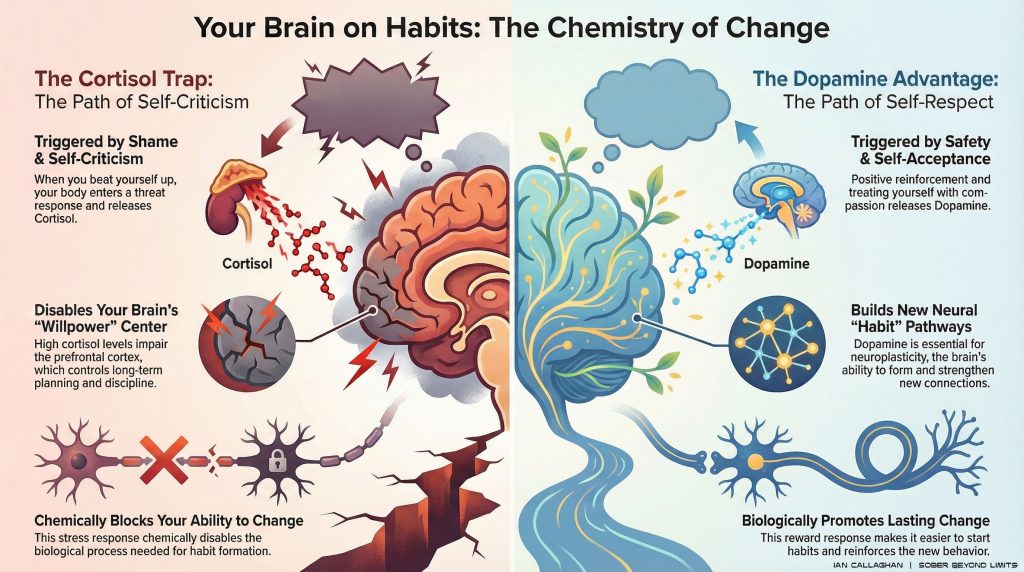
Cortisol vs dopamine similarities and differences form the foundational chemical architecture of human behaviour, dictating everything from our response to danger to our pursuit of pleasure. While Cortisol acts as the body’s primary stress hormone produced in the adrenal glands, Dopamine functions as the key neurotransmitter for reward and motivation within the brain.
Key Takeaways:
The Balance: Chronic high cortisol downregulates dopamine receptors, leading to “Anhedonia” (the inability to feel pleasure)—a common hurdle in early sobriety.
Cortisol: A steroid hormone (catabolic) that manages the “fight or flight” response. Essential for survival but toxic if chronically elevated.
Dopamine: A neurotransmitter (anabolic) driving reward, motivation, and motor control. It creates the “anticipation” of pleasure.
Understanding the intricate balance between these two chemical messengers is critical for optimising mental health, managing stress, and enhancing cognitive performance. This comprehensive analysis explores their biological mechanisms, physiological effects, and strategies for maintaining equilibrium.
In this video, I break down how 50 years of cold water therapy has physically rewired my response to stress and inflammation.
“Behavioral Interaction”
Scenario
Cortisol’s Role
Dopamine’s Role
Outcome
Waking Up
Spikes to trigger alertness (CAR).
Low; builds as you plan your day.
Natural “Get up and go.”
Public Speaking
Mobilises glucose for “Fight or Flight.”
Focuses attention on the audience.
“Positive Pressure” flow state.
Late Night Scrolling
High (due to blue light/stress).
Spiking (cheap reward hits).
“Tired but Wired” Insomnia.
At a Glance: The Core Cortisol vs dopamine similarities and differences
The Short Answer: The primary difference between cortisol and dopamine lies in their biological classification and function. Cortisol is a steroid hormone that manages the body’s “fight or flight” stress response and metabolism. Dopamine is a neurotransmitter that drives the brain’s reward system and motivation. While they often work together during acute stress, chronic high cortisol can deplete dopamine, leading to burnout.
What is Cortisol? The Body’s Alarm System
Cortisol is a steroid hormone belonging to the glucocorticoid class, primarily responsible for the body’s stress response and for regulating metabolism. According to the Society for Endocrinology, it serves as a vital survival mechanism, mobilising energy by increasing blood glucose levels and suppressing functions that would be non-essential in a fight-or-flight scenario.
The HPA Axis and Production
Cortisol is produced in the adrenal cortex, which sits atop the kidneys. Its release is controlled by the Hypothalamic-Pituitary-Adrenal (HPA) axis—a complex set of direct influences and feedback interactions among three components:
The Hypothalamus
The Pituitary Gland
The Adrenal Glands
When the brain perceives a threat, the hypothalamus releases CRH (Corticotropin-Releasing Hormone). This signals the pituitary gland to secrete ACTH, which stimulates the adrenals to flood the system with cortisol.
Primary Functions of Cortisol
While commonly demonised as the “stress chemical,” cortisol is essential for life. Its influence extends far beyond panic:
Glucose Metabolism: Stimulates gluconeogenesis (creating glucose) in the liver to provide rapid energy.
Anti-inflammatory Action: In acute bursts, it suppresses the immune system to lower inflammation.
Circadian Rhythm: Levels naturally peak in the morning (Cortisol Awakening Response) to help you wake up and drop at night to facilitate sleep.
What is Dopamine? The Molecule of More
Dopamine is a catecholamine neurotransmitter and hormone that plays a central role in the brain’s reward system, motor control, and executive function. Neurobiological research indicates that dopamine does not merely produce pleasure; it creates the anticipation of reward, driving motivation and goal-directed behaviour.
Synthesis and Pathways
Unlike cortisol, dopamine is primarily synthesised in the brain, specifically in the substantia nigra and the ventral tegmental area (VTA). It is derived from the amino acid tyrosine. Dopamine travels along distinct pathways:
Mesolimbic Pathway: Regulates reward and emotion.
Nigrostriatal Pathway: Critical for motor planning and movement.
Mesocortical Pathway: Involved in executive function and decision making.
Primary Functions of Dopamine
Dopamine acts as a chemical messenger between neurons. It is the driving force behind “seeking” behaviours.
Motivation: Reinforces behaviours that aid survival (eating, reproduction).
Motor Control: Ensures smooth, coordinated muscle movements.
Cognitive Function: Supports working memory, focus, and problem-solving.
Cortisol vs Dopamine: Similarities and Differences
The primary difference involves classification and origin: Cortisol is a steroid hormone from the adrenal glands, while dopamine is a neurotransmitter from the brain. However, their similarities are equally significant, particularly in how they prepare the body for action.
Table 1: Cortisol vs Dopamine Comparison
Feature
Cortisol
Dopamine
Primary Classification
Steroid Hormone (Glucocorticoid)
Neurotransmitter (Catecholamine)
Primary Origin
Adrenal Cortex (Kidneys)
Substantia nigra & VTA (Brain)
Main Function
Stress response, metabolism, inflammation
Reward, motivation, motor control
Precursor
Cholesterol
Tyrosine (Amino Acid)
Timescale
Slower acting, longer duration (minutes/hours)
Fast acting, rapid clearance (milliseconds/seconds)
Receptors
Glucocorticoid receptors (found in almost every cell)
Dopamine receptors (D1–D5) in the nervous system
Effect on Heart Rate
Increases (via sensitivity to adrenaline)
Increases (at high doses)
Key Differences in Mechanism
Chemical Structure and Synthesis: Cortisol is lipid-soluble and is synthesised from cholesterol. Because it is a steroid, it can pass through cell membranes to bind with receptors inside the cell nucleus, altering gene expression. This process takes time, explaining why stress effects can linger. Dopamine cannot cross the blood-brain barrier easily. It binds to receptors on the surface of neurons, triggering rapid electrical signals. This allows for instantaneous reactions, such as catching a falling object.
The Physiological Directive: Cortisol is catabolic, meaning it breaks down tissues (like muscle and fat) to release energy. It prioritises immediate survival over long-term maintenance. Dopamine is distinctively motivational. It does not provide the fuel (glucose) like cortisol; instead, it provides the psychological impetus to expend that energy toward a specific goal.
Key Similarities in Function
Survival Orientation: Both chemicals are evolutionarily designed to keep you alive. Cortisol prepares the body to survive a physical threat, while dopamine drives the organism to seek resources required for survival.
Effect on Arousal and Alertness: Both substances heighten arousal. Cortisol sharpens senses and increases blood pressure, while dopamine increases mental alertness and focus, narrowing attention onto the object of desire or threat.
Interaction with Adrenaline: Both interact closely with epinephrine (adrenaline). Cortisol increases the body’s sensitivity to adrenaline, while dopamine is actually a chemical precursor to norepinephrine and epinephrine.
The Interplay: How They Work Together
Cortisol and dopamine share an inverse relationship in chronic conditions, but they rise together during acute stress. This complex dynamic is crucial for understanding Cortisol vs dopamine similarities and differences in real-world contexts like workplace stress or athletic performance.
The Acute Stress Response
In the initial moments of a stressful event (e.g., a car swerving towards you), the brain releases dopamine alongside stress hormones. According to studies in The Journal of Neuroscience, this initial spike in dopamine helps the brain assess the threat and determine an escape route. Simultaneously, cortisol levels rise to mobilise the glucose needed for the muscles to react. In this acute phase, they work in concert to ensure safety.
The Chronic Stress Paradox (The Inverse Relationship)
Long-term exposure to high cortisol is toxic to the dopamine system. This is a critical mechanism in the development of depression and burnout.
Enzyme Alteration: High glucocorticoids can alter the enzymes that break down dopamine, leading to lower baseline levels.
Anhedonia: As cortisol suppresses dopamine function, the ability to feel pleasure or motivation diminishes.
Symptoms of Imbalance
Imbalances in these chemicals manifest distinctively, yet both lead to significant cognitive and physical decline. Recognising these symptoms is the first step toward clinical or lifestyle intervention.
High Cortisol Symptoms (Hypercortisolism)
When the “off switch” for the stress response fails, the body remains in a constant catabolic state.
Physical: Rapid weight gain (especially in the face and abdomen), thinning skin, slow wound healing.
Mental: Anxiety, irritability, and “tired but wired” insomnia.
Systemic: High blood pressure and weakened immune response.
Low Dopamine Symptoms
A deficiency in the reward system strips away the “spark” of daily life.
Physical: Muscle tremors, stiffness, balance issues, and fatigue.
Mental: Lack of motivation, procrastination, low libido, and inability to focus.
Emotional: Feelings of hopelessness and a flat emotional affect.
Table 2: Comparative Symptoms of Dysregulation
Symptom Domain
High Cortisol
Low Dopamine
Sleep
Difficulty falling asleep (insomnia), night waking
Excessive sleeping (hypersomnia), trouble waking up
Weight
Weight gain (abdominal/visceral fat)
Weight changes due to appetite loss or binge eating
Mood
High anxiety, panic, irritability
Apathy, depression, lack of enthusiasm
Cognition
Brain fog, poor short-term memory
Poor concentration, inability to finish tasks
Cravings
Salty and sweet foods (energy density)
Sugar, caffeine, and stimulants (quick hits)
Clinical Perspectives and Disorders
Medical conditions arising from the malfunction of these chemicals highlight the severity of the Cortisol vs dopamine distinction.
Cortisol-Related Disorders
Cushing’s Syndrome: Arises from prolonged exposure to high cortisol levels (often from medication or tumours). Markers include a fatty hump between the shoulders and a rounded face.
Addison’s Disease: Adrenal insufficiency where glands produce too little cortisol. This leads to life-threatening low blood pressure and severe fatigue.
Dopamine-Related Disorders
Parkinson’s Disease: A neurodegenerative disorder caused by the death of dopamine-producing neurons, leading to tremors and rigidity.
Schizophrenia: Often associated with an overactivity of dopamine in certain brain regions, leading to hallucinations.
Optimising Your Levels: Natural Interventions
Regulation can often be achieved through targeted lifestyle changes known as “biohacking.”
Lowering Cortisol Naturally
Phosphatidylserine Supplementation: This phospholipid helps blunt the cortisol response to exercise and mental stress.
Low-Intensity Steady State (LISS) Cardio: While High-Intensity Interval Training (HIIT) spikes cortisol, walking or slow cycling reduces it. A 20-minute walk in nature has been shown to lower salivary cortisol by over 10%.
Strict Sleep Hygiene: Cortisol should be lowest at midnight. Blue light exposure prevents this drop, so avoiding screens 60 minutes before bed is mandatory.
Boosting Dopamine Naturally
Tyrosine-Rich Diet: Consuming foods high in Tyrosine (the precursor to dopamine) helps the brain synthesise the neurotransmitter. Sources include eggs, almonds, chicken, avocados, and bananas.
Cold Water Immersion: According to the European Journal of Applied Physiology, immersion in cold water (14°C) can increase dopamine levels by 250%, with effects lasting for hours.
The “Small Wins” Strategy: Dopamine is released upon goal completion. Breaking large tasks into micro-tasks creates a continuous feedback loop of dopamine release.
The Impact on Executive Function and Productivity
The Yerkes-Dodson Law suggests that performance increases with physiological or mental arousal (stress), but only up to a point.
The Crash: When cortisol exceeds the threshold, anxiety sets in. This floods the prefrontal cortex, shutting down executive function. Simultaneously, the brain may seek “cheap dopamine” (scrolling social media) to counteract the stress, leading to procrastination loops.
Frequently Asked Questions (FAQ)
What is the main difference between cortisol and dopamine?
The main difference lies in their biological classification and origin. Cortisol is a steroid hormone produced by the adrenal glands that manages stress and metabolism. Dopamine is a neurotransmitter produced in the brain that regulates reward, motivation, and motor control.
Can high cortisol cause low dopamine?
Yes, there is a strong link between high cortisol and low dopamine. Chronic stress (high cortisol) can downregulate dopamine receptors and alter the enzymes required to produce dopamine, leading to symptoms of depression and anhedonia (inability to feel pleasure).
Do cortisol and dopamine work together?
Yes, they work together during acute stress. When you face immediate danger, the body releases both cortisol (for energy) and dopamine (for alertness and quick decision-making). However, prolonged simultaneous elevation is harmful to the body.
How can I test my cortisol and dopamine levels?
Cortisol is typically tested via blood, saliva, or urine samples, often measuring the “cortisol curve” throughout the day. Dopamine is harder to measure directly in the brain; doctors usually rely on symptom assessment or measure homovanillic acid (a dopamine metabolite) in urine.
Which foods increase dopamine and lower cortisol?
To increase dopamine, eat tyrosine-rich foods like eggs, almonds, dairy, and lean meats. To help lower cortisol, focus on foods rich in magnesium (spinach, pumpkin seeds) and Omega-3 fatty acids (salmon, walnuts), and avoid excessive caffeine and sugar.
What are the symptoms of high cortisol and low dopamine combined?
This combination typically results in “tired but wired” burnout. Symptoms include anxiety coupled with a lack of motivation, insomnia despite exhaustion, weight gain around the midsection, and a general feeling of hopelessness or flatness.
Ready to build that foundation? Stop guessing and start planning with self-respect. Download the Year Review Workbookto structure your growth without the guilt.
The 4 Emotional Archetypes That Run Your Life (And How to Finally Change Them)
Most people think they’re stuck because they lack motivation or discipline. They think the problem is laziness or inconsistency. The truth is simpler: your emotional life is being run by an archetype you never identified.
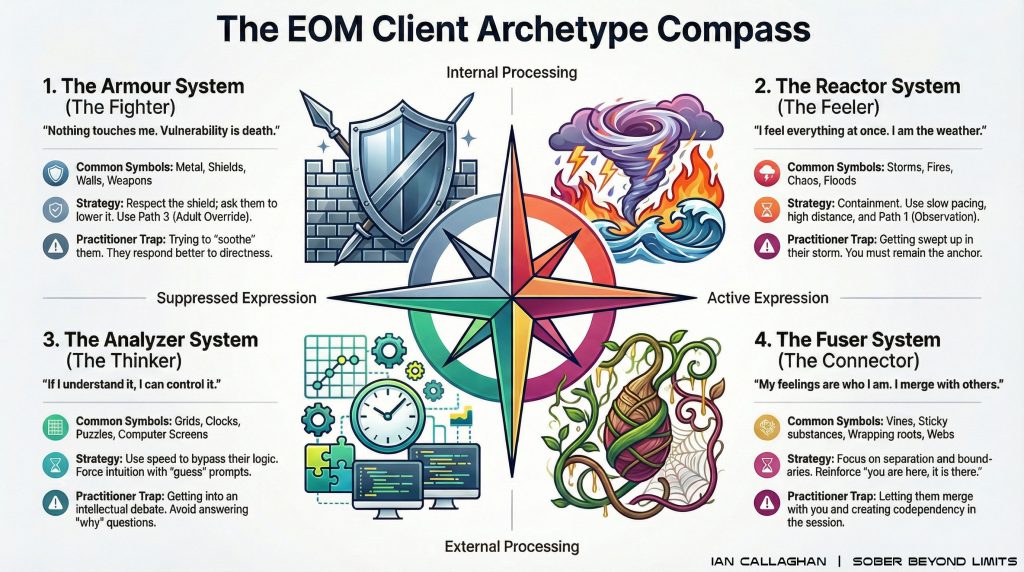
Inside the Emotional Observation Method (EOM), I teach four core archetypes that form the EOM Client Archetype Compass. Once you understand which one you are, everything about your patterns makes sense.
People assume their reactions are conscious choices. They’re not. Your archetype decides how you respond before your thinking brain even gets involved. This is why you shut down, explode, overthink, or merge with other people’s emotions even when you don’t want to.
Your archetype is your autopilot. When you identify it, you can finally take the controls back.
1. The Armour System (The Fighter)
Internal Processing | Suppressed Expression
Signature belief: “Nothing touches me. Vulnerability is death.”
Armour types aren’t cold, they’re defended. They built emotional walls because exposure once felt dangerous.
Common signs:
Shutting down instead of opening up
Appearing calm but tense inside
Disliking emotional conversations
Keeping people at a distance
Preferring independence to intimacy
Why it forms: Protecting the self becomes the safest option.
EOM Strategy: Respect the armour. Use Adult Override. No forced vulnerability.
Healing direction: Safe, chosen vulnerability.
2. The Reactor System (The Feeler)
Internal Processing | Active Expression
Signature belief: “I feel everything at once. I am the weather.”
Reactor types process emotion with intensity. Feelings move fast and hit hard.
Common signs:
Emotional spikes or storms
Sudden overwhelm
Fast activation and slow recovery
Feeling everything at once
Deep sensitivity
Why it forms: The nervous system learns to stay hyper-alert.
You’ll also unlock the EOM Command Console, which guides you through the practical process of running EOM on yourself.
Key Takeaways
You’re not broken, you’re patterned.
Your emotional life follows an archetype.
Armour, Reactor, Analyser, and Fuser are survival systems.
Each pattern formed for a reason.
The free quiz shows your system.
The Manual and Console help you transform it.
FAQ
Which archetype is most common? Reactor and analyser types show up most often in midlife due to stress and emotional load.
Can your archetype change? Yes. Life experience, sobriety, stress, and relationships can shift your dominant system.
Is this therapy? No. EOM is an emotional operating method, not a clinical diagnostic tool.
What if I relate to all four? You’ll use all four at times, but one will always dominate.
Can you change your archetype? Yes, through EOM repatterning and nervous system work.
If you’re ready to stop reacting on autopilot and start consciously directing your emotional life, start with the quiz and explore the manual for bigger change.
The Science Behind Emotional Archetypes
Your emotional archetype forms long before you ever put language to it. Most of the time, before age ten. Not because anything was “wrong” with you, but because your nervous system was forced to pick a strategy that felt safest at the time. These early blueprints become your adult defaults.
Your body reacts milliseconds before your mind explains anything. That’s why you often catch yourself saying things like:
“Why did I react like that?”
“That wasn’t even a big deal.”
“Why do I shut down around certain people?”
“Why do I explode over small things?”
“Why do I feel responsible for everyone else?”
“Why do I overthink everything until I’m exhausted?”
These aren’t personality flaws. They’re patterns of protection. Archetypes are not identity; they are strategies. And strategies can be rewritten.
How Midlife Stress Activates Your Archetype
If you’re in your forties or fifties, your archetype becomes louder. Not because you’re getting worse, but because your capacity is stretched, your hormones shift, your responsibilities grow, and unresolved emotional patterns get amplified.
This is why midlife often triggers:
emotional overwhelm
burnout
drinking or coping mechanisms
relationship breakdowns
career frustration
identity confusion
feeling stuck or restless
Your archetype tries to protect you from the chaos. The problem is, it uses childhood tools to solve adult problems.
Once you recognise the pattern, you can finally update the toolkit.
Tornado mode. Fast emotional spikes. Tears, anger, overwhelm. Nervous system in “high alert”.
Analyser System under stress:
Overthinking becomes an obsession. Paralysis by analysis. Avoids feeling by solving problems that don’t exist yet.
Fuser System under stress:
Clings harder. Loses self-boundaries. Becomes responsible for everyone else’s emotions.
When you know these patterns, you stop blaming yourself and start working with your biology, not against it.
Practical Ways to Start Rewiring Your Archetype
Rewiring doesn’t start with thinking. It starts with awareness.
Here are simple first steps for each archetype:
For the Armour System:
Practise micro-vulnerability (one sentence at a time)
Stop using independence as identity
Allow people to support you without earning it
For the Reactor System:
Slow your breathing before you speak
Step away to regulate, then return
Label the emotion without judging it
For the Analyser System:
Stop the story; drop into sensation
Ask: “What does my body feel right now?”
Move before thinking when safe (walk, stretch, breathe)
For the Fuser System:
Practise separation: “Their emotion is not mine.”
Limit how much emotional labour you perform for others
Ask: “What do I feel underneath this?”
These small shifts create massive long-term changes.
Why the EOM Manual Accelerates Change
You can guess your archetype, or you can understand it properly.
The Emotional Operating System Manual gives you:
A full breakdown of your dominant archetype
Your nervous system trigger map
The origin of your emotional pattern
the behavioural loops that keep it alive
interruption strategies
rewiring steps based on EOM
journaling and reflection prompts
real-world examples you’ll recognise instantly
And with the EOM Command Console, you can run the process yourself anytime. It doesn’t rely on therapy sessions or waiting for someone else. It puts emotional change back in your hands.
Your relationships get easier. Your triggers make sense. You stop reacting on autopilot. You stop blaming yourself for patterns you never consciously chose. You build an emotional operating system that works for your adult life, not your childhood survival.
Your archetype is not who you are. It’s who you learned to be.
Used to monitor number of Google Analytics server requests when using Google Tag Manager
1 minute
_gid
ID used to identify users for 24 hours after last activity
24 hours
_ga_
ID used to identify users
2 years
_gali
Used by Google Analytics to determine which links on a page are being clicked
30 seconds
_ga
ID used to identify users
2 years
__utmx
Used to determine whether a user is included in an A / B or Multivariate test.
18 months
__utmv
Contains custom information set by the web developer via the _setCustomVar method in Google Analytics. This cookie is updated every time new data is sent to the Google Analytics server.
2 years after last activity
__utmz
Contains information about the traffic source or campaign that directed user to the website. The cookie is set when the GA.js javascript is loaded and updated when data is sent to the Google Anaytics server
6 months after last activity
__utmc
Used only with old Urchin versions of Google Analytics and not with GA.js. Was used to distinguish between new sessions and visits at the end of a session.
End of session (browser)
__utmb
Used to distinguish new sessions and visits. This cookie is set when the GA.js javascript library is loaded and there is no existing __utmb cookie. The cookie is updated every time data is sent to the Google Analytics server.
30 minutes after last activity
__utmt
Used to monitor number of Google Analytics server requests
10 minutes
__utma
ID used to identify users and sessions
2 years after last activity
_gac_
Contains information related to marketing campaigns of the user. These are shared with Google AdWords / Google Ads when the Google Ads and Google Analytics accounts are linked together.