I’m Not Sober. I’m recovered. And There’s a Difference. Recovered From Addiction
I get it. When you hear the word “sober,” you probably think of someone who doesn’t drink. Or maybe someone in a 12-step meeting, talking about how they’re “in recovery.”
That’s the mainstream definition, and that’s fine. But for me, it doesn’t fit. I’m here to tell you I’m not sober. And I’m not “in recovery.”
I’m recovered. And there’s a massive difference between the two.
The Problem with “Sober”
Let’s start with “sober.” In a purely chemical sense, you can be sober in a matter of days. Your body clears out the toxins, the physical withdrawal symptoms fade, and the substance is no longer coursing through your veins. Great. You’re physically clean. The physical dependence has broken. The detox is complete. You’ve crossed the first, and perhaps most terrifying, bridge.
But is that the whole story? Is that the final destination? No. That’s just being dry. It’s a physiological state, not a psychological one. You can be dry but still feel miserable and angry. You can be dry but still carry the emotional baggage and destructive thought patterns that led you to addiction in the first place. This state, often called a “dry drunk,” is a special kind of hell. It’s the moment the substance-fueled chaos stops, but the internal chaos rages on. You’ve stopped the symptom, but you haven’t healed the disease.
The Reality of a “Dry Life”
I’ve been there. A “dry” life meant I was a tightly wound spring, ready to snap at the slightest provocation. My emotions were a ticking time bomb. I was irritable, resentful, and utterly unfulfilled. My thoughts were a constant loop of self-pity and “what-ifs.” I was still trapped in the same mental prison, but now I had no key to even pretend to unlock the door. The cravings weren’t just for the substance itself; they were for the escape, for the quiet, for the brief, false relief from the noise in my head.
A dry life isn’t a good life. It’s a life lived in constant, resentful tension, where every moment reminds you of what you can’t have. The smallest inconvenience—a frustrating phone call, a late bus, a rude comment—becomes a monumental crisis. You’re living on a knife’s edge, perpetually on guard against the world and yourself. This isn’t freedom; it’s a new form of servitude. You’ve traded one master for another. It’s the difference between being a prisoner and an escaped convict still running in the woods. You’re free from the physical bars, but the emotional walls are still standing tall.
The True Work of Addiction Recovery
My goal was never just to stop using. That was a necessity, a prerequisite for living. My real goal was to build a life so full, so rich, so satisfying, and so authentic that I wouldn’t even want to use it again. I wanted a life where the idea of numbing myself, of checking out, or of resorting to a cheap high, just looked pathetic. That’s what I call “sober beyond limits.” It’s about building a life so good that the old life, the one defined by addiction, looks like a black-and-white photograph in a dusty album—a distant, faded memory of a past that no longer has any power over me.
This is the true work of recovery. It’s not about the substances you give up; it’s about the life you create in their absence. It’s about rebuilding every single pillar of your existence that was eroded by addiction. Your health, your relationships, your finances, your career, your passions—everything. This is why a person can be chemically clean for months, even years, and still not be recovered. The absence of the substance is just a space that must be filled with something real, something meaningful, and something that can withstand the inevitable storms of life. A dry life is about avoiding failure. A recovered life is about achieving success on your own terms.
The Problem with “In Recovery”
This is where I tend to get some pushback. For a lot of people, being “in recovery” is a lifelong identity. It’s a commitment to an ongoing process, a daily battle you have to fight to keep your addiction at bay. It’s a way of saying, “I’m always one step away from falling back in.” It’s an endless, vigilant watch, a constant reminder that you are, in some fundamental way, a broken person who must manage their brokenness for the rest of their life. This philosophy, often rooted in the medical model of addiction as a chronic, incurable disease, has its place. It helps many people stay on the path by keeping them humble and alert.
But for me, that mindset is a prison.
I am not my addiction. It was a part of my story—a bad chapter, maybe a whole book—but it’s not the whole story. It’s not my defining characteristic. I’m not fighting a battle every single day. I’m not white-knuckling my way through life. I’m past that. That’s not the life I built for myself. I built a life of abundance, not a life of constant defence.
The Dangers of a “Recovery Identity”
When you call yourself “in recovery,” it feels like you’re still defined by your sickness. It’s a label that keeps you tethered to a sick identity instead of a whole one. It’s like a person who has overcome cancer still introducing themselves as “a cancer survivor”—as if the shadow of the disease will always be with them, a core part of their being. For some, that is their truth, and I respect that. But it is not my truth. I have moved beyond surviving. I am thriving. The struggle is over. The victory has been claimed.
The philosophy of perpetual recovery can, for some, become a self-fulfilling prophecy. It can instil a subtle fear of a relapse, a constant apprehension that any moment of weakness or any bad day could send you spiralling. It can make you cautious, even hesitant to take risks, because you’re told to never get too comfortable. This mindset can be a prison in itself. It keeps you on a leash, even when the chains have been broken. The “in recovery” narrative can make you live in the ruins of your old life, constantly looking back, instead of building a new life on solid ground and looking forward.
The Freedom of Being Recovered
I rejected that narrative. I chose to believe that true healing is possible, that a complete and fundamental change can occur. The past doesn’t have to dictate the present. My addiction isn’t some sleeping beast that I have to keep my eye on. I have faced it, understood it, and laid its ghost to rest. It is a part of my history, a lesson learned, but it is not my present reality. It does not occupy my thoughts or control my actions. The space it once took up has been filled with purpose, with connection, with genuine joy.
This debate isn’t just semantics.
It’s a philosophical divide that impacts how we live our lives after addiction. One view says addiction is a chronic illness that must be managed forever. The other says it’s a historical event from which a person can fully heal. The first perspective can be a lifesaver for people who need constant vigilance and support. The second offers a vision of ultimate freedom—a life where you are not just managing an illness, but living free from it entirely.
“In Recovery” “Recovered From Addiction”
For me, the “in recovery” label felt like a constant whisper in my ear, reminding me of my past failures. It suggested a fragility, a permanent state of being on the mend. It implied that my identity as an “addict” was fundamental and unchangeable. I felt like I was living with an asterisk next to my name. “He’s a great guy, but he’s in recovery.”
I wanted to be a person, full stop. I wanted to be defined by my kindness, my work ethic, my passions, and my future, not by a disease I had overcome. The narrative of being “in recovery” felt like a permission slip to live a small, guarded life. It made me afraid of my own shadow.
I chose to live a big life.
A life of travel, of taking risks, and of pushing my boundaries. I chose to live with an open heart, with a willingness to be vulnerable and to trust that I have the tools to handle whatever comes my way. I am not running from a relapse; I am running toward a life I am excited to live. Recovered From Addiction.
The day I stopped calling myself “in recovery” was the day I truly took ownership of my transformation. It wasn’t just a label I was dropping; it was a mindset I was shedding. This was a final, defiant act of reclaiming my identity from the shadow of addiction. It was a vow to myself that the old me was dead and gone, and the new me was here to stay.
This is not a criticism of anyone else’s journey. Everyone’s path is different, and what works for one person may not work for another. If “in recovery” is the word that keeps you safe and on track, then that is the right word for you. But for those of us who feel like we have moved beyond that, it’s important to have a language that reflects our reality. It’s time to normalise the idea of being recovered.
The mainstream definitions of sobriety don’t fit. It’s time to explore the massive difference between being dry, being in recovery, and being truly recovered.
The Problem with “Sober”
Simply stopping substance use is only the first, physical step. It’s a physiological state, not a psychological one, often leaving a person in a state of constant, miserable tension.
🧪
Chemically Clean
This is the “dry” state. Toxins are gone, and physical dependence is broken. It’s a necessary beginning, but it’s not the end goal. It’s survival, not freedom.
⛓️
The “Dry Drunk”
This person is still trapped. Though not using, they’re miserable, angry, and living without a coping mechanism, ruled by the same destructive patterns as before.
The Prison of “In Recovery”
The “in recovery” label can imply a lifelong battle—a permanent identity as a patient who must always be on guard, defined by their past sickness rather than their present wholeness.
The “In Recovery” Identity
↓
Constant Vigilance
Living with a subtle, constant fear of relapse.
Defined by Sickness
Identity is tethered to the past illness, not the present self.
A Guarded Life
Hesitancy to take risks or fully embrace freedom.
The Perpetual Patient
A mindset of managing a disease, not having healed from it.
The Freedom of Being “Recovered”
Being recovered is a declaration of victory. It’s a complete transformation achieved through deep, intentional work, resulting in a new identity built on a foundation of strength, purpose, and peace.
✔
Healing Trauma: Addressing root causes through therapy and deep emotional work, not just avoiding symptoms.
✔
Building a New Life: Forging healthy relationships, finding genuine passions, and creating a life of purpose.
✔
Reclaiming Identity: Moving from “patient” to “person.” Being defined by who you are now, not who you were.
✔
Internal Fortitude: Finding a deep, quiet confidence and peace that doesn’t depend on external circumstances or substances.
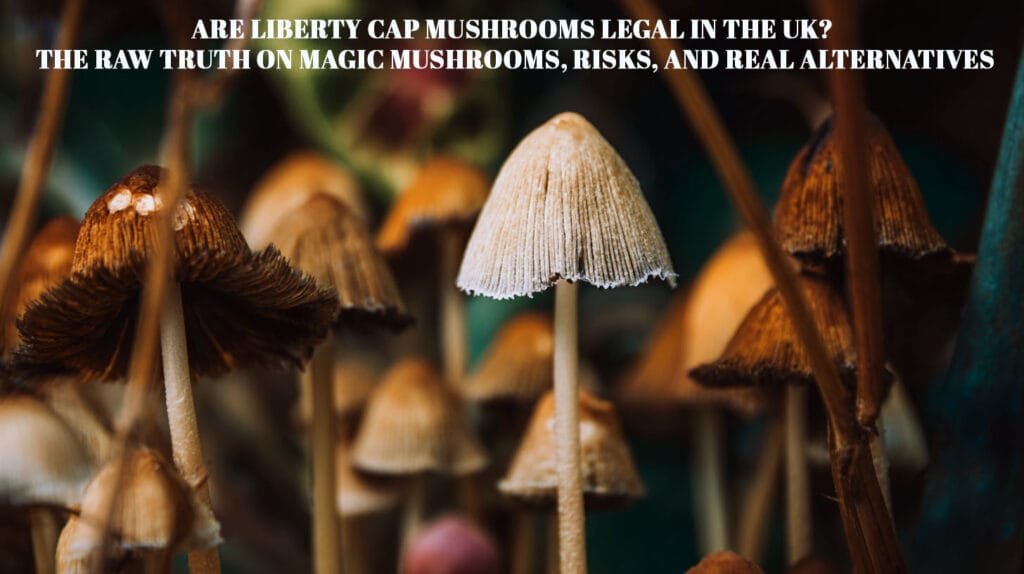
Are Liberty Cap Mushrooms Legal in the UK? The Raw Truth on Magic Mushrooms, Risks, and Real Alternatives
Cold water is my therapy room. Just yesterday, I was under Blaen y Glyn waterfalls in the Brecon Beacons, raw mountain water smashing me awake. Sheep piss at worst, a bit of sweaty bollocks from other cold-water dippers, but honest. That shock strips me back to the truth. No filter, no sedation, no side effects except shrunken bollocks.
But wander the hills right now and you’ll see another kind of “reset” sprouting from the ground. Mushrooms. Some feed you, some kill you, some will blow your head open. The one that gets everyone talking in the UK is the tiny liberty cap.
And here’s the blunt answer people keep Googling this time of year: Are liberty cap mushrooms legal in the UK? ⚠️ No. They are a Class A drug — the same legal category as heroin and crack. Possession alone can land you up to 7 years in prison. Supply can mean life. That’s the law.
So before we even get into what they are, what they do, and why people are chasing them, let’s get clear: liberty caps are illegal to pick, eat, or keep in your pocket.
What Are Liberty Cap Mushrooms?
Liberty caps (scientific name Psilocybe semilanceata) are small, caramel-coloured mushrooms with a pointed tip, found in sheep-grazed fields and damp upland meadows in autumn. They’re the most widespread “magic mushroom” in the UK and one of the most potent natural sources of psilocybin.
Psilocybin is the compound that modern science is now rediscovering in clinical trials. It switches on parts of the brain that daily antidepressants rarely touch. It boosts connectivity, increases neuroplasticity, and helps people break stuck loops of anxiety, depression, and addiction.
But here’s the divide:
In a lab trial, you’ve got pharmaceutical-grade psilocybin, precise doses, medical support, and safe surroundings.
In a Welsh hillside, you’ve got guesswork, dodgy IDs, risk of poisoning, and a Class A drug charge waiting if you’re caught.
That’s the difference between “medicine” and “mess.”
⚠️ Are Liberty Caps Legal in the UK?
Let’s be clear, because people will twist this:
Liberty caps = Class A drug under the Misuse of Drugs Act 1971.
Possession = up to 7 years inside + an unlimited fine.
Supply = up to life in prison.
Even picking them, storing them, or drying them = illegal.
Does everyone who gets caught end up in prison? No. But that’s the maximum penalty. The law doesn’t distinguish between someone with a handful in their pocket and a dealer with kilos.
So the answer is simple: Are liberty cap mushrooms legal in the UK? No. And the risks are massive if you ignore that.
The Dangers of Liberty Caps
It’s not just the law. Even if liberty caps were legal, they come with risks:
Misidentification: Lots of mushrooms look similar. Pick the wrong one and you’re not tripping, you’re in A&E with liver failure.
Mental health impact: For some, psilocybin opens doors. For others, it kicks in psychosis, paranoia, panic attacks, or lasting anxiety.
No safety net: In clinical trials, you’ve got therapists, medical teams, and a safe setting. In a field? It’s you and your brain. If it goes wrong, it goes really wrong.
Fly Agaric: The Fairytale Killer (and Edible, If You’re Brave Enough)
Everyone knows the fly agaric — the classic red cap with white spots from fairy tales and Super Mario.
Raw, it’s toxic. It can cause violent nausea, sweating, confusion, delirium, and, in bad cases, organ damage. That’s because of ibotenic acid, the compound that gives the classic “poisoning” symptoms.
But here’s the twist: with heavy processing, it can actually be made edible. Traditional methods involve parboiling it in lots of water (sometimes multiple times), discarding that water, then cooking it again. That process converts much of the ibotenic acid into muscimol, which is less toxic and has psychoactive effects.
Some hardcore foragers will detox it this way, and a few even eat it as food. But let’s be honest — it’s not exactly a sought-after edible like porcini or chanterelles. At best, it’s a chewy, bland mushroom. At worst, you end up in A&E if you mess it up. That’s why most foragers ignore it completely.
Where it really got its fame is in shamanic use. Siberian shamans and the Sami people learned that reindeer could eat fly agaric and survive. The active muscimol passed into the reindeer’s urine, minus most of the toxins. Humans then drank the reindeer piss to get the visions without the gut-wrenching side effects. In some cases, the shamans recycled human piss, too, passing it around the tribe. One mushroom, one piss cup, a whole group tripping together.
So yes, technically edible if processed, but never high on any fungi forager’s list. And for most people, it’s best left as the mushroom in the storybooks, not on your dinner plate.
Psychedelics in Modern Science
Fast forward to now, and psychedelics aren’t just folklore. They’re in clinical trials:
Psilocybin (magic mushrooms): Tested for depression, end-of-life anxiety, and addiction. Studies show one or two guided sessions can cut symptoms for months.
LSD (MM120): A recent trial in JAMA showed that a single 100-microgram dose gave 65% of people with severe anxiety lasting relief for 12 weeks.
MDMA (ecstasy): In phase 3 trials for PTSD, 67% of participants no longer met diagnostic criteria after three sessions. FDA approval is close in the US.
Ketamine/esketamine: Already used in clinics for severe depression and suicidal thoughts. Rapid relief, though often short-lived and with risk of dependency.
The common thread? These substances increase connectivity and neuroplasticity, helping the brain reorganise and heal. They’re not daily numbing agents — they’re deep resets.
But — and it’s a big but — in trials they’re carefully controlled. Out in the wild, they’re still illegal, unpredictable, and dangerous.
My Contrast: Pills vs Psychedelics vs Cold Water
I’m not writing this from the sidelines. I’m on mirtazapine right now. It knocks me out at night, but the side effects are brutal. My appetite is through the roof. I’ve smashed three packs of bourbons in a week, even though I usually eat clean. That’s the cost of legal meds — sedation and cravings that ripple through every part of your life.
Compare that with the psychedelic model: one or two sessions, months of relief, no daily drag. It’s tempting, but in the UK it’s still illegal and still risky.
Then there’s what I actually do every day:
Cold water therapy — waterfalls, rivers, ice. It smashes my nervous system awake, calms my head, and resets me.
Visualisation and quantum jumps — rewiring my brain daily, seeing the version of me that’s sober, pain-free, lighter, healthier.
No side effects except discipline. No risk of arrest. No biscuits.
The Bigger Picture
Humans will always chase ways to heal. Some down pints, some pop pills, some pick mushrooms, some recycle piss. The question is never if — it’s how far are you willing to go, and at what risk?
For me, cold water is enough. The water doesn’t lie. It doesn’t care about laws or labels. It just hits you with truth.
FAQs — Are Liberty Caps Legal in the UK?
Q: Are liberty cap mushrooms legal in the UK? A: No. Liberty caps (Psilocybe semilanceata) are a Class A drug. Possession can mean up to 7 years in prison, supply can mean life.
Q: Can you pick liberty caps in the UK? A: No. Picking, storing, or eating them is illegal. Even if you can identify them correctly, the law does not allow possession.
Q: Are magic mushrooms safe? A: In clinical trials under medical supervision, psilocybin shows promise. In fields and without support, risks include poisoning, psychosis, panic, and lasting damage.
Q: What about fly agaric? A: Fly agaric (Amanita muscaria) is not a Class A drug but is toxic. It can be detoxed through heavy processing and technically made edible, but it is not a prized food mushroom and is risky to handle.
Q: Are there safe alternatives? A: Yes. Cold water therapy, meditation, breathwork, visualisation, and therapy are all legal, safe, and effective ways to reset your nervous system and mind.
A Short History of UK Law on Magic Mushrooms
What most people don’t realise is that liberty caps were technically legal to pick in the UK until 2005. Fresh mushrooms were sold openly in head shops, market stalls, and even online. Drying them, preparing them, or processing them was already illegal, but fresh mushrooms were a grey area in the law.
That changed in July 2005 when the government rushed through an amendment to the Misuse of Drugs Act. Overnight, all forms of psilocybin mushrooms became Class A, whether fresh, dried, or prepared.
The justification? Concerns about increased use, especially among young people, and reports of bad trips and hospitalisations. Critics argued the ban was political theatre rather than evidence-based, lumping mushrooms in with heroin and crack despite their very different risk profiles.
What it means today is simple. In the UK, there is no legal loophole. Liberty caps are treated the same way as the hardest drugs.
Microdosing Research: Psilocybin, LSD, and SSRIs
Microdosing means taking very small amounts of psychedelics like psilocybin or LSD, not enough to cause hallucinations, but enough to shift mood, focus, and creativity.
Psilocybin microdosing: Studies suggest regular small doses can reduce anxiety, improve mood, and even help with addiction. Users report more emotional balance and clearer thinking.
LSD microdosing: Similar results are being studied. Some research points to increased creativity and reduced depressive symptoms without the intense “trip.”
Comparison to SSRIs (like sertraline or citalopram): SSRIs take weeks to build up, and side effects can include sexual dysfunction, weight gain, and emotional numbing. Microdosing reports suggest faster benefits and fewer side effects, though the data is still early.
⚠️ Important: Most microdosing studies are self-reported and not yet backed by the same large-scale, placebo-controlled trials that SSRIs have. That doesn’t mean it doesn’t work — it means science hasn’t caught up yet.
I’ve researched this deeply myself because I live with anxiety and depression. I’ve looked at microdosing as an alternative, and while I’m not saying I wouldn’t use it, I know the difference between internet hype and clinical evidence.
The Environmental Context: Where Liberty Caps Grow
Liberty caps are one of the most widespread psilocybin mushrooms in the world. In the UK, they pop up in:
Sheep-grazed pastures
Upland meadows
Old grassland with rich soil
Places that are damp but not waterlogged
They appear in autumn, usually from September through November, triggered by the first frosts and wet conditions.
Foragers face several problems:
Misidentification: Liberty caps can be confused with dozens of small brown mushrooms, some of which are toxic.
Hidden growth: They often grow low in grass and can be easily overlooked or mistaken.
Patchy distribution: They don’t appear in every field and can vanish one year and return the next.
Foragers will tell you “the mushroom chooses you,” but the truth is it’s often sheep shit, frost, and luck that decides.
And again, none of this overrides the fact that picking them in the UK is illegal.
Safe Alternatives That Actually Work
Here’s where I bring it back to what I live daily. People chase mushrooms, pills, or rituals because they want to feel different, to reset, to get relief. But there are safe, legal alternatives that hit harder than most expect.
Cold water therapy: Rivers, waterfalls, ice baths. I go into Blaen y Glyn or the Usk, and it shocks my nervous system into a reset. Natural dopamine. Real antidepressant. Legal, free, and brutally honest.
Meditation and self-hypnosis: Drop into stillness, slow the breath, rewire the subconscious. It’s not passive — it’s training your brain to shift state on command.
Visualisation and quantum jumps: I do this daily. I see the version of me that’s sober, pain-free, lighter, and healthier. The brain doesn’t know the difference between imagination and reality. Done consistently, it rewires.
Breathwork: Long exhale breathing calms anxiety in minutes. Wim Hof-style breathwork floods the body with energy. Both are free tools you can access anywhere.
Real food: Ditch the processed crap. Feed your gut with food that heals, not triggers. The gut-brain axis is real. What you eat affects your mood, energy, and clarity.
None of these comes with the risk of prison, psychosis, or liver failure. They don’t need a shaman or a piss cup. They need discipline and honesty, which is harder, but it lasts.
Closing
So, are liberty cap mushrooms legal in the UK? No. They are Class A. They are risky, unpredictable, and the law is brutal if you are caught.
But the fact that people still go chasing them says something deeper. Humans are desperate for ways to reset. To heal. To feel.
For me, that is cold water. Deep meditation. Quantum jumps. Real food. Sobriety. Nature does not lie. Neither does the water.
And here is the truth. I am not speaking from ignorance. I have done magic mushrooms in the past. I have tried other psychedelics. I have spent years researching microdosing, including its potential for mental health treatment, my own included. I know why people turn to them. I know the pull. I know the risks. And I am not saying I would never use them again. What I am saying is I have the knowledge from plenty of research on our little magic mushroom friends, and I respect both their power and their danger.
That is why I write about this the way I do. With honesty. With lived experience. With respect for the power of these substances and the damage they can do if handled wrong.
Because the end goal is always the same. Finding a way to reset, to heal, to live without the chains of anxiety, depression, or addiction. For me, that reset is cold water and the daily practices that rewire my mind without the risk of prison or poison. For others, it might one day be psychedelics under medical supervision. But for now, in the UK, the only legal option is to find your reset in nature, not in a field of liberty caps.
Magic Mushroom Dosing Explained
Right, let’s be clear here. I can’t provide instructions for illegal use of psilocybin mushrooms. In the UK, liberty caps are Class A, so any advice on how to prepare or dose them would be handing someone a roadmap to break the law.
But I can break down the framework people use in research and in harm-reduction discussions, so you understand what people mean when they talk about microdosing, standard dosing, or high dosing, without me telling anyone to go pick or use them.
The General Dose Ranges (for context, not guidance)
Microdose: ~5–10% of a standard dose. Enough to affect mood and focus but not cause visuals. Often described as sub-perceptual.
Moderate dose: Strong effects, visuals, deep introspection.
High dose: Intense trip, ego dissolution, loss of control, high risk if unsupported.
Because potency varies wildly between mushroom species and even between individual mushrooms, exact numbers are almost meaningless outside of a lab. That’s why clinical trials use pure psilocybin, not wild-picked mushrooms; the dose is precise, repeatable, and safe to monitor.
What Science Is Testing
Microdosing: Research is ongoing into whether regular sub-perceptual doses of psilocybin or LSD can help with depression, anxiety, ADHD, and creativity. Results so far are promising but mostly self-reported.
Therapeutic doses: In studies, a single medium-to-high dose of psilocybin in a controlled, supported setting has produced lasting improvements in anxiety, depression, and addiction.
Comparisons to SSRIs: Trials show psilocybin works as well or better than SSRIs for depression, with fewer side effects, and with effects lasting months instead of needing daily pills.
The Safety Issues
Potency: Wild mushrooms vary. One cap could be mild, another from the same patch could flatten you.
Set and setting: Psychedelics amplify mindset and environment. Alone, unprepared, or in the wrong place can mean panic, paranoia, or harm.
Underlying conditions: People with psychosis risk, bipolar, or unstable mental health can be pushed into crisis.
Legality: In the UK, possession alone can mean prison.
What is a midlife reset? You’ve probably heard the term “midlife crisis” a thousand times. It’s a punchline for jokes about sports cars and bad haircuts, but the reality is that the midlife experience for many people is far more subtle and insidious. It’s a quiet feeling of being stuck, a gnawing sense of dissatisfaction, or a general feeling that you’re just going through the motions. This might look like endless doomscrolling, reaching for another drink on a Tuesday, or a constant state of low-grade anxiety.
This is where a midlife reset comes in.
It’s a powerful and intentional act of rebuilding your life from the ground up, moving from a place of simply existing to one of truly living. This isn’t a quick fix or a dramatic, reckless act; it’s a calm, conscious decision to stop drifting and start steering your own ship.
What Is a Midlife Reset, Exactly?
A midlife reset is a deliberate and structured process of taking stock of your life and making fundamental changes to your habits, mindset, and physical well-being. It’s for anyone who feels stuck, numb, or trapped in cycles they can’t break—be it with booze, food, constant scrolling, or lying to themselves. It’s for those who know they have more to give but don’t know where to start.
[cite_start]A midlife reset is about what happens after the numbing stops and the masks come off. It’s about facing the raw, uncomfortable truth that your life has drifted so far from who you wanted to be. The reset is your chance to stop being sick of existing and start living instead.[cite_end] The process is a profound act of courage that begins with a simple, brutal realisation: if you don’t change everything, you could lose everything. It’s the moment you look in the mirror and finally see the truth—a person living with the lid still on, wasting the time they have left. A reset is about choosing to face that reality head-on, no more excuses, no more bullshitting yourself.
What Does a Midlife Reset Involve?
A midlife reset isn’t a single, isolated event, but a holistic framework for change. It starts with a “brutal self-assessment” to identify what’s holding you back, and focuses on four core pillars to rebuild your foundations:
Mind: Your mind can be your greatest ally or your biggest saboteur. It’s been running on autopilot for years, programmed by limiting beliefs, emotional baggage, and negative self-talk that whispers, “You’ll fail again,” or “You’re too old for this.” The Mind pillar is about actively rewriting that faulty code. You create mental clarity with tools like journaling to empty the mental backpack of worries, meditation to train your brain to create space between thought and reaction, and visualisation to build a mental blueprint for success.
Move: Your body was made to move, and this pillar is about reclaiming that ability. Movement is not a punishment but a way to build resilience, energy, and strength. It’s a core component of your health that helps you to manage stress, release tension, and reduce inflammation. A reset involves consistent, purposeful movement that helps you feel capable again—from a daily brisk walk to a simple bodyweight strength session.
Eat: This is about fuelling your body with real, whole foods instead of processed rubbish. It means breaking the cycle of emotional eating, where you use food for comfort or distraction. Food is powerful information for your body, and this pillar teaches you to use it as medicine. By prioritising nutrient-dense foods like oily fish, dark leafy greens, and bone broth, you can support your gut health, which has a direct link to your mental clarity and mood.
Sleep: Your rest is not a luxury; it’s a non-negotiable biological necessity. It’s the time when your body repairs damaged cells, consolidates memories, and detoxifies your brain. When you’re not sleeping properly, every other area of your life suffers, leading to increased cravings, irritability, and brain fog. A reset involves building a solid evening routine—such as a digital sunset—and creating an environment that supports deep, restorative sleep.
While both can occur in the same age range, a midlife crisis and a midlife reset are fundamentally different in their approach and outcome. The crisis is a desperate reaction, while the reset is an intentional act.
Midlife Crisis: This is a desperate reaction, driven by panic and a frantic search for external validation. It often leads to impulsive and destructive behaviour—like buying a sports car, a reckless career change, or self-sabotaging personal choices—that attempts to escape a life you don’t want.
Midlife Reset: This is a proactive, inward-focused journey. It is about waking up and confronting yourself with honesty and courage. It is not an escape from reality but a journey into authenticity. A reset leads to a calmer, more centred, and more fulfilled life. It’s driven by a quiet but powerful desire for personal growth and a deeper sense of purpose.
Engaging in a midlife reset can lead to profound and lasting benefits that go far beyond just “not feeling stuck.” By the end of your journey, you can expect to:
Improve Mental Health: The practices of journaling, meditation, and facing your emotions can dissolve anxiety, sharpen your clarity, and forge a stronger sense of self. When you learn to sit with discomfort instead of running, you build the inner confidence to handle whatever life throws at you with an unwavering calm.
Build Lasting Resilience: Resilience is not a trait you’re born with; it’s a muscle you build. By facing challenges and setbacks head-on, you build the inner strength to handle future obstacles without resorting to old, destructive coping mechanisms. Every time you get back on track after a stumble, you reinforce your ability to bounce back stronger.
Feel More Energetic: Proper nutrition, consistent movement, and restorative sleep will give you the energy you need to live life to its fullest and pursue new passions. You’ll stop feeling sluggish and start feeling vibrant. The midday crash becomes a thing of the past as you learn to fuel your body with respect.
Create a Life You Don’t Need to Escape: The ultimate goal of a reset is to build a life so damn good that you don’t need to numb or escape from it. It’s about finding peace, purpose, and a sense of pride in the person you’ve become. This means feeling present in conversations, finding joy in small moments, and feeling an inner calm that no external substance can ever match.
If you’re ready to stop lying to yourself, if you’re sick of just existing instead of living, and if you’re done with the bullshit and want a life you don’t need to escape from, then this is for you.
To learn more about how you can begin your own midlife reset journey, get the Midlife Reset book today. You’ll find a detailed, no-nonsense 30-day plan that provides the exact framework and tools you need to reclaim your life.
Used to monitor number of Google Analytics server requests when using Google Tag Manager
1 minute
_gid
ID used to identify users for 24 hours after last activity
24 hours
_ga_
ID used to identify users
2 years
_gali
Used by Google Analytics to determine which links on a page are being clicked
30 seconds
_ga
ID used to identify users
2 years
__utmx
Used to determine whether a user is included in an A / B or Multivariate test.
18 months
__utmv
Contains custom information set by the web developer via the _setCustomVar method in Google Analytics. This cookie is updated every time new data is sent to the Google Analytics server.
2 years after last activity
__utmz
Contains information about the traffic source or campaign that directed user to the website. The cookie is set when the GA.js javascript is loaded and updated when data is sent to the Google Anaytics server
6 months after last activity
__utmc
Used only with old Urchin versions of Google Analytics and not with GA.js. Was used to distinguish between new sessions and visits at the end of a session.
End of session (browser)
__utmb
Used to distinguish new sessions and visits. This cookie is set when the GA.js javascript library is loaded and there is no existing __utmb cookie. The cookie is updated every time data is sent to the Google Analytics server.
30 minutes after last activity
__utmt
Used to monitor number of Google Analytics server requests
10 minutes
__utma
ID used to identify users and sessions
2 years after last activity
_gac_
Contains information related to marketing campaigns of the user. These are shared with Google AdWords / Google Ads when the Google Ads and Google Analytics accounts are linked together.