The Truth About Fasting: Why Your Biology Doesn’t Need a Subscription
Medical Disclaimer: Critical Safety Notice
I am not a doctor. I am not pretending to be one. I am a classically trained chef, a British Army veteran, and an NLP Master Practitioner with over 40 years of experience in food and human biology. The following content is for informational purposes only. This is “Your Money or Your Life” (YMYL) territory: if you have underlying health conditions, are on medication (particularly for blood sugar, blood pressure, or kidney function), or are pregnant or breastfeeding, you must consult your GP before starting any fasting protocol. This is not a legal “arse-covering” exercise; it is common sense. Fasting is a powerful physiological stressor, and if your baseline health cannot sustain it, the results can be hazardous. This document is a strategic guide to metabolic flexibility, not a substitute for clinical advice.
The Metabolic Crisis of Constant Grazing
We are currently living through a metabolic crisis, and it isn’t caused by a lack of fuel. It is caused by a lack of a break. For nearly 50 years, I have walked the banks of the River Usk in Wales. I’ve watched the seasons shift, and I’ve watched the human condition decay as we’ve moved further away from our biological roots. Humans evolved too fast long before the advent of the “fridge and supermarket” culture that defines our modern existence. Our ancestors didn’t have three square meals a day as a gospel truth; they had biological programming that allowed them to thrive when food was scarce.
Today, we live in a 24-hour “grazing culture” that keeps us in a perpetual state of energy storage. We never allow the body to perform the essential maintenance it was designed for. The Truth About Fasting is that it is a free, ancient biological practice, currently buried under a mountain of “influencer theatre” and wellness-industry fluff. I’ve spent decades in professional kitchens—the high-pressure, grease-slicked environments where food is a commodity—and years in the British Army, where food is fuel. I have seen the damage done when people treat their bodies like a furnace that needs constant stoking.
Fasting isn’t a “hack” or a trend you need to subscribe to; it is the process of stripping away the metabolic noise and letting your body do the work it already knows how to do. The wellness industry wants to sell you a miracle in a bottle or a subscription to a shiny app. They want you to believe that you need a proprietary powder or a celebrity-endorsed protocol to find health. You don’t. You need to understand your own metabolic machinery and take personal responsibility for it. Fasting is about moving from “storage mode” to “maintenance mode.” It’s about picking up the wrench and fixing your own biology.
1. Takeaway 1: Fasting is a Biological Reset, Not a Starvation Hack
To understand fasting, you must first understand the difference between fasting and starvation. Starvation is involuntary, sustained, and leads to the breakdown of vital organ tissue. Fasting is a deliberate transition—a shift from an anabolic state of growth and energy storage to a catabolic state of systemic maintenance and repair. When you stop eating, you aren’t “starving”; you are activating ancient programs designed to maintain function using stored resources.
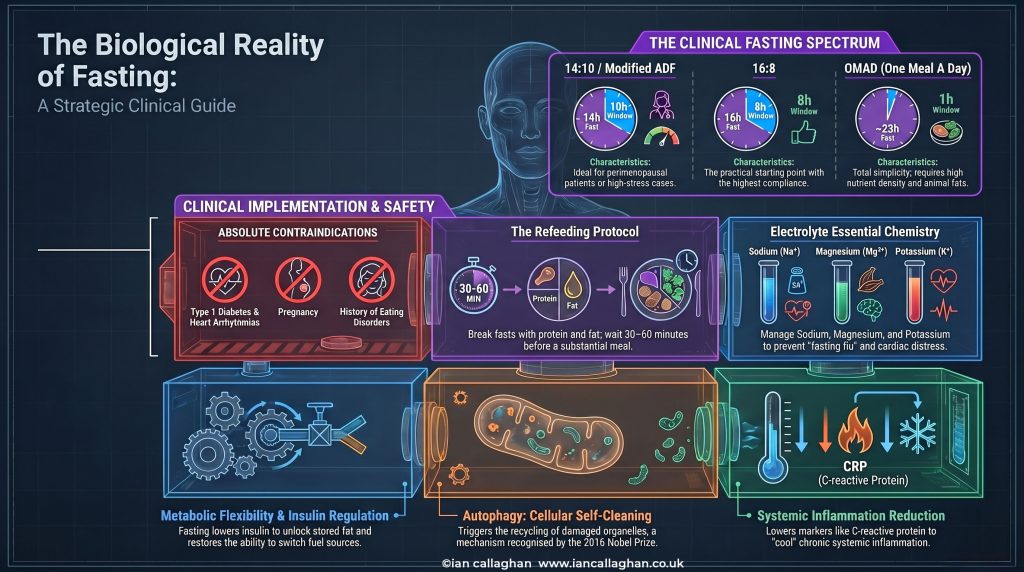
The bedrock of this reset is insulin regulation. Insulin is the body’s primary storage hormone. When you eat, insulin rises to move glucose into your cells. When you eat constantly, insulin remains perpetually elevated, effectively locking the doors to your adipose tissue (body fat). You cannot burn fat if insulin is high. It is biochemically impossible. Fasting forces a drop in insulin, which unlocks access to those fat stores and improves insulin sensitivity—the foundational requirement for reversing metabolic syndrome and glucose dysregulation.
As the source context explains:
“In a clinical context, fasting is a deliberate shift from the ‘metabolic noise’ of constant energy storage to a catabolic state of systemic maintenance and repair.”
This transition follows a rigorous physiological timeline. Within the first 12 to 24 hours of a fast, your system depletes its glycogen stores—the stored carbohydrates in your liver and muscles. The liver holds roughly 100 grams of glycogen, used to maintain blood sugar levels. Once these stores are exhausted, the body is forced to transition fully into fat oxidation and ketone production. This is the point where you stop running on what you just ate and start running on who you are. This shift is the definition of metabolic flexibility—the ability to switch seamlessly between burning glucose and burning stored body fat. If you never stop eating, you never develop this machinery. You become a metabolic “one-trick pony,” entirely dependent on the next hit of exogenous glucose.
2. Takeaway 2: The Nobel Truth of Autophagy (Cellular Housekeeping)
If weight loss is the headline that sells magazines, autophagy is the real story that matters for your healthspan. In 2016, the Nobel Prize in Physiology was awarded to Yoshinori Ohsumi for his work on autophagy. This is not fringe science or “biohacking” nonsense; it is a fundamental cellular mechanism that has been part of our biology since we were single-celled organisms.
Autophagy (from the Greek, meaning “self-eating”) is a “self-cleaning” process where cells, deprived of external nutrients, begin to break down and recycle their own damaged organelles and misfolded proteins. Think of it as cellular housekeeping. When the system is constantly fed, the body is too busy processing new energy to clear out the old debris. Fasting triggers the cleanup crew. The cell identifies a damaged mitochondrion or a protein clump, wraps it in a membrane (an autophagosome), and sends it to the lysosome to be broken down into raw materials.
This isn’t just about tidying up; it’s about survival. By clearing out cellular junk that would otherwise drive systemic decay, autophagy acts as a primary driver of healthspan extension. Furthermore, fasting activates the Migrating Motor Complex (MMC)—the gut’s “self-cleaning wave.” This process sweeps bacteria and undigested debris through the intestine. Constant grazing disrupts the MMC, contributing to bacterial overgrowth and bloating.
Finally, fasting provides neurological support by facilitating the production of Brain-Derived Neurotrophic Factor (BDNF). I call this “brain fertiliser.” BDNF supports neuron maintenance, protects against neuroinflammation, and provides the cognitive clarity that many fasters report after the initial adaptation period. This is why fasting is a sophisticated medical intervention, not just a way to fit into smaller trousers. It is the process of systemic renewal that only happens when you give the machinery a rest.
3. Takeaway 3: Hunger is a Sensation, Not a Crisis
The hardest part of fasting for most people isn’t the biology; it’s the “head stuff.” We have been conditioned by a multi-billion-pound food industry to treat the first hint of hunger as an emergency that requires immediate intervention. My experience in the Army taught me a vital lesson: discomfort is not danger. I remember being out on a 40-mile march, rucksack digging into my shoulders, stomach screaming for food, and my brain telling me I was going to collapse. But I didn’t. The body has reserves. The mind is the first thing that breaks, not the biology.
To master fasting, you must use the Emotional Observation Method to distinguish between different types of hunger. You must learn to sit with the sensation without being driven by it.
- Physical Hunger: This builds gradually. It’s a diffuse sensation in the body, often accompanied by a growling stomach. Crucially, it responds to any nutrient-dense food. If you wouldn’t eat a plain piece of steak or a boiled egg, you aren’t physically hungry.
- Emotional Hunger: This is sudden, urgent, and highly specific. This is a craving for comfort—usually processed carbohydrates or fats—to mask stress, boredom, or anxiety. It is the “I need chocolate now” feeling.
- Head Hunger: This is habit-based. It’s the signal your brain sends because it’s “lunchtime” or because the clock says you should be eating. It is governed by ghrelin, the hunger hormone, which follows your established eating patterns.
Most of what people feel in the first few weeks of fasting is not biological need; it is habit and expectation. You will likely experience an Adaptation Dip during the first 2–3 weeks. As your brain transitions from a constant glucose supply to fat-burning, you may feel “fasting flu,” irritability, and brain fog. This is not a sign of failure. It is temporary metabolic recalibration. Your brain is simply learning how to use a different fuel source. If you can observe these sensations using the Emotional Observation Method—noticing the trigger without reacting—they lose their power. Hunger is like a wave; it peaks and then it passes. You don’t have to drown in it.
4. Takeaway 4: The Industry is Selling You “Chemicals Dissolved in Sadness”
The “Wellness Theatre” is a multi-billion-pound industry designed to monetise a practice that is fundamentally free. They have taken a simple biological reality and buried it under a mountain of unnecessary products, proprietary powders, and complex protocols.
Let’s be blunt about the “support” products the industry pushes:
- Exogenous Ketones: Marketed as a “shortcut” to ketosis, these are often just expensive chemicals dissolved in sadness. Drinking ketones is not the same as the metabolic adaptation of producing them. When you drink them, you are a passenger in the car; when you fast, you are the driver learning how the engine works. Drinking ketones does not trigger the same cascade of metabolic benefits as actual fasting.
- Autophagy Activators: Most supplements claiming to “activate” autophagy are solutions to problems that real food and actual fasting solve for free. Spend your money on grass-fed meat, not “longevity” pills.
- The App Economy: Many fasting apps gamify the process with “streaks” and badges. This triggers the Obsession Trap, where the fast becomes a source of anxiety or a mechanism for punishment rather than a tool for health. These apps serve their own retention metrics, not your biology. If you feel shame for breaking a “window” to eat with your family, the app has become the master and you the slave.
A simple clock is the only technology required for fasting. Do not let the industry convince you that you need to open your wallet to close your mouth. The most effective metabolic tools—water, salt, and time—don’t have a marketing budget.
5. Takeaway 5: The “Breakfast Myth” and the 3-Hour Feeding Lie
We have been told for decades that “breakfast is the most important meal of the day.” This was not public health guidance; it was an advertising slogan for the cereal industry designed to move boxes of processed grains. There is no biological requirement to eat the moment you wake up. In fact, for most people, skipping breakfast is the most practical entry point into a 16:8 protocol.
Similarly, the advice to “eat every three hours to stoke the metabolism” is complete nonsense. The idea is that frequent eating keeps the “metabolic fire” burning through the thermic effect of food (TEF). However, TEF—the energy used to digest a meal—depends on the total calories consumed, not how many times you divide them up. Whether you eat 2,000 calories in one sitting or six, the metabolic cost of digestion is essentially the same.
The difference is that the person eating six times never gives their insulin levels a chance to drop. They stay in a perpetual state of “storage mode,” preventing fat burning and destroying their metabolic flexibility. Constant grazing leads to chronically high insulin and elevated markers of inflammation, such as C-reactive protein. Your body isn’t a furnace that needs constant stoking; it’s a sophisticated energy management system that requires periods of rest to function optimally.
6. Takeaway 6: The Exit is More Dangerous Than the Fast (Refeeding Protocol)
The most acute window of physical danger in fasting is not the fast itself, but the moment you break it—especially for protocols exceeding 48 hours. When your digestive system has been at rest, it becomes highly sensitised. Your insulin response is primed and ready to explode.
If you break a long fast with a high-carb or high-sugar meal—like a “healthy” fruit smoothie or a bowl of cereal—you trigger a massive, vertical insulin spike. This can lead to Refeeding Syndrome, a dangerous and potentially fatal condition where electrolytes—specifically potassium, magnesium, and phosphate—shift rapidly from the blood into the cells to help process the sudden glucose load. This sudden shift can cause acute cardiac failure, respiratory distress, and systemic collapse.
The Professional Refeeding Protocol:
- Protein and Fat First: Lead with the building blocks. Break the fast with a small amount of easy-to-digest protein and fat. Two eggs, a small piece of white fish, or a few slices of chicken. Avoid carbohydrates entirely in this first bite.
- The 30-60 Minute Rule: Wait 30 to 60 minutes after that first small bite. This allows your digestive system and your insulin signalling to “wake up” and stabilise before you consume a substantial meal.
- Manage Your Chemistry (The Essential Three):
- Sodium: As insulin drops during a fast, the kidneys excrete sodium rapidly. This is why people get “fasting flu.” A pinch of high-quality salt in water is a requirement, not a suggestion.
- Magnesium: Take magnesium glycinate before bed. It supports the nervous system and prevents the muscle cramps that often plague new fasters.
- Potassium: Do not supplement potassium heavily without medical supervision. Instead, source it from nutrient-dense real foods (like avocado or meat) during your eating window.
7. Takeaway 7: Seed Oils are Metabolic Disruptors
Fasting is not a “hall pass” for poor nutrition. If you fill your eating window with inflammatory, engineered junk, you are undermining the entire biological reset. In my 40 years as a chef, I’ve seen the industry shift away from traditional fats to cheap, industrial alternatives.
The most critical “forbidden” items in your window are industrial seed oils (rapeseed, sunflower, soybean, and corn oils). These are not just “unhealthy fats”; they are metabolic disruptors. They are highly unstable and prone to oxidation, driving the very systemic inflammation (measured by Interleukin-6) that fasting seeks to resolve.
More importantly, seed oils are engineered to override your satiety signals. They interfere with the hormones leptin and ghrelin, making it nearly impossible for your brain to register that you are full. If you break your fast with food cooked in rapeseed oil, you will likely overeat. If you want to achieve metabolic resilience, your eating window must be built on high-density animal fats (butter, tallow, lard) and whole, nutrient-dense foods. These fats support hormonal stability and provide the satiety that makes the next fasting window possible.
8. Takeaway 8: Walking is a Mandate, Not a Consolation Prize
Movement is the biological signal that tells your body to preserve its muscle tissue while it burns fat. If you are sedentary while fasting, you signal to your body that muscle is an unnecessary expense, and it may begin to break it down for amino acids.
The Metabolic Movement Guide:
- Walking: This is the primary tool for fat oxidation. A daily fasted walk—consistent and low-intensity, like my treks along the River Usk—burns fat without spiking cortisol or requiring heavy recovery. It is the most accessible metabolic tool in your arsenal.
- Resistance Training: This is the “signal” for muscle preservation. To keep your muscle, you must engage in regular resistance training. Fasting actually triggers a spike in growth hormone, but this only protects muscle if you hit your daily protein targets during your eating window.
- High-Intensity Training: Sprints or heavy lifting may require “fuelled” sessions if your fast exceeds 24 hours. If your performance consistently declines or your recovery is poor, adjust your window. You cannot train at peak intensity if your fuel tank is completely empty for days at a time.
9. Takeaway 9: Identifying the “Obsession Trap” and Psychological Risks
Fasting is a tool, not a religion. For some, the rules of fasting can be weaponised by the disordered part of the brain to justify unhealthy restriction. We must distinguish between Intentional Fasting (a tool of awareness) and Disordered Punishment (restriction driven by guilt or shame).
Absolute Contraindications (Do Not Fast If):
- Type 1 Diabetes: High risk of ketoacidosis and life-threatening hypoglycaemia.
- Heart Arrhythmias: Electrolyte shifts can destabilise cardiac rhythms, which can be fatal.
- Pregnancy and Breastfeeding: These are windows of extreme nutrient demand. Metabolic stress is contraindicated for both mother and child.
- History of Eating Disorders: Fasting structures can be neurologically weaponised to justify restriction. Head first, protocol second.
- Significantly Underweight: If you lack adipose reserves, you lack the buffer required to fast safely.
- HPA Axis Dysregulation (Perimenopause): For women in midlife, aggressive fasting can be a massive stressor. If you are struggling with cortisol, poor sleep, and high stress, a 16:8 or OMAD protocol might make things worse. Start with a gentler 14:10 window and focus on consistency over intensity.
Checklist for Unhealthy Restriction:
- Does eating outside a “window” produce disproportionate anxiety or panic?
- Is the fast used to “punish” or “compensate” for a previous meal?
- Does your self-worth fluctuate based on your adherence to the clock?
- Are you hiding your fasting patterns or lying to loved ones about your eating?
If you check these boxes, stop the protocol. Fasting should expand your life, not shrink it.
10. Tiered Implementation: The Progression to Mastery
Developing the metabolic machinery to fast requires a gradual runway. Jumping into advanced protocols like OMAD (One Meal A Day) without an adaptation period is a recipe for failure.
- Tier 1: Foundations (12:12 to 14:10): Start by delaying breakfast. This recalibrates hunger hormones (ghrelin and leptin) and teaches your nervous system that hunger is not an emergency.
- Tier 2: Intermediate (16:8): The professional standard. You fast for 16 hours and eat within an 8-hour window. This is manageable around work and family life while still initiating significant fat burning and insulin reduction.
- Tier 3: Advanced (OMAD): One meal a day, eaten in a roughly one-hour window. This offers total simplicity and continuous fat burning, but it requires that your single meal be exceptionally nutrient-dense. If you eat a “minimum viable meal,” you will accumulate deficiencies.
The first 14 to 21 days are the “danger zone”—the adaptation period where brain fog and irritability are common. Most people quit here because they mistake the brain learning to switch fuels for a signal of failure. It isn’t failure; it’s training.
Conclusion: Picking Up the Wrench
Fasting is one of the most effective tools in your arsenal, particularly in midlife when the metabolism you had in your twenties has shifted. But it requires brutal honesty. You have to be honest about what you’re putting in your mouth, honest about why you’re skipping a meal, and honest about whether you’re looking for a “hack” or a genuine change.
The wellness industry has lied to you by making this complex. It isn’t. It is the simple, gritty reality of biology. Stop looking for a subscription to save you. Stop looking for a guru to give you a glossy PDF. The banks of the River Usk don’t change because of a trend, and neither does your DNA.
Are you ready to stop looking for a hack and start doing the work of understanding your own biology? It’s time to strip away the commercial theatre. The practice is free. The biology is real. Consistency beats intensity every single time.
Pick up the wrench.
The Brutal Truth About Fasting
Cut through the fasting hype with raw, unfiltered truth. This no-bullshit guide exposes the good, the bad, and the ugly of fasting. Learn what really works, what’s dangerous, and why fasting isn’t for everyone. Perfect for midlifers, health seekers, and anyone tired of wellness industry snake oil.