What Happens When You Stop Drinking? A Real Recovery Timeline From Day One to One Year
Most people search “what happens when you stop drinking?” because something has already started to shift.
Maybe the hangovers are lasting longer. Maybe the sleep is broken. Maybe the anxiety has become harder to ignore. Maybe your face looks tired, your stomach is wrecked, your patience has gone, your weight has crept up, your blood pressure is not where it should be, or you are sick of having the same private conversation with yourself every morning.
You know the one.
That is it. I am done—no more. I need to stop.
Then evening arrives, the system changes state, and the old pattern starts selling again.
I drank for 45 years, so I am not writing this as some shiny wellness lad who did Dry January once and discovered herbal tea. I know what alcohol can do to a life when it stops being a drink and becomes a tool. A tool for switching off. A tool for reward. A tool for stress. A tool for not feeling what you do not want to feel. A tool for changing state quickly.
That is why stopping alcohol is not just about removing a substance. It is about watching the body, brain, nervous system, mood, sleep, skin, digestion, identity and daily routine start recalibrating without the chemical shortcut they have been used to.
This page gives you the recovery timeline, but not as a smug little detox calendar. Timelines are useful, but they are not commandments. Your body is not a spreadsheet. Your results will depend on how much you drank, how often you drank, your health, your age, your sleep, your food, your stress load, your medication, your liver function, your mental health and whether you are physically dependent on alcohol.
So use this as a map, not a courtroom verdict.
If you are a heavy or dependent drinker, do not stop suddenly without proper medical advice. Alcohol withdrawal can be dangerous. If you get shakes, sweats, seizures, hallucinations, confusion, severe anxiety, vomiting, rapid heartbeat, or feel physically unable to function without alcohol, speak to your GP, NHS 111, or a local alcohol support service before stopping. This is not a weakness. It is biology.
Quick answer: What happens when you stop drinking?
When you stop drinking, your body begins clearing alcohol, your liver starts reducing its workload, sleep architecture can begin to recover, hydration improves, blood pressure may reduce, digestion can settle, mood may become more stable, and your brain starts recalibrating its reward and stress systems. In the first few days, some people feel better quickly, while others feel anxious, tired, irritable or physically unwell, especially if they were drinking heavily. Over weeks and months, many people notice clearer thinking, better sleep, improved skin, weight loss, lower cravings, better relationships, more energy and reduced long-term risk from alcohol-related disease.
The first benefits can appear within days, but the bigger changes come from staying stopped long enough for the whole system to rebuild.
First, the medical bit nobody should skip.
Alcohol is one of the few substances for which withdrawal can be medically dangerous. That needs to be said clearly because too many people turn quitting into a pride contest.
If you drink heavily every day, drink in the morning to steady yourself, feel shaky or sweaty when you do not drink, need alcohol to feel normal, or have had withdrawal symptoms before, get medical advice before stopping. Severe withdrawal can involve seizures and delirium tremens, also known as DTs. That can become life-threatening.
Do not let shame stop you from getting help. Your body may have adapted to alcohol. If that has happened, stopping needs to be managed properly.
For some people, the safest route is a medically supported reduction or detox plan. For others, stopping may be uncomfortable but manageable. The point is not to guess. The point is to know what level of support you need.
Why does the body change so quickly when alcohol stops
Alcohol does not just affect one part of you. It hits multiple systems at once.
It affects the brain, liver, gut, blood sugar, sleep, hormones, immune function, mood, skin, heart, blood pressure and nervous system. It is not just “empty calories” or a bad habit. It is a toxic, psychoactive, dependence-producing substance, and it is classified as a Group 1 carcinogen.
That does not mean everyone who drinks is doomed. It means we need to stop pretending alcohol is just a harmless social lubricant with a bit of a headache attached.
When you stop drinking, you remove a major source of load. The body then starts doing what it is designed to do: clear, repair, rebalance, and adapt.
Some changes are fast. You stop adding alcohol, and the liver has less to process. Hydration improves. Sleep can begin to normalise. Blood sugar becomes less chaotic for some people. The gut gets a chance to settle. Inflammation can be reduced. Your face may look less puffy. Your mornings become clearer.
Other changes take longer. Brain chemistry, emotional regulation, cravings, confidence, identity and nervous system stability need time. You are not just waiting for alcohol to leave your blood. You are training the whole system to live without it.
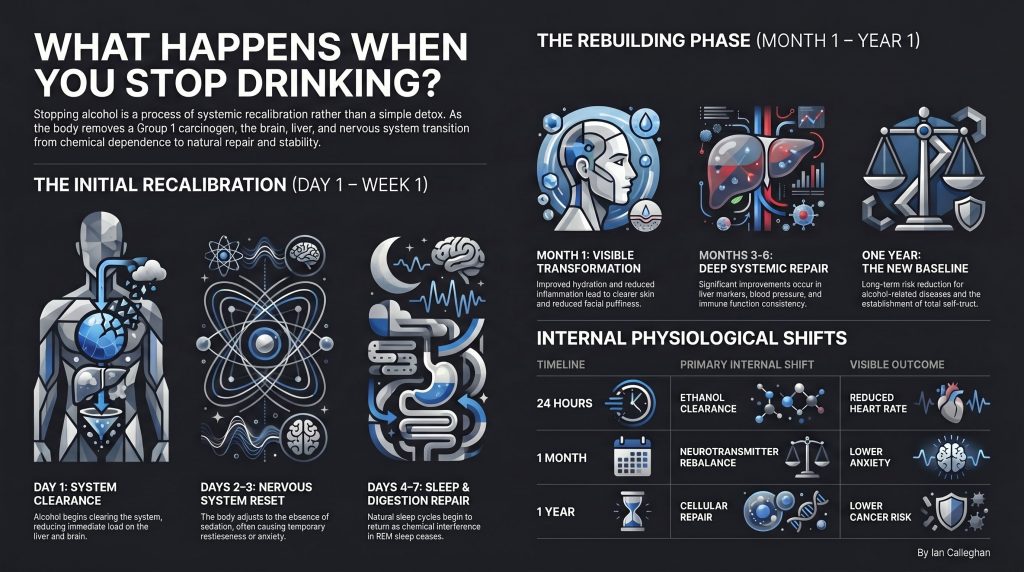
The first 24 hours after stopping drinking
In the first 24 hours, alcohol begins clearing from your system. If you were a lighter or occasional drinker, this stage may feel like a hangover fading. You may notice headache, thirst, tiredness, poor sleep, low mood or irritability, but you may also start to feel a small sense of relief that you have finally stopped adding more alcohol to the system.
If you were drinking heavily or daily, this stage can be more serious. Withdrawal symptoms can begin within hours. Anxiety, sweating, shaking, nausea, vomiting, racing heart, insomnia and agitation can all appear. This is where medical advice matters.
For many people, the first day is less about feeling amazing and more about stopping the damage from continuing. That might not sound glamorous, but it is massive. The body cannot properly recover while you keep throwing the same chemical load back into it.
The first win is simple: no new alcohol today.
That is not small. That is the first clean signal to the machine.
Days 2 to 3: the uncomfortable recalibration stage
Days two and three can be rough, especially if your body is used to regular alcohol. Some people feel clearer quickly. Others feel anxious, restless, tired, flat, emotional, sweaty, shaky or wired. Sleep can be poor. Dreams can be vivid. Mood can swing around. Cravings may come in waves.
This does not mean stopping is making you worse. It means the system is adjusting.
Alcohol changes how the brain handles calming and stimulating signals. When alcohol is removed, the nervous system can feel overactive for a while. This is one reason people can feel edgy, raw or unable to settle in the early days.
This is also where Bob, the internal salesman for the old pattern, often starts talking.
You will feel better if you have one.
You can taper yourself.
This is too hard.
You are not ready.
Start again next week.
The mistake is treating that voice as truth. It is not true. It is the old system trying to restore a familiar state.
During this stage, keep life simple. Eat properly. Hydrate. Rest where you can. Avoid unnecessary conflict. Do not sit in the same old drinking chair at the same old drinking time and expect your brain to behave differently. Change the environment. Change the pattern. Change the state.
If symptoms become severe, get medical help.
Days 4 to 7: sleep, digestion and mood begin to shift
By the end of the first week, many people start noticing small but important changes. The head may feel clearer. The stomach may feel less irritated. The face may look less bloated. Energy may come in flashes. Sleep may still be inconsistent, but the quality can start improving because alcohol is no longer disrupting the night in the same way.
This is one of the first big surprises for many people. Alcohol can make you unconscious, but it does not give you proper sleep. It fragments the night, disrupts REM sleep, affects breathing, increases dehydration and often leaves you waking at stupid o’clock with a racing mind and a dry mouth.
When alcohol goes, sleep does not always become perfect straight away, but the body at least gets the chance to sleep without being chemically interfered with.
This first week is also when people can feel emotionally exposed. Alcohol may have been muting stress, anger, sadness, loneliness or boredom. When it is removed, those feelings can seem louder. That does not mean sobriety is the problem. It means the old anaesthetic has gone.
The answer is not to panic. The answer is to build regulation: food, sleep, movement, daylight, connection, breath, cold water if it suits you, and enough structure to stop the evening turning into a negotiation.
Weeks 2 to 4: the visible changes start
By the second, third and fourth week, many people start seeing changes that are harder to dismiss.
Skin may look clearer because hydration is improving, and inflammation may be lower. Puffiness can be reduced. The eyes can look brighter. Digestion may settle. Energy can become more reliable. Blood pressure may improve for some people. Weight may start shifting, especially if alcohol was bringing extra calories, late-night food, poor sleep and lower activity with it.
But the bigger change is often in the mornings.
You wake up without the punishment cycle. No piecing together what you said. No checking your phone with dread. No bargaining with yourself at 5 am. No dragging a toxic fog into the first half of the day.
That alone is worth more than most people realise.
This stage can also bring cravings for sugar. That does not make you broken. Alcohol and sugar both interact with reward pathways. If you remove alcohol, the system may go looking for another quick hit. Do not turn that into another shame spiral. Stabilise your meals. Eat enough protein. Hydrate properly. Get minerals in. Do not try to run early recovery on restriction and self-hatred.
After 30 days: the first proper checkpoint
Thirty days alcohol-free is a serious checkpoint because it gives the body enough time to show you what life can feel like without constant alcohol interference.
Many people notice better sleep, more stable energy, clearer thinking, improved digestion, better skin, less facial puffiness, lower anxiety, more patience, better workouts or walks, and a stronger sense of self-respect. Not everyone feels brilliant by day 30, but almost everyone has gathered useful data.
You may also start noticing how much of your life has alcohol built into it. Friday night. Cooking. Watching television. Social events. Stress. Celebration. Boredom. Loneliness. Reward.
That awareness can feel uncomfortable, but it is powerful. You cannot change a pattern you cannot see.
For some people, day 30 is where confidence grows. For others, it is where complacency creeps in.
That is the dangerous bit.
You start feeling better, so Bob says you are fixed. You have proved the point. You can probably drink normally now.
Maybe you can. Maybe you cannot. But be honest about your history. If moderation has repeatedly failed, do not let one month of feeling better become the excuse that pulls you back into the same loop.
Months 2 to 3: the brain starts getting steadier
After the first month, the novelty can wear off. This is where the deeper work begins.
The body may feel better, but the mind can still be adjusting. Boredom, identity shifts, emotional flatness and social discomfort can show up. This is the phase where people often realise that quitting drinking is not only about not drinking. It is about rebuilding the life that alcohol used to sit inside.
The brain needs time to recalibrate reward, stress and motivation. If alcohol were your quick route to relief or excitement, normal life can feel quieter for a while. That does not mean something is wrong. It means your system is learning to recognise slower rewards again.
This is the time to build proper routines. Food that supports stable energy. Sleep that is protected. Movement that changes state. Mind work that helps you observe thoughts instead of obeying every one of them. Community or support that keeps you honest. A reason for staying stopped that is bigger than fear.
Many people notice improved concentration, better decision-making, less emotional reactivity and more reliable energy during this stage. They may also notice relationships changing because they are more present, less volatile, less avoidant and less wrapped around the next drink.
That is not magic. It is what happens when the system is not constantly recovering from alcohol.
Months 3 to 6: deeper repair and a new baseline
By three to six months, many people have moved beyond the obvious early wins and into a different kind of recovery.
The body has had more time to lower the alcohol-related load. Liver markers may improve for some people. Blood pressure and cholesterol can improve in some cases. Fitness often improves because sleep, hydration, energy and consistency are better. The immune system may function better because the body is not constantly dealing with alcohol’s effects.
This is also where self-trust starts becoming real.
You have been through evenings, weekends, birthdays, bad moods, stressful days, social awkwardness and probably a few moments where the old version of you would have drunk. Each time you do not, you teach the system something new.
You are not just abstaining. You are becoming a different operator.
This is where the Emotional Observation Method matters in my work. You stop treating every feeling as an emergency. You learn to observe the signal, notice the story, spot The Gate and choose a response that does not wreck tomorrow.
That skill is not only useful for alcohol. It changes how you deal with food, anger, stress, doomscrolling, conflict, fear, avoidance, and all the other ways humans try to escape discomfort.
Six months to one year: the long game starts paying you back
By six months to one year, the benefits can become less dramatic day-to-day but far more profound overall.
You may not wake up every morning thinking, “Look at me, I am alcohol-free.” It may simply become normal. That is the goal. Not white-knuckling and not performing recovery, and just living without alcohol running the operating system.
Long-term abstinence can reduce risk from alcohol-related harms. Cancer risk, liver disease risk, cardiovascular strain, blood pressure issues, poor sleep, anxiety cycles, weight gain and alcohol-related mood instability are all part of the bigger picture. No one gets a guarantee, but removing alcohol removes a major source of physiological stress.
The financial change can also be huge. Alcohol itself costs money, but the real bill often includes takeaways, taxis, lost days, poor decisions, missed work, impulse spending, health costs and time wasted recovering from something you paid to do to yourself.
Relationships can change, too. Some improve because you are more present, calmer and more consistent. Some become strained because the old bond was built around drinking. That can be painful, but it can also be clarifying.
By one year, many people are not just healthier. They are harder to fool. They have seen the trick. They understand that alcohol promised relief while quietly keeping them stuck.
What happens to your brain when you stop drinking?
The brain is one of the biggest reasons to stop drinking, and also one of the reasons early sobriety can feel strange.
Alcohol affects neurotransmitters involved in calm, reward, motivation, inhibition and emotional regulation. When you keep using alcohol to change how you feel, the brain adapts around that pattern. Remove alcohol, and the system has to rebalance.
At first, this can feel uncomfortable. Anxiety, irritability, flat mood, poor concentration or restlessness can happen. Over time, many people notice clearer thinking, better memory, improved focus, more stable mood and better decision-making.
The key phrase is “over time.”
People often expect the brain to reward them immediately for stopping. Sometimes it does. Sometimes it sulks first. If alcohol has been used for years as a shortcut to relief, reward or escape, the brain needs time to trust normal life again.
That is why structure matters. Sleep, food, movement, daylight, social connection and meaningful work all help create a new baseline. You are not just waiting for the brain to heal. You are giving it better inputs.
What happens to your skin when you stop drinking?
Skin is often one of the first visible places people notice change.
Alcohol is dehydrating and can contribute to inflammation, poor sleep, puffiness and broken-looking skin tone. When you stop drinking, hydration can improve, sleep can improve, inflammation may reduce, and the face can look less swollen or tired.
People often talk about the “sober glow.” I am not a fan of turning everything into a cute little phrase, but there is a real reason people look different when they stop poisoning their sleep, hydration and liver every week.
Better skin is not vanity. It is often an outward sign that the internal load is dropping.
What happens to your liver when you stop drinking?
The liver is one of the body’s great repair organs, but it is not indestructible.
Alcohol puts direct pressure on the liver. Fatty liver, inflammation, hepatitis, fibrosis and cirrhosis are all part of the alcohol-related liver disease picture. The earlier you stop, the greater the chance the liver has to recover, depending on the extent of damage already done.
For many people, liver function can improve after stopping drinking, especially when the damage is at an earlier stage. If you already have liver disease or abnormal liver tests, you need proper medical guidance. Do not guess. Get checked.
The important point is simple: every alcohol-free day removes another hit the liver has to process.
What happens to your weight when you stop drinking?
Weight change after quitting alcohol depends on the person, but there are several reasons people often lose weight.
Alcohol brings calories, but that is only part of the story. It also lowers inhibition, worsens sleep, affects appetite, encourages late-night eating, disrupts training consistency and can make the next day a write-off. For many people, the real weight gain is not just the wine, beer or spirits. It is the whole behavioural chain that follows.
Stop drinking, and that chain starts breaking. You may eat better, sleep better, move more, cook more, crave less junk over time and stop losing mornings to recovery mode.
Some people gain weight at first because sugar cravings rise or food becomes the replacement reward. Do not panic. Stabilise the system first. Then refine.
Early sobriety is not the time to starve yourself into another form of misery.
What happens to anxiety when you stop drinking?
Alcohol can feel like it reduces anxiety in the moment, but for many people, it increases anxiety overall.
That next-day dread, often called hangxiety, is not imaginary. Alcohol can disrupt sleep, blood sugar, neurotransmitters and stress chemistry. You may drink to calm down, then wake up with the system more dysregulated than before.
When you stop drinking, anxiety may improve over time, but it can also spike in the early stage, especially if alcohol was your main coping tool. That does not mean sobriety is failing. It means the old anaesthetic is gone and the nervous system needs new regulation.
This is where breathwork, walking, cold water if appropriate, therapy, coaching, journaling, sleep, proper food and reducing caffeine can all matter. You need to give the body reasons to feel safe without alcohol.
Abstinence or moderation: which is better?
This is where people love to argue.
Some people can moderate. Some cannot. The honest answer depends on your history.
If you can genuinely have one or two drinks occasionally, stop without negotiation, experience no harm, feel no pull. Alcohol does not occupy mental space, so that moderation may be possible for you.
But if you have repeatedly tried to cut down and failed, made rules and broken them, promised yourself only weekends and moved the goalposts, switched drinks, changed brands, changed pubs, changed start times, downloaded trackers, deleted trackers, lied to yourself or felt relief at the idea of “controlled drinking” because it still keeps alcohol available, then be honest.
For many people, moderation is not freedom. It is an administration.
It keeps the argument alive. When can I drink? How much? Have I earned it? Is this a special occasion? Does this count? Can I reset tomorrow? Have I been good enough to have one?
Abstinence removes the negotiation.
That does not mean it is easy. It means it is clear.
From a health perspective, the old idea that moderate drinking is protective has been seriously challenged, especially around cancer risk. Alcohol is linked to several cancers, and the World Health Organisation has stated that no level of alcohol consumption is safe for health in relation to cancer risk. That does not mean everyone will make the same choice, but people deserve honest information, not romantic nonsense about a daily glass being a wellness practice.
For me, abstinence gave me something moderation never could: silence from the argument.
Reasons to stop drinking that people do not talk about enough
The obvious reasons are health, money, sleep, weight, liver, heart, brain and relationships. They matter, but they are not the whole story.
One of the biggest reasons to stop drinking is self-trust. Every time you make a promise to yourself and break it, something inside you is listening. Every time you keep one, something rebuilds.
Another reason is time. Alcohol steals more than the drinking hours. It steals mornings, motivation, patience, attention, weekends, recovery days and the quiet confidence that comes from being fully available to your own life.
Another reason is emotional honesty. Alcohol can delay feelings, but it does not delete them. It stores them. Then they leak out as anxiety, anger, numbness, avoidance, poor sleep or the sense that something is wrong even when life looks fine on paper.
Stopping drinking gives you a chance to meet yourself without the filter. That can be uncomfortable. It can also be the beginning of a completely different life.
Quick recovery timeline after stopping drinking
This is a simplified guide. Your timeline may differ.
First 24 hours: Alcohol begins clearing. Hangover symptoms may fade for lighter drinkers. Withdrawal symptoms may begin for dependent drinkers.
Days 2 to 3: The nervous system may feel unsettled. Anxiety, poor sleep, sweating, irritability, cravings or low mood can appear. Severe symptoms need medical help.
Days 4 to 7: Sleep, digestion, hydration, and energy may start to improve. Emotions may feel more exposed because alcohol is no longer muting them.
Weeks 2 to 4: Skin may look better, bloating may reduce, mornings often become clearer, cravings may change, and confidence can grow.
One month: Many people notice better sleep, clearer thinking, more stable mood, improved digestion, weight changes and reduced hangxiety.
Three months: Deeper changes in routine, concentration, energy, emotional regulation and self-trust often become more noticeable.
Six months: Fitness, sleep, mood, relationships and identity can feel more stable. The alcohol-free life starts becoming less of a project and more of a baseline.
One year: Long-term health risk reduction, stronger identity, financial savings, clearer thinking and deeper self-respect can become part of normal life.
Frequently asked questions about what happens when you stop drinking
What happens to your body first when you stop drinking?
The first change is that your body starts clearing alcohol and reducing the immediate load on the liver, brain, gut, sleep system and nervous system. Some people feel clearer quickly. Others feel tired, anxious, shaky or unwell, especially if they were drinking heavily. If withdrawal symptoms are present, get medical advice.
How long after quitting alcohol do you feel better?
Some people feel better within a few days, especially with clearer mornings, better hydration and less hangover anxiety. Others feel worse before they feel better because the nervous system is recalibrating. Many noticeable benefits appear within weeks, while bigger changes in mood, sleep, brain function and identity can take months.
What are the benefits of quitting alcohol for 30 days?
After 30 days, many people notice better sleep, clearer skin, less puffiness, improved digestion, steadier mood, reduced anxiety, more energy, weight changes and better self-trust. It is also enough time to see how much of daily life has alcohol built into it.
Does your liver heal when you stop drinking?
The liver can often improve when alcohol is removed, especially in earlier stages of alcohol-related damage, such as fatty liver. More serious liver disease needs medical assessment and monitoring. If you are worried about liver health, speak to your GP and ask for proper testing.
Why do I feel anxious after stopping drinking?
Alcohol can temporarily reduce anxiety while making the overall anxiety cycle worse. When you stop, the nervous system may feel raw for a while because alcohol is no longer muting it. Sleep, food, movement, breathwork, support and time can all help the system stabilise.
Will I lose weight if I stop drinking?
Many people lose weight after stopping alcohol because they remove alcohol calories, sleep better, eat better, move more and avoid the late-night food chain that often follows drinking. Some people gain weight at first if sugar cravings increase. Stabilise the system before trying to perfect everything.
What happens to your skin when you stop drinking?
Skin can look clearer, less puffy and better hydrated after quitting alcohol. This is often linked to improved hydration, better sleep and reduced inflammation. The change varies, but many people notice a visible improvement within weeks.
Is moderation as good as quitting alcohol?
It depends on the person and the outcome you want. Some people can moderate. Others turn moderation into a constant negotiation. From a health-risk perspective, especially around cancer, alcohol is not harmless even at low levels. If moderation has repeatedly failed for you, abstinence may be clearer and easier long-term.
Why do cravings come in waves?
Cravings are linked to habit, reward, environment, stress, blood sugar, emotion and memory. They often rise, peak and pass. The danger is not the craving itself, but the story the mind builds around it. Spot the signal early, change state, and do not give the internal salesman the microphone.
What is the biggest unexpected benefit of quitting alcohol?
For many people, the biggest unexpected benefit is not weight loss, better skin or saved money. It is self-trust. You start proving to yourself that you can keep a promise, change a pattern and live without needing alcohol to alter your state.
Final word
What happens when you stop drinking is not just a body timeline. It is a life timeline.
Yes, your liver gets less load. Your sleep can improve. Your skin can change. Your brain can become clearer. Your blood pressure may improve. Your anxiety may reduce. Your weight may shift. Your risk of alcohol-related harm can go down.
But the bigger change is this: you stop outsourcing your state to a substance that was quietly charging you more than it ever gave back.
That is the real recovery.
Not becoming perfect. Not becoming boring. Not turning into a smug alcohol-free saint. Just becoming someone who no longer needs to pour a chemical over ordinary life to get through it.
I quit after 45 years by understanding the machine, not by hating myself harder. That is the work I teach through Sober Beyond Limits, Under Load, The Emotional Observation Method and my wider Midlife Reset approach.
If alcohol is still costing you sleep, health, mood, money, confidence, relationships or peace, your body is already giving you information.
The question is whether you are ready to listen.
Sober Beyond Limits
A technical manual for high-functioning drinkers who don’t fit the wellness industry’s idea of who needs help. Built from 45 years inside the problem and 12 years in the British Army. “Not Borrowed Theory”