If you’re raiding the kitchen every night, it’s not weakness. Here’s what your gut bacteria, dopamine system, and blood sugar are actually doing to your sugar cravings at night.
iancallaghan.co.uk
It’s 3 am. Or it’s 9 p.m., or it’s that specific dead hour after dinner when the sugar cravings at night kick in and suddenly you’re standing in front of the fridge or the biscuit cupboard, wondering what the hell is wrong with you.
Maybe it was the wine you said you weren’t having. Maybe it was the third takeaway this week. Maybe it was the chocolate you’d hidden from yourself and found anyway. And now you’re doing the one thing guaranteed to make it worse: telling yourself you’re weak.
You’ve got no discipline. No backbone. Everyone else seems to manage it. What the hell is wrong with you?
Nothing. Absolutely nothing is wrong with you.
What’s wrong is the story you’ve been sold. The idea that cravings at night are a test of character, that the people who resist them are made of stronger stuff, that if you just wanted it badly enough, you’d be fine. That story is not only wrong but also one of the most damaging myths in modern health. It keeps people trapped, ashamed, and cycling through the same failures for years.
Cravings are not a moral failing. They are a biological signal. And most of the time, the biology has been rigged against you.
This is the piece no one showed you. Let’s fix that.
02 — THE WILLPOWER LIE
The Willpower Narrative Was Built to Sell You Something
The willpower myth didn’t emerge from science. It emerged from convenience. It’s an extraordinarily useful story if you’re trying to sell diet plans, supplements, 30-day challenges, or self-help books. If the problem is your lack of discipline, the solution is always another product. Another programme. Another attempt to white-knuckle your way through the next few weeks until you inevitably break.
The diet industry is worth over £70 billion globally. It has an enormous financial interest in you believing the problem is you. Because if the problem is your biology, if cravings are the output of a system that’s been chemically manipulated and nutritionally starved, then the solution isn’t a new app or a meal replacement shake. The solution is to understand what’s actually happening inside you and to change the conditions that create the signal.
That doesn’t sell subscriptions. So they keep blaming your willpower instead.
And here’s the kicker. Willpower itself is a finite resource. It depletes throughout the day. It degrades with poor sleep, high stress, elevated cortisol, and blood sugar instability. So even if willpower were the mechanism, which it isn’t, stacking it against a body running on four hours of kip, a blood sugar crash, and a gut microbiome screaming for quick energy is a fight you were never going to win.
You were fighting biology with belief. That’s not a fair contest.
03 — THE GUT-BRAIN AXIS
Your Gut Is Talking to Your Brain. You Just Don’t Know What It’s Saying.
Here’s the piece that changes everything when people actually hear it.
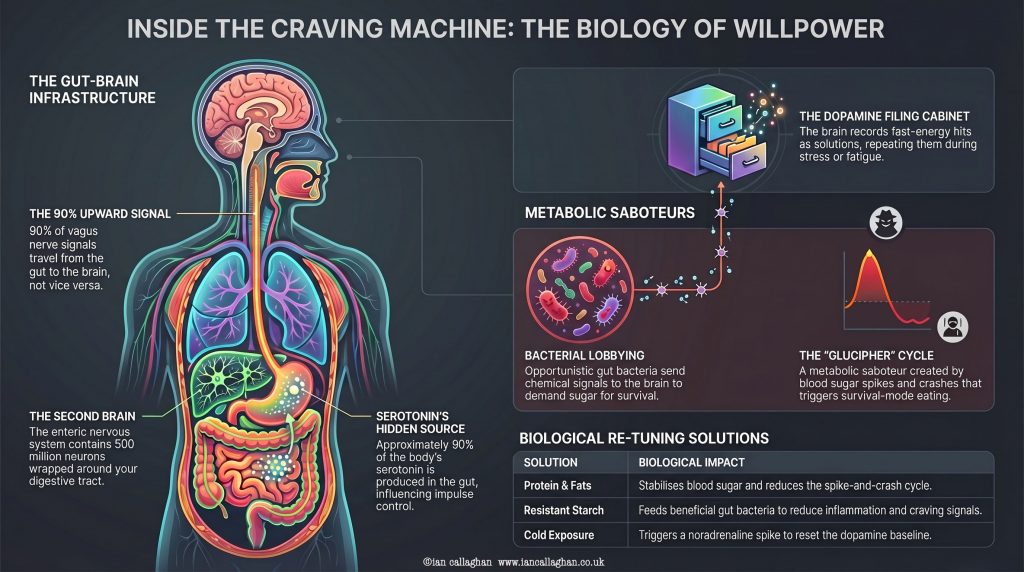
You have two nervous systems. The one in your head and spine that you know about, and a second one wrapped around your digestive tract, called the enteric nervous system. Around 500 million neurons. Not as many as your brain, but more than your spinal cord. This thing has been called the second brain, and the name fits.
These two systems talk to each other constantly through the vagus nerve, a long wandering nerve that runs from your brainstem all the way down through your chest and into your gut. And here’s what most people never get told: roughly 90% of the signals on that vagus nerve travel upward. From gut to brain. Not the other way around.
| THE BIOLOGY Approximately 90% of serotonin in the human body is produced in the gut, not the brain. Serotonin is involved in mood regulation, appetite signalling, and impulse control. Your gut bacteria influence how much serotonin gets made, how it gets metabolised, and how effectively the vagus nerve carries those signals upward. When your microbiome is out of balance, your serotonin production is compromised. When your serotonin is compromised, your mood drops, your impulse control weakens, and the craving signals get louder. |
The bacteria in your gut are not passive passengers. They are metabolically active organisms with their own survival interests. And some of them, particularly the opportunistic strains that thrive on sugar, refined carbohydrates, and alcohol, produce chemical signals that influence your food preferences. They effectively lobby your brain for the fuel that keeps them alive.
Candida overgrowth drives sugar cravings. Certain pathogenic bacterial strains drive cravings for the fermentable fibres and simple carbohydrates that help them reproduce. This isn’t a metaphor. These are real chemical signals travelling up a real nerve into a brain that then tells you it desperately needs a Kit Kat at half ten on a Tuesday night.
That is not a willpower problem. That is a microbiome problem.
04 — WHAT CRAVINGS ACTUALLY ARE
Why Sugar Cravings at Night Are a Biological Event, Not a Choice
Let’s break down what actually happens when a craving fires.
Your brain has a reward prediction system built around dopamine. When you eat something that gives you a hit of fast energy, particularly sugar or alcohol, your brain registers that as a solution to a problem. It files it away. Next time your blood sugar drops, next time you’re stressed, next time your cortisol spikes, the brain goes to the filing cabinet and says: last time we felt like this, that thing worked. Do that.
This is not weakness. This is ancient, efficient survival programming. The problem is that it was built for a world where the most calorically dense thing available was a handful of wild berries. It was never built for a world where every petrol station sells a wall of ultra-processed, laboratory-engineered food designed specifically to light up that exact system.
| BLOOD SUGAR AND THE CRAVING LOOP When blood sugar drops rapidly, particularly after a high-carbohydrate meal, it causes a spike followed by a compensatory insulin response. The body experiences what feels like an emergency—cortisol and adrenaline rise. The brain begins prioritising fast fuel. The craving that follows is not psychological indulgence. It is the hormonal output of metabolic instability. Fix the blood sugar, and you eliminate a huge proportion of the craving signal. |
Add chronic stress into this, and you’ve got a perfect storm. Cortisol drives the brain toward high-reward, low-effort solutions. It narrows your decision-making to short-term thinking. It literally reduces activity in the prefrontal cortex, the part of your brain responsible for long-term planning and impulse regulation. A chronically stressed person fighting cravings is doing it with reduced neurological capacity for exactly the kind of thinking that resisting cravings requires.
And then someone tells them they lack willpower.
05 — GLUCIPHER’S ROLE
Why You Crave Sugar and Alcohol at Night: Meet the Metabolic Saboteur
I talk about Glucipher a lot with my clients and in my community because it puts a face on the process. Glucipher is what I call the metabolic saboteur, the feral little bastard that represents the chaos of unstable blood sugar, chronic insulin elevation, and the chemical noise it generates throughout your body and brain.
When Glucipher is running the show, your energy is a rollercoaster. You wake up foggy. You need something sweet or starchy by mid-morning. You crash after lunch. You get a second wind of fake energy in the afternoon, followed by a wall at 3 p.m. By evening, you’re raiding the kitchen not because you’re greedy but because your blood sugar has crashed, your cortisol has spiked to compensate, and your brain is now operating in survival mode, screaming for fast fuel.
| GLUCIPHER AT WORKA typical Glucipher day looks like this: high-carb breakfast or no breakfast at all, blood sugar spikes then crashes, mid-morning hunger and irritability, high-carb lunch to fix the crash, post-lunch insulin dump and afternoon fatigue, cortisol spike by 4 pm, evening sugar or alcohol craving, late night eating or drinking to “relax”, disrupted sleep, elevated fasting glucose by morning. Repeat, indefinitely, while someone tells you it’s a discipline problem.Glucipher doesn’t care about your goals. He cares about blood sugar. He will blow up every plan you make until you change the metabolic conditions that keep him fed. |
The alcohol connection here is particularly brutal. Alcohol is processed by the liver similarly to fructose. It causes a blood sugar spike followed by a crash. It disrupts sleep architecture, raising cortisol the next day, worsening insulin sensitivity, and making you more likely to crave sugar and alcohol the following night. It also destroys gut bacteria diversity, particularly the beneficial strains, while feeding the opportunistic ones that generate craving signals.
So when someone tells you alcohol cravings are about willpower, understand what they’re actually describing: a cascading biological loop that is self-reinforcing at every level. Microbiome disruption is driving serotonin instability, driving mood drops, driving blood sugar chaos, driving dopamine-seeking, driving the craving for the exact substance that started the problem. That is not a character flaw. That is a trap with a biological lock.
06 — WHAT ACTUALLY FIXES IT
The Things That Actually Work
This is not a prescription. This is what the evidence points to and what I have watched work, in myself and in the people I work with, over many years. None of it is particularly complicated. Most of it runs directly against what you’ve been sold.
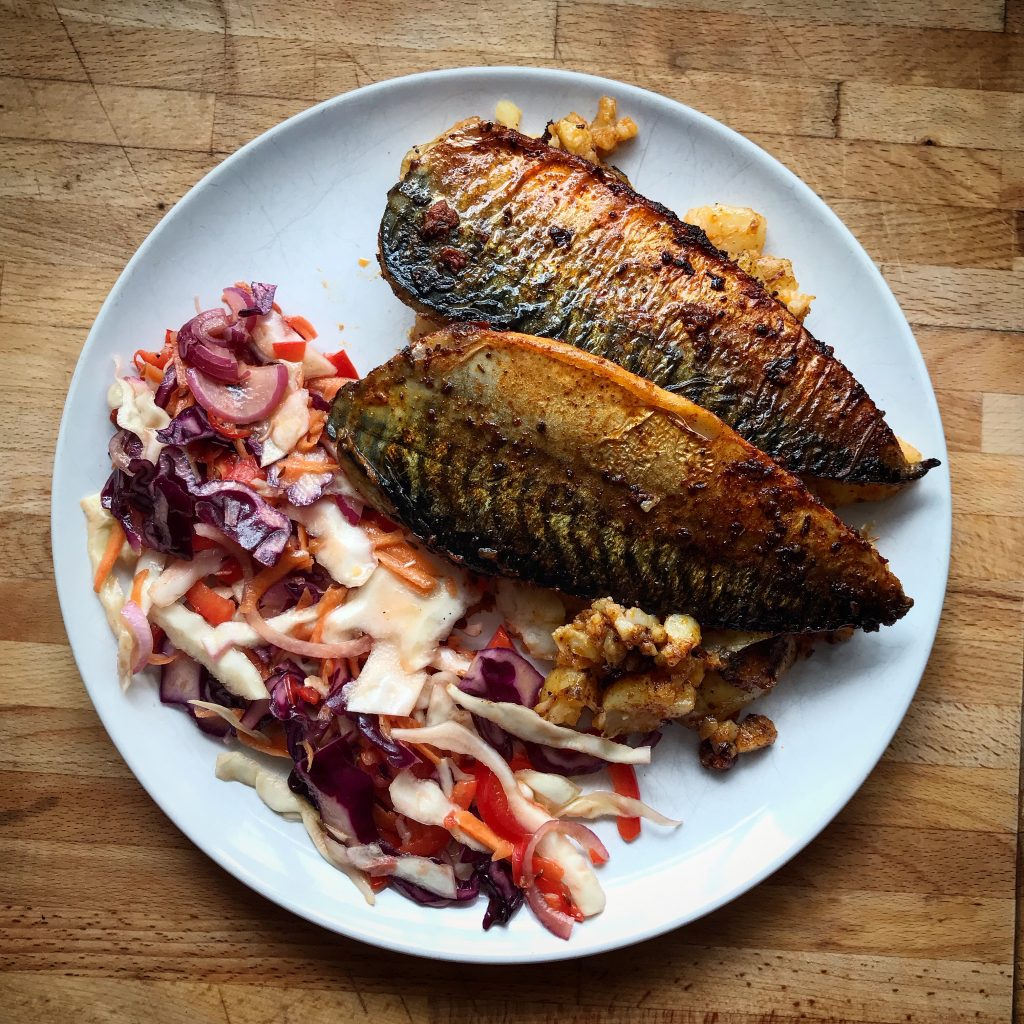
| Real food, full stop Protein and fat at every meal stabilise blood sugar and reduce the spike-and-crash cycle that powers most cravings. Liver, eggs, bone broth, oily fish, and good-quality meat. Not expensive, not complicated. | Resistant starch Feeds beneficial gut bacteria directly. Cooked and cooled potatoes, green bananas, oats. The beneficial strains that grow on this produce butyrate, which reduces gut inflammation and improves the gut-brain signalling that regulates cravings. |
| Sleep One night of poor sleep raises ghrelin (the hunger hormone) and lowers leptin (the satiety signal) the following day. Sleep debt does not accumulate gracefully. It accumulates as craving volume turned up to eleven. | Fasting window Extending the overnight fast to 14-16 hours gives the gut lining time to repair, reduces inflammatory bacterial load, and stabilises insulin across the day. Doesn’t have to be OMAD. Just stop grazing. |
| Cold exposure Cold water immersion drives a noradrenaline spike that reduces craving intensity, improves mood, and resets the dopamine baseline. Not comfortable. Extremely effective. | Mind-body practice Breathwork, meditation, and somatic practices directly stimulate the vagus nerve, improving gut-brain communication and reducing the stress response that amplifies cravings. This is physiology, not spirituality. |
None of these requires products. None of them requires a gym membership, a coach or an app. They require understanding why they work, which is what you now have, and the willingness to change the conditions rather than keep fighting the symptoms.
07 — THE CLOSE
You’re Not Broken. You Were Given Broken Information.
I spent years thinking I was the problem. That somewhere along the line, I’d been issued a faulty set of brakes, that everyone else had this thing figured out, and I was just weak.
Because if you believe you’re the problem, you keep attacking yourself. You run the shame spiral every time you cave. You build a narrative of failure around a biological process that was never fully in your control to begin with. And shame, by the way, does nothing to reduce cravings. Physiologically, shame is a stress response. It raises cortisol. It worsens blood sugar regulation. It turns the volume up on the exact signals you’re trying to quiet.
The exit is not a matter of willpower. The exit is understanding the system and changing the conditions.
Your gut bacteria can change composition within 24 to 48 hours of dietary change. Blood sugar instability can be significantly improved within a few days of removing the foods that cause the swings. Sleep quality improves rapidly when the gut inflammation driving it is addressed. Dopamine baseline recalibrates when you stop overloading the reward system with artificial stimuli.
This is not a slow road. The biology responds faster than you think. But it responds to the right inputs, not to self-loathing.
You have not been failing. You have been fighting the wrong battle with the wrong tools, while being told the problem was you.
Now you know better. Do something different with that.
If this landed, share it with someone who needs to hear it. And if you’re ready, actually to change the conditions rather than manage the symptoms, the Midlife Reset community is where that work happens. Link in bio.
Under Load by Ian Callaghan | The Mechanical Guide to Addiction Recovery
You already know what you’re doing. You’ve known for years.
Metabolic Sovereignty: Silence Food Noise & Fix Your Metabolism
Tired of the “Food Noise” and the afternoon energy crash?