Anhedonia After Quitting Alcohol: Why Everything Feels Grey and What Actually Fixes It
TL;DR | Anhedonia After Quitting Alcohol
Anhedonia After Quitting Alcohol. You stopped drinking, and instead of feeling amazing, you feel nothing. Flat. Grey. Like someone turned the colour down on your life. That’s anhedonia, and it’s not depression, it’s not weakness, and you haven’t broken yourself permanently. It’s a predictable neurochemical consequence of what alcohol did to your dopamine system over the years of drinking. The grey lifts. But only if you understand what’s causing it and give your brain what it actually needs to rebuild. This post explains the mechanism, the honest timeline, and the specific things that accelerate recovery. None of it involves a twelve-step programme or a rehab centre.
You quit drinking, and you expected to feel better.
Everyone said you would—the health content, the sobriety influencers, the before-and-after stories. Better sleep. More energy. Clearer skin. Sharper mind. Pride in yourself. A sense of freedom you’d forgotten existed.
What you got instead was grey.
Not sad, exactly. Not depressed in the way you’d recognise it. Just flat. Like someone reached into your chest and turned the dimmer switch down on everything. Food tastes fine, but doesn’t excite you. Things you used to enjoy feel like going through motions. You sit in a room full of people you love and feel weirdly disconnected from it all. Sunday morning comes,, and instead of being relievedthat you didn’t drink last nigh,t, you feel a low, ambient nothint you can’t name or explain.
And the thought creeps in: what if this is what sober life feels like? What if I’ve been using alcohol to feel anything at all for so long that without it I’m… this?
I know that thought. I sat inside it.
I drank for 45 years. Not always heavily, not always chaotically, but consistently, and for long enough that my brain had completely rewired itself around alcohol as its primary source of reward. When I stopped, over 17 months ago now, the relief lasted about three weeks. Then the grey arrived, and I didn’t have a name for it or a framework for understanding it, which made it significantly harder to sit with than it needed to be.
This post is what I wish someone had handed me then. Not a list of coping strategies. Not a mindfulness exercise. The actual mechanism. Because once you understand what’s happening in your brain, the grey stops feeling like a life sentence and starts feeling like what it actually is: a repair process with a timeline.
What Anhedonia Actually Is
Anhedonia is the clinical term for the inability to feel pleasure. Not reduced pleasure. The absence of it, or close enough to absence that the difference doesn’t matter much when you’re living through it.
It shows up in early sobriety as a very specific cluster of experiences. Nothing feels worth looking forward to. Hobbies feel hollow. Social connection feels effortful and unrewarding. You can laugh at something and register that it’s funny without actually feeling the laugh. Music you used to love plays in the background of your life like it’s happening in another room.
It is also, without question, one of the leading drivers of relapse. Not cravings in the dramatic sense. Just the quiet, daily conclusion that sober life doesn’t feel like anything and drinking at least felt like something. That’s how powerful this state is. That’s how important it is to understand it before it makes that argument to you.
What Alcohol Did to Your Dopamine System
To understand anhedonia, you have to understand what alcohol was doing to your brain’s reward system for all those years, and the maths on it is genuinely quite confronting.
Dopamine is your brain’s primary reward and motivation chemical. It’s released in response to biologically meaningful stimuli: food, sex, connection, achievement, and novelty. When dopamine hits your reward circuit, you feel pleasure, motivation, and the drive to repeat the behaviour. This is how humans are supposed to experience life. Small, real, accumulated dopamine hits from real activities.
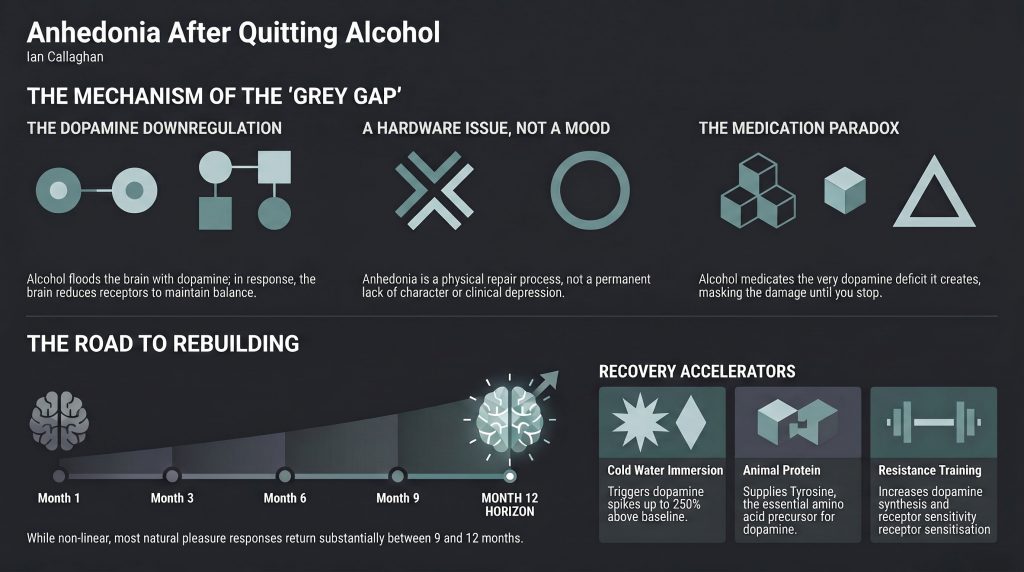
Alcohol floods your dopamine system with an artificially enormous surge, far beyond what any natural activity produces. The first drink releases dopamine at a level your brain was not designed to generate through any normal means. That’s why it feels good. That’s why the first few drinks of an evening carry that particular quality of warmth and ease and rightness that nothing else quite replicates.
But your brain is always trying to maintain balance. It’s a regulatory system before anything else. So in response to these repeated massive dopamine floods, it does two things. It reduces the number of dopamine receptors, because there’s so much dopamine around that it doesn’t need as many doors for it to pass through. And it reduces its own baseline production of dopamine, because the alcohol is doing the job for it.
Over months and years of regular drinking, this becomes profound. Your brain has essentially rebuilt itself around the presence of alcohol as its primary dopamine source. The reward system recalibrates so that normal life activities produce almost no dopamine response at all, not because those things aren’t good, but because the brain’s sensitivity to natural dopamine signals has been so dramatically downgraded.
Now you stop drinking.
The alcohol is gone. The artificial dopamine flood stops. But your brain still has a depleted receptor count and reduced baseline production capacity. It’s running on a reward system that’s been stripped back to handle massive chemical inputs, and now those inputs aren’t coming. The result is a brain that is genuinely struggling to generate meaningful pleasure responses to anything.
That’s anhedonia. It’s not a mood. It’s hardware.
The Timeline: What the Research Actually Says and What I Actually Experienced
Here’s where most content on this topic fails people: it either doesn’t give a timeline at all or gives one so vague it’s useless.
The honest answer is that it varies, and it varies significantly based on how long and how heavily you drank, your age, your general health, your gut microbiome, your sleep quality, your nutrition, and whether you’re actively doing the things that accelerate dopamine system recovery or just white-knuckling your way through it.
But here’s a reasonable, honest framework based on research and on 17 months of my own experience.
In the first two to four weeks after stopping, you’re still in the acute withdrawal phase. The anhedonia during this period is at its most severe and is compounded by the GABA rebound, cortisol dysregulation, and sleep disruption. Everything feels terrible in a more acute, physical way. This is not purely anhedonia. This is your whole system in shock.
From weeks four to twelve, the acute symptoms settle, but the dopamine deficit becomes more apparent rather than less. This is the period when a lot of people say they felt better for a bit, then got worse again. They didn’t get worse. The acute noise quieted, revealing the underlying flatness that had been there all along. This is the period I found hardest, because the obvious physical suffering had passed, and yet there I was still feeling nothing, and that felt more permanent and more personal than the physical symptoms had.
From three to nine months, most people experience a gradual, non-linear improvement. Non-linear is important because it doesn’t feel like a steady climb. It feels like occasional days where something breaks through, where a piece of music lands properly, or food actually tastes like something, or you catch yourself genuinely laughing, followed by more grey days. The breakthrough days become more frequent. The grey days become shorter.
Beyond nine months, the majority of people report that natural pleasure responses have substantially returned, though often qualitatively different to what alcohol-mediated pleasure felt like. Not worse. Just different. More real. Less chemical. A bit quieter at first, then increasingly rich.
At seventeen months, I can tell you this: I feel more than I have felt in decades. Not in a dramatic converted way. Just in a straightforward biological way. Food tastes better. Cold water in the River Usk at 6 am hits like something meaningful. A good conversation lands properly. None of that was available to me when my dopamine system was being run by alcohol.
But the grey period between stopping and getting there was real, and it was long, and I would have navigated it significantly better if I had understood what was happening.
What Makes Anhedonia Worse in Sobriety
Several things compound the dopamine deficit and extend the grey period. Worth naming them plainly.
Poor sleep is a major one. Dopamine production is heavily dependent on sleep quality, particularly deep slow-wave sleep. If you’re not sleeping well, which is extremely common in early sobriety because alcohol disrupted your sleep architecture for years and your brain has to relearn how to sleep without chemical assistance, your dopamine recovery is being throttled at the source. Fixing sleep is not optional if you want the grey to lift faster.
Ultra-processed food makes it significantly worse. This is the one that surprises people. UPFs are engineered to trigger a cheap, fast, sharp dopamine response through hyperpalatable combinations of salt, fat, and sugar in ratios that don’t exist in nature. When you eat them regularly, your brain gets a version of the same dopamine blunting that alcohol causes; receptors downregulate in response to overstimulation. If you quit alcohol and immediately fill the gap with takeaways, biscuits, energy drinks and processed snacks, you may have inadvertently maintained the same pattern of reward system suppression through a different substance. This is more common than anyone discusses.
Sedentary behaviour compounds it too. Movement, particularly resistance training and cold exposure, is among the most potent natural stimulants of dopamine production and receptor sensitivity that we have, not because of some wellness mythology but because of straightforward physiology. Your body produces dopamine partly in response to physical challenge and stress. If you’re not moving, you’re not generating the signals that accelerate recovery.
Social isolation also plays a role because human connection is itself a dopamine trigger, and early sobriety often involves withdrawing from social situations that were previously built around drinking. The very things that would help the brain recover are often avoided because they feel awkward, effortful, or pointless. That’s the anhedonia talking. It lies about what will help.
What Actually Accelerates Recovery: A No-Bullshit Table
| What | Why It Works | Timeline Impact |
|---|---|---|
| Cold water immersion | Direct dopamine spike up to 250% above baseline, receptor sensitisation | Immediate and cumulative |
| Resistance training | Increases dopamine synthesis, BDNF production, receptor upregulation | 4-6 weeks to notice |
| Whole food animal protein | Tyrosine, the amino acid precursor to dopamine, found in meat, eggs, fish | Cumulative over weeks |
| Sleep optimisation | Dopamine produced and receptors reset during deep sleep | Immediate partial benefit |
| Cutting UPFs | Removes competing receptor suppression, allows natural sensitivity to return | 2-4 weeks |
| Sunlight, especially morning | Regulates dopamine rhythm through circadian entrainment | Daily, cumulative |
| Gut health | 50% of dopamine precursor serotonin produced in gut, dysbiosis blunts both | 4-8 weeks with dietary change |
| Meaningful challenge | Anticipation and completion of goals triggers dopamine release | Variable, starts immediately |
| Cold water immersion | I mention it twice because it genuinely is that effective | Ask the River Usk |
That last row is personal. I swim year-round in the River Usk. Not for the dopamine, I love it. Still, the neurochemical effect of cold water immersion on a dopamine-depleted brain in early sobriety is one of the most immediate and measurable interventions available to anyone, and it costs nothing except the willingness to be briefly very cold.
The Grey Lie
There’s something important to name about anhedonia that nobody in the clinical content space ever bothers to name, because they haven’t been inside it.
Anhedonia lies to you about its own permanence.
When you’re in the grey, the grey feels like the truth. It feels like you’ve finally removed the chemical that was creating the illusion of a good life, and now you’re seeing reality clearly: it’s flat and joyless, and this is just what life actually is for you.
That feeling is itself a symptom. It’s a brain running on a depleted reward system generating pessimistic predictions, because a dopamine-deficient brain does exactly that. It’s not insight. It’s a malfunction presenting itself as clarity.
The things you used to enjoy before alcohol became the primary dopamine source? They will return. Not identically. Not on your schedule. But they will return, and when they do, they’ll carry more weight than they did when you were drinking because they won’t be competing with a chemical that was producing ten times their dopamine output for no effort at all.
Seventeen months in, I find more pleasure in a well-made meal than I ever found in a night of drinking. I find more pleasure in the cold water. In a good conversation. In finishing a piece of writing. In the Usk at dawn, when there’s nobody else around. None of that was accessible to me when alcohol was running my reward system—none of it.
The grey is the price of admission to that, and it’s worth paying.
When to Take It More Seriously
Anhedonia that persists beyond twelve months without any signs of improvement warrants a proper conversation with a GP or mental health professional, because in some cases, prolonged anhedonia points to underlying depression that exists independently of the dopamine recovery process. The two can co-exist,t and it takes a clinician to separate them properly.
If you are also experiencing persistent hopelessness, inability to function, suicidal thinking, or complete inability to experience any positive emotion whatsoever, please speak to someone now. Not because you’re broken, but because that level of suffering doesn’t need to be navigated alone, and there are people equipped to help with it.
Frequently Asked Questions
How long does anhedonia last after quitting alcohol? For most people, the worst of it is in the first three months. Meaningful improvement is usually noticeable between three and nine months, with the majority of people reporting substantially restored pleasure responses by twelve months. People who drank heavily for longer periods, and who are not actively supporting their dopamine recovery through nutrition, sleep, movement and cold exposure, may take longer. It is not permanent.
Is anhedonia the same as depression? They overlap, but they’re not identical. Depression typically involves persistent sadness, hopelessness, and low mood. Anhedonia is specifically the absence or reduction of pleasure. You can have anhedonia without the classic depressive presentation, which is why many people in early sobriety don’t recognise what they’re experiencing as a clinical state at all. They feel flat and disconnected and assume that’s what sober life is.
Why do I feel worse in sobriety than I did when I was drinking? Because alcohol was medicating the dopamine deficit it was creating. While you were drinking, the alcohol itself was providing the reward signal your brain could no longer generate naturally. When you stop, the medication stops, but the deficit remains. You feel the true state of your reward system for the first time, often after years of it being masked. This is temporary. The deficit heals. The medication was making it worse every time you used it.
Can food really affect how quickly anhedonia lifts? Yes, significantly. Your brain produces dopamine from tyrosine, an amino acid found in high concentrations in animal protein. Red meat, eggs, fish, and poultry are your most direct dietary sources of dopamine precursors. Ultra-processed foods, seed oils, and high-sugar diets actively suppress dopamine receptor sensitivity, extending the grey period. What you eat while your brain is trying to rebuild its reward system is not a minor variable.
Does cold water actually help, or is that just wellness nonsense? It’s not nonsense. Studies measuring dopamine levels before and after cold water immersion have recorded increases of up to 250% above baseline, sustained over several hours. The mechanism involves cold stress triggering a catecholamine response, including substantial dopamine release. It also sensitises dopamine receptors over time with repeated exposure. It’s not a cure, and it’s not a replacement for the full recovery process. Still, it is one of the most immediate and measurable natural interventions available to someone with a depleted reward system.
Will I ever feel genuine pleasure again? Yes. This is the one I can answer with personal certainty after 45 years of drinking and 17 months on the other side. You will. It comes back differently than how alcohol-mediated pleasure felt. Quieter at first, then richer, then more real than anything alcohol ever delivered. The brain is not static. It heals. Give it what it needs and get out of its way.
The Mechanic’s Summary
You drank for years. Alcohol flooded your dopamine system repeatedly, and your brain adapted by reducing its own capacity to produce and receive dopamine. You stopped drinking. The flood stopped,d but the reduced capacity remained. The grey represents the gap between where your reward system currently is and where it needs to be.
It is not permanent. It is not who you are. It is a repair process with a real timeline and real tools that accelerate it.
Fix your sleep. Eat real food with real protein. Move your body. Get in cold water if you can. Cut the ultra-processed food. Give your gut a chance to recover. Put yourself in situations that require something from you and then deliver on them.
Your brain is rebuilding. Let it.
Pick up the wrench. 🔧
Further Reading
Why the GABA rebound causes anxiety after drinking:
Why does life feel boring after quitting alcohol?
The 30 Day Reset: The food framework that supports dopamine recovery
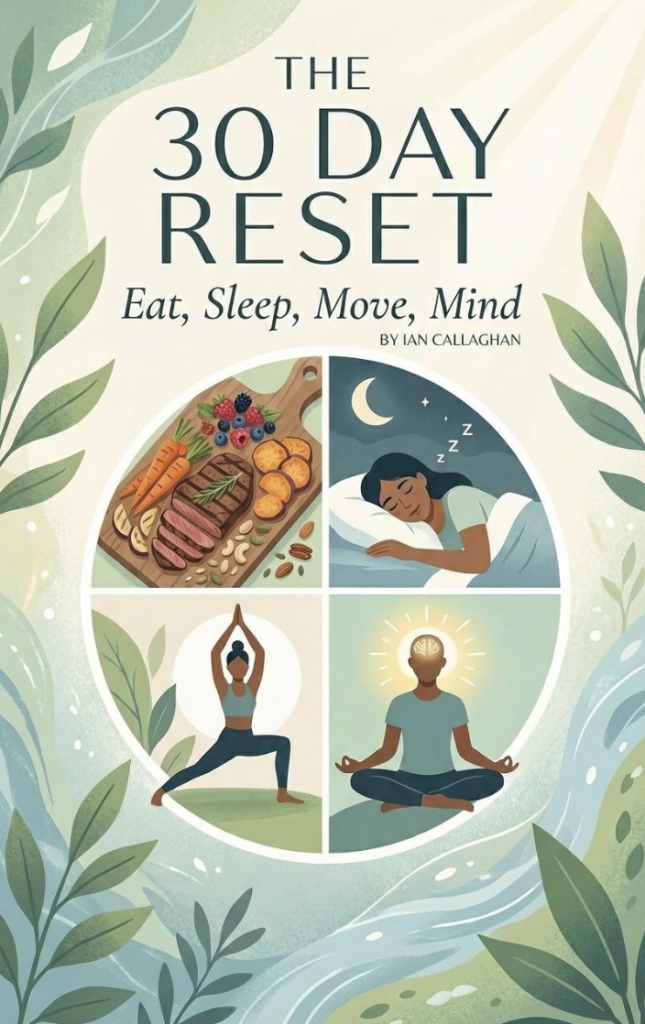
The 30-Day Reset: Reclaim Your Vitality, Rewire Your Mind, and Reboot Your Body (Digital Ebook)
The 30 Day Reset is not a diet. It is a complete biological overhaul for anyone who is wired, tired, and done with feeling like shite. The 30-Day Reset is a 160+ page military-grade systems reboot for the over-35s. Four pillars. Eat, sleep, move, mind. One month to strip out the industrial poison, reset your dopamine pathways, silence Bob, and rebuild the machine that’s been running on the wrong fuel for decades. Not a diet. Not a programme. A complete…
Beyond 12 Steps: the alternative framework that doesn’t require a label
Beyond 12 StepsBeyond 12 Steps is an integrative framework designed to move past simple abstinence. It is about so much more than just quitting booze; it is a comprehensive strategy for the mind, body, and spirit. Whether you are facing substance use or simply the crushing weight of midlife burnout, this book gives you the tools to reclaim your narrative and foster lasting well-being.
Beyond 12 Steps: Integrative Strategies for Mindset and Wellbeing