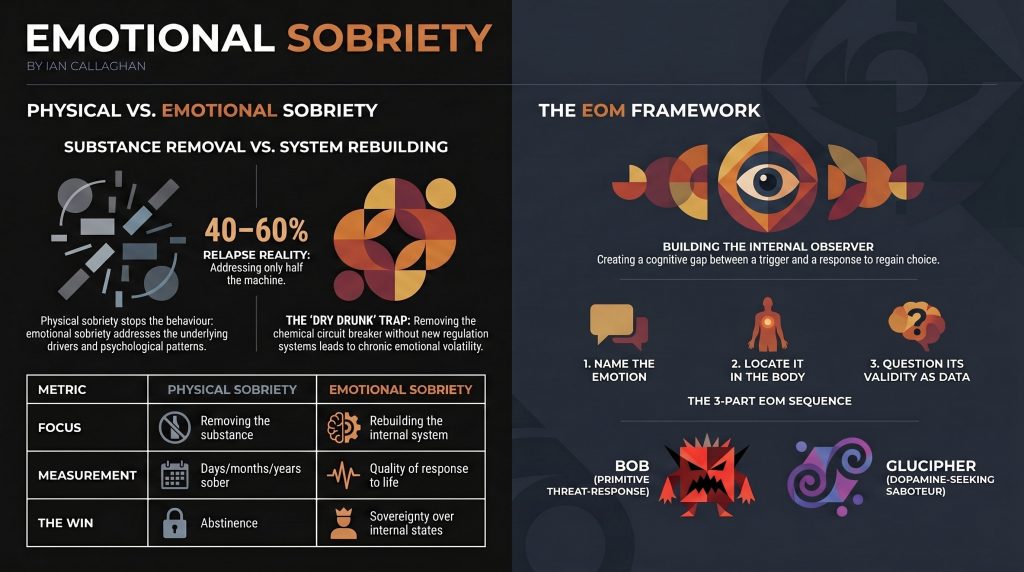
Emotional Sobriety: What Nobody Tells You About Being Sober But Still a Mess
Emotional Sobriety. You stopped drinking. So why are you still losing your shit?
You did the hard part. You put the drink down. Maybe you white-knuckled it; maybe it clicked one day, and you just stopped; maybe you did it quietly without telling anyone. Either way, you did it.
And then you waited for the life you were promised.
The calm. The clarity. The version of yourself you always knew was in there somewhere, buried under the years of numbing. You waited for the relationships to heal, for the decisions to get easier, for the anger to lift. You waited to feel like a functioning human being who wasn’t one bad moment away from saying something they couldn’t take back.
But the anger didn’t lift. The reactivity didn’t go. You’re still snapping at people who don’t deserve it—still lying awake replaying conversations. Still watching yourself blow up over something small and wondering what the hell is wrong with you.
Nothing is wrong with you. But something is definitely still unfinished.
That unfinished business has a name. It’s called emotional sobriety. And it’s the piece of the picture that almost nobody in the mainstream recovery world talks about honestly, because most of what’s out there is either rooted in the 12-step model or so wrapped in clinical language that it’s useless to the person sitting in their kitchen at midnight, sober and still suffering.
This is the honest version.
What Is Emotional Sobriety? The Actual Definition
Emotional sobriety is not about being calm all the time. It’s not about suppressing your feelings, performing wellness, or never raising your voice again. It’s not a personality transplant.
Emotional sobriety is the ability to feel whatever is happening inside you without being run by it.
You can feel the anger and choose how you respond to it. You can feel the fear and still make the call. You can feel the grief and not reach for something to make it stop. You notice the emotion. You observe it. You decide what happens next. The emotion does not decide for you.
That’s it. That’s the whole thing. But getting there from where most people start is serious work.
The term was first used by Bill Wilson, one of the AA founders, in a 1958 letter where he admitted that physical sobriety alone wasn’t enough and that emotional and psychological immaturity was still running the show for many people who hadn’t touched a drink in years. He was right. The problem is that the mainstream recovery world took his insight and pasted it onto the 12-step framework, which means that if you’re not in that world, nobody is giving you a straight answer about what emotional sobriety actually is or how to build it.
The Dry Drunk Problem Nobody Wants to Admit
There’s a term that gets thrown around in recovery circles: the dry drunk. It’s not a kind label, and it’s worth saying upfront that labelling yourself or anyone else a “drunk” of any variety isn’t particularly useful. But the concept underneath the label is real, and it matters.
A dry drunk is someone who has removed the substance but hasn’t dealt with the emotional and psychological patterns that the substance was medicating. They’re not drinking. But the mood swings are still there. The resentment is still there. The emotional volatility, the self-sabotage, the inability to handle stress without blowing the lid off, all of it is still running.
Because the drink was never the root problem, the drink was the solution: a terrible, self-destructive, system-wrecking solution, but a solution to something. When you remove the solution without addressing the thing it was solving, the thing doesn’t disappear. It just runs without its circuit breaker.
I drank for 45 years. I served 12 years in the British Army, where we considered ourselves the fittest, most highly functioning drunks in existence. We were not wrong. I held down a career as an IT technical architect, designing enterprise systems for global organisations. I was analytical, precise, and capable. I could explain every pattern I was running with clinical accuracy.
I was also completely unable to stop.
When I did stop, I hit the dry drunk phase hard. I didn’t know what to call it at the time. I just knew I’d removed the thing I’d used to regulate my nervous system for decades, and now my nervous system was doing whatever it wanted, whenever it wanted, to whoever was nearby. That’s not a recovery story. That’s just a different kind of wreckage.
Emotional sobriety is what comes after. It’s the actual work.
Why Physical Sobriety Is Just the Starting Line
Research consistently shows that somewhere between 40 and 60 per cent of people relapse within the first year of stopping. That’s not a moral failure statistic. That’s a “we’ve only addressed half the machine” statistic.
Here’s what the machine actually looks like.
For most people who use alcohol to cope, the drink is performing several functions at once. It’s regulating a nervous system that never learned to regulate itself. It’s numbing emotional states that feel unbearable or overwhelming. It fills a gap in identity because, without it, you don’t quite know who you are or how to operate socially. It’s medicating unprocessed trauma that has never been named, let alone addressed.
Remove the drink, and all of those underlying functions need somewhere to go. If you don’t build new systems for emotional regulation, the nervous system finds other ways to cope. That might look like food. Work. Rage. Avoidance. Control. Relationships that replicate the same chaos as the old life in a different costume.
Physical sobriety is the starting line. Emotional sobriety is the race.
The Signs You’re Running on Physical Sobriety Alone
This is where it gets uncomfortable. These are the patterns that show up when the drink is gone, but the emotional work hasn’t been done yet. None of them is permanent. All of them are workable. But you have to be honest about recognising them.
Chronic emotional reactivity. Small things hit like big things. Someone cuts you off in traffic, and your day is ruined. A throwaway comment from a colleague and you’re in your head about it for hours. The volume of your response does not match the size of the event.
Resentment that won’t shift. You’re carrying old grievances like they happened this morning. People who wronged you years ago are still living rent-free in your head. You replay old conversations. You construct arguments you’ll never have. You stay angry at things you cannot change.
Shame spirals after emotional outbursts. You lose your temper, you say something you regret, and then you spend three days hating yourself for it. The shame is so familiar it almost feels like home.
Decision paralysis under pressure. When things get stressful, your ability to think clearly disappears. The prefrontal cortex, the brain’s rational decision-making centre, goes offline, and the threat response takes over. You’re running on panic, or you’re frozen. Neither is useful.
Relationship patterns that keep repeating. The people change, but the dynamic stays the same. The same arguments. The same distances. The same feeling that you’re one conversation away from blowing the whole thing up.
Using sobriety itself as an identity rather than a foundation. “I’m a sober person” becomes the whole personality. Every decision runs through that filter. Every social situation is framed around not drinking rather than building something to move toward.
If any of those land, that’s not a judgment. That’s useful information.
Emotional Sobriety vs Physical Sobriety: The Key Differences
| Physical Sobriety | Emotional Sobriety | |
|---|---|---|
| Focus | Removing the substance | Rebuilding the internal system |
| Measurement | Days/months/years sober | Quality of response to life |
| The work | Not picking up | Learning to feel without being controlled |
| What it addresses | The behaviour | The driver of the behaviour |
| Timeline | Starts day one | An ongoing process, not a destination |
| Common trap | White-knuckling | Performing emotional wellness |
| The win | No substance | Sovereignty over your own internal state |
Physical sobriety is binary. You either drank or you didn’t. Emotional sobriety is a practice. You’re always somewhere on the spectrum, always capable of moving forward, always capable of slipping backwards, and the measurement isn’t several days. It’s how you navigate the hard moments.
What Emotional Sobriety Actually Feels Like When You’re Building It
This is what nobody tells you: building emotional sobriety is uncomfortable before it gets better. You’re developing the capacity to sit with feelings you’ve spent years running from. That’s not fun. It’s necessary, but it’s not fun.
Here’s what the trajectory looks like.
Early stage: You notice the emotion after the reaction. You’ve already said the thing, sent the message, slammed the door. You look back and see what happened. This is actually progress, even though it doesn’t feel like it. You’re developing the observer. That observer didn’t exist before.
Middle stage: You notice the emotion during the reaction. You can feel yourself being pulled toward the old response. Sometimes you go with it anyway. Sometimes you don’t. The gap between trigger and response is starting to widen.
Building stage: You notice the emotion before you react. The physical sensation in your body, the tightening in your chest, the heat up the back of your neck, you recognise it as data rather than command. You have a choice. You may not always make the right one, but you have a choice.
That progression is not linear, and it’s not quick. But every time you catch it a stage earlier, you’re rewiring something real.
The EOM Framework: Observing Emotions Instead of Being Them
The Emotional Observation Method is the framework I built to close the gap between knowing and doing. Not a therapy model. Not a set of affirmations. A practical system for people who want to understand their own machine well enough to service it differently.
The core principle is deceptively simple: you are not your emotions. You are the one observing them.
When anger arrives, most people fuse with it. They become angry. Every thought is filtered through it. Every decision is made from the inside. Anger is the operating system, and it’s running everything.
EOM creates separation. You notice the anger. You observe it. You ask what it’s telling you. You don’t have to act on it, and you don’t have to suppress it. You listen to it as data, the same way you’d listen to a warning light on a dashboard, and then you decide what to do with the information.
This sounds simple. Doing it when you’re in the middle of a triggered state is another thing entirely. That’s why the practice matters. You don’t build capacity during a crisis. You build it in the quiet moments so it’s available when the crisis arrives.
The three-part EOM sequence:
- Name it. Give the emotion an actual label. Not “I’m stressed” but “I’m feeling afraid that I’m going to lose control of this situation.” Specificity matters. Research from UCLA shows that naming an emotion reduces amygdala activation, meaning it literally turns down the volume on the threat response.
- Locate it. Find it in your body. Emotions are not abstract. They live somewhere. The tightness in the throat. The weight in the chest. The heat in the jaw. Finding the physical location gives you something concrete to work with.
- Question it. What is this emotion actually responding to? Is this a real threat or an old pattern firing on a new trigger? Is the size of this response proportionate to the actual situation? What does this emotion want me to do, and is that the right move?
That three-part sequence, practised consistently, starts to build the observer. And once the observer is strong enough, you have something to work with.
Bob, Glucipher, and the Characters Running Your Emotional Show
Within the EOM framework, I use two characters to explain the forces driving emotional reactivity. Not to make it cute. Because understanding what’s driving the pattern is the first step to not being driven by it.
Bob is your inner chimp. Your primitive threat-response machine. Bob has been keeping you alive since you were born. Bob’s job is to protect you from danger, social exclusion, loss of status, and anything that reminds him of past pain. Bob is fast, loud, and completely uninterested in what’s actually appropriate in a 21st-century conversation. When you lose your temper at a minor inconvenience, Bob is behind it. When you interpret a neutral comment as an attack, Bob is behind it. Bob is not your enemy. But Bob should not be in charge.
Glucipher is the blood sugar and dopamine saboteur. The part of the system that has learned to crave quick relief and will pitch whatever story is necessary to get it. When the emotional discomfort gets high enough, Glucipher starts building the case for why a drink makes sense, why comfort eating makes sense, why staying in bed makes sense, and why burning the relationship to the ground makes sense. Glucipher is a brilliant storyteller and a terrible strategist.
Emotional sobriety is not about silencing Bob or destroying Glucipher. It’s about making sure neither of them is driving the car.
7 Practical Ways to Build Emotional Sobriety Without a Programme
These are not affirmations. These are not things you put on a vision board. These are practices that build genuine neurological change over time.
1. Regulate the nervous system first, everything else second.
You cannot build emotional sobriety on a dysregulated nervous system. This is non-negotiable. For me, that means daily cold-water exposure in the River Usk year-round, daily meditation, Reiki practice, and OMAD eating, which keeps blood sugar stable and eliminates the spikes and crashes that Glucipher feeds on. Your version will look different. But the nervous system work comes first. Before the journaling, before the therapy, before any of it.
2. Build the observer through daily stillness.
Meditation is not about emptying your mind. It’s about practising being the one watching the mind rather than being the mind. Even ten minutes a day of sitting with your thoughts without acting on them builds the observer muscle. That muscle is what gives you the gap between trigger and response.
3. Get honest about your emotional triggers.
Write them down—the specific situations, people, topics, and dynamics that reliably pull you into reactive states. Most people have six to ten consistent triggers. Once you can see them on paper, they lose some of their power to operate in the dark.
4. Track your physical state.
Tired, hungry, pain, alcohol withdrawal in early sobriety, all of these narrow your emotional window dramatically. A narrow emotional window means smaller triggers produce bigger reactions. Tracking how physical state affects emotional reactivity gives you predictive information you can actually use.
5. Learn the difference between responding and reacting.
A reaction is immediate, automatic, and driven by the threat system. A response involves a pause, however brief, between stimulus and action. The practice is extending that pause. One breath before you reply to the email. One moment before you walk back into the room. Tiny pauses, practised consistently, become a real capacity.
6. Stop outsourcing emotional regulation.
If you’ve spent years using alcohol to regulate your emotional state, you’ve been outsourcing that regulation to a chemical. The work of emotional sobriety is bringing it back in-house. That means developing internal tools, breathwork, cold exposure, movement, stillness, and using them when the pressure is on rather than waiting for someone or something outside yourself to make you feel better.
7. Get comfortable with discomfort without escaping it.
This is the core skill underneath everything else. Emotions are not emergencies. Discomfort is not a crisis. You can feel terrible and not act on it. You can be angry and not express it destructively. You can be afraid and still do the thing. The capacity to sit with discomfort without immediately moving to escape it is the foundation on which everything else rests.
Emotional Sobriety and Men: The Stoic Mask Problem
Most men are never taught that emotions are information. They’re taught that emotions are a weakness. They’re taught to suppress, to perform invulnerability, to identify strength with never showing anything that could be mistaken for feeling.
That conditioning doesn’t just disappear when you get sober. In some cases, sobriety makes it worse, because the one mechanism you’d been using to avoid feeling anything has been removed, and now the feelings are just there, with nowhere to go and no permission to be acknowledged.
The result is men who are physically sober and emotionally constipated. The anger comes out sideways. The grief becomes resentment. The fear becomes control. And the people around them cope with the fallout of feelings that have never been named, never been processed, and never been given a useful direction.
Emotional sobriety for men is not about becoming someone who talks about feelings in groups. It’s about developing enough internal intelligence to know what you’re actually experiencing, make your own decisions about how to handle it, and stop letting unexpressed emotion run your life through the back door.
I spent 12 years in the British Army. I know what the culture expects. I also know what it costs in the long term to pay that price. The herniated discs at L3, L4, and L5 that I carry from my service are a physical reminder of what happens when a machine is run past its limits without servicing. The emotional equivalent is nonetheless damaging. It just shows up more slowly.
How Trauma Keeps Emotional Sobriety Out of Reach
If emotional sobriety feels impossible, no matter how much you try, trauma may be the reason.
Trauma is not just catastrophic events. Trauma is any experience that overwhelmed your nervous system’s capacity to process it at the time it happened. Childhood emotional neglect. A relationship that systematically dismantled your sense of reality. Military service that asked you to process the unprocessable with no real support. Years of shame-based living that taught your system that emotions themselves are dangerous.
Unprocessed trauma creates a state of chronic nervous system dysregulation. Your threat system is permanently calibrated too high because it learned, at some point, that the world is not safe enough to relax in. Emotions arrive at elevated volume and with compressed response timeframes. The window of tolerance is narrow.
No amount of willpower closes that gap. You’re not going to think your way out of a nervous system that has been shaped by experience. You need approaches that work at the level where the damage happened.
For me, that combination includes NLP for reprogramming unconscious patterns, Reiki for working with the energetic and emotional body, cold water immersion for direct regulation of the nervous system, and consistent daily practices that help keep the system in a more regulated state over time. What works for you may look different. But if trauma is in the picture, the path to emotional sobriety runs through it, not around it.
For anyone whose emotional reactivity feels completely outside their control, the deep dive is in the self-sabotage framework in Under Load, specifically the section on the system under pressure.
The Connection Between Emotional Sobriety and Physical Health
This is where things get interesting for anyone paying attention to both their body and their mind.
Chronic emotional dysregulation is not just a psychological problem. It’s a physiological one. Sustained activation of the stress response elevates cortisol, suppresses immune function, disrupts sleep, drives inflammatory processes, destabilises blood sugar, and degrades the quality of every system in the body.
If you’re working on your metabolic health, your sleep, your gut, and your energy while ignoring the emotional regulation piece, you’re leaving a significant variable unaddressed. The body and the nervous system are not separate departments. They’re one system.
This is why the midlife reset work covers all four pillars: eat, sleep, move, and mind. You cannot genuinely optimise one without addressing the others. Emotional sobriety sits inside the mind pillar, but its effects run through the entire machine.
Cold water immersion, which has been part of my practice for decades in the River Usk, is one of the most direct tools available for nervous system regulation. Vagus nerve stimulation from cold exposure builds the same capacity to tolerate discomfort that emotional sobriety requires. You’re training the same system.
What Emotional Sobriety Is Not
It’s worth clearing up some misunderstandings because they actively prevent people from doing the work.
It is not about never feeling negative emotions. Anger, grief, fear, disappointment, these are not failure states. They’re appropriate responses to real events. Emotional sobriety doesn’t mean the emotions disappear. It means they do not control you.
It is not about performing positivity. The wellness industry has a version of emotional health that involves gratitude journals, manifesting, and relentlessly reframing everything as a blessing. That’s not emotional sobriety. That’s emotional suppression with better branding.
It is not a weakness. The person who can sit with emotional discomfort without immediately discharging it into the environment is not weak. They are practising a form of self-mastery that most people never develop because they were never shown it was possible.
It is not a destination. You don’t arrive at emotional sobriety and stay there. It’s an ongoing practice. You will have days when you handle things well and days when you don’t. The measurement is not perfect. It’s the direction of travel.
It is not the same as suppression. Suppression is forcing the emotion down and not letting it surface. That’s the old model, the stoic mask, the “man up” default. Suppression stores what it can’t process. Emotional sobriety is the opposite: you feel the emotion fully and choose what to do with it.
Emotional Sobriety and the Sober Beyond Limits Community
In the Sober Beyond Limits community, this is one of the most consistent themes that comes up from people who are months or years into not drinking and still struggling with why life doesn’t feel the way they thought it would.
Physical sobriety is the entry point. What builds after it determines the quality of the life you’re actually living.
The conversations in that space are not about milestones and chips. They’re about the real work of becoming someone who doesn’t need the drink, because the underlying reasons to reach for it have been addressed. That’s a different project from counting days. It’s a harder project and a more worthwhile one.
If you’re sober and still suffering, that’s not a sign you’ve failed. It’s a sign there’s a next stage of work available to you.
A Note on Professional Support
The work described in this post is real, and it’s doable. It’s also not always work you should do alone.
If your emotional reactivity is severe, if there’s significant trauma in your history, if you’re experiencing what looks like depression or anxiety alongside the reactivity, getting proper support matters. Not because you can’t handle it, but because having the right tools for the specific job makes everything more effective.
What doesn’t matter is which label you carry or which programme you’re part of. The work is the work. The framework is secondary to whether you’re actually doing it. If the 12-step model works for you, use it. If it doesn’t, there are other paths. What’s not an option is staying stuck in a life where you’re physically sober and emotionally wrecked and calling that the destination.
For people dealing with the darker end of this, the piece on suicidal thoughts and what actually helped is honest about what rock bottom with a functioning sobriety looks like, and what came after.
Frequently Asked Questions About Emotional Sobriety
What is the difference between emotional sobriety and physical sobriety?
Physical sobriety means you have stopped using the substance. Emotional sobriety means you have developed the internal capacity to manage your emotional states without reaching for a substance or any other external fix. Physical sobriety is the first step. Emotional sobriety is the deeper work that makes the first step sustainable and actually worth living.
Can you have emotional sobriety without being physically sober?
Technically,y yes, in the sense that emotional regulation is a skill that anyone can develop. But in practice, if you’re still actively drinking, the neurological and physiological effects of alcohol on the brain’s emotional regulation systems make genuine progress extremely difficult. The nervous system’s work becomes exponentially harder when the substance continues to disrupt it.
How long does it take to develop emotional sobriety?
There is no timeline. It’s a practice, not a course. Most people start noticing meaningful shifts in their emotional reactivity within three to six months of consistent work. Deeper patterns, especially those rooted in trauma, take longer. The honest answer is that it’s ongoing, and the goal is progress in the right direction, not completion.
Is emotional sobriety possible without therapy?
Yes, though therapy can accelerate the process significantly, particularly for people with significant trauma in their history. Consistent practice of emotional regulation tools, nervous system regulation, honest self-inquiry, and community support can build emotional sobriety without formal therapy. But if you’re stuck, or if the emotional reactivity is severe, getting professional support is not a failure. It’s a sensible use of available tools.
What does emotional sobriety feel like in practice?
It feels like having a gap. A pause between something happening and your response to it. That gap feels small at first, almost imperceptible. Over time, it grows. You start to notice that you can feel the anger without becoming it, feel the fear without being paralysed by it, feel the grief without drowning in it. Life doesn’t become easy. You become better at handling it.
I’ve been sober for years, but I’m still emotionally reactive. Is this normal?
Yes. Physical sobriety does not automatically produce emotional sobriety, and the length of time you’ve been sober is not a reliable indicator of where you are in the emotional work. Plenty of people with significant sobriety milestones are still running the same emotional patterns they were running in active use. The duration of sobriety matters less than whether the underlying work has been done.
Does emotional sobriety apply to people who don’t have a drinking problem?
Entirely. Emotional sobriety is a life skill, not a recovery concept. Anyone who finds themselves regularly controlled by their emotional states, making decisions from within reactive states they later regret, or using external fixes to regulate internal discomfort is dealing with the same territory. The drink is the most visible version of the problem. It’s not the only version.
What is the Emotional Observation Method?
The EOM is a framework developed from lived experience, NLP, and nervous system work that creates a practical system for observing emotions rather than being run by them. It’s built around the principle that you are not your emotions: you are the one observing them. The core practice is building the observer: the internal capacity to notice what’s happening in your emotional system and make a considered choice about what to do with it, rather than defaulting to an automatic reaction.
The Bottom Line on Emotional Sobriety
You stopped drinking. That was the starting line, not the finish line.
Emotional sobriety is the work that happens after. It’s building an internal system that doesn’t need the drink because the underlying reasons for reaching for it have been addressed. It’s developing the capacity to feel whatever life throws at you without it running you. Over time, it’s becoming someone who operates from choice rather than reaction.
That’s not a wellness retreat concept. That’s the actual job.
Nobody does it perfectly, and nobody arrives at the destination and stays there. But the direction of travel matters enormously. Every time you catch the emotion one stage earlier, every time you choose response over reaction, every time you sit with the discomfort instead of escaping it, you’re building something that compounds.
The machine runs better when it’s been properly serviced. That’s what this work is. Not a cure, not a transformation, not a new identity. Just a properly serviced machine, doing what it was built to do.
If you’re ready to go deeper into the framework, the Under Load self-sabotage book paints the full picture of why intelligent, self-aware people keep repeating patterns that destroy them, and what the systems-based alternative actually looks like.
And if you’re in the middle of this work and want to be around people who are doing it seriously, without the milestones, without the labels, without the programme language, the Skool community at Ian Callaghan Midlife Reset is where that conversation happens.
Pick up the wrench. 🔧
Ian Callaghan is a British Army veteran (12 years), NLP Master Practitioner, Reiki Master, qualified chef, and creator of the Emotional Observation Method. He spent 45 years drinking and did not use AA, rehab, or any programme to stop. He works with people who want to understand their machine well enough to service it differently. Find him at iancallaghan.co.uk.
Related reading:
- Why You Keep Self-Sabotaging: The Under Load Framework
- Midlife Reset: The Full System Overhaul
- How to Quit Drinking in the UK: The Honest Guide
- Suicidal Thoughts: The Moment I Didn’t Go to the Sea
- Reiki for Midlife Sobriety
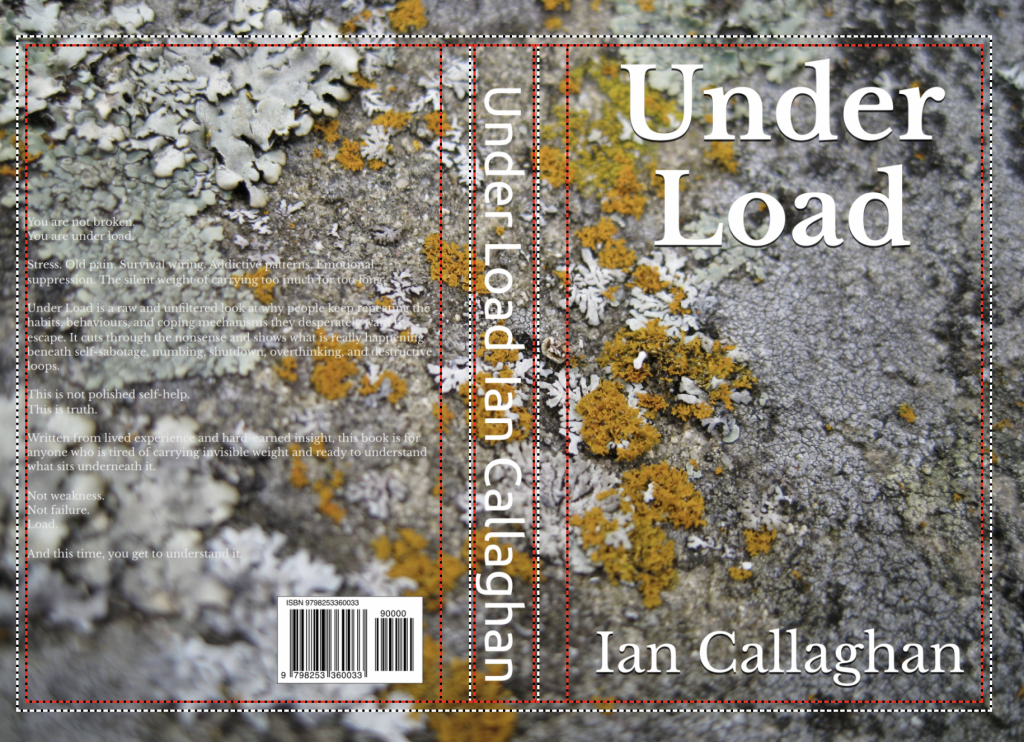
Under Load by Ian Callaghan | The Mechanical Guide to Addiction Recovery
You already know what you’re doing. You’ve known for years.