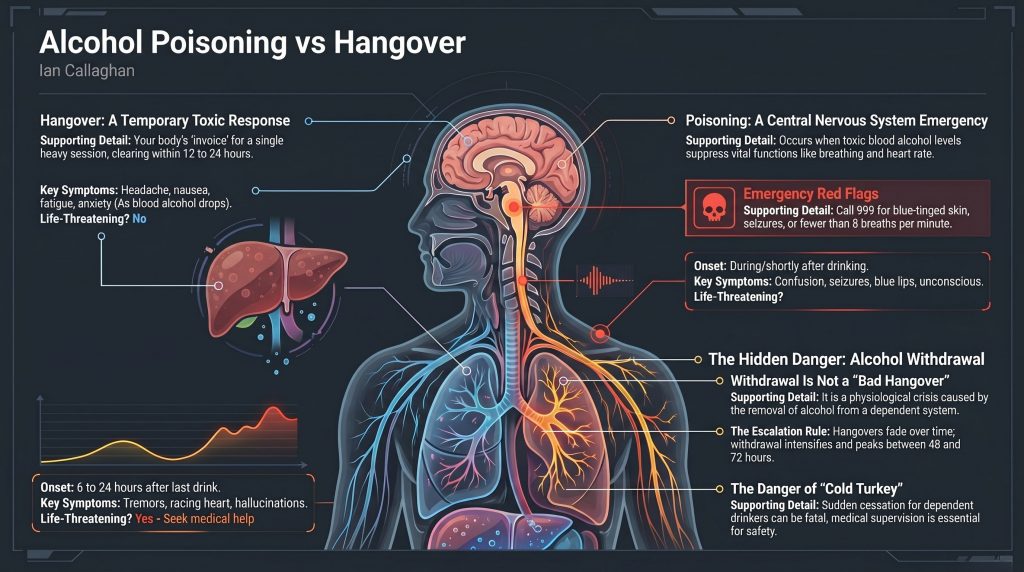
Alcohol poisoning vs hangover: A hangover is your body’s toxic response to a single heavy session, uncomfortable but not dangerous, clearing within 24 hours. Alcohol poisoning is a medical emergency where blood alcohol levels overwhelm the central nervous system: confusion, blue lips, seizures, and unconsciousness. Call 999. Do not wait to see if they sleep it off.
Six in the morning. Sunday. You are awake before your alarm, which hasn’t gone off because you haven’t set one, because yesterday you were going to take it easy.
Your heart is hammering. Your mouth is bone dry. There is a hum of dread behind your eyes that you cannot name, and a shake in your hands you are trying not to look at.
Is this a hangover?
Or is it something else?
I spent 45 years asking that question and never once asked it properly. Forty-five years of British Army, of injuries, of pain, I managed with a bottle and a rationalisation. I told myself it was just ageing. I told myself everyone felt like this on a Sunday. I told myself the shaking hands were just low blood sugar,r and a cup of tea would sort it.
What I didn’t know, because nobody had ever told me plainly, is that there is a clinical difference between a hangover, alcohol poisoning, and alcohol withdrawal. They can look similar from the inside. From the outside, two of them are manageable. One of them can kill you.
This is the post that explains the difference. Without the clinic language. Without the shame. With the actual mechanics of what is happening inside your body, you can make an informed decision about what to do next.
What Is the Difference Between Alcohol Poisoning and a Hangover?
The short version: alcohol is a toxin, and your body responds to it differently depending on how much you drank, how fast, and how long you have been drinking regularly.
A hangover is your body’s invoice for a single heavy session. Uncomfortable. Miserable. But your system is processing the damage, and by tomorrow, you will largely feel human again.
Alcohol poisoning is your body being overwhelmed in real time. Blood alcohol levels are so high that the central nervous system cannot manage the Load. This is a medical emergency.
Alcohol withdrawal is something different again, and it is the one most people confuse with a hangover. Withdrawal happens when your body has become physically dependent on alcohol to regulate its baseline functions, and that alcohol is suddenly removed. Your nervous system goes into crisis. And unlike a hangover, withdrawal does not just pass on its own. Without proper support, severe withdrawal can be fatal.
Three different things. Three different responses are required. Let’s go through each one properly.
What Is a Hangover and What Actually Causes It?
A hangover is your body’s acute toxic response to a single episode of excessive drinking. When your blood alcohol content drops back toward zero, the consequences of what you did to your system show up all at once.
The chemistry is worth understanding. Alcohol is broken down in the liver into acetaldehyde, a toxic compound roughly 30 times more harmful than alcohol itself. Your liver converts acetaldehyde into acetate, which is harmless, but that conversion takes time. While it is sitting in your system, acetaldehyde causes inflammation, depletes glutathione, disrupts your sleep architecture, and hammers your electrolyte balance. Simultaneously, alcohol’s diuretic effect has been pulling fluid out of you all night. The autonomic nervous system is trying to rebalance after hours of suppression. And the cortisol your body produces to compensate for alcohol’s sedative effect is now fully online, which is why the 3 AM racing heart and low-level dread are such reliable features of a bad night.
Why Does a Hangover Feel So Bad?
Because alcohol touches almost every system in your body simultaneously. Dehydration. Electrolyte depletion. Acetaldehyde toxicity. Inflammation of the stomach lining. Disrupted REM sleep. Reactive hypoglycaemia if you ate nothing. Elevated cortisol. And if you are a regular drinker, your body has already adapted to alcohol’s presence and the absence of it, even after one night, creates a mild rebound effect.
That rebound is worth naming. Even in a regular grey-area drinker who is not physically dependent, the morning after involves a mini version of what withdrawal looks like. Anxious. Irritable. Unable to regulate mood. Sensitive to sound. That is your nervous system recalibrating after the GABA suppression alcohol causes. It passes in hours. In someone who is physically dependent, it does not pass. It escalates.
How Long Does a Hangover Last?
Typically 12 to 24 hours, rarely longer than 36. If you are still feeling rough on day two with symptoms escalating rather than fading, that is not a hangover. That is the body telling you something different is happening.
What Is Alcohol Poisoning? (Not What You Think)
Alcohol poisoning is not just a very bad hangover. It is not what happens after a big night. It is a medical emergency that occurs when blood alcohol levels are so high that the central nervous system cannot maintain basic functions.
Your brain controls breathing. It controls heart rate. It controls the gag reflex that stops you from choking. When alcohol reaches a toxic concentration, it starts suppressing those functions. That is not a hangover. That is organ failure in progress.
The people most at risk are not always the people you expect. Binge drinkers who do not drink regularly. People who have eaten nothing. People who mix alcohol with other substances. Teenagers with no tolerance. And sometimes, experienced heavy drinkers push further than usual on a bad night.
Alcohol Poisoning Symptoms: What to Look For
In yourself or someone else, the signs of alcohol poisoning are:
• Confusion or stupor that goes beyond being very drunk
• Vomiting while unconscious or semi-conscious
• Seizures
• Slow or irregular breathing, fewer than 8 breaths per minute
• Blue-tinged or pale skin, particularly around the lips
• Hypothermia, the skin is cold and clammy
• Unconscious and cannot be woken
You do not need all of these. One or two is enough to call 999.
When Does Alcohol Poisoning Become a Medical Emergency?
Immediately. There is no monitoring period. There is no waiting to see if they sleep it off. The myth that you put someone in the recovery position and leave them to sleep is responsible for deaths. Someone with alcohol poisoning can stop breathing. They can choke on vomit. They can die.
Call 999. Stay with them. Put them in the recovery position if they are unconscious. Do not give them coffee, food, or cold water to try to sober them up—none of those work. The only thing that works is medical intervention.
Hangover vs Alcohol Withdrawal: The Comparison Nobody Makes
This is the one that matters most for people reading this at 6 AM on a Sunday with their hands shaking.
Alcohol withdrawal is not a worse hangover. It is a fundamentally different physiological process. A hangover is your body reacting to the poison leaving. Withdrawal is your body going into crisis because the substance it has restructured itself around has been removed.
Your brain adapts to regular alcohol exposure by downregulating its own GABA receptors, the ones responsible for calm and inhibition, and upregulating glutamate, the excitatory system, to compensate for alcohol’s constant suppressive presence. When alcohol is suddenly gone, the brakes are off, and the accelerator is floored. Everything that alcohol was suppressing comes back at full volume. For more on the full toxicology of what alcohol does to the body, the details are there.
What Are Alcohol Withdrawal Symptoms?
Withdrawal symptoms typically begin 6 to 24 hours after the last drink and can escalate over 48 to 72 hours. The range runs from uncomfortable to potentially fatal.
Mild to moderate: tremors particularly in the hands, sweating, rapid heartbeat, elevated blood pressure, nausea and vomiting, anxiety and agitation, severe insomnia, headache.
Severe: hallucinations, visual, auditory, or tactile, intense confusion and disorientation, fever, seizures.
Delirium Tremens: the most severe form, typically appearing 48 to 96 hours after the last drink. Profound confusion, severe agitation, hyperthermia, cardiovascular instability. This is a medical emergency with a mortality rate of up to 15% without treatment.
How Do You Know If It Is Withdrawal and Not Just a Hangover?
The timing is the first clue. A hangover starts when drinking stops and peaks within a few hours. Withdrawal starts hours after the last drink and gets worse, not better, across the first 24 to 72 hours.
The second clue is the pattern. If you find yourself needing a drink to feel normal in the morning, to stop the shaking, to calm the anxiety enough to function, that is not a hangover coping strategy. That is your body demonstrating dependence.
The third clue is escalation. A hangover fades. Withdrawal intensifies. If the symptoms are getting worse rather than better after the first 12 hours, that is the distinction that matters.
Hangover vs Alcohol Poisoning vs Alcohol Withdrawal: The Full Comparison
| Hangover | Alcohol Poisoning | Alcohol Withdrawal | |
| Cause | Single heavy session, blood alcohol returning to zero | Toxic blood alcohol level overwhelming the body | Physical dependence: removing alcohol from a dependent system |
| Onset | When drinking stops or blood alcohol drops | During or shortly after heavy drinking | 6 to 24 hours after last drink |
| Duration | 12 to 24 hours | Hours, requires medical treatment | 2 to 7 days, some symptoms weeks |
| Key symptoms | Headache, nausea, fatigue, anxiety | Confusion, vomiting, seizures, blue lips, unconscious | Tremors, sweating, racing heart, hallucinations, seizures |
| Life-threatening? | No | Yes, call 999 immediately | Yes without medical support |
| Treatment | Rest, water, real food | 999. Do not leave them alone | Medical supervision. Do not quit cold turkey alone |
Why Did I Spend 45 Years Confusing the Two?
Because nobody ever laid it out plainly. And because Bob, the internal PR firm that justifies every drink, is extraordinarily good at reframing the evidence.
I remember mornings in my forties when my hands were shaking before I got out of bed. I told myself it was low blood sugar. I told myself I had just overdone it. I told myself it was stress, the army injury, the three herniated discs at L3, L4, and L5 that the MoD had given me a war pension for and the rest of the medical system largely ignored. The rationalisation was always available. The honest answer was not.
The honest answer was that I had been drinking heavily for so long that my nervous system had restructured itself around alcohol’s presence. The morning shaking was not a hangover. It was my CNS telling me, in the only language it had, that something was wrong.
I did not have a drink in the morning. That is what I told myself, and it separated me from the people who really had a problem. But I was three to four drinks in by lunchtime on a bad day, and I called that managing.
That is what grey-area drinking does. It keeps you just functional enough to stay in denial, just unwell enough to need the relief, and just confused enough about the mechanics to keep rationalising.
45 years. No rehab. No AA. No programme. And no honest understanding of what was happening inside my own system until I built one from the ground up.
The 3 AM Test: Is This a Hangover or Something More Serious?
You wake up at 3 AM. Heart hammering. Hands unsteady. Anxiety at a level that is disproportionate to anything happening in your actual life. The question is whether to go back to sleep or to pay attention.
Here is the test. Be honest.
When did you last drink? If it was last night and you are waking up with the standard dehydration and cortisol spike, that is a hangover processing. Uncomfortable. Not dangerous. Drink water, lie still, let it pass.
How long have you been drinking heavily and regularly? If the answer is weeks, months, or years without a significant break, and today is your first day without alcohol, the 3 AM symptoms may not be a hangover. There may be an early withdrawal.
Are the symptoms getting better or worse? A hangover peaks and fades. If the shaking, the anxiety, and the nausea are intensifying as the hours pass rather than easing, that is not a hangover.
Have you had a seizure, seen or heard things that are not there, or lost track of where you are? Call 999 or get to A&E. This is not a question of waiting it out.
If you are not sure, the vagal brake has nothing to do with this decision. This is not a state regulation conversation. This is a safety conversation. When in doubt, get medical eyes on it. There is no shame in that. There is only risk in not doing it.
Is It Safe to Stop Drinking Cold Turkey?
If you have been drinking heavily and regularly, no. Quitting cold turkey without medical support is genuinely dangerous for people with physical dependence. The withdrawal process needs to be supervised. That does not mean you need a residential programme. It means you need a GP who knows your drinking history, or an urgent referral to a local alcohol service, before you stop.
The fear of what supervised detox looks like keeps a lot of people from seeking it. The reality in the UK is that your GP can prescribe medication to manage withdrawal safely as an outpatient. You do not need to be admitted. You do not need to attend a group. You need medical monitoring during the critical 72-hour window.
If you want to stop drinking without a programme, without labels, without the traditional recovery structure, that is entirely possible. Quitting without rehab is what most people in the Sober Beyond Limits community have done. But the medical safety of the detox window and the personal work of staying free are two different things. Do not conflate them. Get the medical piece handled first.
7 Signs This Is More Than a Hangover
- The symptoms are getting worse after 12 hours, not better. A hangover fades. Withdrawal escalates. If you are more unwell at noon than you were at 8 AM, pay attention.
- Your hands are shaking before you have had anything to drink. Morning tremors that ease after alcohol are a textbook dependence signal. That is not a hangover. That is your nervous system holding you hostage.
- You need a drink to feel normal. Not to feel good. Not to relax. To feel like a functioning human being. That is dependence. Name it.
- You are experiencing anxiety at a level that does not match your circumstances. Withdrawal anxiety is physiological, not psychological. No amount of rational thinking touches it. If the anxiety is overwhelming and has no cause, it may be your CNS in withdrawal, not your mind catastrophising.
- You have missed days of work, cancelled things, or made decisions around drinking that you would not make sober. That is the system controlling you. Not a hangover.
- You are hallucinating or have had a seizure. This is a 999 call. Not a conversation for later. Now.
- You have been here before. This is not the first Sunday morning with these questions. The pattern is the data. If you are reading this post for the second or third time with the same symptoms, the symptom is not the problem. The pattern is.
Frequently Asked Questions
Add the following using the Yoast FAQ block to generate the FAQPage schema. Do not use plain text headings for these questions.
What is the difference between alcohol poisoning and a hangover?
A hangover is your body’s acute response to a single heavy drinking session, peaking as blood alcohol returns to zero and clearing within 24 hours. Alcohol poisoning is a medical emergency where blood alcohol levels are high enough to suppress the central nervous system, affecting breathing, heart rate, and consciousness. A hangover is uncomfortable. Alcohol poisoning requires 999.
Can a bad hangover turn into alcohol poisoning?
No. Alcohol poisoning happens during or immediately after drinking, when blood alcohol is at toxic levels. A hangover happens after blood alcohol has dropped. If someone appears to have alcohol poisoning, that is happening in real time, not the morning after. Do not wait for the morning to call for help.
How do I know if I am experiencing alcohol withdrawal?
Withdrawal typically starts 6 to 24 hours after the last drink and gets worse rather than better over time. Key signs are tremors, sweating, racing heart, intensifying anxiety, and insomnia that does not ease as the day goes on. If you have been drinking heavily and regularly for an extended period and today is your first day without alcohol, and you feel worse than a normal hangover, speak to a GP or call 111.
Is it dangerous to stop drinking suddenly?
For someone with physical dependence, yes. Sudden cessation can trigger severe withdrawal, including seizures and delirium tremens. If you have been drinking heavily every day for weeks or months, do not just stop without medical guidance. Your GP can supervise an outpatient detox with medication to make the process safe. The goal of stopping is right. The method needs to be safe.
What does alcohol poisoning look like in someone else?
Confusion beyond normal drunkenness, vomiting while unconscious or semi-conscious, seizures, slow or irregular breathing, blue or pale lips and skin, cold and clammy skin, and inability to be roused. You do not need all of these. Any one of them is a reason to call 999 immediately and stay with the person until help arrives.
How long do alcohol withdrawal symptoms last?
Mild withdrawal symptoms typically peak at 24 to 72 hours and begin to ease after that. Severe symptoms, including delirium tremens, usually appear between 48 and 96 hours after the last drink. Some symptoms, particularly anxiety, disturbed sleep, and mood instability, can continue for weeks as part of post-acute withdrawal. This is known as PAWS and is well-documented in people coming off heavy, regular alcohol use.
Can you die from a hangover?
From a hangover alone, no. A hangover is deeply unpleasant but not life-threatening. However, severe dehydration, electrolyte imbalance in someone with an underlying heart condition, and the risk of falling or making dangerous decisions while impaired can all carry risk. And what feels like a hangover in a regular heavy drinker may actually be early withdrawal, which can be fatal without medical support. When in doubt, get it checked.
What to Do Next
If you are reading this at 6 AM with a racing heart and are unsure which category you are in, the most important thing you can do right now is be honest with yourself about the pattern.
One bad night and a rough morning is a hangover. Get water in you, eat something real when you can stomach it, and sleep if you can. You will feel human again.
If the pattern is weekly, if the Sunday mornings have become a fixture, if you find yourself planning your week around when and where you can drink and how much you can manage without it showing, that is not a hangover problem. That is a system problem. And a system problem needs a system solution, not another Monday morning resolution that lasts until Wednesday.
The alcohol and mental health connection runs deeper than most people acknowledge. The anxiety, the sleep disruption, the mood instability, the loss of motivation, none of that is who you are. It is what alcohol does to a nervous system that has been running Under Load for too long.
If you are in the early days of stopping and want to understand what is happening physiologically, surviving the early days of quitting alcohol lays it out without the recovery language.
And if you want to be in a room with people who have been exactly where you are on a Sunday morning and came out the other side without a programme, without labels, without white-knuckling it on willpower alone, there are two places to find them.
The Sober Beyond Limits Facebook community is approaching 10,000 people who know exactly what a Sunday morning like this feels like and what to do with it.
The Skool community is where the deeper work happens. The frameworks, the tools, the weekly accountability, the Q&As, the people who are doing this properly and want the mechanics, not the motivation.
Pick up the wrench. 🔧