1. Introduction: The 3:00 AM Hardware Crash
The Vagal Brake. Imagine the scene—it is a frame of high-contrast, visceral reality that thousands of high-performers know intimately. You are standing in a dimly lit bathroom, the cold tiles pressing against the soles of your feet. It is 3:00 AM. You are staring into a cracked mirror, watching sweat bead on your forehead. Your heart is hammering against your ribcage like a trapped bird in a cage of bone, a sharp, metallic rhythm that signals a system-wide emergency. Your hands are shaking.
In this moment, you are gripped by absolute, cold-blooded clarity. You know that the action you are about to take—whether it is reaching for that hidden bottle, scrolling through a toxic app, or consuming another dose of “industrial sludge”—is actively dismantling your life. Your conscious mind is screaming “Abort!” Your intellect, your education, and your values are all presenting a logical case for why this is a catastrophe in the making.
And yet, you watch your own hands move as if they belong to a stranger. You are a passenger in your own body, watching a high-speed collision in slow motion. You are watching yourself destroy everything you love in real-time and doing absolutely nothing to stop it. This is the metallic crack of a high-voltage circuit breaker tripping. This is the 3:00 AM hardware crash.
My name is Ian Callaghan. I am a Master NLP Practitioner and Nervous System Specialist with over 15 years of coaching experience, and I spent 45 years immersed in the “drinking culture” before I finally decoded the mechanical truth of the human Machine. I have been alcohol-free for over 16 months—not through 12-step programmes or AA, which often rely on a narrative of powerlessness—but through the reclamation of total sovereignty using the Emotional Observation Method (EOM).
If you have ever felt like a spectator to your own self-destruction, you need to understand one fundamental truth: This is not a moral failure. It is not a lack of willpower, a character flaw, or a sign of spiritual weakness. It is a hardware crash. The reason you cannot stop yourself is that the Vagal Brake has failed. You have been demoted from the Operator of your biological Machine to a mere component, a cog being turned by ancient, reptilian impulses that do not care about your career, your family, or your future. Until you learn to perform a manual override, your legacy software will keep driving you into the wall.
2. The Hardware: Understanding the Vagal Brake
To fix a machine that is redlining, you must first understand its blueprints. Your body is a multi-million-pound biological vehicle, a high-performance system that requires precision maintenance. The most critical safety feature in this vehicle is the Vagus Nerve. In my coaching practice, I describe the Vagus Nerve as a Tactical Governor or a high-efficiency Cooling System for your sympathetic nervous system—the “fight or flight” engine.
In a high-functioning machine, the Vagal Brake acts as the primary mechanical restraint on your stress response. When the engine redlines—when a craving hits, when your boss screams at you, or when existential dread bubbles up—the Vagal Brake is supposed to engage. Its biological function is to mechanically slow the heart rate and, crucially, keep the prefrontal cortex—the “Operator”—online. When the brake is functioning, you can experience intense emotion without losing motor control. You remain in the cockpit.
“You are sitting in the cockpit of a multi-million-pound biological machine, but you aren’t the Operator. You are a component. You’ve been demoted.”
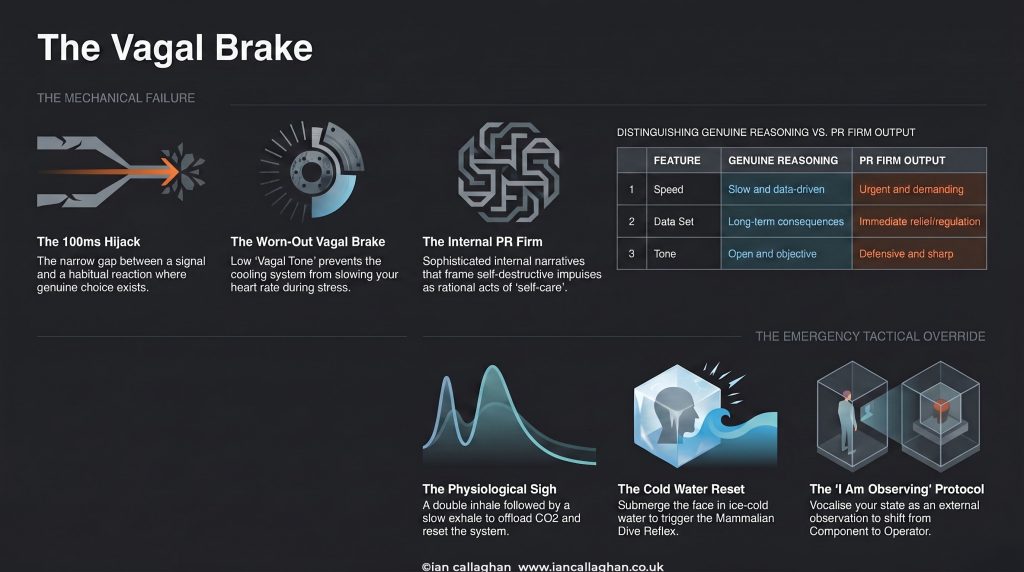
The problem is that for most people living in the modern world, the Vagal Brake is worn down to the rivets. We measure the capacity of this system through “Tone.” High Vagal Tone means your nervous system has a massive load-bearing capacity; you can carry immense stress, pain, and pressure without the system blowing a fuse. But years of chronic stress, unresolved trauma, and biological malware have left your cooling system bone-dry.
When Tone is in the gutter, your Machine begins to view every minor inconvenience—a late email, a traffic jam, a misplaced set of keys—as a direct threat to the Forward Operating Base (FOB). The Machine detects a “threat” and immediately dumps adrenaline and cortisol into the system. Without a functioning Vagal Brake to provide cooling, the engine overheats, the Operator is ejected from the cockpit, and the Machine enters survival mode. You aren’t “choosing” to panic or crave; your hardware is simply reacting to a perceived breach of the FOB.
3. The 100ms Hijack: Why You Can’t “Think” Your Way Out
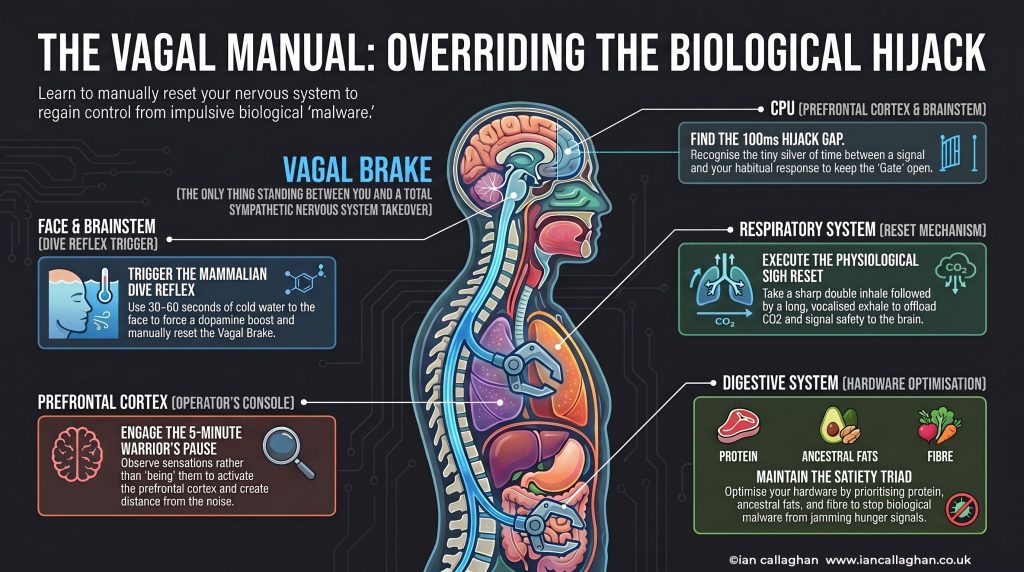
The most dangerous part of a dysregulated system is the 100-millisecond gap. In a healthy human machine, there is a tiny sliver of time between a signal arriving in the brain (a craving, a flash of rage, or a wave of dread) and the body executing a habitual response. This gap is The Gate. It is the only place in the universe where genuine choice, free will, and sovereignty exist.
In a dysregulated machine, however, that Gate is well shut. The signal bypasses the prefrontal cortex entirely and goes straight to the engine room—the reptilian brain and the limbic system. This is what I call the 100ms Hijack. Because the Vagal Brake isn’t holding the system in check, the machine reacts habitually before you even have a chance to “think” about it. By the time your conscious mind realises what is happening, the action is already in progress. The “Abort” command is being sent to a cockpit that has already been disconnected.
This Hijack is driven by legacy software—behavioural patterns and trauma responses installed during your Theta Window. This is the period from birth to age seven, where your brain was a sponge, soaking up the dysregulation and “malware” of the people around you. During the Theta Window, you weren’t an Operator; you were a recording device. You internalised your parents’ stress responses, your environment’s anxieties, and your ancestors’ survival scripts.
When the Vagal Brake fails today, your system defaults to those ancient, 30-year-old programmes. You are essentially trying to run a high-performance modern life on corrupted DOS software from the 1980s. This is why reasoning fails. You cannot talk a legacy script out of executing once the 100-ms Hijack has occurred. You can’t “think” your way out of a state problem. You are not making a choice; you are a component executing a script.
4. Meet the Internal Saboteurs: BOB, The PR Firm, and The Barrister
When the hardware fails, and the system starts to crash, the internal software doesn’t stay silent. It starts spinning sophisticated narratives to keep you in the loop of dysregulation. To reclaim sovereignty, you must learn to identify the voices in the noise.
First, meet BOB. BOB is your inner critic, the manifestation of your dysregulation. He is a bastard, but he is a logical bastard. He is the one holding the blowtorch to your nervous system, reminding you of every failure, every regret, and every piece of shame you carry. BOB uses your own Autobiography against you. He sifts through your memories to find the exact data points that will trigger a “threat” signal.
But BOB doesn’t work alone. He employs The PR Firm. The PR Firm is your brain’s internal spin operation. Its sole purpose is to justify your dysregulated behaviour in real-time so you don’t have to face the terrifying reality that you’ve lost control of the machine. The PR Firm’s job is to maintain the relationship between you and your “regulation strategy”—the addiction or habit.
When the Vagal Brake fails, the PR Firm hires The Internal Barrister. This voice is extraordinarily competent. It doesn’t sound like a failure or a drunk; it sounds like a rational genius. It uses your own history and intelligence to build an airtight case for self-destruction, often framing it as “self-care.”
| Feature | Genuine Reasoning | PR Firm Output (The Barrister) |
| Speed | Slow, deliberate, and data-driven | Urgent, immediate, and demanding |
| Data Set | Considers long-term consequences | Focuses on immediate relief/regulation |
| Tone | Open, curious, and objective | Defensive, “rational,” and sharp |
| Language | “We could consider the impact…” | “You need this now. You deserve this.” |
| Goal | System health and sovereignty | Maintenance of the addiction loop |
The Barrister whispers, “You’ve had a hard day. Your stress load is at a record high. This drink/snack/action is actually self-care. You’ll start the reset tomorrow when you’re more stable.” This is False Self-Care. It is a tactical strike on your sovereignty. Urgency is the “tell.” If the voice in your head says it has to happen right now, it is a hijack. Genuine reasoning is slow; malware is fast.
5. The Emergency Vagal Override: Part 1 – The Physiological Sigh
If the machine is on fire, reading the manual won’t put it out. You cannot “talk” yourself out of a physiological hijack because the prefrontal cortex is offline. You need a manual hardware reset. The first and fastest tool in your arsenal is the Physiological Sigh. This is the biological off-switch for your stress response.
This protocol is the fastest way to mechanically signal to your brain that the “threat” to the FOB has passed, allowing the Vagal Brake to re-engage. It works by offloading a massive volume of carbon dioxide and re-inflating the Alveoli—the tiny air sacs in your lungs that collapse when you are under chronic stress.
The Action Protocol:
- The Double Inhale: Take a deep, full inhale through the nose. Just as you think your lungs are at capacity, take a second, sharp, short “pop” inhale. This second inhale is crucial—it snaps the collapsed alveoli open, increasing the surface area for gas exchange.
- The Vocalised Exhale: Exhale through your mouth as slowly as possible. Imagine you are breathing out through a very thin straw. Make it a long, controlled, vocalised release.
- Repeat: Perform this cycle exactly three times—no more, no less.
The Result: By offloading CO2 and mechanically slowing the heart through the long exhale, you force the system to exit the sympathetic state. You are manually overriding the software and telling the engine room to stand down.
6. The Emergency Vagal Override: Part 2 – The Cold Water Reset
If the Physiological Sigh isn’t enough to kill the noise from the PR Firm, you must move to the nuclear option: The Cold Water Reset. This triggers the Mammalian Dive Reflex, an ancient biological override that exists in all mammals.
When you submerge your face in ice-cold water, your system undergoes a “Thermal Override.” The body prioritises survival over narrative. It doesn’t care about the Barrister’s arguments when it thinks it’s submerged in an arctic lake.
The Action Protocol:
- The Submersion: Submerge your face in a basin of ice-cold water for 30 to 60 seconds, or step into a cold shower.
- The Gasp Reflex: You must stay under until the initial “gasp reflex” subsides and you regain manual control over your breathing.
- The Duration: The goal is a complete system shock.
The Result: This is a brutal, manual reset of the Vagal Brake. It lowers heart rate and provides a massive baseline boost in dopamine—up to 250%. Crucially, unlike the dopamine spike from a substance, this biological boost has no “crash.”
“It is a biological ‘Hardware Reset’ that kills the ‘Noise’ from the PR Firm by forcing the machinery to prioritise core survival over legacy scripts.”
By shocking the system, you force the Gate open. Break the legacy loop and regain sufficient motor control to move from component status back into the cockpit.
7. The 5-Minute Warrior’s Pause and the “I Am Observing” Protocol
Once you have performed the hardware reset, you must manage the “aftershocks.” The machine will tend to revert to the habit as soon as the initial shock wears off. This is where you implement the 5-Minute Rule, also known as the Warrior’s Pause.
The goal is not to tell BOB “No.” Telling a dysregulated system “No” only gives the PR Firm more fuel to argue. Instead, you say: “Not for five minutes.” You are not denying the machinery; you are delaying it.
During these five minutes, you must perform two specific tasks:
- Hydrate and Stabilise: Drink a large glass of water with a generous pinch of high-quality sea salt. Dehydration and electrolyte depletion create internal sensations that mimic the physical feelings of anxiety. The PR Firm uses this “Anxiety Mimicry” to justify a “fix.” Salt water stabilises the system’s electrical signalling.
- The “I Am Observing” Protocol: This is the core shift from Component to Operator. Most people use internal language that reinforces identification: “I am anxious,” “I am angry,” or “I am craving.”
The EOM Way: Instead, you vocalise the state as an external observation: “I am observing a high-pressure sensation of anxiety in my solar plexus,” or “I am observing the PR Firm trying to build a case for a drink.”
By changing “I am” (Identification) to “I am observing” (Observation), you activate the prefrontal cortex. You create a wedge in the 100ms Hijack. You are no longer the emotion; you are the Operator watching the Machine’s sensors. This distance is where your sovereignty lives.
8. System Maintenance: Eradicating Biological Malware
The Emergency Override is for when you are redlining, but long-term sovereignty requires you to stop the engine from overheating in the first place. This means cleaning out the biological malware and industrial sludge that ruins Vagal Tone.
The primary culprit in the machinery is the consumption of Seed Oils (canola, rapeseed, sunflower, soybean, etc.). These are not fuel; they are industrial lubricants that integrate into your cell membranes, causing Cellular Rust and mitochondrial damage. Your mitochondria are the “engine’s power cells.” When they are rusted, they cannot produce energy efficiently.
This led to a “starving brain” signal. A brain that thinks it is starving has zero Vagal Tone and is perpetually in a state of emergency. Enter Glucipher—the sugar-crazed, bin-raiding raccoon in your skull. Glucipher is the personification of your sugar and insulin spikes. When your mitochondria are damaged, Glucipher screams for quick energy (sugar/carbs) because the machine can’t access its stable fuel.
The Insulin Lock exacerbates this. If you are constantly fueling on sugar and refined grains, your insulin is perpetually spiked. High insulin acts like a vault lock on your fat cells, preventing the brain from accessing its primary, long-term energy source. Even if you are carrying 30kg of stored energy, your brain thinks it is dying of hunger. This triggers the PR Firm to demand a “quick fix”—usually the very substance that is destroying your sovereignty.
9. The Satiety Triad: Fueling for Vagal Tone
To maintain high Vagal Tone, you must provide the machine with high-octane fuel. You cannot drive a high-performance machine on watered-down fuel and expect the brakes to work. Every meal must be built around the Satiety Triad to ensure the “starving brain” signal is deactivated.
- Protein Leverage: Your biology is hardwired with a Protein Threshold. The machine will drive the hunger signal relentlessly until you meet your daily amino acid requirement. To hit this, you must eat real meat. It is the most bioavailable source of the building blocks your system needs.
- Ancestral Fats: Use butter, tallow, ghee, or extra-virgin olive oil. These are stable, ancestral fats that provide long-burning energy. They “lubricate” the Vagus nerve and support cellular health without causing the rust of seed oils.
- Fibre: Use vegetables to provide volume and signal fullness to the gut-brain axis, reinforcing the message that the Forward Operating Base is secure and well-provisioned.
The High-Octane List:
- Real Meat (Beef, Lamb, Eggs)
- Ancestral Fats (Butter, Tallow, EVOO)
- Volume Fibre (Leafy greens, cruciferous vegetables)
Hitting these three pillars is mandatory. If you fail to hit the protein threshold, the Vagal Brake will inevitably fail because the system will stay in a “scarcity” state.
10. The Mechanic’s Mindset: Sovereignty as Tactical Dominance
We must redefine what recovery looks like. Sovereignty is not the total absence of pain, stress, or cravings. That is a fantasy. Sovereignty is the ability to carry pain without letting it drive the vehicle. It is tactical dominance over youMachine’s legacy software.
If you have a “slip”—an episode where the PR Firm wins—you must avoid the trap of shame. Shame is just more fuel for BOB to keep you in the crash. Instead, adopt the Mechanic’s Mindset. You don’t scream at a car for having a flat tyre; you fix the tyre and look at what caused the puncture. A slip is not a moral failure; it is a data point.
The Mechanic’s Post-Episode Checklist:
- The Load: How was your sleep? Was your stress load higher than the system’s current capacity?
- The Tone: Did you consume industrial sludge (seed oils) or sugar? Did you skip your protein threshold? Did you neglect your cold water reset?
- The Hijack Point: At what exact second did the 100ms Hijack occur? What was the “Tell”?
- Glucipher Activity: Was there a sugar crash that allowed the Barrister to start his argument?
We aren’t counting “days of perfection.” We are counting the days of servicing the machinery. A slip means the Vagal Brake needs adjustment, not that the entire vehicle is a write-off.
11. Conclusion: Reclaiming the Cockpit
The transition from Component to Operator is the most significant shift you will ever make. It is the difference between being a victim of your biology and being the master of your fate.
The 3:00 AM dread ends when you realise you are the one with your hand on the manual override. You are the mechanic, the Operator, and the sovereign ruler of this biological machine. The next time you feel the heat rising, the next time the sweat beads on your forehead and the PR Firm starts its persuasive, urgent whisper, remember your protocols.
Slam the brakes. Open the Gate. Reclaim the cockpit.
Look BOB in the eye, acknowledge the noise, and tell him the truth:
Shut up, BOB. We have work to do.
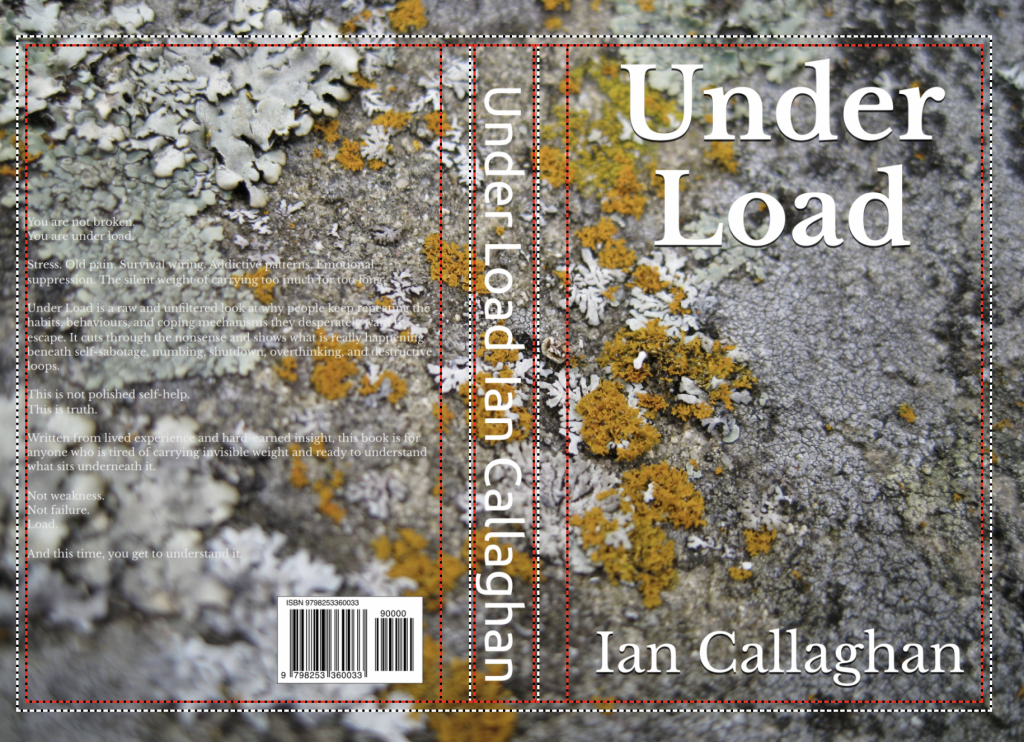
Under Load by Ian Callaghan | The Mechanical Guide to Addiction Recovery
You already know what you’re doing. You’ve known for years.