Gen X Nervous System Rebuild: The Unfiltered Blueprint for Radical Midlife Autonomy
Nervous System Rebuild. For the high-performing Gen X machine, the “standard” recovery narrative is a catastrophic mismatch. You’ve spent forty years under relentless load—masking the pressure of leadership, the volatility of global markets, the complexities of family life, and the heavy, silent role of the “strong one.” You’ve navigated recessions, technological revolutions, and personal crises, all while maintaining a functional facade fueled by pints, bravado, and a social calendar built on chemical sedation.
But now, the dashboard is lit up like a Christmas tree. The 3:00 AM internal negotiations have become a nightly ritual. You aren’t “broken,” but you are significantly under load. You are running a 1987 emotional operating system in a 2026 world, and the hardware is finally screaming for a hard reset.
Traditional recovery models tell you that you are “powerless.” They ask you to “surrender” your agency to a higher power in a drafty church hall. As a former soldier who spent 45 years in the trenches of heavy drinking, masking pain and “getting the job done,” that narrative never sat right with me. I didn’t find the way out through labels or groupthink; I found it by treating my body and my mind as a high-stakes engineering project. I didn’t need a meeting; I needed a total Gen X nervous system rebuild.
In the last 90 days, my content has reached over 33 million people. That isn’t because I’m selling a “wellness brochure” with soft-focus morning yoga. It’s because the message of radical self-respect, biological infrastructure, and the Beyond 12 Steps framework is the gritty, unfiltered truth that the “Red Ocean” of the recovery industry is too scared to talk about.
This is the definitive, 6,000-word deep-dive guide to reclaiming your autonomy and rebuilding your machine from the cellular level up.
The 40-Year Mask: The Psychological Weight of the “Strong One”
Before we talk about the solution, we have to acknowledge the specific weight our generation carries. Gen X was the “latchkey” generation. We were raised to be self-sufficient, to ignore discomfort, and to “keep a stiff upper lip” long before “resilience” was a buzzword in corporate HR. We grew up in an era when emotional expression was seen as a sign of weakness, and “getting on with it” was the only accepted response to adversity.
While these traits made us successful in our careers and resilient in crisis, they also taught us a dangerous, long-term skill: The Art of the Mask.
For 40 years, you’ve worn the mask of the successful professional, the dependable parent, and the guy who “has it all together.” But underneath that mask, your nervous system has been taking the hit. You’ve used alcohol not just for “fun,” but as a tactical tool to suppress the internal alarm system. You used it to transition from the high-stress work environment to the emotional demands of home. You used it to silence the voice that asks, “Is this all there is?”
When you decide to stop the sedation, you aren’t just giving up a drink; you are removing the only management system you’ve had for your nervous system for four decades. This is why traditional recovery feels like such a shock to the system—it takes away your primary tool but gives you nothing but “surrender” in return. The Gen X Nervous System Rebuild is about giving you a new set of high-performance tools to replace the old, destructive ones. It’s about clearing the cache, updating the firmware, and reinforcing the hardware.
The Bio-Psycho-Social Load of Gen X
We are the “sandwich generation.” We are caring for ageing parents while raising teenagers, all while sitting at the peak of our professional responsibilities. The load isn’t just psychological; it’s biological. Chronic stress leads to a state of Allostatic Load—the wear and tear on the body which accumulates as an individual is exposed to repeated or chronic stress. For Gen X, this load is often ignored until the physical symptoms—insomnia, gut issues, high blood pressure—become impossible to ignore.
The mask isn’t just a social performance; it’s a physiological straightjacket. It keeps your sympathetic nervous system in a low-level “on”state 24 hours a day. You’ve forgotten what actual relaxation feels like because your “resting state” is actually a state of hyper-vigilance. The rebuild starts by admitting that the mask is heavy and that it’s time to take it off.
The Red Ocean of Recovery vs The Biological Blue Ocean
The recovery industry is a “Red Ocean”—a saturated market of sanitised advice, stock photos of sunsets, and “one-size-fits-all” steps. It’s a space where you are defined by your failures and your “defects of character.” It treats you as a patient rather than a high-performance machine that has simply been running on the wrong fuel and the wrong software for too long.
The Gen X Nervous System Rebuild is a Blue Ocean opportunity. It moves the conversation away from abstinence and into Biological Infrastructure. We don’t focus on “not drinking”; we focus on rebuilding a nervous system that no longer requires sedation to handle the load of modern life.
Why the 12-Step Model Often Fails the Gen X High-Performer
For many, the 12-step model is a lifesaver. But for a specific type of Gen X high-performer—the leaders, the veterans, the entrepreneurs—it can actually be a barrier to long-term success.
- The Surrender Paradox: High-performers thrive on agency, responsibility, and autonomy. Telling a veteran or an entrepreneur they are “powerless” creates an immediate cognitive dissonance. This dissonance increases the cortisol load—the very stress hormone that triggers the “fight or flight” response. When your brain is told it has no control, it panics. That panic is what drives the urge to sedate.
- The Identity Void: Most paths focus on subtracting the habit. But after 40 years, the drink isn’t just a habit; it’s a persona. It’s the “life of the party,” the “hard worker,” the “guy who can hold his liquor.” When you remove it, you enter the Identity Void. Without a structured plan for Identity Reconstruction, you are just a “sober person” waiting for life to become boring. You feel like a diminished version of yourself rather than an upgraded one.
- The Neglect of the Machine: You cannot talk your way out of a physiological “fight or flight” loop. If your nervous system is stuck in a chronic stress response—your heart rate variability is low, your cortisol is high, and your sleep is non-existent—no amount of sharing in a circle will fix the biological drive for sedation. You have to reset the hardware physically. You have to go into the dashboard and clear the codes.
Pillar 1: The Neuro-Reset (The Science of the Vagus Override)
The foundation of the rebuild is the Neuro-Reset. Your nervous system is currently “stuck” in a sympathetic overdrive. You are living in a permanent state of high alert, which is why “just relaxing” feels like a chore rather than a relief. This is what I call Systemic Overload.
The HPA Axis and the Cortisol Trap
The Hypothalamic-Pituitary-Adrenal (HPA) axis is your body’s central stress response system. In Gen X high-performers, this system is often “stuck” in the ON position. Chronic stress leads to elevated cortisol levels, which in turn lead to insulin resistance, abdominal fat gain, and muscle mass loss. More importantly, it fries your dopamine receptors.
When your receptors are fried, normal life feels grey. You need a massive chemical hit (like alcohol) just to feel “normal.” The Neuro-Reset is designed to down-regulate the HPA axis and repair the dopamine baseline.
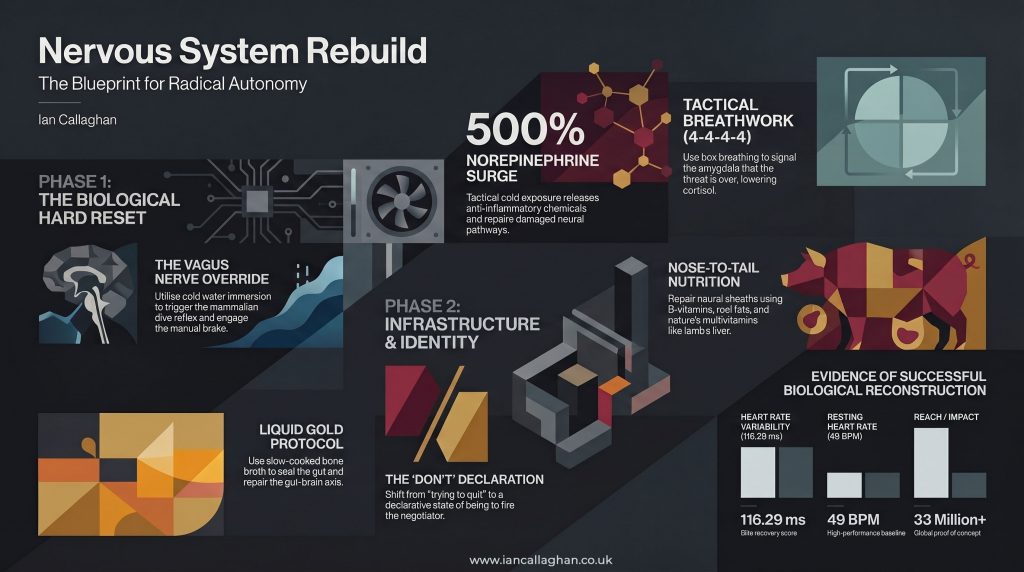
The Physiology of the Hard Reset | Nervous System Rebuild
This isn’t about the “lifestyle” dryrobe aesthetic you see on the school run. This is about tactical biological warfare. Cold water immersion is a physiological trigger for the Mammalian Dive Reflex.
- The Vagus Nerve & The Vagal Brake: The Vagus nerve is the longest in your body, running from the brainstem to the abdomen. It is the primary channel for the parasympathetic nervous system—the “rest and digest” system. When you enter a freezing river or a cold shower at 4:00 AM, you are forcing your Vagus nerve to engage. It is the manual “brake” for your nervous system. For 45 years, I ran my machine with the accelerator pinned to the floor and no brakes. Cold water immersion taught me how to find the brakes and apply them with precision.
- Norepinephrine and Cold Shock Proteins: When you hit the cold, your body releases a massive surge of norepinephrine—up to 500%. This isn’t just a “rush”; norepinephrine acts as a powerful anti-inflammatory for the brain. Simultaneously, your body produces “cold shock proteins” (such as RBM3), which have been shown in animal studies to help repair damaged synapses and protect neural pathways.
- The Dopamine Baseline Shift: Research indicates that cold exposure can increase baseline dopamine levels by up to 250% for several hours. Unlike the dopamine spike from alcohol or sugar, which is followed by a crash, this is a sustained elevation. For someone navigating the Sober Flatline—the grey apathy that often hits around month 6—this dopamine baseline shift is the difference between relapse and resilience. It provides the “biological hope” your brain needs to keep going.
Tactical Reset Protocol: The 3-Minute Hard Reset
For those just starting the rebuild, you don’t need a freezing river. You can start in your shower.
- The Warm Start: Do your normal wash. Get the machine ready.
- The Turn: Switch the dial to full cold. Don’t negotiate. Don’t think. Just turn.
- The Breath: Your body will want to gasp. Override it. Focus on long, slow exhalations. This is you telling your brain: “I am in control of this discomfort.”
- The Duration: Stay for 60 seconds, building up to 3 minutes. This is the “infrastructure check.” If you can handle 3 minutes of freezing water, the “Witching Hour” craving for a beer is a minor annoyance by comparison.
Breathwork for Tactical Regulation
In the military, stress management wasn’t a luxury; it was a requirement for survival. We used tactical regulation to keep our minds clear in a chaotic environment.
- Box Breathing (4-4-4-4): This is the manual override for your heart rate. Inhale for 4, hold for 4, exhale for 4, hold for 4. It signals to the amygdala—the brain’s fear centre—that the threat is over. It lowers cortisol in real-time.
- The Emotional Observation Method: my proprietary framework for the “Witching Hour” (usually 4:00 PM to 6:00 PM). Instead of fighting the urge, you open the Gate. You observe the brain’s “negotiator” with curiosity rather than fear. You see the craving for what it is: a biological tantrum from a system that misses its sedative. You don’t say “I want a drink.” You say, “I am observing a sensation of wanting a drink.” This subtle shift in language creates a massive shift in power. You are no longer the craving; you are the architect of your response.
Pillar 2: The Fuel (Biological Reconstruction and the “Liquid Gold” Protocol)
You cannot rebuild a high-performance engine on green powders, kale smoothies, and the ultra-processed “meat alternatives” sold by the wellness industry. To fix the damage of 40 years of heavy masking, your body requires infrastructure fuel. Alcohol is a neurotoxin that drains your biological “bank account” of essential minerals and vitamins—specifically B-vitamins, magnesium, and zinc. To rebuild, you have to make some massive deposits.
The Legend of “Liquid Gold”
I call traditional, slow-cooked bone broth “Liquid Gold.” It is the baseline for gut-brain recovery.
- The Gut-Brain Axis: 90% of your serotonin—the “feel-good” neurotransmitter—is produced in your gut. Alcohol is a solvent; it destroys the delicate gut lining (the villi), leading to systemic inflammation and a “leaky” gut-brain connection. This is why you feel anxious, “brain-fogged,” and depressed after a binge. Your “second brain” is on fire.
- Sealing the Leaks: Liquid Gold provides the collagen, proline, and glycine necessary to seal the gut and calm the nervous system. Glycine, in particular, acts as an inhibitory neurotransmitter, helping to quiet the “noise” in your brain. It’s not a “health trend”; it’s a biological repair kit.
- The Ritual of Preparation: In the Beyond 12 Steps framework, preparing real food is as important as eating it. The hours of simmering the bones, the smell of the kitchen, the focus on the ingredients—this is a meditative ritual that reinforces your new identity as someone who values their biological temple. It is a commitment to the rebuild.
The “Liquid Gold” Recipe for the Nervous System Rebuild
- The Base: Marrow bones, knuckles, and joints (ideally from a local, ethical butcher). This is where the collagen lives.
- The Acid: A splash of apple cider vinegar. This is essential to pull the minerals (calcium, magnesium, phosphorus) out of the bone.
- The Slow Burn: 24 to 48 hours in a slow cooker. You aren’t just cooking; you are extracting the life force from the ingredients.
- The Result: A rich, gelatinous broth. When it’s cold, it should look like jelly. That’s the sign of a successful extraction. You drink it every morning. It’s the first deposit in your biological bank account.
Nose-to-Tail Nutrition: Reclaiming Gen X Roots
Our generation was raised on real food before the low-fat lie, and the seed-oil industry took over. We grew up on liver and onions, stews, and proper Sunday roasts. For the rebuild, we return to Nose-to-Tail eating.
- Lambs Liver: Nature’s multivitamin. Flash-fried at high heat with plenty of butter, it delivers a massive hit of B vitamins (especially B12), iron, and Vitamin A—the exact nutrients your nervous system requires to repair neural sheaths and restore cognitive function.
- Real Fats & The Satiety Signal: We don’t fear butter or tallow. We fear the chemical spreads that clog our circuitry. Your brain is 60% fat. When you feed your body high-quality animal fats, you provide the satiety signal your brain needs to stop hunting for quick sugar hits. Alcoholism and sugar addiction are two sides of the same coin; fat is the currency that buys your freedom from both.
- Metabolic Fasting: We don’t just eat; we time our meals to allow the body to engage in Autophagy—the process of cellular “self-eating” in which the body clears out damaged components. By giving the digestive system a break, we allow the energy to be redirected toward nervous system repair.
Pillar 3: Mindset Coaching and Visualisation Science
The most dangerous phase of recovery is the Identity Void. Most people fail because they are “trying to quit.” We move the needle by becoming the person who simply doesn’t drink. This requires a radical, linguistic shift in how you view yourself and your history.
The Science of Visualisation as a Neural Roadmap
Neuroscience demonstrates that the brain struggles to distinguish between a vivid mental image and a physical reality. This is why your palms sweat when you think about a stressful situation. We use this to our advantage.
- Mental Rehearsal vs Positive Thinking: Positive thinking is passive and often delusional. Mental rehearsal is active and tactical. In my coaching, we mentally rehearse success. You visualise yourself navigating a high-stakes board meeting or a chaotic family dinner. You see the glass of wine being offered, you hear your response (“No thanks, I’m good”), and you feel the surge of pride as you choose your autonomy over sedation.
- Neuroplasticity & The Habit Loop: Every time you visualise a successful outcome, you are performing a “rep” for your brain. You are literally thickening the neural pathways of your new identity. Over time, the old “drinker” pathways wither away from disuse (long-term depression of synapses). This is how you bridge the gap between “quitting” and “being.”
The “Doesn’t” vs. “Don’t” Rule: The Language of Authority
Language is the software of the mind. Most people say, “I’m trying not to drink” or “I can’t drink right now.” These are weak statements of temporary restriction.
- The “Don’t” Declaration: I use “don’t.” I don’t drink. It is a declarative state of being. It’s like saying “I don’t smoke” or “I don’t eat glass.” It is a permanent boundary. It shuts down the internal negotiation before the 3 AM negotiator even wakes up. It removes the “option” of failure.
Reclaiming the Present Moment: The Narrative Architect
For a high-performer, the mind is always in the future (anxiety about the next project) or the past (regret about the last bender). The rebuild requires you to own the now. You are the architect of your narrative. You stop telling the story of “the guy who messed up” and start telling the story of “the man who rebuilt himself.” You move from a reactive victim of your cravings to a proactive architect of your destiny.
Pillar 4: Nature-Based Coaching and Grounding for Nervous System Rebuild
The “church hall” or “office chair” models of coaching are claustrophobic. They keep you stuck in the same artificial environment that created the stress in the first place. Real growth requires the scale, the chaos, and the brutal honesty of the natural world.
Nature as the Ultimate Infrastructure
Nature-Based Mindset Coaching is about reconnecting with the environment to find the grounding that a digital life or a group meeting can’t provide. It is the practice of externalising the Noise.
- The Scale Perspective: When you stand in an ancient forest or look out over a misty lake, your “problems” are put into their proper context. You realise that your nervous system is a part of a much larger, more resilient infrastructure. The forest doesn’t have a “Pink Cloud” or a “12th Step.” It just is.
- The Reset of the Senses: Modern life is a sensory overload of blue light, notifications, and artificial noise. Nature provides a sensory “re-calibration.” The sound of the wind, the texture of the bark, the temperature of the water—these are the real-world anchors that pull you out of the “Identity Void” and back into your body.
- The Vibe of the Wild: I take my clients into the woods or to the river because the environment does half the work. The cold water provides the physical shock, the trees provide the oxygen, and the silence provides the space to actually hear your own thoughts for the first time in 40 years. You cannot rebuild your nervous system while sitting in the same room where you usually drink. You have to move the body to move the mind.
The Data Receipts: Proving the Rebuild with HRV
In a world full of “wellness influencers” selling vibes and “manifestation,” I lead with the receipts. I don’t ask you to believe how I feel; I ask you to look at the hard data of my biological machine. If my framework works, it should show up on the dashboard.
The 33 Million View Social Proof
My reach—33,302,173 views in the last 90 days—is proof that the Gen X demographic is finished with the wellness lie. They don’t want “shiny”; they want “real.” This volume of engagement demonstrates that the Beyond 12 Steps framework is not just a book; it is a category-defining movement. People are hungry for the truth, and it carries a specific weight.
The 116 RMSSD: Biological Authority
I recently took a waking Heart Rate Variability (HRV) reading using a 15-year-old, basic sensor. I didn’t need a high-end wearable or a subscription-based ring to prove the point.
- The Result: A waking RMSSD of 116.29 ms.
- The Context: For a Gen X man with 45 years of drinking history, 116 ms is an elite recovery score. It indicates a nervous system that is highly resilient, capable of rapid adaptation, and fully recovered from the chronic load of sedation.
- The Minimum HR: My resting heart rate hit 49 BPM. This is the result of the Neuro-Reset and the Fuel Pillar. My biological age is trending significantly younger because I’ve stopped the sedation and started the rebuild. I am proof that you can reverse the damage with the right blueprint.
The “Create Before Consume” Morning Routine: Defensive Architecture
To protect your Gen X Nervous System Rebuild, you must establish a defensive perimeter around your morning. If you wake up and immediately check your phone—letting the world’s news, politics, and social comparison into your head—you have already surrendered your nervous system. You are starting the day in a reactive state.
- Hydrate (The Infrastructure Flush): Start with a large glass of filtered water. I use a Wrekin Water filter because clean, mineral-rich hydration is the first step in flushing the metabolic waste of the night before.
- Move (Active Meditation): I do 100 adaptations of Tai Chi squats and arm swings. This isn’t a “workout”; it’s proprioceptive grounding. It tells your brain exactly where your body is in space. It wakes up the circulatory system without the stress of high-intensity cardio.
- Measure (The State of the Union): Check your HRV. Know your biological capacity for the day. If your score is low, you adjust the load. If it’s high, you lean in. You are the pilot of your machine.
- Create Before Consume (The Narrative Command): Produce value—write, paint, film, or coach—before you allow the world’s algorithms into your head. You are a creator of your life, not a consumer of the world’s distractions. This one rule will change your life faster than any supplement.
Navigating the “Sober Flatline” (Months 3 to 6)
The biggest lie in the recovery industry is that you will feel “amazing” after 30 days. For most Gen Xers, the real struggle begins at month 3. This is the Sober Flatline.
The initial excitement of quitting has worn off. The “Pink Cloud” has evaporated. You are left with a dopamine system that has forgotten how to function without a chemical catalyst. You feel grey, exhausted, and secretly depressed. You start asking, “Is this it? Is this what being sober feels like?”
How to survive the Flatline:
- Don’t Chase the High: Accept the “grey” as a sign of neural healing. Your brain is under construction. It is “down-regulating” your receptors so you can handle normal life again.
- Double Down on the Neuro-Reset: This is the time to increase your cold exposure. You need the natural dopamine spike to bridge the gap while your internal receptors repair themselves.
- Check the Fuel: Ensure you aren’t substituting booze for sugar. Sugar spikes create insulin crashes that mimic the feelings of anxiety and depression. Stick to the Liquid Gold and the Liver.
The Identity Void (Months 6 to 1 Year)
As you approach the one-year mark, the battle shifts from the physical to the existential. This is the Identity Void. You realise that alcohol was the glue holding your old social and professional life together. You have to decide who you are going to be for the next 40 years.
- Pruning the Social Circle (The Fuckit Bucket): You will lose “drinking buddies.” A drinking buddy is not a friend; they are a co-conspirator in sedation. If they call you “boring” for rebuilding your life, they go in the bucket. Real friends support the evolution.
- Building the New Pillars: This is where you find your new “X, Y, and Z.” For me, it was photography, river swimming, and building a community. These aren’t “hobbies”; they are the new pillars of your identity. You aren’t “recovering”; you are becoming.
- The One-Year Horizon: At 12 months, the rebuild is largely complete. Your HRV is stable, your sleep is deep, and the “3 AM negotiator” has been fired. You are finally living a life you can actually achieve.
Conclusion: Becoming Unfuckwithable
The journey Beyond 12 Steps is not about staying sober; it’s about becoming unfuckwithable. It is about moving from the grey apathy of a sedated existence into a life defined by radical self-respect, biological precision, and purposeful action.
You don’t need another “wellness” product. You don’t need to “surrender” to anything. You need to look at the raw truth of your own machine, pull the levers of the Neuro-Reset, and start building the life you actually want to show up for.
The framework is here. The infrastructure is yours. The rebuild starts now.
Take the Next Step in Your Rebuild
🔗 GET THE BOOK: Grab the 100-page blueprint, Beyond 12 Steps, and start the mental and physical reconstruction today. This is the manual for your machine.
Beyond 12 StepsBeyond 12 Steps is an integrative framework designed to move past simple abstinence. It is about so much more than just quitting booze; it is a comprehensive strategy for the mind, body, and spirit. Whether you are facing substance use or simply the crushing weight of midlife burnout, this book gives you the tools to reclaim your narrative and foster lasting well-being.
Beyond 12 Steps: Integrative Strategies for Mindset and Wellbeing
🔗 JOIN THE COMMUNITY: Stop battling in isolation. Join the inner circle at the Sober Beyond Limits Skool Classroom for monthly group coaching, live Q&As, and the Total Systems Reset modules. This is where the work gets done.
🔗 THE 99p DEEP DIVE: Get my weekly 3,000-word PDFs and audio guides on Facebook for less than the price of a pint. No excuses.
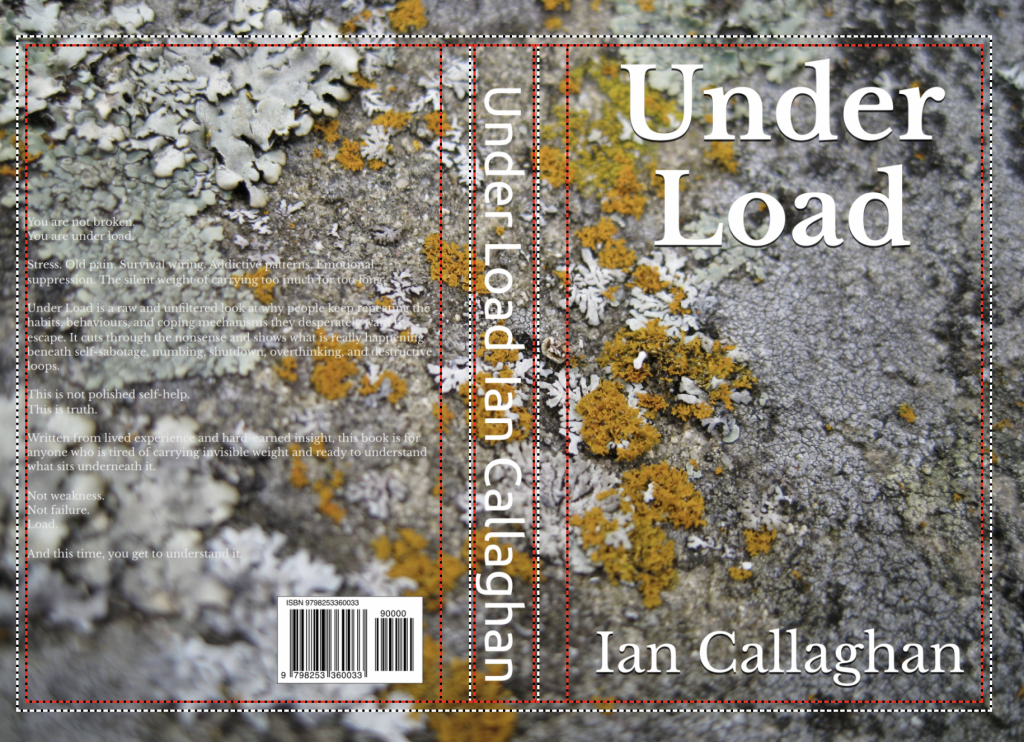
Under Load by Ian Callaghan | The Mechanical Guide to Addiction Recovery
You already know what you’re doing. You’ve known for years.