HRV Doesn’t Lie: Two Mornings, Two Completely Different Results | HRV lifestyle choices
HRV lifestyle choices. I’m 58 years old. I’ve been swimming in the River Usk for 50 years, year-round, no wetsuit. I eat one meal a day, real food, animal fats, nothing from a packet. I meditate, I breathe, I’ve spent decades paying attention to how my body works.
I thought I had a reasonable handle on how lifestyle choices were affecting my physiology.
Then I strapped on a Polar H9 chest strap, opened Kubios HRV, and got the receipts.
What came back across two consecutive mornings stopped me in my tracks. Not because it was surprising. Because it was exactly what I already knew, written in numbers I couldn’t argue with.
Monday Morning. The Data.
Sunday had been a good day out. Charity rugby match in the afternoon, fresh air, good company. Came home, ate a part-baked baguette, beef dripping chips, and a couple of Guinness 0s. Not a wild night by anyone’s standard. No alcohol. Home at a reasonable time. In bed at a decent hour.
Monday morning, I strapped on the H9, sat still for two minutes, and let Kubios do its job.
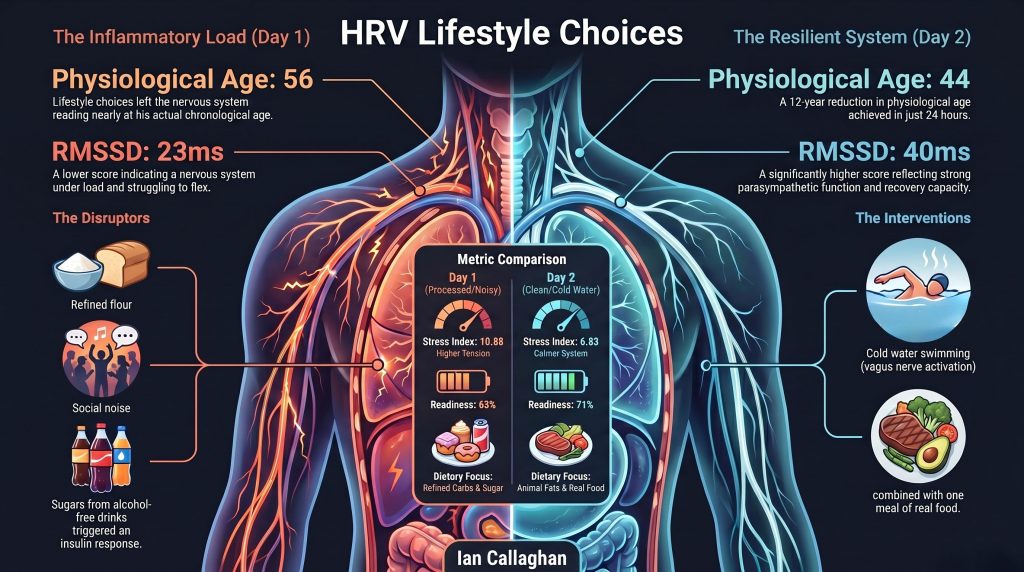
RMSSD: 23ms Readiness: 63% Stress index: 10.88 Physiological age: 56
I’m 58. My nervous system was reading two years younger than my actual age. On paper,r that sounds fine. In context, xt tells a different story because the next morning’s numbers are about to make Monday look like a car crash.
I already knew before I looked at the app. I felt bleurgh as I walked out of bed. Flat. Not ill, not hungover, just not right. That feeling you dismiss as getting older. It isn’t getting older. It’s data.
What Monday Actually Was
No river. A rugby crowd, noise, social stimulation, and the nervous system working all afternoon. A part-baked baguette, refined white flour, fast glucose spike, and insulin response. Beef dripping chips are the least offensive part of that plate by a distance. Two Guinness 0s, alcohol-free but not metabolically free, malt and residual sugars still trigger an insulin response at the end of a fast.
None of it is catastrophic in isolation. All of it stacked. And my nervous system was carrying the bill Monday morning.
Tuesday Morning. The Data.
Monday, I ate one meal. Ribeye steak cooked in butter. Large open mushrooms roasted in garlic butter. Spinach wilted down with Philadelphia garlic and herb melted through it. No bread, nothing processed, nothing from a packet. Food that had one ingredient or came from an animal.
At 5 p.m., I walked into the River Usk. Cold, moving water, chest deep. No wetsuit. Same river I’ve been getting into since I was eight.
Came home. Ate. Slept.
Tuesday morning, same chest strap, same app, same two minutes sitting still.
RMSSD: 40ms Readiness: 71% Stress index: 6.83 Physiological age: 44
I’m 58. My nervous system read 14 years younger than my actual age. The stress index nearly halved. The readiness score climbed. Every single marker moved in the right direction.
And again, I knew before I looked. I woke up feeling more rested. Not dramatically different. Just right. The way you’re supposed to feel.
What Tuesday Actually Was
One meal. Real food. Cold water in a Welsh river at 5 in the afternoon—eight hours of sleep.
That’s it. That’s the entire intervention. No supplements, no ice bath kit, no biohacking protocol that costs £300 a month. A chest strap that cost £42, an app, a river that’s been running through Monmouthshire since before anyone was counting.
The 12 Year Swing
Physiological age 56 on Monday. Physiological age 44 on Tuesday. Same man. Same chest strap. Same app. 24 hours apart.
Kubios calculates physiological age based on your autonomic nervous system function compared to population norms for your age group. It’s not a vanity metric. It’s a measure of how well your nervous system is actually working relative to what it should be doing at your age.
One day of junk food, no cold water, and a crowd put me at 56. One day of clean food, one meal, and the Usk put me at 44.
The variables aren’t complicated. The results aren’t subtle.
What HRV Actually Measures | HRV lifestyle choices
Heart rate variability is the variation in the time between heartbeats. It sounds counterintuitive, but you want that variation. A nervous system that can flex between beats is resilient. One that can’t is under load.
RMSSD is the most commonly tracked HRV metric for day-to-day recovery. Higher is generally better. Mine went from 23ms to 40ms overnight.
The stress index measures the regularity of your heart rhythm. Lower means your nervous system is calmer. Mine dropped from 10.88 to 6.83.
None of this is complicated science. Your body keeps score. HRV is just the scoreboard.
Why the River Works
Cold water immersion activates the vagus nerve, the long wandering nerve that runs from your brainstem through your heart, lungs and gut and governs your parasympathetic nervous system. That’s your rest-and-recover system. Your brake pedal.
Getting into cold moving water triggers an initial sympathetic spike, the cold shock response, and then, as your nervous system adapts, a significant parasympathetic rebound. When done consistently, it trains the vagus nerve. Your brake pedal gets stronger.
I’ve been doing this for 50 years without knowing the terminology for it. The H9 and Kubios just gave me the language to describe what the Usk has always done.
Why the Food Works in HRV Lifestyle Choices
Everything you eat is either inflammatory or anti-inflammatory. Everything you eat either spikes your blood sugar or doesn’t. Everything you eat either supports or disrupts your gut microbiome.
Your gut and your vagus nerve are in constant conversation. The gut-brain axis is a two-way signal highway, and what you put in one end shows up at the other by morning. A baguette and two Guinness 0s at 9 pm are not neutral. Your nervous system is still processing it at 7 am.
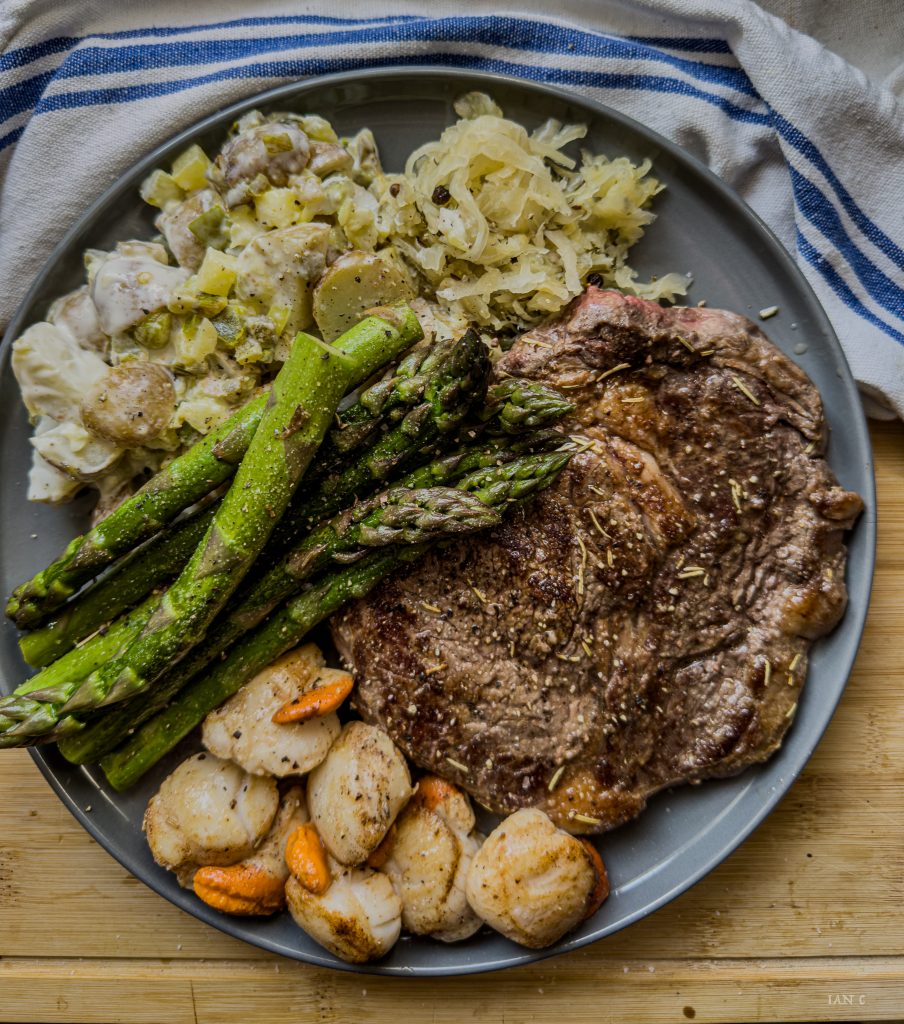
One real meal a day gives your gut time actually to do its job. Animal protein and fat don’t spike insulin. Monday, I ate one meal. Ribeye steak and pan-seared scallops. Asparagus. Sauerkraut. And a jersey royal potato salad that most people would walk past without a second thought, but is doing more work on that plate than anything else on it.
The Jersey Royals had been cooked and cooled in avocado oil mayonnaise with cold, brined jalapenos through it. Cooking and cooling potatoes converts a significant portion of the starch into resistant starch. That resistant starch bypasses your small intestine entirely and goes straight to your large intestine, where your gut bacteria ferment it as food. You didn’t eat a potato salad. You ate a prebiotic delivery system dressed in avocado oil mayo with a jalapeño kick.
Add the sauerkraut alongside it, and that one plate contained two fermented foods, resistant starch directly feeding the microbiome, asparagus, which is itself a prebiotic, and clean animal protein from two sources. Not a seed oil in sight. No processed ingredients anywhere on the plate.
Your gut bacteria had an extraordinary night. Your vagus nerve is noticed by morning. which supports sleep quality and vagal tone overnight.
The plate I ate Monday night was designed by industrial food science to be convenient. The plate I ate Tuesday night was designed by 50 years of paying attention to what my body actually does with food.
The data knows the difference.
This Isn’t Biohacking
Biohacking implies you’re trying to trick your biology into performing better than it should. I’m not doing that. I’m removing the things that stop it from working properly and letting it do what it was always going to do.
Cold water. Real food. One meal. Sleep.
A £42 chest strap to prove what your body already knew.
If you woke up this morning feeling bleurgh and you’re blaming your age, check what you did yesterday. The answer is usually in there.
FAQ for HRV Lifestyle Choices
Does what you eat the night before affect your HRV the next morning?
Yes, significantly. Blood sugar spikes from refined carbohydrates trigger an insulin response that disrupts overnight recovery. Alcohol, including low-alcohol options like Guinness 0, adds further metabolic load. Your nervous system is still processing all of it while you sleep, and the HRV reading the next morning reflects that directly.
Does cold water swimming improve HRV?
Consistent cold-water immersion trains vagal tone by repeatedly activating the parasympathetic nervous system via the vagus nerve. Over time, this strengthens your autonomic nervous system’s ability to recover. A single session can shift the same morning’s metrics. Decades of it build a fundamentally more resilient nervous system.
What is the physiological age in Kubios HRV?
Kubios calculates physiological age by comparing your autonomic nervous system function against population norms for your chronological age group. A lower physiological age than your actual age indicates your nervous system is functioning better than average for your age. It is not a vanity metric. It reflects real autonomic health.
What is a good RMSSD score for a man over 55?
Population averages for men over 55 typically sit in the 20-35ms range for resting RMSSD. Higher scores indicate better parasympathetic function and recovery capacity. Scores above 40ms in this age group reflect genuinely strong autonomic health. Individual baselines matter more than absolute numbers; track your own trend over time rather than comparing to others.
Can HRV change significantly in 24 hours?
Yes. HRV is acutely sensitive to lifestyle inputs. Food choices, alcohol, sleep quality, cold water exposure, and social and environmental stress all show up in the next morning’s readings. A 12-year swing in physiological age over two consecutive days is not unusual when lifestyle inputs differ significantly. Your nervous system responds immediately. The data reflects that by morning.
Under Load by Ian Callaghan | The Mechanical Guide to Addiction Recovery
You already know what you’re doing. You’ve known for years.
The 30-Day Reset: Reclaim Your Vitality, Rewire Your Mind, and Reboot Your Body (Digital Ebook)
The 30 Day Reset is not a diet. It is a complete biological overhaul for anyone who is wired, tired, and done with feeling like shite. The 30-Day Reset is a 160+ page military-grade systems reboot for the over-35s. Four pillars. Eat, sleep, move, mind. One month to strip out the industrial poison, reset your dopamine pathways, silence Bob, and rebuild the machine that’s been running on the wrong fuel for decades. Not a diet. Not a programme. A complete…