I am 58. I spent 12 years in the British Army and 25 years as an IT Technical Architect. I quit drinking after 45 years on the winter solstice of 2024. In the months that followed, I lost over 5 stone, reversed a pre-diabetes diagnosis, and watched my HRV data tell a story my GP had never thought to look for. I am an NLP Master Practitioner, a Reiki Master, and a qualified chef, and I now work full-time as a coach and author. I did not go through a mid life crisis. I went through a mid life systems failure. There is a difference, and understanding it is the key to blowing up your life rather than actually fixing it.
The cliché version of the midlife crisis is a man buying a Porsche and leaving his wife for someone half his age. It is used as a punchline. The problem is that the punchline is getting in the way of a genuine diagnosis for millions of people, men and women, who are quietly falling apart in ways that don't make for a good joke.
Over 10,000 people have joined the Sober Beyond Limits Facebook community, and 520 are inside the Midlife Reset Skool community doing this work in real time. What I hear from them is not the cliche. What I hear is the grinding—the flatness. The drinking crept up without anyone noticing. The rage that arrives too fast at too small a provocation. The sense of performing a version of yourself that no longer fits, while having no clear idea who the real version actually is.
That is not a crisis. That is a systems failure. And systems failures have a diagnosis.
What a Mid Life Crisis Actually Is (And What It Isn't)
The term mid life crisis was coined in 1965 by psychoanalyst Elliott Jacques to describe a shift in how people relate to time and mortality in their middle years. It was a genuine, serious psychological observation about a real transition. What happened to it, culturally, was that it was reduced to a punchline about expensive cars and poor decisions.
The punchline is doing real damage. Because when people are genuinely struggling at 40, 45, 50, 55, they dismiss what they are feeling as either the cliche they don't want to identify with or as something shameful and personal that they should be able to manage alone.
Neither of those responses is useful. Both of them delay the diagnosis.
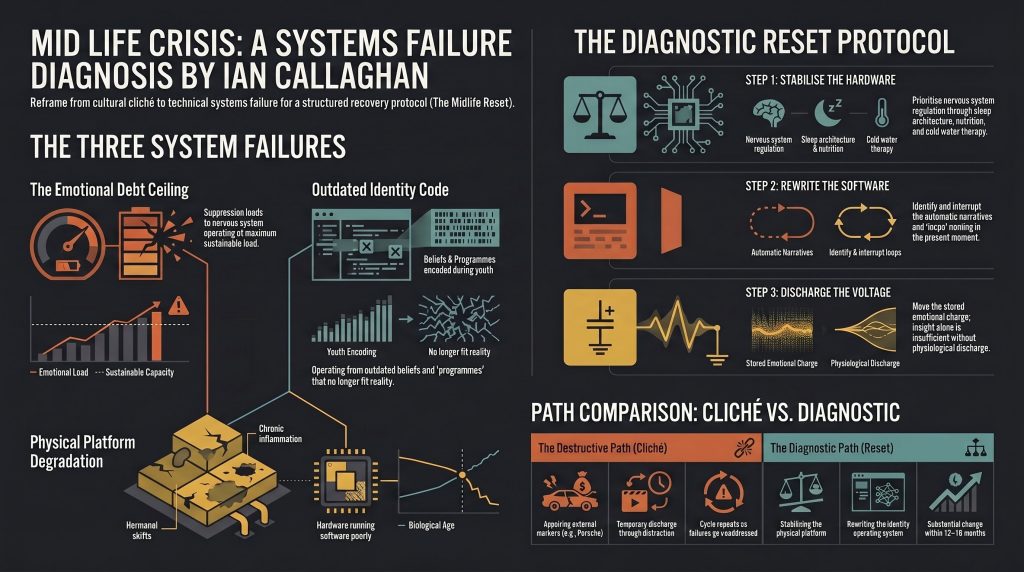
A mid life crisis, properly understood, is what happens when three specific system failures that have been building for years reach critical load at roughly the same time. It is not a character flaw. It is not a weakness. It is not inevitable. It is a convergence of biological, psychological, and identity-level pressures that most people are completely unprepared for because nobody explained the mechanism.
If you are not sure whether what you are experiencing is burnout or something more systemic, the Midlife Reset vs Burnout diagnostic guide will help you locate where you actually are. Treating a reset with rest causes depression. Treating burnout with action causes collapse. The diagnosis matters.
At what age does a Mid Life Crisis Hit?
The data and the lived experience both suggest a range rather than a fixed age. Most people land somewhere between 38 and 58, with the 45-55 window being the densest concentration. But the trigger is not the birthday. The trigger is the convergence.
The three system failures described below take years to build. They can converge at 38 for someone who started carrying a load early. They can converge at 58 for someone whose system has been compensating effectively for longer than most. Age is a rough guide, not a definition.
What tends to mark the convergence is a specific feeling. The sense that something that used to work is no longer working. The automatic motivation has gone quiet. The reliable coping mechanisms are becoming unreliable. The identity that felt solid is becoming difficult to locate.
That feeling is data. It is the machine telling you the load has exceeded the system's compensatory capacity.
What Are the First Signs of a Mid Life Crisis?
The first signs are rarely dramatic. The dramatic version, the Porsche, the affair, the career implosion, is usually what happens after the first signs have been ignored for years.
The real first signs are quieter and more insidious.
The drinking creeps from one glass to three without a clear decision. The sleep that degrades without an obvious cause. The irritability arrives faster and in response to smaller provocations than it used to. The Sunday evenings carry a weight they didn't use to carry—the sense of going through the motions of a life that used to feel like yours.
For many people in the Sober Beyond Limits community, the first sign they recognised in retrospect was the drinking. Not because they were drinking to dangerous levels necessarily, but because the function of the drinking had changed. It had moved from social or celebratory to regulatory, from something they chose to something they needed. That shift, when you can identify it clearly, is one of the earliest diagnostic signals of a system under unsustainable load.
What Is the Root Cause of a Mid Life Crisis?
There is not one root cause. There are three, and they converge.
System Failure 1: The Emotional Debt Ceiling
Most people who reach the midlife collision point have spent 20 to 30 years operating a specific emotional strategy: suppress, perform, push through.
It works for a while. The army runs on it. Corporate environments run on it. Parenthood runs on it. High-performance careers run on it. It is an effective short-term survival mechanism in any environment that punishes emotional expression or rewards endurance over honesty.
The problem is that suppression is not resolution. Every time an emotional activation gets pushed down rather than processed, the stored charge accumulates in the nervous system. The body keeps a precise account of every debt.
By midlife, most people are running a nervous system at maximum load. Hair-trigger reactivity. Chronic low-level anxiety. Emotional numbness. Or all three simultaneously. The drinking, the rage, and the flatness are not character flaws. They are the nervous system's emergency pressure-release mechanisms. The machine has hit its debt ceiling and is doing whatever it can to discharge the load.
The connection between the vagus nerve and mental health is one of the most important biological topics that most people in midlife have never been told about. Your cravings are not a willpower problem. They are a nervous system problem. Understanding that changes everything about how you approach the fix.
System Failure 2: The Identity Programme Running on Outdated Code
The identity most people operate from in midlife was formed in their teens and twenties. The core beliefs about what they are worth, what they are capable of, what they deserve, and what is expected of them were encoded during a period of maximum vulnerability and minimum agency.
Every decision, every relationship, every professional choice since then has been filtered through that operating system. And the midlife collision happens when the life that the programme built no longer matches the life you actually want — and you don't yet have the tools to rewrite the code.
This is exactly what the seven-day diagnostic in I Know What To Do, So Why Don't I Do It? is designed to surface. Most people do not fail because they lack information. They fail because they are trying to use information to fix an operating system problem. The guide is free. It takes seven days. It will show you the loop you are running more clearly than anything else I know.
System Failure 3: The Physical Platform Degrading Under the Software
At 40-plus, hormonal balance shifts. Sleep quality deteriorates. Chronic inflammation rises. The physical platform on which the emotional and cognitive systems run is under increasing load. And most people accelerate that degradation through the same patterns that got them here: high stress, poor nutrition, inadequate recovery, and the substances used to regulate all of the above.
The body and the mind are not separate systems. When the hardware degrades, the software runs worse. Reactivity increases. Decision-making fragments. Emotional regulation becomes increasingly unreliable.
I know what my pre-diabetes numbers looked like and what they look like now. I know what my HRV data showed before and after removing alcohol, fixing nutrition, and rebuilding sleep architecture. The data is documented,d and it is not subtle. The body responds to different inputs. The midlife metabolism does not just slow down on its own. It responds to what you put into it and what you ask of it. Change the inputs, and the system responds.
Mid Life Crisis in Men: Why It Looks Different
Men experiencing a mid life crisis rarely talk about it in the language of a crisis. They show up to work. They pay the bills. They coach the Saturday football. They maintain the performance. And underneath it, something is collapsing in silence.
The male version of the mid life crisis is almost always characterised by two things that work against each other. The suppression is deeper, and the pressure release is more explosive. Men who have spent decades not processing emotional load tend to have more stored charge in the system when it finally has to go somewhere. The drinking gets heavier. The rage arrives faster. The withdrawal becomes more total.
The post "The Midlife Reset for Men: Fix the Machine, Not the Symptoms" details the three-layer protocol. The mechanic framing, hardware reset, software rewrite, and voltage discharge are not metaphors. It is the actual sequence in which the work has to be done. You cannot rewrite the operating system while the nervous system is still running at 95% load. You fix the platform first.
There is also a specific problem with how men respond to standard advice. Exercise more. Drink less. Talk to someone. It is all correct at the output level, and none of it addresses the mechanism. Telling someone with an overloaded nervous system to manage their stress better is like telling a car with a broken engine to drive more carefully. The instruction is technically accurate and completely useless given the actual problem.
Mid Life Crisis in Women: The Same Machine, Different Triggers
The three system failures are not gender-specific. They are human. The emotional debt ceiling, the outdated identity code, and the physical platform degradation affect women and men through the same mechanisms at the same fundamental level.
What differs is the cultural context in which the load was accumulated and the specific triggers that tend to bring the convergence forward.
For many women, the midlife collision is accelerated by perimenopause and menopause, which drive hormonal changes that have no direct male equivalent in terms of speed and intensity. The physical platform degradation that happens gradually for men can happen rapidly and dramatically for women in their late 40s and early 50s. Sleep architecture collapses. Mood regulation becomes harder. Physical symptoms arrive that have no precedent in the person's previous experience of their own body.
The identity load is also typically different. Many women arrive at midlife having spent 20 years organising their identity primarily around relationships and responsibilities to others, as a partner, parent, carer, colleague, and having lost clear sight of who they are when those roles are removed or reduced. The empty nest, the career plateau, the relationship that has run on performance rather than connection, these are the triggers that tend to bring the identity system failure forward.
The fix is the same. The sequence is the same. Hardware first. Software second. Voltage discharge third. But the diagnosis needs to account for the specific context in which the load was built.
What Are the Stages of a Mid Life Crisis?
The standard models describe a neat progression from denial through exploration to resolution. Real life is messier than that. But there is a recognisable pattern.
The first stage is the grinding. The low-level sense that something is wrong without a clear name for it. Most people spend years here, medicating the feeling rather than diagnosing it.
The second stage is the signal becoming impossible to ignore. A health scare. A relationship breaking point. A career event that forces a reckoning. A moment of looking in the mirror and not recognising the person looking back. Something happens that makes the underlying system failure visible.
The third stage is the response. This is where the crisis either becomes destructive or diagnostic. The Porsche and the affair are destructive responses to a genuine signal. They attempt to address the identity failure by acquiring new external markers of identity, while leaving the underlying system failures completely untouched. The diagnostic response starts with the question: what is actually failing here, and what does it need?
The fourth stage, for people who take the diagnostic path, is the rebuild—not becoming someone new and removing the code that was never theirs to begin with, and operating from something more current, more accurate, and more genuinely their own.
How to Deal With a Mid Life Crisis: What Actually Works
The standard advice fails because it addresses the outputs without touching the mechanism.
What actually works starts at the machine level.
First, the physical platform has to be stabilised. The nervous system needs to come off maximum load before anything else is possible. This means addressing inflammation through nutrition, cortisol through sleep architecture, and sympathetic dominance through cold exposure and breathwork. Cold water therapy is the fastest available intervention for training the parasympathetic response. Every cold exposure is a repetition of the same pattern: a stimulus arrives, the system activates, you observe without reacting, and the system returns to baseline. It is the core skill of the entire reset practised at the level of pure physiology.
If alcohol is part of the picture, it needs to be understood in its full context before it can be effectively addressed. What actually happens when you quit midlife drinking is not what most people expect. The first weeks are uncomfortable. What follows is not. Alcohol is one of the most effective short-term nervous system regulators available without a prescription. Removing it without understanding what it was doing and what should replace it is why most attempts to moderate or quit fail within six weeks.
Second, the identity operating system needs to be examined. Not by excavating the past. By looking at what is running in the present. The specific beliefs that fire in specific situations. The automatic assessments. The narratives that keep pulling you back into behaviour you already know is costing you. The gap between knowing and doing is not a willpower gap. It is an operating system gap.
Third, the stored charge needs somewhere to go. Insight without discharge is entertainment. You can understand your patterns with clinical precision and still keep running them. The voltage has to move. This is the piece that most midlife crisis frameworks miss entirely because they operate at the level of story and behaviour while leaving the underlying charge untouched.
If you want to understand where to start with your specific version of this, the Emotional Archetype Quiz identifies which of the four primary system errors you are running and tells you exactly where to apply the first tool.
How Long Does a Mid Life Crisis Last?
The honest answer is that it lasts as long as the system failures go unaddressed.
For people who take the destructive path, acquiring external solutions to internal system failures, it tends to cycle. The Porsche gets boring. The affair ends. The career change turns out to be the same person in a different location. The underlying system failures are still running. Another discharge event becomes necessary.
For people who take the diagnostic path, the timeline looks like this, based on my own experience and what I consistently observe in the people I work with.
The hardware changes are noticeable in the first weeks. Sleep improves—the baseline reactivity drops. There is more space between stimulus and response.
The software changes compound over the first months. The old loops become recognisable. The familiar narratives start to sound like a recording rather than the truth. Decisions that felt impossible begin to feel navigable.
The identity-level update takes longer. Twelve to eighteen months is realistic for substantial change across all three layers. Five stone over eighteen months. Pre-diabetes reversed. HRV data that tells a different story than it did eighteen months ago. The work is real, and the timeline is honest.
The Four Questions That Cut to the Centre
Before any framework, before any protocol, there are four questions worth sitting with honestly.
What is the nervous system managing that has not been addressed directly?
Which parts of the identity being operated from were written by someone else, in circumstances that no longer exist?
What has the drinking, the rage, the flatness, or the performance actually been doing? And what should it be replaced with?
What would be different if the machine were not running an inherited programme?
These are not comfortable questions. They are the correct ones.
Where to Start
The free seven-day field guide, I Know What To Do, So Why Don't I Do It?, is where most people who find this work begin. It is a diagnostic, not a motivational piece. In seven days, it shows you the loop you are running, the load feeding it, Bob's sales pitch, The Gate, and what one clean interruption looks like. 301 people downloaded it in the first six days. The open rate is 68.46%. It works because it describes exactly what is happening, not what should be happening.
The Midlife Reset Skool community is free and has 520 people in it doing this work in real time. No AA. No rehab. No labels. No recovery theatre. Just the machine, the data, the loop and the work.
The Sober Beyond Limits Facebook community has over 10,000 members and is where most of this work started. It is where the conversations that don't fit anywhere else happen.
If you want the full framework, Under Load is the book. Seven parts. Thirty-four chapters. From the first drink at eleven to the daily maintenance of sovereignty. It is not a recovery book. It is a diagnostic manual for a machine that has been running the wrong programme for a very long time.
Or book a session directly and we'll look at your specific machine together.
The mid life crisis is not a punchline. It is a signal. And signals have a source.
Pick up the wrench. 🔧
Frequently Asked Questions
What is a mid life crisis?
A midlife crisis is the point at which three specific system failures that have been building for years converge at a critical load simultaneously. The emotional debt ceiling is where decades of suppressed nervous system activation reach maximum load. The identity programme failure, where the operating system built in youth no longer matches the life being lived. And the physical platform degradation, where hormonal shifts, sleep deterioration, and inflammation compound the first two failures. It is not a character flaw, a weakness, or an inevitable part of ageing. It is a system's failure with a diagnosis and a repair protocol. At what age does a mid life crisis happen?
Most mid life crises emerge between 38 and 58, with the densest concentration between 45 and 55. The trigger is not the birthday. The trigger is the convergence of three specific system failures described in this post. Someone carrying a heavy emotional burden from an early age may hit the convergence at 38. Someone whose system has been compensating effectively may not hit it until 58. Age is a rough guide, not a definition.
What are the first signs of a mid life crisis?
The first signs are rarely dramatic. They include drinking that shifts from social to regulatory without a clear decision being made, sleep that degrades without obvious cause, irritability that arrives faster and at smaller provocations than it used to, a sense of going through the motions of a life that no longer feels yours entirely, and a flatness in motivation that used to be automatic. The dramatic events, the affair, the career implosion, the expensive purchase, are usually what happens after these quieter signals have been ignored for years.
What is the root cause of a mid life crisis?
There is not one root cause. There are three converging failures: the emotional debt ceiling built through years of suppression and performance, the identity programme running on code written in youth that no longer fits the life being lived, and the physical platform degrading under the combined load of hormonal shifts, sleep deterioration, chronic stress, and often the substances used to regulate all of the above. Addressing any one of these without the others produces temporary relief at best.
What are the stages of a mid life crisis?
The real stages are the grinding, where the system is under load but the signal can still be medicated; the signal becoming impossible to ignore, usually triggered by a specific event; the response, which either takes the destructive path or the diagnostic path; and for those who take the diagnostic path, the rebuild, which is not about becoming someone new but about removing the code that was never genuinely theirs. The standard neat progression models miss the messiness of real experience.
How do you deal with a mid life crisis?
The standard advice fails because it addresses outputs without touching the mechanism. What works starts at the machine level. First, stabilise the physical platform: nervous system load, inflammation, sleep architecture, and alcohol, if that is part of the picture. Then examine the identity operating system as it runs in the present, not by excavating the past. Then move the stored charge that keeps pulling old patterns back, regardless of insight or intention. The free seven-day field guide at iancallaghan.co.uk/i-know-what-to-do-so-why-dont-i-do-it is the starting diagnostic.
How long does a mid life crisis last?
It lasts as long as the underlying system failures go unaddressed. For people who take the destructive path of seeking external solutions to internal failures, the cycle tends to continue because nothing structural has changed. For people who take the diagnostic path, the hardware changes are noticeable in the first weeks, the software changes compound over the first months, and the identity-level update takes 12 to 18 months to produce substantial change. Those are honest timelines, not motivational ones.
Is a mid life crisis the same in men and women?
The three system failures are not gender-specific. The mechanism is the same. What differs is the cultural context in which the load was accumulated, the specific triggers that tend to bring the convergence forward, and the hormonal context. Perimenopause and menopause can accelerate the physical platform degradation for women in ways that have no direct male equivalent in terms of speed and intensity. The identity load also tends to differ in its specific content. But the repair protocol works across both because it operates at the level of the nervous system and the identity programme, not at the level of gender-specific symptoms.
What is the difference between a mid life crisis and a mid life reset?
A midlife crisis occurs when system failures go undiagnosed, and the machine forces a discharge on its own terms, usually through a dramatic or destructive event. A mid life reset is the deliberate, diagnostic alternative. It starts with identifying what is actually failing and why, before the system is forced to act unilaterally. The crisis is the machine running its emergency protocol. The reset is you getting under the bonnet before the engine blows. The Midlife Reset vs Burnout diagnostic guide helps you locate exactly where you are.
Ian Callaghan is a British Army veteran, former IT Technical Architect, NLP Master Practitioner, Reiki Master, and full-time coach and author. He reversed pre-diabetes, lost 5 stone, and quit drinking at 57 after 45 years. He works with people in midlife who are done performing a version of themselves that no longer fits. All books and digital products are at iancallaghan.co.uk/the-shop. Join the free Midlife Reset Skool community at skool.com/iancallaghan.