Your Cravings Are a Nervous System Problem, Not a Willpower Problem
By Ian Callaghan | Sober Beyond Limits | iancallaghan.co.uk
You already know what you’re doing.
You know what it costs. You’ve watched it cost you things you can’t get back. You’ve made the decision, with absolute conviction, not to do it again. And you’ve done it again anyway.
That gap. Between knowing and stopping. Between the insight and the behaviour. Between the version of yourself at midnight when the craving hits and the version of yourself the morning after, who can’t explain why it happened again. That gap has a name. It is a vagus nerve problem. And the connection between vagus nerve function and mental health is the thing the entire recovery industry has systematically refused to put in plain language, because doing so would dismantle the architecture that keeps people cycling through programmes, relapses, and shame for decades.
I spent 45 years drinking. Not as a social habit. As a regulatory strategy. A way of managing a nervous system that was running on a load it was never designed to carry alone. I also smoked 40 cigarettes a day and spent several years doing cocaine at several hundred pounds a weekend. I am not writing this from a theoretical position. I am writing this from the wreckage of everything that didn’t work first, and from the other side of understanding what actually does.
I am Ian Callaghan—British Army veteran. Qualified chef. NLP Master Practitioner. And a bloke who doesn’t drink. Not because of willpower. Because I finally understood how the machine works.
This is that explanation.
Vagus Nerve and Mental Health: What the Recovery Industry Never Told You
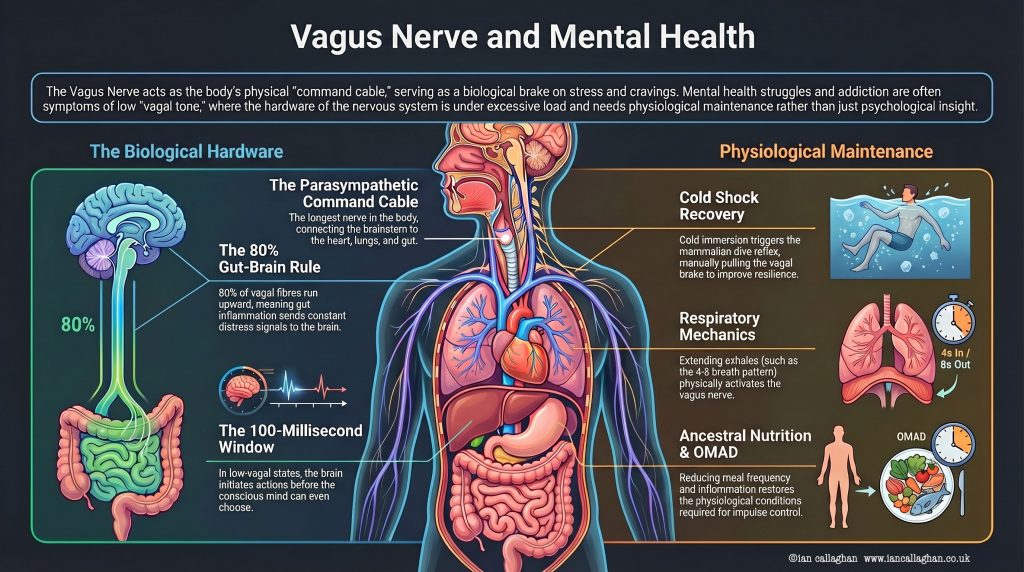
The vagus nerve is the longest in the human body. It runs from your brainstem down through your throat, heart, lungs, and all the way to your gut. It is the physical command cable of your parasympathetic nervous system, the rest-and-digest system, the biological brake on stress, anxiety, and the craving response.
When your vagal tone is high, you have access to calm. You can feel a craving, observe it, and choose how to respond. The gap between the signal and the action is open. You are the operator of your own machine.
When your vagal tone is low, that brake is off. The nervous system sits permanently in a low-grade threat response. The prefrontal cortex, the part of your brain responsible for long-term thinking, impulse control, and the ability to say no, is the first thing to go offline. The craving does not feel like a choice because by the time you are consciously aware of it, it is not one. The machine has already voted.
This is not philosophy. This is neuroscience. And it explains, at a mechanical level, why everything you have been taught about addiction and willpower has been setting you up to fail.
| Cold shock stimulates the vagus nerve. It is the command cable for your parasympathetic nervous system. While the initial shock is stressful, the recovery from that shock triggers your vagus nerve to calm you down. You are literally training your nervous system to bounce back from stress faster. Ian Callaghan — The 30 Day Reset |
The vagus nerve is not a wellness concept. It is hardware. And like all hardware, it can be in good condition or poor condition. When you spend years managing emotional load with alcohol, sugar, screens, or any other regulation shortcut, you are not just developing a habit. You are degrading the physical infrastructure that would otherwise give you a choice in the matter.
Low vagal tone is not permanent. It is a maintenance problem. And maintenance problems have solutions. But they do not respond to motivation, willpower, or the kind of insight the therapy industry sells as the destination. They respond to direct physiological intervention.
More on that below. First, we need to talk about why the frameworks you’ve been handed are structurally broken.
The Three Frameworks That Guarantee Relapse
Most people arrive at the question of addiction already carrying three explanations that feel true, carry authority, and are wrong. Not partially wrong. Wrong in the specific way that guarantees the approach built on them will eventually fail.
The Disease Model
Addiction is a chronic brain disorder. You did not choose it. You cannot cure it. Manage it, one day at a time, in permanent acknowledgement of your powerlessness.
This framework was built to reduce stigma, and it did some good in that direction. But it has a structural flaw that no amount of good intention can fix: it makes you passive. If you have a disease, you are a patient. Patients receive treatment. They do not fix themselves. And the disease model, in removing the moral stigma, simultaneously removed the one thing that changes anything: agency.
| You are not powerless over your nervous system. You are under load. Those are completely different conditions with completely different solutions. Ian Callaghan — Under Load |
The Moral Failure Model
Lack of willpower—weak character. If you had the backbone other people have, you would stop. This framework does not just fail to help. It actively makes things worse.
Shame is not a corrective. Shame is a load. Every time you pile shame onto a nervous system already running at capacity, you reduce vagal tone further. You make the gap between craving and action smaller. You make the next episode more likely, not less. The moral failure model is the framework most likely to generate the very behaviour it claims to address.
And it is built on a premise that doesn’t survive scrutiny. The people who end up in the grip of compulsive, self-destructive behaviour are not, on the whole, people who lack character. They are soldiers, architects, executives, parents—people who perform at the highest level in every domain of their lives except this one. A mechanical framework explains that. A moral one cannot.
The Willpower Model
The most exhausting one because it sounds the most reasonable. You know it’s wrong, so stop doing it. Apply sufficient determination. White-knuckle through the craving.
Willpower is a prefrontal cortex function. It is a high-toned luxury. It requires metabolic resources, cognitive space, and a nervous system that is not already running in survival mode. When vagal tone is low and the system is under load, the prefrontal cortex is the first thing to go offline. The part of your brain responsible for willpower is precisely the part that gets throttled when you need it most.
| Willpower is a high Tone luxury. You cannot apply it to a low-tone problem. That is like trying to use a car battery to power a building.Ian Callaghan — Under Load |
White-knuckling is not a strategy. It is the absence of one. The person who has tried it and found it wanting is not weak. They have simply been given the wrong tool for the job.
The 100 Milliseconds: Why Your Brain Has Already Decided Before You Know
In 1996, neuroscientist Benjamin Libet conducted an experiment that disturbed a great many people who had built their worldviews around conscious free will. He asked participants to flex their wrist whenever they felt like it while monitoring brain activity. He found that the brain produced a preparatory signal for the movement approximately 550 milliseconds before the action occurred. Participants reported becoming consciously aware of their intention to move approximately 200 milliseconds before they acted.
This means the brain had already initiated the action 350 milliseconds before the person was conscious of deciding to take it. That was a wrist flex in a laboratory, under no stress or load.
Now scale that to a nervous system running in an unstable state, under the specific load that activates the legacy wiring, with the amygdala already engaged and the prefrontal cortex already throttled.
The gap between the stimulus and the action does not widen under those conditions. It collapses.
| By the time you are in a position to decide, the machine has usually already decided. What you call a choice is often a ratification.Ian Callaghan — Under Load |
This is the 100ms window—the gap between the signal arriving and the machine attaching to it and running the habitual response. In a high-vagal-tone state, that gap is open. There is space to observe the craving, name it, and choose differently. In a low-vagal-tone state, the gap is closed. The craving arrives as a command, not a suggestion.
The behaviour that follows is not a choice in any meaningful sense of the word. It is an execution. And understanding that at a mechanical level changes everything, because it relocates responsibility where it actually sits, not in the moment of the craving, where you never had a chance anyway, but in the decisions that shaped the system’s tone and load before that moment arrived.
You cannot fight the craving. You can service the machine so the craving doesn’t get to run the show.
The Dopamine Myth: What Cravings Are Actually Doing
Most people understand cravings as a desire for pleasure. Alcohol feels good, so you want more of it. Sugar tastes good, so the brain demands a repeat. This is the simplified version, and it misses what matters most.
Cravings are not primarily about pleasure. They are about incentive salience. The brain tags certain stimuli as worth pursuing, not because they feel good in the moment, but because they have historically resolved a state problem. The drink didn’t just feel good. It lowered a nervous system that was running too hot. It created temporary stability in a system with no other reliable means of regulation.
Over time and with repetition, the dopamine pathways downregulate. The brain becomes desensitised to the signal. You need more substance to reach the same level of regulation. And crucially, the baseline drops. What you are managing now is not just the original state problem but the withdrawal gap created by the down-regulation itself. You are feeding a fire you lit to keep warm.
| Modern life has hijacked your dopamine pathways. You have been conditioned to seek instant, cheap hits of comfort in food, alcohol, and endless scrolling. This has made you chemically lazy. We are shifting your nervous system from a constant state of Sympathetic dominance to Parasympathetic dominance. This is mental weightlifting.Ian Callaghan — The 30 Day Reset |
The PR Firm is what I call the brain’s internal rationalisation engine. It does not want you to understand any of this. It wants to sell you the next hit. So it constructs a story: you’ve earned it, you deserve it, just this once, it’s been a hard week, it won’t matter this time. The story is not the truth. It is the machine finding the path of least resistance to temporary stability, and then constructing a narrative that makes that path feel like a reasonable choice.
The machine identified a problem—a nervous system running at load with no adequate regulation strategy. And found the fastest available fix. It filed that fix under effective and kept returning to it.
This is not a moral position. It is a mechanical one. The machine is not defective. It is logical. Understanding that does not remove responsibility. It changes what responsibility actually means.
What the Vagus Nerve Has to Do With Your Gut (And Why That Matters for Cravings)
80% of the fibres in the vagus nerve run upward. From gut to brain. Not brain to gut. This is the neurological basis of the gut-brain axis, and it explains why your emotional state is so profoundly connected to what you eat, how your digestion is functioning, and whether the population of bacteria in your gut is healthy or dysbiotic.
When the gut is inflamed, the vagus nerve carries that distress signal upward. The brain registers it as a threat. The nervous system responds. Cortisol rises. Vagal tone drops. The craving window closes.
This is why the food component of any genuine recovery protocol is not optional. Not because food is morally superior to alcohol. Because the gut-brain axis runs on the vagus nerve, and a chronically inflamed gut is a direct suppressor of the very hardware you need online to have any chance of making different choices.
Ultra-processed food, industrial seed oils, refined sugar, and chronic alcohol consumption all inflame the gut lining, disrupt the tight junctions, and send a sustained distress signal up the vagus nerve to a brain that translates it as danger. You are not imagining the anxiety, the brain fog, the inability to think clearly, or the feeling of being trapped in a loop. Your nervous system is receiving a genuine physiological distress signal and responding accordingly.
The ancestral nutrition approach I follow and teach isn’t dietary ideology. It is vagal tone maintenance. Animal fats, real food, bone broth, fermented foods, OMAD. These are not trends. They are the inputs a human nervous system was built to run on, and their absence is measurable in vagal tone degradation.
How to Stimulate the Vagus Nerve: The Practical Physiology
This section answers the question that people actually type into Google: “How do I stimulate the vagus nerve?” But the honest answer is longer than most websites are willing to give. Because there is a difference between a technique that temporarily activates the vagus nerve and a practice that raises baseline vagal tone over time. One is a patch. The other is maintenance.
Both matter. Here is what I use and what the physiology supports.
Cold Water Immersion
I go into the River Usk in water that would make most people’s chests seize on contact, not for drama. Cold immersion is one of the most direct, measurable, and fast-acting interventions for vagal tone outside a clinical setting.
| Cold exposure can raise dopamine levels by 250%. Unlike the spike and crash of a sugary snack or a line of Coke, the dopamine hit from cold water isn’t a sharp peak. It is a slow, steady incline that stays elevated for several hours—the difference between a lightning strike and a steady, blue-flame gas burner.Ian Callaghan — The 30 Day Reset |
The initial cold shock activates the mammalian dive reflex. Heart rate drops, vasoconstriction occurs, and the system briefly prioritises survival. The recovery from that shock, the moment the body begins to thermoregulate, is when the vagus nerve fires. Noradrenaline spikes. The parasympathetic system comes online. Heart rate variability improves. You are, in physiological terms, manually pulling the vagal brake after releasing it.
Over time and with consistent practice, this trains the nervous system’s ability to recover from stress. The bounce-back time shortens. The threshold before the system enters threat response increases. You are building a higher baseline vagal tone through deliberate, controlled adversity.
You do not need a river. A cold shower works. Start with 30 seconds at the end of a normal shower. Breathe through it rather than gasping. Over two to four weeks, extend to two or three minutes. The protocol is in The 30 Day Reset.
Breathwork as a Direct Vagal Intervention
The exhale activates the vagus nerve. The inhale suppresses it. This is the mechanical basis of every breathwork protocol worth using.
A longer exhale than inhale shifts the autonomic nervous system toward parasympathetic dominance. This is not a metaphor. Heart rate variability measurements taken during extended exhale breathing show measurable vagal activation in real time. You are not calming yourself down through mindset. You are physically changing the state of your nervous system through respiratory mechanics.
The 4-8 breath pattern, four counts in, eight counts out, is the Vagal Brake protocol in Emotional Mastery. It is step five of the ten-step EOM field protocol and the fastest manual override available without equipment. Three rounds are enough to measurably shift the autonomic balance when caught in the lead-up to a craving state.
Box breathing, the physiological sigh, and the 4-7-8 technique each have specific applications for different states. The detail is in The 30 Day Reset. But the principle is the same across all of them: you are using respiratory mechanics to talk directly to the vagus nerve, bypassing the narrative the PR Firm is constructing.
The 90-Second Rule and the Pressure Test
Dr Jill Bolte Taylor’s research on emotion identified that the neurochemical signature of any emotional state lasts approximately 90 seconds in the body if you do not add narrative to it. After 90 seconds, the chemical has been flushed from the bloodstream. What sustains the craving, the anxiety, the anger, beyond 90 seconds is not the original physiological signal. It is the story you are telling about it.
The Pressure Test in Emotional Mastery is built on this: hold the voltage of a craving state for 90 seconds without acting on it and without constructing a justifying narrative. Open circuit posture, no forward lean, no rehearsal of the story, somatic grounding, feet on the floor. The craving drops. Not because you suppressed it. Because the neurochemistry has run its biological half-life,e and the PR Firm has been muzzled long enough for the system to stabilise.
This requires a functioning vagal brake, which is why the practices above are not optional add-ons. They are the prerequisite for the protocol to work.
Nutrition, OMAD, and the Gut-Brain Axis
Meal frequency directly affects vagal tone by modulating the gut environment. Constant eating, particularly of ultra-processed food and refined carbohydrates, keeps the gut in a state of sustained inflammatory activation. The vagus nerve carries that signal upward. The brain stays in a low-grade threat response. Vagal tone stays depressed.
OMAD, one meal a day within a defined eating window, allows the gut environment to recover between meals. Inflammation drops. The vagus nerve signal normalises. The brain comes out of threat mode. Decision-making quality improves. The craving response becomes more manageable, not because of willpower, but because the physiological conditions required for the prefrontal cortex to stay online have been restored.
This is not fasting as a trend. This is vagal tone management through meal timing.
The Shame Loop: Why Self-Blame Is the Engine of the Cycle
There is a moment most people who struggle with compulsive behaviour know intimately. It happens after. After the drink, the relapse, the binge. The moment when the prefrontal cortex comes back online, surveys what just happened, and asks the question that has no satisfying answer.
Why did I do that?
And then the shame lands. The conviction that something is fundamentally wrong with you. That a person with genuine strength, genuine values, and genuine commitment to their own life would not have done this again.
Here is what that shame actually does to your nervous system.
Shame is a load. Every unit of shame added to the system after an episode reduces the vagal tone available for the next encounter with the same trigger. The guilt spiral that follows a relapse does not make the next relapse less likely. It makes it more likely. Because it depletes the one resource, vagal tone, that is the only thing standing between the craving signal and the execution of the habitual response.
| Stop treating the output as the problem. Start reading it as the data it is. The machine is trying to tell you something about the load.Ian Callaghan — Under Load |
The correct response to an episode is not a verdict. It is a debrief. In the military, a debrief is a structured review of what happened, the conditions, what worked, what failed, and what changes to make before the next engagement. It is not a tribunal. It is information gathering in the service of better performance next time.
What was the load at the time of the episode? How had I slept? What had I eaten? What was the accumulated stress in the days before? Was there a specific trigger, and where in the legacy wiring does it connect? At what point did the gap between the signal and the action close? What specific input can be changed to give the machine a better chance next time?
These are answerable questions. The shame question has no practical answers. It produces feeling without function. It occupies the cognitive space that should be used for diagnosis and instead uses it for self-punishment.
Addiction is not your identity. It is your machine’s current solution to a load problem it has, in many cases, carried since childhood. The machine can be serviced. The load can be managed. The wiring can be updated over time.
But not through shame. Through maintenance.
The EOM: A Mechanical Framework for What the Recovery Industry Refuses to Address
The Emotional Observation Method is the framework I developed over fifteen years of coaching people who walked in circles, produced extraordinary insight in one session, and extraordinary self-destruction in the next. I built it from the wreckage of everything that didn’t work in my own life first, and I applied it to my own machine before I asked anyone else to apply it to theirs.
It is built on a single premise that the recovery industry has consistently refused to centre: you cannot think your way out of a state problem. And most of what the recovery industry offers is more thinking.
The EOM is not therapy. It is not a programme. It does not have steps in the twelve-step sense. It does not ask you to surrender to anything, label yourself with anything, or accept that you are powerless. You are not powerless. You are under load.
The ten-step field protocol begins with the hardware reset. A direct physiological intervention to pull the machine out of the threat response state before any cognitive work is possible. Cold exposure, the physiological sigh, or the mammalian dive reflex equivalent. Survival over story. State before narrative.
From there, it moves through the vagal brake breath pattern, the gate, the observation protocol, somatic atlas mapping, the null-signal pause, signal analysis, the pressure test, path selection, and the identity save. Each step is a mechanical intervention on a specific point of the craving or reactive cycle. None of them requires motivation. All of them require that the machine’s vagal tone is high enough to run them.
The detail is in Emotional Mastery. But the principle behind the whole system is this:
| The argument is never really about the dishes. The craving is never really about the drink. Under load, you are always fighting a war that ended decades ago.Ian Callaghan — Under Load |
The craving is a signal from the nervous system seeking regulation. The behaviour is the machine’s current solution to a state problem. The solution is not to fight the signal or suppress the behaviour. It is to service the machine so thoroughly and consistently that the signal does not trigger the habitual execution. So the gap stays open. So you remain the operator.
That is what Sober Beyond Limits means. It is not a sobriety framework in the conventional sense. It is a system reset. The limits it addresses are not just the limits of substances. They are the limits of every pattern that keeps you stuck: compulsive behaviour, emotional dysregulation, fear of change, chronic anxiety, brain fog, and the inability to tolerate discomfort long enough to let the craving pass.
The vagus nerve is the hardware. The EOM is the operating system. The Four Pillars, eat, sleep, move, and mind, are the maintenance protocol. Put them together, and you have a machine that can carry the load.
Frequently Asked Questions
What mental health problems does vagus nerve stimulation treat?
Clinical vagus nerve stimulation via implanted device has regulatory approval in some countries for treatment-resistant depression and epilepsy. But the question most people are actually asking is about the connection between vagal tone and everyday mental health. Low vagal tone is associated with chronic anxiety, depression, poor emotional regulation, difficulty with social connection, and susceptibility to compulsive behaviour. Raising vagal tone through the practices described above, cold immersion, extended exhale breathing, real food, movement, and adequate sleep, addresses the physiological underpinning of these conditions at the hardware level rather than symptom-managing at the surface.
How does the vagus nerve affect mental health?
The vagus nerve is the primary mediator of the parasympathetic nervous system and regulates heart rate variability, which is one of the most reliable biomarkers of overall stress resilience and mental health. Low HRV is associated with anxiety, depression, PTSD, and addiction. The vagus nerve also regulates the gut-brain axis, mediating the inflammatory signalling that affects mood, cognition, and the craving response. When vagal tone is high, the nervous system can move fluidly between activation and recovery. When vagal tone is chronically low, the system sits in a persistent threat state that makes every aspect of mental health harder.
How to stimulate the vagus nerve for anxiety?
The fastest practical interventions are: extended exhale breathing (longer out than in, the 4-8 pattern is a direct entry point), cold water on the face or full cold immersion if available, the physiological sigh (double inhale through the nose, long slow exhale), and the posture anchor (open chest, feet grounded, spine neutral). These are physiological interventions, not mindset techniques. They work because they create direct mechanical input to the vagus nerve through respiratory and thermal pathways. For sustained reduction in anxiety rather than in-the-moment management, consistent daily practice, particularly cold exposure and breathwork, raises baseline vagal tone over weeks so the anxiety threshold rises.
Can the vagus nerve be healed after years of alcohol use?
Yes. Vagal tone is not a fixed trait. It is a physiological condition that responds to inputs. Years of alcohol use suppresses vagal tone through multiple pathways, direct neurotoxicity, gut dysbiosis, disrupted sleep architecture, and the down-regulation of dopamine pathways. All of these are reversible to a significant degree. The timeline varies. The gut environment begins to shift within weeks of removing alcohol and introducing an anti-inflammatory diet. Sleep architecture improves within the first month of sobriety if the other pillars are in place. Baseline HRV, the most reliable proxy for vagal tone, measurably improves with consistent cold exposure and breathwork within four to eight weeks. The machine can be serviced. It takes longer than the PR Firm wants you to believe, and it is more possible than the recovery industry wants you to know.
What is the difference between vagus nerve stimulation and improving vagal tone?
Clinical vagus nerve stimulation refers to electrical stimulation via implanted or surface-mounted devices. Improving vagal tone refers to raising the baseline activity and responsiveness of the vagal system through lifestyle practices. The latter is accessible, free, and supported by a substantial body of research on heart rate variability, cold exposure, breathwork, and gut health. This post is about the latter. It is what I practice and teach through the EOM framework and the Four Pillars.
Where to Go From Here
If this has landed where it needed to land, the place to start is The 30 Day Reset.
It is the practical first entry point into everything covered in this post. Across thirty days it addresses all four pillars: eat, sleep, move, and mind. It includes the cold shock protocol, the breathwork rituals, the dopamine reset mechanics, and the day-by-day operational structure to start raising vagal tone from the ground up. It is not a diet. It is not a programme. It is a systems reboot built on the biology that governs this.
Beyond that, Under Load goes deeper into the mechanical framework of why intelligent, capable, self-aware people keep doing the things that are destroying them and how to take back the controls. If you’ve read this post and thought ‘this explains things no book I’ve ever read has explained’, Under Load is the book that expands the whole architecture.
Emotional Mastery is the EOM operator’s manual. If the ten-step field protocol interests you, the vagal brake, the gate, the pressure test, the identity save, the full detail is in there.
All three are available at iancallaghan.co.uk/the-shop/
No Amazon. No middleman. Direct.
About Ian Callaghan
Ian Callaghan is a British Army veteran, qualified chef, NLP Master Practitioner, Reiki Master, and the creator of the Emotional Observation Method. He is based in Monmouthshire, Wales, and has spent over fifteen years coaching men and women through the kind of systemic reset this post describes. He has a 45-year personal history with alcohol and doesn’t drink. Not because of a label or a programme. Because he finally understood how the machine works.
He writes at iancallaghan.co.uk and runs the Sober Beyond Limits community. His YouTube channel, Facebook page (56,000+ followers), and Sober Beyond Limits group (8,300+ members) are where most of this work finds its audience first.
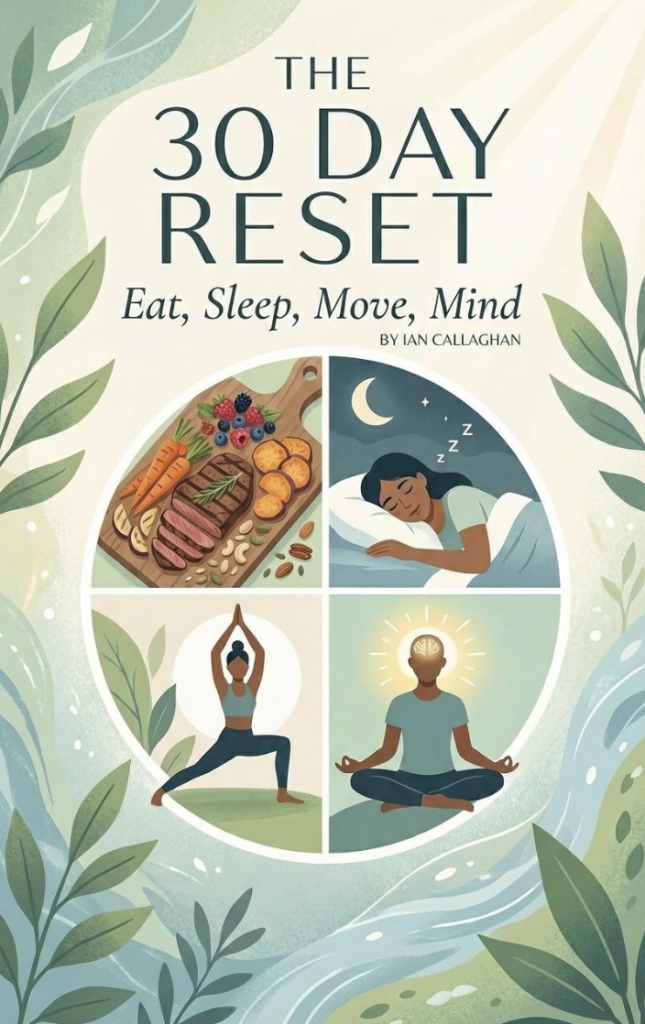
The 30-Day Reset: Reclaim Your Vitality, Rewire Your Mind, and Reboot Your Body (Digital Ebook)
The 30 Day Reset is not a diet. It is a complete biological overhaul for anyone who is wired, tired, and done with feeling like shite. The 30-Day Reset is a 160+ page military-grade systems reboot for the over-35s. Four pillars. Eat, sleep, move, mind. One month to strip out the industrial poison, reset your dopamine pathways, silence Bob, and rebuild the machine that’s been running on the wrong fuel for decades. Not a diet. Not a programme. A complete…

Under Load by Ian Callaghan | The Mechanical Guide to Addiction Recovery
You already know what you’re doing. You’ve known for years.