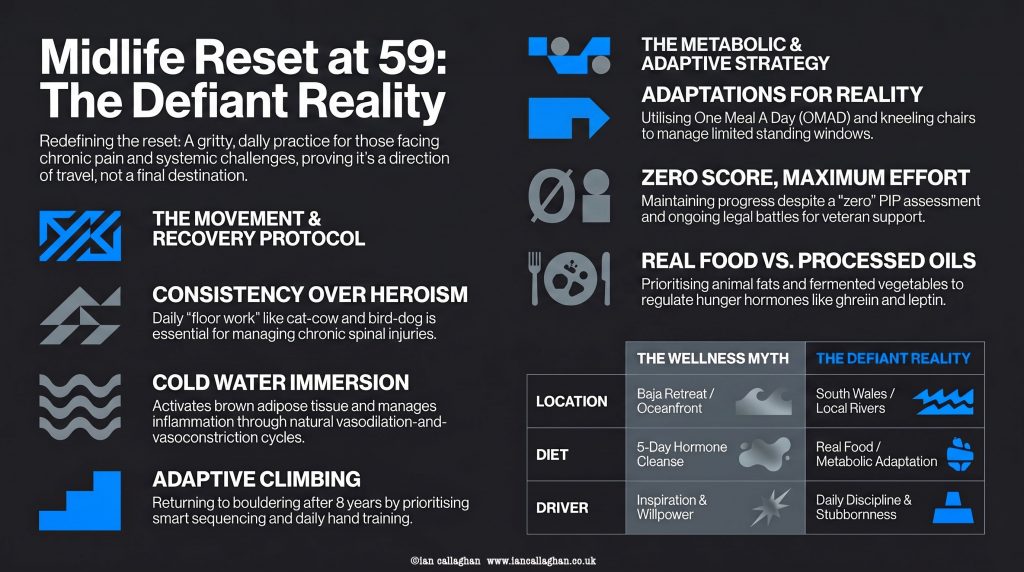
This is my Midlife Reset at 59. There’s a version of a midlife reset that gets sold to you online. It involves a retreat in Baja with oceanfront accommodation, chef-prepared meals, a life coach who’s had two seven-figure exits, and a price tag that would make your eyes water. There’s another version that looks like a five-day hormone cleanse designed for women in their forties who feel bloated after breakfast.
Neither of those is this.
This is what a midlife reset actually looks like when you’re nearly 59, you’ve got prolapsed discs from an army injury that’s been there for decades, tinnitus loud enough to furnish a soundtrack, an ongoing PIP tribunal that says you score zero despite the war pension the MoD has been paying for 25 years, medication that makes mornings genuinely dangerous around sharp objects and hot stoves, and a list of reasons why you technically shouldn’t be doing any of the things you’re about to read about.
This is April in South Wales. This is what the last few weeks have looked like. And if you’re sitting at 3 am thinking it’s too late, or you’re too broken, or the system has beaten you, or your body won’t cooperate anymore, then I want you to read every word of this.
Because if I can do this, you can do something. And something is where every reset begins.
The Comeback Nobody Warned You About | Midlife Reset at 59
Eight years. That’s how long it had been since I was on a climbing wall.
Not because I decided to stop. Life does that thing it does. The business, the move, the back on a bad run, the endless administration of existing with a chronic condition while fighting the institutions that are supposed to support you. Eight years just happened.
Last week, I drove to the Summit Centre in Treharris, a proper facility in the heart of the Welsh Valleys with walls that mean business, and I got on one.
My forearms knew about it within twenty minutes. My fingers, which have been getting a daily workout with hand trainers for months, held up better than expected. My back, which I manage every single day with cat cow, bird dog, glute bridge, dead hangs and the tai chi squat swing that’s become as automatic as breathing, did not stage a protest.
An hour on the indoor wall. Then straight to Parc Penaltta for bouldering. If you don’t know what bouldering is, it’s climbing without ropes at a lower height, pure problem solving between your body and the rock, and it’s significantly harder on already destroyed forearms than the roped stuff. Smart sequencing. Probably not recommended by any medical professional.
Then a hike to a waterfall.
Then cold water. Because of course.
I want to be honest with you here. I’m not telling you this to be impressive. I’m telling you this because six months ago, there were days when the back was bad enough that getting off the floor was the morning’s main achievement. The distance between that floor and a climbing wall in Treharris is built from one thing only.
Consistency. Not heroism. Not willpower in the motivational poster sense. Just doing the daily work, every day, for years, without waiting to feel ready. I still have days where the 15ft trip from bed to the loo is a victory.
David Goggins spent two hours a day on the floor stretching a body that doctors said was finished. He wasn’t doing it because it felt good. He was doing it because the alternative was giving up the ground he’d fought for. I finished his book this week and recognised something I’ve known for a long time. The body responds to consistent, intelligent, daily effort. Not to bursts of inspiration. Not to extreme measures. To show up on the floor, or in the river, or on the wall, even when everything is suggesting you shouldn’t bother.
Cold Water Is Not a Trend. It’s Just What I Do.
This month alone, I’ve been in the River Usk, the sea at Borth, a mountain keeper’s pond, and two waterfalls. I’ve been getting in the Usk year-round for fifty years. I was doing this before Wim Hof made it a brand, before ice baths became a lifestyle accessory, before wellness influencers started charging for cold plunge protocols.
The research is catching up to what cold-water people have known for a very long time. Cold water immersion activates brown adipose tissue, the metabolically active fat that generates heat rather than storing it. It improves insulin sensitivity. It elevates dopamine for sustained periods after immersion. It triggers a vasodilation-and-vasoconstriction cycle that genuinely works on inflammation and recovery.
After a day of climbing and bouldering, the cold water at that waterfall wasn’t a luxury. It was the smartest recovery tool available, and it cost nothing.
The day after the climbing, my forearms were not the disaster they should have been. That’s not luck. That’s the cold water, the daily movement work, the dead hangs, and forty years of understanding what this body needs and giving it that, rather than what the wellness industry wants to sell me.
I’ve been in rivers, seas, ponds and waterfalls this month. Next week, when Polarity Wellbeing in Cwmbran reschedule after a maintenance issue, I’ll be adding a proper ice bath and infrared sauna to the contrast therapy rotation. That Fire and Ice protocol, heat to cold, vasodilation to vasoconstriction, is one of the most effective recovery tools that exists, and it’s available twenty minutes from my front door.
I’m not selling you cold water. I’m just telling you that when I couldn’t stand consistently enough to cook three meals, when the mirtazapine was making mornings foggy, and the back was making everything else negotiable, getting in cold water every week was one of the things that didn’t stop. It costs nothing. It asks nothing. It just works.
The Food Is Not What You Think It Is
Let me tell you what I ate this weekend, and then let’s talk about what Pete from Facebook had to say about it.
On Saturday, after the climbing wall and the waterfall, I came home and cooked bavette steak. Sliced against the grain, proper char, pink through the middle, salt crystals on top. Triple-cooked chips in beef dripping. Raw sauerkraut, kimchi and cold-brined jalapeño relish. Vine tomatoes. Roasted mushrooms. Avocado oil aioli.
Pete, who had clearly never cooked a bavette in his life, turned up in the comments to inform me that if this was OMAD, I must be either starving or asleep a lot, because it clearly wasn’t enough to keep hunger at bay, and that was when people ate shite at 10 p.m.
Pete. Mate.
Here’s what Pete missed. I eat one meal a day for two reasons. The first is that I’ve understood metabolic health for forty years, and I know that when you eat real food with adequate protein and saturated fat, your hunger hormones function properly. Ghrelin drops. Leptin signals correctly. You are not hungry at 10 pm because Glucipher, the blood sugar chaos demon that runs on processed carbohydrates and seed oils, is not running your hormonal show.
The second reason I eat once a day is that I cannot consistently and safely cook three meals. The medication makes mornings hazardous around sharp objects and heat. The back has a limited standing window that I protect and ration. So I cook once, brilliantly, with adaptations. I use a kneeling chair. I batch cook. I plan. I make the one session count.
This is not a lifestyle choice made from a position of perfect health. This is an adaptation built around real limitations that still manages to produce food that makes people stop scrolling.
On Sunday, it’s slow-roasted shoulder of lamb. My old, battered cast-iron pot, a vessel with more history baked into it than most people’s entire kitchen, goes on with the lamb, sitting on a trivet of onions and carrots that will confit beneath it in the rendered fat all afternoon. The lamb gets incisions filled with anchovy, garlic and rosemary. The anchovy is my chef’s secret. Nobody can taste it. What they taste is a depth and savouriness that makes the lamb taste more like lamb than it can on its own. It disappears into the fat and becomes something else entirely. That’s glutamate chemistry. That’s classical French and Italian technique. That’s forty years of knowing what ingredients do at a molecular level.
I’ve cooked for a NATO summit. I’ve done 25 to 30 kilos of smoked brisket over 18 hours for food festivals while simultaneously running a kotlich over an open fire, doing Albanian lamb meatballs with mint and feta in broth. I’ve cooked bavettes directly on white coals in a layby next to a waterfall in the Elan Valley. I’ve done bavettes on the estuary at Ynyslas while people next to me wrestled with disposable supermarket barbecues.
None of that is on my social media. Most of it, my audience has never heard. I tell you this not to impress you but because I want you to understand something about the food conversation.
Real food cooked with real knowledge is not expensive, complicated, or time-consuming in the way people have been led to believe. A bavette costs a fraction of a sirloin and tastes better when you know what to do with it. Bone broth costs almost nothing. Raw fermented vegetables are cheaper than supplements and do more. Beef dripping is practically free from a decent butcher, and triple-cooked chips in it are in a completely different category to anything fried in rapeseed oil.
The calorie-counting gurus won’t tell you that a calorie of beef dripping is not the same as a calorie of industrial seed oil. They won’t tell you that raw fermented cabbage is doing things inside your gut that a probiotic capsule can’t replicate. They won’t tell you that the obsession with calorie arithmetic ignores the entire conversation about what food actually does at a cellular level. Eat real food. Understand what it does. Stop counting and start thinking.
What Midlife Reset Actually Means When Your Body Is Fighting You
I want to be straight with you about something.
The PIP system scored me zero. The same DWP that assessed me as unfit for work and paid me LCWRA. The same umbrella organisation that the MoD sits under, which has been paying a war pension for 25 years in acknowledgement of the service injury that started all of this. Zero.
I have a kneeling chair in my kitchen. A walking stick by the door. A prescription that makes the first hours of the day a genuine safety consideration. Prolapsed discs that arrived courtesy of the British Army and have been managed every single day for decades through movement, cold water, visualisation, Reiki, and the kind of stubborn refusal to let it become the main character that the army probably installed before the disc made it necessary.
I’m waiting on a tribunal. I’m fighting a legal case against the MoD for hearing damage. I am doing all of this alone, as a single bloke in a Welsh valley, because that is the reality of the situation, and there is no point pretending otherwise.
And I climbed a wall last week for the first time in eight years.
This is not an inspirational story about overcoming adversity. I am not your 3 am success porn. I’m a nearly 59-year-old man with real ongoing conditions, real financial pressures, a real legal fight, and a real body that requires real daily management, who is also getting into cold water, cooking lamb shoulder, and planning to resurrect a 12-year-old Gozney wood oven in a Welsh garden this summer.
Both things are true simultaneously. That’s what midlife reset actually looks like.
It’s not the retreat in Baja. It’s not the five-day hormone cleanse. It’s not the life coach with two seven-figure exits telling you to reclaim your energy across the six Fs.
It’s getting on the floor every morning for cat-cow and bird-dog. It’s getting into the river every week regardless of the temperature. It’s cooking one meal properly rather than three meals badly. It’s reading Goggins on the bad days and recognising something familiar in the obsessive daily floor work he did to reclaim a body that was supposed to be finished.
It’s choosing, every single day, not to let the system, the condition, the age, or the circumstances have the final word.
The Reset Is Not An Event. It’s a Direction.
Some would say 59 is past midlife. Fair enough. By the maths, they’re probably right.
What I know is that the trajectory matters more than the starting point. I’m not where I was eight years ago, physically, mentally, or financially, and some of that is genuinely hard. But the direction of travel this month, the climbing wall, the cold water, the food, the plans for the outdoor kitchen, the Polarity collab, the content, the Skool community growing, the Sober Beyond Limits group at over 8,900 people, the books doing what they do quietly in the background, that direction is forward.
If you’re reading this at 3 am with your own list of reasons why reset is for other people, younger people, healthier people, people without your specific set of circumstances, I’m not going to tell you it’s simple. It isn’t.
But I am going to tell you that it starts with one thing. One walk. One cold shower. One real meal cooked properly. One morning on the floor doing the work your body actually needs. One decision is to stop waiting for the circumstances to improve before you start moving in the direction you want to go.
The circumstances may not improve. That’s the part nobody tells you. Mine haven’t all improved. Some are actively worse than five years ago. And I’m still here, getting on climbing walls and getting in waterfalls and anchovy stuffing lamb shoulders in a battered cast pot while the Welsh valley does what it does outside the window.
That’s the reset. Not a destination. A direction.
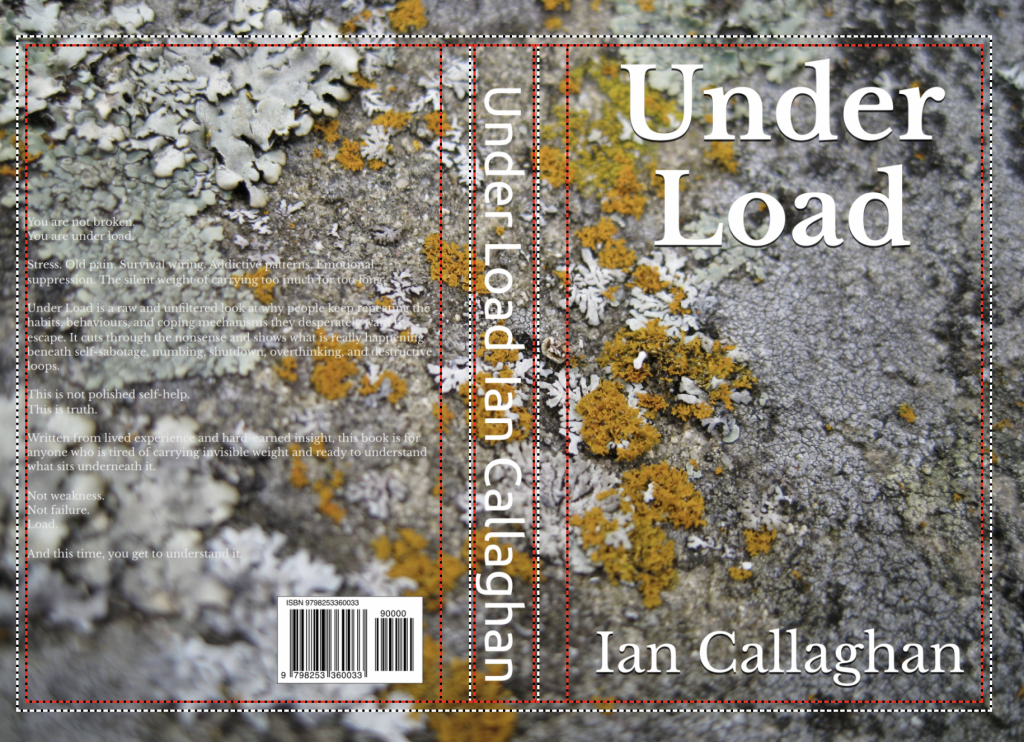
Under Load by Ian Callaghan | The Mechanical Guide to Addiction Recovery
You already know what you’re doing. You’ve known for years.
Find me in the Skool community if you want to do this alongside others who are figuring it out in real time. The link is above. So are the books, if you want the deeper framework behind any of this.
The lamb went in at 11. The river was cold. Both were worth it.
Tell me in the comments: what’s the one thing you keep putting off that you know would move the needle? No right or wrong answer. Just be honest.