Real Food Gut Health |The Truth They Don’t Want You To Read.
Real Food Gut Health. I want to show you something.
This morning, Facebook served me my memories—eight years of posts stacked up like evidence at a trial. And what I found stopped me before I went to the river.
Eight years ago, I said real food gut health was not complicated. That ultra-processed food was destroying metabolic health. Type 2 diabetes was reversible through diet. That the gut microbiome mattered and that fermented foods, sauerkraut, kefir, and kimchi, did everything a £21 supplement pouch claimed to do, at a fraction of the cost, better, and with thousands of years of human evidence behind them.
I was 50 years old, still drinking, with a few hundred Facebook followers and no platform to speak of.
Nobody was listening particularly hard.
Now I am 58. I have an RMSSD of 210ms, the HRV of someone half my age. I have reversed my pre-diabetes, lost five stone, and gone 17 months without alcohol. I have 58,000 Facebook followers, built from 400 in under four months. And I am still saying the same things.
Because biology has not changed. What I was saying eight years ago was correct. What the industry spent eight years doing was proving it.
This is the reckoning.
What Real Food Gut Health Actually Means. And What I Said in 2016.
Real food gut health is not a trend. It is not a product category. It is a biological reality that has been operating in human bodies since before recorded history.
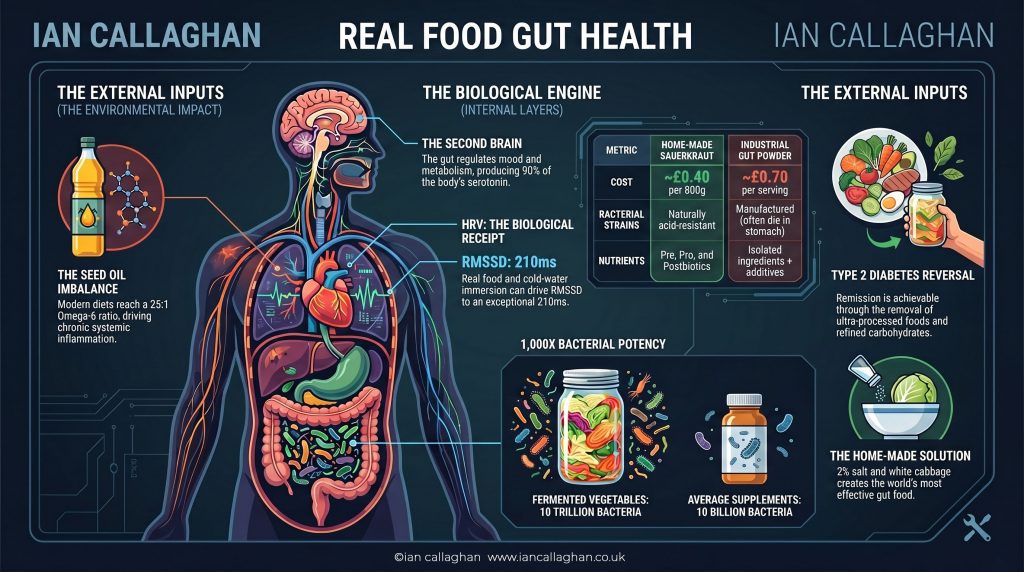
The gut microbiome, the ecosystem of trillions of bacteria, fungi, and other microorganisms living in your digestive tract, regulates your immune function, mood, metabolic rate, inflammatory response, and cognitive performance. It produces approximately 90% of your body’s serotonin. It communicates with your brain via the vagus nerve in both directions. It is, in every meaningful sense, a second brain.
It runs on real food. It is damaged by ultra-processed food. And it can be rebuilt, measurably, through the fermented foods that human beings have eaten for thousands of years.
In 2016, I posted a graphic explaining the difference between prebiotics, the fibre that feeds the bacteria, and probiotics, the live bacteria themselves. I listed the real food sources. Sauerkraut. Kefir. Kimchi. Yogurt. Tempeh. Pickles. On the prebiotic side: onion, garlic, artichoke, asparagus, oats, banana.
I also said, in the same week: no magic pills, teas, coffees, supplements, or calorie-counting systems will do what real food does. Everything brands advertise is designed to make a profit from you. They do not care about your health. That is your priority, your job.
I said vegan junk food was still junk food. That carbohydrates trigger insulin production and fat storage regardless of whether they came from a plant-based sausage roll or a regular one. The human body is perfectly adapted to an omnivorous diet. That soya production for the vegan food industry was destroying rainforest and soil fertility.
I said type 2 diabetes costs the NHS £1.5 million an hour and that it is reversible through the correct diet.
All of this, in one week, eight years ago, to an audience of a few hundred people.
Every word of it has been proven correct by subsequent scientific publications.
What the Ultra-Processed Food Industry Did Between 2016 and 2024.
While I was saying all of that, the ultra-processed food and wellness supplement industries were busy.
Global UPF consumption continued its upward trajectory. By 2023, studies showed ultra-processed food accounted for more than 56% of dietary energy intake in the United Kingdom, higher than in France, Spain, or Brazil and comparable only to the United States and Canada. A landmark study published in the Lancet Regional Health Europe in 2023 tracked 266,666 people across seven European countries and found that higher UPF consumption was associated with significant increases in the combined risk of cancer, cardiovascular disease, and metabolic disease. A separate 2019 BMJ study following 105,000 participants found that every 10% increase in ultra-processed food consumption was associated with a 12% increase in overall cancer risk.
Type 2 diabetes diagnoses in the UK rose from approximately 3.3 million in 2016 to over 4.3 million by 2023, with an estimated 2.4 million more in the pre-diabetic range. The NHS spent, and continues to spend, approximately £1.5 million every hour treating a condition that is largely driven by diet and largely reversible through diet.
The vegan food market exploded exactly as I predicted. Beyond Meat launched in 2016. Impossible Foods expanded globally in 2019. By 2021, every UK supermarket had an entire plant-based range. By 2023, the bubble was deflating, with plant-based food companies posting massive losses as consumers belatedly realised that a vegan sausage roll made from pea protein isolate, methylcellulose, rapeseed oil, and rice starch was not the health revolution it had been marketed as.
The gut health supplement industry grew from approximately $38 billion globally in 2016 to over $75 billion by 2024. Probiotic pouches. Prebiotic capsules. Synbiotic powders with 28 superfood ingredients. Each one is doing what a jar of sauerkraut has done since before the Roman Empire, and each one costs anywhere from 10 to 30 times more per serving than the real food alternative.
And the influencer wellness industry, which barely existed in 2016, became one of the most lucrative content categories on the internet. Twenty-two-year-olds with ring lights and supplement deals telling people with decades of metabolic damage what to eat. Nutritionists who had never properly cooked a meal in their lives are advising on ancestral eating. Personal trainers selling gut health programmes built around the same products I had been calling out for years.
Many of the people currently selling you real food gut health programmes were in school when I wrote those 2016 posts.
The Science That Proved Everything I Said.
The research published between 2016 and 2025 has done nothing but confirm what any chef, any nutritionist worth their credentials, and any person who has actually read the existing literature already knew.
On ultra-processed food and metabolic disease: the NOVA classification system, developed by Brazilian researchers at the University of São Paulo, provided the framework that decades of nutrition research had been missing. It categorised food not by nutrients but by degree of processing, and the epidemiological evidence built on it has been devastating. High UPF intake is consistently associated with reduced micronutrient density, increased energy intake, activation of reward pathways that drive overconsumption, chronic low-grade inflammation, hormonal disturbances, gut microbiome dysbiosis, and elevated risk of every major chronic disease on the list. A 2025 review published in Metabolites at the University of Oklahoma synthesised the accumulated evidence. It concluded that ultra-processed foods influence metabolic health through interconnected behavioural, hormonal, microbial, and biochemical mechanisms that extend well beyond nutrient composition alone.
On the gut microbiome and real-food gut health: a 2018 study published in Cell found that the gut microbiome is highly responsive to dietary changes, both positively and negatively, within days. A 2022 Stanford study published in Cell found that a high-fermented-food diet increased microbiome diversity and significantly reduced inflammatory markers more effectively than a high-fibre diet alone. The diversity of bacterial strains in traditionally fermented foods like sauerkraut, including Lactiplantibacillus plantarum, Leuconostoc mesenteroides, Levilactobacillus brevis, Weissella species, and Pediococcus pentosaceus, outperforms the limited strain count in most commercial supplements, and these strains are naturally acid-resistant because they evolved inside an acidic fermentation environment. A 2024 study published in Nutrients confirmed that short-term sauerkraut supplementation induced favourable changes in the gut microbiota in athletes, with the researchers noting that whole fermented foods had been largely neglected in favour of isolated probiotic research.
On type 2 diabetes reversal: Dr Roy Taylor’s DiRECT trial, published in The Lancet in 2018, demonstrated that nearly half of participants achieved remission of type 2 diabetes through dietary intervention alone, without medication, within one year. The mechanism is the removal of ectopic fat from the liver and pancreas, restoring normal insulin function. The approach that achieves this most effectively removes ultra-processed food, refined carbohydrates, and seed oils, and replaces them with real, whole food. I reversed my own pre-diabetes in 17 months through OMAD, ancestral eating, zero ultra-processed food, and zero seed oils. No medication. No programme. No supplement. Real food.
On omega-6 to omega-3 ratios and seed oils: the ratio in the ancestral human diet was approximately 4:1. In the modern Western diet, driven largely by the widespread use of industrial seed oils, that ratio is estimated to be between 15:1 and 25:1. Excess omega-6, particularly linoleic acid from processed seed oils, promotes inflammatory signalling pathways associated with cardiovascular disease, metabolic syndrome, insulin resistance, and neurological decline. The mechanistic evidence has been building in the research literature for decades. The public health messaging has not caught up, largely because the seed oil industry has significant lobbying power and the evidence challenges decades of dietary guidelines built on the flawed lipid hypothesis.
All of this was knowable in 2016. Most of it was already published. I was saying it. The industry was selling you the opposite.
The Sauerkraut vs Supplement Comparison Nobody Wants You to Do.
This morning, I looked at a UK gut-health product. A powder in a pouch. 25 billion live cultures from 13 strains. 28 superfood ingredients. Six dietary fibres. Five added enzymes. Four vitamins. 170 safety tests. Backed, they claim, by 327 scientific and clinical studies—£ 21 for 30 servings.
Let me do the comparison they do not want you to do.
Two ounces of properly made raw sauerkraut contains more probiotic bacteria than 100 capsules of a standard supplement. Four to six ounces of fermented vegetables contain approximately 10 trillion bacteria versus the 10 billion in the average supplement, an order of magnitude difference of 1,000. The bacterial strains in sauerkraut are naturally acid-resistant because they developed inside an acidic fermentation environment. The manufactured strains in most supplements are not, and many do not survive transit through stomach acid. Sauerkraut contains prebiotics in the form of naturally occurring fibre from the cabbage, probiotics from the fermentation, and postbiotics in the form of short-chain fatty acids and other metabolites produced during fermentation. A supplement contains one of these categories, at best. Sauerkraut provides vitamins C and K2, the latter produced by the bacteria themselves during fermentation and essential for calcium metabolism and cardiovascular function. The powder provides four added vitamins that would not be there without the manufacturing process.
The “327 scientific and clinical studies” cited on the pouch are not studies of the product. They are studies of gut health mechanisms. Of fermented foods. Of probiotic bacteria. Of prebiotic fibre. Of the gut-brain axis. Every single one is actually evidence for eating sauerkraut, kefir, and real fermented food rather than buying a subscription box of flavoured powder.
Cost comparison: a head of white cabbage fermented with 2% of its weight in good salt produces approximately 800 grams of sauerkraut for about 40 pence. The powder costs 70 pence per serving for an inferior result.
This is how the supplement industry works. It borrows the credibility of real science to sell you a processed product that does a fraction of what the real food alternative does. It is not nutrition. It is marketing wearing a lab coat.
My HRV Is the Receipt.
Last week, I ran an accidental controlled experiment. Same man. Same River Usk in Monmouthshire,e where I have been swimming year-round since childhood. Two nights of cold water immersion—clean an ancestral food one night, a takeaway the next. The HRV differential the following morning was significant enough to warrant a 3,000-word case study.
Day two, clean food and river: RMSSD 210ms, SDNN 267ms, PNN50 at 71%. An RMSSD above 100ms is exceptional at any age. Above 200ms at 58 years old, after 45 years of drinking, is the kind of number that makes cardiologists look twice.
Day three, takeaway and river: RMSSD dropped to 97ms, SDNN fell to 118ms, PNN50 to 40%. Same cold water. Same man. The only variable was food.
The fries in that takeaway were cooked in seed oils. The pitta was made from processed wheat. My autonomic nervous system registered every molecule of it overnight and reported it in the morning data.
I am 58 years old. I have three herniated discs at L3, L4 and L5 from military service in the 1st The Queen’s Dragoon Guards. I have an active court case against the MOD for tinnitus and hearing loss. I am fighting PIP. I drank heavily for 45 years. I should not have an RMSSD of 210ms.
I have it because I eat real food, fermented food included, cooked in animal fat, with zero seed oils and zero ultra-processed ingredients. I fast until one meal a day. I swim in a cold river. I breathe deliberately. I do not drink alcohol. And I have been saying for eight years that this is what works.
Why the Influencers Are Late and Why That Matters for Real Food Gut Health.
When I first posted about the gut microbiome in 2016, most of the people currently selling gut health programmes on Instagram and TikTok were in school or university. They discovered these ideas through the content ecosystem, not through years of reading, cooking, coaching, and living inside a body they had dismantled and rebuilt.
This matters because when knowledge travels through aesthetics rather than understanding it gets flattened. The nuance disappears. The history disappears. The science gets simplified into content that fits a 60-second video, and the commercial pressure to build a platform makes the supplement partnership more attractive than the 40p jar of sauerkraut that performs better.
I am not performing well. I arrived at this through four decades of obsessive reading, professional chef training at 16, NLP Master Practitioner qualifications, Reiki Master attunement, coaching people through systemic change, and living through the consequences of my own bad inputs for long enough to understand what reversing them actually does to the body.
The knowledge I am sharing now is the same knowledge I was sharing in 2016. The only things that have changed are the platform, the audience size, and the biometric data I now have to prove it is working.
Eight Years. One Message. The Same Truth.
2016: Type 2 diabetes costs the NHS £1.5 million an hour. It is reversible through diet—no magic pills, teas, coffees or supplements. Real food gut health is the only answer.
2016: Vegan junk food is still junk food. Carbohydrates trigger insulin production regardless of their source. The human body is optimally adapted to an omnivorous, ancestral diet.
2016: The gut microbiome matters. Sauerkraut, Kefir, Kimchi. Fermented real food. Not powders.
2026: RMSSD 210ms. Pre-diabetes reversed. Five stones lost. 17 months without alcohol. 58 million Facebook views. 58,000 followers built in under four months.
The message has not changed because the biology has not changed. Human beings have the same gut microbiome, the same insulin response, the same requirement for real food cooked in real fat that they have always had. No marketing changes that. No subscription box changes that. No influencer with a discount code changes that.
The metabolic health of the UK population is worse now than it was in 2016. Type 2 diabetes diagnoses are up. Obesity rates are up. The gut health supplement industry has doubled in size. Ultra-processed food makes up more than half of what most people eat.
None of that is a coincidence. It is the predictable outcome of an industry that sells the appearance of health rather than the conditions for it.
Real food gut health does not come in a pouch with a heart logo on the packaging. It comes from a head of white cabbage, some good salt, and a jar left on your counter for a week. It comes from cooking one proper meal a day from ingredients your great-grandmother would recognise, in fat that came from an animal, seasoned properly, eaten without guilt.
I have been saying this for eight years. I will still be saying it in another eight. Biology does not care how sophisticated the marketing gets.
Pick up the wrench. 🔧
Frequently Asked Questions About Real Food Gut Health
Is real food actually better for gut health than probiotic supplements?
Yes, by a significant margin, and the evidence is not close. Two ounces of properly made raw sauerkraut contains more probiotic bacteria than 100 supplement capsules. Fermented vegetables contain approximately 10 trillion bacteria, compared with the 10 billion in most supplements. The bacterial strains in fermented whole food are naturally acid-resistant, meaning they survive transit through stomach acid far more effectively than manufactured strains. Real fermented food also provides prebiotics, probiotics, and postbiotics simultaneously, in a food matrix that your biology has been processing for thousands of years. Most supplements provide one of these at best.
Can type 2 diabetes really be reversed through diet alone?
Yes. Dr Roy Taylor’s DiRECT trial, published in The Lancet in 201,8 demonstrated remission in nearly half of participants through dietary intervention alone, without medication, within one year. The mechanism involves the removal of ectopic fat from the pancreas and liver, thereby restoring normal insulin secretion and sensitivity. The dietary approach that achieves this most effectively removes ultra-processed food, refined carbohydrates, and industrial seed oils, and replaces them with real, whole food. I reversed my own pre-diabetes markers within 17 months through OMAD and ancestral eating: no medication, no programme, no supplement.
What are seed oils, and why do they damage gut health and metabolic function?
Seed oils, including sunflower, rapeseed, vegetable, soybean, and corn oil, are industrially extracted using high heat and chemical solvents. They are extremely high in the omega-6 fatty acid linoleic acid. The ancestral human omega-6 to omega-3 ratio was approximately 4:1. In the modern Western diet driven by seed oil consumption, it is estimated at 15:1 to 25:1. This imbalance drives chronic inflammatory signalling that underpins virtually every major metabolic and cardiovascular disease. Seed oils also oxidise at high cooking temperatures, producing aldehydes and other compounds associated with cellular damage. Cook in butter, lard, ghee, tallow, or extra virgin olive oil. These are the fats human biology was designed for.
How do I make sauerkraut at home?
Quarter a head of white cabbage and slice it thinly. Weigh it. Add 2% of its weight in good salt, not table salt, either sea salt or Himalayan pink salt. Massage the cabbage with the salt until it releases its liquid, about 5 to 10 minutes. Pack it tightly into a clean glass jar, pressing it down so the brine rises above the cabbage. The cabbage must be submerged under the brine. Cover loosely and leave at room temperature for 5 to 7 days, pressing down daily if needed. Taste from day 3. Cost: approximately 40 pence for 800 grams of the most effective gut health food on earth. No powder required.
What does HRV have to do with real food gut health?
Heart Rate Variability measures the variation in time between consecutive heartbeats and reflects the health of your autonomic nervous system, particularly the balance between your sympathetic and parasympathetic branches. The gut-brain axis, the bidirectional communication highway between your microbiome and your nervous system via the vagus nerve, directly influences HRV. Gut dysbiosis caused by ultra-processed food and seed oils drives chronic inflammation that suppresses vagal tone and lowers HRV. Real food, fermented food, and the removal of inflammatory inputs restore vagal tone and raise HRV. My accidental three-day experiment with the same cold-water exposure and different food inputs showed an RMSSD difference of 210ms versus 97ms, depending solely on what I had eaten the night before. The autonomic nervous system does not lie.
Why is ultra-processed food so harmful to the gut microbiome specifically?
Ultra-processed foods damage the gut microbiome through multiple simultaneous mechanisms. Emulsifiers, commonly added to UPFs to improve texture and shelf life, have been shown in multiple studies to directly disrupt the mucus layer that protects the gut wall, promoting intestinal permeability and low-grade inflammation. Artificial sweeteners alter the composition of gut bacteria in ways associated with glucose intolerance. The absence of fibre in most UPFs starves beneficial bacteria of their food source. The seed oils in most UPFs drive an omega-6 imbalance that promotes the growth of inflammatory bacterial populations. Preservatives disrupt bacterial metabolism. The combined effect is dysbiosis, a state of bacterial imbalance that is associated with metabolic disease, depression, anxiety, immune dysfunction, and systemic inflammation.
Is OMAD (one meal a day) safe for gut health?
For most healthy adults, OMAD supports gut health rather than undermining it. The extended fasting window allows the migrating motor complex, the gut’s housekeeping mechanism, to operate fully between meals, clearing debris and pathogens from the digestive tract. Fasting also activates autophagy, the cellular recycling process that clears damaged cells, including in the gut lining. The key is what you eat in that meal. One meal a day built from real food, fermented vegetables, bone broth, animal protein, good fats, and minimal processed carbohydrates provides everything the gut microbiome needs. One meal a day built from ultra-processed food does not. OMAD is a tool, not a solution by itself. The food inside the window is what determines the outcome.
Ian Callaghan is a British Army veteran, qualified chef, NLP Master Practitioner, Reiki Master and multi-discipline coach based in Goytre, Monmouthshire. He has been writing about real food, gut health, metabolic disease and human biology since 2016. His books and programmes are available exclusively at iancallaghan.co.uk/the-shop/
The 30-Day Reset: Reclaim Your Vitality, Rewire Your Mind, and Reboot Your Body (Digital Ebook)
The 30 Day Reset is not a diet. It is a complete biological overhaul for anyone who is wired, tired, and done with feeling like shite. The 30-Day Reset is a 160+ page military-grade systems reboot for the over-35s. Four pillars. Eat, sleep, move, mind. One month to strip out the industrial poison, reset your dopamine pathways, silence Bob, and rebuild the machine that’s been running on the wrong fuel for decades. Not a diet. Not a programme. A complete…
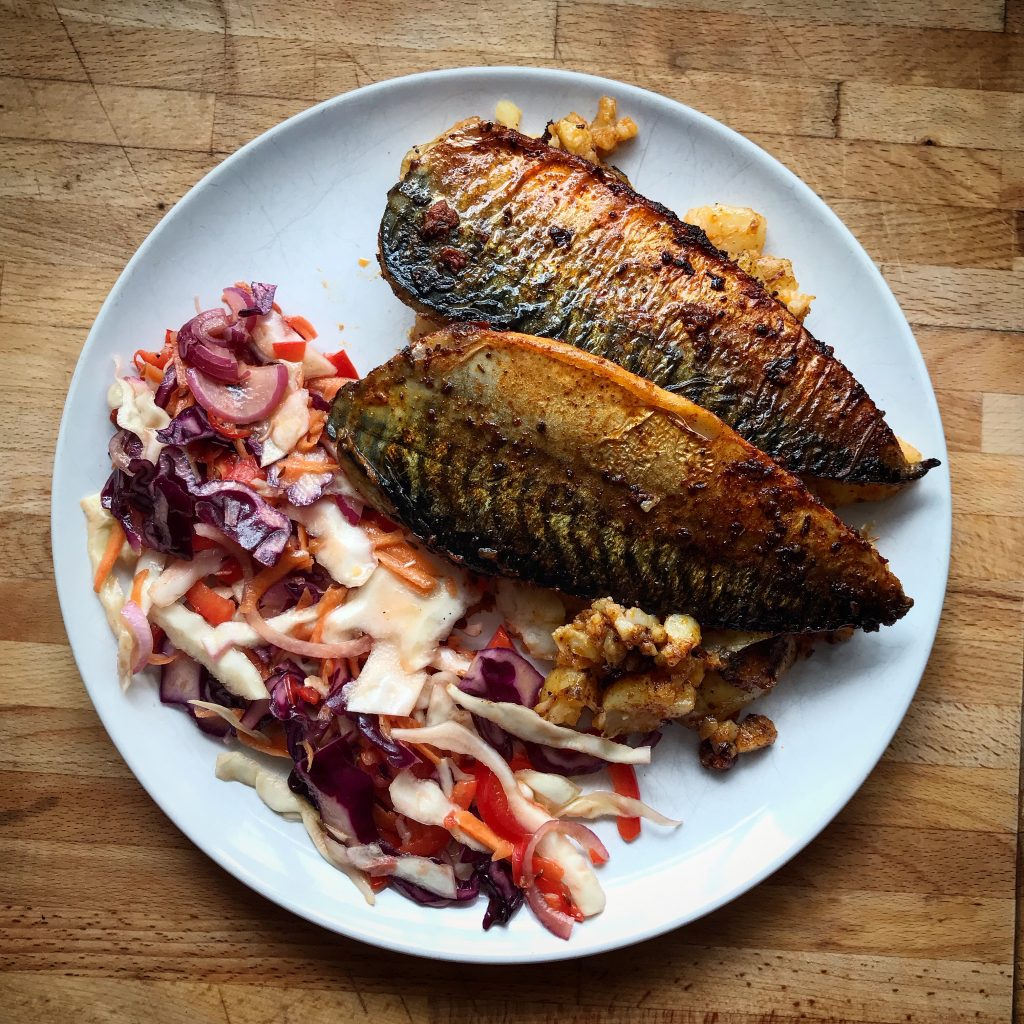
Metabolic Sovereignty: Silence Food Noise & Fix Your Metabolism
Tired of the “Food Noise” and the afternoon energy crash?