I’m 58, I Quit Drinking After 45 Years, Lost 5 Stone, Reversed Pre-Diabetes, and My HRV Says I’m Built Different. Here’s the Data.
Midlife Rebuild. This isn’t a feel-good story about finding yourself at a yoga retreat. This is a systems rebuild. And I’ve got the receipts.
I spent 25 years as an IT Technical Architect designing complex infrastructure. I know what happens when you run 2026 demands on legacy hardware. Crashes. Failures. System degradation. And for most of my adult life, that’s exactly what I was doing to my own body and drinking for 45 years, eating badly, ignoring the signals, masking the symptoms—the human equivalent of a server held together with gaffer tape and unquestioning optimism.
Seventeen months ago, I shut the whole thing down and rebuilt it from the ground up. No rehab. No 12-step programme. No label. Just a bloke from Monmouthshire who looked at the data and made a decision.
What followed has been the most significant physiological and psychological transformation of my life. And I can prove it.
The Numbers First. Because Numbers Don’t Lie.
Before I tell you how, let me show you what.
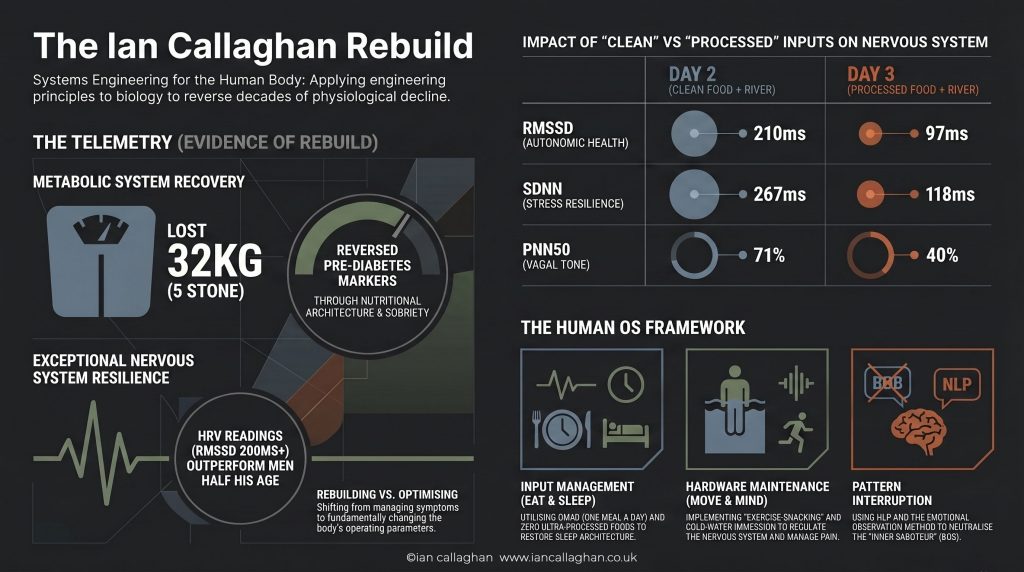
Five stone gone. Pre-diabetes reversed. HRV readings that would embarrass men half my age. Chronic inflammation markers are down. Sleep architecture rebuilt from scratch. A nervous system that was running on cortisol and ethanol is now operating on something closer to its original design spec.
And then there’s the experiment I accidentally ran this week.
Three mornings. Same man. Same river. Different variables. The results tell you everything you need to know about what food actually does to your biology overnight.
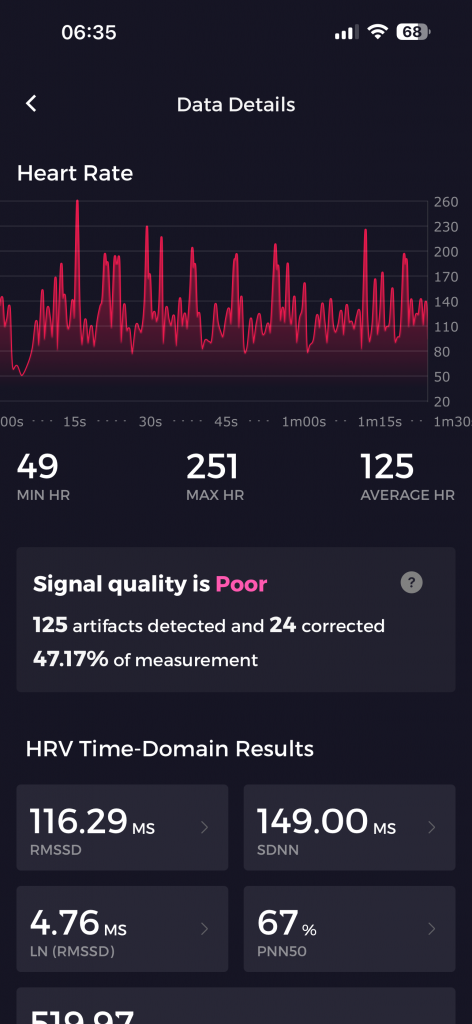
Day one was a noisy reading, poor signal quality on my HRV monitor, which is about 15 years old and struggling. Take it with a pinch of salt.
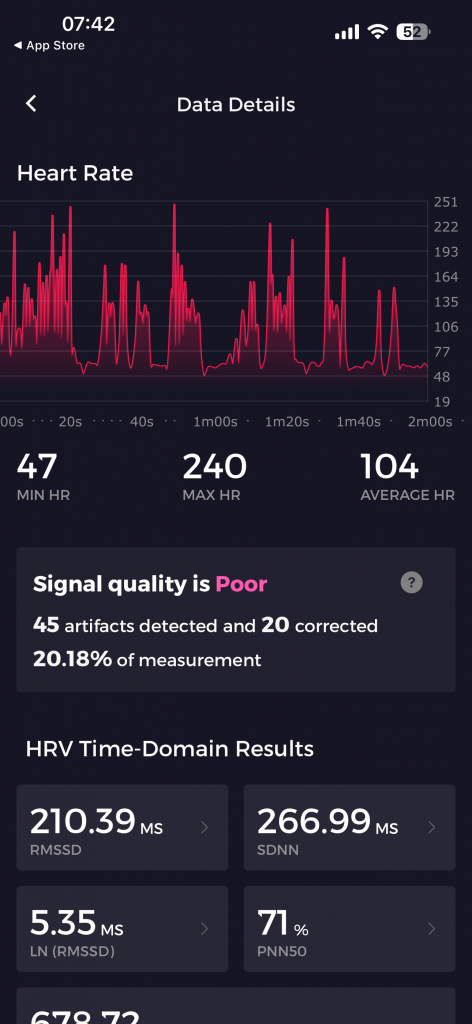
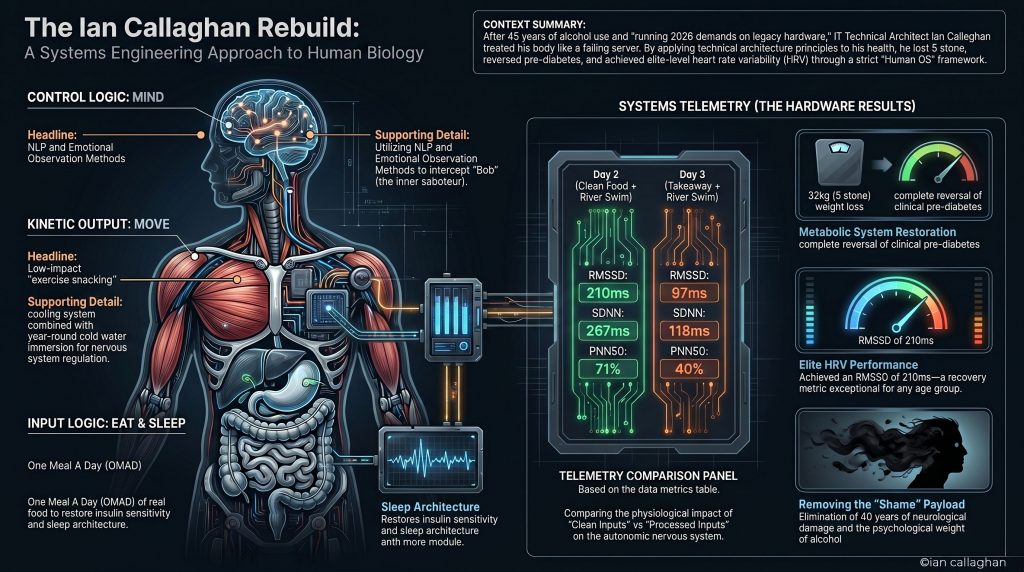
Day two: the night before, I’d been in the River Usk for around 20 minutes. Clean food all day. Woke up at 7:42 am to an RMSSD of 210ms, SDNN of 267ms, PNN50 at 71%, and an average resting heart rate of 104 during the measurement. For context, an RMSSD above 100ms is exceptional at any age. Above 200ms at 58 years old, after 45 years of drinking, is something a cardiologist would want to look at twice.
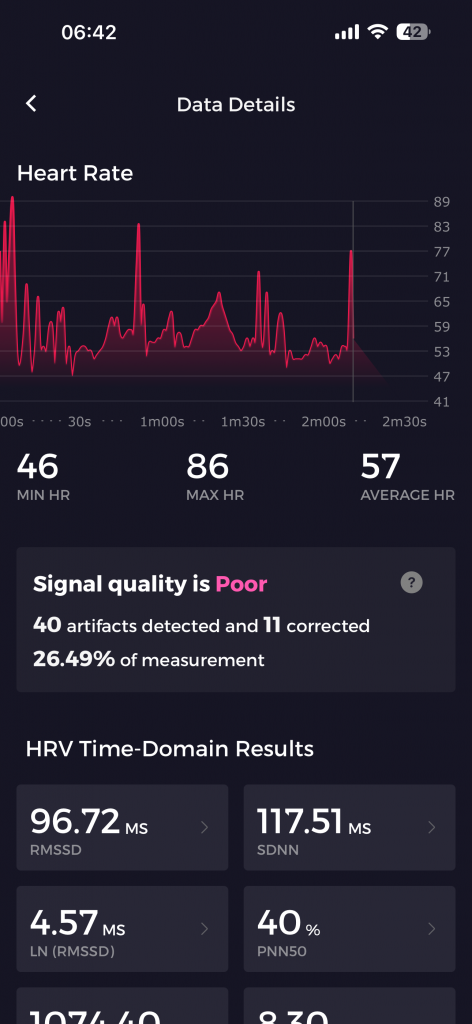
Day three: the night before, I’d been in the river again—same cold water exposure. But I’d also eaten a takeaway. Mixed gyro, salad, tzatziki, some pitta and fries. Not a 2 am kebab from a van. By most people’s standards, it was a reasonably decent meal. But by morning, my RMSSD had dropped to 97ms, SDNN to 118ms, and PNN50 down to 40%. Heart rate is sitting at 57.
Same cold water. Different food. The HRV told the story my body couldn’t hide.
The fries were cooked in seed oils. The pitta was made from processed wheat. Even the gyro meat in most takeaways is blended with fillers and stabilisers. None of it was catastrophic. But my autonomic nervous system registered every bit of it and showed up the next morning with the evidence.
That’s not theory. That’s telemetry.
Who the Hell Am I and Why Does Any of This Matter?
Fair question.
I’m Ian Callaghan. 58 years old. British Army veteran, 1st The Queen’s Dragoon Guards, 12 years served. Qualified chef. NLP Master Practitioner. Reiki Master. Technical Architect with CCNA and MCSE certifications. Multi-discipline coach based on the edge of the Brecon Beacons in Monmouthshire, Wales.
I also drank for over 40 years. Heavily. Consistently. In the way that becomes so normal, you stop seeing it as a problem and start calling it personality.
I didn’t go to rehab. I didn’t join AA. I don’t carry a chair count, day, or introduce myself with a label. I’m just a bloke who doesn’t drink. He looked at what alcohol was doing to his hardware and decided enough was enough.
Seventeen months ago, I made that decision. And the rebuild started immediately.
The Four Pillars. Not a Wellness Framework. An Operating System. Midlife Rebuild
Everything I do sits on four pillars. Eat. Sleep. Move. Mind. Not because I read it in a book, but because after decades of dismantling and reassembling my own biology, these are the four systems that either run clean or cause cascading failure everywhere else.
Eat
I eat one meal a day. OMAD. Not because it’s trendy —it isn’t —but because it’s what my body does best—one window. Real food. Animal fats, fermented foods, bone broth, organ meat when I can get it, resistant starch, and seasonal vegetables. Zero seed oils. Zero ultra-processed food. Nothing with more ingredients than my grandmother would recognise.
I’m a trained chef. I know what’s in food. I know what seed oils do at high heat. I know why the vegetable oil lobby has spent 50 years convincing people that butter is the enemy. I know what industrial food production looks like from the inside. And I refuse to put any of it in my body.
The weight loss was almost a side effect. Five stone gone. Pre-diabetes reversed. Not through calorie counting, points systems, or meal replacement shakes, but through eating food that is actually food.
I recently invested in a Wrekin water filter. Not a plastic Brita jug. Because if I’m this deliberate about what I eat, why would I drink tap water full of chlorine, fluoride, and microplastics? The inputs matter. All of them.
Sleep
Alcohol destroys sleep architecture. Not just quantity, quality. It sedates you rather than letting you sleep. You miss the deep restorative stages. You wake at 33 amwith your nervous system in low-grade panic. You call it insomnia. It isn’t. It’s ethanol metabolism.
Within weeks of stopping drinking, the sleep changed completely. I’d forgotten what it felt like to wake up actually rested—not less drunk. Not just functional. Genuinely rested. That alone would have been worth it.
Sleep is where your body does its maintenance. Skip it or corrupt it, and nothing else works properly—your HRV tanks. Your insulin sensitivity degrades. Your cortisol stays elevated. Your decisions get worse. Everything downstream of bad sleep is a mess.
Fix the sleep, and half your problems fix themselves.
Move
I don’t go to the gym. I’m not built for it, literally, three herniated discs at L3, L4 and L5 from my army service means conventional lifting can put me horizontal for days. So I adapted.
And before anyone romanticises the army injury as a badge of honour,r the institution handed out and walked away from, let me be clear. I’m currently fighting an active court case against the MOD for tinnitus and hearing loss caused during service. At the same time,e I’m battling PIP, the government’s disability benefit system, which has its own unique talent for making people feel like they’re lying about the body that was broken in service to the country. Two institutional fights are running simultaneously, on top of chronic pain, on top of rebuilding everything else.
I’m telling you this not for sympathy. I’m telling you this because the people in my audience are not rebuilding from a position of comfort. They’re rebuilding under fire. And if the transformation is possible while navigating all of that, it’s possible for anyone.
Exercise snacking throughout the day. Bird dog. Cat cow. Glute bridges. Planks. Tai chi squat arm swings. Resistance bands. Hand grips. Dead hangs. Assisted pull-ups. Yoga poses worked into the day rather than carved out of it.
I walk every day. The Brecon Beacons are on my doorstep, and I use them. I’m getting back into climbing, carefully, with a back that has its opinions about things.
And then there’s the river.
I’ve been swimming in the River Usk year-round my entire life. Not since Wim Hof made it fashionable. Not since some podcast told me cold water was good for inflammation, since before any of that had a name or a hashtag or a warrior attached to it. The river is 50 metres from where I grew up. It’s been part of my daily practice for as long as I can remember.
Cold water immersion does things to your nervous system that nothing else replicates. Vagal tone. Norepinephrine release. Dopamine baseline reset. Brown adipose tissue activation. The data backs all of it. But I didn’t need the data. I knew it from the inside out before the science caught up.
The HRV readings on the mornings after river swims tell the same story every time.
Mind
I’m an NLP Master Practitioner. I’ve spent decades studying how the mind processes experience, encodes belief, and either propels or sabotages everything you try to do. I use that knowledge daily. On myself first.
Meditation. Visualisation. Breathwork. Reiki. EOM, my own Emotional Observation Method, which is about learning to watch your emotional states rather than be consumed by them. These aren’t wellness add-ons. They’re functional tools for nervous system regulation.
I call my inner saboteur Bob. Bob is the part of your mind that tells you one drink won’t hurt, that you’ve earned it, that everyone else is doing it, that you’ll start Monday again. Bob has a very sophisticated PR operation, and he’s been running it for decades. The work is learning to recognise Bob’s voice and not act on it.
The meditation and breathwork are how I keep Bob in his box.
The Sobriety Part. Let’s Be Honest About This.
I drank for over 40 years. That’s not a background detail. That’s four decades of consistent neurological damage, liver stress, disrupted sleep, elevated cortisol, impaired gut function, suppressed immune response, and a running dialogue of shame that I got very good at drowning out with more alcohol.
I didn’t quit because I hit rock bottom. I quit because I looked at the data, and it was undeniable. Alcohol is a WHO Group 1 carcinogen. Not a grey area. Not “fine in moderation.” A carcinogen. The same category as asbestos and tobacco. The only reason we don’t talk about it that way is that the alcohol industry has spent billions making sure we don’t.
Seventeen months into my Midlife Rebuild, the physical changes have been extraordinary. But the psychological shift has been more significant. I described it once as having 40kg of invisible shame removed. The lies. The guilt. The performance is fine. All of it is gone.
I walk differently now. I make eye contact differently. I speak differently. Not because I found God or joined a movement, but because there’s nothing to hide anymore. Sobriety sharpened everything, including my voice.
The Reach. Because This Is Also a Media Story.
In December 2025, I had 400 Facebook followers.
By May 2026, under four months later, I had 58,000. A group of 10,000 members. 58 million views. An audience that is 82.2% aged 35 to 64. The demographic that every health brand struggles to reach authentically,y because most of their ambassadors are 28 years old and have never had a problem in their life.
On YouTube, in the last 90 days alone: 68,843 views. 2,000 hours of watch time. 1,075 subscribers. A 99.4% like ratio. 62.91% audience retention. A single video, “What Really Happens When You Quit Drinking,” pulled 16,557 views and 350 subscribers on its own.
LADbible picked me up. Ran my story. My quotes. My data. Because it’s a real story with real numbers and a real human behind it.
None of this came from paid ads. No social media agency. No growth hacking tools. Just showing up with the truth every single day and refusing to sanitise it.
Before Facebook, there was TikTok. I’d built 25,000 followers there before a video hit 400,000 views, and the subsequent surge in comments triggered TikTok’s Layer 7 Application Filter, which misclassified normal human engagement velocity as network automation. They banned the account. I appealed twice through their standard process, got nowhere, so I sent their Trust and Safety team a formal technical letter as a CCNA and MCSE certified Technical Architect, diagnosing the exact mechanism that caused the false positive, citing Engagement Velocity spikes, device telemetry correlation, and the specific comment rate-limiting behaviour that their filter misread. I requested a manual audit of the server logs.
Their response was complete silence.
So I moved to Facebook with 400 followers and grew to 58,000 in under four months.
I’m not telling that story to complain about TikTok. I’m telling it because it proves two things. First, I can build audiences from scratch across platforms without a budget, a team, or tools. Second, I’m not someone who wears technology for show. I understand how these systems work at an architectural level. When a brand partners with me on a health tech product, I’m not going to read the marketing copy. I’m going to understand the data, interrogate the methodology, and explain it to an audience that trusts me precisely because I never bullshit them.
That’s a different proposition entirely from a lifestyle influencer with a ring light and a discount code.
Why the Wellness Industry Gets This Age Group Wrong
Every supplement brand, every fitness app, every recovery programme targets the same demographic. Young, aspirational, already relatively healthy, looking to optimise.
The men and women in my audience aren’t optimising. They’re rebuilding, they are deep in Midlife Rebuild.
There’s a significant difference, and most brands completely miss it.
Optimising means taking something that works reasonably well and making it slightly better. Rebuilding means taking a system that has been running on the wrong inputs for decades, that has accumulated damage, inflammation, metabolic dysfunction, and psychological weight, and fundamentally changing its operating parameters.
The people who need Whoop aren’t the CrossFit athletes who already know their HRV. They’re the 52-year-old who hasn’t had a proper night’s sleep in a decade and doesn’t understand why. They’re the 47-year-old who quit drinking three months ago and wants to understand what’s actually happening in their nervous system. They’re the 58-year-old swimming in a Welsh river every morning and tracking his autonomic recovery with a 15-year-old chest strap because nobody has offered him anything better.
That’s my audience. And that audience is enormous, underserved, and desperate for tools that treat them like adults.
The HRV Monitor Situation. And What Comes Next.
My current HRV monitor is approximately 15 years old. The app, Elite HRV, struggles with the signal. As you’ve seen from my three morning readings, the artefact rate is high, and the data is messy.
But even through the noise, the signal is clear. The food experiment proved it. Cold water plus clean eating equals a nervous system operating at a level that surprises people who see the numbers.
I’m actively looking for a new monitor. Something that gives me clean data I can share with my audience in real time. Because the content writes itself, every morning reading is a data point. Every food choice, every river swim, every meditation session shows up in the numbers. That’s not a blog post. That’s a longitudinal case study with 58,000 people watching in real time.
If you’re a health tech brand reading this, that’s your pitch. Not an influencer posting a discount code. A genuine proof of concept, documented in public, by the kind of human your product was actually built for.
What I’ve Published. The Proof of Work.
Seven books. All available exclusively at iancallaghan.co.uk/the-shop/
Under Load. The 30 Day Reset. Emotional Mastery. Fix Your Metabolism. Nobody Taught You This. Beyond 12 Steps. And others.
A coaching practice. A Facebook community of 10,000 members. A subscriber hub. A Skool community. A YouTube channel. A blog with over 350 posts.
All of it was built as a single operator with no team, no agency, no budget. At the same time, fighting the MOD in court. While battling PIP. At the same time, I am managing chronic pain from three herniated discs at L3, L4 and L5. All of it was built on the evidence of my own life.
The Bottom Line
I’m not selling a shortcut. There isn’t one.
What I’m telling you is that at 58, after 45 years of drinking, after decades of running on the wrong inputs, the human body has a remarkable capacity to rebuild when you give it what it actually needs.
The data backs it. The HRV backs it. The five stone backs it. The reversed pre-diabetes backs it. The 58 million views from people who recognise their own story back it.
This isn’t wellness content. This is systems engineering applied to human biology. And the case study is me.
Pick up the wrench. The rebuild starts the moment you decide it does.
Frequently Asked Questions
Can you reverse pre-diabetes by quitting alcohol?
Yes, and the mechanism is straightforward once you understand it. Alcohol drives insulin resistance through multiple pathways — it disrupts liver glucose regulation, elevates cortisol, damages the gut lining, and chronically raises blood sugar. Remove the alcohol, add real food, sort the sleep, and insulin sensitivity often improves significantly within months. My own pre-diabetes markers reversed within the first year alongside OMAD and ancestral eating. It’s not a guarantee for everyone, but it’s far more common than the medical establishment acknowledges.
Does cold water swimming improve HRV?
The evidence points strongly in that direction, and my own data backs it up. Cold water immersion activates the vagus nerve, drives norepinephrine release, and triggers a parasympathetic rebound after the initial cold shock response. Over time, regular cold exposure appears to improve vagal tone, which is the primary driver of HRV. My best readings consistently follow river swims, and the differential between cold water plus clean eating versus cold water plus processed food is stark enough to be visible in the numbers the very next morning.
What is exercise snacking, and does it actually work?
Exercise snacking is the practice of distributing short bouts of movement throughout the day rather than concentrating all activity into one gym session. Bird dogs, glute bridges, dead hangs, resistance band work, tai chi movements, planks — done in two- to five-minute windows across the day. The research suggests it produces comparable and in some cases superior metabolic and cardiovascular outcomes to a single daily session, particularly for people who can’t sustain conventional training due to injury or pain. For me, with three herniated discs at L3, L4 and L5, it isn’t a preference. It’s the only option. And the HRV data suggests it’s working.
How long after quitting alcohol does sleep improve?
Most people notice a change within the first two weeks, though the first few days can actually feel worse as the nervous system recalibrates without alcohol’s sedative effect. The deep restorative sleep stages — slow-wave sleep and REM — begin to return within the first month for most people. By three months, the architecture is usually significantly rebuilt. What took me by surprise was just how profound the difference was. I hadn’t slept properly in decades and had completely normalised the exhaustion. Waking up genuinely rested rather than just functional was one of the most disorienting early experiences of stopping.
OMAD stands for One Meal A Day. It’s an intermittent fasting approach where all daily calories are consumed in a single eating window, typically one to two hours. It’s not a fad for me — it’s how I’ve eaten for years because it aligns with my natural hunger patterns and produces stable energy, mental clarity, and metabolic efficiency. Whether it’s appropriate for anyone else depends on their individual health status, history, and goals. If you’re on medications that require food, diabetic, pregnant, or have a history of disordered eating, it needs careful consideration and medical input. For a 58-year-old man following a whole-food diet, it works exceptionally well.
What does HRV actually measure and why does it matter?
Heart Rate Variability measures the variation in time between consecutive heartbeats. Counterintuitively, more variation is better — it indicates a nervous system that is responsive and adaptable, with good balance between the sympathetic (fight or flight) and parasympathetic (rest and digest) branches. Low HRV is associated with chronic stress, poor recovery, cardiovascular risk, and accelerated ageing. High HRV correlates with resilience, good sleep quality, metabolic health, and longevity. It’s one of the most useful single metrics for understanding how well your system is actually functioning, which is why I track it every morning. The numbers don’t lie, and they don’t care how you feel about them.
What is the midlife rebuild,d and who is it for?
The midlife rebuild is what happens when you stop managing symptoms and start fixing the system. It’s for anyone in their 40s, 50s, or beyond who is running on the wrong inputs—too much alcohol, ultra-processed food, disrupted sleep, a sedentary lifestyle, and a mind full of patterns written decades ago and never updated. It’s not a programme you buy. It’s a decision you make. The tools are simple: real food, proper sleep, daily movement, nervous system regulation, and the willingness to be honest about what isn’t working. Everything else follows from that.
Is it possible to quit drinking without AA or rehab?
Yes. I did it. Millions of people have. AA and rehab serve an important function for many people, particularly those with severe physical dependency who need medically supervised withdrawal. But they are not the only path, and for a significant proportion of people, they are not the right path. What I used was a combination of understanding the neuroscience of addiction, NLP techniques for pattern interruption, cold water therapy for nervous system regulation, nutritional rebuilding, meditation and breathwork, and a refusal to use labels that build identity around the problem rather than the solution. None of that required a programme, a sponsor, or a chip. It required honesty, structure, and a decision not to go back.
Ian Callaghan is a British Army veteran, qualified chef, NLP Master Practitioner, and multi-disciplinary coach based in Goytre, Monmouthshire. He has been featured by LADbible and built a Facebook audience of 58,000 followers and 58 million views in under four months. His books are available exclusively at iancallaghan.co.uk/the-shop/
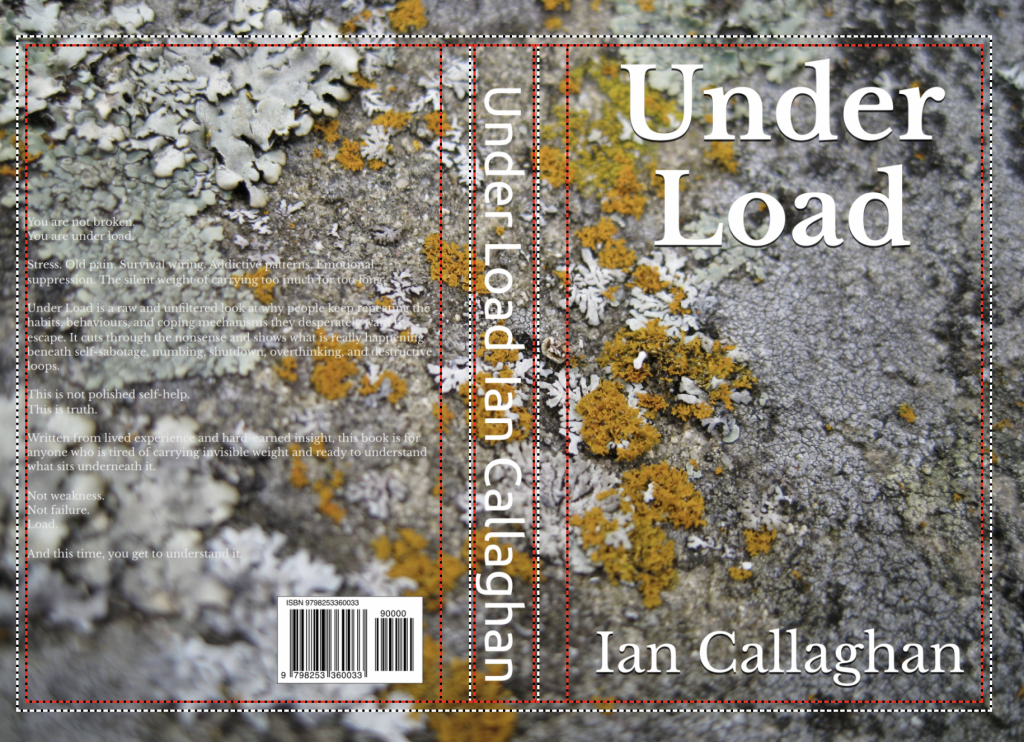
Under Load by Ian Callaghan | The Mechanical Guide to Addiction Recovery
You already know what you’re doing. You’ve known for years.