Why the Wellness Industry Feels Like a Scam
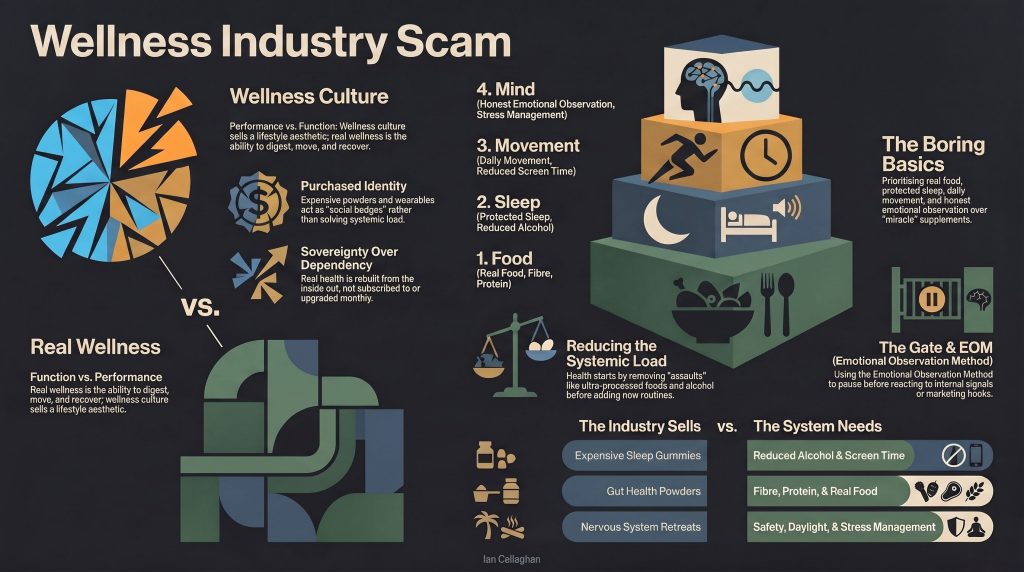
The wellness industry scam is not that health is fake. Health is real. Repair is real. Food, sleep, movement, emotional regulation, nervous system capacity and honest self-awareness all matter. The scam is the way the wellness industry sells expensive products, status, routines, retreats and identity to people who are already exhausted, inflamed, stressed and under load, while often ignoring the boring basics that would actually give the body a chance to recover.
The uncomfortable truth about the wellness industry
The wellness industry has done a brilliant job of convincing ordinary, tired, stressed, overloaded people that health is something they have to keep buying. Not something they rebuild. Not something they protect. Not something they understand from the inside out. Something they purchase, upgrade, subscribe to, photograph and perform.
That is the scam.
Not health itself. Not meditation. Not breathwork. Not cold water. Not real food. Not movement. Not proper nervous system regulation. I use those tools. I teach those tools. I live by a lot of those tools. I would be a hypocrite if I sat here pretending they do not work, because used properly, they absolutely can.
The scam starts when those tools get dragged into the marketing machine, stripped of context, polished into a lifestyle aesthetic and sold back to exhausted people as proof they are not enough without them.
Most people do not need another £47 powder, another miracle supplement, another nervous system reset course, another tracker, another influencer routine or another bloke in linen trousers telling them to align with abundance while flogging a subscription.
Most people need proper food, better sleep, daylight, movement, less alcohol, fewer ultra-processed foods, fewer assaults on the nervous system, more honest connections, and a clearer understanding of what their bodies are actually trying to tell them.
That is not glamorous enough for the wellness industry because it does not create dependency. It does not need a subscription. It does not need a luxury retreat. It does not photograph well next to a ceramic mug and a beige blanket.
But it works. And once you realise that, the whole wellness game starts looking very different.
Why am I writing this
I am not writing this as some bloke sneering from the outside because he saw a few dodgy adverts online.
I am a British Army veteran, a qualified chef, an NLP Master Practitioner, a Reiki Master, a coach, and the creator of the Emotional Observation Method. I drank for 45 years, quit alcohol, rebuilt my own food, sleep, movement and mind from the ground up, lost weight, live with long-term military injury and pain, and now coach people through cravings, stress, emotional regulation, sobriety, compulsive behaviour, food, midlife overload and identity change.
So when I talk about wellness, I am not talking about a lifestyle aesthetic. I am talking about what survives real life.
I am talking about the wet Tuesday version of wellness. The version that still has to work when your back hurts, your sleep is poor, your head is noisy, your finances are stretched, your relationships are under strain, your old coping mechanism is tapping on the window. Bob has turned up with a full legal argument for why you should drink, binge, scroll, spend, eat crap, isolate or blow your life up again.
That is where the truth lives. Not on a retreat. Not in the branding. Not in the influencer kitchen. In the ordinary moment when your system is under load, you still need to make the next decision.
What is the wellness industry actually selling?
The wellness industry does not only sell health products. It sells identity. That is why it works so well.
The powder is not just a powder. It is a signal that you are the kind of person who takes care of yourself. The wearable is not just a wearable. It is a signal that you are optimised. The retreat is not just a retreat. It is a signal that you are healing. The green juice is not just a green juice. It is a little social badge that says you are trying, improving, upgrading, becoming.
That is the hook.
Wellness stopped being about function and became a costume. You can see it everywhere. The right water bottle. The right mat. The right gut health powder. The right supplement stack. The right morning routine. The right wearable. The right breathwork app. The right retreat photo where everyone looks peaceful, thin, expensive and spiritually constipated in a field.
It sells the idea that health has a look. Worse than that, it sells the idea that if your life does not look like that, you are doing something wrong.
If your breakfast is not photogenic, if your house is not calm, if your body is not lean, if your nervous system is not regulated, if your sleep is wrecked, if your cravings are loud, if your anxiety is up, if your digestion is off, if Glucipher is dragging you towards sugar at 9 pm and Bob is telling you that one drink, one binge or one scroll does not count, then apparently you are not aligned enough, disciplined enough or committed enough.
Bollocks.
That is not wellness. That is class signalling with a turmeric latte.
A single parent working shifts does not need to be told they are failing because they have not got time for a two-hour morning routine. A midlife bloke with back pain, poor sleep, debt stress and a liver that spent decades processing lager does not need a cacao ceremony before he is allowed to rebuild. A woman dealing with perimenopause, work pressure, ageing parents, teenage kids and a nervous system that has been running red for years does not need another shiny expert telling her she is out of alignment.
They need the load reduced. That is where real wellness starts.
Why does the wellness industry feel like a scam?
The wellness industry feels like a scam because it often sells solutions without looking at the system that created the problem.
A person is exhausted, so they are sold energy. They are anxious, so they are sold calm. Their digestion is wrecked, so they are sold gut health. Their sleep is poor, so they are sold magnesium sprays, sleep gummies and weighted blankets. Their cravings are out of control, so they are sold willpower hacks. Their life is overloaded, so they are sold another routine to squeeze into it.
Nobody stops and asks the obvious questions. How much alcohol is in a week? How much ultra-processed food is going in? How many hours of proper sleep are happening? How much protein, fat and fibre is the body getting? How much daylight is reaching the eyes? How much movement is built into the day? How much stress is normalised because everyone around them is also running on fumes? How many emotions are being buried under food, booze, shopping, work, porn, scrolling, resentment or people-pleasing? How often is Bob running the meeting while the actual operator sits in the corner, wondering what the hell happened?
These are not glamorous questions, but they are useful questions.
The body does not live in the aesthetic. It lives in the inputs. Your nervous system does not care what colour your yoga mat is. Your gut does not care whether the powder came in a recyclable pouch with a leaf on the label. Glucipher does not give a toss whether the sugar is organic, handmade, small-batch, or blessed under a full moon. Bob does not become less manipulative because you renamed him your inner protector and bought a nicer journal.
Your system responds to what you repeatedly do, consume, tolerate, ignore and justify. That is where the work starts.
Is the wellness industry making people feel broken?
Yes, a lot of wellness marketing makes people feel broken because broken people are easier to sell to.
That does not mean every practitioner is a fraud or every product is useless. It means the machine around wellness often relies on insecurity. The person has to believe something is missing. They have to believe they are not calm enough, clean enough, disciplined enough, feminine enough, masculine enough, healed enough, spiritual enough, lean enough, regulated enough or optimised enough.
Then the offer appears: buy this, and you will feel like the kind of person who has their life together.
That is clever marketing, but it is also dangerous.
People do not buy wellness products because they love powders. They buy them because they are tired of feeling tired. They buy them because their mood is unstable, their appetite is all over the place, their stomach is bloated, their joints hurt, their skin looks dull, their libido has vanished, their patience is gone, their sleep is broken,n and their body feels like a house they no longer understand.
Then the industry steps in with a smile and says, here, buy this.
It rarely says,” Let us look at the whole system. That is the conversation I care about, because I do not see people as broken. I see systems under load.
That is not me being poetic. It is the most useful frame I have found after decades of alcohol, food issues, pain, stress, personal development, coaching and rebuilding. When you stop treating every behaviour as a moral failure and start seeing it as a signal, the shame drops and the work becomes clearer.
Bob is not proof that you are weak. Bob is the old operating system, trying to keep a familiar pattern alive. Glucipher is not proof that you have no discipline. It is the sugar-seeking part of the system looking for fast relief. The PR Firm is not wise. It is internal spin, building a case for the behaviour that keeps you stuck. The Gate is the gap where you notice the signal before you obey it. EOM is the practice of observing emotion without immediately becoming its employee.
That is real power. Not pretending you are healed because you bought another product. Real power is understanding the mechanism.
Are wellness products worth the money?
Some wellness products are worth the money when they solve a specific problem, meet a genuine need and do not distract you from the basics. That is the honest answer.
Supplements can help when there is a real deficiency or a clear reason to use them. Wearables can help if the data changes behaviour rather than creating an obsession. Breathwork apps can be useful if they help you build state control. Cold water can build capacity if it is used intelligently. Therapy, coaching, bodywork, strength training, meditation, nutrition support and good education can all be valuable.
The problem starts when products replace ownership.
A gut powder will not undo a diet built around ultra-processed food. A sleep spray will not cancel out alcohol, late-night scrolling and chronic stress. A nervous system course will not help much if you keep living in a way that tells the body it is never safe. A retreat will not save you if you come home to the same inputs, the same avoidance, the same old operating system, and the same refusal to stand at The Gate.
The useful question is not whether a product is good or bad. The better question is what job you are asking that product to do. If it is supporting a system you are already rebuilding, fair enough. If it is rescuing you from the basics you keep avoiding, that is Bob in a wellness hoodie.
Why do people keep buying wellness products when the basics work?
People keep buying wellness products because buying feels easier than changing. That is not an insult. It is human.
Buying gives immediate relief. It creates a little hit of hope. It feels like action. The parcel arrives. The label looks clean. The routine feels new. The brain gets to say, good, we are doing something.
But doing something is not the same as changing the system.
This is where the PR Firm gets clever. It can make avoidance sound like research. It can make another purchase sound like a commitment. It can make procrastination look like preparation. It can tell you that once you find the right supplement, the right podcast, the right protocol, the right coach, the right plan or the right device, then you will finally start.
Meanwhile, the boring basics sit there untouched. Sleep is still wrecked, food is still chaotic, alcohol is still normalised, movement is still inconsistent, stress is still unmanaged, emotions are still buried, Bob is still negotiating, Glucipher is still driving, and The Gate is still unused.
That is why simple is so powerful and so inconvenient for the industry. Simple does not mean easy. Simple means clear. The body needs better inputs, fewer assaults and repeated signals of safety. That is not a hack. It is a rebuild.
What is real wellness compared with wellness culture?
Real wellness is function. Wellness culture is often performance.
Real wellness asks whether you can sleep, digest, move, recover, think clearly, regulate emotion and make better choices under pressure. Wellness culture often asks whether your life looks like wellness from the outside.
That difference matters.
A person can have the supplements, the mat, the retreats, the morning routine, the water bottle, the expensive leggings, the wearable and the perfect kitchen, while still being metabolically wrecked, emotionally avoidant, secretly drinking too much, sleeping badly, eating processed rubbish and reacting from old patterns all day.
Another person can live a very ordinary life, cook real food, walk daily, protect their sleep, stop poisoning themselves with alcohol, lift a few weights, get outside, breathe properly, observe their emotions, tell Bob to shut up when needed, and slowly become stronger than they have been in years.
One looks like wellness. The other is wellness.
That is why I keep coming back to Food, Sleep, Movement and Mind. Food is the input. Sleep is the repair window. Movement is the signal. Mind is the operator. Get those four wrong for long enough, and the system starts screaming. Get them right consistently enough,h and the system starts coming back online.
Not overnight. Not in some fake thirty-day glow-up where everyone pretends healing is photogenic. But steadily, mechanically and honestly.
Is nervous system regulation being used as wellness marketing?
Yes. Nervous system regulation is real, but wellness marketing has turned it into another thing people feel they have to buy.
Nervous system language is useful when it helps people understand their bodies. It becomes bullshit when it is used as a sales fog. People are now being sold regulation as if it were a new luxury product. Regulate your nervous system with this mat. Reset your nervous system with this retreat. Heal your nervous system with this breathwork bundle. Calm your nervous system with this drink, this course, this candle, this wearable, this app, this £900 weekend in a converted barn with herbal tea and forced vulnerability.
The nervous system is real. Regulation is real. State change is real. The vagal brake is real. Breath, cold water, movement, safety, connection, sleep and emotional awareness can all change state.
But the body is not stupid.
You cannot sprinkle nervous system language over an overloaded life and call it healing. If you are drinking most nights, sleeping badly, eating ultra-processed food, never moving, living on caffeine, scrolling until midnight, suppressing every emotion and letting Bob run the old scripts, your nervous system is not going to be fooled by a candle and a lavender pillow spray.
It wants evidence. Repeated evidence. It wants to know whether the body is fed properly, whether sleep is protected, whether recovery is happening, whether movement exists, whether the threat is being reduced, whether connection is present, and whether emotion is being processed rather than buried under another coping mechanism.
That is why real regulation is built, not bought.
How do you spot wellness marketing bullshit?
You spot wellness marketing bullshit by looking for the move underneath the message.
Is the product helping you understand your body, or making you feel dependent on the seller? Does the claim sound specific, grounded and realistic, or does it promise total transformation with very little effort? Are they talking about food, sleep, movement, stress, alcohol, emotional regulation and daily habits, or jumping straight to a product? Do they explain who the product is not for, or is everyone apparently the perfect customer? Would the advice still be useful if you removed the branding? Does it reduce load, or does it give you another thing to track, buy, manage and feel guilty about? Would you still want it if nobody saw you using it? Is this genuine support, or is Bob and the PR Firm dressing avoidance up as self-improvement?
Those questions matter because modern wellness marketing does not always look like an advert. Sometimes it looks like education. Sometimes it looks like empowerment. Sometimes it looks like trauma awareness. Sometimes it looks like science. Sometimes it looks like spirituality. Sometimes it looks like a personal story that happens to end with a discount code.
That does not automatically make it bad. It means you need to stay awake.
What should you do instead of buying more wellness products?
Start by stripping it back, not forever and not as punishment, but as an audit.
Look at your food without turning it into calorie-counting, guilt or influencer nonsense. Are you giving the body real materials to rebuild with, or are you asking it to run on edible entertainment? Protein, proper fats, fibre, minerals and actual meals are not old-fashioned. They are the foundation.
Look at your sleep as infrastructure, not self-care. Alcohol, late food, stress, screens and blood sugar chaos do not magically stop at bedtime. The body has to process whatever you throw at it. If sleep is wrecked, cravings, mood, appetite, HRV, patience and decision-making all take the hit.
Look at movement without punishing yourself. You do not need to train like a twenty-seven-year-old influencer with no injuries and a ring light. You need to signal life to the system. Walk. Stretch. Lift if you can. Swim if you can. Move within your capacity and build from where you are.
Look at your mind without drowning it in motivational fluff. Catch Bob. Watch the PR Firm. Notice Glucipher. Practise EOM. Stand at The Gate and stop letting every internal signal become an instruction.
That is where real change happens. Not because you bought a new identity, but because you became the operator again.
A simple real wellness audit
Before you buy another product, ask this properly.
Are you sleeping enough to repair? Are you eating enough real food to stabilise energy, mood and cravings? Are you drinking alcohol and pretending it is not affecting your nervous system? Are you moving at your actual capacity daily? Are you getting daylight, fresh air and some rhythm to the day? Are you using food, booze, scrolling, shopping, porn, work or drama to avoid emotion? Are you practising emotional observation, or are you reacting to every signal as if it is an instruction? Are you trying to buy your way out of a pattern you have not been willing to face?
This is where EOM becomes practical. You notice the urge. You observe the emotion. You do not immediately obey it. You do not shame it either. You stop at The Gate and look properly.
You ask what the signal actually is. Is it need, fear, boredom, pain, loneliness, status anxiety, old identity, genuine curiosity or clever marketing landing at the right weak spot?
That pause is everything.
The wellness industry depends on your insecurity outpacing your awareness. It needs you to feel discomfort and click before you question it. It needs you to believe the answer is outside you. It needs you to mistake consumption for change.
When you build the pause, the machine loses grip. You can still buy the powder if you want. You can still use the wearable. You can still go to the retreat. You can still do the breathwork. You can still take the supplement. But now you are the operator, not the mark.
That is the difference.
So is the entire wellness industry a scam?
No. That would be too easy and dishonest.
Good people are doing good work. Breathwork can change state. Meditation can train awareness. Cold water can build capacity when used intelligently. Proper nutrition can transform energy, mood, cravings and metabolic health. Strength work can rebuild confidence. Therapy can be life-changing. Coaching can help people see patterns they have been trapped in for years. Supplements can be useful when there is a genuine need.
But the industry around those tools is full of bollocks. It is full of overpromising. It is full of people selling identity instead of function. It is full of fear-based marketing disguised as empowerment. It is full of complexity where simplicity would do. It is full of luxurious aesthetics that pretend to be healthy. It is full of people who have never been properly under load, telling exhausted humans to raise their vibration.
That is why it needs to be called out. Not because people should reject wellness, but because people deserve better than wellness theatre.
They deserve tools that work in real life. Not just on a retreat. Not just when the lighting is right, not just when the fridge is full, nobody is ill, the bills are paid, and the nervous system is already calm. Real wellness has to work when you are tired, stressed, sore, skint, lonely, triggered, tempted, angry, ashamed, bored or standing in the kitchen at 9 p.m. with Bob and Glucipher both trying to run the evening.
That is where the work has to hold.
The real problem is dependency, not wellne.ss
The wellness industry is not a scam because health is fake. Health is real. Repair is real. Nervous system regulation is real. Food matters. Sleep matters. Movement matters. Emotional awareness matters. Ritual matters. Community matters. Support matters.
The scam is the selling of dependency to people who need sovereignty.
The scam is convincing exhausted people that the answer is always another product, another protocol, another identity, another upgrade, another expert, another retreat, another performance. It is making simple human repair look exclusive, expensive, and complicated, then selling it back to people who already know, deep down, that their lives are asking for something more honest.
You were never meant to spend your whole life chasing wellness. You were meant to build a body, mind and life you do not need to escape from every night.
That is the work. And it starts with taking back the authority they have been selling back to you in instalments.
FAQ
Is the wellness industry a scam?
The wellness industry is not entirely a scam, but much of its marketing is built around selling expensive products, status, and identity to people who need basic system repair. Real wellness starts with food, sleep, movement, stress reduction, emotional regulation, reduced alcohol, intake fewer ultra-processed foods ,and better daily ihabits
Why does the wellness industry feel fake?
The wellness industry can feel fake because it often turns useful health tools into lifestyle performance. Real practices like meditation, breathwork, cold water, nutrition and movement can work. Still, the marketing around them often sells an expensive identity rather than helping people understand what their bodies actually need.
What is the biggest problem with wellness culture?
The biggest problem with wellness culture is that it can make ordinary people feel broken, inferior, or behind because their lives do not look calm, expensive, or perfectly optimised. It often rewards appearance over function and sells products before addressing the system’s real needs.
Are wellness products worth buying?
Some wellness products are worth buying if they solve a specific problem and support a system you are already rebuilding. They become a problem when they distract from the basics: food, sleep, movement, stress, alcohol, emotional regulation, sunlight, connection and daily habits.
Are supplements a waste of money?
Supplements are not automatically a waste of money. They can help when there is a clear reason to use them. They are a poor replacement for proper food, sleep, movement, sunlight, emotional regulation and removing the behaviours that are creating the problem in the first place.
What is real wellness?
Real wellness is function, not aesthetic. It means being able to sleep, digest, move, think clearly, recover from stress, regulate emotion and make better choices under pressure. It is built through repeated daily inputs, not bought through a product identity.
Why do people buy wellness products?
People buy wellness products because they want relief, hope and a sense of control. Buying something can feel like an action, especially when someone is tired, anxious, inflamed, ashamed or desperate for change. The danger is mistaking buying for rebuilding.
How do I spot wellness marketing bullshit?
Look for vague promises, fear-based messaging, expensive identity language, before-and-after fantasy, claims that ignore food, sleep, movement, stress and alcohol, and products that make you feel dependent on the seller. Good wellness support should help you understand your body, not outsource your authority.
What should I focus on instead of wellness trends?
Focus on food, sleep, movement and mind. Eat real food, protect sleep, move daily within your capacity, reduce alcohol and ultra-processed foods, get daylight, manage stress and practise emotional observation. Those basics are not glamorous, but they are the foundation of real change.
How does EOM help with wellness marketing?
EOM, the Emotional Observation Method, helps you notice the emotional signal before you obey it. Instead of buying, drinking, eating, scrolling or reacting automatically, you pause at The Gate and ask what is actually happening. That pause helps you become the operator again.
CTA
If this hit a nerve, that is probably because you already knew half of it before you read it.
You do not need more wellness theatre. You need a working system.
That is what I break down inside my books, my coaching and the Midlife Reset community. Food, sleep, movement, mind, cravings, stress, alcohol, emotional regulation, Bob, Glucipher, The Gate, EOM, and the real work of becoming the operator again.

The Sovereign Operator Bundle: Complete Metabolic & Emotional Mastery
Stop running the same loop every bloody week.
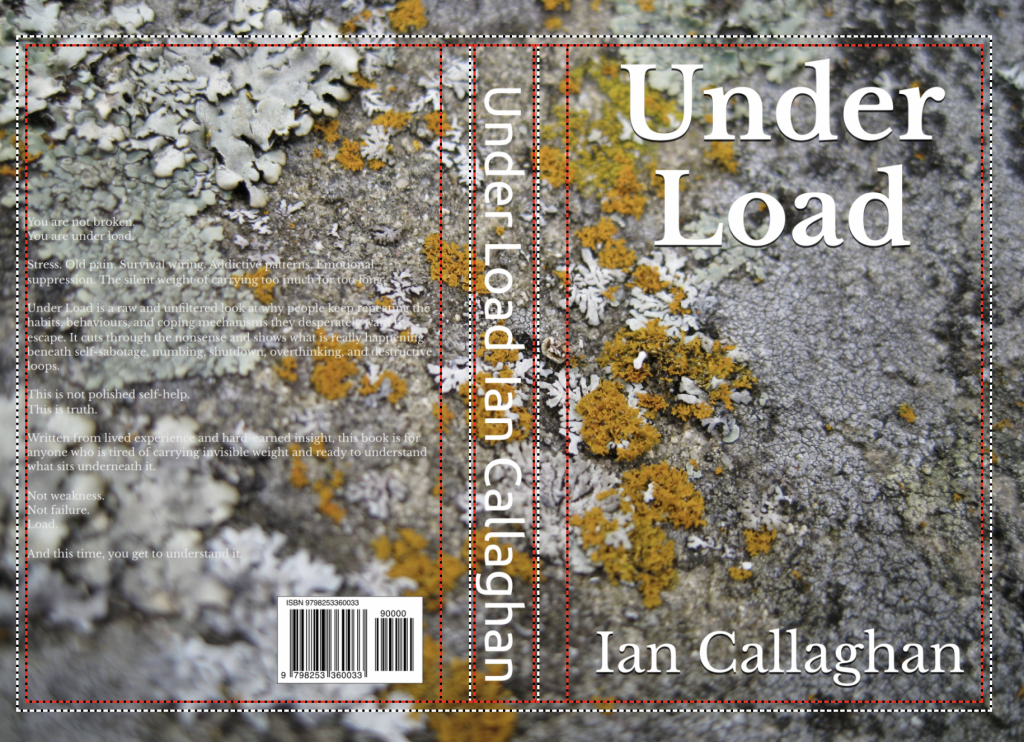
Under Load by Ian Callaghan | The Mechanical Guide to Addiction Recovery
You already know what you’re doing. You’ve known for years.
As soon as I found your sites on Facebook I had a deluge of wellness sites comes up on my feed. Everytime I clicked on the link at the end they were trying to sell me something rather just advise.
This blog is to the point and clear and the steps are free! Not easy but doable and even small changes make a difference!