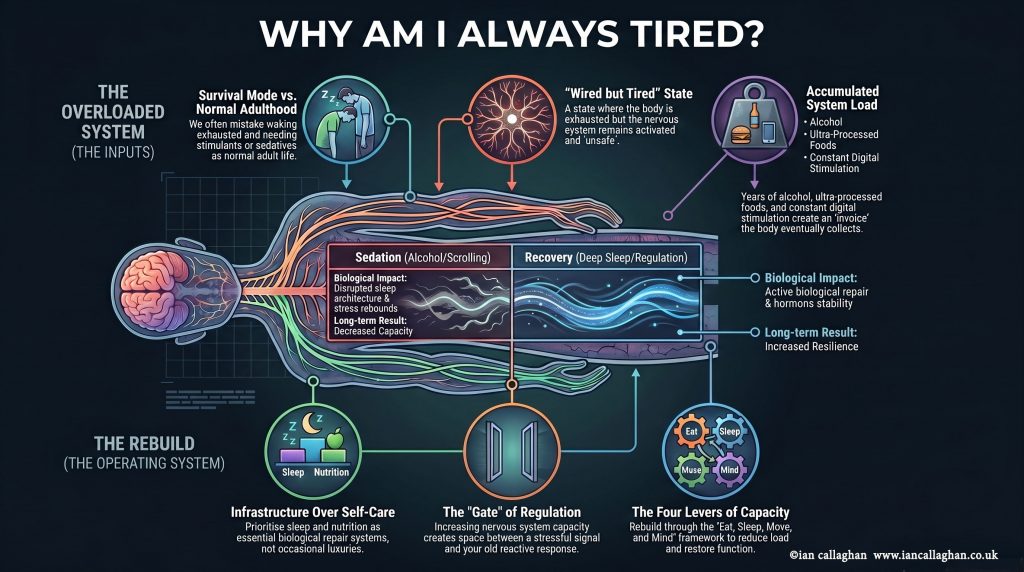
Most people are not lazy, weak or broken. They are running a nervous system under siege.
Why am I always tired? There is a point when many adults quietly start to panic because they feel something has changed, but they cannot quite explain what it is.
They are still going to work. They are still paying the bills. They are still answering messages, doing the shopping, cooking when they can be bothered, pretending they are fine, laughing at the right moments and dragging themselves through the day like functional adults.
From the outside, they look normal enough.
Inside, though, it feels different.
They wake up tired after a full night in bed. They sit on the edge of the mattress, wondering why they feel like they have already done a shift. They cannot switch their brain off when they finally sit down at night. They feel irritated by things that never used to bother them. They go into the kitchen looking for something, but they do not even know what the something is.
They open the fridge, close it again, pick up the phone, scroll, put it down, pick it back up and wonder why they feel so restless in their own skin.
Then the story starts.
Maybe I am depressed.
Maybe I am lazy.
Maybe this is just age.
Maybe this is what happens after 35.
Maybe this is what happens after 40.
Maybe everybody feels like this.
Maybe I need to try harder.
Maybe I need more motivation.
Maybe I need another supplement, another app, another morning routine, another bloody podcast from somebody with perfect teeth and soft lighting telling me to journal my way to peace.
I think a huge number of people are asking the wrong question.
The question is not always, “What is wrong with me?”
A better question is, “What load is my system carrying?”
Because most people do not wake up one morning and suddenly become weak, broken, unmotivated or useless. That is not how this happens. What usually happens is slower, quieter and far more socially acceptable.
The nervous system takes the load for Loaders.
Poor sleep. Alcohol. Ultra-processed food. Constant stress. Financial pressure. Work demands. Relationship tension. Artificial light. Doom scrolling. Emotional suppression. No silence. No recovery. No proper off switch.
Then, one day, the body starts waving red flags, and the person calls it a personality flaw.
This is where modern life has done a proper number on people. It has normalised dysfunction so aggressively that millions of adults now mistake survival mode for normal adulthood. They think waking exhausted is normal. They think needing wine to switch off is normal. They think being unable to sit quietly without reaching for a phone is normal. They think feeling emotionally flat is normal. They think living on caffeine, sugar, stress and distraction is just what responsible adults do.
It is common.
That does not make it normal.
Your nervous system is not some vague wellness concept. It is not fluffy language for people doing sound baths in linen trousers. It is the operating system underneath your behaviour. It affects your sleep, stress tolerance, digestion, emotional regulation, cravings, inflammation, blood sugar stability, recovery capacity, focus, mood and impulse control.
If that system is under constant pressure, everything built on top of it starts to wobble.
That is why this matters.
We have millions of people trying to fix behaviour while ignoring the state of the body that drives it. They are trying to stop drinking, stop snacking, stop scrolling, stop snapping, stop procrastinating and stop feeling anxious while the nervous system underneath is still running like a smoke alarm in a house full of burnt toast.
No wonder willpower fails.
Quick answer: Why am I always tired?
You may feel tired all the time because your body is not fully recovering, even when you are technically resting. Poor sleep, alcohol, chronic stress, ultra-processed food, blood sugar crashes, constant stimulation, emotional pressure and nervous system overload can all leave you exhausted, wired, anxious or flat.
That is the clean answer.
Now let’s talk like adults.
Most people are not tired because they are doing one thing wrong. They are tired because they are living inside a system that keeps taking from them all day and giving almost nothing back.
They wake up tired, hammer coffee to function, sit in stress all day, eat whatever is convenient, scroll through other people’s lives, drink to take the edge off, sleep badly, then wake up and do the same thing again.
That is not recovery.
That is controlled collapse.
And sooner or later, the body starts telling the truth.
Why do I wake up tired even after sleeping?
Waking up tired usually means the body has not recovered properly overnight. You may have been in bed for seven or eight hours, but that does not mean your nervous system, brain, hormones, muscles, digestion and recovery systems had a proper night of repair.
This is a massive distinction.
People think sleep is just a time of unconsciousness.
It is not.
Sleep is an active biological repair.
If your nervous system is still on alert, if alcohol is still being processed, if blood sugar is swinging, if stress hormones are elevated, if your brain is still chewing on the day, if your gut is dealing with ultra-processed food, your body may be asleep but not properly recovered.
That is why somebody can spend eight hours in bed and still wake up feeling like they have been dragged backwards through a hedge.
The clock says they slept.
Their body says otherwise.
This is why I call it sleep infrastructure, not self-care. Sleep is not a scented candle activity. It is not a luxury. It is not something to squeeze in once the emails, Netflix, arguments, wine and scrolling are done.
Sleep is where the body repairs itself.
If that goes, everything else gets harder.
Cravings get louder. Pain feels bigger. Emotional control gets weaker. Hunger signals distort. Motivation drops. Bob starts making speeches. The internal barrister starts building the case. The PR Firm tells you that you deserve a drink, a takeaway, a scroll, a blowout, a restart on Monday.
Then you blame yourself for having no discipline.
You do not have a discipline problem at 10 pm when you are shattered, overstimulated, underfed, stressed, and under-recovered.
You have a capacity problem.
That is a different conversation.
Why do I feel wired but tired?
Feeling wired but tired usually means your body is exhausted,d but your nervous system is still activated. You are physically drained, but internally switched on. That is why you can feel desperate for rest and still be unable to relax.
This is one of the most common patterns I see in adults now.
They are shattered all day, then strangely alert at night. They drag themselves through work, then get a second wind when they should be winding down. They say they want peace, but when silence arrives, they reach for the phone because stillness feels uncomfortable.
That is not random.
That is a nervous system that has forgotten how to come down safely.
Modern life keeps people in low-level survival mode for hours every day. Not always full panic. Not always obvious anxiety. Sometimes it is much quieter than that.
Jaw tension.
Shallow breathing.
Tight chest.
Restless legs.
Irritation.
Impatience.
Constant checking.
Needing noise in the background.
Feeling uneasy when nothing is happening.
That is the body saying, “I am not fully safe yet.”
A lot of people look functional on the outside while, internally, running threat chemistry all day long. They still go to work. They still answer emails. They still post birthday messages. They still make jokes. But the body underneath is not in a calm, regulated state.
Over time, that affects everything.
Sleep becomes lighter. Digestion becomes unreliable. Cravings increase. Patience drops. Emotional reactions become stronger. Recovery takes longer. The world feels louder. The body becomes less tolerant of alcohol, poor food, late nights and stress.
Then people say they are falling apart.
They are not falling apart.
Their compensation is failing.
That is a very different conversation.
Why modern life makes people feel permanently exhausted
Look at the average day for many adults now.
They wake up and reach for the phone before their feet touch the floor. Within thirty seconds, they have checked messages, emails, bad news, comments, numbers, notifications and the curated lives of strangers. Their nervous system has already been pulled into reaction before the day has even started.
Then they drink coffee because they slept badly. They rush because they are late. They sit in traffic or jump straight into work. They deal with people, deadlines, bills, noise, screens, decisions and interruptions. They eat something beige and fast because there is no time. Their blood sugar jumps, then drops, and then they wonder why they are irritable by mid-afternoon.
By evening, they are exhausted but not calm.
That difference matters.
A lot of people are tired without being relaxed. They are physically drained but neurologically switched on. So they reach for the things that change state quickly.
Wine. Crisps. Chocolate. Takeaway. Netflix. Phone. Shopping. Porn. Arguments. Anything that moves the dial.
That is not always a pleasure.
A lot of the time, it is regulation.
The nervous system under load sees Loadelieff. Fast relief. Not because the person is stupid, weak, or morally defective, but because the body wants a change in state. It wants out of the discomfort.
This is why telling people to “just make better choices” is often useless. It sounds sensible from the outside, but it ignores what is happening inside the system.
A depleted person at 9 pm is not making decisions from the same place as a rested, nourished, regulated person at 9 am.
That is why Bob gets louder at night.
That is why the internal barrister starts building a case.
That is why the PR Firm comes in and tells you that you deserve it, that you have earned it, that one will not hurt, and that you can start Monday again.
The old operating system knows exactly when to speak.
It waits until capacity is low.
That is why this is not about motivation.
Motivation is fragile when the system is under load.
CaLoadty is the real game.
Why do I feel worse after 35 or 40?
Many people feel worse after 35 or 40 because they are no longer recovering from stress, alcohol, poor sleep, ultra-processed food and emotional load as Loadly as they did when they were younger. Age matters, but accumulated load often matters more.
This is one of the biggest lies people are sold.
They are told that feeling like absolute rubbish in their thirties, forties and fifties is simply part of getting older.
Obviously, ageing changes things. Recovery shifts. Hormones shift. Muscle mass changes if you do nothing to protect it. Sleep can become more fragile. Nobody sensible is pretending the body at 50 behaves exactly like the body at 25.
But age gets blamed for things that are not just age.
A lot of what people call ageing is actually decades of accumulated load.YeLoad off poor sleep. Years of using alcohol as a chemical off switch. Years of eating food that does not properly nourish the body. Years of stress, chemistry running all day. Years of sitting too much, moving too little, and never properly downshifting, and years of swallowing emotion, putting everyone else first, and calling it responsibility.
The body is brilliant at adapting.
That is the problem.
It will let you get away with things for a long time. It will compensate. It will find workarounds. It will keep you moving. It will let you run on fumes and pretend you are fine until one day the bill turns up.
The body keeps the score, yes.
But the nervous system keeps the invoice.
Eventually, it collects.
That collection does not always arrive as one dramatic collapse. Sometimes it arrives as subtle signs that people dismiss.
You wake up tired. You become more reactive. You cannot handle noise like you used to. You dread social plans. You need more caffeine to get going and more alcohol, sugar or scrolling to come down. You feel wired at night, flat in the morning and oddly detached from your own life.
This is where people start saying, “I do not feel like myself anymore.”
That sentence matters.
It is everywhere now. People say it in Facebook comments, YouTube comments, forums, messages, GP waiting rooms, kitchens, workplaces and marriages. They say it like a confession. As if the old versions of them have gone missing, and nobody has given them a map to find their way back.
For some people, yes, depression is part of the picture. Anxiety is part of the picture. Trauma may be part of the picture. Medical issues may be part of the picture. This is not about dismissing any of that.
But a huge number of people are also chronically under-recovered. Their system has been under load all night and is under repair. That changes the mood. It changes cravings. It changes patience. It changes how the world feels when you wake up in the morning.
If your body is running threat chemistry every day, your mind is not going to feel peaceful just because you wrote three things you are grateful for in a notebook.
Why do I wake up at 3 am with anxiety?
Waking at 3 am with anxiety can be linked to stress hormones, alcohol rebound, blood sugar instability, poor sleep quality, unresolved stress or a nervous system that does not feel safe enough to stay in deep recovery.
This is one of the biggest search-intent doors right now because millions of people are lying awake in the early hours, wondering what the hell is happening.
They wake up at 2 am, 3 am, or 4 am with a racing mind, a dry mouth, a tight chest, a strange sense of dread, or a sudden need to fix their whole life before sunrise.
Sometimes it is anxiety. Sometimes it is hormones. Sometimes it is alcohol rebound. Sometimes it is blood sugar instability. Sometimes,s it is stress hormones kicking in because the body does not feel safe enough to stay in deep recovery.
Often it is a mixture.
The important point is this.
Sleep is not just a mental event.
It is physical recovery.
Your body has to feel safe enough to drop into proper repair.
If you go to bed after alcohol, ultra-processed food, unresolved stress, blue light, arguments, scrolling and years of nervous system load, do not be shocked when the body does not simply drift into perfect recovery because the clock says bedtime.
People treat sleep like a switch.
It is not.
Sleep is the result of the day you just lived.
That is not meant as blame. It is meant as information.
If your nights are a mess, look at the whole system. Evening alcohol. Late food. Blood sugar. Caffeine. Screen light. Emotional stress. Lack of movement. No daylight. No wind down. No silence. No transition between the day and bed.
You cannot live like a hunted animal all day and expect the body to behave like a monk at night.
Why alcohol wrecks sleep and anxiety after 35
Alcohol can make you feel relaxed at first because it sedates the nervous system, but sedation is not the same as recovery. Alcohol can disrupt sleep quality, increase overnight stress responses, reduce HRV, raise heart rate, worsen anxiety the next day and make recovery harder.
This is where a lot of people get uncomfortable, because alcohol has been sold as the adult off switch.
Stressful day? Have a drink.
Social event? Have a drink.
Good news? Drink.
Bad news? Drink.
Grief? Drink.
Celebration? Drink.
Boredom? Drink.
Sunshine? Drink.
Christmas? Drink.
Bank holiday? Drink.
Tuesday? Drink.
Then people wonder why their nervous system is in bits.
Alcohol can make you feel temporarily calmer because it sedates the system. That part is real. I am not pretending that people imagine the relief. I drank for decades. I know exactly what that first drink can feel like. The shoulders drop. The noise softens. The world loosens its grip for a while.
But sedation is not recovery.
Underneath that temporary relief, the body still has to process a toxin. Sleep architecture gets disrupted. Heart rate can rise. HRV can drop. Stress hormones can rebound. Glutamate can kick back. Blood sugar can become unstable. Anxiety can increase the next day. Recovery can be impaired.
This is why people wake at 3 am after drinking and think it is random.
It is not random.
The body is dealing with the cost.
After 35 or 40, people often notice this more. They say they cannot drink like they used to. One glass ruins their sleep. Two drinks feel like a full session used to feel. Recovery takes days instead of hours.
They blame age, but age is only part of the story.
The bigger issue is total load.
IfLoadr system is already under pressure from stress, poor sleep, processed food, inflammation, financial worry and constant stimulation, alcohol lands on top like another weight in a backpack that is already too heavy.
At some point the body says no.
Not politely.
I quit after decades of drinking, not because I found a magic mindset quote, but because I stopped lying to myself about the cost. Alcohol was no longer giving me relief. It was taking out loans in my name and leaving my nervous system to pay the interest.
That is the bit people need to hear.
Can ultra-processed food make you tired and anxious?
Ultra-processed food can contribute to tiredness, cravings, mood swings, and low energy by affecting blood sugar, inflammation, satiety, gut health, and the reward system. It is not just about calories or weight.
Most people still talk about food as if it were only about body fat.
That is one of the reasons so many conversations around nutrition are useless.
Food is not just fuel. Food is information. It affects blood sugar, inflammation, satiety, gut health, mood, energy, sleep, cravings and nervous system stability.
I trained as a chef at 16. I have spent over 40 years working with food, cooking, and nutrition. The modern food environment is not normal. A lot of it is engineered to be eaten quickly, overconsumed easily and craved repeatedly.
Ultra-processed food is not simply “naughty food” or “treat food.” A lot of it is designed to override normal satiety. It is easy to overeat, quick to digest, emotionally rewarding and hard to stop eating.
That matters when you place it in front of a stressed, tired, dysregulated person who is already seeking state change.
This is why the old advice of “just have a little bit” misses the point. Some foods are built to make “a little bit” difficult. They hit the brain, the gut and the reward system in ways real food generally does not.
A stressed person does not usually crave steamed fish and broccoli at 10 pm. They crave crunch, salt, sugar, fat, speed and comfort. They crave something that changes state quickly.
Again, that does not remove responsibility. I am not interested in turning adults into helpless victims.
But responsibility gets stronger when people understand what they are dealing with.
If you think the problem is simply greed, you will attack yourself.
If you understand the problem is a loaded nervous system seeking regulation in an engineered food environment, you can build a better strategy.
That is the difference between shame and systems.
Why do I feel emotionally flat all the time?
Feeling emotionally flat can happen when the body has been under stress for too long. Chronic nervous system overload can reduce emotional capacity, motivation, joy, connection, and resilience because the system prioritises survival over thriving.
A lot of people think emotional numbness means they are broken.
I do not see it that way.
If somebody has spent years under stress, suppressing emotion, using alcohol or food to regulate, sleeping badly, pushing through pain and pretending everything is fine, emotional numbness can be the body’s way of protecting them from overload.
The system turns the volume down because full volume would be too much.
That is why people can look at their own life and think, “I should be happier than this.” They may have a job, family, house, car, holidays, decent income, all the things they were told would make them feel alright. Yet inside,e there is a dullness they cannot explain.
This is not always ingratitude.
It is often under recovery, disconnection and chronic load.
ThLoaddy cannot live in constant defence and deep joy at the same time. Survival mode narrows the world. It makes everything about getting through the next demand, the next bill, the next shift, the next argument, the next craving, the next evening.
This is why recovery is not just abstinence.
It is capacity building.
It is learning to feel again without being taken out by what you feel. It is learning to observe emotion without immediately obeying it. That is the heart of the Emotional Observation Method.
Emotion is not an instruction.
It is information.
But you need enough nervous system capacity to read the information without reacting.
Why people swap drinking for sugar, scrolling or chaos
People often swap one coping mechanism for another because the underlying nervous system is still looking for relief. If the system remains overloaded, removing alcohol may lead to more sugar, scrolling, shopping, porn, gambling, drama or another quick state change.
This is one of the biggest things missed in recovery and self-help spaces.
People remove one behaviour and then act surprised when another one appears.
They stop drinking and start hammering sugar. They quit smoking and start eating constantly. They leave a chaotic relationship and become addicted to scrolling. They stop gambling and start shopping. They remove the obvious problem, but the body underneath is still looking for relief.
That does not mean change is pointless.
It means the deeper work is not just removing the thing.
The deeper work is rebuilding the operating system underneath the thing.
This is where Sober Beyond Limits matters, because sobriety is not only about alcohol. It is about becoming sober from the patterns that keep running your life while you pretend you are choosing them.
Alcohol is one expression. Food can be another. Doom scrolling can be another. Drama can be another. Overworking can be another. People pleasing can be another.
The behaviour may look different, but the mechanism underneath is often the same.
The system is uncomfortable and wants a state change.
This is why I talk about The Gate.
The Gate is that tiny gap between signal and response. The signal might be stress, boredom, shame, loneliness, anger, pain or exhaustion. The old response might be drinking, eating, scrolling, snapping or numbing.
The work is learning to recognise the signal before the old operating system runs the script.
You cannot do that well if your system is permanently under load.
A Loadegulated person has a narrower Gate.
A regulated person has more space.
That space is where freedom lives.
What is HRV, and why does it matter when you feel exhausted?
HRV, or heart rate variability, is a measure of variation between heartbeats. It can give a rough window into nervous system flexibility, recovery and stress load. LoLoadV can be linked with alcohol, poor sleep, illness, inflammation, stress and under recovery.
HRV is not perfect,t and it is not a religion.
People can get far too obsessed with numbers and turn recovery into another source of stress. That said, HRV can be useful because it provides a rough window into how the autonomic nervous system adapts to load.
The reason this matters is that people lie to themselves beautifully.
I did it for years.
“I’m fine.”
“I can handle it.”
“It wasn’t that much.”
“I’ll sort it on Monday.”
“I just need a decent sleep.”
The body does not care about your story.
The body records the input.
Alcohol shows up. Poor sleep shows up. Stress shows up. Illness shows up. Overtraining shows up. Ultra-processed food can show up. A row can show up. Too much stimulation can show up.
That is why HRV has become such a powerful topic of conversation for people in their mid-thirties, forties, fifties, and sixties. Not because everybody needs to become a data nerd, but because it helps people see that what they call “feeling a bit off” is often measurable system strain.
Once people see that, the conversation changes.
It stops being, “Why am I so useless?”
It becomes, “What did I do to my system and what does it need now?”
That is a more useful question.
How do you start fixing constant tiredness and nervous system overload?
Start by reducing the biggest load on the load system and rebuilding the basics: better sleep, less alcohol, real food, daily movement, daylight, less scrolling, less ultra-processed food and more nervous system regulation. Do not start with punishment. Start with an honest audit.
The first step is not to blow your whole life up and start Monday again with a punishment plan.
That is the old pattern in a different outfit.
The first step is an honest audit.
Look at the load. NoLoadst the obvious stuff, all of it.
How are you sleeping? What are you eating? How much alcohol is going in? How much caffeine? How much scrolling? How much movement? How much daylight? How much silence? How much resentment are you swallowing? How much pressure are you pretending is fine?
Do not turn it into a moral trial.
Turn it into data.
Then start reducing the biggest loads first.
For many people, that means alcohol, because alcohol hammers sleep, HRV, mood, blood sugar, recovery and emotional regulation. For others, it may be ultra-processed food, late-night scrolling, poor sleep routines, toxic stress, constant overstimulation or a complete lack of movement.
Start where the biggest leak is.
Then rebuild capacity slowly.
This is where my Eat, Sleep, Move, and Mind framework comes in. Not as cute wellness branding. These are the four main levers that most people can actually pull.
Eat means feeding the body so that it can build, repair and regulate you, because it does. It means protein, healthy fats, fibre, real food, stable blood sugar, and food that supports capacity rather than constantly hijacking it.
Sleep means treating recovery like infrastructure. Not as something you get to after emails, Netflix, wine, arguments and scrolling. Sleep is where the body repairs itself. If that is broken, everything else becomes harder.
Moving means using your body daily in ways that build capacity rather than punishing yourself. Not everyone needs brutal training. Some people need walking, mobility, work strength, cold water, sunlight, and consistency. The body was made to move, but it also needs to be respected, especially if you are carrying injuries or pain.
Mind means learning to observe the signal before you obey the old script. It means understanding Bob, the PR Firm, the internal barrister and the tiny Gate between stimulus and response. It means regulation, awareness and state change without self-destruction.
That is the rebuild.
Not hacks. Not thirty-day miracle nonsense. Not pretending that one supplement will rescue a body being attacked from every direction.
Reduce load.
In-Load capacity.
Repeat long enough for the system to believe you.
Why does this matter if you do not identify as an addict
Millions of people know something is wrong, but they do not identify with the language of addiction, recovery or mental health treatment. They do not want to call themselves alcoholics. They do not want to sit in a circle. They do not want a label. They do not think they are at rock bottom.
They are still functioning.
But functioning is not freedom.
A lot of people are functioning while being quietly owned by patterns they do not understand. The evening drink owns them. The 9 pm food search. The doom scroll. The Sunday dread. The emotional shutdown. The constant tiredness. The sense that life has become maintenance instead of living.
These people are not always asking, “Am I an addict?”
They are asking, “Why do I feel like this?”
That is where the real conversation begins.
Because if you can explain the mechanism without shaming the person, you give them a way in. You give them a door they can actually walk through. Not an identity they have to accept before they are allowed to change.
This is why Under Load exiLoad
It gives people a way to understand behaviour as load, old operating systems and old patterns rather than moral failure. It does not let people off the hook, but it takes them out of the shame loop long enough to pick up the wrench.
You are not powerless.
But you may be overloaded.
That distinction changes everything.
My lived experience with alcohol, food, recovery and rebuilding the system
I am not writing this as somebody who read three studies, bought a ring light and decided to become a nervous system expert on the internet.
I drank for 45 years before I finally stopped lying to myself. I quit cocaine over 20 years ago. I smoked heavily. I have lived with pain from military injury and prolapsed discs. I have known what it is to use substances, food, noise, distraction and sheer bloody stubbornness to push through when the system underneath was in bits.
I am also a trained chef, an Army veteran, an NLP Master Practitioner, a Reiki Master and a coach with years of experience helping people understand behaviour without drowning them in shame. I have lost over 5 stone since quitting drinking. I have rebuilt my health in real time, not as a tidy theory, but as a lived process.
That matters because people can smell polished nonsense a mile off.
This is not about pretending life becomes perfect when you stop drinking or eat better food or track HRV. It does not. You still have stress. You still have pain. You still have bills. You still have Bob trying to run the old scripts when you are tired.
The difference is that you start seeing the mechanism.
And once you see the mechanism, you stop treating every craving, crash, mood swing and bad night like proof that you are broken.
You start treating it like information.
That is where change becomes possible.
Final thoughts: you are not broken, but your system may be under load
MosLoadople do not need another lecture about discipline. They have already heard that. They have already beaten themselves up for years. They have already promised themselves they would start Monday, stop tomorrow, do better next week and sort themselves out when life calms down.
Life rarely calms down by itself.
You have to reduce the load on Loadose.
You have to build capacity on purpose.
You have to stop calling survival mode normal just because everyone around you is living there, too.
If you are waking tired, emotionally flat, craving relief, drinking to switch off, eating for comfort, scrolling yourself numb and wondering why life feels heavier than it should, you are not necessarily broken.
You may be under load.
Once you understand that, you can stop treating it as a character flaw and start treating it as a system problem.
That is where the rebuild begins.
Not with shame.
Not with labels.
Not with motivational fog.
With honesty, load reduction, capacity building, and a refusal to keep living as if survival is the best you can hope for.
Frequently Asked Questions
Why am I always tired even when I get enough sleep?
You may be tired even after sleeping because your body is not recovering properly. Alcohol, stress, poor sleep quality, ultra-processed food, blood sugar swings, anxiety, inflammation and nervous system overload can all leave you exhausted despite spending enough hours in bed.
Why do I wake up tired every morning?
Waking up tired every morning can be a sign that your sleep is not restorative. You may be sleeping lightly, waking through the night, processing alcohol, dealing with stress hormones or living with a nervous system that remains activated instead of dropping into proper recovery.
Why do I feel wired but tired at night?
Feeling wired but tired often means your body is exhausted, but your nervous system is still switched on. This can happen after chronic stress, too much stimulation, late caffeine, alcohol, scrolling, emotional pressure or years of poor recovery.
Why do I wake up at 3 am feeling anxious?
Waking at 3 am with anxiety can be linked to alcohol rebound, blood sugar instability, stress hormone activation, hormonal changes, unresolved stress or poor sleep quality. It is often a sign that the body does not feel fully safe or regulated during the night.
Can alcohol make anxiety worse the next day?
Yes. Alcohol can temporarily sedate the nervous system, but it may worsen anxiety later by disrupting sleep, affecting stress hormones, reducing HRV, altering blood sugar and triggering rebound effects as the body processes it.
Why can’t I drink as I used to?
Many people become less tolerant of alcohol after 35 or 40 because recovery capacity changes and accumulated stress load increase. Alcohol may disrupt sleep, mood and nervous system recovery more noticeably than it did when you were younger.
Can ultra-processed food make me tired?
Yes. Ultra-processed food can affect blood sugar, satiety, inflammation, gut health, and cravings. For some people, it contributes to energy crashes, mood swings, hunger, poor sleep and feeling out of control around food.
What are the signs of nervous system overload?
Signs of nervous system overload can include waking tired, feeling wired but exhausted, poor sleep, waking at 3 am, emotional reactivity, cravings, anxiety, brain fog, digestive issues, low resilience, needing alcohol or sugar to relax and feeling unable to switch off.
Is nervous system overload the same as burnout?
They can overlap. Burnout is often what people call it when the system has been under sustained pressure for too long without enough recovery. Nervous system overload explains the underlying mechanism, particularly the imbalance between activation and repair.
What should I focus on first if I feel exhausted all the time?
Start with the biggest load. For many people, that is alcohol, poor sleep, ultra-processed food, chronic stress, constant scrolling or lack of movement. Improve the basics first: real food, better sleep, daily movement, daylight, reduced stimulation and nervous system regulation.
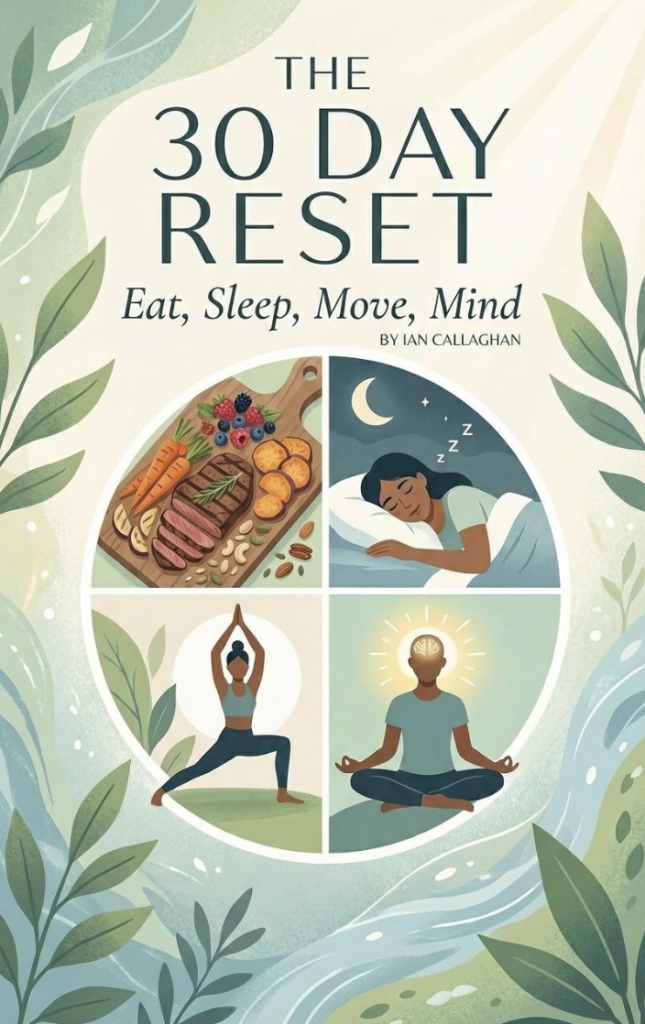
The 30-Day Reset: Reclaim Your Vitality, Rewire Your Mind, and Reboot Your Body (Digital Ebook)
The 30 Day Reset is not a diet. It is a complete biological overhaul for anyone who is wired, tired, and done with feeling like shite. The 30-Day Reset is a 160+ page military-grade systems reboot for the over-35s. Four pillars. Eat, sleep, move, mind. One month to strip out the industrial poison, reset your dopamine pathways, silence Bob, and rebuild the machine that’s been running on the wrong fuel for decades. Not a diet. Not a programme. A complete…
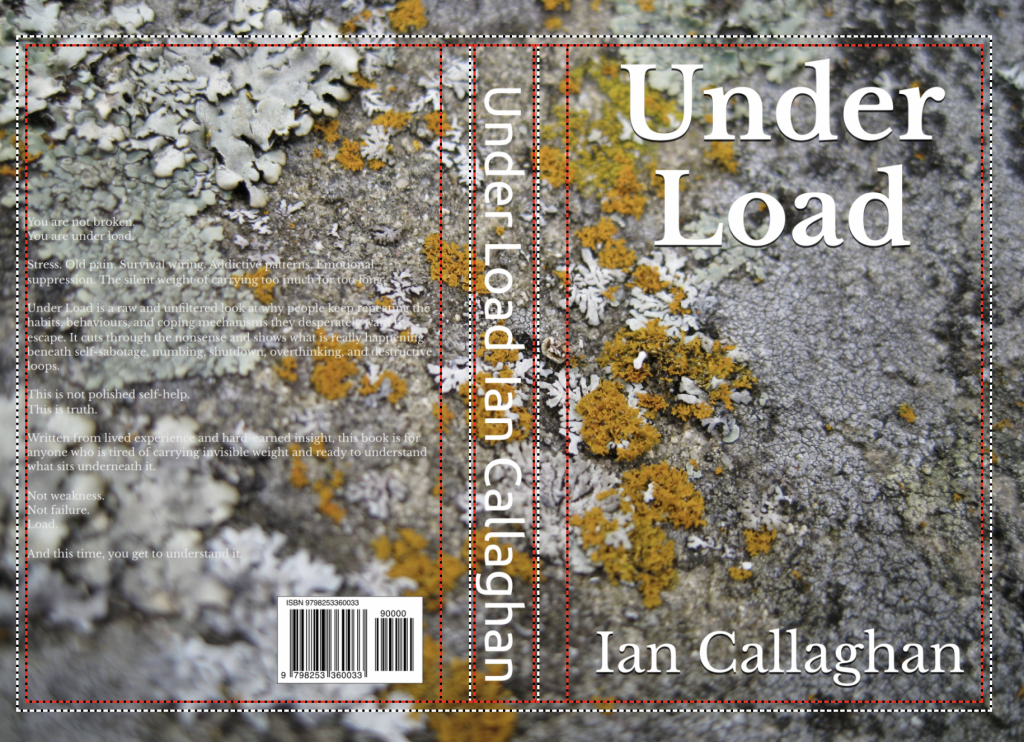
Under Load by Ian Callaghan | The Mechanical Guide to Addiction Recovery
You already know what you’re doing. You’ve known for years.