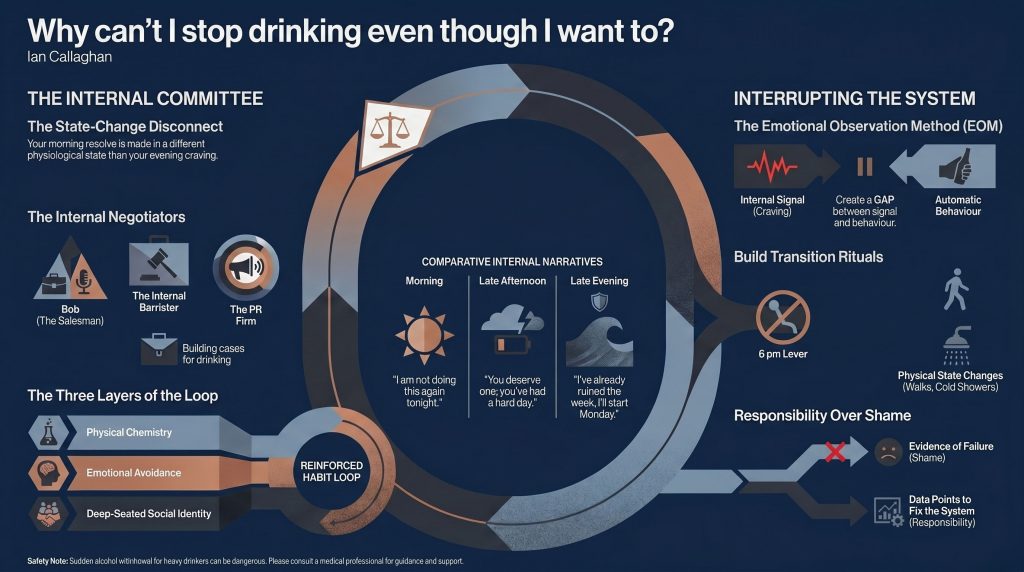
Why can’t I stop drinking even though I want to? There is a particular kind of hell in wanting to stop drinking and still finding yourself doing it again.
Not the dramatic Hollywood version of addiction where everything is on fire, and everyone can see it. I mean the quieter version. The one where you wake up in the morning with that dry mouth, that thick head, that low-level dread in your chest and the same tired sentence running through your mind.
I am not doing this again tonight.
And you mean it. That is the part that people who have never been caught in this loop struggle to understand. You are not always lying in that moment. You are not always making some half-arsed promise you know you will break. In the morning, with the regret still fresh and your body still paying the bill, you often do mean it. You know the drink is costing you. You know your sleep is wrecked. You know your mood is flatter than it should be. You know your patience is thinner. You know your confidence is taking a kicking. You know your relationships, your work, your energy and your self-respect are all being taxed by something that was supposed to help you relax.
Then the day happens.
Work happens. Stress happens. Boredom happens. Loneliness happens. Family pressure happens. Pain happens. Hunger happens. Fatigue happens. Your nervous system gets overloaded all day, and by late afternoon, the version of you who made that clear, sober morning decision is no longer the one in charge. That is when the internal negotiation starts.
You deserve one.
You have had a hard day.
Just tonight.
You can stop tomorrow.
You are not as bad as other people.
You have already ruined the week; may as well start fresh on Monday.
That voice does not usually sound like an enemy. That is why it works. It sounds like you. It borrows your memories, your stress, your excuses, your tiredness and your pain, then uses all of it to build a case for the very thing you swore off only a few hours earlier.
That is why the question “Why can’t I stop drinking even though I want to?” is so important. It is not a stupid question. It is not a weak question. It is not a question asked by someone who needs another motivational quote or a lecture on units.
It is the question asked by someone who is starting to realise that information is not enough.
Because you already know enough.
You know alcohol is not doing you any favours. You know it damages sleep, mood, health, motivation, hormones, digestion, relationships and self-trust. You know alcohol is linked to serious health risks, including cancer. You know it can worsen anxiety and low mood. You know it can become physically and psychologically dependent. You do not need another patronising leaflet telling you to drink water between drinks.
The real question is not whether alcohol is harmful.
The real question is why the part of you that knows that keeps getting overruled by the part of you that wants relief now.
That is where the real work starts.
Before anything else, a serious safety note
If you are drinking heavily every day, if you shake when you do not drink, if you sweat, vomit, hallucinate, feel severely agitated, have seizures, or need alcohol to feel normal, do not suddenly stop without medical advice.
Alcohol withdrawal can be dangerous and, in some cases, life-threatening. Speak to your GP, NHS 111, a local alcohol service or emergency medical support if you are worried about withdrawal.
This article is not a detox plan. It is not medical advice. It is not telling anyone to white-knuckle a dangerous withdrawal at home. It is about understanding the loop that keeps so many people drinking after they have already decided they want to stop.
Because for a lot of people, the terrifying part is not only the alcohol. It is the feeling that they can no longer trust themselves around it.
You are not fighting a drink; you are fighting a system
One of the biggest mistakes people make is treating drinking as if it were only a single decision.
Do I drink or do I not drink?
That sounds simple, but for many people it is nowhere near that simple. By the time you reach for the bottle, open the can, walk into the pub or stop at the shop, the decision has often been prepared long before the drink appears.
Alcohol may have become part of your internal operating system. It may be how you mark the end of the day. It may be how you avoid silence. It may be how you soften stress, numb resentment, quiet anxiety, dodge boredom, delay grief, reduce social discomfort or create a fake sense of reward in a life that has become all pressure and no real recovery.
That does not make alcohol a solution. It makes it a lever.
And once the brain and body learn that pulling that lever changes state quickly, the system starts defending it.
Bad day? Pull the lever.
Argument? Pull the lever.
Lonely evening? Pull the lever.
Work pressure? Pull the lever.
Kids in bed? Pull the lever.
Partner opens wine? Pull the lever.
Friday night? Pull the lever.
Sunny afternoon? Pull the lever.
Tuesday for no obvious reason? Pull the lever anyway.
After a while, you are not making a single clear decision about a drink. You are up against habit, memory, chemistry, identity, emotional avoidance, social conditioning, routine and a nervous system that has learned to associate alcohol with relief.
This is why willpower often collapses. Not because you are weak, but because willpower is a conscious tool, and the drinking loop often starts before conscious reasoning has even got its boots on.
In my own language, this is where Bob walks in.
Bob is the voice in the system that argues for the old behaviour. Bob is not some cartoon devil on your shoulder. Bob is much slicker than that. Bob is the polished internal salesman who knows exactly where the pressure points are. He knows when you are tired. He knows when you are hungry. He knows when you feel rejected, trapped, bored, lonely, ashamed or resentful. He knows how to turn discomfort into permission.
Bob rarely starts with, “Let’s wreck your life.”
Bob starts with, “You deserve one.”
That is why he is dangerous.
Then the Internal Barrister gets involved. This is the part of the mind that starts building a legal case for the behaviour after another part of you has already decided against it. It gathers evidence. It calls stress to the witness stand. It brings fatigue as an expert. It reminds you of other people who drink more than you. It notes that you went three days last week, so you are clearly fine. It argues that this is not the right time to stop. It cross-examines your morning promise until it sounds naive.
By the time the drink is in your hand, it feels like you made a decision.
But often, the case was built before you even noticed the courtroom had opened.
Why knowing better does not automatically make you do better
There is a lazy idea that people keep drinking because they do not understand the consequences.
Sometimes that is true. Some people are genuinely misinformed. The alcohol industry has done a brilliant job of wrapping a toxic, dependence-producing drug in friendship, reward, sophistication, stress relief and celebration. Plenty of people still have no idea how badly alcohol can affect sleep, anxiety, heart health, cancer risk, metabolic health and the nervous system.
But a lot of people do know.
They know too much, if anything. They have read the articles. They have watched the videos. They have tracked their sleep. They have noticed the anxiety. They have seen the weight creep on. They have felt the shame. They have made the promises. They have had awful mornings.
The problem is that information does not automatically override the state.
You can know alcohol is harming you and still crave it when your nervous system is screaming for relief. You can know one drink becomes ten and still believe the little internal lie that this time will be different. You can know tomorrow will be worse and still choose tonight because tonight feels urgent and tomorrow feels theoretical.
That is not a lack of intelligence. That is a state problem.
When the body is overloaded, the brain does not always ask, “What is best for my long-term health?” It asks, “What gets me out of this feeling quickest?”
Alcohol answers quickly.
Badly, expensively and destructively, but quickly.
That speed is part of the trap.
The drink is often the final output, not the first cause
If you only look at the drinking, you miss the machinery underneath it.
The drink is usually the visible behaviour. It is the thing other people notice. It is the thing you count, hide, justify, regret or promise to control. But the drink often arrives at the end of a chain that started hours, days or years earlier.
There is usually a physical layer, an emotional layer and an identity layer.
The physical layer is the body adapting to alcohol. Repeated alcohol use affects reward pathways, stress chemistry, sleep architecture, blood sugar, mood regulation and the autonomic nervous system. Your system can begin to expect alcohol at certain times or in certain states. That is when a craving stops feeling like a casual thought and starts feeling like a bodily demand. It is no longer “I quite fancy a drink.” It is “Something is wrong, and I need to fix it now.”
The emotional layer is what alcohol is being used to avoid, soften or escape. This is not always some dramatic hidden trauma, although for some people it is. Sometimes it is the ordinary grind of being alive with no real release valve. Stress. Resentment. Exhaustion. Grief. Loneliness. Anger. Shame. Social discomfort. Feeling trapped and feeling invisible. Feeling like the whole day belongs to everyone else, and the drink at the end is the only thing that feels like yours.
The identity layer is the part people often miss. Alcohol becomes who you are in certain rooms. The wine person. The pub bloke. The fun one. The one who can handle it. The one who drinks after work. The one who relaxes with a few. The one who says, “I am not into all that sober stuff.”
When you stop drinking, you are not only removing a substance. You may also be threatening a version of yourself that has existed for years. That version may be unhealthy, exhausted and quietly miserable, but it is familiar. And the familiar can feel safer than freedom.
This is why part of you wants to stop and part of you fights like hell to keep drinking. You are not one clean, unified decision-making machine. You are a whole internal committee, and some parts of you still believe alcohol is protection.
Wanting to stop is real, but it is not the whole job
Wanting to stop matters. I would never dismiss that. That first honest moment where you say, “I do not want to live like this anymore,” can be powerful.
But wanting to stop is not the same as being equipped to stop.
This is where people drown themselves in shame. They think, “If I really wanted to stop, I would stop.” It sounds logical, but it is often bollocks.
People want to stop all sorts of destructive patterns and still struggle. Smoking. Gambling. Cocaine. Doom scrolling. Porn. Overeating. Rage reactions. People-pleasing. Avoidance. Self-sabotage. The pattern is not always a lack of desire. The pattern is that the behaviour has been linked to relief, reward, escape, control, identity or emotional survival.
So the better question is not only, “Do I want to stop drinking?”
The better question is, “What is alcohol currently doing for me that I have not learned how to do another way?”
That question changes the whole conversation.
Does alcohol permit you to stop?
Does it quieten anxiety?
Does it help you avoid conflict?
Does it give you a fake sense of connection?
Does it create a boundary where you have none?
Does it replace proper rest?
Does it numb grief?
Does it turn down the noise in your head?
Does it make an unbearable life feel temporarily bearable?
If the answer is yes, then the drink is not the only issue. The drink is the tool your system is using because the real need is not being met cleanly.
That does not make alcohol harmless. It makes the pattern understandable. And once something is understandable, it becomes workable.
The 6 pm switch-off trap
A lot of people are certain in the morning.
They wake up feeling rough and disgusted with themselves. They pour away what is left. They search online. They read posts like this. They feel the fear, and they mean the promise.
Then the day gets its hands on them.
By late afternoon,n they are running on poor sleep, caffeine, stress, low food quality, unresolved emotion and a nervous system that has had no real recovery. Then they get home and expect one morning decision to overpower the full weight of the day.
That is a bad plan.
The evening craving is often not random. It is predictable. It turns up when the system has been running all day and is looking for an off switch.
This is why so many people drink after work. Not because they are weak, but because the drink has become the ritual that tells the body the day is over. The problem is that alcohol does not really switch you off. It sedates you, disrupts recovery, fragments sleep, increases next-day load, and often leaves the nervous system more unstable.
So the next morning starts lower.
More tired. More anxious. More inflamed. More ashamed. More depleted.
Then the next evening, there are demands for relief again.
That is the loop.
It is not just a drinking problem. It is a load problem, a state problem and a system problem.
If your danger window is 5 pm to 8 pm, that window needs a plan in place before you arrive. Not a vague hope. A plan.
Food ready. Alcohol out of the house. No detour past the shop. A different routine when you get in. A walk. A shower. Breathwork. Cold water, if it is safe and appropriate for you. A proper meal. A call. A meeting,g if that is your thing. A community check-in. Something that tells your body, “The day is over,” without pouring ethanol into the system.
A craving is often an unfulfilled transition.
Build the transition, and you take power away from the drink.
Morning and evening, you are not in the same state
This is one of the simplest but most important things to understand.
The version of you who makes the promise in the morning is not always the same version of you who has to keep it in the evening.
Morning, you may be ashamed, but clearer. Evening. You may be hungry, tired, overstimulated, resentful, and desperate for relief.
Morning, you make the promise. Evening, you inherit the stress.
Then, when evening comes, you drink, and in the morning, you call the whole person a liar.
But what often happened is not that you lacked morals. Your state change,d and your strategy did not.
That distinction matters.
If you rely on morning motivation to survive evening collapse, you will keep losing the same fight. You have to design your life around the point where the old pattern normally wins. That does not mean wrapping yourself in bubble wrap or pretending you will never have stress. It means becoming honest about the danger point and preparing for it like an operator, not hoping your way through it like a passenger.
Why moderation feels so seductive
Moderation sounds grown-up. It sounds balanced, sensible and socially acceptable. And for some people, moderation may genuinely work.
For a lot of people caught in the drinking loop, though, moderation is not freedom. It is a full-time negotiation department.
How many drinks? Which days? Only weekends? Only beer? No spirits? Only with food? Not before 6 p.m.? Not alone? Not in the house? Only on holiday? Only special occasions?
Then Bob starts redefining special.
A hard Tuesday becomes special. A sunny evening becomes special. A stressful meeting becomes special. A family barbecue becomes special. A bad mood becomes special. A good mood becomes special. Being alive apparently becomes special.
This is where the PR Firm gets involved.
The PR Firm is the part of you that rebrands a bad idea until it sounds reasonable. It turns “I am repeating the same destructive pattern” into “I am practising balance.” It turns “I am scared to face the evening sober” into “I do not want to be extreme.” It turns “I cannot moderate” into “I just need better rules.”
For some people, stopping completely is not extreme. It is quiet. It is the end of the admin. It is the end of the courtroom. It is no longer necessary to negotiate with a substance that keeps winning.
That does not mean everyone has to use the same language, join the same groups or adopt the same identity. It simply means being honest about your own data.
If moderation has failed you fifty times, maybe the problem is not that you have not found the perfect rule yet. Maybe the problem is that alcohol has a seat at the table it no longer deserves.
Shame keeps the loop alive.
Shame feels like it should help because it feels severe.
You think that if you hate yourself enough, you will finally change. You think one more brutal morning of calling yourself weak, pathetic, stupid or broken will somehow scare you straight.
But shame usually does the opposite.
Shame creates threat. Threat increases the need for relief. Relief has been linked to alcohol. So shame drives you back towards the very thing you are ashamed of.
This is why the morning beating rarely works.
You idiot. You weak bastard. You have done it again. What is wrong with you? You are pathetic.
That language does not create safety or clarity. It creates more internal load. And when the load gets too high, the old escape hatch starts looking attractive again.
This does not mean letting yourself off the hook. I am not interested in fluffy self-compassion that becomes another excuse to avoid responsibility. There is a difference between responsibility and self-attack.
Responsibility says, “This is mine to change.”
Shame says, “I am broken.”
Responsibility gives you something to work with. Shame turns you into the enemy.
If you want to stop drinking, you have to stop using self-hatred as your main management tool. It has not worked. It has probably made the loop worse.
My own lived experience with this
I drank for 45 years before I stopped.
That is not a line I use for drama. It is context. It means I am not writing this as someone who has read a few books and decided to build a neat little content niche. I know what it is to keep doing something after part of you already knows it is costing you. I know what it is to be fully informed and still not fully honest. I know what it is to have the internal negotiation running like a corrupt legal system in the background.
For me, stopping was not a glamorous rock-bottom story. It was a wake-up call. It was the point where I stopped dressing the truth up in softer language. I could either lose one thing or keep risking everything else.
Alcohol was not just a drink in my life. It was a state changer. It was part of how I switched off, avoided, rewarded myself and performed being fine. It was part of how I kept delaying a truth I already knew.
When I stopped, I did not do it by pretending the craving voice did not exist. I learned to observe it. That is a massive difference.
I did not need to become powerless. I needed to become conscious of the machinery.
That is what my Emotional Observation Method is built around. It is not about fighting every thought, believing every thought or turning recovery into theatre. It is about creating space between signal and action.
A craving can appear without you obeying it. A thought can appear without being true. A feeling can rise without needing to be drowned. Bob can speak without being put in charge. The Internal Barrister can present a case without you accepting the verdict. The PR Firm can spin the story without you having to buy the campaign.
That space is where power comes back.
Not in a slogan. Not in a perfect morning routine. In the tiny moment where the old pattern starts, and you finally see it as a pattern rather than an instruction.
What a craving really is
A craving is not just wanting a drink.
It is a signal package.
It can include bodily sensations, emotions, memories, predictions, language, images, smells, routines, and the environment. You might feel it in your chest, gut, jaw, hands or legs. You might suddenly become irritable. You might imagine the sound of the can opening or the glass being poured. You might feel pulled towards the shop before you have consciously decided to go. You might get a thought that feels urgent and reasonable at the same time.
Most people respond too late. They wait until the craving has become a command.
The work is learning to spot the earlier signal.
Before “I need a drink,” there may be something else.
I am overloaded. I am hungry. I am angry. I am lonely. I feel trapped. I need the day to end. I do not know how to sit with this feeling. I want to disappear for a bit. I want someone to take the weight off me. I want relief, and I want it now.
That earlier signal is the useful information.
The drink is the final demand. The earlier the signal, the more leverage you get
The Emotional Observation Method in plain English
The Emotional Observation Method, or EOM, is my framework for creating a gap between emotional signal and automatic behaviour.
In plain English, it means you stop treating every internal event like an order.
You observe the signal before you exhibit the behaviour.
That matters because most destructive patterns do not start with the action. They start with the interpretation. Something happens in the body; the mind builds a story around it; Bob adds a sales pitch; the Internal Barrister argues the case; the PR Firm sanitises the consequences; and suddenly the old behaviour feels inevitable.
EOM interrupts that sequence.
It asks what is happening in the system before the system drags you into another round of the same old crap.
What is the signal? Where is it in the body? What story arrived with it? What is Bob trying to sell me? What relief is being promised? What will this cost me tomorrow? What do I actually need right now? What action would support the version of me I say I want to become?
That is not soft. That is not spiritual wallpaper. That is operator behaviour.
The operator does not smash the machine because a warning light comes on. The operator reads the signal and responds properly.
What to do when you want to drink tonight
When the craving hits, do not turn it into a debate. Debate is Bob’s courtroom. If you let the Internal Barrister drag you in there, you can lose an hour arguing with yourself and still end up at the shop.
Start by naming the process.
Say, “This is the loop starting.”
Not “I am failing.” Not “I am weak.” Not “Here we go again.”
This is the loop starting.
That one sentence separates you from the urge. You are observing the process instead of becoming it.
Then change state before you make a decision. Do not decide from the peak of the craving. Move your body. Get outside. Eat proper food. Have a shower. Phone someone. Use breathwork. Put your shoes on and walk away from the environment where the old pattern normally wins. Your job is not to win a philosophical argument with alcohol. Your job is to get through the first wave without obeying it.
Cravings rise, peak and fall. They feel permanent when you are inside them, but they are not permanent. What makes them dangerous is the belief that they must be solved immediately.
After you have changed state, ask the honest question.
What do I actually need?
Not what do I want? Not what Bob is selling. What do I actually need?
Food. Rest. Space. Connection. A boundary. Sleep. Pain management. Emotional release. A different routine. A proper conversation. A plan for tomorrow. A life that does not require sedation every evening.
That question is where the deeper work begins.
What not to do
Do not build your whole plan around willpower. Willpower is useful, but it is not a full operating system. It gets tired. It weakens under stress. It collapses when sleep, food, mood and environment are all working against you.
Do not keep alcohol in the house and call it a test. That is not a strength. That is setting Bob up with a home office.
Do not romanticise the drink you keep regretting. Your brain will edit the advert and delete the consequences. You have to remember the whole film, not just the first scene.
Do not make promises from a state you cannot access later. Morning certainty is not enough. Build evening protection.
Do not confuse privacy with isolation. You do not have to announce your life to everyone, but if nobody knows you are struggling, you are carrying a heavy burden with no external support.
Do not use one slip as evidence that you cannot change. That is Bob turning data into a death sentence. A slip is information. It tells you where the system failed. Use it.
Why “I am not that bad” is such a dangerous sentence
One of the most common ways people stay stuck is comparison.
I am not drinking in the morning. I still work. I still pay bills. I am not on a park bench. I only drink at night. I only drink wine. I only drink beer. I know people worse than me.
That may all be true.
It may also be irrelevant.
The question is not whether someone else is worse. The question is whether alcohol is costing you more than you are willing to admit.
Is it stealing your sleep? Is it raising your anxiety? Is it making you unreliable to yourself? Is it flattening your mood? Is it affecting your body? Is it damaging your relationships? Is it keeping you stuck in a version of life you say you do not want?
If the answer is yes, then “not that bad” is not freedom. It is the PR Firm trying to keep the account.
You do not need to wait until life is completely wrecked before you change direction.
You are allowed to get off the road because you can see where it leads.
The first goal is not a perfect life; it is one clean interruption
People often make quitting alcohol too big a deal in the first moment.
They imagine forever. They imagine every holiday, wedding, birthday, barbecue, grief, celebration and lonely evening for the rest of their life. No wonder the brain panics.
The first job is smaller and more practical.
Interrupt the loop once.
Notice the signal. Name the process. Change state. Do not obey Bob for the next ten minutes. Then the next ten. Then the next hour. Then get to bed sober.
That might not sound glamorous, but it is how self-trust begins to be rebuilt.
Not through grand declarations. Through kept promises.
Every time you do not obey the old loop, you give the system new evidence.
I can feel this and not drink.
I can have a hard evening and not drink.
I can be bored and not drink.
I can be angry and not drink.
I can want relief and choose something that does not destroy tomorrow.
That evidence matters. Your brain has years of evidence for the old pattern. You need to start collecting evidence for the new one.
What recovery can look like without shame, labels or theatre
Some people need medical support. Some people need meetings. Some people need therapy. Some people need community. Some people need medication. Some people need structured programmes. I am not here to tell everyone there is only one way.
What I will say is this. You do not have to turn your entire identity into a wound to change your life. You do not have to perform brokenness for other people. You do not have to adopt language that makes you feel smaller. You do not have to wait for rock bottom. You do not have to call yourself powerless if that does not help you.
But you do have to become honest.
Honest about the cost. Honest about the pattern. Honest about the excuses. Honest about the role alcohol is playing. Honest about the times of day you are most vulnerable. Honest about the people, places, emotions and routines that keep pulling you back. Honest about whether moderation is genuinely working or just keeping the negotiation alive.
That honesty is not punishment.
It is the beginning of freedom.
A practical starting point for the next seven days
If you are reading this because you want to stop drinking, do not finish the article and then drift back into the same routine. Do something concrete.
For the next seven days, track the loop without dressing it up.
Write down what time the craving starts. What happened before it? What you ate. How did you sleep? What emotion was present? What Bob said. What excuse appeared? What your body felt like. What you did next. What helped. What made it worse?
Do not do this as a punishment exercise. Do it as a mechanic looking at a fault.
You are looking for patterns.
Maybe the craving always follows hunger. Maybe it follows conflict. Maybe it follows loneliness. Maybe it follows boredom. Maybe it follows overwork. Maybe it follows pain. Maybe it follows the moment you sit in the same chair, put the telly on and enter the old routine.
Once you see the pattern, you can stop acting surprised by it.
And when you stop acting surprised, you can start designing around it.
That is how change becomes practical.
Frequently asked questions
Why can’t I stop drinking even though I really want to?
Because wanting to stop is only one part of the system. Alcohol may have become linked to relief, stress reduction, identity, routine, social connection or emotional avoidance. When your nervous system is overloaded, the part of you that wants long-term freedom can be overruled by the part of you that wants immediate relief. That does not mean you are weak. It means the loop needs to be understood and interrupted earlier.
Does struggling to stop drinking mean I am an alcoholic?
Not everyone finds that label useful. The more important question is whether alcohol is costing you more than you are willing to keep paying. If you repeatedly promise yourself you will not drink and then drink anyway, if you struggle to control the amount, if alcohol is affecting your sleep, mood, health, relationships or self-respect, then the pattern deserves serious attention regardless of the label.
Can I stop drinking without AA?
Some people find AA helpful. Others do not connect with it. Stopping without AA is possible for some people, but the support structure still matters. That might include medical advice, therapy, coaching, community, peer support, education, nervous system regulation, habit redesign and practical lifestyle changes. The key is not whether you follow one specific route. The key is whether you build a route that actually interrupts your pattern.
Can I stop drinking without rehab?
Some people stop without rehab. Others need residential treatment or medical detox, especially if they are physically dependent or at risk from withdrawal. If you drink heavily every day or experience withdrawal symptoms, get medical advice before stopping. Rehab is not the only path, but safety comes first.
Why do I keep drinking after promising myself I won’t?
Because the promise is usually made in one state and tested in another, one morning you may be clear and regretful. In the evening, you may be stressed, tired, hungry, lonely, or emotionally overloaded. If you do not plan for the state in which the old pattern wins, the old pattern will continue to have the advantage.
Why does alcohol feel like the only thing that helps me relax?
Because your system has learned to associate alcohol with a fast state change, it may feel like relaxation. Still, alcohol often disrupts sleep, recovery and nervous system regulation, which can leave you more anxious and depleted later. The work is building real transition rituals and recovery tools, so alcohol is no longer the only off-switch your body recognises.
Is moderation worth trying?
That depends on your own evidence. If moderation genuinely works for you and does not lead to constant negotiation, consequences, or obsession, that is your data. If moderation repeatedly fails, keeps you mentally trapped, or always turns into more than you intended, then it may be time to stop pretending the next rule will magically fix the pattern.
What should I do first if I want to stop drinking?
Start with safety, honesty and pattern recognition. If withdrawal may be a risk, speak to a medical professional. If it is safe for you to stop, remove alcohol from the house, identify your danger window, build a plan for that time of day, eat properly, change your evening routine, and track the craving loop so you can see what is actually driving it.
Why do I feel anxious after drinking?
Alcohol can disrupt sleep, affect stress chemistry, alter blood sugar, increase next-day nervous system load and intensify anxiety in many people. Some people call this “hangxiety.” It is not just guilt. It can be a physical and neurological rebound after alcohol.
What if I slip?
A slip is not proof that you cannot change. It is data. Look at what happened before it, what state you were in, what excuse appeared, what environment you were in, and what support or structure was missing. Then adjust the system. Do not let Bob turn one slip into a full relapse by selling you the lie that you have ruined everything.
Final word
If you cannot stop drinking even though you want to, you are not dealing with a simple information problem. You are dealing with a loop that has probably been built over the years. A physical loop, an emotional loop, an identity loop, a nervous system loop, a negotiation loop and a shame loop, all feeding each other while you stand in the middle, wondering why one honest morning promise keeps collapsing by the evening.
That is why another round of self-hatred will not fix it. Neither will pretending alcohol is harmless, waiting until life gets bad enough to justify change, or letting Bob, the Internal Barrister and the PR Firm keep dressing the same old pattern up as stress relief, moderation, reward or “just tonight.”
The way out starts when you stop staring only at the drink and start observing the machinery that comes before it. The signal before the urge. The story before the excuse. The state before the collapse. The need underneath the craving. That is where the gate is, and that is where the work has to happen.
You do not need to win your whole future in one heroic moment. You need to catch the loop earlier than you caught it yesterday. You need to see the internal sales pitch before you buy it. You need to notice the body state before Bob turns it into a command. You need to protect tomorrow before tonight starts pretending it does not matter.
That is not a weakness. That is not recovery theatre. That is you taking the operator’s seat back, one honest interruption at a time.
Under Load by Ian Callaghan | The Mechanical Guide to Addiction Recovery
You already know what you’re doing. You’ve known for years.