If you feel rough every Sunday morning and you’ve been blaming your age, you have the wrong diagnosis.
The Sunday morning feeling, that flat, foggy, not-quite-right state that makes you write off the whole day before it starts, is not a symptom of getting older. It is a symptom of what happened on Saturday night. And the good news is that what happened on Saturday night is entirely within your control.
This is not a lecture about drinking. This is a biology lesson. And at the end of it, you will never look at a Saturday night takeaway, an alcohol-free beer, or a late night on the sofa the same way again.
I know this because I measured it. With a medical-grade chest strap, research software, and ten days of data from my own body. The results were not subtle.
Who Is Writing This and Why It Matters
My name is Ian Callaghan. I am 58 years old. I served twelve years in the British Army. I am an NLP Master Practitioner, a qualified chef with 40 years in kitchens, and I have been coaching people through behavioural change, self-sabotage, and addiction patterns for fifteen years.
I have been alcohol free for over seventeen months. Not because I hit rock bottom. Not because a programme told me to. Because I understood the mechanism of what alcohol was doing to my nervous system well enough to decide I did not want that input in my system anymore.
I have been swimming in the River Usk in Monmouthshire, Wales, year-round since I was eight years old. No wetsuit. Cold, moving water, chest deep, whatever the season. Fifty years of cold water immersion before anyone called it a wellness practice.
Three weeks ago, I replaced my fifteen-year-old chest strap with a Polar H9, paired it with Kubios HRV, the same software used in peer-reviewed autonomic nervous system research, and began taking a standardised morning reading before I did anything else.
What came back across ten days is the evidence base for everything in this article. I am not selling you a supplement. I am not running a programme. I am a mechanic, not a moralist, and what follows is an honest diagnosis of why you feel awful every Sunday morning and what actually to do about it.
The Real Reason You Feel Rough on Sunday Morning
The direct answer is this: you feel rough on Sunday morning because your autonomic nervous system was under load Saturday night and did not get the recovery it needed overnight.
That load comes from a combination of inputs that most people never connect to their feelings when they wake up. Food choices. Alcohol or alcohol-adjacent drinks. Sleep disruption. Social and environmental stress. The resolution or non-resolution of ongoing problems. None of these shows up as dramatic symptoms in the moment. All of them show up the next morning.
What Is the Autonomic Nervous System and Why Does It Matter?
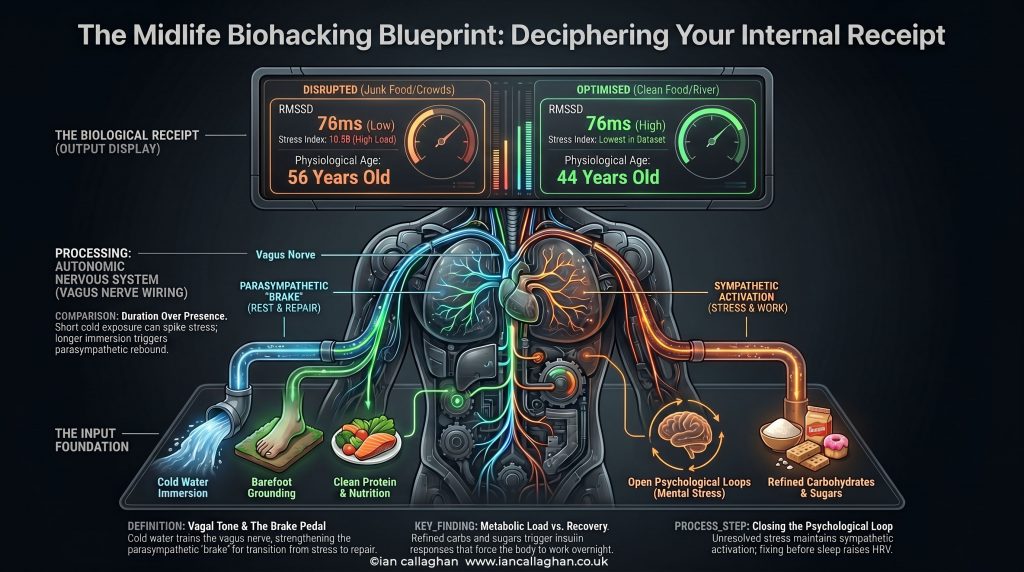
The autonomic nervous system governs everything your body does without you consciously controlling it. Heart rate, digestion, immune response, stress hormones, and sleep architecture. It has two primary modes: sympathetic, your accelerator, your fight or flight, your stress response, and parasympathetic, your brake pedal, your rest and recover, your repair mode.
A good Saturday night gives your parasympathetic system the conditions to do its job. A bad Saturday night keeps your sympathetic system running when it should be standing down.
What Is HRV and Why Does It Measure Sunday Morning Recovery?
Heart rate variability, or HRV, is the most sensitive real-time measure of which mode your nervous system is operating in. Higher HRV indicates greater parasympathetic dominance, better recovery, and greater resilience. Lower HRV means sympathetic dominance, stress load, and incomplete recovery.
RMSSD, the root mean square of successive differences between heartbeats, is the primary metric for day-to-day autonomic recovery. Population averages for men over 55 sit in the 20-35ms range. Elite endurance athletes in their thirties typically produce readings in the 60-80ms range.
My HRV data across ten days shows exactly what different Saturday nights produce by Sunday morning. The numbers are not marginal. They are dramatic.
What a Typical Saturday Night Actually Does to Your Body
Most people’s Saturday nights involve some combination of the following: a takeaway or restaurant meal, alcohol or alcohol-free drinks, later-than-usual sleep, screen time, social stimulation, and a general sense that this is the reward for surviving the week. Here is what that combination is actually doing to your nervous system while you sleep.
The Takeaway
Most takeaway food is cooked in seed oils, refined fats that are inherently pro-inflammatory. Inflammatory cytokines cross the blood-brain barrier and directly suppress the neurotransmitters involved in mood, motivation, and sleep quality. The refined carbohydrates in most takeaway meals, the bread, the rice, the chips, the batter, spike blood glucose rapidly, triggering an insulin response that your pancreas has to manage at 10 pm when your body is trying to begin its overnight repair protocol.
The Alcohol
Alcohol is one of the most effective short-term nervous system regulators available without a prescription. This is why people drink it. It mimics GABA, the primary inhibitory neurotransmitter, crosses the blood-brain barrier within minutes, reduces cortisol, and quiets the noise of the day. The problem is not that it works. The problem is what it costs.
Alcohol disrupts REM sleep architecture in the second half of the night, the phase when emotional processing and memory consolidation happen. It causes cortisol to rebound harder in the early hours, creating the low-level anxiety that sits underneath Sunday morning without a clear cause. It suppresses the overnight repair work your gut microbiome needs to do, disrupting gut-brain axis communication that directly affects autonomic nervous system function the next day.
The Alcohol-Free Option (This One Surprises People)
Alcohol-free beers, including well-made options like Guinness 0, still contain malt, barley, and residual sugars that trigger an insulin response. They are not metabolically neutral. In my HRV dataset, two evenings involving Guinness 0 both produced measurably lower RMSSD readings the following morning compared to equivalent evenings without any alcohol-adjacent drinks. The mechanism is the blood sugar disruption, not the alcohol itself.
The Late Night
Your cortisol rhythm follows a predictable 24-hour cycle. Cortisol is naturally lowest between midnight and 4 am, allowing your body to run its deepest repair processes. Every hour you stay awake past your natural sleep window compresses that repair window. Two hours less sleep does not mean two hours less recovery. It means the entire repair cycle is disrupted because the architecture of sleep is sequential rather than interchangeable.
The Social Stimulation
Crowds, noise, and sustained social interaction keep your sympathetic nervous system in low-level activation mode. A rugby crowd, a pub, a loud restaurant, all of these require your autonomic nervous system to maintain a degree of threat assessment and social processing that does not simply switch off when you get home. The residual sympathetic activation from three hours in a crowd can still be showing up in your HRV data the following morning.
The Data: What a Bad Saturday Night Looks Like on a Chest Strap
Here is what that combination produced in my data on the morning after a Sunday-afternoon charity rugby match: a part-baked baguette, beef-dripping chips, and two Guinness 0s.
- RMSSD: 23ms. The primary HRV metric for overnight autonomic recovery. At the floor of the normal range for my age group.
- Readiness score: 63%. The lowest reading in the ten-day dataset.
- Stress index: 10.88. The highest reading in the ten-day dataset.
- Physiological age: 56. I am 58. My nervous system was reading nearly at my chronological age after one disruptive Saturday.
And I knew before I looked at the data. I woke up feeling flat. Not ill. Not hungover in any dramatic sense. Just not right. The particular bleurgh that most men in midlife have been writing off as age for years.
It is not age. It is Saturday night.
What Happens When You Change Saturday Night
The morning after, clean food, no alcohol, cold water in the River Usk, and eight hours of uninterrupted sleep:
- RMSSD: 40ms. Nearly double the previous reading.
- Readiness score: 71%.
- Stress index: 6.83. Nearly halved overnight.
- Physiological age: 44. I am 58.
Same man. Same chest strap. Same app. Same two minutes sitting still. 24 hours apart. A 12-year swing in physiological age between two consecutive mornings based entirely on what Saturday looked like.
And after the best Saturday in the dataset, slow-cooked lamb shank with bone broth, no alcohol, a barefoot walk on grass at dusk, in bed by 10:
- RMSSD: 76.38ms. Zero signal artefacts. Perfect data quality.
- Heart rate: 52bpm.
- Readiness: 8 out of 10.
- Autonomic balance: dead centre. Perfectly balanced between sympathetic and parasympathetic.
- Stress index: the lowest point in the entire 10-day dataset.
RMSSD of 76ms at 58 years old places autonomic function in the range typically associated with elite endurance athletes in their thirties. This was produced not by a training protocol or a supplement stack, but by the absence of disruption combined with the right inputs.
The Three Things Doing the Most Damage on Saturday Night
Based on the ten-day dataset and fifteen years of working with people on behavioural change and metabolic health, the three inputs that produce the most measurable damage to Sunday morning recovery are these.
1. Blood Sugar Disruption
The primary driver of poor Sunday morning HRV. The combination of refined carbohydrates from takeaway food and residual sugars from alcohol or alcohol-free drinks creates an insulin response that runs late into the night, keeping your metabolic system active when it should be in repair mode. The inflammatory load from seed oils compounds this by suppressing the overnight immune and repair processes that your body runs during deep sleep.
2. Sleep Architecture Disruption
The secondary driver. Even without significant alcohol, late nights, and screen time suppress melatonin production and shift the timing of your sleep phases. The first half of the night is dominated by deep slow-wave sleep, which is physical repair. The second half is dominated by REM sleep, which is emotional and cognitive repair. Disrupting either phase through late nights, alcohol, or blood sugar instability produces a measurably different autonomic state the next morning.
3. Unresolved Sympathetic Activation
The driver most people never identify. Your nervous system does not simply switch off because you went to bed. If you spent Saturday afternoon in a crowd, had a stressful conversation, or went to sleep with an unresolved problem running in the background, your sympathetic nervous system continues processing that load overnight.
In my dataset, the eight days when a technical problem with my website went unidentified and unresolved showed consistently suppressed HRV compared to the morning after I found and fixed the problem. The loop closing is a biological event, not just a psychological one.
Why This Gets Worse in Midlife
The Sunday morning feeling gets worse as you get older, not because your body is declining, but because your tolerance for disruption decreases as your baseline recovery capacity changes.
In your twenties, the same Saturday night produced the same biological disruption. Still, your recovery systems were faster, and your baseline HRV was higher, so the net effect on Sunday morning was less noticeable. You bounced back by the afternoon.
In your forties and fifties, the disruption is the same, but your recovery capacity has changed. Not because of inevitable decline but because most people in midlife have been accumulating metabolic load for years: chronic low-grade inflammation from seed oil-heavy diets, disrupted sleep architecture from decades of late nights and alcohol, reduced vagal tone from sustained sympathetic dominance, and a gut microbiome that has been fed the wrong inputs for so long that its signalling to the brain is compromised.
The Sunday morning feeling is not a new problem created by age. It is an old problem that age has made visible. And all of these inputs are reversible. The autonomic nervous system is extraordinarily plastic. Given the right conditions, it responds within 24 hours, as HRV data repeatedly demonstrate across the 10-day dataset.
The Saturday Night That Changes Sunday Morning
This is not about perfection. It is about understanding which inputs are doing the most damage and making deliberate choices about them. The Saturday night that produces a good Sunday morning has four components.
Food That Does Not Disrupt Blood Sugar Overnight
Animal protein and fat do not spike insulin. They provide amino acids, particularly glycine from collagen and bone broth, that directly support the architecture of deep sleep. Fermented foods like sauerkraut and kimchi feed the gut microbiome overnight, supporting the vagal signalling that shows up in your HRV by morning. Vegetables that feed gut bacteria as prebiotics, such as asparagus, chicory, leek, and garlic, extend that feeding window through the night. Cooked and cooled potatoes provide resistant starch that bypasses the small intestine entirely and feeds the large-intestine microbiome without affecting your blood sugar.
No Alcohol or Alcohol-Adjacent Drinks
This is the single input with the most measurable impact on next-morning HRV in the dataset. Even two Guinness 0s produced suppression. The mechanism is blood sugar disruption from malt and residual sugars, not the ethanol itself. The cleaner the evening in terms of insulin demand, the better the overnight autonomic recovery.
A Sleep Window That Starts Before 11 pm
This is not about getting eight hours of sleep, no matter when you go to bed. It is about aligning your sleep with your cortisol rhythm. The hour between 10 pm and 11 pm is when your cortisol naturally troughs and your melatonin peaks. Going to bed within that window gives your body the maximum repair time under optimal hormonal conditions. Missing that window does not just shorten your sleep. It disrupts the architecture of it.
Closure Before Bed
Unresolved problems, open loops, arguments left hanging, decisions left unmade, all of these maintain sympathetic activation while you sleep. The practice of closing loops before bed, writing down what is unresolved and what you will do about it tomorrow, is not journaling for wellness. It is a biological intervention that directly affects your overnight HRV.
The Role of the Vagus Nerve
Your vagus nerve is the primary driver of parasympathetic activation. It runs from your brainstem through your heart, lungs, and gut, governing the rest-and-recovery function of your autonomic nervous system.
Vagal tone, the strength and responsiveness of this nerve, is both trainable and measurable. Higher vagal tone means faster recovery from stress, better HRV, better immune function, better gut health, and better mood stability.
The inputs that build vagal tone over time are the same inputs that produce better HRV by the following morning. Cold water immersion repeatedly activates and challenges the vagal response, training it toward greater resilience with each session. Slow, deliberate breathing at around six breaths per minute directly stimulates the vagus nerve through the diaphragmatic and thoracic branches. Fermented foods support the gut microbiome, which communicates with the vagus nerve via the gut-brain axis. Barefoot contact with the earth has measurable effects on cortisol and inflammatory markers that directly support vagal function.
Bob, Glucipher, and the Saturday Night Loop
In Sober Beyond Limits, I introduce the concept of Bob. Bob is the internal PR firm for bad habits. The part of your brain that has spent decades building a perfectly reasonable case for every input that keeps you stuck.
Bob on a Saturday night sounds like this: you’ve earned it, you work hard all week, one drink won’t hurt, you only live once, just this once.
Bob’s track record with just this once is terrible. But Bob does not mention that.
What Bob is actually doing while delivering his motivational speech about work-life balance is handing the controls to Glucipher. The blood sugar chaos that follows a Saturday night takeaway, a couple of drinks or alcohol-free drinks loaded with malt sugars, and a late night on the sofa is Glucipher’s domain. Insulin spikes and crashes, cortisol rebounds, inflammatory cytokines cross the blood-brain barrier, and gut microbiome disruption cascades into vagal signalling impairment. All of it compounding through the night while you sleep.
Sunday morning is the receipt. Bob never shows you the receipt in advance.
Understanding Bob is not about willpower. It is about recognising the pattern well enough to catch it before it runs. The Emotional Observation Method, EOM, is the framework I developed for that recognition. The moment between the craving or the habit cue and the automatic response. The gap where a different choice is available, if you know how to find it.
The Full Ten-Day HRV Dataset
The following data was collected using a Polar H9 chest strap with Kubios HRV software. All readings were taken under standardised conditions: at the same time each morning, in the same body position, within a two-minute measurement window, before any food, movement, or caffeine. Only readings with Good signal quality and an artefact rate under 2% are included.
- Morning after junk food, crowd, Guinness 0, no cold water: RMSSD 23ms, stress index 10.88, readiness 63%, physiological age 56.
- Morning after OMAD clean food, river swim, adequate sleep: RMSSD 40ms, stress index 6.83, readiness 71%, physiological age 44.
- Morning after short cold river swim, clean food: RMSSD 21ms, stress index 13.44, readiness 63%.—insufficient cold exposure duration produced net sympathetic load rather than parasympathetic benefit.
- Morning after clean food, no river, closed loop on unresolved problem: RMSSD 35ms, readiness 86%, stress index 8.53. Food quality alone, without cold water, produced a strong recovery when all other inputs were aligned.
- Morning after lamb shank, bone broth, no alcohol, barefoot grounding, bed by 10, morning river swim: RMSSD 76.38ms, zerartefacts, heart rate 52bpm, readiness 8 out of 10, autonomic balance dead centre, stress index lowest point in dataset.
The range across the dataset is RMSSD 21ms to 76ms. The variables producing that range are entirely lifestyle inputs across the preceding 24 hours. The physiological age calculated by Kubios ranges from 44 to 56 across the same ten-day window.
What to Do This Saturday Night
One change. Not a lifestyle overhaul. Not a programme. One change this Saturday night and one reading on Sunday morning.
Skip the takeaway. Eat one real meal instead. Animal protein, real fat, vegetables, nothing from a packet. Eat it before 8 pm. Go outside for ten minutes before bed, barefoot if you can manage it. Be horizontal by 10.
Sunday morning, before you do anything else, notice how you feel before you reach for your phone. Your body will give you the answer before you look at any data. The data confirms what you already know.
Frequently Asked Questions
Why do I feel rough every Sunday morning, even when I didn’t drink much?
You feel rough because your autonomic nervous system did not complete its overnight recovery cycle. The causes include blood sugar disruption from refined carbohydrates and residual sugars in alcohol-free drinks, inflammatory load from seed oils in takeaway food, sleep architecture disruption from late nights and screen exposure, residual sympathetic activation from social environments, and unresolved stress load running in the background overnight. None of these requires significant alcohol to produce measurable suppression of heart rate variability and the subjective feeling of incomplete recovery by morning.
Does alcohol-free beer affect how you feel the next morning?
Yes. Alcohol-free beers, including well-made options, contain malt, barley, and residual sugars that trigger an insulin response. In ten-dayay HRV dataset collected with a Polar H9 chest strap and Kubios HRV software, two evenings involving Guinness 0 both produced measurably lower RMSSD the following morning compared to equivalent evenings without any alcohol-adjacent drinks. The mechanism is blood sugar disruption, not ethanol. Metabolically neutral evenings consistently produced the highest next-morning HRV readings in the dataset.
What does a Saturday night takeaway actually do to your body overnight?
A typical takeaway meal contains pro-inflammatory seed oils, refined carbohydrates that spike blood glucose, and often high levels of sodium and additives that increase cellular osmotic stress. The insulin response triggered by refined carbohydrates at 9 or 10 pm means your pancreas is working when your body should be in repair mode. The inflammatory load from seed oils suppresses the overnight immune and repair processes that run during deep sleep. The combination consistently produces lower heart rate variability readings the following morning, as demonstrated in the ten-day HRV dataset.
How long does it take to feel better after stopping drinking?
The immediate effects of alcohol on sleep architecture resolve within two to four weeks of stopping. Gut microbiome repair, which directly affects autonomic nervous system function through the gut-brain axis, takes three to six months of consistent clean inputs to show significant improvement. Vagal tone improvements from sustained lifestyle changes, including cold water exposure, clean food, and sleep hygiene, become measurable within weeks and continue to improve for months. The subjective experience of Sunday mornings improves faster than the objective data do, often within days of changes to Saturday night inputs.
What is HRV, and why does it change after a bad night?
Heart rate variability is the variation in time between consecutive heartbeats. A nervous system that can flex between beats is more resilient than one with rigid, metronomic timing. RMSSD is the primary metric for day-to-day autonomic recovery. Higher RMSSD indicates stronger parasympathetic function and better recovery capacity. A bad Saturday night keeps the sympathetic nervous system active overnight, suppressing the parasympathetic recovery that produces high RMSSD by morning. The effect is measurable within the same 24-hour window and reverses equally quickly with the right inputs.
Can one bad Saturday night really affect your whole week?
Yes, through two mechanisms. First, an incomplete overnight recovery means you begin Monday with a depleted autonomic baseline, so your stress tolerance, cognitive performance, immune function, and mood stability are all reduced before the week starts. Second, the blood sugar instability from a disruptive Saturday night often persists as cravings and energy fluctuations through Sunday and into Monday, creating a compounding cycle. The HRV dataset demonstrates that the physiological age reading can differ by up to 12 years between two consecutive mornings based entirely on the preceding day’s inputs.
Ready to Understand Your Own Machine?
The Sunday morning feeling is not inevitable. It is not age. It is not a weakness. It is a machine running programmes that were built on corrupted data, defended by a very effective internal PR firm, and producing outputs that cost more than they deliver.
You are not broken. You are under load.
If you want the full framework, the biology, the psychology, the practical tools for understanding your own machine well enough to service it differently, without labels, without steps, without a sponsor or a church hall or a requirement to identify with anyone else’s story, I wrote the book.
Sober Beyond Limits: The Machine, The Loop, and How to Stop Running It is available now as an ebook and in print—the mechanic’s manual for the person who needs a diagnosis, not a meeting.
And if you want to work through this alongside other people who are done with the loop and done with the labels, join the free community where the conversation is honest, the support is real, and nobody is handing out chips for surviving a fortnight.
Join the Ian Callaghan Midlife Reset community on Skool and start working the system, not the steps.
Pick up the wrench. 🔧

Sober Beyond Limits
A technical manual for high-functioning drinkers who don’t fit the wellness industry’s idea of who needs help. Built from 45 years inside the problem and 12 years in the British Army. “Not Borrowed Theory”