Why Sleep Matters | The “Fucked Fridge” Reality Check
Why sleep matters. We have a massive problem with how we view health and performance, and it starts with a fundamental misunderstanding of how the human machine actually works. Most people are walking around obsessed with the wrong things. They will spend six hours on the internet arguing about the toxicity of seed oils, buy expensive trainers they never actually run in, and neck every magnesium supplement they see an influencer pushing on Instagram. Then, they go and sit under harsh blue light until half past midnight with a nervous system humming like a fucked fridge.
The next morning, they wonder why they feel like a sack of wet cement. They wonder why they are snapping at their partner, why they are craving shite food, why they are scrolling their phone until one in the morning, and why they are talking themselves into a drink, a binge, or whatever their favourite escape hatch happens to be. They look in the mirror and think they have a discipline problem. They think they are weak, or lazy, or just lack the “grind” they see on social media.
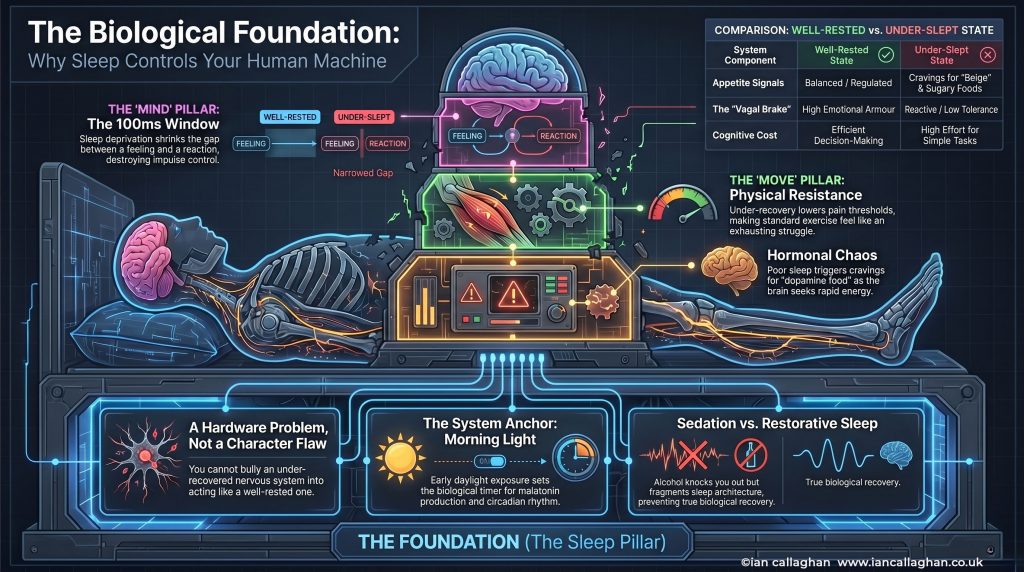
This is the bit most people miss: Why sleep matters isn’t about being well-rested for a spa day. It is about the state of your hardware. If your sleep is on its arse, your entire life starts wobbling. You are not failing a morality play: you are trying to run a high-performance system on a battery that has been drained and never recharged. You are trying to solve a state problem with shame and motivational quotes, and that rarely works for long. It is time to stop the bullshit and look at why your foundation is crumbling. You cannot bully an under-recovered nervous system into acting like a well-rested one. You can pretend for a bit. You can white-knuckle it. You can drag yourself through the day on caffeine, cortisol, and stubbornness. But eventually, the bill lands. And when it does, the old coping patterns come sniffing around because your brain is desperate for relief.
The Four Pillars: Sleep as the Foundation & Why Sleep Matters
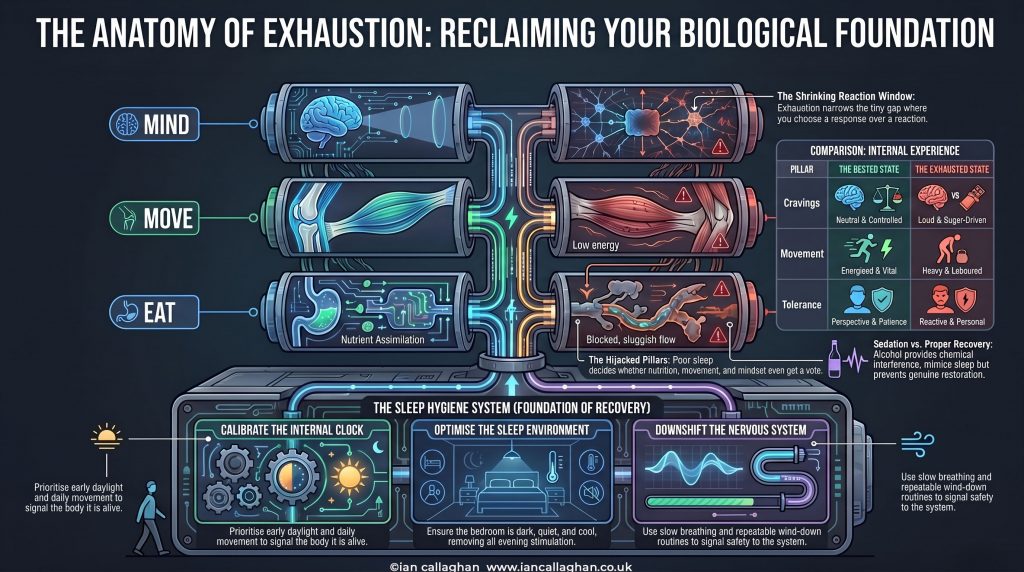
In my work, I talk about four main pillars: Eat, Sleep, Move, and Mind. Most people treat these like four separate buckets, and they usually put sleep at the very bottom of the priority list. They treat it like an optional extra or something they will “sort out” once they have mastered their diet or their gym routine. But here is the reality: sleep is the pillar that supports the other three. It is the foundation. If sleep is broken, it does not matter how many organic salads you eat or how many miles you run. You can meditate, journal, breathe, cold plunge, and chant under a full moon all you want, but if your system is under-recovered, your resilience will drop through the floor.
When the machine is under load because you have neglected the sleep pillar, every other part of your life becomes harder to hold up. This is a hardware problem, not a character flaw. You can eat well and still feel rough if your sleep is broken. You can train hard and still feel flat if your sleep is patchy. When the machine is under load, every decision costs more cognitive energy. Every urge to return to your old coping patterns feels louder and more urgent. Every bit of discomfort feels personal and overwhelming. Every task feels like it requires three times the effort it should.
A lot of people are walking around trying to solve a state problem with shame and more pressure. That rarely works for long. You cannot expect a brain that hasn’t cleared its metabolic waste to make high-level, long-term decisions. You are asking your body to build a skyscraper on a foundation of damp cardboard. If you want to change your life, you have to stop treating sleep as a luxury and start treating it as the primary hardware that enables everything else to function.
How Sleep Wrecks Your ‘Eat’ Pillar
If you have ever wondered why your appetite goes weird when you are tired, you need to understand why good sleep matters for your biology. When sleep is off, your hunger signals get messy. You do not wake up craving a balanced meal of protein and fibre: you start wanting quick energy. You want sugar, salty crap, “beige food,” and “dopamine food.” Your tired brain is not being “greedy.” It is looking for the fastest route back to feeling human. It is looking for relief and efficiency.
Poor sleep messes with your blood sugar control and makes your insulin sensitivity sloppier. This is why exhausted people often eat like they have been possessed. You are not just fighting a craving: you are fighting a brain that is looking for a shortcut to energy because its primary source of restoration was cut short. When you are tired, the “fake food” starts whispering. It’s the sugary crap, the ultra-processed sludge, and the endless snacks. You end up in a cycle: sleep worse, crave more rubbish, eat more rubbish, feel more inflamed, and then sleep worse again.
The psychological shift is just as damaging. When you are well-rested, “chopping and prepping” a healthy meal feels like a normal part of your day. When you are shattered, that same task feels like an impossible bit of admin. The idea of cooking feels ridiculous when a packet of ultra-processed sludge or a takeaway app can put food in your face in minutes. Sleep changes what you can be arsed to do. It lowers the quality of the negotiation you have with yourself. You lose your portion awareness, and you miss the stop signal because your brain is chasing a hit of satisfaction that it should have gotten from rest. You aren’t a glutton: you’re just exhausted, and your brain is making bad deals because it’s desperate for a spark of life.
How Sleep Sabotages Your ‘Move’ Pillar
We often talk about “laziness” as if it is a personality trait, but half the time, it is just under-recovery. You do not move like yourself when you have not slept. Your energy drops, your coordination is off, and your reaction time slows down. When you are underslept, the workout that looked doable in your head feels like dragging a washing machine up a hill in reality. Your joints feel worse, your body feels heavier, and your pain threshold drops.
If your body feels like a fight before breakfast, you are not going to be bouncing into a workout with a grin on your face. That does not make you broken. It makes you tired. If you already live with pain, stress, hormonal shifts, or midlife wear and tear, broken sleep throws petrol on all of it. This is where people start falling out with the movement. They think exercise is the problem or that they have lost their “mojo.” The real issue is that the body has not recovered enough to properly meet the movement.
When every bit of movement feels like punishment rather than progress, you stop doing it. Then you feel worse, you sleep worse again, and the loop tightens until you are stuck on the sofa, feeling like a failure. Good sleep does not guarantee motivation, but it massively improves the odds that your body will cooperate when your mind says, “Let’s go.” Momentum in the Move pillar is often less about heroics and more about not feeling like every bit of movement is a miserable chore. When you respect the Sleep pillar, you stop fighting your own physiology every time you put on your trainers.
How Sleep Frays the ‘Mind’ Pillar (Emotional Regulation)
The most dangerous impact of poor sleep is what it does to your head. I often talk about the “100 millisecond window.” This is that tiny bit of space between a feeling and a reaction. It is the gap where you get to choose a new behaviour instead of firing off an old, destructive pattern. When you are shattered, that window gets a hell of a lot smaller. Your “vagal brake,” the part of your nervous system that helps you slow down and stay calm, has less grip. Your patience, your perspective, and your impulse control all start to fail.
This is when “Bob” gets louder. Bob is that voice in your head, the internal PR firm that is brilliant at building a case for nonsense. When the brain is tired, your internal barrister starts presenting a beautifully structured case for self-sabotage. It tells you that you “deserve” the drink, that the takeaway does not matter, or that you will “start again tomorrow.” It sells you self-soothing and calls it “self-care,” when in reality, it is just self-medication for a depleted system.
This is how sleep affects health on a psychological level: it provides the emotional armour you need against stress, grief, boredom, and loneliness. Without that armour, you are twitchy, reactive, and far more likely to hand the keys back to your old patterns. You think the world has suddenly become more annoying or hostile, but often, the world is the same: it is just your capacity to meet it that has dropped. Recovery from anything, whether it is addiction or just a bad habit, requires the ability to tolerate discomfort. That tolerance is built on a foundation of rest. Without it, you are trying to fight a war with no boots and no shield.
The Great Sedation Trap: Alcohol vs Restorative Sleep
One of the biggest myths I have to debunk is the idea that alcohol helps you sleep. It is a lie, and it is a dangerous one. Alcohol does not help you sleep: it knocks you out. There is a massive difference between sedation and restorative sleep. When you use alcohol to “relax” at night, you are engaging in a chemical tug of war. You are passing out, but you are not recovering. Alcohol creates a chemically disturbed sleep architecture. It suppresses REM sleep and fragments your night.
This is why you wake up at 3 am with your heart thumping, feeling anxious, dry, and hot. You haven’t rested: you have just interrupted your consciousness. As the alcohol is processed, your system enters a state of “rebound excitation,” where your nervous system starts revving while you are still trying to sleep. If you keep doing this, you lose touch with what proper rest actually feels like. Many people think they have insomnia when what they actually have is a system that is being hammered by a wrecking ball every night.
You do not fix sleep by anaesthetising yourself. You fix it by allowing the biology to do its job without interference. A lot of drinkers think they are “naturally” bad sleepers, not realising that they are essentially poisoning their recovery system every single evening. If you want to know why sleep matters, look at the difference between a morning after a few “nightcaps” and a morning after actual, natural sleep. One leaves you mentally threadbare and reactive: the other gives you a fighting chance at the day ahead.
The Gut-Brain Axis: Why Your Belly is Keeping You Awake
The “gut-brain axis” is a term that gets thrown around a lot by supplement goblins, but the biological reality is simple: your gut and your brain are in constant communication. They talk through nerves, hormones, and immune signalling. If your gut is off, your sleep will be off. If your sleep is off, your gut gets dragged into the mess. It is a loop. Poor sleep increases inflammation and messes with your microbiome. This leads to a stressed gut, which feeds back into your mood and anxiety levels.
When you are eating “ultra-processed sludge,” your system becomes inflamed and irritated. A body that is in a state of internal irritation does not feel safe enough to “stand down.” This is why some people are exhausted but still cannot settle. Their nervous system is not convinced the coast is clear because their gut is throwing up flares of inflammation and distress. The gut is heavily involved in signalling safety or threat. If the internal terrain is noisy and irritated, your brain stays on high alert.
Supporting your gut is not just about digestion: it is about signalling safety to your brain so it can finally shut the shop for the night. This is where the “90 per cent of serotonin is in the gut” fact comes in. While that serotonin doesn’t cross the blood-brain barrier directly, the health of your gut influences the precursors and signals that your brain needs to regulate mood and sleep. If you want a calm mind, you need a settled belly.
Natural gut-supportive actions:
- Eat more real food that your great-grandmother would recognise: protein, eggs, fish, and plants.
- Stop smashing ultra-processed crap that irritates the system and fuels inflammation.
- Work out what your gut hates, whether it’s booze, late-night sugar, or industrial seed oils, and stop bullshitting yourself about it.
- Chew your food properly instead of inhaling it like a bin while you scroll on your phone.
- Respect the connection between stress and digestion: don’t eat while you’re in a “fight or flight” state.
- Prioritise fibre from actual plants to feed the microbiome that helps regulate your nervous system.
Modern Habits: The Architecture of Sleep Destruction
We live in a world that is designed to wreck our sleep. We have built an architecture of sleep destruction,n and then we act surprised when we feel like rubbish.
- Blue Light: Flooding your eyes with bright light late at night tells your brain it is showtime, not bedtime. It suppresses melatonin and keeps your internal clock stuck in “noon” mode.
- Doom Scrolling: Pumping your brain full of outrage, novelty, and comparison right before bed is the opposite of a downshift. You are inviting the whole world’s problems into your bed.
- Caffeine-as-a-personality: Necking coffee all day to survive and then wondering why your brain is still pacing the room at 11 pm. Caffeine has a half-life that many people conveniently ignore.
- Erratic Routines: Having wildly different wake times every day makes your system feel like it is permanently jet-lagged. It’s called “social jetlag,” and it’s exhausting.
This creates a “tired and wired” state. Your body is physically exhausted, but your nervous system is still revving at 5,000 RPM. You cannot go from 100 mph to zero in a second. You are an organism, not a machine with an off button. You are trying to outsmart millions of years of biological evolution with a smartphone and a double espresso, and you are losing.
The Real-World Sleep System (Hygiene Without the Fluff)
Most sleep advice is written for people who live in a spa. It assumes you have no kids, no stress, and a trust fund. I am not interested in “monk-like” routines involving bamboo pyjamas and moon milk. I am interested in building a sleep system that works in the real world. Sleep hygiene is about reducing friction and giving your body a fighting chance. It is about making sleep more likely instead of spending all day doing the opposite.
1. Rhythm & Anchors
The body loves rhythm more than drama. While you do not need military precision, your wake time is the real anchor of your day. Getting up at roughly the same time helps set your body clock and stops the “Monday-to-Friday survival and weekend chaos” routine that leaves you feeling permanently off. A lot of people try to fix their sleep by focusing only on bedtime, but wake time anchors the entire system.
2. Morning Light
One of your most powerful sleep tools happens in the morning, not the evening. Get outside early. Ten minutes of real daylight (even grey, British daylight) tells your brain what time of day it is. This sets the timer for melatonin production later that night. It is a biological signal the body needs. Standing by the fridge in your pants with the kitchen light on is not the same thing. The body isn’t asking for Ibiza: it’s asking for signal.
3. The Runway
You need a downshift, not a brick wall. Reduce the sensory pile-on at least 30 minutes before bed. This means less in the inbox, less doomscrolling, and less pointless conflict. Give your system a chance to realise it is safe to power down. You are an organism that needs cues. Even twenty minutes of reducing the light and noise can help more than people realise.
4. The Boring Bedroom
Your bedroom should not be Piccadilly Circus. It should be dark, quiet, and cool. Flashing chargers, the telly on, and a phone glowing next to your head are all signals of stimulation. If the environment is cluttered and hot, your system will feel it too. Don’t sleep in a room that feels like a baked potato. A cooler temperature is a natural signal for the body to rest.
5. The Shutdown Routine
Build a repeatable set of cues that tell your brain we are closing for the night. This could be a hot shower, some slow stretching, or reading a few pages of a book. It is not performance art: it is about familiarity. Familiarity tells the brain it is safe to let go. Repetition teaches the system what comes next, reducing the “safety” check your brain performs before it enters deep sleep.
Supplements: Natural Supports vs Marketing Bollocks
I am not anti-supplement, but I am anti-bullshit. People love buying a pill to avoid fixing a lifestyle problem. It feels active and clever to buy a “sleep gummy,” but if you are scrolling in bed and living on caffeine, no pill is going to save you. Supplements like magnesium, glycine, or certain herbal options can be useful supports, but they are not fixes.
The industry loves selling a capsule for a lifestyle problem. If you are drinking every weekend, never seeing daylight, and running on chronic stress, no magic bean is rescuing you from that. The best “supplement” for your sleep is getting morning daylight, moving your body during the day, and stopping the late-night booze. Misplaced hope in a bottle often prevents people from doing the boring, effective work that actually changes their biology. Simple does not mean weak, and basic does not mean ineffective.
The Transformation: What Happens When You Respect the Pillar?
When you stop treating sleep like a luxury and start treating it like a foundation, everything changes. A better-slept brain is less desperate. It has more “brake” and more room for the future. You start making decisions from a place of capacity rather than depletion. You become more likely to eat well, more likely to move, and more able to tolerate the discomfort and urges that come with changing your life.
Respecting your sleep is an act of self-respect. It is an admission that you are a biological organism that requires recovery to function. It is moving away from the “grind” mentality and toward a reality where your hardware actually supports your goals. When you protect your sleep, you stop treating yourself like a machine to be rinsed for output and start treating yourself like someone worth looking after. That shift in identity is where the real transformation happens.
The information provided in this article is for educational and informational purposes only and is not intended as medical advice. Always consult with a qualified healthcare professional before making significant changes to your diet, exercise routine, or sleep habits, or before starting any new supplements. If you are struggling with chronic insomnia, addiction, or mental health issues, please seek professional support. This content does not replace the advice of a doctor or a licensed specialist.
FAQ: Why Sleep Matters in the Real World
Why is sleep important if I’m trying to lose weight?
Poor sleep messes with your appetite hormones, specifically leptin and ghrelin, and wrecks your blood sugar control. When you are tired, you crave “dopamine food” and high-energy shite because your brain is looking for a fast fuel source. It also makes the “admin” of healthy eating feel impossible, leading you to reach for ultra-processed shortcuts. You aren’t lacking willpower: you are fighting a hormonal storm triggered by exhaustion.
Why does poor sleep make me want to drink or binge?
A tired brain has a much smaller “100 millisecond window” for impulse control. Your internal barrister (Bob) becomes very good at building a case for self-sabotage because your brain is desperate for the quick hit of relief that alcohol or food provides when the hardware is under load. Your “vagal brake” loses its grip, making you more reactive and less able to sit with the discomfort of an urge.
Can I catch up on sleep over the weekend?
Not really. Wildly different sleep and wake times between the week and the weekend create a state of “social jetlag.” This leaves your nervous system in a state of permanent confusion. Consistency with your wake time is a much better anchor for your nervous system than trying to “binge” on sleep two days a week. You can’t repay a biological debt with a weekend splurge.
Why do I wake up at 3 am with my heart racing?
This is the classic sign of “chemically disturbed sleep architecture,” frequently caused by alcohol. While alcohol might help you pass out (sedation), as the sedative effect wears off, your body releases stress hormones like cortisol and adrenaline to compensate. This leaves you “tired and wired” in the middle of the night, often accompanied by anxiety and night sweats.
How long does it take to see the benefits of better sleep?
You will often feel a difference in your “100ms window” and your mood within a few days of establishing a consistent rhythm. However, repairing a long-term “hardware problem” and regulating your gut-brain axis are processes of consistent repetition. It is about lowering the floor of stress and inflammation over time, not a one-night fix.
Internal Link Anchor Text Suggestions
- How to manage cravings when the hardware is under load.
- Gut health and mental health: The biological communication loop.
- The four pillars of recovery: Why you can’t white-knuckle your way to a new life.
- Developing emotional armour against stress and loneliness.
Call to Action (CTA)
Stop trying to solve a state problem with more pressure. If you are feeling like a sack of wet cement and your standard of decision-making is hitting the floor, stop white-knuckling your way through the day and start fixing your hardware. Respect the Sleep pillar. Build your runway. Get your daylight. Stop treating your biology like an enemy and start giving it the recovery it needs actually to perform. Your future is decided in the room you create for yourself, and that room is built on a foundation of proper rest. If your life is falling apart, look at the foundation first. Fix the machine, and the rest of the work becomes a hell of a lot easier.

Under Load by Ian Callaghan | The Mechanical Guide to Addiction Recovery
You already know what you’re doing. You’ve known for years.