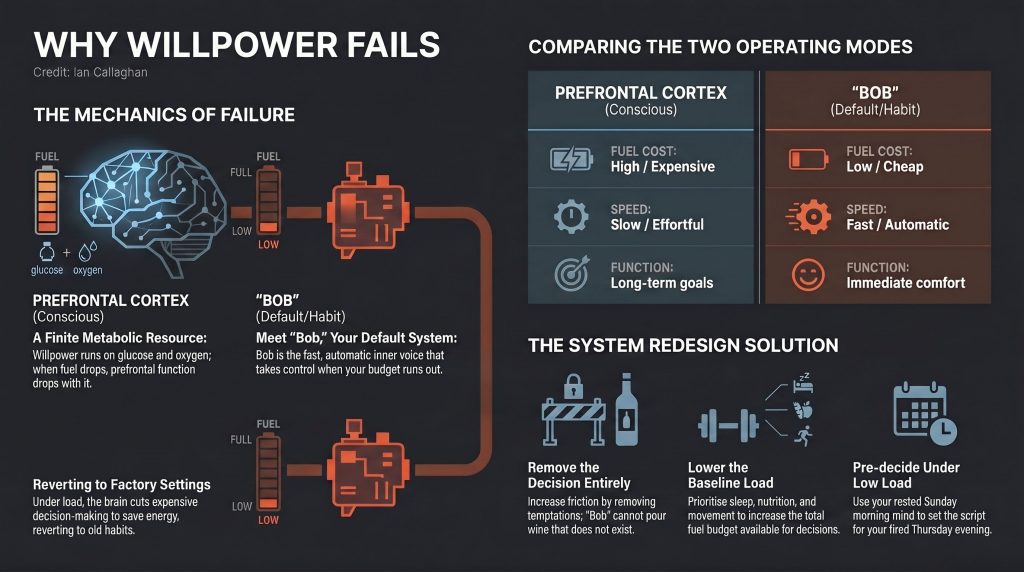
Why willpower fails is not a moral problem.
Why willpower fails. You set a goal on a Sunday night: new diet, no booze, gym four times a week, the whole reset. Monday, you nail it. Tuesday,y you nail it. Wednesday, you nail it. By Friday evening, the plan is a corpse on the kitchen floor, and you are eating something out of a foil tray with a glass of red in your hand, wondering what the hell happened to the version of you who made the plan.
The standard explanation: you weren’t motivated enough. You didn’t want it badly enough. You lacked discipline. You need to find your why.
All wrong. The reason why willpower fails.
Willpower is real. But it is a finite, depleting resource that runs on the same fuel as everything else your nervous system is trying to do. When the fuel runs out, the system reverts to its default state. That reversion is not a moral failure. It is mechanical. It is the system doing exactly what it was built to do.
This post explains why willpower-based approaches to behaviour change fail predictably, what is actually happening under the hood, and what works instead. Not motivation. Not affirmations. Not finding your why. System redesign.
What willpower actually is and why willpower fails.
Willpower is a metabolic process. The prefrontal cortex, the part of your brain that handles effortful decisions, planning, impulse control, and overriding short-term comfort for long-term outcomes, runs on glucose, oxygen, and a regulated nervous system. When any of those three drops, prefrontal function drops with it.
This is not theoretical. Research on ego depletion and decision fatigue has been around for decades. Roy Baumeister’s lab at Florida State has repeatedly demonstrated that exerting self-control on one task reduces the capacity for self-control on the next task. The original experiments used radishes and cookies. The mechanism applies to every effortful decision you make in a day.
Here is the IT systems analogy that actually maps to what is happening. Willpower is the equivalent of running every process in foreground mode. It works in the short term, but it consumes all the other bandwidth. The longer you run it that way, the closer the whole system gets to thrashing. Eventually, it crashes back to a low-power state.
The body has an obvious fail-safe for this. When fuel drops, when stress is high, when sleep is poor, when blood sugar is dysregulated, the system starts cutting things to stay alive. The first thing it cuts is effortful decision-making, because that is the most expensive process running. It hands the controls back to the older, faster, cheaper pathways. Habit. Default. Whatever you have always done in this situation before.
That is not a bug. It is a survival design. Your nervous system would rather you make a slightly suboptimal choice than burn through your last reserves trying to make the perfect one. The problem is that, in modern life, the slightly suboptimal choice is the second drink. Or the takeaway. Or the doomscroll. Or the missed gym session. Or the argument with your partner that you knew you could have walked away from.
You did not lose willpower because you are weak. You lost it because the budget ran out, and the system rebooted to factory settings.
The Emotional Observation Method, briefly
The framework that explains all of this properly is the Emotional Observation Method. EOM for short. EOM treats every destructive behaviour as the predictable output of a system under load. Not as a moral failing. Not as a personality flaw. Not as evidence that you are broken. As a mechanical consequence.
Under Load is the book that lays out EOM in full across seven parts and thirty-four chapters. The summary version follows here, focused on the willpower question.
EOM starts from a basic premise. A human being is a system. Like any system, it has a baseline state, a capacity, and a load. The baseline is what happens when nothing is asking anything of you. Capacity is how much load it can carry before something gives way. The load is everything currently drawing on your fuel reserves: stress, poor sleep, blood sugar dysregulation, emotional pressure, low-grade chronic fear, unresolved relationship friction, work demands, financial worry, the hundred small decisions you make each day that you do not even register.
Willpower draws from the same fuel reserve as all of those.
When the load exceeds capacity, the system starts cutting things. The expensive, effortful, prefrontal-cortex-driven processes go first. The cheap, automatic, limbic-system-driven processes take over. That is when the second drink happens. That is when the new habit collapses. That is when you do the thing you swore you would not do at 9 am.
The wanting is intact. You still want the change. The fuel is gone.
Meet Bob
EOM identifies several recurring constructs that govern how the system behaves under load. The most important one is Bob.
Bob is the inner voice. The part of you that runs default behaviours when the rest of you is offline. Not a trauma response. Not a wounded child. Not anything mystical. Just the cheap, fast, automatic version of you that takes the controls when the expensive, effortful, prefrontal version runs out of fuel.
Bob has a job. The job is to keep the system running on autopilot when conscious control is unavailable. He does this by reaching for whatever has worked before. Whatever delivered relief, dopamine, calm, distraction, comfort. He does not care whether the thing is good for you in the long term. He cares about now. About getting through the next ten minutes without expending fuel the system does not have to spare.
Bob is excellent at his job. The wine pours itself. The takeaway gets ordered. The phone is in your hand, and you are scrolling before you decide to do any of it. That is Bob. He is fast and efficient, operating below the threshold of conscious awareness. By the time you “decide” to do the thing, the decision has already been made. You are watching yourself execute it.
When your prefrontal cortex is fully fuelled and online, you can override Bob. You can notice the urge, pause, and choose differently. You can have the conversation. You can skip the wine. You can cook the proper meal.
When the fuel runs out and prefrontal function drops, Bob takes the controls without asking. Bob is not bad at his job. He is brilliant at it. The job just isn’t what adult life actually requires most of the time.
The fix is not silencing Bob. You cannot silence the inner voice. He is older than your conscious mind, and he has root access to the operating system. The fix is keeping the rest of the system fuelled enough that Bob does not get unsupervised access to the controls. That is most of what behaviour change actually is.
Why most advice fails
Now you can see why most behaviour-change advice predictably fails.
Most programmes assume willpower is renewable on demand. They assume you can “just decide” to do the difficult thing every day for the rest of your life. They assume motivation is a stable feature of your psychology rather than a metabolic state that varies with sleep, food, stress, and load. They are asking you to spend a finite resource forever and treating you as a failure when the resource runs out.
12-step programmes work for some people partly because the community substitutes for the depleted internal regulation. When you cannot self-regulate, the meeting regulates you. The sponsor regulates you. The fellowship regulates you. That is a partial fix that depends on attendance. Stop attending, and the regulation goes with it. This is why people relapse after years of sobriety, the moment life pulls them away from the rooms.
“More motivation” advice is even worse. It assumes the problem is upstream of willpower. It is not. Motivation, the felt sense of wanting to do the thing, is itself a metabolic state. You have plenty of it on a well-rested Tuesday morning. You have none of it on a stressed-out Thursday evening. Trying to manufacture motivation in a depleted system is asking the empty tank to refill itself.
The honest version is uncomfortable. Any sustainable change requires either reducing the load on the system so willpower lasts longer, or removing the need for willpower in the relevant decisions, or both. Trying to power through with willpower alone will fail. Not because you are weak. Because the maths do not work.
What works instead
System redesign over willpower expenditure. Five mechanisms that work without burning fuel:
1. Removing the decision entirely
If the wine is in the house, you have to use willpower not to drink it every time you walk past the kitchen. If the wine is not in the house, the decision is made once at the supermarket, and that’s it. The same logic applies to ultra-processed food, scrolling apps, and anything you reach for under load. Friction up. Defaults down. Bob cannot pour wine that does not exist.
2. Reducing the system load
Better sleep, regulated blood sugar, less chronic stress, fewer micro-decisions. Every reduction in baseline load increases the budget available for the decisions that genuinely require willpower. Most people are running on a depleted system, permanently, and then wonder why they have nothing left for the moments that matter. Sleep first. Food second. Movement third. Mind fourth. The four pillars of any reset that actually hold.
3. Pre-deciding under low load
The decision to skip the work drinks should be made on Sunday morning when you are rested and clear, not on Thursday evening when you are tired and your colleague is offering you a pint. By the time you are standing at the bar, the willpower budget is too low to make a good call. Under low load, future-you decides for tired-you. Tired, you execute the script.
4. Building automaticity
Repetition until the new behaviour becomes the default. Once a behaviour is automatic, it leaves the willpower budget entirely. Brushing your teeth at night does not draw on willpower. Going for a run on autopilot at 7 am does not draw on willpower. The investment is in the build phase. Six to twelve weeks of conscious effort, and then the system runs it for free. This is why people who have been sober for years stop white-knuckling it at some point. The new behaviour is now the default.
5. Working with the nervous system, not against it
Breath, cold exposure, movement, rest. These are not optional wellness extras. They are system maintenance. A regulated nervous system has more fuel available for everything else. A dysregulated nervous system runs on cortisol fumes and burns through willpower in hours.
This is what EOM is built around. Not “try harder.” Not “want it more.” System redesign that removes the load and reduces the need for willpower in the first place.
The honest limit
Willpower still has a place. It is the bridge across the worst moments. It is the override switch when the system is failing, and you need a few hours of conscious control to get to the other side. It is the thing that gets you to the meeting, makes the phone call, and gets you to walk past the off-licence on the worst day. It matters.
The mistake is treating it as the primary engine instead of the emergency lever.
An adult life run mostly on willpower is exhausting and unstable. You spend every day depleting yourself trying to override defaults that should not be running in the first place. Eventually, the system breaks down, and Bob takes the controls for a week, and you are back where you started, wondering what is wrong with you.
An adult life run on system design, with willpower as a backup, is sustainable. The defaults are correct. The load is managed. Bob still runs the things he is good at, like keeping you alive and breathing, but he does not get to make the decisions that require a fully fuelled prefrontal cortex.
That is what the work is. Not stronger willpower. Better system design.
Where to go next
The full framework is under load. Seven parts, thirty-four chapters. Why do human beings keep doing the things that are destroying them, and how can they take back control? The eBook includes AI Ian, a trained companion built on the full EOM framework. Read the full Under Load page →
If you want to apply EOM directly to your own situation in real time, book a 1:1 session →. Sessions are where the framework gets applied to your actual nervous system, your actual defaults, your actual load.
If you want a structured starting point before going deep, The 30 Day Reset is built around the four pillars (Eat, Sleep, Move, Mind) that reduce system load enough for behaviour change actually to stick. Browse the catalogue →
Frequently asked questions
Is willpower a real thing or a myth?
Willpower is real. The myth is that it is unlimited. It is a finite, depleting resource that runs on the same fuel as the rest of your nervous system. When you exert self-control on one decision, you have less available for the next one. This is not a personality trait. It is a metabolic process. The strongest-willed person on the planet runs out of willpower if you deplete their sleep, food, and regulated nervous system enough.
How much willpower do I have per day?
There is no fixed number. Willpower capacity varies day to day depending on sleep quality, blood sugar, stress levels, emotional load, and how well your nervous system is regulated. A well-rested person with stable blood sugar and a calm baseline has significantly more available willpower than the same person after a stressful week, poor sleep, and processed food. The question is not how to maximise willpower. The question is how to need less of it in the first place.
Why do I always slip up in the evenings?
Because that is when the willpower budget is lowest, you have spent the day making decisions, managing emotions, dealing with people, and navigating work pressure. By 7 pm, the prefrontal cortex is depleted, and Bob is running the show. Bob has the same 7 pm defaults he’s had your entire life: the wine, the takeaway, the scroll, the avoided conversation. Evenings are not your weakness. Evenings are when the system runs out of fuel and reverts to default. Fix the upstream load, and the evenings get easier almost automatically.
Does motivation help if willpower runs out?
Motivation is itself a metabolic state. It runs on the same fuel as willpower. You cannot manufacture motivation in a depleted system any more than you can manufacture willpower. This is why “find your why” advice fails so consistently. The why is intact. The fuel to act on the why is gone. What helps is reducing the load on the system so that motivation is available when you need it, rather than trying to grit your teeth through a depleted state and pretend you are inspired.
What is the Emotional Observation Method?
The Emotional Observation Method, EOM for short, is a framework that treats every destructive behaviour as the predictable output of a system under load. Not as a moral failing. Not as a personality flaw. As a mechanical consequence. EOM identifies the constructs that govern how the system behaves under load, including Bob (the part of you that runs default behaviours when the rest of you is offline), and provides a system redesign approach to behaviour change that does not depend on willpower as the primary engine. The full framework is in the book Under Load.
How do I stop relying on willpower for sobriety?
By redesigning the system so that willpower is not required for the daily decisions. Remove the alcohol from the house. Reduce the chronic stress that drives the craving. Improve sleep and blood sugar regulation. Build the new habits to automaticity over six to twelve weeks. Work with your nervous system through breath, movement, and cold exposure rather than fighting against it. Pre-decide on low-load days for high-load moments. Willpower remains the emergency lever for the worst nights, but it is no longer the engine driving every decision. Sustainable sobriety is a system design problem, not a willpower problem.
Ian Callaghan is a British Army veteran, NLP Master Practitioner, Reiki Master, and creator of the Emotional Observation Method. He spent 45 years drinking before stopping on the Winter Solstice 2024. Author of Under Load and the Uncovering Truths series. He works globally via video call and writes from Goytre, Monmouthshire.

Under Load by Ian Callaghan | The Mechanical Guide to Addiction Recovery
You already know what you’re doing. You’ve known for years.