Right, listen up. If you’re here, chances are you’re staring down the barrel of midlife and wondering why, despite all your efforts, you’re still getting in your own damn way. You’ve probably tried to change, to push through, to 'think positive' – and you’ve likely ended up exactly where you started: frustrated, stuck, and maybe even a bit pissed off. I get it. I’ve been there. For 45 years, I spent my life drinking, telling myself I couldn’t function without it, that it was my release. That, my friends, was a limiting belief, a deep-seated one, a self-sabotage mechanism of epic proportions.
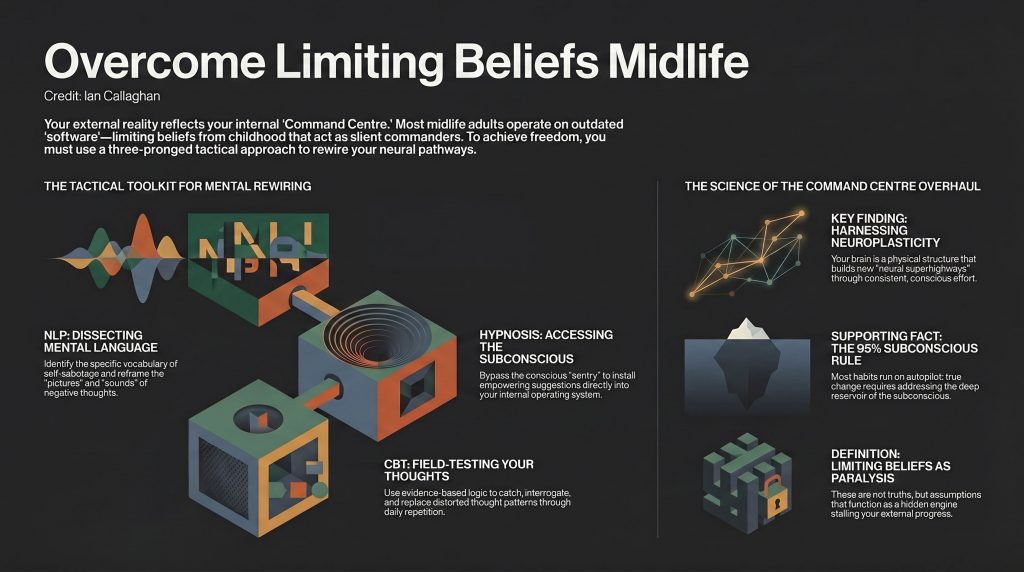
The truth is, your external world – your career, your relationships, your health, your bank balance – is a direct reflection of your internal world. Specifically, it’s a reflection of the bullshit stories you’ve been telling yourself since you were a kid. These are your limiting beliefs, the silent commanders dictating your every move. Want to truly overcome limiting beliefs midlife? You need a Command Centre overhaul. It’s time to stop screwing around with surface-level fixes and get to the core. It’s time to rewire your mind.
This isn't some fluffy self-help crap. This is about dismantling the mental blocks that keep you playing small. As an ex-military man who stared down the barrel of quitting booze after four and a half decades, and as a qualified coach in NLP, hypnosis, and CBT, I’m telling you, it’s possible. It’s brutal. It’s hard. But it’s the only way to get the life you actually deserve.
What Are Limiting Beliefs, Really, and Why Do They Hold You Hostage?
So, what exactly are these 'limiting beliefs' everyone bangs on about? Simply put, they’re assumptions you hold about yourself, about the world, and about others that restrict you in some way. They’re often deeply ingrained, unconscious patterns that you accept as undeniable truths, even when they’re a load of bollocks. They’re the voice in your head that whispers, "You’re not good enough," "You’ll always fail," "You don't deserve success," or "Change is too hard."
Think of it like this: when I was serving, if a soldier believed he couldn’t complete a mission, that belief alone was enough to paralyse him. It didn’t matter how fit he was, how well-trained, or how capable; if the belief was there, he was done for before he even started. The same goes for you. These beliefs are the hidden engine behind every external goal you struggle to hit. They dictate your choices, your reactions, and ultimately, your reality.
For me, it was the pervasive belief that alcohol was my friend, my crutch, my escape. "I need a drink to relax," "I deserve this," "It’s just what I do." These weren't conscious decisions anymore; they were deeply embedded programs, running in the background, subtly sabotaging every attempt I made to stop. Every time I tried to cut back, that inner critic, fuelled by those limiting beliefs, would kick in with justifications and rationalisations. That’s the insidious nature of them – they feel like your thoughts, your truth, making them incredibly difficult to challenge without the right tools.
The Command Centre: How Your Brain Got Wired (and How to Unwire It)
Your brain is the most powerful computer on the planet, but it’s only as good as its programming. And let’s be honest, most of us have been running on some pretty shoddy default software for decades. From childhood experiences, perceived failures, the words of well-meaning but misguided parents, teachers, or even shitty bosses – your subconscious mind has been meticulously collecting data and forming conclusions. These conclusions become your beliefs, and your beliefs become your reality. It’s a vicious cycle.
In the army, we learned to follow orders, to react, and to build habits. Some were vital for survival, others… well, some just became ingrained. Similarly, your brain has built neural pathways, superhighways of thought, around these limiting beliefs. The more you’ve thought about something, the stronger that pathway becomes. "I always mess things up" – boom, a neural superhighway. "I can’t speak in front of people" – another one. These aren’t just ideas; they’re physical structures in your brain, and they’re tough to reroute.
The good news? Your brain is neuroplastic. It can change. It can adapt. It can build new pathways and dismantle old, unhelpful ones. This isn't some woo-woo concept; it's hard science. But it takes conscious, consistent effort. You’ve got to become the commander of your own grey matter, not just a passenger. This is where tools like NLP, Hypnosis, and CBT come into play. They give you the instruction manual to reprogram your own Command Centre, to rewire your mind midlife for a future of your choosing, not one dictated by past programming.
NLP: The Language of Change – Dismantling the Mental Blocks
Neuro-Linguistic Programming, or NLP, isn't magic; it's a powerful set of tools that allows you to understand how your mind works and, more importantly, how to change it. It’s about the language you use (linguistic), the way your brain processes information (neuro), and the patterns you follow (programming). It’s about becoming acutely aware of the internal dialogue that shapes your world.
One of the first things you do with NLP is identify the specific limiting beliefs. They’re often couched in vague terms, like "I'm just not a confident person." NLP helps you unpack that. What specifically makes you feel unconfident? In what situations? What does that belief sound like in your head? What images do you associate with it? We dissect it, like a military operation, to understand its structure.
Then, we go about reframing it. If your belief is "I'm too old to start something new," we challenge that. Says who? What's the evidence? Who would you be if you didn't believe that? We use techniques like changing the submodalities – altering the 'picture' or 'sound' of the belief in your mind. Is that negative voice loud and close? Shrink it down, push it away, make it sound like a cartoon character. It sounds simple, but it’s incredibly effective at disrupting those entrenched neural pathways.
When I was fighting my own battle with drink, NLP was crucial. I had built up so many associations: stress equals drink, celebration equals drink, boredom equals drink. NLP helped me break those unconscious patterns. I learned to identify the triggers and consciously install new, healthier responses. It wasn't about willpower alone; it was about changing the internal programming that made those choices feel inevitable. It's about taking back control from those old, unconscious patterns.
Hypnosis: Going Deeper – Accessing the Subconscious
Forget the swinging pocket watches and stage acts. Clinical hypnotherapy is about accessing your subconscious mind – that vast reservoir of beliefs, habits, and memories that runs 95% of your life on autopilot. When you're in a hypnotic state, you're not asleep; you're deeply relaxed and highly focused, making your mind far more receptive to positive suggestions and new ways of thinking. This is where we can truly target those deep-seated limiting beliefs.
Your conscious mind is like the sentry at the gate, often filtering out new information that contradicts its established beliefs. But when that gate is relaxed through hypnosis, we can bypass the conscious filter and plant new, empowering suggestions directly into the subconscious. This isn't about control; it's about collaboration with your deepest mind to overcome limiting beliefs midlife that have been holding you back for decades.
For me, facing the prospect of life without alcohol after 45 years was terrifying. My subconscious had built up a fortress around the idea of drinking. Through hypnotherapy, I could address those fears directly at a deeper level. I could visualise a future where I was powerful and free, not reliant on a bottle. I could install new beliefs such as "My strength comes from within, not from a substance" and "I am capable of immense change." These weren't just thoughts; they were experienced as deep, internal truths.
This isn't a magic wand; it requires engagement and a genuine desire for change. But for shifting deeply entrenched patterns, for those times when you feel like there’s an invisible force pulling you back, hypnotherapy provides a direct line to your internal operating system. It helps you rewrite the outdated code that's been sabotaging your efforts, allowing you to rewire your mind midlife for sustained, profound transformation.
CBT: Actionable Steps – Challenging and Changing Thought Patterns
Cognitive Behavioural Therapy, or CBT, is the practical, hands-on, boots-on-the-ground approach to tackling your limiting beliefs. Where NLP gives you the understanding of your mental language and hypnosis goes deep, CBT gives you the actionable strategies to challenge distorted thinking patterns in your daily life. It’s about becoming your own mental drill sergeant, identifying and correcting your thought processes as they happen.
CBT operates on the principle that your thoughts, feelings, and behaviours are all interconnected. Change one, and you can change the others. So, if you have a limiting belief like, "I'm a failure," CBT helps you:
- Identify the specific thought: "I made a mistake at work, I’m such a failure."
- Challenge the thought: Is that truly a failure, or just a mistake? Have I failed at everything? What evidence do I have that I am a complete failure? What’s an alternative explanation for this mistake?
- Replace the thought: "I made a mistake, which is human. I can learn from this and do better next time. This doesn’t define my worth."
This takes discipline. It’s not a one-and-done exercise. It’s like physical training: you do the reps consistently until the new thought patterns become automatic. When I was in the thick of quitting booze, those old thoughts, those justifications, would creep back in. CBT gave me the tools to catch them red-handed, to interrogate them, and to replace them with more constructive narratives. It was vital for building resilience.
This isn't about positive affirmations that you don't believe in. It’s about logical, evidence-based self-talk. It’s about systematically dismantling the faulty logic of your limiting beliefs and building a robust, realistic, and empowering internal dialogue. It’s about ensuring that the conscious work you do with NLP and hypnosis is supported by daily mental hygiene, cementing those new neural pathways and helping you to truly overcome limiting beliefs midlife.
The Brutal Truth: Your Mind is Your Battlefield (and Your Ultimate Weapon)
Look, I’m not going to sugarcoat it. Changing deeply ingrained beliefs, particularly in midlife when those patterns are decades old, is not a gentle stroll in the park. It’s a battle. It requires courage, consistency, and a willingness to get uncomfortable. Your mind will resist. Your old patterns will fight back. That’s just the way it is. But here's the kicker: your mind is also your ultimate weapon, if you learn how to wield it.
This is the 'Mind' pillar of my coaching philosophy, and it underpins everything else. You can eat the best food, sleep like a baby, and move your body like a beast, but if your mind is still running on faulty software, you'll always find a way to sabotage your progress. You'll always hit that invisible ceiling.
My journey of quitting booze wasn’t just about putting down the bottle. It was about rewiring 45 years of identity and belief. It was about confronting the raw truth of who I was without that crutch and rebuilding from the ground up. It was brutal. Every single day, I had to challenge those limiting beliefs, those deep-seated 'truths' that had governed my life. I used NLP to dismantle the language, hypnosis to access the subconscious, and CBT for the daily grind of conscious thought correction.
The payoff? Freedom. Power. A life that isn't dictated by past programming. A Command Centre that actually works for you, not against you. If you’re serious about a midlife reset, if you’re tired of the same old results, then it's time to stop making excuses and start the hard work of truly transforming your mind. This isn't just about changing what you do; it’s about changing who you believe you are, so you can finally step into the powerful, capable person you were always meant to be. Get it in ya.
Ready to Take Command?
The tools are there. The roadmap is clear. Your midlife doesn't have to be a slow slide into mediocrity, dictated by old fears and limiting beliefs. It can be a powerful resurgence, a new beginning where you are the master of your own destiny.
It starts with acknowledging that the battle is within, and then equipping yourself with the strategies to win it. Don't let another year slip by with the same old excuses. It’s time to overcome limiting beliefs midlife and build the life you actually want. The time is now. Stop waiting for permission. Give yourself the order.
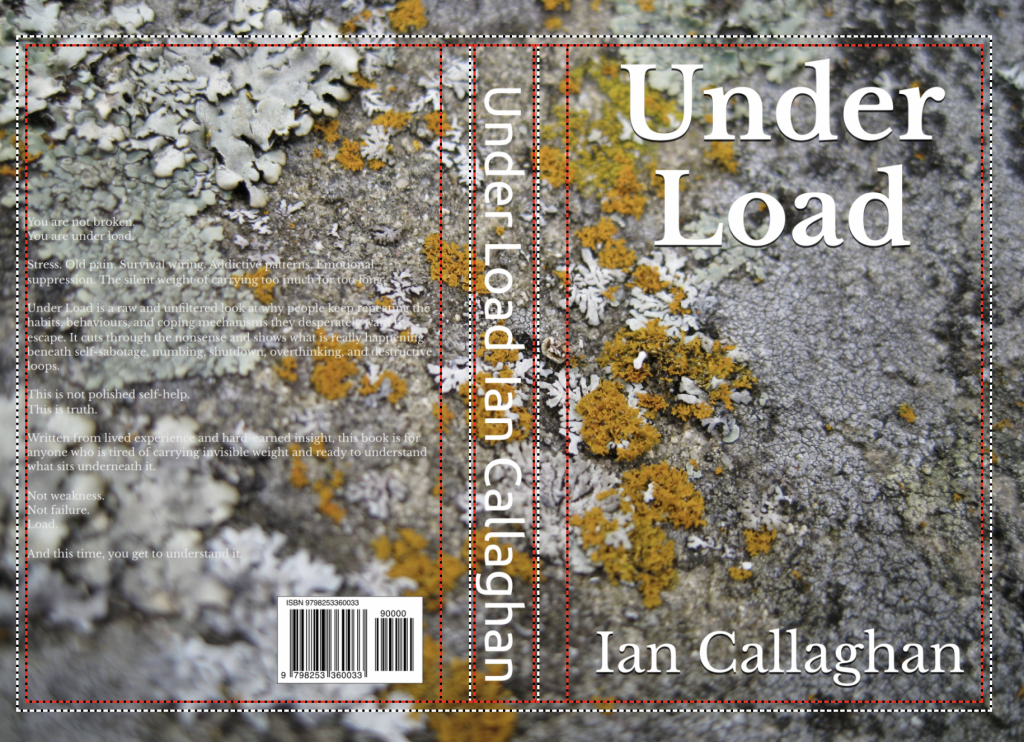
Under Load by Ian Callaghan | The Mechanical Guide to Addiction Recovery
You already know what you're doing. You've known for years.