Right, listen up. If you’re here, chances are you’re staring down the barrel of midlife and wondering why, despite all your efforts, you’re still getting in your own damn way. You’ve probably tried to change, to push through, to 'think positive' – and you’ve likely ended up exactly where you started: frustrated, stuck, and maybe even a bit pissed off. I get it. I’ve been there. For 45 years, I spent my life drinking, telling myself I couldn’t function without it, that it was my release. That, my friends, was a limiting belief, a deep-seated one, a self-sabotage mechanism of epic proportions.
The truth is, your external world – your career, your relationships, your health, your bank balance – is a direct reflection of your internal world. Specifically, it’s a reflection of the bullshit stories you’ve been telling yourself since you were a kid. These are your limiting beliefs, the silent commanders dictating your every move. Want to truly overcome limiting beliefs midlife? You need a Command Centre overhaul. It’s time to stop screwing around with surface-level fixes and get to the core. It’s time to rewire your mind.
This isn't some fluffy self-help crap. This is about dismantling the mental blocks that keep you playing small. As an ex-military man who stared down the barrel of quitting booze after four and a half decades, and as a qualified coach in NLP, hypnosis, and CBT, I’m telling you, it’s possible. It’s brutal. It’s hard. But it’s the only way to get the life you actually deserve.
What Are Limiting Beliefs, Really, and Why Do They Hold You Hostage?
So, what exactly are these 'limiting beliefs' everyone bangs on about? Simply put, they’re assumptions you hold about yourself, about the world, and about others that restrict you in some way. They’re often deeply ingrained, unconscious patterns that you accept as undeniable truths, even when they’re a load of bollocks. They’re the voice in your head that whispers, "You’re not good enough," "You’ll always fail," "You don't deserve success," or "Change is too hard."
Think of it like this: when I was serving, if a soldier believed he couldn’t complete a mission, that belief alone was enough to paralyse him. It didn’t matter how fit he was, how well-trained, or how capable; if the belief was there, he was done for before he even started. The same goes for you. These beliefs are the hidden engine behind every external goal you struggle to hit. They dictate your choices, your reactions, and ultimately, your reality.
For me, it was the pervasive belief that alcohol was my friend, my crutch, my escape. "I need a drink to relax," "I deserve this," "It’s just what I do." These weren't conscious decisions anymore; they were deeply embedded programs, running in the background, subtly sabotaging every attempt I made to stop. Every time I tried to cut back, that inner critic, fuelled by those limiting beliefs, would kick in with justifications and rationalisations. That’s the insidious nature of them – they feel like your thoughts, your truth, making them incredibly difficult to challenge without the right tools.
The Command Centre: How Your Brain Got Wired (and How to Unwire It)
Your brain is the most powerful computer on the planet, but it’s only as good as its programming. And let’s be honest, most of us have been running on some pretty shoddy default software for decades. From childhood experiences, perceived failures, the words of well-meaning but misguided parents, teachers, or even shitty bosses – your subconscious mind has been meticulously collecting data and forming conclusions. These conclusions become your beliefs, and your beliefs become your reality. It’s a vicious cycle.
In the army, we learned to follow orders, to react, and to build habits. Some were vital for survival, others… well, some just became ingrained. Similarly, your brain has built neural pathways, superhighways of thought, around these limiting beliefs. The more you’ve thought about something, the stronger that pathway becomes. "I always mess things up" – boom, a neural superhighway. "I can’t speak in front of people" – another one. These aren’t just ideas; they’re physical structures in your brain, and they’re tough to reroute.
The good news? Your brain is neuroplastic. It can change. It can adapt. It can build new pathways and dismantle old, unhelpful ones. This isn't some woo-woo concept; it's hard science. But it takes conscious, consistent effort. You’ve got to become the commander of your own grey matter, not just a passenger. This is where tools like NLP, Hypnosis, and CBT come into play. They give you the instruction manual to reprogram your own Command Centre, to rewire your mind midlife for a future of your choosing, not one dictated by past programming.
NLP: The Language of Change – Dismantling the Mental Blocks
Neuro-Linguistic Programming, or NLP, isn't magic; it's a powerful set of tools that allows you to understand how your mind works and, more importantly, how to change it. It’s about the language you use (linguistic), the way your brain processes information (neuro), and the patterns you follow (programming). It’s about becoming acutely aware of the internal dialogue that shapes your world.
One of the first things you do with NLP is identify the specific limiting beliefs. They’re often couched in vague terms, like "I'm just not a confident person." NLP helps you unpack that. What specifically makes you feel unconfident? In what situations? What does that belief sound like in your head? What images do you associate with it? We dissect it, like a military operation, to understand its structure.
Then, we go about reframing it. If your belief is "I'm too old to start something new," we challenge that. Says who? What's the evidence? Who would you be if you didn't believe that? We use techniques like changing the submodalities – altering the 'picture' or 'sound' of the belief in your mind. Is that negative voice loud and close? Shrink it down, push it away, make it sound like a cartoon character. It sounds simple, but it’s incredibly effective at disrupting those entrenched neural pathways.
When I was fighting my own battle with drink, NLP was crucial. I had built up so many associations: stress equals drink, celebration equals drink, boredom equals drink. NLP helped me break those unconscious patterns. I learned to identify the triggers and consciously install new, healthier responses. It wasn't about willpower alone; it was about changing the internal programming that made those choices feel inevitable. It's about taking back control from those old, unconscious patterns.
Hypnosis: Going Deeper – Accessing the Subconscious
Forget the swinging pocket watches and stage acts. Clinical hypnotherapy is about accessing your subconscious mind – that vast reservoir of beliefs, habits, and memories that runs 95% of your life on autopilot. When you're in a hypnotic state, you're not asleep; you're deeply relaxed and highly focused, making your mind far more receptive to positive suggestions and new ways of thinking. This is where we can truly target those deep-seated limiting beliefs.
Your conscious mind is like the sentry at the gate, often filtering out new information that contradicts its established beliefs. But when that gate is relaxed through hypnosis, we can bypass the conscious filter and plant new, empowering suggestions directly into the subconscious. This isn't about control; it's about collaboration with your deepest mind to overcome limiting beliefs midlife that have been holding you back for decades.
For me, facing the prospect of life without alcohol after 45 years was terrifying. My subconscious had built up a fortress around the idea of drinking. Through hypnotherapy, I could address those fears directly at a deeper level. I could visualise a future where I was powerful and free, not reliant on a bottle. I could install new beliefs such as "My strength comes from within, not from a substance" and "I am capable of immense change." These weren't just thoughts; they were experienced as deep, internal truths.
This isn't a magic wand; it requires engagement and a genuine desire for change. But for shifting deeply entrenched patterns, for those times when you feel like there’s an invisible force pulling you back, hypnotherapy provides a direct line to your internal operating system. It helps you rewrite the outdated code that's been sabotaging your efforts, allowing you to rewire your mind midlife for sustained, profound transformation.
CBT: Actionable Steps – Challenging and Changing Thought Patterns
Cognitive Behavioural Therapy, or CBT, is the practical, hands-on, boots-on-the-ground approach to tackling your limiting beliefs. Where NLP gives you the understanding of your mental language and hypnosis goes deep, CBT gives you the actionable strategies to challenge distorted thinking patterns in your daily life. It’s about becoming your own mental drill sergeant, identifying and correcting your thought processes as they happen.
CBT operates on the principle that your thoughts, feelings, and behaviours are all interconnected. Change one, and you can change the others. So, if you have a limiting belief like, "I'm a failure," CBT helps you:
Identify the specific thought: "I made a mistake at work, I’m such a failure."
Challenge the thought:Is that truly a failure, or just a mistake? Have I failed at everything? What evidence do I have that I am a complete failure? What’s an alternative explanation for this mistake?
Replace the thought: "I made a mistake, which is human. I can learn from this and do better next time. This doesn’t define my worth."
This takes discipline. It’s not a one-and-done exercise. It’s like physical training: you do the reps consistently until the new thought patterns become automatic. When I was in the thick of quitting booze, those old thoughts, those justifications, would creep back in. CBT gave me the tools to catch them red-handed, to interrogate them, and to replace them with more constructive narratives. It was vital for building resilience.
This isn't about positive affirmations that you don't believe in. It’s about logical, evidence-based self-talk. It’s about systematically dismantling the faulty logic of your limiting beliefs and building a robust, realistic, and empowering internal dialogue. It’s about ensuring that the conscious work you do with NLP and hypnosis is supported by daily mental hygiene, cementing those new neural pathways and helping you to truly overcome limiting beliefs midlife.
The Brutal Truth: Your Mind is Your Battlefield (and Your Ultimate Weapon)
Look, I’m not going to sugarcoat it. Changing deeply ingrained beliefs, particularly in midlife when those patterns are decades old, is not a gentle stroll in the park. It’s a battle. It requires courage, consistency, and a willingness to get uncomfortable. Your mind will resist. Your old patterns will fight back. That’s just the way it is. But here's the kicker: your mind is also your ultimate weapon, if you learn how to wield it.
This is the 'Mind' pillar of my coaching philosophy, and it underpins everything else. You can eat the best food, sleep like a baby, and move your body like a beast, but if your mind is still running on faulty software, you'll always find a way to sabotage your progress. You'll always hit that invisible ceiling.
My journey of quitting booze wasn’t just about putting down the bottle. It was about rewiring 45 years of identity and belief. It was about confronting the raw truth of who I was without that crutch and rebuilding from the ground up. It was brutal. Every single day, I had to challenge those limiting beliefs, those deep-seated 'truths' that had governed my life. I used NLP to dismantle the language, hypnosis to access the subconscious, and CBT for the daily grind of conscious thought correction.
The payoff? Freedom. Power. A life that isn't dictated by past programming. A Command Centre that actually works for you, not against you. If you’re serious about a midlife reset, if you’re tired of the same old results, then it's time to stop making excuses and start the hard work of truly transforming your mind. This isn't just about changing what you do; it’s about changing who you believe you are, so you can finally step into the powerful, capable person you were always meant to be. Get it in ya.
Ready to Take Command?
The tools are there. The roadmap is clear. Your midlife doesn't have to be a slow slide into mediocrity, dictated by old fears and limiting beliefs. It can be a powerful resurgence, a new beginning where you are the master of your own destiny.
It starts with acknowledging that the battle is within, and then equipping yourself with the strategies to win it. Don't let another year slip by with the same old excuses. It’s time to overcome limiting beliefs midlife and build the life you actually want. The time is now. Stop waiting for permission. Give yourself the order.
If your husband is having a midlife crisis, you are probably watching something you cannot name, cannot reach, and cannot fix for him. This post explains what is actually happening, from someone who has been on the other side of it.
I was that partner.
I am 58. I spent 12 years in the British Army and 25 years as an IT Technical Architect. For 45 years, I drank. I went quiet in ways I couldn't explain and couldn't stop. I performed a version of myself that was functional enough to keep everything running while something underneath it was grinding in a way I had no language for. I was not having an affair. I was not buying a Porsche. I was not doing anything dramatic. I was just slowly becoming less present, less accessible, and more dependent on the bottle to regulate whatever the noise was that I couldn't name.
On the winter solstice of 202,4 I quit drinking. In the months that followed, I lost over 5 stone, reversed a pre-diabetes diagnosis, rebuilt my sleep, and started understanding the machine I had been running for nearly five decades. I now work full-time as a coach and author, with over 10,000 people in the Sober Beyond Limits Facebook community and 520 in the free Midlife Reset Skool community doing this work.
I am writing this post for the person on the other side of that husband. The one watching something happen and not knowing what they are looking at. The one who has tried talking, tried patience, tried distance, tried everything, and is still no closer to understanding what is going on inside the person they thought they knew.
This is what was actually happening from inside the machine.
First: This Is Not About Him Falling Apart
The instinct when you are watching your husband withdraw, drink more, rage at small things, or go flat and unreachable is to interpret it as a relationship problem. As something you did or didn't do. As evidence that he has checked out, that the marriage is over, or that he is simply a different person than the one you married.
Some of those things may eventually be true. But they are not what is happening first.
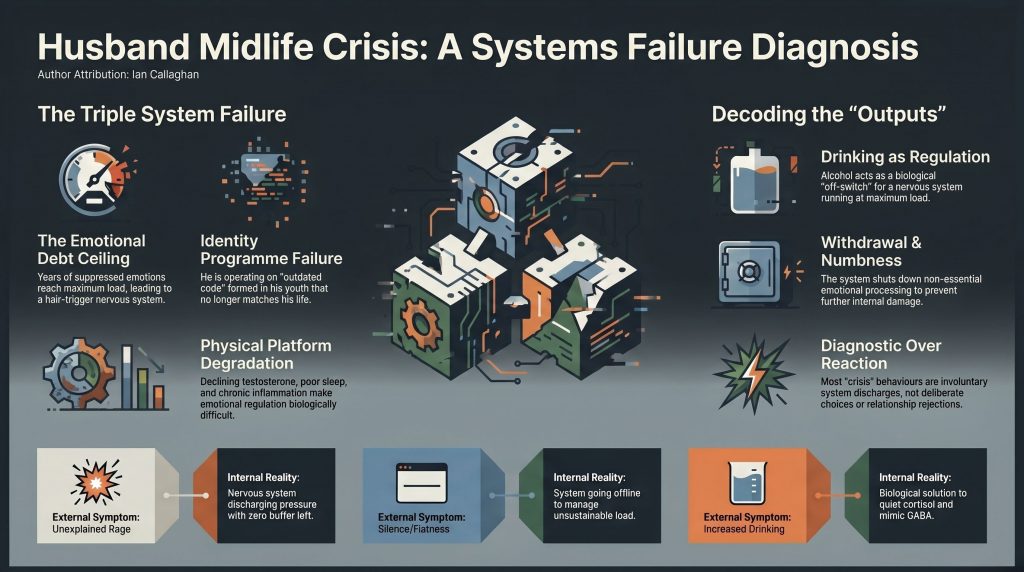
What is happening first is a system's failure. Three specific failures that have been building for years, probably decades, and have now reached a point where the system can no longer compensate. He is not choosing to be this way. He almost certainly cannot explain what is happening because he lacks the language for it, and the system that would generate that language is the same one currently under maximum load.
Understanding what is actually breaking down does not mean excusing the behaviour. It means diagnosing it correctly. Because you cannot respond usefully to something you are misreading. And most of the standard advice for partners of men in a midlife crisis is built on a misreading of the mechanism.
If you are not sure whether what you are experiencing is burnout, a midlife crisis, or something else entirely, the Midlife Reset vs Burnout diagnostic guide is worth reading. The distinction matters because the right response to each is different, and the wrong response to either makes things significantly worse.
What a Midlife Crisis Actually Is in a Man's Body and Mind
The cliche version is a man buying a sports car and leaving his wife for someone younger. That version exists. It is also the end stage of a process that started years earlier and went unaddressed.
You are more likely to watch the early or middle stage. The stage where the system is under unsustainable load and is doing whatever it can to regulate, but has not yet produced the dramatic event that would make the crisis legible to the outside world.
A midlife crisis, at its core, is the convergence of three specific system failures. The emotional debt ceiling is where years of suppressed nervous system activation reach maximum load. The identity programme failure, where the operating system built in his teens and twenties no longer matches the life he is living. And the physical platform degradation, where hormonal shifts, sleep deterioration, chronic inflammation, and often alcohol compound the first two failures until the whole system starts producing symptoms he cannot explain, and you cannot reach.
It is not a mood. It is not a phase. It is not about you. It is a machine that has been running at an unsustainable load for longer than it can sustain, and is now showing you the diagnostic data whether either of you wants to see it or not.
Why He Cannot Explain It to You
This is the part that is hardest to sit with.
He is not deliberately keeping things from you. He is not being evasive as a strategy. He genuinely does not have access to what is happening at the level it is happening.
Men experiencing a midlife systems failure rarely have the emotional vocabulary to describe what is occurring in their nervous systems. They have spent years, often decades, operating an emotional strategy built around suppression and performance. Push it down. Push through. Keep functioning. That strategy works until it doesn't, and when it stops working, the person running it often has no framework for what is happening because the framework was never built.
What he can feel is the outputs. The irritability. The flatness. The sense that something is wrong without a clear target for what it is. The drinking that used to be social has become regulatory, without a clear decision. The withdrawal that feels to him like needing space, but looks to you like disappearing.
When men don't have the language for what they are experiencing, they reach for what feels safer. Numbers. Data. Biohacks. Supplements. The gym. Or the bottle. These are not random. They are the system attempting to regulate without the tools to understand what it is regulating against.
The gap between knowing and doing is not a willpower gap. It is an operating system gap. He probably knows on some level that the drinking is too much, that the withdrawal is damaging things, that something needs to change. Knowing it and being able to act on it are two completely different things when the system acting is the same one under maximum load.
Why Is He Drinking More?
This is the question I get most often from partners. Not why is he unhappy. Not why is he distant? Why is he drinking more?
The answer is biological before it is behavioural.
Alcohol is one of the most effective short-term nervous system regulators available without a prescription. It crosses the blood-brain barrier in minutes. It mimics GABA, the primary inhibitory neurotransmitter. It reduces cortisol. It quiets the noise. For a nervous system running at maximum load with no other available regulation mechanism, alcohol is not a choice. It is a solution. An expensive, self-defeating, progressively damaging solution, but a solution that works reliably in the short term every single time.
When you watch your husband pour a drink the moment he gets home, or notice that the glasses have got bigger, or find yourself counting bottles, what you are watching is a machine using the only off-switch it knows how to reach for. The connection between the vagus nerve and mental health explains why this happens at the biological level. His cravings are not a character flaw. They are a nervous system problem.
What actually happens when a midlife drinker quits is not what most people expect and is worth understanding, regardless of where he currently is with alcohol. Because understanding the function of drinking is the first step toward understanding what needs to replace it, removing the off-switch without replacing it leaves the system hunting for relief, which is why cold turkey without support so often leads back to the same place.
The Three Systems That Are Failing
The Emotional Debt Ceiling
Most men who reach the midlife collision point have spent 20 to 30 years operating a specific emotional strategy: suppress, perform, push through.
The army runs on it. High-pressure careers run on it. Traditional masculinity runs on it. It is an effective short-term survival mechanism in any environment that punishes emotional expression or rewards endurance over honesty.
The problem is that suppression is not resolution. Every time an emotional activation gets pushed down rather than processed, the stored charge accumulates in the nervous system. By midlife, most men are running a nervous system at maximum load. Hair-trigger reactivity. Chronic low-level anxiety. Emotional numbness. Or all three simultaneously.
The rage that arrives too fast at too small a provocation is not him being a bad person. It is a nervous system discharging pressure it has nowhere else to put. The flatness is not him not caring. It is emotional numbness, the system shutting down non-essential processing under unsustainable load. The withdrawal is not a rejection. It is the machine going offline to prevent further damage.
None of this is a justification for behaviour that hurts you. It is a diagnosis of the mechanism producing the behaviour. You cannot address the behaviour effectively without understanding the mechanism.
The Identity Programme Running on Outdated Code
The identity most men operate from in midlife was formed in their teens and twenties. The core beliefs about what they are worth, what they are capable of, what is expected of them, and what they are allowed to want were encoded during a period of maximum vulnerability and minimum agency.
Every career choice, every relationship dynamic, every way of showing up in the world since then has been filtered through that operating system. And the midlife collision happens when the life that the programme built no longer matches the life he actually wants, and he does not yet have the tools to rewrite the code.
This is why the standard midlife-crisis advice of "talk to him, tell him how you feel, ask him what he wants" often yields so little. He cannot clearly access what he wants because the programme running his identity filters every honest answer through decades of conditioning about what he is allowed to want. The question lands. The system searches for an answer. And what comes back is either the performance version or nothing at all.
The Physical Platform Degrading Under the Software
Testosterone declines from around 35 onwards, gradually but consistently. Sleep architecture deteriorates with age, particularly the deep sleep phases most critical for hormonal regulation and emotional processing. Chronic inflammation rises, driven by years of stress, poor nutrition, inadequate recovery, and, in many cases,s alcohol. The physical platform on which the emotional and cognitive systems run is under increasing load.
When the hardware degrades, the software runs worse. Reactivity increases. Decision-making fragments. Emotional regulation becomes less reliable. The midlife metabolism is not just slowing down on its own. It is responding to inputs. And the inputs most midlife men are running, high stress, inadequate sleep, alcohol as a regulator, and poor nutrition, are precisely the inputs that accelerate the degradation.
The HRV data tells this story clearly if anyone takes the time to look at it. Heart rate variability is one of the most reliable markers of nervous system health and cardiovascular resilience. Most men in midlife have never heard of it. Most GPs have never mentioned it. But it is the number that objectively shows you what state the machine is actually in.
What His Behaviour Is Actually Communicating
The withdrawal is not: I don't want to be here. I don't have enough capacity to be present, and I'm not sure why.
The rage is not "I am angry at you." It is: My nervous system has no buffer left,t and the smallest additional load is causing a discharge.
The drinking is not: I prefer alcohol to you. This is the only regulation mechanism I know how to reach for, and I need it to function.
The flatness is not: I have stopped caring. It is: The system has shut down non-essential emotional processing to manage the load.
The silence is not: I have nothing to say to you. I don't have the language for what is happening, so I am running the only strategy I know: going quiet and pushing through.
None of this makes it easier to live with. All of it matters for how you respond.
What Doesn't Help (And Why You're Probably Doing It)
Asking him to talk about his feelings when his system is at maximum load is like asking someone to explain a car crash while they're still in it. The request is reasonable. The timing makes it impossible.
Issuing ultimatums before he has any framework for what is happening produces compliance or escalation, neither of which addresses the underlying system failures. He might stop drinking for two weeks to demonstrate he doesn't have a problem. He might double down in reaction to feeling controlled. Neither is change.
Researching his problem and presenting him with solutions is experienced as an attack on his competence, even if that's the last thing you intend. Men in midlife, with system failure, are already running a background programme of inadequacy. Evidence that you have diagnosed them more accurately than they have diagnosed themselves does land badly, regardless of how gently it's delivered.
Taking it personally in a way that produces either withdrawal or escalation on your part adds to the load on a system that is already at capacity. His behaviour is about his system. Your responses to his behaviour are legitimate. But responding from your own flooded state to his flooded state produces more heat than light.
What tends to help is making changes in the environment rather than confronting behaviour—reducing the amount of alcohol available in the house without making a statement, eating better food together without announcing a programme, and getting outside and moving without framing it as an intervention. Small structural changes that reduce the load on the system without requiring him to acknowledge that the system is failing.
What Actually Helps
The most useful thing a partner can do is understand the mechanism clearly enough to stop personalising the outputs.
That does not mean accepting everything. It means responding to what is actually happening rather than what it looks like from the outside.
It also means understanding that he needs to do this work himself. You cannot do it for him. You can create conditions that make it more or less likely he will find his way to it. You can remove friction. You can reduce the load where you can. You can stop adding confrontations that push him further into a defensive shutdown. But the work of understanding and servicing the machine is his work, not yours.
If he is open to it, the free seven-day field guide I Know What To Do, So Why Don't I Do It? is the lowest-friction starting point I know. It does not require him to identify as someone with a problem. It does not require him to sit in a room and explain his history to a stranger. It requires seven days of honest observation of his own patterns. 301 people downloaded it in the first six days it was available. The open rate is 68.46%. It works because it describes exactly what is happening without asking him to perform insight he does not yet have.
The Midlife Reset for Men post explains the three-layer repair protocol in detail. It is written for him, not about him. If you share it, share it without commentary. Put it somewhere he can find it without feeling like he is being managed.
The free Midlife Reset Skool community is where people at every stage of this work gather. 520 members. No labels. No recovery theatre. No requirement to have it figured out before you show up.
What You Need, Regardless of What He Does
This is the part that gets missed in almost every article written for men's partners in midlife crisis. All of the focus goes on him. What he is going through. What he needs. How to support him. How to be patient.
You are also in this.
Watching someone you love disappear into something you cannot name or reach is its own particular kind of load. There is uncertainty about whether this is temporary or permanent. The erosion of intimacy. The loneliness of being in a relationship where the other person is physically present and emotionally somewhere else. The anger at being managed out of your own feelings because his feelings are the crisis. The grief for the version of the relationship that existed before whatever this is.
Those things are real, and they deserve attention that has nothing to do with how he is doing.
You do not have to wait for him to start the work before you start yours. Understanding the mechanism of what is happening, as this post is trying to help you do, is the beginning of that. So is making sure your own load is being managed, your own support is in place, and your own sense of what you need from this relationship is being held clearly, not buried under the weight of his crisis.
The Sober Beyond Limits community has over 10,000 members, and a significant proportion of them are partners, not people in crisis themselves. They are there because they needed somewhere to make sense of what they were watching. That is a legitimate reason to show up.
FAQ
What are the signs my husband is having a midlife crisis?
The real signs are rarely dramatic. Look for drinking that has shifted from social to regulatory, sleep that is deteriorating, irritability arriving faster and at smaller provocations than it used to, emotional withdrawal that feels different from normal introversion, a flatness in motivation or enthusiasm that was not there before, and a sense that he is going through the motions of his life rather than living it. The dramatic events, the affair, the impulsive career change, the expensive purchase, are usually what happens after these quieter signals have gone unaddressed for years.
Why does my husband seem angry and withdrawn?
The anger and withdrawal are outputs of a nervous system at maximum load, not choices. After years of emotional suppression, the system has no buffer left. Small additional loads produce disproportionate reactions. The withdrawal is the machine attempting to go offline to prevent further damage. Neither the anger nor the withdrawal is specifically directed at you, even when it lands that way. Understanding the mechanism does not make it easier to be on the receiving end of. It does make it possible to respond to what is actually happening rather than what it looks like from the outside.
Why is my husband drinking more?
Alcohol is one of the most effective short-term nervous system regulators available. For a nervous system running at maximum load with no other available regulation mechanism, it is not a choice. It is a solution that works reliably in the short term every time. The drinking has probably shifted from social or celebratory to regulatory without a clear decision being made. That shift is one of the earliest diagnostic signals of a system under unsustainable load.
Should I leave my husband during his midlife crisis?
That is a decision only you can make, and it depends entirely on specifics that no general post can account for. What this post can offer is this: the decision is clearer when made from understanding the mechanism rather than from the acute experience of watching it. If the behaviour is abusive, that changes the calculation entirely,y and safety comes first. If the behaviour is painful but not abusive, understanding what is actually happening gives you better information for the decision than the standard crisis narrative does.
How long does a man's midlife crisis last?
It lasts as long as the underlying system failures go unaddressed. For men who take the destructive path of seeking external solutions to internal failures, the cycle tends to continue because nothing structural has changed. For men who take the diagnostic path and do the actual work on the three system failures, the hardware changes are noticeable in the first weeks, the software changes compound over the first months, and the identity-level update takes 12 to 18 months to produce substantial change. Those are honest timelines, not motivational ones.
How do I help my husband through a midlife crisis?
The most useful help is understanding the mechanism clearly enough to stop personalising the outputs and to reduce the load on the system where you can, without requiring him to acknowledge that the system is failing. Small environmental changes, less available alcohol, better food, more time outside, and less confrontation during peak load times create conditions that make the work more possible without him having to announce he is doing it. If he is open to it, the free seven-day guide at iancallaghan.co.uk/i-know-what-to-do-so-why-dont-i-do-it is the lowest-friction starting point available.
Can a midlife crisis destroy a marriage?
Yes. Particularly when the mechanism goes undiagnosed, and both partners respond to the outputs without understanding the cause. The destructive path, in which the man seeks external solutions to internal failures, often causes serious, sometimes irreparable, damage to the relationship. The diagnostic path, where the underlying system failures are actually addressed, frequently produces relationships that are more honest and more genuinely connected than they were before the crisis forced the reckoning. The outcome depends almost entirely on whether the mechanism gets diagnosed or whether everyone keeps responding to the symptoms.
What should I do if my husband won't talk about it?
Stop trying to make him talk about it in the way you need him to. He cannot access what you are asking for because the system that would generate honest emotional language is the same system that is under maximum load. What he can do is read something that describes his experience more accurately than he can describe it himself. The Midlife Reset for Men post and the midlife crisis post are both written for him, not about him. Leave them somewhere accessible without commentary. The seven-day guide at iancallaghan.co.uk/i-know-what-to-do-so-why-dont-i-do-it requires observation, not conversation. That is an easier door for most men to walk through.
Ian Callaghan is a British Army veteran, former IT Technical Architect, NLP Master Practitioner, Reiki Master, and full-time coach and author. He reversed pre-diabetes, lost 5 stone, and quit drinking at 57 after 45 years. He was the husband described in this post. He works with midlife people who are done performing a version of themselves that no longer fits. All books and digital products are at iancallaghan.co.uk/the-shop. Join the free Midlife Reset Skool community at skool.com/iancallaghan.
I am 58. I spent 12 years in the British Army and 25 years as an IT Technical Architect. I quit drinking after 45 years on the winter solstice of 2024. In the months that followed, I lost over 5 stone, reversed a pre-diabetes diagnosis, and watched my HRV data tell a story my GP had never thought to look for. I am an NLP Master Practitioner, a Reiki Master, and a qualified chef, and I now work full-time as a coach and author. I did not go through a mid life crisis. I went through a mid life systems failure. There is a difference, and understanding it is the key to blowing up your life rather than actually fixing it.
The cliché version of the midlife crisis is a man buying a Porsche and leaving his wife for someone half his age. It is used as a punchline. The problem is that the punchline is getting in the way of a genuine diagnosis for millions of people, men and women, who are quietly falling apart in ways that don't make for a good joke.
Over 10,000 people have joined the Sober Beyond Limits Facebook community, and 520 are inside the Midlife Reset Skool community doing this work in real time. What I hear from them is not the cliche. What I hear is the grinding—the flatness. The drinking crept up without anyone noticing. The rage that arrives too fast at too small a provocation. The sense of performing a version of yourself that no longer fits, while having no clear idea who the real version actually is.
That is not a crisis. That is a systems failure. And systems failures have a diagnosis.
What a Mid Life Crisis Actually Is (And What It Isn't)
The term mid life crisis was coined in 1965 by psychoanalyst Elliott Jacques to describe a shift in how people relate to time and mortality in their middle years. It was a genuine, serious psychological observation about a real transition. What happened to it, culturally, was that it was reduced to a punchline about expensive cars and poor decisions.
The punchline is doing real damage. Because when people are genuinely struggling at 40, 45, 50, 55, they dismiss what they are feeling as either the cliche they don't want to identify with or as something shameful and personal that they should be able to manage alone.
Neither of those responses is useful. Both of them delay the diagnosis.
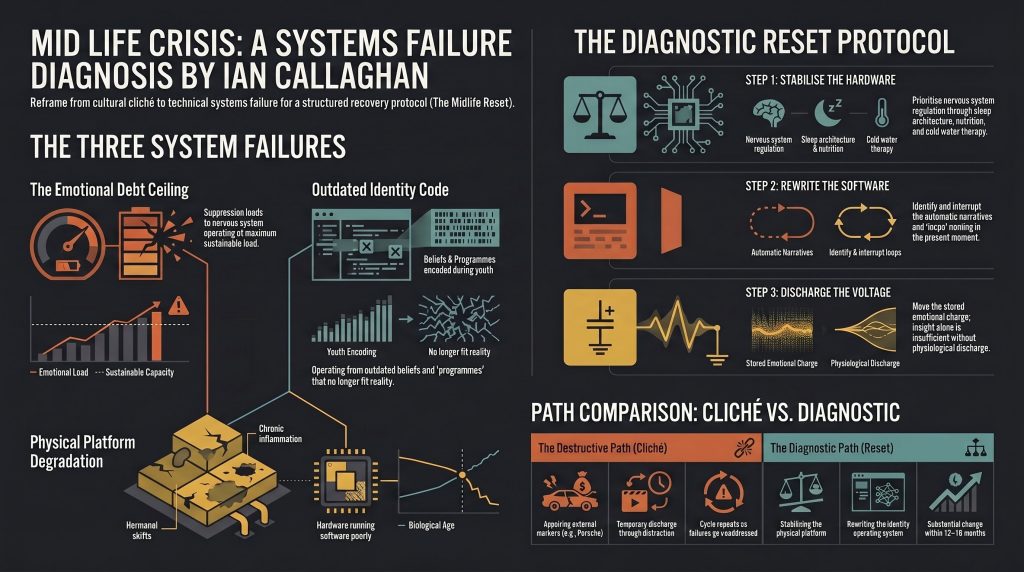
A mid life crisis, properly understood, is what happens when three specific system failures that have been building for years reach critical load at roughly the same time. It is not a character flaw. It is not a weakness. It is not inevitable. It is a convergence of biological, psychological, and identity-level pressures that most people are completely unprepared for because nobody explained the mechanism.
If you are not sure whether what you are experiencing is burnout or something more systemic, the Midlife Reset vs Burnout diagnostic guide will help you locate where you actually are. Treating a reset with rest causes depression. Treating burnout with action causes collapse. The diagnosis matters.
At what age does a Mid Life Crisis Hit?
The data and the lived experience both suggest a range rather than a fixed age. Most people land somewhere between 38 and 58, with the 45-55 window being the densest concentration. But the trigger is not the birthday. The trigger is the convergence.
The three system failures described below take years to build. They can converge at 38 for someone who started carrying a load early. They can converge at 58 for someone whose system has been compensating effectively for longer than most. Age is a rough guide, not a definition.
What tends to mark the convergence is a specific feeling. The sense that something that used to work is no longer working. The automatic motivation has gone quiet. The reliable coping mechanisms are becoming unreliable. The identity that felt solid is becoming difficult to locate.
That feeling is data. It is the machine telling you the load has exceeded the system's compensatory capacity.
What Are the First Signs of a Mid Life Crisis?
The first signs are rarely dramatic. The dramatic version, the Porsche, the affair, the career implosion, is usually what happens after the first signs have been ignored for years.
The real first signs are quieter and more insidious.
The drinking creeps from one glass to three without a clear decision. The sleep that degrades without an obvious cause. The irritability arrives faster and in response to smaller provocations than it used to. The Sunday evenings carry a weight they didn't use to carry—the sense of going through the motions of a life that used to feel like yours.
For many people in the Sober Beyond Limits community, the first sign they recognised in retrospect was the drinking. Not because they were drinking to dangerous levels necessarily, but because the function of the drinking had changed. It had moved from social or celebratory to regulatory, from something they chose to something they needed. That shift, when you can identify it clearly, is one of the earliest diagnostic signals of a system under unsustainable load.
What Is the Root Cause of a Mid Life Crisis?
There is not one root cause. There are three, and they converge.
System Failure 1: The Emotional Debt Ceiling
Most people who reach the midlife collision point have spent 20 to 30 years operating a specific emotional strategy: suppress, perform, push through.
It works for a while. The army runs on it. Corporate environments run on it. Parenthood runs on it. High-performance careers run on it. It is an effective short-term survival mechanism in any environment that punishes emotional expression or rewards endurance over honesty.
The problem is that suppression is not resolution. Every time an emotional activation gets pushed down rather than processed, the stored charge accumulates in the nervous system. The body keeps a precise account of every debt.
By midlife, most people are running a nervous system at maximum load. Hair-trigger reactivity. Chronic low-level anxiety. Emotional numbness. Or all three simultaneously. The drinking, the rage, and the flatness are not character flaws. They are the nervous system's emergency pressure-release mechanisms. The machine has hit its debt ceiling and is doing whatever it can to discharge the load.
The connection between the vagus nerve and mental health is one of the most important biological topics that most people in midlife have never been told about. Your cravings are not a willpower problem. They are a nervous system problem. Understanding that changes everything about how you approach the fix.
System Failure 2: The Identity Programme Running on Outdated Code
The identity most people operate from in midlife was formed in their teens and twenties. The core beliefs about what they are worth, what they are capable of, what they deserve, and what is expected of them were encoded during a period of maximum vulnerability and minimum agency.
Every decision, every relationship, every professional choice since then has been filtered through that operating system. And the midlife collision happens when the life that the programme built no longer matches the life you actually want — and you don't yet have the tools to rewrite the code.
This is exactly what the seven-day diagnostic in I Know What To Do, So Why Don't I Do It? is designed to surface. Most people do not fail because they lack information. They fail because they are trying to use information to fix an operating system problem. The guide is free. It takes seven days. It will show you the loop you are running more clearly than anything else I know.
System Failure 3: The Physical Platform Degrading Under the Software
At 40-plus, hormonal balance shifts. Sleep quality deteriorates. Chronic inflammation rises. The physical platform on which the emotional and cognitive systems run is under increasing load. And most people accelerate that degradation through the same patterns that got them here: high stress, poor nutrition, inadequate recovery, and the substances used to regulate all of the above.
The body and the mind are not separate systems. When the hardware degrades, the software runs worse. Reactivity increases. Decision-making fragments. Emotional regulation becomes increasingly unreliable.
I know what my pre-diabetes numbers looked like and what they look like now. I know what my HRV data showed before and after removing alcohol, fixing nutrition, and rebuilding sleep architecture. The data is documented,d and it is not subtle. The body responds to different inputs. The midlife metabolism does not just slow down on its own. It responds to what you put into it and what you ask of it. Change the inputs, and the system responds.
Mid Life Crisis in Men: Why It Looks Different
Men experiencing a mid life crisis rarely talk about it in the language of a crisis. They show up to work. They pay the bills. They coach the Saturday football. They maintain the performance. And underneath it, something is collapsing in silence.
The male version of the mid life crisis is almost always characterised by two things that work against each other. The suppression is deeper, and the pressure release is more explosive. Men who have spent decades not processing emotional load tend to have more stored charge in the system when it finally has to go somewhere. The drinking gets heavier. The rage arrives faster. The withdrawal becomes more total.
The post "The Midlife Reset for Men: Fix the Machine, Not the Symptoms" details the three-layer protocol. The mechanic framing, hardware reset, software rewrite, and voltage discharge are not metaphors. It is the actual sequence in which the work has to be done. You cannot rewrite the operating system while the nervous system is still running at 95% load. You fix the platform first.
There is also a specific problem with how men respond to standard advice. Exercise more. Drink less. Talk to someone. It is all correct at the output level, and none of it addresses the mechanism. Telling someone with an overloaded nervous system to manage their stress better is like telling a car with a broken engine to drive more carefully. The instruction is technically accurate and completely useless given the actual problem.
Mid Life Crisis in Women: The Same Machine, Different Triggers
The three system failures are not gender-specific. They are human. The emotional debt ceiling, the outdated identity code, and the physical platform degradation affect women and men through the same mechanisms at the same fundamental level.
What differs is the cultural context in which the load was accumulated and the specific triggers that tend to bring the convergence forward.
For many women, the midlife collision is accelerated by perimenopause and menopause, which drive hormonal changes that have no direct male equivalent in terms of speed and intensity. The physical platform degradation that happens gradually for men can happen rapidly and dramatically for women in their late 40s and early 50s. Sleep architecture collapses. Mood regulation becomes harder. Physical symptoms arrive that have no precedent in the person's previous experience of their own body.
The identity load is also typically different. Many women arrive at midlife having spent 20 years organising their identity primarily around relationships and responsibilities to others, as a partner, parent, carer, colleague, and having lost clear sight of who they are when those roles are removed or reduced. The empty nest, the career plateau, the relationship that has run on performance rather than connection, these are the triggers that tend to bring the identity system failure forward.
The fix is the same. The sequence is the same. Hardware first. Software second. Voltage discharge third. But the diagnosis needs to account for the specific context in which the load was built.
What Are the Stages of a Mid Life Crisis?
The standard models describe a neat progression from denial through exploration to resolution. Real life is messier than that. But there is a recognisable pattern.
The first stage is the grinding. The low-level sense that something is wrong without a clear name for it. Most people spend years here, medicating the feeling rather than diagnosing it.
The second stage is the signal becoming impossible to ignore. A health scare. A relationship breaking point. A career event that forces a reckoning. A moment of looking in the mirror and not recognising the person looking back. Something happens that makes the underlying system failure visible.
The third stage is the response. This is where the crisis either becomes destructive or diagnostic. The Porsche and the affair are destructive responses to a genuine signal. They attempt to address the identity failure by acquiring new external markers of identity, while leaving the underlying system failures completely untouched. The diagnostic response starts with the question: what is actually failing here, and what does it need?
The fourth stage, for people who take the diagnostic path, is the rebuild—not becoming someone new and removing the code that was never theirs to begin with, and operating from something more current, more accurate, and more genuinely their own.
How to Deal With a Mid Life Crisis: What Actually Works
The standard advice fails because it addresses the outputs without touching the mechanism.
What actually works starts at the machine level.
First, the physical platform has to be stabilised. The nervous system needs to come off maximum load before anything else is possible. This means addressing inflammation through nutrition, cortisol through sleep architecture, and sympathetic dominance through cold exposure and breathwork. Cold water therapy is the fastest available intervention for training the parasympathetic response. Every cold exposure is a repetition of the same pattern: a stimulus arrives, the system activates, you observe without reacting, and the system returns to baseline. It is the core skill of the entire reset practised at the level of pure physiology.
If alcohol is part of the picture, it needs to be understood in its full context before it can be effectively addressed. What actually happens when you quit midlife drinking is not what most people expect. The first weeks are uncomfortable. What follows is not. Alcohol is one of the most effective short-term nervous system regulators available without a prescription. Removing it without understanding what it was doing and what should replace it is why most attempts to moderate or quit fail within six weeks.
Second, the identity operating system needs to be examined. Not by excavating the past. By looking at what is running in the present. The specific beliefs that fire in specific situations. The automatic assessments. The narratives that keep pulling you back into behaviour you already know is costing you. The gap between knowing and doing is not a willpower gap. It is an operating system gap.
Third, the stored charge needs somewhere to go. Insight without discharge is entertainment. You can understand your patterns with clinical precision and still keep running them. The voltage has to move. This is the piece that most midlife crisis frameworks miss entirely because they operate at the level of story and behaviour while leaving the underlying charge untouched.
If you want to understand where to start with your specific version of this, the Emotional Archetype Quiz identifies which of the four primary system errors you are running and tells you exactly where to apply the first tool.
How Long Does a Mid Life Crisis Last?
The honest answer is that it lasts as long as the system failures go unaddressed.
For people who take the destructive path, acquiring external solutions to internal system failures, it tends to cycle. The Porsche gets boring. The affair ends. The career change turns out to be the same person in a different location. The underlying system failures are still running. Another discharge event becomes necessary.
For people who take the diagnostic path, the timeline looks like this, based on my own experience and what I consistently observe in the people I work with.
The hardware changes are noticeable in the first weeks. Sleep improves—the baseline reactivity drops. There is more space between stimulus and response.
The software changes compound over the first months. The old loops become recognisable. The familiar narratives start to sound like a recording rather than the truth. Decisions that felt impossible begin to feel navigable.
The identity-level update takes longer. Twelve to eighteen months is realistic for substantial change across all three layers. Five stone over eighteen months. Pre-diabetes reversed. HRV data that tells a different story than it did eighteen months ago. The work is real, and the timeline is honest.
The Four Questions That Cut to the Centre
Before any framework, before any protocol, there are four questions worth sitting with honestly.
What is the nervous system managing that has not been addressed directly?
Which parts of the identity being operated from were written by someone else, in circumstances that no longer exist?
What has the drinking, the rage, the flatness, or the performance actually been doing? And what should it be replaced with?
What would be different if the machine were not running an inherited programme?
These are not comfortable questions. They are the correct ones.
Where to Start
The free seven-day field guide, I Know What To Do, So Why Don't I Do It?, is where most people who find this work begin. It is a diagnostic, not a motivational piece. In seven days, it shows you the loop you are running, the load feeding it, Bob's sales pitch, The Gate, and what one clean interruption looks like. 301 people downloaded it in the first six days. The open rate is 68.46%. It works because it describes exactly what is happening, not what should be happening.
The Midlife Reset Skool community is free and has 520 people in it doing this work in real time. No AA. No rehab. No labels. No recovery theatre. Just the machine, the data, the loop and the work.
The Sober Beyond Limits Facebook community has over 10,000 members and is where most of this work started. It is where the conversations that don't fit anywhere else happen.
If you want the full framework, Under Load is the book. Seven parts. Thirty-four chapters. From the first drink at eleven to the daily maintenance of sovereignty. It is not a recovery book. It is a diagnostic manual for a machine that has been running the wrong programme for a very long time.
The mid life crisis is not a punchline. It is a signal. And signals have a source.
Pick up the wrench. 🔧
Frequently Asked Questions
What is a mid life crisis?
A midlife crisis is the point at which three specific system failures that have been building for years converge at a critical load simultaneously. The emotional debt ceiling is where decades of suppressed nervous system activation reach maximum load. The identity programme failure, where the operating system built in youth no longer matches the life being lived. And the physical platform degradation, where hormonal shifts, sleep deterioration, and inflammation compound the first two failures. It is not a character flaw, a weakness, or an inevitable part of ageing. It is a system's failure with a diagnosis and a repair protocol. At what age does a mid life crisis happen?
Most mid life crises emerge between 38 and 58, with the densest concentration between 45 and 55. The trigger is not the birthday. The trigger is the convergence of three specific system failures described in this post. Someone carrying a heavy emotional burden from an early age may hit the convergence at 38. Someone whose system has been compensating effectively may not hit it until 58. Age is a rough guide, not a definition.
What are the first signs of a mid life crisis?
The first signs are rarely dramatic. They include drinking that shifts from social to regulatory without a clear decision being made, sleep that degrades without obvious cause, irritability that arrives faster and at smaller provocations than it used to, a sense of going through the motions of a life that no longer feels yours entirely, and a flatness in motivation that used to be automatic. The dramatic events, the affair, the career implosion, the expensive purchase, are usually what happens after these quieter signals have been ignored for years.
What is the root cause of a mid life crisis?
There is not one root cause. There are three converging failures: the emotional debt ceiling built through years of suppression and performance, the identity programme running on code written in youth that no longer fits the life being lived, and the physical platform degrading under the combined load of hormonal shifts, sleep deterioration, chronic stress, and often the substances used to regulate all of the above. Addressing any one of these without the others produces temporary relief at best.
What are the stages of a mid life crisis?
The real stages are the grinding, where the system is under load but the signal can still be medicated; the signal becoming impossible to ignore, usually triggered by a specific event; the response, which either takes the destructive path or the diagnostic path; and for those who take the diagnostic path, the rebuild, which is not about becoming someone new but about removing the code that was never genuinely theirs. The standard neat progression models miss the messiness of real experience.
How do you deal with a mid life crisis?
The standard advice fails because it addresses outputs without touching the mechanism. What works starts at the machine level. First, stabilise the physical platform: nervous system load, inflammation, sleep architecture, and alcohol, if that is part of the picture. Then examine the identity operating system as it runs in the present, not by excavating the past. Then move the stored charge that keeps pulling old patterns back, regardless of insight or intention. The free seven-day field guide at iancallaghan.co.uk/i-know-what-to-do-so-why-dont-i-do-it is the starting diagnostic.
How long does a mid life crisis last?
It lasts as long as the underlying system failures go unaddressed. For people who take the destructive path of seeking external solutions to internal failures, the cycle tends to continue because nothing structural has changed. For people who take the diagnostic path, the hardware changes are noticeable in the first weeks, the software changes compound over the first months, and the identity-level update takes 12 to 18 months to produce substantial change. Those are honest timelines, not motivational ones.
Is a mid life crisis the same in men and women?
The three system failures are not gender-specific. The mechanism is the same. What differs is the cultural context in which the load was accumulated, the specific triggers that tend to bring the convergence forward, and the hormonal context. Perimenopause and menopause can accelerate the physical platform degradation for women in ways that have no direct male equivalent in terms of speed and intensity. The identity load also tends to differ in its specific content. But the repair protocol works across both because it operates at the level of the nervous system and the identity programme, not at the level of gender-specific symptoms.
What is the difference between a mid life crisis and a mid life reset?
A midlife crisis occurs when system failures go undiagnosed, and the machine forces a discharge on its own terms, usually through a dramatic or destructive event. A mid life reset is the deliberate, diagnostic alternative. It starts with identifying what is actually failing and why, before the system is forced to act unilaterally. The crisis is the machine running its emergency protocol. The reset is you getting under the bonnet before the engine blows. The Midlife Reset vs Burnout diagnostic guide helps you locate exactly where you are.
Ian Callaghan is a British Army veteran, former IT Technical Architect, NLP Master Practitioner, Reiki Master, and full-time coach and author. He reversed pre-diabetes, lost 5 stone, and quit drinking at 57 after 45 years. He works with people in midlife who are done performing a version of themselves that no longer fits. All books and digital products are at iancallaghan.co.uk/the-shop. Join the free Midlife Reset Skool community at skool.com/iancallaghan.
Used to monitor number of Google Analytics server requests when using Google Tag Manager
1 minute
_gid
ID used to identify users for 24 hours after last activity
24 hours
_ga_
ID used to identify users
2 years
_gali
Used by Google Analytics to determine which links on a page are being clicked
30 seconds
_ga
ID used to identify users
2 years
__utmx
Used to determine whether a user is included in an A / B or Multivariate test.
18 months
__utmv
Contains custom information set by the web developer via the _setCustomVar method in Google Analytics. This cookie is updated every time new data is sent to the Google Analytics server.
2 years after last activity
__utmz
Contains information about the traffic source or campaign that directed user to the website. The cookie is set when the GA.js javascript is loaded and updated when data is sent to the Google Anaytics server
6 months after last activity
__utmc
Used only with old Urchin versions of Google Analytics and not with GA.js. Was used to distinguish between new sessions and visits at the end of a session.
End of session (browser)
__utmb
Used to distinguish new sessions and visits. This cookie is set when the GA.js javascript library is loaded and there is no existing __utmb cookie. The cookie is updated every time data is sent to the Google Analytics server.
30 minutes after last activity
__utmt
Used to monitor number of Google Analytics server requests
10 minutes
__utma
ID used to identify users and sessions
2 years after last activity
_gac_
Contains information related to marketing campaigns of the user. These are shared with Google AdWords / Google Ads when the Google Ads and Google Analytics accounts are linked together.