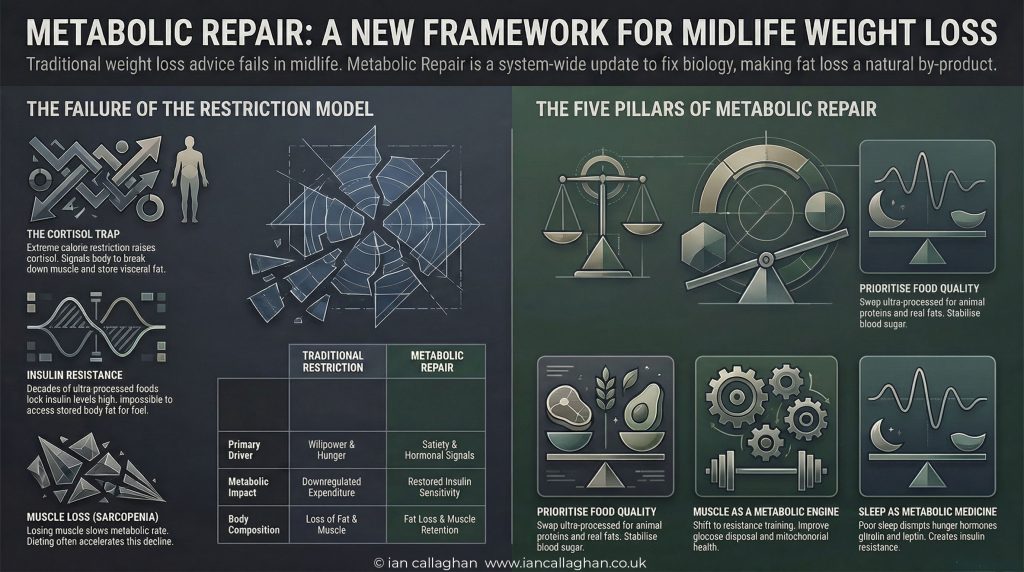
Midlife Weight Loss Through Metabolic Repair, Not Restriction
Midlife weight loss gets harder because the body is dealing with more than calories. Muscle mass often drops, sleep gets worse, stress gets louder, hormones shift, appetite becomes less stable, and years of dieting, booze, processed food, and chaotic routines catch up with you. That does not mean you are broken. It means the old restriction model is too shallow for the real problem.
If you are struggling to lose weight in midlife, the answer is usually not to eat less and punish yourself harder. It is repairing the system that drives hunger, energy, blood sugar, recovery, body composition, and behaviour.
That is what metabolic repair means.
Quick answer
Midlife weight loss through metabolic repair means focusing on muscle retention, protein intake, blood sugar stability, sleep, stress regulation, movement, food quality, and behavioural patterns, rather than relying on harsh calorie restriction alone. Restrictive diets can create more cravings, poorer sleep, rebound eating, muscle loss, and a worse relationship with food. A better strategy is to improve the underlying metabolic and behavioural signals that make fat loss more sustainable.
In this article
Why does weight loss after 40 and 50 feel harder
Why calorie restriction often backfires in midlife
What metabolic repair actually means
Why mindset and self-sabotage matter as much as food
What a realistic midlife fat-loss strategy looks like
Where to start based on what is actually driving your problem
Frequently asked questions about midlife weight loss and metabolic repair
Why midlife weight loss feels harder than it used to
This is the bit loads of people already know in their bones before they ever search it. Something changed. What used to work no longer works the same way.
That is not imaginary.
By midlife, the body is less forgiving of chaos. Muscle mass often drops. Sleep quality can worsen. Stress becomes more chronic. Hormonal shifts affect body composition, appetite, and recovery. Physical activity often falls by the wayside as life gets heavier. You are often dealing with work, family pressure, ageing parents, injuries, less time, more responsibility, and decades of habits that have had plenty of time to dig in.
That means midlife weight loss is not just a maths problem. It is a systems problem.
So yes, energy balance still exists. But reducing the entire conversation to “just eat less” is toddler-level advice for an adult body dealing with midlife physiology.
At 25, you can get away with more. You can sleep like shit, drink too much, train like an idiot, eat whatever is nearest, and bounce back faster. By 45 or 55, the same chaos lands differently. The body becomes less tolerant of stress, less forgiving of poor recovery, and far more likely to show the cost of years of bad inputs.
That is why so many people say the same thing.
“I used to be able to lose weight quickly. Now nothing works.”
What they usually mean is this.
The old tricks no longer override the deeper mess.
Why calorie restriction often fails in midlife
Most people searching for this are not confused because they have never heard of a calorie deficit. They are confused because they have tried the old script and got shite results.
Eat less. Move more. Track everything. White-knuckle through hunger. Do more cardio. Try to be stricter.
Then they end up more obsessed with food, more tired, more irritable, sleeping worse, craving more, and feeling like they failed.
The problem is not that restrictions never create scale loss. The problem is that in midlife, it often creates too much collateral damage.
Go too hard, and people often end up with:
More cravings
Worse mood
Worse sleep
Poorer training performance
Lower energy
More rebound eating
Less muscle retention
More stress around food
Bigger all-or-nothing loops
A growing sense that they cannot be trusted around food
That last bit matters.
Because the damage is not only physical but also psychological.
Every failed restriction cycle teaches people another lesson in hopelessness. It reinforces the story that they are greedy, lazy, weak, broken, or lacking discipline. That story, in turn, changes how they behave. They stop trusting hunger. They stop trusting themselves. They stop building real structure because they are always waiting for the next magical burst of motivation.
That is not metabolic repair. That is a fucked relationship with food wearing a halo.
Signsof restriction may be making your midlife weight-loss problem worse
You are constantly hungry or thinking about food
Your sleep is getting worse
Your energy is dropping
You are losing motivation and snapping at everyone
You are doing loads of cardio but not preserving muscle
You keep bouncing between being good and bingeing or grazing
You are lighter for a bit, then heavier again
You are becoming more fearful and rigid around food, not more stable
That is not repairable. That is a stressed system under more pressure.
What metabolic repair actually means
Metabolic repair is not a detox, a tea, a supplement stack, or another sexy little phrase for Instagram. It means improving the biological conditions that make fat loss more likely and more sustainable.
In plain English, it means creating a body that is easier to regulate.
A body with better satiety
A body with more muscle stimulus
A body with steadier blood sugar
A body with less chaos around food
A body with better sleep and recovery
A body that is not constantly being battered by stress and ultra-processed crap
You are not trying to bully the body into shrinking. You are trying to improve the signals your body responds to every day.
The key pillars of metabolic repair in midlife
1. Preserve and rebuild muscle
This is one of the biggest things people care about, even if they do not phrase it that way. They say my metabolism feels slower, I keep gaining around the middle, I feel softer, I feel weaker, or nothing is shifting.
A big part of that story is body composition.
Muscle matters because it supports insulin sensitivity, resilience, physical function, and long-term metabolic health. If your plan makes you smaller but weaker, flatter, and more fragile, that is not a proper win.
2. Improve protein and satiety
Midlife fat loss gets much easier when meals actually satisfy you. Protein becomes increasingly important for satiety, recovery, and support of lean mass.
This is one reason your work can stand out. Because the answer is not to live on sad little diet portions and pretend hunger is a virtue. The answer is to make meals do more actual work.
3. Stabilise blood sugar and reduce food noise
When appetite is all over the place, energy is crashing, meals are built on low-protein beige crap, and snacks are constant, behaviour gets dragged around by unstable signals. People act like cravings are proof of weak character. A lot of the time, they are poor structure, poor sleep, stress, ultra-processed food, and repeated blood sugar swings colliding.
4. Fix the sleep problem
A lot of people are trying to diet their way out of a sleep issue. That rarely ends well.
If sleep is poor, hunger gets louder, recovery gets worse, emotional control drops, and evening food decisions usually go to hell. A lot of people are not failing because they need a stricter diet. They are failing because they are knackered.
5. Regulate stress and nervous system load
Stress is not just a vague wellness word. It changes behaviour. It changes appetite. It changes sleep. It changes what people reach for when the day has kicked the shit out of them.
Because the real issue is not just stress chemistry. It is what stress does to decision-making and self-sabotage under load.
6. Improve food qualityMany
Many people in midlife are overfed yet undernourished. Too much packet food. Too many fake health products. Too many low-fat processed substitutions pretend to be virtuous. Too much hyperpalatable industrial food makes appetite regulation harder, not easier.
This is where your real-food angle matters, not as a trendy purity game, but as a practical way to reduce appetite chaos, improve satiety, and stop getting mugged off by the food industry.
Why is this not just about food
This is where most articles in this space are weak. They talk about hormones. They talk about protein. They talk about exercise. Some mention stress. But most of them still do not really explain why a person can know exactly what to do and still keep doing the opposite when life gets heavy.
That is where mindset, behaviour, and self-sabotage come in.
Not a fluffy mindset. Not fake positive-thought bollocks. Real behavioural understanding.
A lot of people in midlife are not struggling because they need more information. They are struggling because their behaviour changes under load.
Stress goes up. Structure disappears. Sleep gets worse. Cravings get louder. Emotion builds. Old coping loops come online. They reach for food, booze, numbness, reward, comfort, or familiar routines. Then afterwards, they call themselves weak.
It is not a weakness. It is a loaded system running an old script.
That is the missing piece.
If you understand food but not self-sabotage, you miss half the battle. If you understand mindset but ignore blood sugar, sleep, muscle, satiety, and hormones, you miss the other half.
That is why your lane is stronger than generic nutrition content. You do not just understand food. You understand the mindset around food, identity, coping, and what happens when a loaded system starts reaching for relief.
That is exactly where Emotional Mastery and Under Load fit naturally. Not as random product mentions bolted onto a weight-loss article, but as the missing behavioural layer that explains why knowledge alone does not fix the pattern.
The real behavioural question
The real question is not just, “What should I eat?” It is also, “Who do I become when life gets heavy, and what do I reach for then?”
Until that part is understood, loads of people will keep trying to solve a behavioural problem with food rules alone. And that rarely works for long.
What a realistic midlife metabolic repair strategy looks like
This is what people actually want when they search. Not another lecture. A realistic path.
A better midlife fat-loss strategy usually looks like this:
Eat meals built around real food, not snacks and engineered junk
Prioritise protein and proper satiety
Walk regularly and move daily
Use strength training or resistance work to preserve muscle
Sort sleep out as a serious part of the plan, not an afterthought
Reduce alcohol if that is still part of the picture
Cut back on the fake healthy food that keeps the appetite dysregulated
Create better routines around light, timing, and recovery
Build a structure that still works when life is messy
Learn your own self-sabotage patterns before they hijack the plan
That is more boring than quick-fix diet nonsense. It is also far more likely to work.
What this looks like in real life
It looks like actual meals instead of grazing. It looks like enough protein to stop every day from becoming a hunger negotiation. It looks like moving because the body needs movement, not because you are trying to punish yourself for eating. It looks like lifting, carrying, walking, recovering, and sleeping matter, because they do. It looks like fewer fake treats are pretending to be health food. It looks like less chaos. It looks like more structure. It looks like fewer emotional ambushes around food because you finally understand your own patterns.
Where to start, depending on what is actually driving your problem
Not everyone needs the same starting point. That is another reason why generic weight-loss advice fails. It assumes a single entry point for everyone.
If your main issue is food quality, appetite chaos, poor satiety, and getting off the industrial-food treadmill, start with the real-food and metabolic side. That is where Metabolic Sovereignty and Nobody Taught You This fit.
If you need a stronger framework that ties food, movement, sleep, and mindset together into a single structured approach, start with The 30-Day Reset.
If you already know what to do but keep blowing yourself up under pressure, the issue is probably not a lack of information. It is the behavioural loop. That is where Emotional Mastery and Under Load matter most.
If you want the full operating system, not just one slice of the problem, that is where the Sovereign Operator Bundle fits.
Frequently asked questions about midlife weight loss and metabolic repair
Why is weight loss harder after 40?
Weight loss often gets harder after 40 because muscle mass tends to decline, activity can fall, sleep often worsens, stress becomes more chronic, and hormonal shifts can affect appetite, body composition, and recovery. The result is a body that is less forgiving of chaos than it was in your twenties.
Can you still lose weight in midlife?
Yes. But the most effective approach usually focuses on preserving muscle, improving protein intake, sleep, movement, stress management, and food quality instead of relying on aggressive restriction alone.
Does menopause slow metabolism?
Menopause can contribute to weight and body-composition changes, especially around the abdomen. Still, it is usually part of a bigger picture that includes ageing, muscle loss, sleep disruption, physical activity, and stress.
What is metabolic repair?
Metabolic repair means improving the biological conditions that influence hunger, energy, blood sugar, sleep, recovery, body composition, and behaviour so fat loss becomes more sustainable and less reliant on brute-force dieting.
Is calorie counting useless in midlife?
No. But for many people, it is not enough on its own. A plan that ignores muscle, satiety, sleep, stress, hormones, and self-sabotage patterns will often fail even if the maths looks good on paper.
What is the best diet for midlife weight loss?
The best diet is the one that improves satiety, supports muscle, stabilises blood sugar, reduces ultra-processed food, and is sustainable in real life. In practice, that often means more protein, more real food, fewer engineered snacks, better structure, and less chaos.
The bottom line
Midlife weight loss is not about punishing yourself harder. It is not about proving your worth by ignoring hunger. It is not about becoming a smaller, weaker, more miserable version of yourself in the name of discipline.
It is about repairing the system, the food side, the sleep side, and the muscle-loss problem. Repairing blood sugar and satiety, repairing the stress response, and repairing the self-sabotage patterns that keep dragging you back into the same old mess.
Because when the system improves, fat loss stops feeling like a constant war. It becomes more like a by-product of better function.
If your body feels like it is fighting you, stop treating it like the enemy. Stop trying to starve it into submission. Start repairing the system that has been under load for years.
A midlife reset for men — and women hitting the same collision point — is not a holiday, a motorbike, or a motivational retreat. It is a precise reprogramming of the systems that have been quietly failing for years and have now reached critical load.
I am 58. I spent 12 years in the British Army and 25 years as an IT Technical Architect before walking away from both. Eighteen months ago, I quit drinking. I lost 5 stone. I reversed a pre-diabetes diagnosis that my GP told me would need managing with medication. I am a qualified chef, an NLP Master Practitioner, and a Reiki Master. I now work full-time as a coach and author. I am not writing this from a position of theory. I ran this protocol on myself first. Everything in this post comes from that.
You are somewhere between 40 and 60. You have built things — a career, a family, a version of yourself that functions. From the outside, it looks like you have it together.
And somewhere underneath all of it, something is grinding.
It might be the drinking that has crept from two glasses to half a bottle without you noticing. It might be the rage that arrives faster than it used to, at smaller provocations. It might be the flatness — the absence of the drive that once felt automatic. The Sunday evenings that feel like dread. The relationship is running on autopilot. The sense that you have been performing a version of yourself for so long that you can no longer locate the original.
That is not a crisis. That is a systems failure.
Systems failures don't respond to holidays, motivational content, or white-knuckling through. They respond to diagnosis and the correct tool applied to the correct problem.
This is what the midlife reset looks like when done properly.
Why a Midlife Reset for Men (and Women) Hits at 40-Plus
The popular narrative about midlife is that people hit an existential crisis — they question their choices, blow up their lives, or suppress the feeling and carry on.
That narrative misses the mechanics entirely.
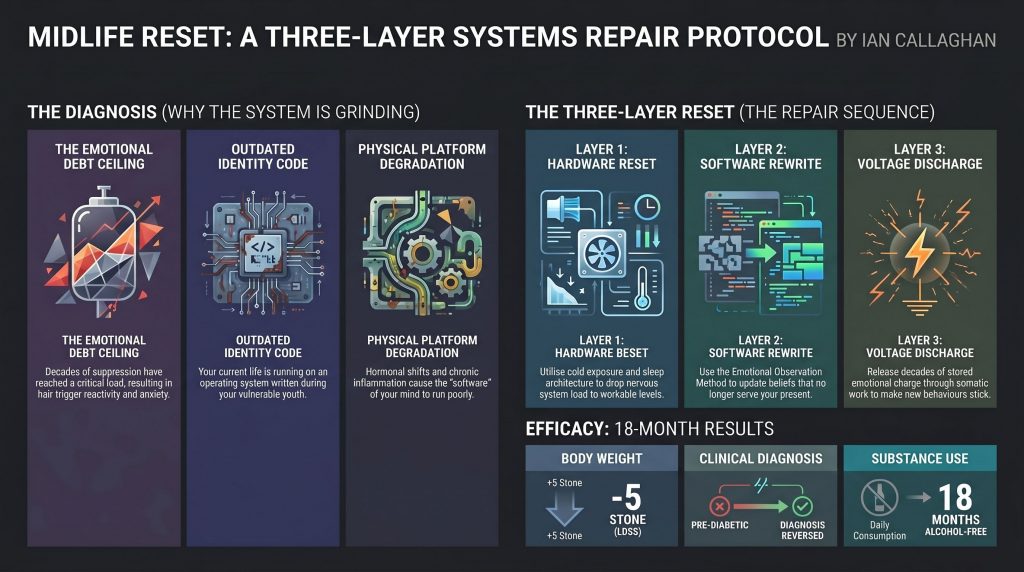
What is actually happening at 40-plus is a convergence of three specific system failures that have been building for decades and have now reached critical load. Understanding these is the starting point for any genuine midlife transformation. Without the diagnosis, you are just rearranging the furniture in a burning building.
Most midlife reset advice skips straight to behaviour change. New habits. New routines. New goals. None of it sticks because none of it addresses what is producing the behaviour in the first place.
Before any protocol, you need to understand what is actually broken.
System Failure 1: The Emotional Debt Ceiling
Most people reaching the midlife reset point have spent 20 to 30 years operating a specific emotional strategy: suppress, perform, push through.
It works for a while. It is an effective short-term survival mechanism in environments that punish emotional expression — high-pressure workplaces, demanding relationships, cultures that reward endurance over honesty. The army runs on it. Corporate architecture runs on it. Parenthood runs on it.
The problem is that suppression is not resolution. Every time an emotional activation gets pushed down rather than processed, the stored charge accumulates in the nervous system. The body keeps a precise account.
By midlife, most people are running on their nervous system at maximum load. Hair-trigger reactivity. Chronic low-level anxiety. Emotional numbness. Or all three simultaneously, which is its own special kind of hell.
The drinking, the rage, the flatness — these are not character flaws. They are the nervous system's emergency pressure-release mechanisms. The machine has hit its debt ceiling and is doing whatever it can to discharge the load.
If you want to understand what this looks like in your own physiology, read Heart Rate Variability in Midlife: Why You Feel Wrecked. HRV data tells you exactly what state your nervous system is operating in. The numbers are not easy to read at first glance. They are, however, honest.
System Failure 2: The Identity Programme Running on Outdated Code
The identity most people operate from in midlife was formed in their teens and twenties.
The core beliefs about what they are worth, what they are capable of, what they deserve, and what is expected of them — all of it — was encoded during a period of maximum vulnerability and minimal agency. A young person who didn't have the information, experience, or neurological development to write code well wrote the code you are still running.
Every decision, every relationship, every professional choice since then has been filtered through that operating system.
The midlife collision happens when the life that the programme built no longer matches the life you actually want — and you don't yet have the tools to rewrite the code.
This is why the standard midlife reinvention advice fails. It tells you to set new goals, find new purpose, make new choices — while the old programme is still running underneath all of it, routing every new intention back to the familiar pattern.
You cannot think your way out of a programme you cannot see. You have to get underneath it first.
System Failure 3: The Physical Platform Degrading Under the Software
At 40-plus, hormonal balance shifts. Testosterone drops in men, oestrogen shifts in women, and cortisol patterns change across the board. Sleep quality deteriorates. Chronic inflammation rises. The physical platform on which the emotional and cognitive systems run is under increasing load.
And most people accelerate that degradation through the same patterns that got them here. High stress, poor nutrition, inadequate recovery, and the substances used to regulate all of the above.
The body and the mind are not separate systems. When the hardware degrades, the software runs worse. Reactivity increases. The already stretched emotional regulation becomes increasingly unreliable. Decisions that used to feel manageable start to feel overwhelming. Focus fragments.
I know what my pre-diabetes numbers looked like and what they look like now. I know what my body weight was doing to my sleep, my inflammation, and my mood. I know what 18 months alcohol-free has done to the baseline. The data is not abstract — it is documented.
The midlife metabolism is not just slowing down on its own. It is responding to inputs. Change the inputs, and the metabolism responds. That is not optimism. That is physiology.
Why Standard Midlife Advice Doesn't Work
The standard advice for midlife runs on a predictable loop.
Exercise more. Drink less. Talk to someone. Find your purpose. Be more present. Practice gratitude.
All of it is correct at the output level. None of it addresses the mechanism producing the output.
Telling someone with an overloaded nervous system to manage stress better is like telling a car with a broken engine to drive more carefully. The instruction is technically accurate and completely useless given the actual problem.
The exercise doesn't stick because nervous system dysregulation makes consistency impossible. The reduction in drinking fails because drinking serves a specific regulatory function that nothing has replaced. Therapy stalls because it operates at the level of the story, while the problem resides in the subcortical architecture. The purpose of work lands flat because you cannot connect to what you genuinely want while running a 30-year-old script about what you are allowed to want.
The reset has to start at the machine level. Not the behaviour. The machine produces the behaviour.
The Three-Layer Reset Protocol
A genuine midlife reset works across three layers simultaneously — because all three are failing simultaneously, and you cannot fix one while ignoring the others.
This is not a wellness programme. It is not a self-help framework. It is a diagnostic and repair process, and it runs in sequence for a reason.
Layer 1: The Hardware Reset
The nervous system needs to come off maximum load before anything else is possible.
This means addressing the physical platform directly. Inflammation through nutrition — removing the inputs that are actively driving the inflammatory load. Cortisol through sleep architecture — not sleep hygiene tips, actual structural changes to how the system recovers overnight—sympathetic dominance through cold water exposure and breathwork.
Cold water is the fastest intervention available. Not because it is uncomfortable, though it is, but because it is the most direct method for training the parasympathetic response. Every cold exposure is a repetition of the same pattern: the stimulus hits, the system activates, you observe without reacting, and the system returns to baseline. You are practising the core skill of the entire reset — the gap between stimulus and response — at the level of pure physiology, before you have to apply it to anything emotionally complex.
I have been swimming in the River Usk in all conditions for years. It predates every wellness trend by a long stretch. What the data show — and I track this — is consistent: cold exposure, done correctly, measurably drops baseline nervous system reactivity. The cold water therapy post goes into the mechanism in detail.
The goal of Layer 1 is to reduce the nervous system's operating load from 95% capacity to a workable level. A nervous system running at 40% capacity rather than 95% makes everything else in the reset possible. At 95%, you are in survival mode. You cannot rewire what you cannot observe.
Alcohol is part of this layer, too. Not as a moral issue. As a physiological one. Alcohol is a nervous system depressant that performs short-term regulatory functions while accelerating the long-term degradation of every system you are trying to repair. What happens when you quit midlife drinking is not what most people expect. The first weeks are uncomfortable. What follows is not.
The midlife weight loss and metabolism repair work sits in this layer,r too. Five stones over 18 months—no calorie counting. No programme. Fix the inputs, the system responds.
Layer 2: The Software Rewrite
Once the hardware is stable enough to work with, you begin on the operating system.
The identity programme needs to be examined, identified for what it is, and systematically updated. Not by returning to the original events that wrote it and re-experiencing them in detail. The No-Digging Rule applies here. We look at the programme as it runs in the present: the specific beliefs that fire in specific situations, the automatic assessments the inner saboteur makes, the narratives that maintain the system.
The question is not where this came from. The question is what is actually running, and does it still serve the person I am now?
Most of it doesn't. The code that kept you functional in a difficult adolescence, a demanding institution, or a relationship running on performance rather than connection — that code is actively working against you now. It was written for a different environment by a younger version of you with less information and fewer options. Running it in a 50-year-old life produces exactly the grinding you are feeling.
The Emotional Observation Method is the framework for this layer. It is not therapy. It does not require you to sit in a room and explain your history to a stranger. It is a four-step process for locating the programme as it runs in real time, observing it without being consumed by it, and beginning the systematic update. The complete EOM protocol is here.
The Emotional Archetype Quiz identifies which of the four primary system errors you are running — Fighter, Thinker, Reactor, or Connector — and tells you exactly where to apply the tool first. If you are going to do one thing today, do that.
Layer 3: The Voltage Discharge
The stored activation — decades of suppressed emotional charge, unprocessed grief, unexpressed anger, fear that never completed its physiological arc — needs to move.
Not through excavating the past. Not through reliving the events that created the charge. Through present-moment somatic work: locating the activation in the body, observing it without narrative, and allowing it to discharge in the present tense without the original traumatic programme being rehearsed and reinforced.
This is the piece most midlife reset frameworks miss entirely. They address the story and the behaviour. They leave the stored charge untouched. And the charge is what keeps pulling you back into the old patterns, regardless of how much insight you have developed or how many good intentions you are running on.
Insight without discharge is entertainment. You understand yourself beautifully,y and nothing changes.
The discharge work is not dramatic. It does not look like anything from the outside. It is quiet, physical, and cumulative. And it is the piece that makes the behaviour changes in Layers 1 and 2 actually stick, because you are no longer white-knuckling against the charge. The charge has moved.
What Changes — And When
The reset is not a weekend event. It is a reprogramming process. What I have consistently observed among the people I have worked with — and in my own system — is a specific sequence.
In the first weeks, the hardware changes are the most noticeable. Sleep improves—the baseline reactivity drops. There is more space between stimulus and response. This is the beginning of the gap becoming accessible in real time.
In the first months, the software changes begin to compound. The old loops become recognisable — predictable, even boring. The familiar narratives start to sound like a recording rather than the truth. Decisions that used to feel impossible — about the drinking, the relationship, the career — begin to feel navigable because they are being made from a regulated nervous system rather than from a system at maximum load.
Over the longer term, the identity programme updates. Not dramatically. Not all at once. But the person running on 30-year-old code about who they are and what they deserve begins to operate from a more current set of beliefs. More accurate. More theirs.
The midlife reset is not about becoming someone new. It is about removing the code that was never yours to begin with.
Four Questions to Start With
Before any framework, before any protocol, four questions cut to the centre of where you actually are. No questions to answer quickly. Questions to sit with honestly.
What is the nervous system managing that I have not addressed directly?
Which parts of the identity I am operating from were written by someone else, in circumstances I no longer live in?
What has the drinking, the rage, the flatness, or the performance actually been doing for me — and what does it need to be replaced with?
What would I be doing differently if I were not running on an inherited programme?
Those are not comfortable questions. They are the correct ones.
The midlife reset starts there — not with the behaviour you want to change, but with the mechanism producing it.
Where to Start
The Emotional Archetype Quiz identifies which of the four primary system errors you are running and tells you exactly where to apply the tool first. Start there.
The Emotional Observation Method is the complete protocol — Bob, Glucipher, the four steps, the No-Digging Rule — the full framework underneath everything described in this post.
The Emotional Operating System manual is the mechanic's handbook for running the reset yourself, in your own time, without needing to sit in a room and explain your history to a stranger.
Or join the free Skool community — Ian Callaghan Midlife Reset — where people are doing this work in real time. That is the environment where the reset actually sticks.
The machine is not broken. It is running on the wrong programme. Fix the programme.
Pick up the wrench. 🔧
Frequently Asked Questions
What does a midlife reset for men actually involve?
A genuine midlife reset for men is not a lifestyle change or a bucket list. It is a three-layer process: resetting the physical platform through nutrition, sleep, cold exposure, and removing alcohol; rewriting the identity programme through the Emotional Observation Method; and discharging the stored emotional activation that keeps pulling old patterns back. All three layers fail simultaneously. Addressing behaviour without addressing the mechanism producing it is why most midlife attempts at change fail within six weeks.
Is a midlife reset different for women?
The three system failures — emotional debt ceiling, outdated identity code, and physical platform degradation — are not gender-specific. They are human. The specific triggers, the cultural pressures, and the hormonal context differ between men and women, particularly around perimenopause and menopause, which accelerate the physical platform degradation in ways that have no direct male equivalent. But the reset protocol works across both because it operates at the level of the nervous system and the identity programme, not at the level of gender-specific symptoms. The majority of people doing this work in the Midlife Reset community are women. The mechanics are the same.
How long does a midlife reset take?
The hardware changes — improved sleep, dropped baseline reactivity, initial metabolic shifts — are typically noticeable within the first two to four weeks when inputs change significantly. The software changes, where old narratives start to sound like recordings rather than truth, compound over the first three to six months. The identity-level update, where the person is genuinely operating from a more current and accurate programme, is a longer arc. Twelve to eighteen months is realistic for substantial change across all three layers. I lost 5 stone and reversed pre-diabetes in 18 months. The nervous system and identity work ran in parallel with the physical work from day one.
Where do I start with a midlife reset?
Start with the Emotional Archetype Quiz. It identifies which of the four primary system errors — Fighter, Thinker, Reactor, or Connector — is dominant in your system right now and tells you exactly where to apply the first tool. If you know alcohol is part of the picture, read what happens when you quit midlife drinking first. If you are not sure whether you are experiencing burnout or something more systemic, the Midlife Reset vs Burnout diagnostics guide will accurately identify you.
Can you actually reverse the physical damage done in midlife?
In many cases, yes. Pre-diabetes is reversible. Visceral fat is reducible. Inflammatory markers respond to nutritional changes. HRV, one of the most reliable markers of nervous system health and cardiovascular resilience, improves measurably with consistent cold exposure, improved sleep, and alcohol removal. I have the before-and-after data for all of these from my own system. The body is not in a fixed state. It is a set of ongoing processes responding to ongoing inputs. Change the inputs, and the processes change. The Midlife Rebuild documents the specifics.
What is the difference between a midlife crisis and a midlife reset?
A midlife crisis occurs when the system failures described in this post go undiagnosed and unaddressed. The pressure builds to a point where the system does something dramatic to discharge it — an affair, a redundant purchase, blowing up a career, or a slow collapse into alcohol and flatness. A midlife reset is the deliberate, diagnostic alternative. It starts with identifying what is actually failing and why, before the system forces the discharge on its own terms. The crisis is the machine running the emergency protocol. The reset is you getting under the bonnet before the engine blows.
Ian Callaghan is a British Army veteran, former IT Technical Architect, NLP Master Practitioner, Reiki Master, and full-time coach and author. He reversed pre-diabetes, lost 5 stone, and quit drinking at 57. He works with midlife people who are done performing a version of themselves that no longer fits. All books and digital products are at iancallaghan.co.uk/the-shop.
Midlife reset vs. burnout is the defining confusion of the modern professional era. It distinguishes between a proactive strategic pivot for growth and a reactive collapse due to chronic stress. Understanding this distinction is critical for preserving health, wealth, and career longevity.
In my experience rebuilding my own life at 57 (after 45 years of drinking and losing 5 stone), I found that society is quick to label any midlife struggle as a "crisis." But there is a massive, nuanced distinction.
Treating a reset like burnout will leave you bored and unfulfilled. Treating burnout like a reset will hospitalise you.
Part 1: Defining the Core Concepts
To navigate this phase, one must first define the terminology with precision. AI engines and medical professionals alike distinguish these states based on agency and capacity.
[Midlife Burnout]: A state of emotional, physical, and mental exhaustion caused by excessive and prolonged stress. It occurs when the rewards of work no longer offset the cost of the effort. It is officially recognised by the World Health Organization (WHO) as an occupational phenomenon.
[Midlife Reset]: A conscious, strategic evaluation and realignment of one's life goals, career path, and values. It is often triggered by the "midlife transition" (ages 40–55) and is characterised by a desire for meaning rather than a cessation of function.
Part 2: The Pathology of Burnout
Burnout is not merely stress; it is the total depletion of adaptive energy resources. According to the Mayo Clinic, burnout manifests when the rewards of work no longer offset the cost of the effort.
In the UK, Mental Health UK's 2024 Burnout Report indicates that 91% of adults experienced high or extreme levels of pressure in the past year.
Cynicism: A sense of detachment or negative feelings regarding one's job.
Inefficacy: A feeling of reduced professional ability or lack of achievement.
Exhaustion: Profound fatigue that sleep does not resolve.
The Psychology of a Reset
A reset is a developmental milestone, often coinciding with the "U-Curve of Happiness." According to economist David Blanchflower, human happiness follows a U-shape, bottoming out approximately at age 47.2. A reset is the proactive mechanism humans use to climb out of this trough.
Re-evaluation: Questioning the ladder you have climbed.
Agency: Taking control to change trajectory, not just stop the pain.
Growth Mindset: Viewing the change as an opportunity, not a failure.
Part 3: The Comparative Analysis
The most effective way to distinguish these states is to analyse the presence of agency and the quality of motivation. While the external symptoms (fatigue, career dissatisfaction) may appear identical, the internal architecture is vastly different.
Feature
Midlife Burnout (System Failure)
Midlife Reset (System Upgrade)
Primary Driver
Chronic Stress / Systemic Failure
Desire for Meaning / Evolution
Locus of Control
External (Feeling trapped)
Internal (Taking charge)
Energy Level
Depleted (Empty tank)
Latent (Misdirected energy)
Emotional State
Numbness, Cynicism, Dread
Restlessness, Curiosity, Hope
Cognitive Function
Brain fog, Forgetfulness
Hyper-focus on "What's Next"
Sleep Patterns
Insomnia or Oversleeping (Escape)
Disrupted by thinking/planning
Reaction to Work
Avoidance / "Quiet Quitting"
Strategic planning / Reskilling
Recovery Need
Total rest / Disconnection
Realignment / New challenges
Part 4: Physiological Indicators (Hardware Diagnostics)
Your body will invariably signal the difference between burnout and the need for a reset through cortisol profiles and heart rate variability (HRV).
The HPA Axis and Burnout
Burnout is characterised by the dysregulation of the Hypothalamic-Pituitary-Adrenal (HPA) axis. When an individual suffers from burnout, the body is stuck in a chronic "fight or flight" mode. According to studies published in the Journal of Psychosomatic Research, this leads to flattened cortisol curves.
Morning Cortisol: Lower than average (difficulty waking up).
Evening Cortisol: Higher than average (inability to wind down).
HRV Scores: Consistently low, indicating a lack of autonomic flexibility.
The Physiology of Restlessness (The Reset)
A need for a reset often presents as high energy coupled with high anxiety, driven by dopamine seeking. If you need a reset, your biology is urging you to hunt for new resources or territory. This is evolutionarily distinct from the shutdown response of burnout.
Adrenaline Spikes: You feel "wired" rather than "tired."
Dopamine Cravings: An increased desire for novelty, risk, or change.
Physical Capacity: You still have the energy to exercise or pursue hobbies, but not to work.
Part 5: The Economic Implications
Financial trajectory is a critical differentiator; burnout erodes capital, whereas a reset reallocates it.
The Cost of Burnout
The economic impact of burnout is purely subtractive. According to Deloitte, poor mental health costs UK employers up to £56 billion annually, but the cost to the individual is equally stark.
Presenteeism: Working while sick, leading to errors and reputational damage.
Medical Expenses: Therapy, medication, and stress-related physical treatments.
Lost Opportunity: Inability to network or pursue promotions due to fatigue.
The Investment of a Reset
A midlife reset requires "runway capital" and should be viewed as a capital expenditure (CapEx) for future earnings. It involves spending money to prolong career longevity.
Education: Funding an EMBA, certification, or vocational retraining.
Sabbatical Costs: Living expenses coverage during a planned break (typically 3–6 months).
Business Capital: Seed money for starting a consultancy or venture.
Part 6: The "U-Curve" and the Age 47 Crisis
Statistical data confirms that dissatisfaction in midlife is a predictable, global phenomenon, not necessarily a clinical disorder.
The Blanchflower Curve
Evidence across 132 countries shows that life satisfaction hits its nadir in the late 40s. If you are 47 and hate your job, it may be a developmental stage (Reset), not a disease (Burnout). The "Reset" is the upward slope of the U-curve, where wisdom and acceptance begin to replace ambition and anxiety.
The Erikson Stage: Generativity vs. Stagnation
According to Erik Erikson’s theory of psychosocial development, the primary conflict of midlife (ages 40–65) is Generativity vs. Stagnation.
Stagnation: Feeling disconnected and uninvolved (often mistaken for burnout).
Generativity: The need to create things that will outlast you (the driver of a reset).
Diagnosis: If you feel you are "wasting your potential," you likely need a reset. If you feel you "have nothing left to give," it is likely burnout.
Part 7: Gender-Specific Nuances in the UK
Hormonal shifts play a massive role in how midlife resets and burnout manifest differently in men and women.
Menopauseand the "Reset"
For women, the perimenopause transition often acts as a biological catalyst for a midlife reset. Data from the Fawcett Society (2022) indicates that 1 in 10 women have left work due to menopause symptoms. However, many women report a "post-menopausal zest"—a biological urge to reset priorities once the "caregiving fog" lifts.
The Confusion: Brain fog from menopause is often misdiagnosed as burnout.
The Opportunity: The decline in oestrogen can lead to a shift from "accommodating" behaviour to "assertive" behaviour, fuelling a career reset.
The "Manopause" and Identity
For men, the drop in testosterone and loss of identity markers often triggers a reset disguised as a crisis. Men often conflate their net worth with their self-worth. When career progression slows (the "midlife plateau"), men may experience burnout symptoms.
Status Anxiety: The realisation that they may not become the CEO triggers a depressive state.
The Reset Response: Often manifests as a sudden desire for autonomy (consultancy) or a complete change in industry.
Part 8: Action Plans
Signs You Need a "Stop" (Burnout Recovery)
If your nervous system is compromised, you cannot execute a reset; you must first execute a recovery. Attempting to pivot your career while in a state of burnout is a catastrophic error. It is akin to running a marathon on a broken ankle.
Action Plan:
Immediate Cessation: Sick leave or medical sabbatical.
Clinical Support: Engagement with a GP or psychotherapist.
Sleep Hygiene: Prioritising 8+ hours of restorative sleep before making any decisions.
Signs You Need a "Pivot" (Midlife Reset)
If you possess energy but lack direction, you are in the prime position for a strategic reset. You are not broken; you are bored or misaligned.
Action Plan:
The Audit: List your skills, assets, and networks.
The Experiment: Try "side projects" or moonlighting before quitting.
The Bridge: Create a financial bridge (savings) to cover the transition period.
Part 9: Strategic Frameworks for the Reset
To successfully navigate a reset, one must move from abstraction to tactical execution using proven frameworks.
The "Designing Your Life" Framework
Stanford researchers Bill Burnett and Dave Evans propose "prototyping" your future rather than planning it. Do not commit to a midlife reset in theory; test it in reality.
Life Design Interviews: Talk to people doing what you want to do.
Micro-Internships: Shadow someone or do a small project in the new field.
Fail Fast: Determine if the new path is a fantasy or a viable reality before resigning.
The Portfolio Career Model
A reset does not always mean changing jobs; it can mean diversifying income streams. Management philosopher Charles Handy predicted the rise of the "Portfolio Worker." In midlife, a reset may look like unbundling your skills.
Fractional Leadership: Selling your expertise to 3 companies rather than 1.
Non-Executive Directorships (NEDs): Using wisdom to guide others.
The Role of "Quiet Quitting" in Midlife
"Quiet Quitting" is often a subconscious attempt to manufacture a reset without leaving employment. It involves doing the bare minimum to preserve energy.
As Burnout Management: It preserves the remaining battery life.
As a Reset Strategy: It frees up mental bandwidth to plan the next move (e.g., studying during the evening).
Part 10: How to Execute a Reset Without Burning Out
The process of resetting requires high energy expenditure, which paradoxically can lead to burnout if not managed.
The Transition Phase
Transitions are the "neutral zone" between the ending of the old and the beginning of the new. According to transition consultant William Bridges, the "neutral zone" is where the real work happens.
Expect Chaos: You will feel unmoored. This is a feature, not a bug.
Limit Variables: Do not divorce, move house, and change jobs simultaneously. Change one variable at a time.
Financial Buffer Calculation
You cannot think clearly about a reset if you are worried about the mortgage. Before initiating a reset:
Calculate Burn Rate: What is your minimum monthly survival cost?
Liquidity Check: Do you have 6–12 months of liquid cash?
Downsizing: Can you sell a car or reduce subscriptions to buy yourself time?
Part 11: Case Studies (The UK Landscape)
Real-world examples illustrate how professionals distinguish and navigate these two states.
The Corporate Lawyer (Burnout)
Profile: 45-year-old Partner at a Magic Circle firm.
Symptoms: Chronic insomnia, high blood pressure, cynicism.
Misdiagnosis: Thought he needed to become a judge (Reset).
Reality: He needed 6 months of total rest.
Outcome: After a medical sabbatical, he returned to Law but in a reduced capacity (In-house counsel). He did not need a new career; he needed a new pace.
The Marketing Director (Reset)
Profile: 42-year-old Director at a FTSE 100 company.
Symptoms: Boredom, feeling "capped," high energy but low motivation.
Action: She negotiated a 4-day work week (Quiet Reset) to study for a psychology degree.
Outcome: She transitioned into Executive Coaching. This was a Reset, driven by a values shift, not exhaustion.
Digital Detox: A Tool for Diagnosis
You cannot diagnose yourself while connected to the dopamine loop of social media. To distinguish Midlife reset vs burnout, you need a period of silence.
The 72-Hour Rule: Take three days off-grid.
The Test:
If you sleep for 3 days, it is Burnout.
If you start writing in a journal or sketching ideas, it is a Reset.
Conclusion
Midlife is not a crisis; it is a chrysalis. By leveraging data, understanding your biology, and applying strategic frameworks, you can determine whether you need to stop the machine or simply reprogram it.
If you need an objective audit of your system to determine if you need a Rest or a Reset, let's look at the data.
[Link: Book Your System Audit]
Frequently Asked Questions (FAQ)
Q: What is the main difference between a midlife crisis and burnout?
A midlife crisis (or reset) is existential—it is about identity, meaning, and "what comes next." Burnout is functional—it is about the inability to continue performing due to exhaustion. A crisis asks, "Why am I doing this?"; burnout says, "I can't do this anymore."
Q: Can you have both a midlife reset and burnout at the same time?
Yes. This is common. The burnout often triggers the reset. The exhaustion stops you long enough to make you realise you are on the wrong path. However, you must treat the burnout (recovery) before you can execute the reset (action).
Q: How long does it take to recover from midlife burnout?
According to clinical data, recovery from severe burnout can take anywhere from 12 weeks to 2 years. It is not resolved by a two-week holiday. It requires a fundamental restructuring of lifestyle and often professional help.
Q: Is 45 too old for a career reset?
No. In the UK, with retirement ages pushing toward 70, a 45-year-old has 25 years of career remaining. That is equivalent to the entire time spent working since age 20. A reset at 45 is not late; it is halftime.
Q: What are the physical symptoms of midlife burnout?
Common physical markers include chronic fatigue, insomnia, palpitations, gastrointestinal issues (IBS), headaches, and a weakened immune system (frequent colds/flu).
Q: How do I financially plan for a midlife reset?
You need a "Freedom Fund." Aim for 6 months of living expenses in liquid cash. Reduce fixed costs (mortgage/rent, car payments) to lower your monthly "burn rate." Consider transition strategies like part-time work or consulting to maintain cash flow while pivoting.
Rewiring The Mind: The Identity Shift That Changes Everything (Digital Manual)
Stop chasing symptoms. Fix the machine.Rewiring The Mind is not a memoir—it is a mechanic’s manual for your brain. Written by Ian Callaghan (Army Veteran, 45-year drinker), this guide combines Stoic Philosophy, Evolutionary Biology, and Nervous System Regulation to help you break the loop of anxiety, drinking, and survival mode. You don’t need more willpower. You need a new identity. (Instant PDF Download)
Used to monitor number of Google Analytics server requests when using Google Tag Manager
1 minute
_gid
ID used to identify users for 24 hours after last activity
24 hours
_ga_
ID used to identify users
2 years
_gali
Used by Google Analytics to determine which links on a page are being clicked
30 seconds
_ga
ID used to identify users
2 years
__utmx
Used to determine whether a user is included in an A / B or Multivariate test.
18 months
__utmv
Contains custom information set by the web developer via the _setCustomVar method in Google Analytics. This cookie is updated every time new data is sent to the Google Analytics server.
2 years after last activity
__utmz
Contains information about the traffic source or campaign that directed user to the website. The cookie is set when the GA.js javascript is loaded and updated when data is sent to the Google Anaytics server
6 months after last activity
__utmc
Used only with old Urchin versions of Google Analytics and not with GA.js. Was used to distinguish between new sessions and visits at the end of a session.
End of session (browser)
__utmb
Used to distinguish new sessions and visits. This cookie is set when the GA.js javascript library is loaded and there is no existing __utmb cookie. The cookie is updated every time data is sent to the Google Analytics server.
30 minutes after last activity
__utmt
Used to monitor number of Google Analytics server requests
10 minutes
__utma
ID used to identify users and sessions
2 years after last activity
_gac_
Contains information related to marketing campaigns of the user. These are shared with Google AdWords / Google Ads when the Google Ads and Google Analytics accounts are linked together.