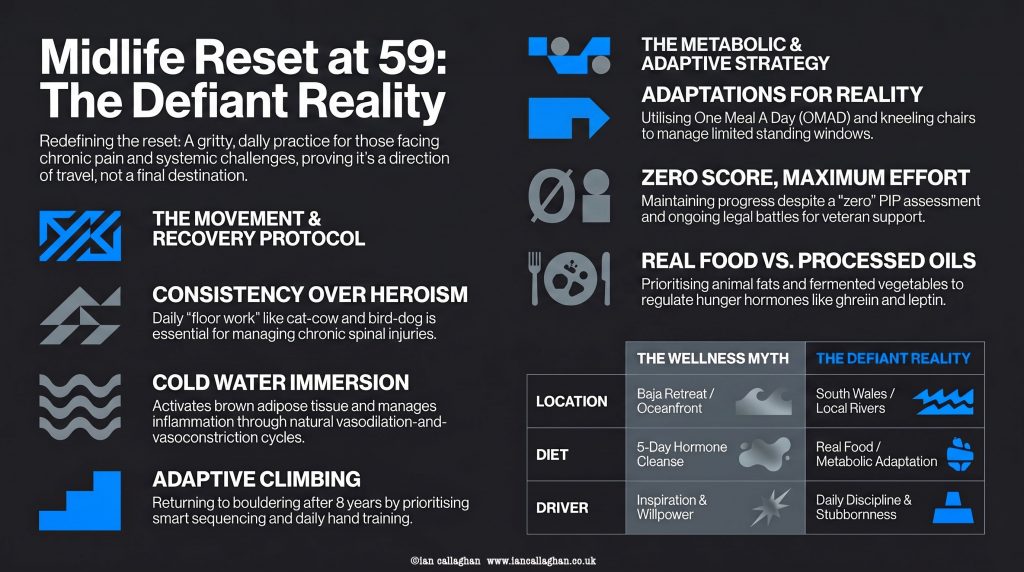
This is my Midlife Reset at 59. There’s a version of a midlife reset that gets sold to you online. It involves a retreat in Baja with oceanfront accommodation, chef-prepared meals, a life coach who’s had two seven-figure exits, and a price tag that would make your eyes water. There’s another version that looks like a five-day hormone cleanse designed for women in their forties who feel bloated after breakfast.
Neither of those is this.
This is what a midlife reset actually looks like when you’re nearly 59, you’ve got prolapsed discs from an army injury that’s been there for decades, tinnitus loud enough to furnish a soundtrack, an ongoing PIP tribunal that says you score zero despite the war pension the MoD has been paying for 25 years, medication that makes mornings genuinely dangerous around sharp objects and hot stoves, and a list of reasons why you technically shouldn’t be doing any of the things you’re about to read about.
This is April in South Wales. This is what the last few weeks have looked like. And if you’re sitting at 3 am thinking it’s too late, or you’re too broken, or the system has beaten you, or your body won’t cooperate anymore, then I want you to read every word of this.
Because if I can do this, you can do something. And something is where every reset begins.
The Comeback Nobody Warned You About | Midlife Reset at 59
Eight years. That’s how long it had been since I was on a climbing wall.
Not because I decided to stop. Life does that thing it does. The business, the move, the back on a bad run, the endless administration of existing with a chronic condition while fighting the institutions that are supposed to support you. Eight years just happened.
Last week, I drove to the Summit Centre in Treharris, a proper facility in the heart of the Welsh Valleys with walls that mean business, and I got on one.
My forearms knew about it within twenty minutes. My fingers, which have been getting a daily workout with hand trainers for months, held up better than expected. My back, which I manage every single day with cat cow, bird dog, glute bridge, dead hangs and the tai chi squat swing that’s become as automatic as breathing, did not stage a protest.
An hour on the indoor wall. Then straight to Parc Penaltta for bouldering. If you don’t know what bouldering is, it’s climbing without ropes at a lower height, pure problem solving between your body and the rock, and it’s significantly harder on already destroyed forearms than the roped stuff. Smart sequencing. Probably not recommended by any medical professional.
Then a hike to a waterfall.
Then cold water. Because of course.
I want to be honest with you here. I’m not telling you this to be impressive. I’m telling you this because six months ago, there were days when the back was bad enough that getting off the floor was the morning’s main achievement. The distance between that floor and a climbing wall in Treharris is built from one thing only.
Consistency. Not heroism. Not willpower in the motivational poster sense. Just doing the daily work, every day, for years, without waiting to feel ready. I still have days where the 15ft trip from bed to the loo is a victory.
David Goggins spent two hours a day on the floor stretching a body that doctors said was finished. He wasn’t doing it because it felt good. He was doing it because the alternative was giving up the ground he’d fought for. I finished his book this week and recognised something I’ve known for a long time. The body responds to consistent, intelligent, daily effort. Not to bursts of inspiration. Not to extreme measures. To show up on the floor, or in the river, or on the wall, even when everything is suggesting you shouldn’t bother.
Cold Water Is Not a Trend. It’s Just What I Do.
This month alone, I’ve been in the River Usk, the sea at Borth, a mountain keeper’s pond, and two waterfalls. I’ve been getting in the Usk year-round for fifty years. I was doing this before Wim Hof made it a brand, before ice baths became a lifestyle accessory, before wellness influencers started charging for cold plunge protocols.
The research is catching up to what cold-water people have known for a very long time. Cold water immersion activates brown adipose tissue, the metabolically active fat that generates heat rather than storing it. It improves insulin sensitivity. It elevates dopamine for sustained periods after immersion. It triggers a vasodilation-and-vasoconstriction cycle that genuinely works on inflammation and recovery.
After a day of climbing and bouldering, the cold water at that waterfall wasn’t a luxury. It was the smartest recovery tool available, and it cost nothing.
The day after the climbing, my forearms were not the disaster they should have been. That’s not luck. That’s the cold water, the daily movement work, the dead hangs, and forty years of understanding what this body needs and giving it that, rather than what the wellness industry wants to sell me.
I’ve been in rivers, seas, ponds and waterfalls this month. Next week, when Polarity Wellbeing in Cwmbran reschedule after a maintenance issue, I’ll be adding a proper ice bath and infrared sauna to the contrast therapy rotation. That Fire and Ice protocol, heat to cold, vasodilation to vasoconstriction, is one of the most effective recovery tools that exists, and it’s available twenty minutes from my front door.
I’m not selling you cold water. I’m just telling you that when I couldn’t stand consistently enough to cook three meals, when the mirtazapine was making mornings foggy, and the back was making everything else negotiable, getting in cold water every week was one of the things that didn’t stop. It costs nothing. It asks nothing. It just works.
The Food Is Not What You Think It Is
Let me tell you what I ate this weekend, and then let’s talk about what Pete from Facebook had to say about it.
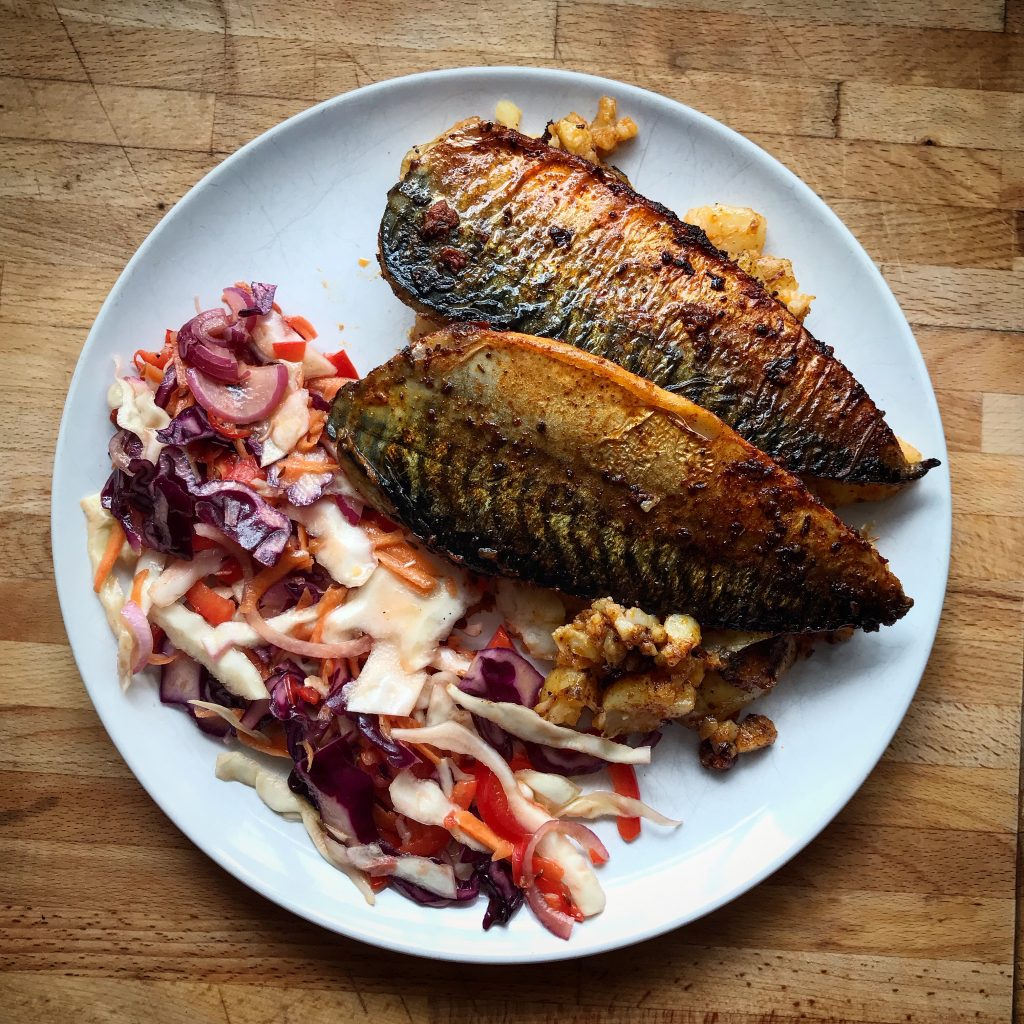
On Saturday, after the climbing wall and the waterfall, I came home and cooked bavette steak. Sliced against the grain, proper char, pink through the middle, salt crystals on top. Triple-cooked chips in beef dripping. Raw sauerkraut, kimchi and cold-brined jalapeño relish. Vine tomatoes. Roasted mushrooms. Avocado oil aioli.
Pete, who had clearly never cooked a bavette in his life, turned up in the comments to inform me that if this was OMAD, I must be either starving or asleep a lot, because it clearly wasn’t enough to keep hunger at bay, and that was when people ate shite at 10 p.m.
Pete. Mate.
Here’s what Pete missed. I eat one meal a day for two reasons. The first is that I’ve understood metabolic health for forty years, and I know that when you eat real food with adequate protein and saturated fat, your hunger hormones function properly. Ghrelin drops. Leptin signals correctly. You are not hungry at 10 pm because Glucipher, the blood sugar chaos demon that runs on processed carbohydrates and seed oils, is not running your hormonal show.
The second reason I eat once a day is that I cannot consistently and safely cook three meals. The medication makes mornings hazardous around sharp objects and heat. The back has a limited standing window that I protect and ration. So I cook once, brilliantly, with adaptations. I use a kneeling chair. I batch cook. I plan. I make the one session count.
This is not a lifestyle choice made from a position of perfect health. This is an adaptation built around real limitations that still manages to produce food that makes people stop scrolling.
On Sunday, it’s slow-roasted shoulder of lamb. My old, battered cast-iron pot, a vessel with more history baked into it than most people’s entire kitchen, goes on with the lamb, sitting on a trivet of onions and carrots that will confit beneath it in the rendered fat all afternoon. The lamb gets incisions filled with anchovy, garlic and rosemary. The anchovy is my chef’s secret. Nobody can taste it. What they taste is a depth and savouriness that makes the lamb taste more like lamb than it can on its own. It disappears into the fat and becomes something else entirely. That’s glutamate chemistry. That’s classical French and Italian technique. That’s forty years of knowing what ingredients do at a molecular level.
I’ve cooked for a NATO summit. I’ve done 25 to 30 kilos of smoked brisket over 18 hours for food festivals while simultaneously running a kotlich over an open fire, doing Albanian lamb meatballs with mint and feta in broth. I’ve cooked bavettes directly on white coals in a layby next to a waterfall in the Elan Valley. I’ve done bavettes on the estuary at Ynyslas while people next to me wrestled with disposable supermarket barbecues.
None of that is on my social media. Most of it, my audience has never heard. I tell you this not to impress you but because I want you to understand something about the food conversation.
Real food cooked with real knowledge is not expensive, complicated, or time-consuming in the way people have been led to believe. A bavette costs a fraction of a sirloin and tastes better when you know what to do with it. Bone broth costs almost nothing. Raw fermented vegetables are cheaper than supplements and do more. Beef dripping is practically free from a decent butcher, and triple-cooked chips in it are in a completely different category to anything fried in rapeseed oil.
The calorie-counting gurus won’t tell you that a calorie of beef dripping is not the same as a calorie of industrial seed oil. They won’t tell you that raw fermented cabbage is doing things inside your gut that a probiotic capsule can’t replicate. They won’t tell you that the obsession with calorie arithmetic ignores the entire conversation about what food actually does at a cellular level. Eat real food. Understand what it does. Stop counting and start thinking.
What Midlife Reset Actually Means When Your Body Is Fighting You
I want to be straight with you about something.
The PIP system scored me zero. The same DWP that assessed me as unfit for work and paid me LCWRA. The same umbrella organisation that the MoD sits under, which has been paying a war pension for 25 years in acknowledgement of the service injury that started all of this. Zero.
I have a kneeling chair in my kitchen. A walking stick by the door. A prescription that makes the first hours of the day a genuine safety consideration. Prolapsed discs that arrived courtesy of the British Army and have been managed every single day for decades through movement, cold water, visualisation, Reiki, and the kind of stubborn refusal to let it become the main character that the army probably installed before the disc made it necessary.
I’m waiting on a tribunal. I’m fighting a legal case against the MoD for hearing damage. I am doing all of this alone, as a single bloke in a Welsh valley, because that is the reality of the situation, and there is no point pretending otherwise.
And I climbed a wall last week for the first time in eight years.
This is not an inspirational story about overcoming adversity. I am not your 3 am success porn. I’m a nearly 59-year-old man with real ongoing conditions, real financial pressures, a real legal fight, and a real body that requires real daily management, who is also getting into cold water, cooking lamb shoulder, and planning to resurrect a 12-year-old Gozney wood oven in a Welsh garden this summer.
Both things are true simultaneously. That’s what midlife reset actually looks like.
It’s not the retreat in Baja. It’s not the five-day hormone cleanse. It’s not the life coach with two seven-figure exits telling you to reclaim your energy across the six Fs.
It’s getting on the floor every morning for cat-cow and bird-dog. It’s getting into the river every week regardless of the temperature. It’s cooking one meal properly rather than three meals badly. It’s reading Goggins on the bad days and recognising something familiar in the obsessive daily floor work he did to reclaim a body that was supposed to be finished.
It’s choosing, every single day, not to let the system, the condition, the age, or the circumstances have the final word.
The Reset Is Not An Event. It’s a Direction.
Some would say 59 is past midlife. Fair enough. By the maths, they’re probably right.
What I know is that the trajectory matters more than the starting point. I’m not where I was eight years ago, physically, mentally, or financially, and some of that is genuinely hard. But the direction of travel this month, the climbing wall, the cold water, the food, the plans for the outdoor kitchen, the Polarity collab, the content, the Skool community growing, the Sober Beyond Limits group at over 8,900 people, the books doing what they do quietly in the background, that direction is forward.
If you’re reading this at 3 am with your own list of reasons why reset is for other people, younger people, healthier people, people without your specific set of circumstances, I’m not going to tell you it’s simple. It isn’t.
But I am going to tell you that it starts with one thing. One walk. One cold shower. One real meal cooked properly. One morning on the floor doing the work your body actually needs. One decision is to stop waiting for the circumstances to improve before you start moving in the direction you want to go.
The circumstances may not improve. That’s the part nobody tells you. Mine haven’t all improved. Some are actively worse than five years ago. And I’m still here, getting on climbing walls and getting in waterfalls and anchovy stuffing lamb shoulders in a battered cast pot while the Welsh valley does what it does outside the window.
Find me in the Skool community if you want to do this alongside others who are figuring it out in real time. The link is above. So are the books, if you want the deeper framework behind any of this.
The lamb went in at 11. The river was cold. Both were worth it.
Tell me in the comments: what’s the one thing you keep putting off that you know would move the needle? No right or wrong answer. Just be honest.
Your Cravings Are a Nervous System Problem, Not a Willpower Problem
By Ian Callaghan | Sober Beyond Limits | iancallaghan.co.uk
You already know what you’re doing.
You know what it costs. You’ve watched it cost you things you can’t get back. You’ve made the decision, with absolute conviction, not to do it again. And you’ve done it again anyway.
That gap. Between knowing and stopping. Between the insight and the behaviour. Between the version of yourself at midnight when the craving hits and the version of yourself the morning after, who can’t explain why it happened again. That gap has a name. It is a vagus nerve problem. And the connection between vagus nerve function and mental health is the thing the entire recovery industry has systematically refused to put in plain language, because doing so would dismantle the architecture that keeps people cycling through programmes, relapses, and shame for decades.
I spent 45 years drinking. Not as a social habit. As a regulatory strategy. A way of managing a nervous system that was running on a load it was never designed to carry alone. I also smoked 40 cigarettes a day and spent several years doing cocaine at several hundred pounds a weekend. I am not writing this from a theoretical position. I am writing this from the wreckage of everything that didn’t work first, and from the other side of understanding what actually does.
I am Ian Callaghan—British Army veteran. Qualified chef. NLP Master Practitioner. And a bloke who doesn’t drink. Not because of willpower. Because I finally understood how the machine works.
This is that explanation.
Vagus Nerve and Mental Health: What the Recovery Industry Never Told You
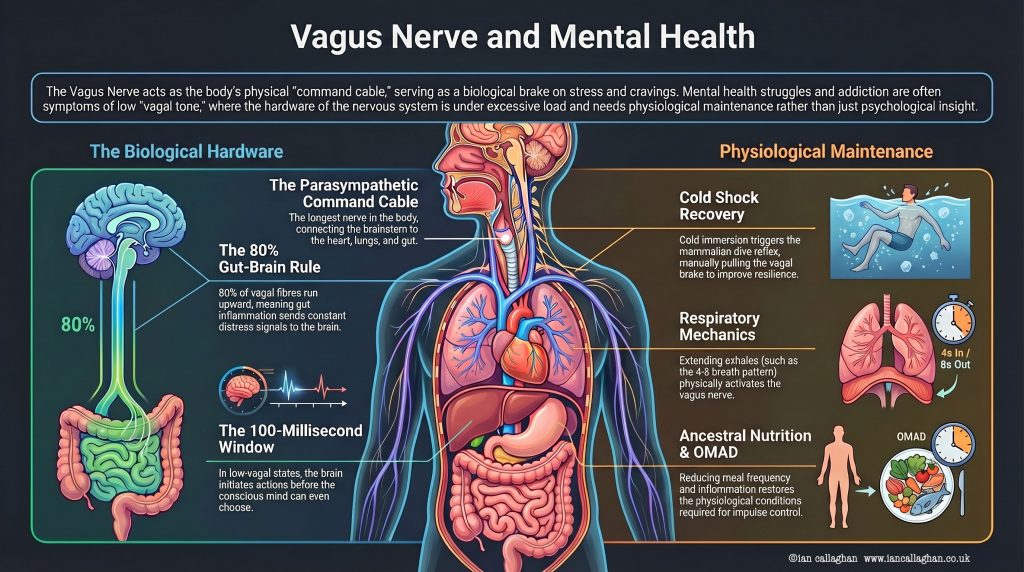
The vagus nerve is the longest in the human body. It runs from your brainstem down through your throat, heart, lungs, and all the way to your gut. It is the physical command cable of your parasympathetic nervous system, the rest-and-digest system, the biological brake on stress, anxiety, and the craving response.
When your vagal tone is high, you have access to calm. You can feel a craving, observe it, and choose how to respond. The gap between the signal and the action is open. You are the operator of your own machine.
When your vagal tone is low, that brake is off. The nervous system sits permanently in a low-grade threat response. The prefrontal cortex, the part of your brain responsible for long-term thinking, impulse control, and the ability to say no, is the first thing to go offline. The craving does not feel like a choice because by the time you are consciously aware of it, it is not one. The machine has already voted.
This is not philosophy. This is neuroscience. And it explains, at a mechanical level, why everything you have been taught about addiction and willpower has been setting you up to fail.
Cold shock stimulates the vagus nerve. It is the command cable for your parasympathetic nervous system. While the initial shock is stressful, the recovery from that shock triggers your vagus nerve to calm you down. You are literally training your nervous system to bounce back from stress faster. Ian Callaghan — The 30 Day Reset
The vagus nerve is not a wellness concept. It is hardware. And like all hardware, it can be in good condition or poor condition. When you spend years managing emotional load with alcohol, sugar, screens, or any other regulation shortcut, you are not just developing a habit. You are degrading the physical infrastructure that would otherwise give you a choice in the matter.
Low vagal tone is not permanent. It is a maintenance problem. And maintenance problems have solutions. But they do not respond to motivation, willpower, or the kind of insight the therapy industry sells as the destination. They respond to direct physiological intervention.
More on that below. First, we need to talk about why the frameworks you’ve been handed are structurally broken.
The Three Frameworks That Guarantee Relapse
Most people arrive at the question of addiction already carrying three explanations that feel true, carry authority, and are wrong. Not partially wrong. Wrong in the specific way that guarantees the approach built on them will eventually fail.
The Disease Model
Addiction is a chronic brain disorder. You did not choose it. You cannot cure it. Manage it, one day at a time, in permanent acknowledgement of your powerlessness.
This framework was built to reduce stigma, and it did some good in that direction. But it has a structural flaw that no amount of good intention can fix: it makes you passive. If you have a disease, you are a patient. Patients receive treatment. They do not fix themselves. And the disease model, in removing the moral stigma, simultaneously removed the one thing that changes anything: agency.
You are not powerless over your nervous system. You are under load. Those are completely different conditions with completely different solutions. Ian Callaghan — Under Load
The Moral Failure Model
Lack of willpower—weak character. If you had the backbone other people have, you would stop. This framework does not just fail to help. It actively makes things worse.
Shame is not a corrective. Shame is a load. Every time you pile shame onto a nervous system already running at capacity, you reduce vagal tone further. You make the gap between craving and action smaller. You make the next episode more likely, not less. The moral failure model is the framework most likely to generate the very behaviour it claims to address.
And it is built on a premise that doesn’t survive scrutiny. The people who end up in the grip of compulsive, self-destructive behaviour are not, on the whole, people who lack character. They are soldiers, architects, executives, parents—people who perform at the highest level in every domain of their lives except this one. A mechanical framework explains that. A moral one cannot.
The Willpower Model
The most exhausting one because it sounds the most reasonable. You know it’s wrong, so stop doing it. Apply sufficient determination. White-knuckle through the craving.
Willpower is a prefrontal cortex function. It is a high-toned luxury. It requires metabolic resources, cognitive space, and a nervous system that is not already running in survival mode. When vagal tone is low and the system is under load, the prefrontal cortex is the first thing to go offline. The part of your brain responsible for willpower is precisely the part that gets throttled when you need it most.
Willpower is a high Tone luxury. You cannot apply it to a low-tone problem. That is like trying to use a car battery to power a building.Ian Callaghan — Under Load
White-knuckling is not a strategy. It is the absence of one. The person who has tried it and found it wanting is not weak. They have simply been given the wrong tool for the job.
The 100 Milliseconds: Why Your Brain Has Already Decided Before You Know
In 1996, neuroscientist Benjamin Libet conducted an experiment that disturbed a great many people who had built their worldviews around conscious free will. He asked participants to flex their wrist whenever they felt like it while monitoring brain activity. He found that the brain produced a preparatory signal for the movement approximately 550 milliseconds before the action occurred. Participants reported becoming consciously aware of their intention to move approximately 200 milliseconds before they acted.
This means the brain had already initiated the action 350 milliseconds before the person was conscious of deciding to take it. That was a wrist flex in a laboratory, under no stress or load.
Now scale that to a nervous system running in an unstable state, under the specific load that activates the legacy wiring, with the amygdala already engaged and the prefrontal cortex already throttled.
The gap between the stimulus and the action does not widen under those conditions. It collapses.
By the time you are in a position to decide, the machine has usually already decided. What you call a choice is often a ratification.Ian Callaghan — Under Load
This is the 100ms window—the gap between the signal arriving and the machine attaching to it and running the habitual response. In a high-vagal-tone state, that gap is open. There is space to observe the craving, name it, and choose differently. In a low-vagal-tone state, the gap is closed. The craving arrives as a command, not a suggestion.
The behaviour that follows is not a choice in any meaningful sense of the word. It is an execution. And understanding that at a mechanical level changes everything, because it relocates responsibility where it actually sits, not in the moment of the craving, where you never had a chance anyway, but in the decisions that shaped the system’s tone and load before that moment arrived.
You cannot fight the craving. You can service the machine so the craving doesn’t get to run the show.
The Dopamine Myth: What Cravings Are Actually Doing
Most people understand cravings as a desire for pleasure. Alcohol feels good, so you want more of it. Sugar tastes good, so the brain demands a repeat. This is the simplified version, and it misses what matters most.
Cravings are not primarily about pleasure. They are about incentive salience. The brain tags certain stimuli as worth pursuing, not because they feel good in the moment, but because they have historically resolved a state problem. The drink didn’t just feel good. It lowered a nervous system that was running too hot. It created temporary stability in a system with no other reliable means of regulation.
Over time and with repetition, the dopamine pathways downregulate. The brain becomes desensitised to the signal. You need more substance to reach the same level of regulation. And crucially, the baseline drops. What you are managing now is not just the original state problem but the withdrawal gap created by the down-regulation itself. You are feeding a fire you lit to keep warm.
Modern life has hijacked your dopamine pathways. You have been conditioned to seek instant, cheap hits of comfort in food, alcohol, and endless scrolling. This has made you chemically lazy. We are shifting your nervous system from a constant state of Sympathetic dominance to Parasympathetic dominance. This is mental weightlifting.Ian Callaghan — The 30 Day Reset
The PR Firm is what I call the brain’s internal rationalisation engine. It does not want you to understand any of this. It wants to sell you the next hit. So it constructs a story: you’ve earned it, you deserve it, just this once, it’s been a hard week, it won’t matter this time. The story is not the truth. It is the machine finding the path of least resistance to temporary stability, and then constructing a narrative that makes that path feel like a reasonable choice.
The machine identified a problem—a nervous system running at load with no adequate regulation strategy. And found the fastest available fix. It filed that fix under effective and kept returning to it.
This is not a moral position. It is a mechanical one. The machine is not defective. It is logical. Understanding that does not remove responsibility. It changes what responsibility actually means.
What the Vagus Nerve Has to Do With Your Gut (And Why That Matters for Cravings)
80% of the fibres in the vagus nerve run upward. From gut to brain. Not brain to gut. This is the neurological basis of the gut-brain axis, and it explains why your emotional state is so profoundly connected to what you eat, how your digestion is functioning, and whether the population of bacteria in your gut is healthy or dysbiotic.
When the gut is inflamed, the vagus nerve carries that distress signal upward. The brain registers it as a threat. The nervous system responds. Cortisol rises. Vagal tone drops. The craving window closes.
This is why the food component of any genuine recovery protocol is not optional. Not because food is morally superior to alcohol. Because the gut-brain axis runs on the vagus nerve, and a chronically inflamed gut is a direct suppressor of the very hardware you need online to have any chance of making different choices.
Ultra-processed food, industrial seed oils, refined sugar, and chronic alcohol consumption all inflame the gut lining, disrupt the tight junctions, and send a sustained distress signal up the vagus nerve to a brain that translates it as danger. You are not imagining the anxiety, the brain fog, the inability to think clearly, or the feeling of being trapped in a loop. Your nervous system is receiving a genuine physiological distress signal and responding accordingly.
The ancestral nutrition approach I follow and teach isn’t dietary ideology. It is vagal tone maintenance. Animal fats, real food, bone broth, fermented foods, OMAD. These are not trends. They are the inputs a human nervous system was built to run on, and their absence is measurable in vagal tone degradation.
How to Stimulate the Vagus Nerve: The Practical Physiology
This section answers the question that people actually type into Google: “How do I stimulate the vagus nerve?” But the honest answer is longer than most websites are willing to give. Because there is a difference between a technique that temporarily activates the vagus nerve and a practice that raises baseline vagal tone over time. One is a patch. The other is maintenance.
Both matter. Here is what I use and what the physiology supports.
Cold Water Immersion
I go into the River Usk in water that would make most people’s chests seize on contact, not for drama. Cold immersion is one of the most direct, measurable, and fast-acting interventions for vagal tone outside a clinical setting.
Cold exposure can raise dopamine levels by 250%. Unlike the spike and crash of a sugary snack or a line of Coke, the dopamine hit from cold water isn’t a sharp peak. It is a slow, steady incline that stays elevated for several hours—the difference between a lightning strike and a steady, blue-flame gas burner.Ian Callaghan — The 30 Day Reset
The initial cold shock activates the mammalian dive reflex. Heart rate drops, vasoconstriction occurs, and the system briefly prioritises survival. The recovery from that shock, the moment the body begins to thermoregulate, is when the vagus nerve fires. Noradrenaline spikes. The parasympathetic system comes online. Heart rate variability improves. You are, in physiological terms, manually pulling the vagal brake after releasing it.
Over time and with consistent practice, this trains the nervous system’s ability to recover from stress. The bounce-back time shortens. The threshold before the system enters threat response increases. You are building a higher baseline vagal tone through deliberate, controlled adversity.
You do not need a river. A cold shower works. Start with 30 seconds at the end of a normal shower. Breathe through it rather than gasping. Over two to four weeks, extend to two or three minutes. The protocol is in The 30 Day Reset.
Breathwork as a Direct Vagal Intervention
The exhale activates the vagus nerve. The inhale suppresses it. This is the mechanical basis of every breathwork protocol worth using.
A longer exhale than inhale shifts the autonomic nervous system toward parasympathetic dominance. This is not a metaphor. Heart rate variability measurements taken during extended exhale breathing show measurable vagal activation in real time. You are not calming yourself down through mindset. You are physically changing the state of your nervous system through respiratory mechanics.
The 4-8 breath pattern, four counts in, eight counts out, is the Vagal Brake protocol in Emotional Mastery. It is step five of the ten-step EOM field protocol and the fastest manual override available without equipment. Three rounds are enough to measurably shift the autonomic balance when caught in the lead-up to a craving state.
Box breathing, the physiological sigh, and the 4-7-8 technique each have specific applications for different states. The detail is in The 30 Day Reset. But the principle is the same across all of them: you are using respiratory mechanics to talk directly to the vagus nerve, bypassing the narrative the PR Firm is constructing.
The 90-Second Rule and the Pressure Test
Dr Jill Bolte Taylor’s research on emotion identified that the neurochemical signature of any emotional state lasts approximately 90 seconds in the body if you do not add narrative to it. After 90 seconds, the chemical has been flushed from the bloodstream. What sustains the craving, the anxiety, the anger, beyond 90 seconds is not the original physiological signal. It is the story you are telling about it.
The Pressure Test in Emotional Mastery is built on this: hold the voltage of a craving state for 90 seconds without acting on it and without constructing a justifying narrative. Open circuit posture, no forward lean, no rehearsal of the story, somatic grounding, feet on the floor. The craving drops. Not because you suppressed it. Because the neurochemistry has run its biological half-life,e and the PR Firm has been muzzled long enough for the system to stabilise.
This requires a functioning vagal brake, which is why the practices above are not optional add-ons. They are the prerequisite for the protocol to work.
Nutrition, OMAD, and the Gut-Brain Axis
Meal frequency directly affects vagal tone by modulating the gut environment. Constant eating, particularly of ultra-processed food and refined carbohydrates, keeps the gut in a state of sustained inflammatory activation. The vagus nerve carries that signal upward. The brain stays in a low-grade threat response. Vagal tone stays depressed.
OMAD, one meal a day within a defined eating window, allows the gut environment to recover between meals. Inflammation drops. The vagus nerve signal normalises. The brain comes out of threat mode. Decision-making quality improves. The craving response becomes more manageable, not because of willpower, but because the physiological conditions required for the prefrontal cortex to stay online have been restored.
This is not fasting as a trend. This is vagal tone management through meal timing.
The Shame Loop: Why Self-Blame Is the Engine of the Cycle
There is a moment most people who struggle with compulsive behaviour know intimately. It happens after. After the drink, the relapse, the binge. The moment when the prefrontal cortex comes back online, surveys what just happened, and asks the question that has no satisfying answer.
Why did I do that?
And then the shame lands. The conviction that something is fundamentally wrong with you. That a person with genuine strength, genuine values, and genuine commitment to their own life would not have done this again.
Here is what that shame actually does to your nervous system.
Shame is a load. Every unit of shame added to the system after an episode reduces the vagal tone available for the next encounter with the same trigger. The guilt spiral that follows a relapse does not make the next relapse less likely. It makes it more likely. Because it depletes the one resource, vagal tone, that is the only thing standing between the craving signal and the execution of the habitual response.
Stop treating the output as the problem. Start reading it as the data it is. The machine is trying to tell you something about the load.Ian Callaghan — Under Load
The correct response to an episode is not a verdict. It is a debrief. In the military, a debrief is a structured review of what happened, the conditions, what worked, what failed, and what changes to make before the next engagement. It is not a tribunal. It is information gathering in the service of better performance next time.
What was the load at the time of the episode? How had I slept? What had I eaten? What was the accumulated stress in the days before? Was there a specific trigger, and where in the legacy wiring does it connect? At what point did the gap between the signal and the action close? What specific input can be changed to give the machine a better chance next time?
These are answerable questions. The shame question has no practical answers. It produces feeling without function. It occupies the cognitive space that should be used for diagnosis and instead uses it for self-punishment.
Addiction is not your identity. It is your machine’s current solution to a load problem it has, in many cases, carried since childhood. The machine can be serviced. The load can be managed. The wiring can be updated over time.
But not through shame. Through maintenance.
The EOM: A Mechanical Framework for What the Recovery Industry Refuses to Address
The Emotional Observation Method is the framework I developed over fifteen years of coaching people who walked in circles, produced extraordinary insight in one session, and extraordinary self-destruction in the next. I built it from the wreckage of everything that didn’t work in my own life first, and I applied it to my own machine before I asked anyone else to apply it to theirs.
It is built on a single premise that the recovery industry has consistently refused to centre: you cannot think your way out of a state problem. And most of what the recovery industry offers is more thinking.
The EOM is not therapy. It is not a programme. It does not have steps in the twelve-step sense. It does not ask you to surrender to anything, label yourself with anything, or accept that you are powerless. You are not powerless. You are under load.
The ten-step field protocol begins with the hardware reset. A direct physiological intervention to pull the machine out of the threat response state before any cognitive work is possible. Cold exposure, the physiological sigh, or the mammalian dive reflex equivalent. Survival over story. State before narrative.
From there, it moves through the vagal brake breath pattern, the gate, the observation protocol, somatic atlas mapping, the null-signal pause, signal analysis, the pressure test, path selection, and the identity save. Each step is a mechanical intervention on a specific point of the craving or reactive cycle. None of them requires motivation. All of them require that the machine’s vagal tone is high enough to run them.
The detail is in Emotional Mastery. But the principle behind the whole system is this:
The argument is never really about the dishes. The craving is never really about the drink. Under load, you are always fighting a war that ended decades ago.Ian Callaghan — Under Load
The craving is a signal from the nervous system seeking regulation. The behaviour is the machine’s current solution to a state problem. The solution is not to fight the signal or suppress the behaviour. It is to service the machine so thoroughly and consistently that the signal does not trigger the habitual execution. So the gap stays open. So you remain the operator.
That is what Sober Beyond Limits means. It is not a sobriety framework in the conventional sense. It is a system reset. The limits it addresses are not just the limits of substances. They are the limits of every pattern that keeps you stuck: compulsive behaviour, emotional dysregulation, fear of change, chronic anxiety, brain fog, and the inability to tolerate discomfort long enough to let the craving pass.
The vagus nerve is the hardware. The EOM is the operating system. The Four Pillars, eat, sleep, move, and mind, are the maintenance protocol. Put them together, and you have a machine that can carry the load.
Frequently Asked Questions
What mental health problems does vagus nerve stimulation treat?
Clinical vagus nerve stimulation via implanted device has regulatory approval in some countries for treatment-resistant depression and epilepsy. But the question most people are actually asking is about the connection between vagal tone and everyday mental health. Low vagal tone is associated with chronic anxiety, depression, poor emotional regulation, difficulty with social connection, and susceptibility to compulsive behaviour. Raising vagal tone through the practices described above, cold immersion, extended exhale breathing, real food, movement, and adequate sleep, addresses the physiological underpinning of these conditions at the hardware level rather than symptom-managing at the surface.
How does the vagus nerve affect mental health?
The vagus nerve is the primary mediator of the parasympathetic nervous system and regulates heart rate variability, which is one of the most reliable biomarkers of overall stress resilience and mental health. Low HRV is associated with anxiety, depression, PTSD, and addiction. The vagus nerve also regulates the gut-brain axis, mediating the inflammatory signalling that affects mood, cognition, and the craving response. When vagal tone is high, the nervous system can move fluidly between activation and recovery. When vagal tone is chronically low, the system sits in a persistent threat state that makes every aspect of mental health harder.
How to stimulate the vagus nerve for anxiety?
The fastest practical interventions are: extended exhale breathing (longer out than in, the 4-8 pattern is a direct entry point), cold water on the face or full cold immersion if available, the physiological sigh (double inhale through the nose, long slow exhale), and the posture anchor (open chest, feet grounded, spine neutral). These are physiological interventions, not mindset techniques. They work because they create direct mechanical input to the vagus nerve through respiratory and thermal pathways. For sustained reduction in anxiety rather than in-the-moment management, consistent daily practice, particularly cold exposure and breathwork, raises baseline vagal tone over weeks so the anxiety threshold rises.
Can the vagus nerve be healed after years of alcohol use?
Yes. Vagal tone is not a fixed trait. It is a physiological condition that responds to inputs. Years of alcohol use suppresses vagal tone through multiple pathways, direct neurotoxicity, gut dysbiosis, disrupted sleep architecture, and the down-regulation of dopamine pathways. All of these are reversible to a significant degree. The timeline varies. The gut environment begins to shift within weeks of removing alcohol and introducing an anti-inflammatory diet. Sleep architecture improves within the first month of sobriety if the other pillars are in place. Baseline HRV, the most reliable proxy for vagal tone, measurably improves with consistent cold exposure and breathwork within four to eight weeks. The machine can be serviced. It takes longer than the PR Firm wants you to believe, and it is more possible than the recovery industry wants you to know.
What is the difference between vagus nerve stimulation and improving vagal tone?
Clinical vagus nerve stimulation refers to electrical stimulation via implanted or surface-mounted devices. Improving vagal tone refers to raising the baseline activity and responsiveness of the vagal system through lifestyle practices. The latter is accessible, free, and supported by a substantial body of research on heart rate variability, cold exposure, breathwork, and gut health. This post is about the latter. It is what I practice and teach through the EOM framework and the Four Pillars.
Where to Go From Here
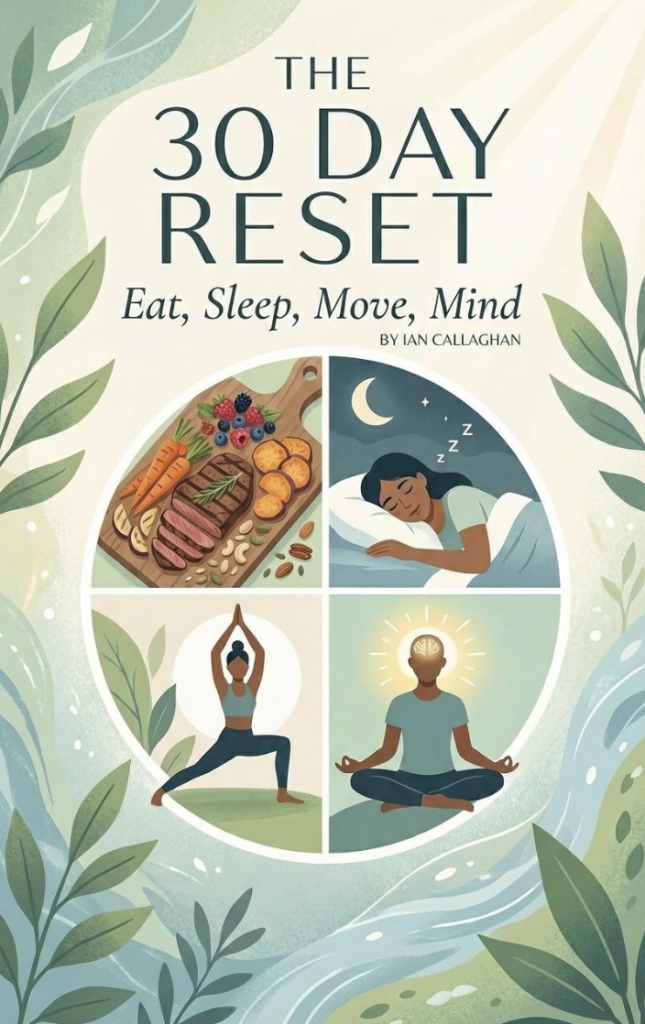
If this has landed where it needed to land, the place to start is The 30 Day Reset.
It is the practical first entry point into everything covered in this post. Across thirty days it addresses all four pillars: eat, sleep, move, and mind. It includes the cold shock protocol, the breathwork rituals, the dopamine reset mechanics, and the day-by-day operational structure to start raising vagal tone from the ground up. It is not a diet. It is not a programme. It is a systems reboot built on the biology that governs this.
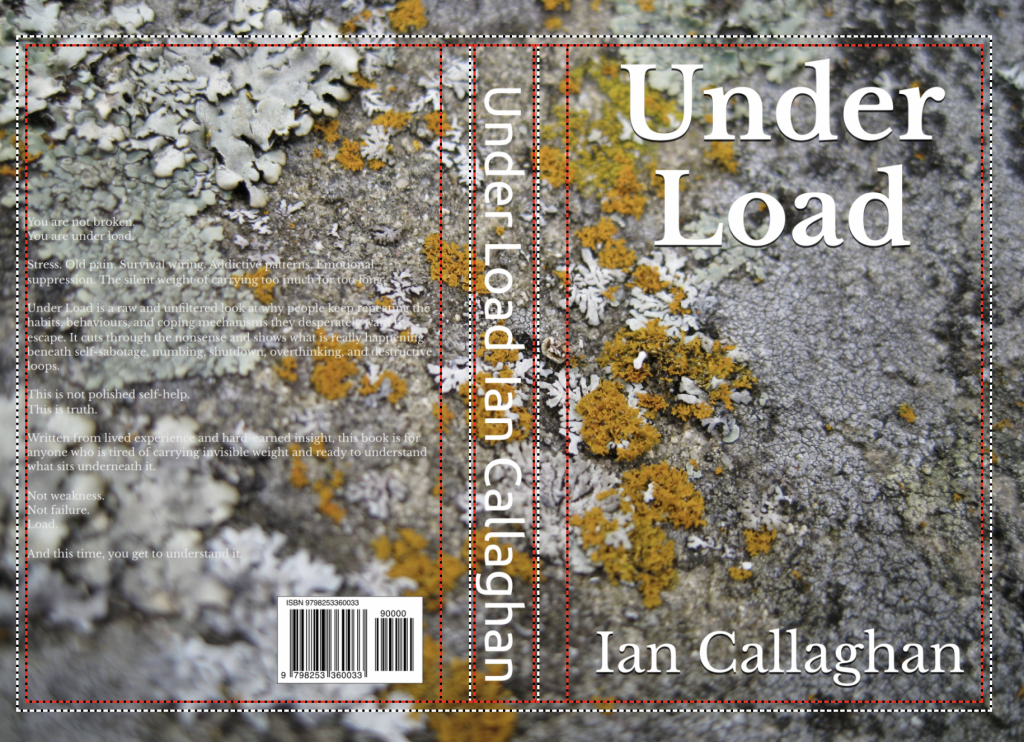
Beyond that, Under Load goes deeper into the mechanical framework of why intelligent, capable, self-aware people keep doing the things that are destroying them and how to take back the controls. If you’ve read this post and thought ‘this explains things no book I’ve ever read has explained’, Under Load is the book that expands the whole architecture.
Emotional Mastery is the EOM operator’s manual. If the ten-step field protocol interests you, the vagal brake, the gate, the pressure test, the identity save, the full detail is in there.
All three are available at iancallaghan.co.uk/the-shop/
No Amazon. No middleman. Direct.
About Ian Callaghan
Ian Callaghan is a British Army veteran, qualified chef, NLP Master Practitioner, Reiki Master, and the creator of the Emotional Observation Method. He is based in Monmouthshire, Wales, and has spent over fifteen years coaching men and women through the kind of systemic reset this post describes. He has a 45-year personal history with alcohol and doesn’t drink. Not because of a label or a programme. Because he finally understood how the machine works.
He writes at iancallaghan.co.uk and runs the Sober Beyond Limits community. His YouTube channel, Facebook page (56,000+ followers), and Sober Beyond Limits group (8,300+ members) are where most of this work finds its audience first.
The 30 Day Reset is not a diet. It is a complete biological overhaul for anyone who is wired, tired, and done with feeling like shite. The 30-Day Reset is a 160+ page military-grade systems reboot for the over-35s. Four pillars. Eat, sleep, move, mind. One month to strip out the industrial poison, reset your dopamine pathways, silence Bob, and rebuild the machine that’s been running on the wrong fuel for decades. Not a diet. Not a programme. A complete…
If you’re raiding the kitchen every night, it’s not weakness. Here’s what your gut bacteria, dopamine system, and blood sugar are actually doing to your sugar cravings at night.
iancallaghan.co.uk
It’s 3 am. Or it’s 9 p.m., or it’s that specific dead hour after dinner when the sugar cravings at night kick in and suddenly you’re standing in front of the fridge or the biscuit cupboard, wondering what the hell is wrong with you.
Maybe it was the wine you said you weren’t having. Maybe it was the third takeaway this week. Maybe it was the chocolate you’d hidden from yourself and found anyway. And now you’re doing the one thing guaranteed to make it worse: telling yourself you’re weak.
You’ve got no discipline. No backbone. Everyone else seems to manage it. What the hell is wrong with you?
Nothing. Absolutely nothing is wrong with you.
What’s wrong is the story you’ve been sold. The idea that cravings at night are a test of character, that the people who resist them are made of stronger stuff, that if you just wanted it badly enough, you’d be fine. That story is not only wrong but also one of the most damaging myths in modern health. It keeps people trapped, ashamed, and cycling through the same failures for years.
Cravings are not a moral failing. They are a biological signal. And most of the time, the biology has been rigged against you.
This is the piece no one showed you. Let’s fix that.
02 — THE WILLPOWER LIE
The Willpower Narrative Was Built to Sell You Something
The willpower myth didn’t emerge from science. It emerged from convenience. It’s an extraordinarily useful story if you’re trying to sell diet plans, supplements, 30-day challenges, or self-help books. If the problem is your lack of discipline, the solution is always another product. Another programme. Another attempt to white-knuckle your way through the next few weeks until you inevitably break.
The diet industry is worth over £70 billion globally. It has an enormous financial interest in you believing the problem is you. Because if the problem is your biology, if cravings are the output of a system that’s been chemically manipulated and nutritionally starved, then the solution isn’t a new app or a meal replacement shake. The solution is to understand what’s actually happening inside you and to change the conditions that create the signal.
That doesn’t sell subscriptions. So they keep blaming your willpower instead.
And here’s the kicker. Willpower itself is a finite resource. It depletes throughout the day. It degrades with poor sleep, high stress, elevated cortisol, and blood sugar instability. So even if willpower were the mechanism, which it isn’t, stacking it against a body running on four hours of kip, a blood sugar crash, and a gut microbiome screaming for quick energy is a fight you were never going to win.
You were fighting biology with belief. That’s not a fair contest.
03 — THE GUT-BRAIN AXIS
Your Gut Is Talking to Your Brain. You Just Don’t Know What It’s Saying.
Here’s the piece that changes everything when people actually hear it.
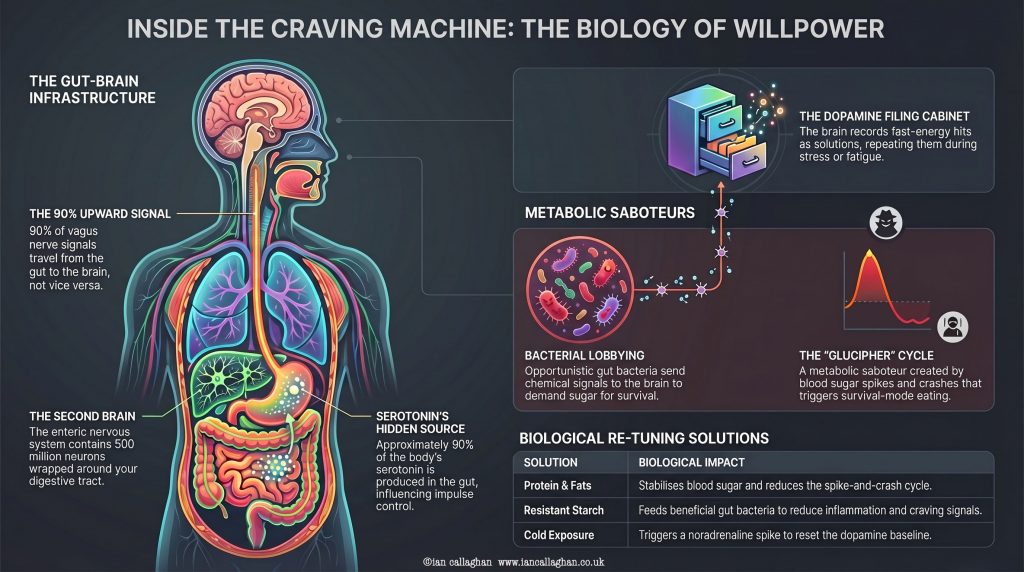
You have two nervous systems. The one in your head and spine that you know about, and a second one wrapped around your digestive tract, called the enteric nervous system. Around 500 million neurons. Not as many as your brain, but more than your spinal cord. This thing has been called the second brain, and the name fits.
These two systems talk to each other constantly through the vagus nerve, a long wandering nerve that runs from your brainstem all the way down through your chest and into your gut. And here’s what most people never get told: roughly 90% of the signals on that vagus nerve travel upward. From gut to brain. Not the other way around.
THE BIOLOGY Approximately 90% of serotonin in the human body is produced in the gut, not the brain. Serotonin is involved in mood regulation, appetite signalling, and impulse control. Your gut bacteria influence how much serotonin gets made, how it gets metabolised, and how effectively the vagus nerve carries those signals upward. When your microbiome is out of balance, your serotonin production is compromised. When your serotonin is compromised, your mood drops, your impulse control weakens, and the craving signals get louder.
The bacteria in your gut are not passive passengers. They are metabolically active organisms with their own survival interests. And some of them, particularly the opportunistic strains that thrive on sugar, refined carbohydrates, and alcohol, produce chemical signals that influence your food preferences. They effectively lobby your brain for the fuel that keeps them alive.
Candida overgrowth drives sugar cravings. Certain pathogenic bacterial strains drive cravings for the fermentable fibres and simple carbohydrates that help them reproduce. This isn’t a metaphor. These are real chemical signals travelling up a real nerve into a brain that then tells you it desperately needs a Kit Kat at half ten on a Tuesday night.
That is not a willpower problem. That is a microbiome problem.
04 — WHAT CRAVINGS ACTUALLY ARE
Why Sugar Cravings at Night Are a Biological Event, Not a Choice
Let’s break down what actually happens when a craving fires.
Your brain has a reward prediction system built around dopamine. When you eat something that gives you a hit of fast energy, particularly sugar or alcohol, your brain registers that as a solution to a problem. It files it away. Next time your blood sugar drops, next time you’re stressed, next time your cortisol spikes, the brain goes to the filing cabinet and says: last time we felt like this, that thing worked. Do that.
This is not weakness. This is ancient, efficient survival programming. The problem is that it was built for a world where the most calorically dense thing available was a handful of wild berries. It was never built for a world where every petrol station sells a wall of ultra-processed, laboratory-engineered food designed specifically to light up that exact system.
BLOOD SUGAR AND THE CRAVING LOOP When blood sugar drops rapidly, particularly after a high-carbohydrate meal, it causes a spike followed by a compensatory insulin response. The body experiences what feels like an emergency—cortisol and adrenaline rise. The brain begins prioritising fast fuel. The craving that follows is not psychological indulgence. It is the hormonal output of metabolic instability. Fix the blood sugar, and you eliminate a huge proportion of the craving signal.
Add chronic stress into this, and you’ve got a perfect storm. Cortisol drives the brain toward high-reward, low-effort solutions. It narrows your decision-making to short-term thinking. It literally reduces activity in the prefrontal cortex, the part of your brain responsible for long-term planning and impulse regulation. A chronically stressed person fighting cravings is doing it with reduced neurological capacity for exactly the kind of thinking that resisting cravings requires.
And then someone tells them they lack willpower.
05 — GLUCIPHER’S ROLE
Why You Crave Sugar and Alcohol at Night: Meet the Metabolic Saboteur
I talk about Glucipher a lot with my clients and in my community because it puts a face on the process. Glucipher is what I call the metabolic saboteur, the feral little bastard that represents the chaos of unstable blood sugar, chronic insulin elevation, and the chemical noise it generates throughout your body and brain.
When Glucipher is running the show, your energy is a rollercoaster. You wake up foggy. You need something sweet or starchy by mid-morning. You crash after lunch. You get a second wind of fake energy in the afternoon, followed by a wall at 3 p.m. By evening, you’re raiding the kitchen not because you’re greedy but because your blood sugar has crashed, your cortisol has spiked to compensate, and your brain is now operating in survival mode, screaming for fast fuel.
GLUCIPHER AT WORKA typical Glucipher day looks like this: high-carb breakfast or no breakfast at all, blood sugar spikes then crashes, mid-morning hunger and irritability, high-carb lunch to fix the crash, post-lunch insulin dump and afternoon fatigue, cortisol spike by 4 pm, evening sugar or alcohol craving, late night eating or drinking to “relax”, disrupted sleep, elevated fasting glucose by morning. Repeat, indefinitely, while someone tells you it’s a discipline problem.Glucipher doesn’t care about your goals. He cares about blood sugar. He will blow up every plan you make until you change the metabolic conditions that keep him fed.
The alcohol connection here is particularly brutal. Alcohol is processed by the liver similarly to fructose. It causes a blood sugar spike followed by a crash. It disrupts sleep architecture, raising cortisol the next day, worsening insulin sensitivity, and making you more likely to crave sugar and alcohol the following night. It also destroys gut bacteria diversity, particularly the beneficial strains, while feeding the opportunistic ones that generate craving signals.
So when someone tells you alcohol cravings are about willpower, understand what they’re actually describing: a cascading biological loop that is self-reinforcing at every level. Microbiome disruption is driving serotonin instability, driving mood drops, driving blood sugar chaos, driving dopamine-seeking, driving the craving for the exact substance that started the problem. That is not a character flaw. That is a trap with a biological lock.
06 — WHAT ACTUALLY FIXES IT
The Things That Actually Work
This is not a prescription. This is what the evidence points to and what I have watched work, in myself and in the people I work with, over many years. None of it is particularly complicated. Most of it runs directly against what you’ve been sold.
Real food, full stop Protein and fat at every meal stabilise blood sugar and reduce the spike-and-crash cycle that powers most cravings. Liver, eggs, bone broth, oily fish, and good-quality meat. Not expensive, not complicated.
Resistant starch Feeds beneficial gut bacteria directly. Cooked and cooled potatoes, green bananas, oats. The beneficial strains that grow on this produce butyrate, which reduces gut inflammation and improves the gut-brain signalling that regulates cravings.
Sleep One night of poor sleep raises ghrelin (the hunger hormone) and lowers leptin (the satiety signal) the following day. Sleep debt does not accumulate gracefully. It accumulates as craving volume turned up to eleven.
Fasting window Extending the overnight fast to 14-16 hours gives the gut lining time to repair, reduces inflammatory bacterial load, and stabilises insulin across the day. Doesn’t have to be OMAD. Just stop grazing.
Cold exposure Cold water immersion drives a noradrenaline spike that reduces craving intensity, improves mood, and resets the dopamine baseline. Not comfortable. Extremely effective.
Mind-body practice Breathwork, meditation, and somatic practices directly stimulate the vagus nerve, improving gut-brain communication and reducing the stress response that amplifies cravings. This is physiology, not spirituality.
None of these requires products. None of them requires a gym membership, a coach or an app. They require understanding why they work, which is what you now have, and the willingness to change the conditions rather than keep fighting the symptoms.
07 — THE CLOSE
You’re Not Broken. You Were Given Broken Information.
I spent years thinking I was the problem. That somewhere along the line, I’d been issued a faulty set of brakes, that everyone else had this thing figured out, and I was just weak.
Because if you believe you’re the problem, you keep attacking yourself. You run the shame spiral every time you cave. You build a narrative of failure around a biological process that was never fully in your control to begin with. And shame, by the way, does nothing to reduce cravings. Physiologically, shame is a stress response. It raises cortisol. It worsens blood sugar regulation. It turns the volume up on the exact signals you’re trying to quiet.
The exit is not a matter of willpower. The exit is understanding the system and changing the conditions.
Your gut bacteria can change composition within 24 to 48 hours of dietary change. Blood sugar instability can be significantly improved within a few days of removing the foods that cause the swings. Sleep quality improves rapidly when the gut inflammation driving it is addressed. Dopamine baseline recalibrates when you stop overloading the reward system with artificial stimuli.
This is not a slow road. The biology responds faster than you think. But it responds to the right inputs, not to self-loathing.
You have not been failing. You have been fighting the wrong battle with the wrong tools, while being told the problem was you.
Now you know better. Do something different with that.
If this landed, share it with someone who needs to hear it. And if you’re ready, actually to change the conditions rather than manage the symptoms, the Midlife Reset community is where that work happens. Link in bio.
Used to monitor number of Google Analytics server requests when using Google Tag Manager
1 minute
_gid
ID used to identify users for 24 hours after last activity
24 hours
_ga_
ID used to identify users
2 years
_gali
Used by Google Analytics to determine which links on a page are being clicked
30 seconds
_ga
ID used to identify users
2 years
__utmx
Used to determine whether a user is included in an A / B or Multivariate test.
18 months
__utmv
Contains custom information set by the web developer via the _setCustomVar method in Google Analytics. This cookie is updated every time new data is sent to the Google Analytics server.
2 years after last activity
__utmz
Contains information about the traffic source or campaign that directed user to the website. The cookie is set when the GA.js javascript is loaded and updated when data is sent to the Google Anaytics server
6 months after last activity
__utmc
Used only with old Urchin versions of Google Analytics and not with GA.js. Was used to distinguish between new sessions and visits at the end of a session.
End of session (browser)
__utmb
Used to distinguish new sessions and visits. This cookie is set when the GA.js javascript library is loaded and there is no existing __utmb cookie. The cookie is updated every time data is sent to the Google Analytics server.
30 minutes after last activity
__utmt
Used to monitor number of Google Analytics server requests
10 minutes
__utma
ID used to identify users and sessions
2 years after last activity
_gac_
Contains information related to marketing campaigns of the user. These are shared with Google AdWords / Google Ads when the Google Ads and Google Analytics accounts are linked together.